It is wretched, distressing, tragic – and beautiful
“The great Christian mystery of the crucifixion and the resurrection and the whole mystery of why we die, and why we die so miserably sometimes… In our time it’s a very unpopular story.“ – Trina Paulus
David Miller is the Managing Editor of Loveland Magazine
by David Miller
Traveling to the Stations of the Cross, also known as the Way of the Cross or Via Crucis, is a Christian tradition to commemorate Jesus’s passion and death on the cross. The observance began as devote pilgrims traced Christ’s path to crucifixion through Jerusalem on the Via Dolorosa.
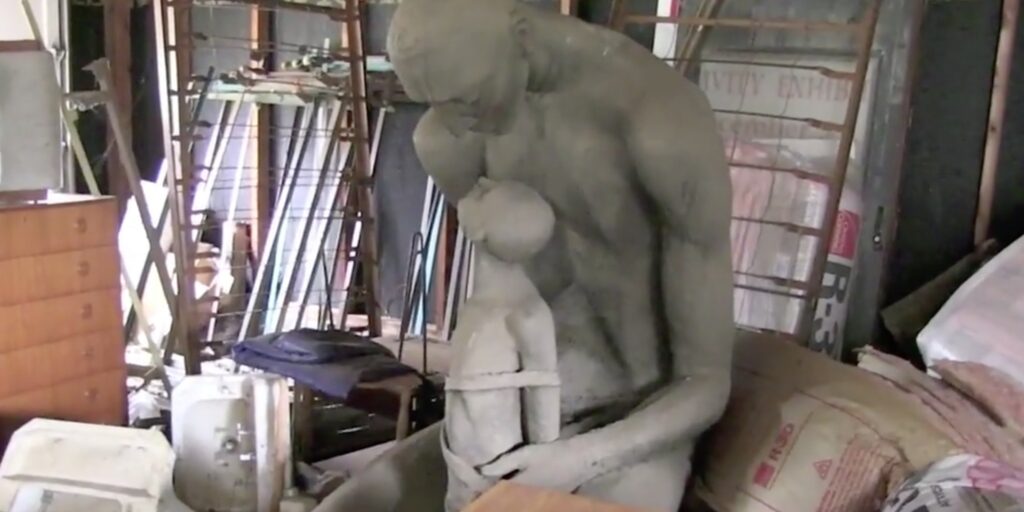
Years before filming this interview and at the time of my first seeing Abraham and Isaac, I begged the Grailville folks to let me help them find a place where the father and son could be publicly displayed, however, I remember being told they determined it too controversial to do so. It was only “appropriate for mature audiences” and no one in Loveland was mature enough to see the old testament story depicted so threateningly and savagely real.
Listening to artist Trina Paulus talk about her Abraham and Isaac and the essence of what she was conveying through the work of her sculpting hands and spiritual heart is still heartbreaking that the human soul was meant to struggle to understand such a contemptible subject.
It had been stored temporarily for several years just outside of Loveland. Loveland Magazine Reporter Alana Johnson went with Paulus to an unlit garage at the Grailville Conference and Retreat Center in 2011 to see it. Paulus hadn’t seen her statue for several years.”
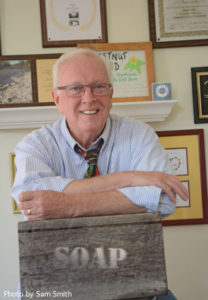
During the interview, Paulus said, “Over here you will see a hand with the knife in it… and over here… you’ll see the hand with his son. I’ve done a lot of thinking about this over the years – the great Christian mystery of the crucifixion and the resurrection and… The very unpleasant thing is that God can ask everything of us sometimes… The whole mystery of why we die, and why we die so miserably sometimes… In our time it’s a very unpopular story.“[/vc_column_text][vc_column_text]
The Very Unpleasant Thing: That God Can Ask Everything of us Sometimes
[vc_row][vc_column][vc_column_text]Miami Township, Ohio – Barrett Paving will be resurfacing12.6miles of road,andadditionally replacing curb and gutter at needed locations. Work will be performed this summer when school is not in session to avoid conflicts with school buses. They are allowing the contractor to begin concrete work as soon as temperature and weather are appropriate.
The project also includes an asphalt rejuvenation treatment. An asphalt rejuvenator is a substance that penetrates asphalt and is designed to replace the lost maltenes, the soft fraction of the asphalt binder in the original asphalt pavement. This should restore the original qualities of viscosity and significantly extend the life of the pavement according to the Township Service Director, John Musselman.
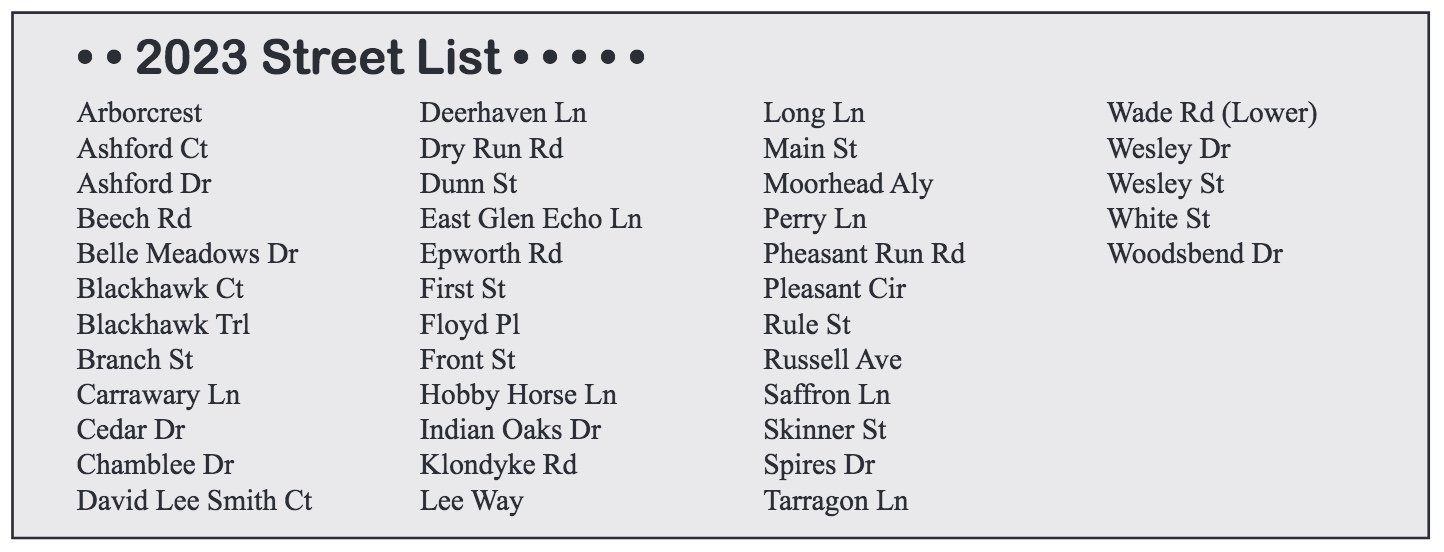
Here is the list of streets in the Township that are scheduled for resurfacing.
What does an AR-15 do to a human body? A visual examination of the deadly damage. – Washington Post
How to Make a Difference
Moms Demand Action is a grassroots movement of Americans fighting for public safety measures that can protect people from gun violence. We pass stronger gun laws and work to close the loopholes that jeopardize the safety of our families. We also work in our own communities and with business leaders to encourage a culture of responsible gun ownership. We know that gun violence is preventable, and we’re committed to doing what it takes to keep families safe.
After Jim Brady, a gun owner, Republican and President Reagan’s Press Secretary, survived a gunshot to his head, he and his wife Sarah, worked tirelessly alongside Democrats and Republicans to pass the bipartisan Brady Bill to ensure background checks were conducted on gun sales. But we cannot rest on that victory. America’s gun violence epidemic continues to worsen. Today, led by Brady President Kris Brown, we work with gun owners and non-gun owners and individuals of all identities and ideologies to create solutions! Together, there is nothing we cannot accomplish.
A movement of nearly 10 million mayors, teachers, survivors, gun owners, students, and everyday Americans.
Ultimately, our movement exists to end gun violence and save lives.
Thanks to the hard work of our volunteers across the country, we have won unprecedented victories against the gun lobby—at the ballot box, in state legislatures, and in corporate America.
Born out of a tragic school shooting, March For Our Lives is a courageous youth-led movement dedicated to promoting civic engagement, education, and direct action by youth to eliminate the epidemic of gun violence.
We aim to create safe and healthy communities and livelihoods where gun violence is obsolete.
From Tragedy To Transformation
Sandy Hook Promise is a national nonprofit organization founded and led by several family members whose loved ones were killed at Sandy Hook Elementary School on December 14, 2012. Based in Newtown, Connecticut, our intent is to honor all victims of gun violence by turning our tragedy into a moment of transformation. By empowering youth to “know the signs” and uniting all people who value the protection of children, we can take meaningful actions in schools, homes, and communities to prevent gun violence and stop the tragic loss of life.
[/vc_column_text][vc_video link=”https://www.youtube.com/watch?v=WXtFhqIhWwo”][vc_column_text]Access to an unsecured firearm in the home increases the risk of injury or death. Protect yourself and your loved ones by storing your guns securely – locked, unloaded, and away from ammunition. Learn more about safe gun storage practices at www.EndFamilyFire.org.[/vc_column_text][vc_video link=”https://youtu.be/UwZXj0rymOU” title=”Access to an unsecured firearm in the home increases the risk of injury or death. Protect yourself and your loved ones by storing your guns securely – locked, unloaded, and away from ammunition. Learn more about safe gun storage practices at www.EndFamilyFire.org.”][/vc_column][/vc_row]
Loveland, Ohio – Loveland Schools begin their Spring Break this Friday afternoon March 31, and classes will resume on Monday, April 10.[/vc_column_text][/vc_column][vc_column width=”1/3″][vc_widget_sidebar sidebar_id=”td-default”][/vc_column][/vc_row]
UPDATE: The Test and Protect contract between Hamilton County and The Health Collaborative expires at the end of this year when CARES Act funding ends, but the testandprotectcincy.com website will continue to be updated with no-cost testing locations in our region. Hamilton County Commissioners allocated an additional $1.2 million in American Rescue Plan dollars to continue to fill gaps in testing in 2022. New locations will be announced soon.
10+ stores in Hamilton County, 30 + stores in region
Schedule online or call 1 (800) 679-9691
PCR Drive-Thru Testing. Type of test varies by location, see website for details. Patients with insurance testing for travel and work requirements could be required to pay a copay. Please check with your provider.
Below is a release issued by the University of Cincinnati today.
Updates
Spring 2022 Return to Campus
Due to the recent increase in local, state, and national COVID-19 cases, and the high transmission rate of the Omicron variant, the University of Cincinnati will transition online January 5, 2022 and pivot back to full in-person activities on Monday, January 24, 2022.
To minimize the disruption that the high transmissibility of the Omicron variant and subsequent quarantining and classroom absences would have on our operations, classes, along with academic support services, will be conducted online for the first two weeks of the academic semester.
The goal of this in-person delay is for us to assess the impact of Omicron on our populations; let the spike in transmissions run its course; implement additional measures for screening testing and vaccination; and allow faculty, staff, and students the opportunity to receive booster shots.
We want to ensure that, when we come back, we come back to a safer, healthier and fully vibrant face-to-face experience.
Vaccine Requirement
In response to full FDA approval of the Pfizer-BioNTech vaccine, the University of Cincinnati is requiring students, faculty and staff to be vaccinated against COVID-19. The university is taking this step to promote the health and safety of our university community. Research shows vaccines are the most effective form of protection against COVID-19.
All World Health Organization endorsed vaccines, including those in the U.S. made by Pfizer, Moderna and Johnson & Johnson, will fulfill the vaccine requirement. Booster shots may also be required in the future.
The university’s physician-led COVID Response Team is closely monitoring, local, regional, national and global trends related to COVID 19. Current standard policies apply to university-related domestic travel. International travel, is subject to additional review in light of changing circumstances.
Effective December 6, 2021, due to the Omicron variant you will need to have a COVID-19 viral test (regardless of vaccination status or citizenship) no more than 1 day before you travel by air into the United States. You must show your negative result to the airline before you board your flight. If you recently recovered from COVID-19, you may instead travel with documentation of recovery from COVID-19 (i.e., your positive COVID-19 viral test result on a sample taken no more than 90 days before the flight’s departure from a foreign country and a letter from a licensed healthcare provider or a public health official stating that you were cleared to travel).
Effective November 29, 2021, students and scholars from Botswana, Eswatini, Lesotho, Malawi, Mozambique, Namibia, South Africa, and Zimbabwe will not be able to enter the U.S. as a result of the Omicron Coronavirus variant. Currently, no exemptions or an expiration date have been issued. Additional details will be added as they become available.
Facial Coverings
Given the most-recent developments with the virus, and in keeping with guidance from the CDC, individuals, both fully vaccinated and those not fully vaccinated, are required to wear a facial covering indoors (unless you have received an exemption or accommodation; or when eating, drinking or alone in a private room). See more details on facial coverings.
Those who are not fully vaccinated are required to wear a facial covering when outdoors and unable to maintain social distancing. Individuals who are not wearing a facial covering when outdoors are attesting to compliance with this requirement.
Spring 2022 Screening Testing
Currently, the university is offering weekly COVID screening testing. The testing site is located on the ground level of Steger Student Life Center.
Faculty, staff and students can submit proof of vaccination, which consists of a snapshot of your vaccination card, via the UC COVID Check app and the web-based version of the COVID Check app. Please do not submit other materials at this link.
The university may revisit these testing practices and protocols, depending on testing needs and the changing context.
Quarantine and Isolation
Given that broad access to vaccines is available, on-campus quarantine and isolation housing is on reserve for student use but may be limited depending on events. Thus, on-campus quarantine and isolation housing cannot be guaranteed at any time. All students should have individual plans for isolation and quarantine housing in the event they are required to do so. Let’s remember that vaccination is currently the best way to prevent the need to quarantine or isolate.
UC COVID Check App
The UC COVID Check App will remain in use and operation during the Spring 2022 Semester.
Students are required – and faculty, staff and visitors are strongly encouraged – to report via the UC COVID Check App if they develop viral symptoms, receive a positive COVID test result or have been in close contact with a COVID-positive person.
To Remember
As we move forward together as a community, let’s also remember our campus practices may need to change as conditions change. As such, all COVID-19 practices and policies are subject to revision and updates.
Questions
Please read the above information, links and other navigation on this page. If you still have questions after reviewing the available information, please email campusreturn@uc.edu Please check this site regularly as all COVID-19 practices and policies delineated throughout this site are subject to revision and updates.
“I promise to all those surrounding me including all of you in Loveland I will continue to make this community the absolute best place to live and visit.”
Cassie Mattia
Listen as Cassie Accepts her Award.
______________________________________________
by David Miller
Cassie’s friend Jennifer D’Alberto Kavensky had pre-recorded a video introduction of her that was projected onto a big screen.
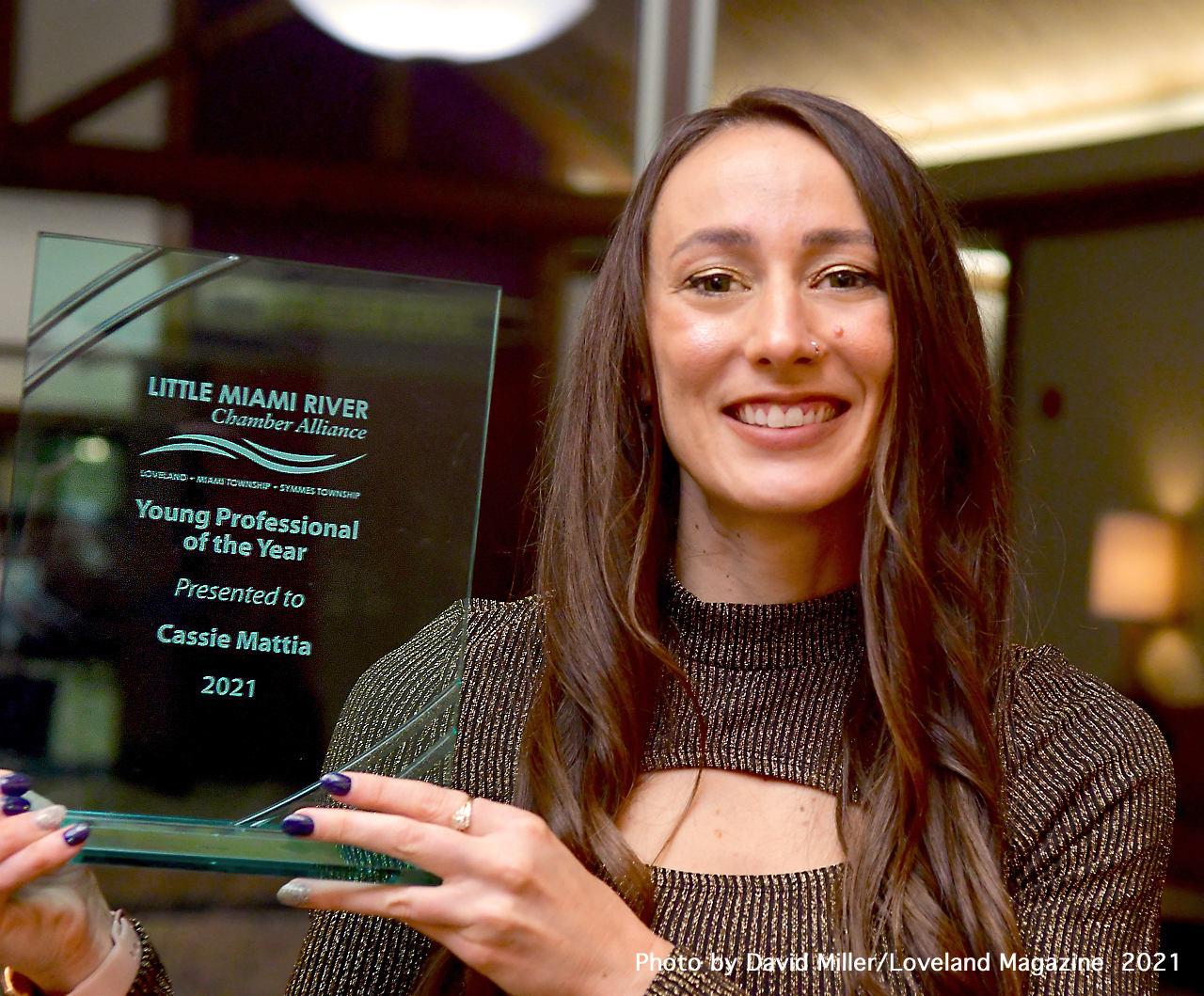
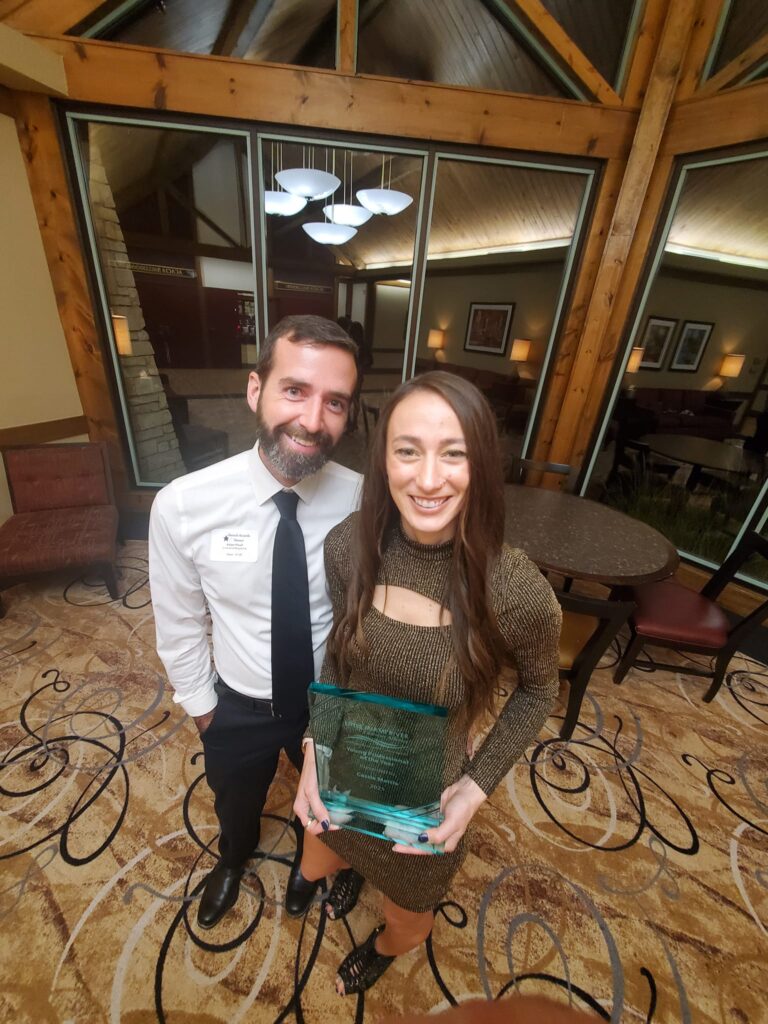
Loveland, Ohio – “Words cannot describe how unbelievable the 2021 Little Miami River Chamber Alliance Awards were on Wednesday,” said Loveland Magazine Co-Owner Cassie Mattia. “The atmosphere, the music, the people, the decor, the food, and of course the awards ceremony was the icing on the cake for one of the best years of my life.”
The occasion was the 2021 Annual Awards Dinner, a gala put on by the Little Miami River Chamber Alliance. It is an evening for area businesses to come together and celebrate their successes and community contributions. The celebration was at the Oasis Conference Center.
Cassie was selected as the 2021 Young Professional of the Year.
AND ALL THE WINNERS ARE
Photo by Loveland Lifestyle Magazine/Courtney Kraemer
Business of the Year – Premier Tumbling and Dance
Emerging Business of the Year – Monarch Financial Advisors
Beautification Award – Mile 42 Coffee and Eads Fence Company
Community Involvement Award – Jason Pinson
Business Community Advocate Award – Brittney Frietch Team, Re/Max Preferred Group
Non-Profit of the Year – The Care Center
Woman Owned Business of the Year – Loveland Lifestyle
Young Professional of the Year – Cassie Mattia
Randy K. Stanifer Health, Wellness & Fitness Business of the Year – Loveland Massage Center
Recreation Business of the Year – Grand Sands Volleyball
Community Responder Award – Miami Township Fire/EMS
Chamber Choice Award – Tano Bistro – Loveland
Co-Owners of Loveland Magazine David Miller and Cassie as they enter the Oasis Conference Center.
Proceeds from a silent auction benefited Grant Us Hope, an organization dedicated to youth suicide prevention, and a Chamber Scholarship fund. Emily Barlow with Loveland Lifestyle Magazine was the Emcee.
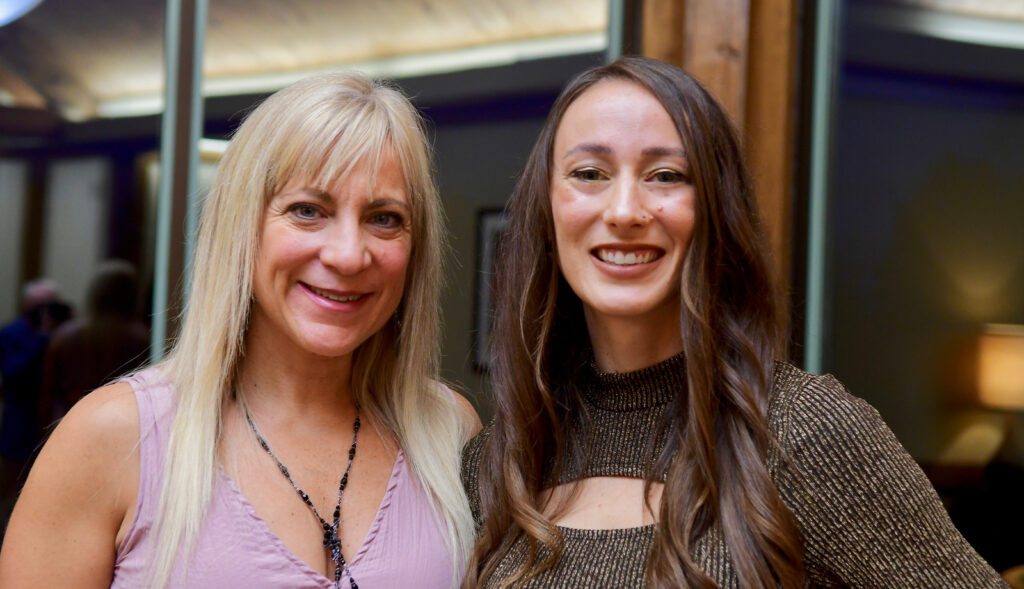
I could not be more proud to call Cassie my business partner. I’m so very happy that she was recognized for her achievements and as a community leader. She is the Co-owner, Associate Editor, and Director of Marketing for Loveland Magazine.
Cassie said the next day, “Thank you to all those that spent time out of their day to send in nominations and testimonials on my behalf for this award, you have no idea how much it means to me and how eternally grateful I am. I am so excited to see where this unbelievable path takes me and I promise to all those surrounding me including all of you in Loveland I will continue to make this community the absolute best place to live and visit.”
Cassie walked into my life 3-1/2 years ago by knocking on the door and announcing she wanted to write for Loveland Magazine. It was unbelievable fun Wednesday night celebrating with her.
There is more to the story. What she brought with her in that oversized purse she carries was dedication, hard work, kindness that I see every single day, and a devotion to her family and to her boyfriend Adam. She’s the big sister that everyone should have.
Cassie and her boyfriend Adam Ploof
In that bag is forgiveness, is a photographic memory, what just must be an off-the-scale high IQ, writing skills, and her journalism background with degrees she worked so hard to achieve. However, her bag is always 90% packed with positivity, sometimes to overflow.
She recently joked that I was so old that when I ran road races they were on dirt roads. Well… Cassie is so young-of-heart, that she runs each day on sunshine younger than today’s sunrise. A rare personality that anyone older than today, and most people her age, should be so lucky to have.
Thank you so much Cassie for agreeing to be a co-owner of Loveland Magazine. It was such a fun, fun night celebrating with you and Adam.
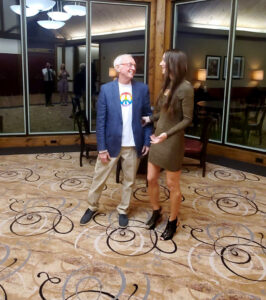
When we walked under the Oasis portico, before we went in – I pointed in both directions with a sweeping motion and joked “Look Cassie… they reserved this whole country club just for you tonight! Hmm, where’s the red carpet I ordered?”
Adam parked the car and caught up with us and, well, I just went in pretending the three of us were walking on the red carpet and I saw the evening transform into the “Gala” it was billed to be.
And, no one could’ve wiped off the grin I carried the rest of the evening being with my friend and partner, the Loveland Area’s “Young Professional of the Year”.
We are pleased people are now researching the Pandemic and how local newspapers survived. Some didn’t. Loveland Magazine did survive, and it was pure everyday persistence, sacrifice, and a dedication to staying alive (literally), and as a local Newspaper. We were early declared “Essential Workers” however that declaration did not provide us anything as the designation was quickly ignored at every level of government when they dolled out relief dollars and the help they could have provided. We stood in line with everyone else at the chance to apply for PPE funds, etc., and at times we were at the back of the lines for eligibility. We were still standing when our own City bought new high-tech water fountains with the COVID relief funds they received. Much of what you read here though is how we did it. What this story misses is an incredible effort it took for local papers in smaller communities to find accurate specific COVID 19 data in a hometown like ours that is in three counties with each county reporting in different formats and on different days of the week.
But how did so many local news organizations – especially newspapers – manage to survive the pandemic? Weeklies beefed up their daily online news coverage, business models were blown up and existing rationales for why journalism matters became more than theoretical to rural journalists.
Their determination to survive and serve as a public health lifeline for their communities fueled an oral history project that my colleague Teri Finnemanand I conducted, interviewing 28 journalists across seven states in the middle of the country. We learned how locally owned and family-owned newspapers made it through COVID-19.
“There’ve been times that we’ve had to reach out to mayors and different cities and communities across the state … to make sure that … they knew that [journalists] were deemed essential workers,” said Ashley Wimberley, executive director of the Arkansas Press Association. That label exempted news workers from stay-at-home orders and designated them as critically needed by their communities.
Oral history grabs the first impressions of history for those living now, looking back at what just happened. It helps people understand the present and how to move forward, out of a crisis. But it also records events for scholars and citizens in the future.
“Always remember that when you’re putting those stories in your newspaper, that you are printing your community’s history,” Amy Johnson, the publisher of the Springview Herald in Nebraska, told us.
Benny Polacca of the Osage News in Oklahoma told us something similar: He encouraged journalists covering some future pandemic to “do your due diligence in order to come to some type of understanding, some type of argument, some type of focus, if you were going to be reporting or researching the time of COVID-19.”
Often, it’s journalism on the coasts that gets the attention of researchers. The New York Times, The Washington Post, the Los Angeles Times – these big news organizations are written about constantly.
By talking to journalists in North Dakota, South Dakota, Nebraska, Kansas, Oklahoma, Arkansas and Louisiana, our project pushed back against this tendency to ignore the middle of the nation and its important journalism. As a kind of new essential worker, journalists found themselves in charge of explaining complicated guidance from state and local officials about COVID-19, how schools would work and where to get help.
“I hope that, through this, that our role as journalism, they [the public] realize how important it is that the information we put out, you know, how it affects them every day,” Johnson said.
Kansas Press Association Executive Director Emily Bradbury had a message for these journalists who were working for news organizations increasingly threatened with being shut down: “I want them to know that in the midst of an emergency, in the midst of what can seem like a hopeless situation, when they look at their financials, that what they’re doing is important. And what they’re doing matters, and that no one else can do what they do, and they look out for their communities like no one else.”
Emily Bradbury, Kansas Press Association Executive Director, tells reporters that ‘what they’re doing is important. And what they’re doing matters…and they look out for their communities like no one else.’ Will Mari and Teri Finneman, Author provided photo.
Loans, side hustles and deals
Reporters and editors found new ways of paying the bills. That meant accepting government subsidies in the form of Paycheck Protection Program loans. It meant, for some, going door to door and asking readers to subscribe, or keep subscribing. It meant consolidating newspapers, putting out more online editions, or taking pay cuts.
“People just don’t understand. It costs a lot of money and time to do this, and I just wish we – there was more value or people appreciate it or understood the value and the cost of really providing this service,” said Bonita Gooch, the publisher of The Community Voice, a Black newspaper based in Wichita, Kansas.
Some publishers took on side hustles to bring in revenue, creating ad copy for local business or doing marketing work.
At The Kingfisher Times & Free Press in Oklahoma, for example, Christine Reid, the paper’s editor, created ads for a local vocational-technical school. “I’ve also tried to use that as an avenue to … generate more ads for the newspaper,” Reid said.
Local publishers did whatever it took to stay afloat. As some of our initial findings have shown, that showed both opportunity and hesitancy about change.
“We’re gonna have to rely less on advertising revenue and more on subscription revenue, and so we’ve got to make sure we’re offering a unique product that they want to pay for,” said Letti Lister, the president and publisher of the Black Hills Pioneer in Spearfish, South Dakota.
We saw tentative signs of hope, as journalists got financial and moral support from their readers during a fraught election. “If anything, it’s rallied the troops, if you will, in our community because they trust us, they know that we’re going to report the news in a timely manner and keep the public up to date,” said Amy Wobbema, publisher of the New Rockford Transcript in North Dakota. Arguably most coverage was calm and steady.
But there was still hesitancy over what newspapers had to do to adapt. Some journalists are uncomfortable with receiving government funding and would rather rely on community support.
As South Dakota Newspaper Association Executive Director Dave Bordewyk put it: “Sort of, ‘Look, contribute to our newspaper … because if you value that importance of local news and journalism, then we need your support beyond just subscribing to the newspaper or advertising, which has gone away.’”
“That’s what we hope. What I hope comes out of this is that readers can understand that, and can … have a renewed value on what that [local] publication has done for their community during this pandemic,” Bradbury told us.
Around 97 percent of patients of all ages in Ohio hospitals today are unvaccinated.
When you get COVID-19 without the protection of a vaccine, there is a very real risk you’ll end up in the hospital or the obituary pages.
Columbus, Ohio – Ohio Governor DeWine today provided an update on the increased impact that COVID-19 is having on Ohio’s younger populations and the stress that the surge of cases is having on hospitals statewide.
“The bottom line is that we’re seeing our highest levels ever of hospitalizations among those under 50 years old,” said Governor DeWine. “Those who are getting very sick, being hospitalized, and dying of COVID are getting younger and younger. And it is because they are not vaccinated.”
Today, there were 459 newly-reported hospitalizations, the highest number of new hospitalizations since January.
The number of new hospitalizations for COVID-19 of those under 50, was the highest during the entire pandemic during the week of Sept. 5th, when Ohio hospitals admitted 398 patients under the age of 50.
During the most recent completed reporting week (Sept. 5 — Sept. 11), 230 Ohioans 39 and younger were admitted to the hospital, which is the highest number of admissions for COVID in this age group during the entire pandemic, even higher than during the winter surge levels when no one was vaccinated.
Around 97 percent of patients of all ages in Ohio hospitals today are unvaccinated.
In July, 48 percent of COVID-19 deaths were among those 69 years old and younger. In August, preliminary data shows that an average of two people younger than 50 died of COVID-19 in Ohio every day.
Last month, preliminary numbers showed 18 Ohioans 39 and younger died from COVID-19. This is compared to five people in that age range who died in June and two people in that age range who died in July.
Dr. Bruce Vanderhoff, Director, Ohio Department of Health “If you are young and unvaccinated it’s now probably only a question of when, not if, you get COVID-19. When you get COVID-19 without the protection of a vaccine, there is a very real risk you’ll end up in the hospital or the obituary pages. The numbers really tell it all, COVID has changed and is now making younger Ohioans who are not vaccinated very sick. Don’t become a statistic when there is a simple, safe, and effective alternative. Go out today and get vaccinated.”
Suzanne Bennett, M.D., Extracorporeal Membrane Oxygenation (ECMO) Program Director, University of Cincinnati Health “These rising numbers of sick COVID patients places a significant burden on our hospital beds, our medical teams, and worse yet, it creates scenarios that no one wants to think about where we do not have the space for patients who would otherwise benefit from receiving their care at large academic medical centers. We now need the help of the people in our community more than ever so that no one else needs to die from this disease.”
Alan Rivera, M.D., Hospitalist, Fulton County Health Center
“We are in a crisis mode. As compared to last year, our nursing staff is down probably 50 percent. We have nurses leaving the field, retiring early, or finding jobs elsewhere because of the long hours and the emotional strain. On top of that, our COVID numbers are now going up. In June and July I didn’t see any COVID patients. Now, the majority of the census in our hospital are COVID patients, and they’re younger, anywhere from 30 to 50.”
Joe Bates, R.N., B.S.N., Clinical Coordinator, Critical Care Unit, Genesis HealthCare System (Zanesville) “We’re seeing the younger population being hit hardest with this right now. Our average age right now that we’re seeing is around 59, with many of them being younger, as compared to last year when the average was about 78 years of age. Of the COVID positives that we currently have in the ICU, none of them are vaccinated who are on the ventilator.”
Terri Alexander, R.N., P.C.C.N., Summa Health (Akron)
“It’s just a sad, sad situation that we’re dealing with, and it’s tragic because it’s just so preventable. Please, please, please, get vaccinated. We live in a culture that has never experienced coming to the hospital and getting turned away, and I think people can’t fathom what that’s truly like until its them or their family members who are coming in and getting turned away.”



 [/vc_column_text][/vc_column][/vc_row]











![[DeWine] COVID-19 Update for Ohio: highest levels ever of hospitalizations among those under 50](https://lovelandmagazine.com/wp-content/uploads/2020/05/covid-ohio-feature-.png)