Tag: Loveland Magazine

  • Adam Ploof has 1 month to meet his 100 Mile Challenge

    Adam Ploof has 1 month to meet his 100 Mile Challenge

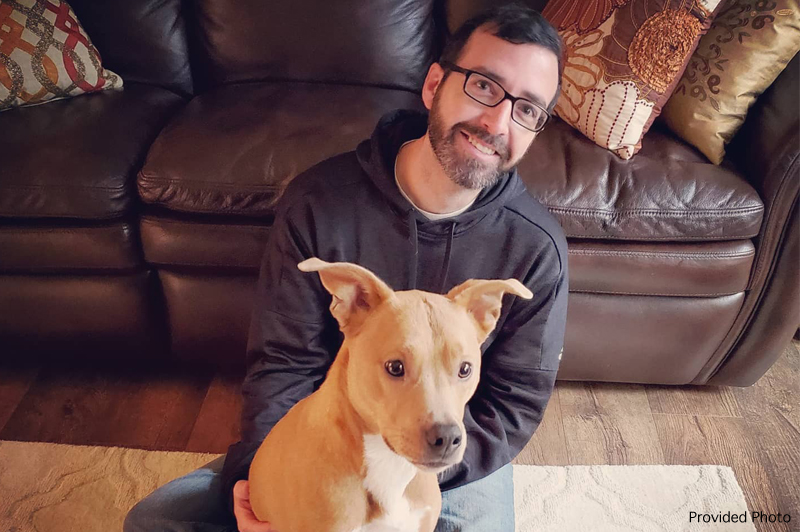
    Adam Ploof and Nala

    by David Miller,

    Loveland, Ohio – Join me in supporting Adam Ploof and CancerFree KIDS for the 100 Mile Challenge – Corporate Competition, presented by Interlink Cloud Advisors.

    I’ve decided to spotlight my friend Adam Ploof who is also the boyfriend of my Loveland Magazine partner, Cassie Mattia. I was excited Monday afternoon when Adam’s FaceBook post popped up and I read that he has challenged himself to walk 100 miles to raise money for childhood cancer research. When you personally know the person who challenged themself to walk 100 miles in 1 month, it suddenly becomes less aloof or something. BTW, I also know their furbabies, Dean and Nala quite well and they will be participating.

    During September, Childhood Cancer Awareness Month, Adam and his colleagues from Loveland-based, Oasis Turf & Tree will each be striving to complete 100 miles of activity to each raise at least $100 for CancerFree KIDS to fund life-saving childhood cancer research. If Oasis Turf & Tree wins the Corporate Competition, they will have a 2022 CancerFree KIDS Research Grant named in their honor! I hope you will join us in our efforts to help Adam reach his goal of $500.

    Adam told me he took on the challenge, “Just to raise awareness for the cause.” He said that “anything inside and outside of work except for the milage he accumulates on the machines he rides on at work, counts. “My phone only catches on for walking distances, running, or cycling. Walking, cycling, kayaking. You name it as long as it’s physical exercise could count though. Cassie and I always take both our dogs Dean and Nala on walks every day, so the furbabies will be part of the competition too.”

    Oasis Turf & Tree contributes to greater causes each year by doing such things as regular trips to the Ronald McDonald House for the chance to spend the day preparing meals for families. Oasis celebrates Black History Month, Martin Luther King Jr. Day, Veterans Day, and National First Responders Day.

    This September, about 1,290 kids in the US will be diagnosed with pediatric cancer. They join thousands of others who are currently in treatment and hundreds of thousands more who previously battled cancer. The 100 Mile Challenge exists to “celebrate the survivors, remember those for whom a cure did not come soon enough, and give hope to kids currently undergoing treatment by funding the very best research to improve treatment options for all kids diagnosed with cancer, now and in the future.”

    If you are able to donate, please click the “Donate” button below. I have also included the CancerFree KIDS address if you are more comfortable sending a check. I greatly appreciate any amount you are able to give to help Adam pass his goal!

    Cassie makes this ask, “Please support my wonderful boyfriend Adam Ploof as he raises money for CancerFree KIDS! I love that we both are passionate about our community and organizations that deserve all the care and support they can get!”

    Nala, Adam, Cassie, and Dean

    Please make checks payable to CancerFree KIDS and send to CancerFree KIDS PO BOX 575, Loveland, OH 45140. Write “Adam Ploof” on the memo line to credit your donation to his fundraising page

    Thank you in advance for supporting Adam and Oasis Turf & Tree in funding life-saving childhood cancer research!

    CancerFree KIDS works every day to find gentler and more effective treatments for kids with cancer by funding research that would otherwise go unfunded. They do this because…

    • Childhood cancer is not profitable meaning almost no investment from industry and only 4% of federal cancer research dollars are allocated to pediatrics.
    • Cancer is the #1 killer of children by disease and two-thirds of children who do survive go on to have chronic health issues because of their treatments.
    • To launch gentler and more effective treatments for children. As of now there are 660 FDA approved cancer drugs for adults and only 35 approved for children.
  • [Video Interview] “You want to try one out?”

    [Video Interview] “You want to try one out?”

    David Miller

    “You want to try one out?”, asked Shannon Meadors.

    by David Miller

    Loveland, Ohio – It took me from Sunday evening until Tuesday morning, and bugged me to no end till I realized why I came about two feet from crashing a $2K electric tricycle into one of the concrete picnic tables at Nisbet Park. You don’t “lean” to turn it, you actually do turn the handlebars.

    “You want to try one out?”, asked Shannon Meadors.

    I did.

    I shouldn’t have.

    I was in Nisbet Park listening to the very cool sounds of My Brother’s Keeper, a Cincinnati-based progressive bluegrass band that has played venues all over the country.

    When I spotted the stream of adult trikes rolling into the park my first thought was, well this is very cool, ya never know anymore what ya might see on the Loveland Bike Trail these days. The second was, in the 1960s, Loveland was infamously known for criminal biker gangs. This sight put a different spin on Loveland history for me.

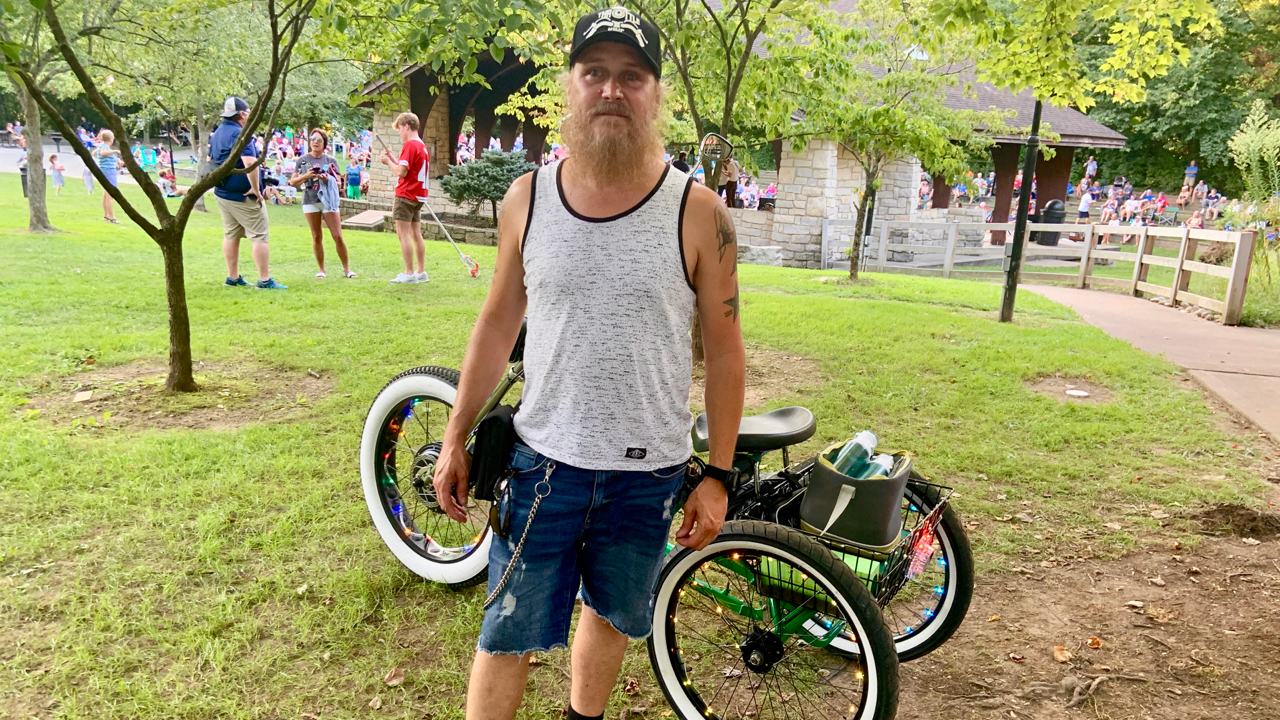
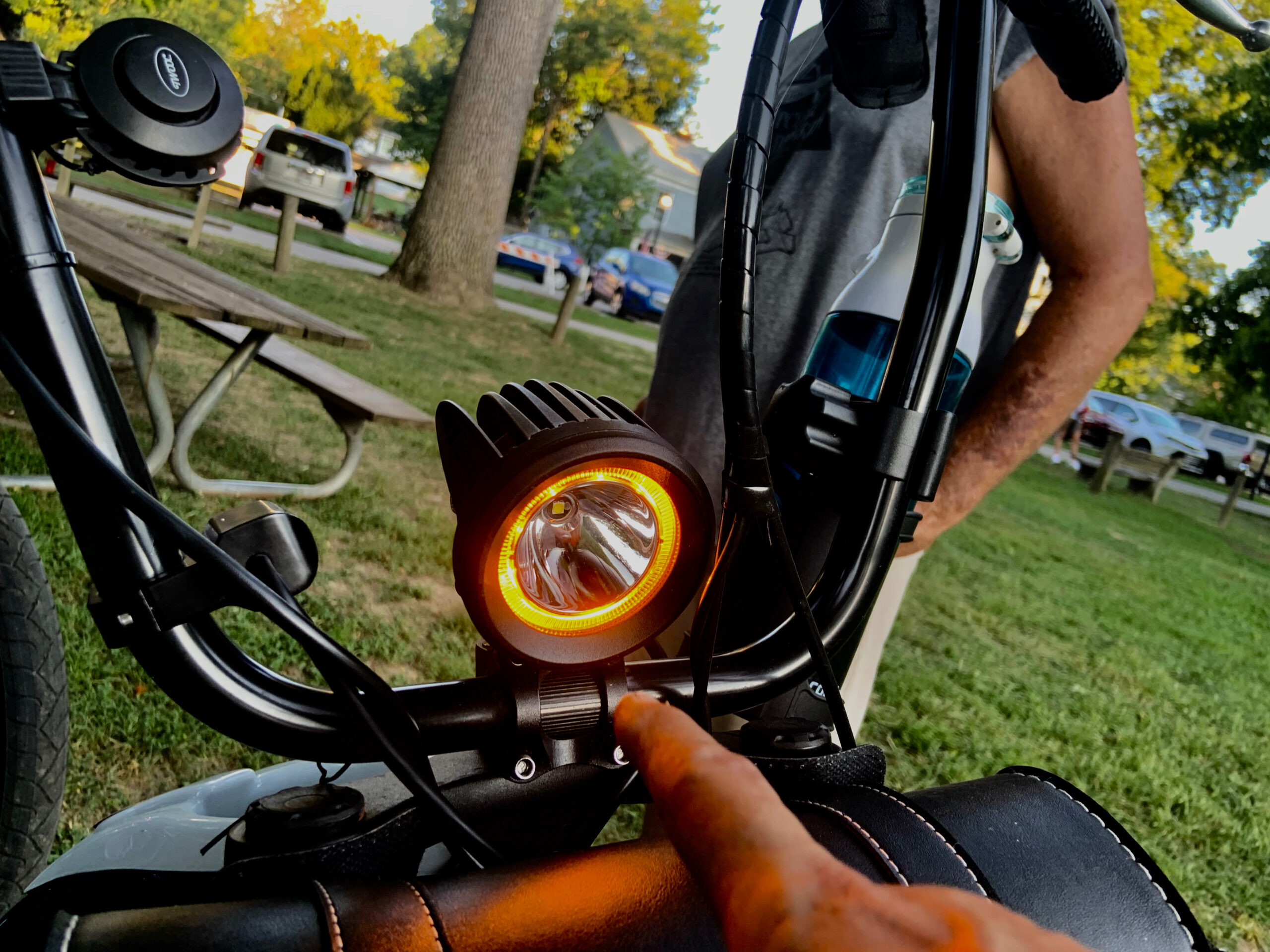
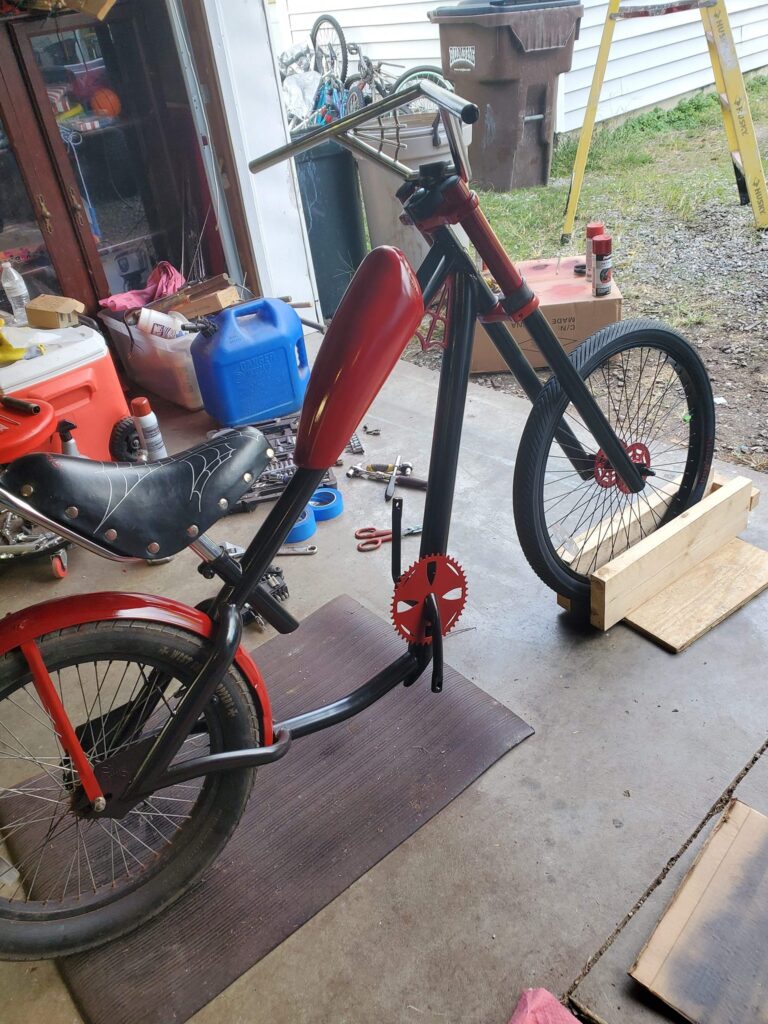
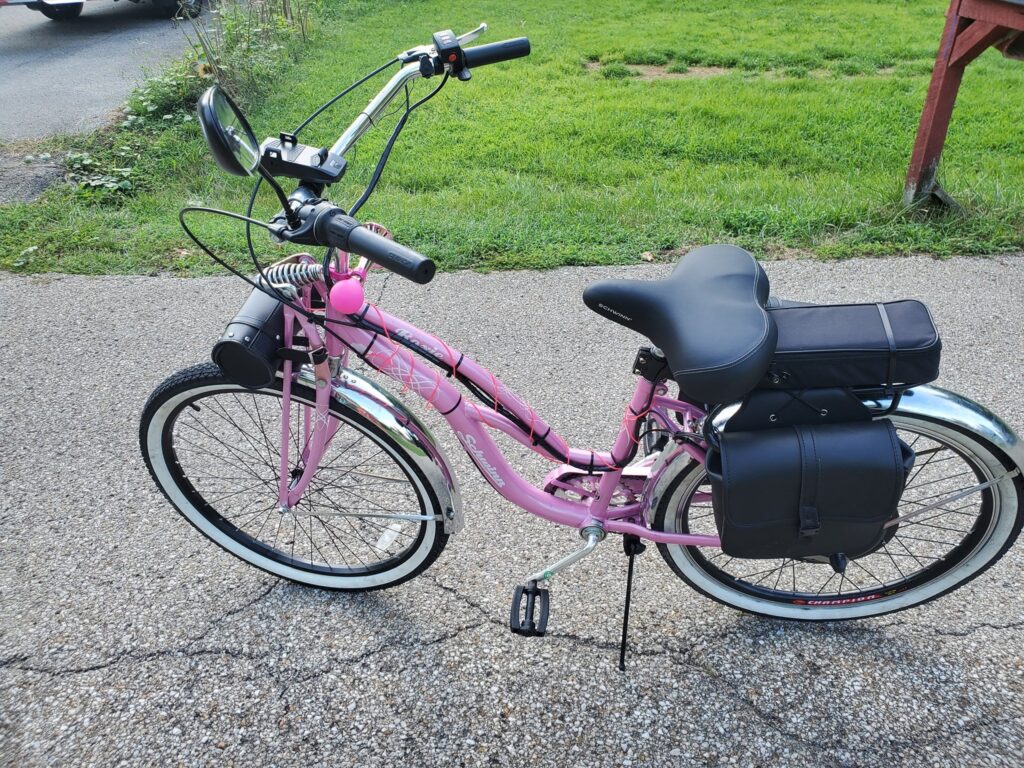
    An “electric motorcycle gang” of nine mature adults rode in on tricked-out electric adult tricycles with custom handlebars, Bluetooth sound systems, large padded seats, baskets, luggage compartments, and gyrating multicolored LED lights. The bikes also had custom, electronic horns, fat tires, saddle bags, drink holders, and cell phone chargers.

    Describing he and his twin brother Shawn’s creations, Shannon says, “how fast do ya wanna go?” They have capable speeds up to 30 mph with disk brakes in front and deluxe mirrors mounted on some stunning ape hanger handlebars.

    They look like a “carnival ride at night” is how they are described on their website.

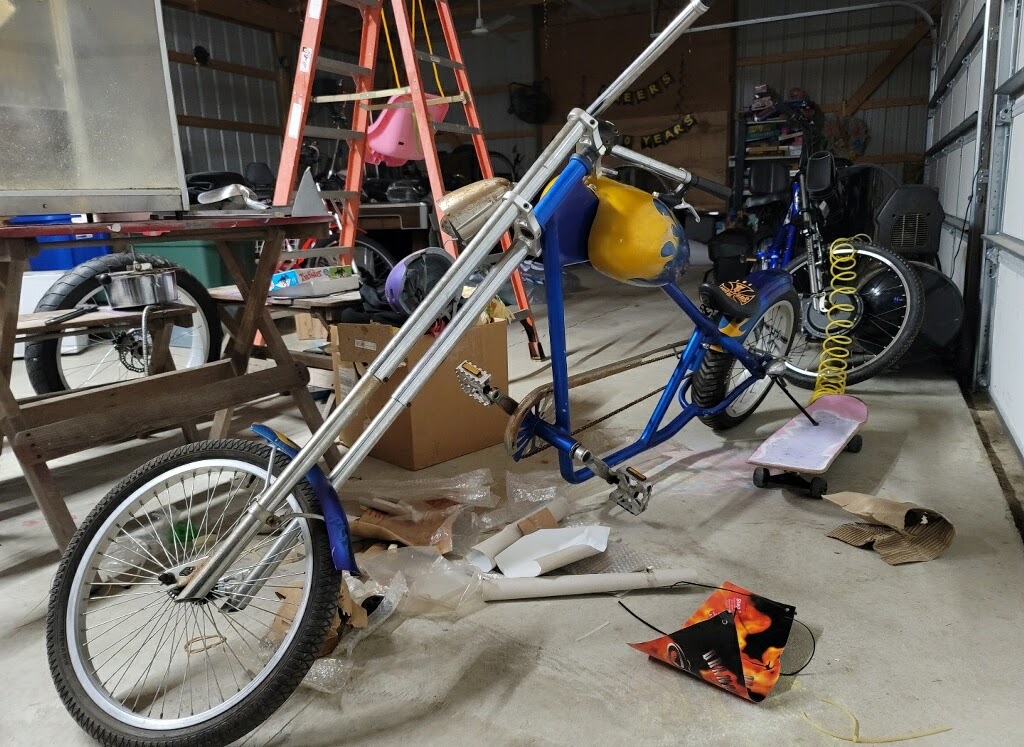
    Throttle King Custom Bicycles can build you a custom-style chopper at their fabrication shop in Amelia.

    Shannon and Shawn worked for a metal manufacturer for 20 years before they became unemployed earlier this summer when the business moved to Mexico. They turned to their side gig to make ends meet.

    They also make “big wheel drifters” similar to what kids rode decades ago and custom chopper Trikes with custom white wall tires.

    “You don’t realize how much you like riding bikes until you get a really cool, comfortable bike,” said Shannon. His 82-year-old father is back out on a bike again riding one of the custom trikes almost every day. “And, he loves it,” said Shannon.

    There were nine riders, including Shannon’s twin on the Loveland Bike Trail Sunday and had already gone 18 miles. With dusk approaching, they were not yet calling it a day, and why would they? It wasn’t dark enough for all of their twinkling LEDs to truly sparkle and bedazzle!

    Phone: [ 513-491-2074]

    Email: [ throttlekingcustom@gmail.com ]

    Follow me: [@throttlekingcustombicycles on Facebook]

    [@throttle.king.custom on instagram]

    [@throttle_king_bicycles on TikTok]


  • Downtown Loveland Streetscape Master Plan

    Downtown Loveland Streetscape Master Plan

    Loveland, Ohio – City Council will hold a public hearing (at or about) 7 PM in the council chambers at City Hall on September 27 to review and receive public input on a proposed Downtown Loveland Streetscape Master Plan.

    The project aims to, “Create a planning document that will guide both short- and long-term infrastructure and streetscape investments in the city’s downtown business district.”

     View the proposed master plan

  • 2022 HOMEARAMA at Loveland’s ChimneyRidge opens Saturday

    2022 HOMEARAMA at Loveland’s ChimneyRidge opens Saturday

    Loveland, Ohio – Do you love art, music, animals, the Reds, wine, beer or just spending time with friends? No matter what you enjoy doing, you won’t want to miss the special events at HOMEARAMA® 2022.

    The fun kicks off with a pop-up art show on opening day, September 3. That Saturday is also Careers in Construction day, where attendees of every age can learn more about building and trades jobs and skills.

    On Sunday, September 4, we salute Hometown Heroes, offering reduced admission for military members, teachers and frontline personnel. Listen for B105’s remote broadcast and enjoy an onsite car show.

    Off work on Labor Day? The show will be open from noon to 9 p.m., so come to tour six luxury homes and stay for a drink or bite to eat.

    Are you lucky enough to already live in Loveland? Your special day at HOMEARAMA® is September 9. Residents receive discounted admission to the show all day. Stay for music by Boutique, on the stage from 6 to 9 p.m.

    September 10 is the perfect day for music lovers at the show. WHRM will broadcast remotely from the show at ChimneyRidge in the afternoon. At 5 p.m. Katie Pritchard takes the music stage.

    We love Cincinnati and on Sunday, September 11, we’re going all out with Everything Cincy day. Don’t miss all the home team action: from 12:30 -1:30 p.m., come to the meet and greet with Cincinnati Reds Hall of Famer and part of the Big Red Machine, George Foster (accompanied by Mr. Redlegs) and enter to win tickets to a game-day suite at Great American Ball Park. There will also be a meet and greet with FC Cincinnati & FC Cincy’s Mascot “Gary The Lion.”

    Rolling Into Week Two

    Grab your gal pals for a special Ladies Night Sip & Shop from 4 to 9 p.m. on Thursday, September 15. You’ll enjoy drinks with your friends and music by The Brody Brunch.

    The final Friday of the show brings a flurry of activity to HOMEARAMA® in Loveland. It’s Little Miami River Chamber Alliance Day and we’ll host Fiesta Friday, too. From 5 to 8 p.m., we celebrate Hispanic Heritage Month. DJ Kombat will provide the soundtrack for a lively evening.

    On September 17, it’s Beerfest, presented by Yelp Cincy. The taps will be flowing from noon to 9 p.m. That night, the 3 Micks perform from 5 to 8 p.m.

    All good things must come to an end, but HOMEARAMA® will sign off with a fan favorite, Animal Adoption Event: Find Your Next Furry Friend! Will you be tempted to take a new pet home? The String Theory Band plays closing night from 4 to 7 p.m.

    Plan Your Visit

    Get in on all the fun: Plan your visit to HOMEARAMA®. Buy your tickets to the show today!


    Directions

    From I-275 North or South, Take Exit 52 Loveland/Indian Hill. Turn Left onto Loveland-Madeira Road, right onto West Loveland Avenue, left onto State Route 48, left onto Butterworth Rd then a right into ChimneyRidge and follow signs to HOMEARAMA® parking.

    GPS Address – 10377 Butterworth Road, Loveland, OH 45140

    OR 11 ChimneyRidge, Loveland, OH 45140

  • CDC Recommends the First Updated COVID-19 Booster

    CDC Recommends the First Updated COVID-19 Booster

    In the coming weeks, CDC also expects to recommend updated COVID-19 boosters for other pediatric groups

    by David Miller

    Today, CDC Director Rochelle P. Walensky, M.D., M.P.H., endorsed the CDC Advisory Committee on Immunization Practices’ (ACIP) recommendations for use of updated COVID-19 boosters from Pfizer-BioNTech for people ages 12 years and older and from Moderna for people ages 18 years and older.

    The CDC said today, “Updated COVID-19 boosters add Omicron BA.4 and BA.5 spike protein components to the current vaccine composition, helping to restore protection that has waned since previous vaccination by targeting variants that are more transmissible and immune-evading.”

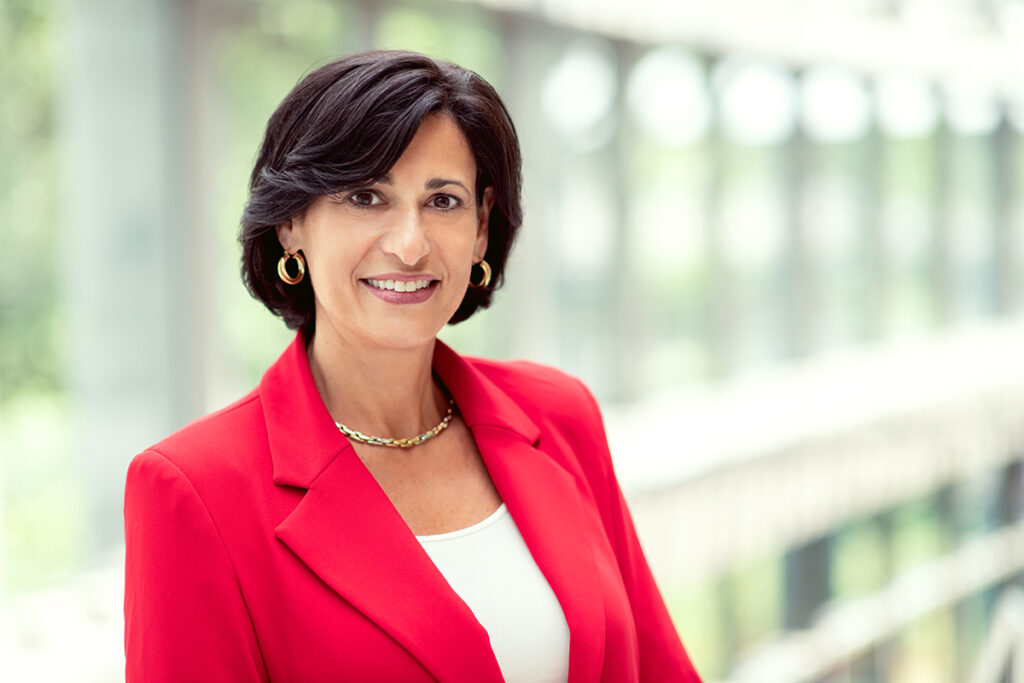
    CDC Director Rochelle P. Walensky – CDC photo

    In the coming weeks, the CDC is also expected to recommend updated COVID-19 boosters for other pediatric groups, per the discussion and evaluation of the data by ACIP on Sept. 1, 2022.

    “When data are available and FDA authorizes these other types of COVID-19 boosters, CDC will quickly move to help make them available in the United States,” according to a press statement issued today.

    The Food and Drug Administration’s (FDA) authorization of updated COVID-19 boosters, and CDC’s recommendation for use, are the next steps forward in our country’s vaccination program.

    Dr. Walensky said today, “The updated COVID-19 boosters are formulated to better protect against the most recently circulating COVID-19 variant. They can help restore protection that has waned since previous vaccination and were designed to provide broader protection against newer variants. This recommendation followed a comprehensive scientific evaluation and robust scientific discussion. If you are eligible, there is no bad time to get your COVID-19 booster and I strongly encourage you to receive it.”

  • There’s more to preventing suicide than an Instagram post

    There’s more to preventing suicide than an Instagram post

    by Olivia Rohling

    At 12:00 a.m. on September 1st, 2022, the calendar officially flipped to September. As with every month, the month of September has its fair share of holidays and monthly recognitions. There’s Labor Day on the 6th, Grandparents Day on the 12th, Yom Kippur that begins on the 15th, and my birthday (which I’m totally counting as a holiday) that falls on the 23rd. September is also Childhood Cancer Awareness Month, World Alzheimer’s Month, and the one I’m writing this article about: National Suicide Prevention Month.

    I’m not sure if it’s just because of the people I choose to follow on social media, though I’m sure that at least plays some part in what I’m about to say, but when the calendar flipped to September, and being the avid Instagram-scroller that I am, I continuously came across the same anti-suicide infographic posted on people’s stories listing resources like the National Suicide Prevention Hotline and more. At first, like I’m sure many others who viewed the same infographic, I thought “That’s a nice gesture.” I didn’t see anything wrong with such posts. And to be clear, there isn’t necessarily something “wrong” or “bad” about posting and sharing such infographics that have mental health resources and information, and I’m not here to bash and shame those who choose to do so. Their intentions are in the right place, and some of those who choose to share such information may very well have a personal connection to the topic of mental illness and suicide, which makes sharing such resources all the more valid and understandable.

    Like I said, there isn’t anything wrong with caring enough about others and a topic like mental illness to share helpful resources across social media, but rather there is something missing with the good intentions already in place. Though it’s nice to think you’re making a difference by posting these resources, chances are, they help fewer people than you think. It would be nice if mental illnesses weren’t so complex, and attempting to solve the problems they cause was as simple as an Instagram post, but that’s just not the way it works. The issue of mental illness runs much deeper than a simple repost on Facebook. Preventing suicide means checking in on your friends: The one who never seems to stop laughing, the one you know is struggling, the one who’s struggled in the past, the one who seems perfectly fine, and even the one who says “Check in on your friends.” And it’s not a, “Hey, how are you?” because that’s how you get the simple “Tired” as a response. You ask, “How are you doing, really? Is there anything you need? How can I help you? Please be honest with me.” And checking in on someone is not a one-time thing. Be persistent. Be ready for an answer that isn’t “I’m fine” or “I’m just tired.”

    Preventing suicide starts with not turning away when the not-so-pretty and less romanticized symptoms of mental illness present themselves. Preventing suicide starts with being a good listener. Preventing suicide starts with supporting free or even just affordable healthcare so that the help that is so often talked about can be attainable for those who need it. Posting the National Suicide Prevention Hotline might do something, but what someone who is struggling with mental illness and suicidal thoughts really needs is support and care that is visible and intentional.

    I don’t want you to take away from this article that you should stop posting infographics with helpful resources across social media. In fact, I’d encourage you to still do so if that’s your kind of thing. Posts as such are informative and how we educate ourselves. What I want you to take away from this is that suicide prevention runs much deeper than a social media post. There is a second component to the social media posts that we often forget, and it’s the piece of real action.

    Don’t forget: Tell your friends you love them sincerely and often.

  • Be a Honeysuckle Hero

    Be a Honeysuckle Hero

    by Lauren Enda

    Loveland, like most of southwestern Ohio, has been invaded. According to UC biology professor, Denis Conover, “Amur honeysuckle is now the most abundant woody plant in Hamilton County. One bush can produce thousands of seeds that get dispersed by birds and mammals. Native plants just don’t have a chance. Everything that depends on the native plants — insects, birds — can be lost.” * The onslaught of invasive species is troublesome and dangerous to our local ecosystems. Multiple types of invasives are resident in Loveland’s nature preserves, parks, roadsides, and back yards. And we must eradicate them as the first step in healing our woodlands and natural spaces. 

    How can you help? Fight to protect Loveland’s woodlands on Saturday, September 10th from 9am to 3pm at the West Loveland Nature Preserve. (See further information below.) A coalition of residents, City of Loveland Public Works, non-local volunteers, and hired contractors will be working together to start healing the city’s green spaces. This event is hopefully the first of many to remove invasives from our city one area at a time. 

    Everyone is invited to join the fight. An invasive removal contractor, Honeysuckle Removal,** will do the really hard labor of cutting the invasives, many of which are decades old and twenty feet tall. Volunteers will work behind them to apply herbicide to ensure the invasives don’t regrow and then pile the debris for the City of Loveland Public Works to pick up after the event. The more volunteers we have, the more the contractor can focus on cutting invasives and the quicker the rebirth of the woodlands will be. In a show of good will, the contractor is “donating” two people from their company to help us get through the invasives quicker and educate volunteers. Pretty great, right?

    You can volunteer for an hour, or you can come all day. If you don’t have time to stay and work, please stop by anyway to learn a bit more about invasives, their dangers, and how to eradicate them in your own yards. 

    Many intractable problems exist in our world today, most of them so huge and so far away that we may feel there is nothing we can do. But removing invasives is relatively easy, local, doable, and extremely beneficial to our ecosystems. Everyone can make a real difference in fighting this massive problem. You will see direct results of your work, helping sunlight hit the forest floor for the first time in years. Joining the fight for healing the West Loveland Nature Preserve is as easy as showing up on Saturday, September 10th. Once you see the transformation of the area, you will better understand the problem, the solution, and how important this work is.

    For more information or to volunteer, please contact Lauren at lauren_enda@hotmail.com.

    What: Invasive removal at West Loveland Nature Preserve

    When: Saturday, September 10th from 9 am to 3 pm

    Where: Park on Glen Lake Rd, Pheasant Woods Court, or Shingleoak Drive. There is an entrance to the Preserve near there along West Loveland Avenue

    What to wear: Long-sleeved shirt and long trousers, hat, and if desired, sunscreen and bug spray 

    What to bring: Sturdy work gloves, water bottle, eye protection if you have it

    Lauren Enda lives in Loveland at Hidden Creek


    * Invasive species are taking over Ohio forests | University Of Cincinnati (uc.edu)

    ** Honeysuckle Removal LLC

  • Will you please help fill the shelves of the LIFE Food Pantry?

    Will you please help fill the shelves of the LIFE Food Pantry?

    Loveland, Ohio – Here are the weekly needs of the LIFE Food Pantry.

    Thank you for supporting your local pantry and neighbors who need a bit of assistance!

    FOOD

    Baked Beans

    BBQ Sauce

    Beef Stew

    Canned Carrots

    Canned Chicken

    Canned Mixed Fruit

    Canned Pineapple

    Canned Salmon

    Cereal

    Chili Beans

    Coffee

    Cooking Oil

    Ensure/Boost

    Flour

    Granola Bars

    Hearty Soups

    Instant Mashed Potatoes

    Juice (LARGE NOT INDIVIDUAL)

    Kidney Beans

    Manwich/Sloppy Joe

    Mixed Vegetables

    Oatmeal Packets

    Pineapple

    Potato Dishes

    Refried Beans

    Rice-a-Roni

    Sugar

    Syrup

    PERSONAL CARE

    Body Wash

    Conditioner

    Deodorant

    Lotion

    Razors

    Shampoo

    Shaving Cream

    Toothpaste

    Tampons

    Diapers Sizes 5,6

    Pullups (all sizes)

    HOUSEHOLD

    Kleenex

    Paper Towels

    Cleaning Products

    About the LIFE Food Pantry

    RECEIVE FOOD

    FOOD PANTRY HOURS
    SUNDAY: Closed
    MONDAY: Closed
    TUESDAY: 10–12, 4–6:30
    WEDNESDAY: 10–12
    THURSDAY: 10–12, 4–6:30
    FRIDAY: 10–12
    SATURDAY: 10–12

    541 Loveland-Madeira Road, Loveland, Ohio 45140
    (513) 583-8222

  • What’s The Cost of proposed Loveland School levy?

    What’s The Cost of proposed Loveland School levy?

    by Linda Holtkamp

    By now, the people of Loveland Schools should know about the proposed Loveland School levy, and how the cost of this proposed increase will affect your property taxes.

    Currently, 1 Mill is equal to almost exactly $1,000,000, and the school is asking us for 4.9 Mills, additional. The formula to calculate what this proposed levy will cost you is simple. Superintendent Mike Broadwater has a video on the school website with an explanation and many thanks to him for providing that.

    Find your property on your County Auditor’s website. Look for “property search” on both Hamilton and Clermont County sites. There you will find both the Appraised Market Value (full appraised value of your home) and also the Assessed Value (the amount that is taxable). Then grab your calculator and use this:

    Appraised Market Value (full home or house value) x .35 x .0049 = $$$$

    OR, use your Assessed Value (taxable amount) x .0049 = $$$$

    With either math formula, the amount you will owe will be the same $$$$.

    The .0049 represents the amount of this levy ask… 4.9 Mills, generating a total of close to $4.9 Million Dollars, each year, continuously (permanently), as an operating levy for the schools. 

    A Google search for current home values in Loveland lists that properties in Loveland range from $40,000 to $2.9 Million. The Grail was going to sell land to the school district for $7.7 Million, so yes, there are some high-value properties that exist here.

    The LCSD treasurer used the Zillow website in his presentation at a recent board meeting. Zillow lists the average house value in Loveland, at the end of July, to be $377,047.

    Using the average house value that the treasurer listed, $377,047, the calculated increase for an average value home in Loveland, for this school levy, will be about $650 per year. This is a permanent tax, which will be piled on top of the existing 18 continuous (permanent) levies, two permanent inside millage taxes, as well as a 26-year bond levy (which will be paid off in a few years).

    69% of homes in Loveland are lived in by the homeowner, while 31% are rental properties, according to RentCafe, a marketing website that tracks these trends.

    Homeowners will have to pay the extra costs of this levy, and other recent property taxes that have passed but not yet been billed, starting in January 2023. Landlords can be expected to raise rents to cover the 13% increase in Loveland School taxes, and those other taxes as well. Rentals in Loveland are pricy, average $1,361 for 959 sq. ft., only surpassed locally by rentals in Blue Ash.

    Information from the recent Census lists that 6.1% of people in Loveland are under 5 years old, and that 26.3% are under 18 years of age. This would indicate that, out of Loveland’s population, about 20% are school-age children. A good number of those school-age children do not attend Loveland Schools, but opt for private, parochial, charter, or homeschooling.

    Residents over 65 years old, seniors, again according to Census numbers, comprise 15.9% of the population of Loveland. It seems there are close to as many senior citizens in Loveland as there are school-age children.

    According to the school website, the District serves a population of 50,000, when including those who live both inside and outside of Loveland City proper. Student enrollment in LCSD is approximately 4,000. That works out to 8% of Loveland-at-large residents are students of LCSD.  That means 92% of Lovelanders sacrifice monetarily via property taxes, to educate 8% of the Loveland district population.

    Though many residents strongly insist this 13% increase in school property taxes is for the good of the 4,000 current students of Loveland, is there ever any emphasis on how a 13% increase might harm the considerable number of senior citizens in Loveland? The Homestead tax reduction, (aimed at helping seniors) has effectively disappeared, so relief on property taxes is essentially nonexistent. 

    For those who feel that not passing this levy will hurt property values… that depends on your outlook. Of all the people who live in Loveland now, according to the Census, 69% were born in Ohio. As a life-long resident myself, I know that many, many of these 69% are “long-term” residents of Loveland. Think of those you know who have made their home here for at least 15 years, as well as those who have lived here for decades. Do we like seeing our property values rise? Of course, we do. But do these permanent levies, which burden us forever, give us a good return on our investment? Or are higher property values more likely to aid those who live here only for a short time? We’ve spent tens upon tens of thousands of dollars to support the schools. Our schools… LCSD. Proudly. Will property value increases repay any of that? Will some residents eventually be forced out of their homes because continual taxation is part of the homeownership costs that are skyrocketing? Admittedly you can’t monetize the value of education. You can’t accurately assess the harm of passing on the cost of these school levies to those who truly can’t afford them, either.

    Remember that 2/3 of our community does not have children attending Loveland Schools. But a tax like this, if passed, places a burden on every single resident.. homeowner or renter, school parent or senior. The importance of voting cannot be overstated, and absentee or early in-person voting makes it easy for us all.

    Many of us complain about how much is sent to schools already, but these taxes are firmly entrenched, school enrollment numbers continue to drop, and LCSD has been making everything work pretty well with the over $50 Million Dollars per year that they already get (some $35 Million of that from local property taxes… us). They use these funds to educate 4,000 students out of a district population of 50,000… 8% of our community at large.

    These funds cannot be taken back, so use them with our blessing.

    Don’t ask for more.

  • Jewish congregations mount legal challenges to state abortion bans

    Jewish congregations mount legal challenges to state abortion bans

    Members of the Jewish community have spoken out against abortion bans in Ohio, saying it infringes on their religious freedom. Photo by Morgan Trau, WEWS.

    BY: ARIANA FIGUEROA – Ohio Capital Journal

    WASHINGTON — Thousands of years of Jewish scripture make it clear that access to abortion care is a requirement of Jewish law and practice, according to Rabbi Karen Bogard.

    “We preserve life at all costs,” she said in an interview with States Newsroom. “But there is a difference between that which is living, and that which is not yet living.”

    Bogard is a rabbi at Central Reform Congregation in St. Louis, which is in the  progressive tradition of Reform Judaism. She said that whether it’s the Torah — the first five books of the Old Testament in the Hebrew Bible — or the Talmud — the central text of Rabbinic Judaism and the primary source of Jewish religious law and theology — those pieces of Jewish literature “really draw the difference between life and potential life.”

    But with the fall of Roe v. Wade in late June, some members of the Jewish faith as well as other religious groups find their beliefs in deep conflict with state laws that ban or greatly restrict abortion — especially if a pregnant patient’s life is in danger.

    Since the Supreme Court’s Dobbs v. Jackson Women’s Health Organization decision, states now are permitted to craft their own laws regarding abortion, and in Bogard’s home state of Missouri, the procedure is banned.

    “Our congregants are heartbroken,” she said. “It’s really violating to be told what you can and can’t do with your own self.”

    Legal challenges are resulting. The enactment of state laws that ban or restrict access to abortion has already sparked a lawsuit in Florida from a liberal Jewish congregation in the Sunshine State. In Ohio, another liberal Jewish congregation is joining the American Civil Liberties Union in a lawsuit against the state’s six-week abortion ban.

    A coalition of three dozen rabbis also filed a brief on a separate lawsuit in the Buckeye State, where physicians are challenging the new abortion law in the Supreme Court of Ohio.

    Similar lawsuits are anticipated, not only from liberal Jewish congregations, but other religious groups as well.

    There’s currently a lawsuit in the U.S. District Court for the Southern District of Texas Houston Division filed by the Satanic Temple — not to be confused with the Church of Satan — on behalf of a member who argues the state’s abortion ban violates that temple member’s religious beliefs allowing access to an abortion ritual.

    The ritual involves members repeating verses in a mirror to affirm body autonomy and repel any guilt, shame or discomfort that can surface when undergoing an abortion.

    “There’s going to be a wave of religious freedom lawsuits,” Rabbi Daniel Bogard, who’s married to Rabbi Karen Bogard, said. “We’re going to find out if this country really believes in religious freedom, or whether this country believes in the freedom of a small minority to impose its will on the rest of us.”

    But it’s unclear if these religious-based lawsuits challenging state abortion laws can win in court.

    “We’re very much in the wild, wild west of abortion law and religious law,” said Candace Bond-Theriault, the director of racial justice policy and strategy at Columbia Law School’s Center for Gender and Sexuality Law.

    Jewish law

    According to Jewish law, a fetus is not considered a full human being and the biblical foundation for this is found in Exodus 21:22 of the Torah, Rabbi Daniel Bogard said.

    The translation reads: “When men fight, and one of them pushes a pregnant woman and a miscarriage results, but no other damage ensues, the one responsible shall be fined according as the woman’s husband may exact from him, the payment to be based on reckoning. But if other damage ensues, the penalty shall be life for life, eye for eye, tooth for tooth, hand for hand, foot for foot, burn for burn, wound for wound, bruise for bruise.…”

    Rabbi Daniel Bogard said that the Jewish legal interpretation of these passages states that a fetus is not a person, because the miscarriage results in only monetary compensation, rather than the “life for life” punishment.

    There are several other passages in Jewish literature that make the distinction that the life of the person who is pregnant is prioritized.

    “If we’re going to live in a religiously free society, we are each allowed to interpret these verses on our own for our own traditions and a minority in this country can’t impose their conservative white Christian religiosity on the rest of us,” Rabbi Daniel Bogard said.

    The lawsuits challenging abortion laws are predominately filed by congregations that practice Reform Judaism, but Conservative Judaism also supports access to abortion.

    The question of access to abortion gets more restrictive when it comes to Orthodox Judaism, but access to the medical procedure isn’t barred, says Yedida Eisenstat, a fellow at the Center for the Study of Law and Religion at Emory University in Atlanta.

    “Abortion in Judaism absolutely does have a place, and within Jewish law, there absolutely is a place for abortion,” she said. “Judaism is not anti-abortion, like Christianity is, so it absolutely does make sense for Jewish congregations to be saying, ‘Hey, this is a violation of our religious rights.’”

    Eisenstat specializes in Jewish biblical interpretation and also works as an editorial associate at the Posen Library of Jewish Culture and Civilization.

    “Judaism doesn’t have one voice or one opinion or one ruling about everything,” she said, adding that every situation is different and “there’s all this other gray area,” when it comes to theoretical cases in Jewish law pertaining to abortion.

    And interpretations on abortion in Jewish law, or Halacha, vary across American Jewish denominations.

    “We use the theoretical cases to illuminate other cases — just like in American law — so there isn’t one blanket answer for every situation, every situation has its own nuances,” she said. “And again, that’s why this is a decision, a very personal decision, not one that the government should be making.”

    The Rabbinical Assembly, a major institution of Conservative Judaism, condemned the Supreme Court’s ruling in Dobbs.

    “Denying individuals access to the complete spectrum of reproductive healthcare, including contraception, abortion-inducing devices and medications, and abortions, among others, on religious grounds, deprives those who need medical care of their Constitutional right to religious freedom,” the organization said in a statement.

    Orthodox Judaism is typically more aligned with Christian conservative views on religious liberty issues, Eisenstat said, but differs on the belief that life begins at conception.

    Following the Dobbs decision, the Rabbinical Council of America and Agudath Israel, large organizations that represent Orthodox Jewish communities, urged states to consider exceptions to expand abortion access.

    “As the debate over abortion rights enters this new phase, we encourage states to craft policies that will simultaneously express the great value we place on life as well as protecting the rights to abortion when warranted by Jewish law,” the Rabbinical Council of America said in a statement.

    Florida lawsuits

    Rabbi Barry Silver is a self-proclaimed “rabbi-rouser.”

    He’s an attorney, a social activist, a former Democratic legislator in the Florida House of Representative and the leader of the Congregation L’Dor va-Dor, a synagogue practicing progressive Judaism in Palm Beach, Florida.

    Silver, along with three rabbis, a United Church of Christ reverend, a Unitarian Universalist minister, an Episcopal Church priest and a Buddhist lama, each have filed separate lawsuits challenging the state’s 15-week abortion ban that went into effect July 1. Those suits argue that the new abortion law violates Florida’s state constitution, as well as U.S. constitutional protections for freedom of speech and religion.

    The suits also claim the law creates “substantial” burdens on individuals’ ability to practice their faith, and creates a “potential” burden on religious leaders to advise their members. Because of the vagueness of the law, Silver said, rabbis or other religious leaders who counsel their clergy members on abortion could face criminal charges.

    “It criminalizes the practice of Judaism as well as all the other religions that are not aligned with fundamentalist Christianity, which is pretty much everybody,” Silver said of Florida’s new abortion law.

    Silver’s Congregation L’Dor Va-Dor also filed a separate suit in June in state court that argues the 15-week abortion ban violates the right to privacy guaranteed by the Florida state constitution.

    “For Jews, all life is precious and thus the decision to bring new life into the world is not taken lightly or determined by state fiat,” according to the lawsuit. “As such, the act prohibits Jewish women from practicing their faith free of government intrusion and this violates their privacy rights and religious freedom.”

    Silver said he still plans to counsel his congregants who need or are considering abortion care, despite Florida’s new law.

    “We do the right thing and if they want to come after us, they can make our day, we’re not going to stop saying what we need to say. We’re not gonna stop practicing Jewish law,” he said.

    A spokesperson with GOP Gov. Ron DeSantis’ office did not answer questions from States Newsroom about whether the newly passed abortion law prevents Jewish people from practicing their faith.

    “Governor DeSantis is pro-life, and we believe HB 5 will ultimately withstand all legal challenges,” a spokesperson with DeSantis’ office wrote in an email to States Newsroom, referring to the abortion law. “The struggle for life is not over.”

    Congregation L’Dor Va-Dor’s suit claiming Florida’s constitution has an explicit right to privacy is “fairly straightforward, and would generally be unremarkable,” said Caroline Mala Corbin, a law professor at the University of Miami School of Law.

    “Under the existing law, it’s a no-brainer challenge,” Corbin said.

    She added that the Florida Supreme Court has interpreted that language to cover abortion.

    “Except that, like the U.S. Supreme Court, the Florida Supreme Court has taken a sharp turn to the right, so just as you have the U.S. Supreme Court completely remake abortion law, it’s a possibility the Florida Supreme Court will as well,” she said.

    Corbin said the court could rule several ways in the congregation’s case.

    “They might argue, ‘We question your sincerity,’ which would be shocking given how deferential they are to other claims of religious liberty,” she said.

    The court could also rule that the congregation did not prove Florida’s abortion law created a substantial burden, or that even if the law prevents someone from practicing their religion, “the state has a compelling reason for its law, and therefore, the state must prevail,” she said.

    “So the state might respond, even if this does affect your ability to live your religious truth, the state has a compelling interest in saving lives and therefore the state still prevails,” Corbin said.

    Future cases

    Micah Schwartzman, the director of the University of Virginia School of Law’s Karsh Center for Law and Democracy, and the Hardy Cross Dillard professor of law, said lawsuits brought on behalf of a group of people, like the one from Silver’s congregation in Florida, rather than a particular individual, will have more procedural hurdles to prove the group has standing to sue under state and federal law.

    “I’m not terribly confident about these early lawsuits,” Schwartzman said.

    He pointed to the case in Texas, the one by the Satanic Temple, which the religious organization filed in federal court on behalf of one of its members, and said he expects to see similar cases.

    “I think in the future, we’re going to see cases that are brought on behalf of particular individuals who are burdened by abortion restrictions or prohibitions,” he said. “And those types (of cases) will have a stronger chance of surviving the preliminary stages of litigation.”

    Schwartzman said there’s also the question of religious exemptions, particularly in states that have enacted trigger law bans or near total bans on abortion, and whether those laws impose a burden on people trying to practice their religion.

    State abortion laws are going to have some exemptions for abortion, he said, such as in cases of rape and incest and to protect the life and health of the mother.

    “And in those circumstances, courts are going to face the question if these laws have certain secular exceptions, why shouldn’t they also grant exceptions on religious grounds?” he said. “And I think that will be the structure of many challenges that we will see in the future.”

    Elizabeth Sepper, a religious liberty, health law and equality scholar at the University of Texas School of Law, said that over the last couple of decades the Supreme Court has “reduced the establishment clause to rubble,” which under the First Amendment prohibits the government from establishing a religion.

    When Roe v. Wade was initially issued, Congress passed the Hyde Amendment, which prohibits the use of federal funds to cover the cost of abortions, with some limited exceptions.

    Sepper said Congress’ decision to pass a restriction related to abortion in the case of the Hyde Amendment, is an example of “an establishment of religion because when legislators pass abortion bans that say ‘Well, human beings come into life at the moment of conception,’ that’s a doctrine — is a theological stance — that’s rooted in a particular religious faith, and we all know religious faith that is.”

    “I think some large segment of the population on both sides of the abortion issue understands (that) to be the truth, which is that many abortion bans require religious reasoning,” Sepper said.