Tag: loveland ohio

  • Ribbon Cutting and Open House at new Chamber office

    Ribbon Cutting and Open House at new Chamber office

    by David Miller

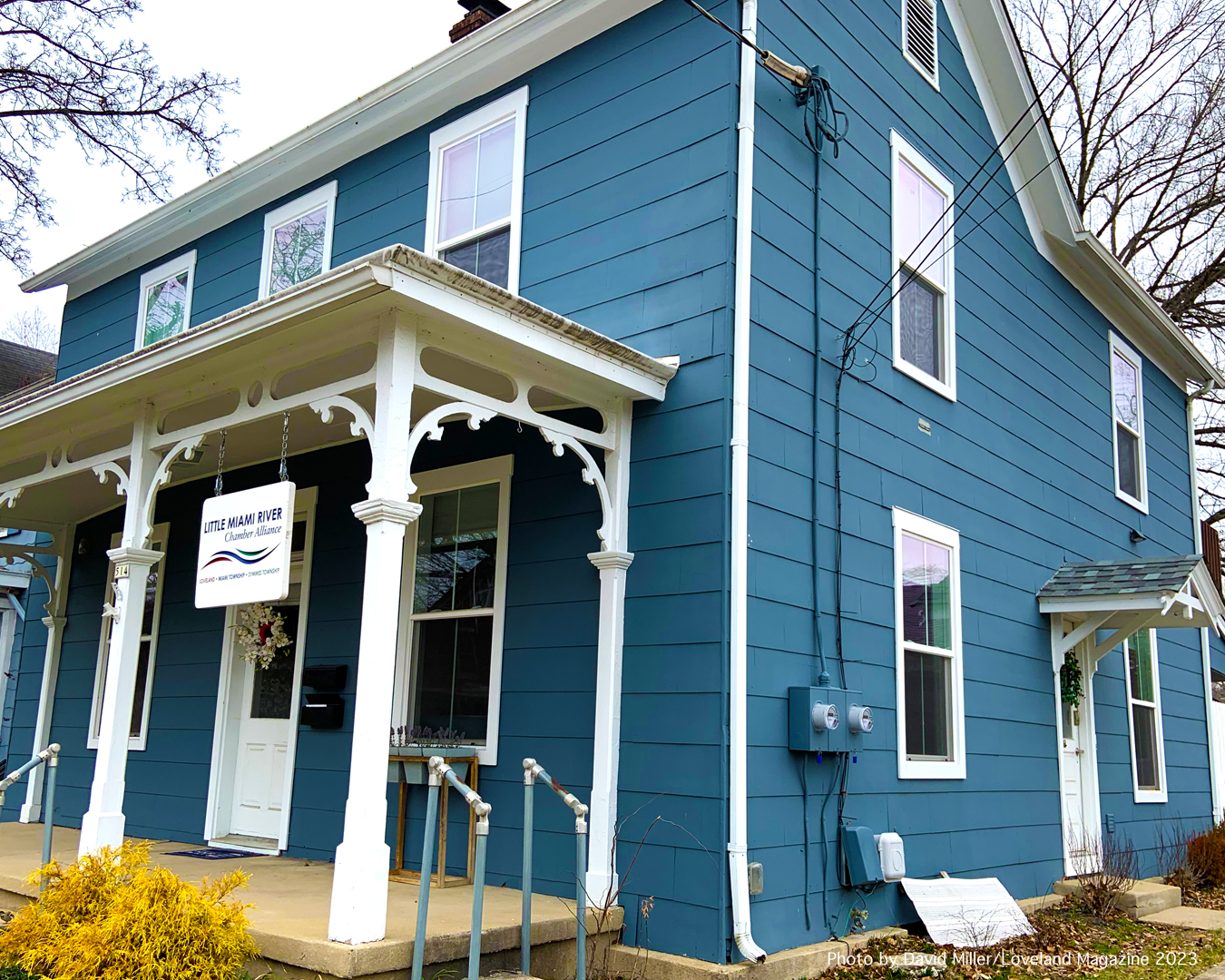
    Loveland, Ohio – The public is invited to join the Little Miami River Chamber Alliance as they celebrate moving into their new office.

    There is plenty of free parking behind the office that can be accessed from either the driveway off of West Loveland or the driveway off of Center Alley.

    March 2

    5 until 7 PM

    514 West Loveland Avenue

    Drinks and light appetizers provided

    The ribbon cutting is at 5:30 PM

    The new office is next-door to Union Savings Bank.

  • Paxton’s Grill in Historic Loveland, Ohio now serves breakfast

    Paxton’s Grill in Historic Loveland, Ohio now serves breakfast

    Loveland, Ohio – The wait is over, Loveland! Breakfast has returned Back to Paxton’s!

    A full breakfast menu will be available every day, from 8 AM until 2 PM.

    Paxton’s Website

    Paxton’s on FaceBook

  • The 2023 Valentine Breakfast in video and photos

    The 2023 Valentine Breakfast in video and photos

    by David Miller

    Miami Township, Ohio – The Little Miami River Chamber Alliance held its annual Valentine’s Day Breakfast on Friday, February 10 at the Oasis Conference Center. The emcee was Pastor Bill Hounshell.

    2014 Valentine Lady, Janis Fogle

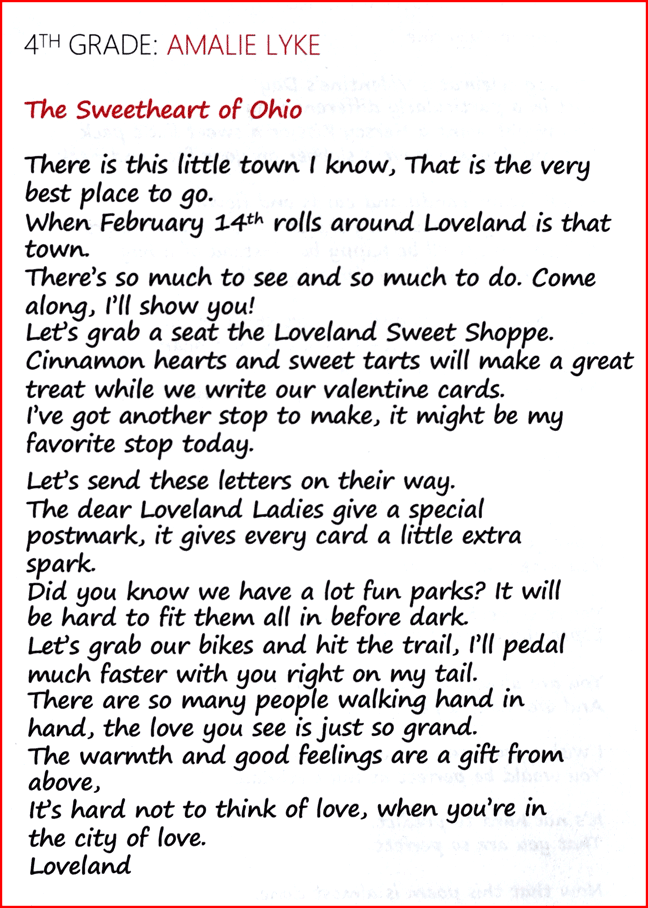
    Children from the Loveland schools and the adult that won their age-group poetry submissions were called to the microphone to recite their poems. Loveland school superintendant, Mike Broadwater presented the poetry winners a certificate.

    2014 Valentine Lady, Janis Fogle said on the Loveland Valentine Ladies FaceBook page that the Loveland Valentine Ladies have already stamped close to 2,650 Valentine cards at the Loveland Post Office, for the 2023 Valentine season. She said, “Cards went to locations such as The Netherlands, Austria, Sweden, the UK, as well as most of the 50 states, plus Washington DC.”

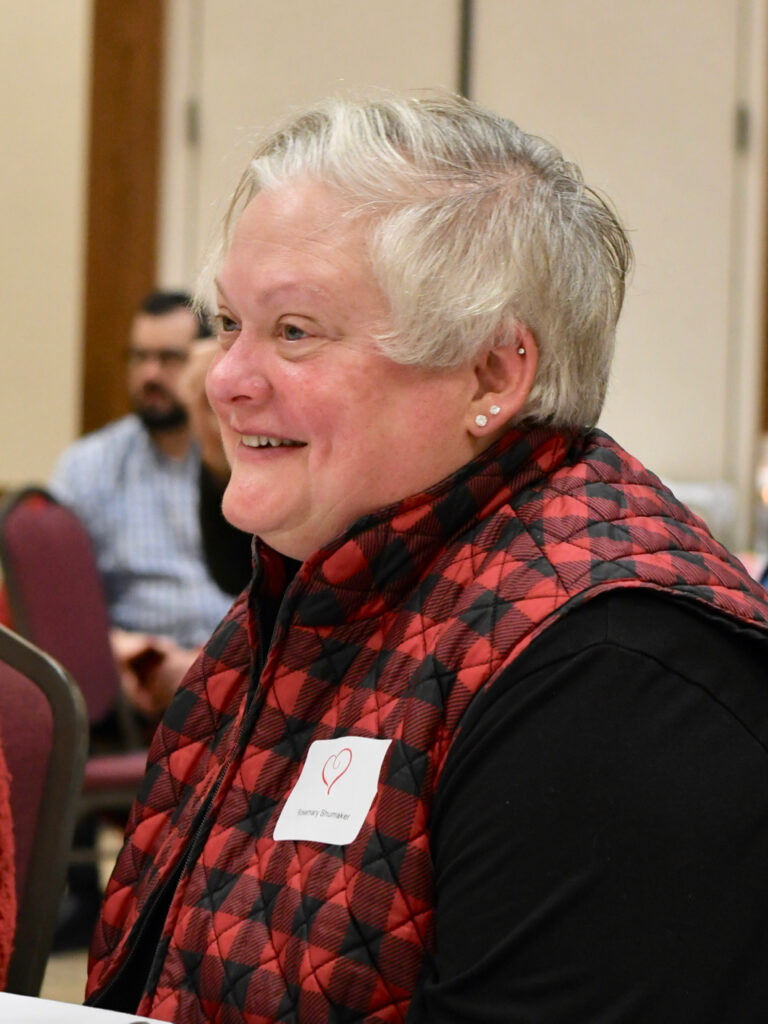
    Rosemary Shumaker

    This year’s Valentine Card designer, Rosemary Shumaker was introduced and an enlargement of her card was prominent on center stage.

    The 2023 Loveland Valentine Card designed by Rosemary Shumaker
    Steve Zinser, a former Loveland Principal led the Delta Kings as they serenaded 2023 Valentine Lady, Donna Barns as well as singing numerous songs throughout the morning.

    Here are video and photo highlights:

    Here are the poetry contest winners reading their poetry:

  • Attorneys general from 23 GOP-led states including Ohio back suit seeking to block abortion pill

    Attorneys general from 23 GOP-led states including Ohio back suit seeking to block abortion pill

    BY: JENNIFER SHUTT – Ohio Capital Journal

    Attorneys general representing nearly two dozen Republican states are backing a lawsuit that would remove the abortion pill from throughout the United States after more than two decades, eliminating the option even in states where abortion access remains legal.

    The state of Missouri filed its own brief in the case Friday while Mississippi Attorney General Lynn Fitch filed a brief on behalf of her state as well as Alabama, Alaska, Arkansas, Florida, Georgia, Idaho, Indiana, Iowa, Kansas, Kentucky, Louisiana, Montana, Nebraska, Ohio, Oklahoma, South Carolina, South Dakota, Tennessee, Texas, Utah and Wyoming.

    “The serious nature of the FDA’s unlawful actions, and the agency’s decision to invite lawbreaking by private parties and government actors across the country, favors broad relief,” the 22 Republican attorneys general wrote in the multi-state brief.

    “The FDA and the Administration as a whole have no intention to respect the Constitution, the Supreme Court, or the democratic process when it comes to abortion. This Court’s decisive action is warranted,” they added.

    The case, Alliance for Hippocratic Medicine v. U.S. Food and Drug Administration, was originally filed in the U.S. District Court for the North District of Texas in mid-November by Alliance Defending Freedom, an anti-abortion legal organization.

    The lawsuit argues, on behalf of four anti-abortion medical organizations and four anti-abortion physicians, that the U.S. Food and Drug Administration exceeded its authority when it approved mifepristone to end pregnancies in 2000.

    The prescription medication was originally approved for up to seven weeks into a pregnancy but is now approved for up to 10. It is used as part of a two-drug regimen that includes misoprostol as the second pharmaceutical.

    The abortion pill, mifepristone, is legal at the federal level, though several GOP states have laws in place that restrict abortion to less than 10 weeks, setting up a dispute between state law and the federal government’s jurisdiction to approve pharmaceuticals.

    If the judge doesn’t pull the abortion pill entirely, the anti-abortion organizations’ lawsuit argues to move the dosage and prescribing process back to how it worked before 2016, when the FDA made changes to its approval.

    DOJ says suit ‘unprecedented’

    The U.S. Justice Department argued in its court filing the anti-abortion groups’ lawsuit “is extraordinary and unprecedented.”

    “Plaintiffs have pointed to no case, and the government has been unable to locate any example, where a court has second-guessed FDA’s safety and efficacy determination and ordered a widely available FDA-approved drug to be removed from the market — much less an example that includes a two-decade delay,” wrote attorneys for the U.S. Justice Department.

    The Republican attorneys general said in their Friday briefs that “while the FDA is authorized to evaluate new drugs for safety and effectiveness, States are primarily responsible for protecting the health and welfare of their citizens.”

    “Many States, including several amici here, have thus enacted laws to regulate abortion-inducing drugs and account for their dangers,” they wrote.

    “Such laws can include in-person examination and dispensing requirements, qualification requirements for prescribers, mandates for informed consent, bans on distribution by mailing, or some combination of these and other safety limitations.”

    The 22 attorneys general argued in their brief that the FDA’s approval of the abortion bill has two legal flaws.

    The first is that it “defies the agency’s own regulations” since the section the FDA first approved the drug under, Subpart H, “does not permit the agency to greenlight elective abortions on a wide scale.”

    The second, they wrote, is that allowing abortion medication to be sent via the mail is in direct contrast to a federal law that prohibits “using the mail to send or receive abortion-inducing drugs such as mifepristone.”

    Missouri Attorney General Andrew Bailey, in a separate brief, wrote that he agreed with the arguments made in the original lawsuit and by his fellow Republican attorneys general, but that he wanted to highlight facts “recently uncovered in litigation.”

    Missouri’s brief alleges that medication abortions, which have been used for more than two decades, “are much riskier than surgical abortions” and that “there is a lack of substantial information that the drugs will have the effect they purport.”

    Accessing abortions

    Dr. Jamila Perritt, president & CEO for Physicians for Reproductive Health, said during a press briefing this week on the court case that abortion medication is safe and effective, and that “when abortion is more difficult to access, we know that this means abortion gets pushed later and later into pregnancy as folks try to navigate these barriers.”

    If the judge in the case were to pull mifepristone, Perritt said, people in states where abortion is still legal would be able to access abortion using misoprostol alone since “there are approved regimens of managing medication abortion using only misoprostol.”

    Perritt added that “while it is equally safe … dosage and timing to completion of the abortion varies if mifepristone is not added to the equation.”

    Patients in legal states would also still have access to procedural abortion, Perritt noted.

    Reproductive health experts have said the suit is based on flawed evidence, selected studies and anecdotes.

    Dr. Iffath Abbasi Hoskins, president of the American College of Obstetricians and Gynecologists, said in a written statement in January that “restricting access to mifepristone interferes with the ability of obstetrician–gynecologists and other clinicians to deliver the highest-quality evidence-based care for their patients.”

    “Since 2020, continued usage of mifepristone for abortion care without the in-person dispensing requirement has been shown to be safe and effective,” she wrote when the FDA announced it would allow commercial pharmacies to fill prescriptions for mifepristone.

    The judge in the lawsuit, Trump appointee Matthew Joseph Kacsmaryk, could rule on whether to pull mifepristone from the market as soon as this month.

    Any ruling is likely to be appealed to the conservative-leaning 5th U.S. Circuit Court of Appeals and could eventually find itself in the U.S. Supreme Court.


  • $461,000 awarded to improve Loveland Tiger’s safety

    $461,000 awarded to improve Loveland Tiger’s safety

    by David Miller

    Loveland, Ohio – Loveland City School District has been awarded nearly a half million dollars in the latest round of the Ohio K-12 School Safety Grant program. The state funding will support improvements to safety security upgrades across the district. 

    “The safety of our students is our greatest responsibility, and receiving state support for our efforts will help tremendously. We appreciate Governor DeWine and the General Assembly’s dedication to the Ohio K-12 School Safety Grant program,” Superintendent Mike Broadwater said in a news release from the District.

    Loveland Superintendent Mike Broadwater

    The grant provides $461,250 to pay for security system improvements across the district. This grant will allow for the installation of additional security cameras and equipment. The grant will also provide funds for new safety technology on all district school buses according to the release.

    This is the fourth round of the Ohio K-12 School Safety Grant program. Of all school districts in Hamilton County, Loveland received the fourth-highest grant funding in this current round. Loveland also received $100,000 in the second round of the program, which was used to replace the public address system at Loveland Primary and Loveland Elementary Schools.

    Loveland Early Childhood Center is earmarked for $65,225 in this latest round.

    Loveland Elementary is earmarked for $50,000 in this latest round.

    Loveland High School is earmarked for $100.000 in this latest round.

    Loveland Intermediate School is earmarked for $97,625 in this latest round.

    Loveland Middle School is earmarked for $98,400 in this latest round.

    Loveland Primary School is earmarked for $50,000 in this latest round

    The Goshen Local School District received $400,000 in the latest round of school safety grants. The Great Oaks Career Campus in Clermont County received $100,000.

    There is a “Round Five” to be recommended in the coming weeks according to Governor Mike DeWine Ohio as part of the General Assembly’s House Bill 45.

    Indian Hill Exempted Village School District had previously been awarded $299,714, Sycamore Community Schools $93,824, and Little Miami Local Schools $200,000.


  • Food Pantry sends SOS

    Food Pantry sends SOS

    Loveland, Ohio – If you are doing your shopping for the weekend would you consider dropping a box or two of cereal off at the LIFE Food Pantry?

    The pantry has sent out an SOS saying they are completely out of cereal.

    “Thank you for helping us keep those little tummies fed (ok, big tummies eat cereal too…)!”

    LIFE is a faith and community-supported organization that provides food, financial assistance, and programs to those experiencing hardship in the greater Loveland area.

    Tuesday – Saturday 10 AM until noon

    Tuesdays and Thursdays 4 PM until -6:30 PM

    Other Current Needs

    FOOD: Applesauce, Baked Beans, Bisquick, Canned Chicken, Cereal, Chili Beans, Cooking Oil, Flour, Hearty Soups, Hot Cocoa Mix, Juice-Family Size, Peanut Butter, Pears, Pineapple, Potato Sides, Refried Beans, Rice Side Dishes, Sugar
     
    PERSONAL CARE: Body Wash, Cold Medications, Feminine Hygiene Products

    PAPER GOODS: Kleenex, Paper Towels, Toilet Paper

    BABY: Pull-Ups (all sizes), Diapers (sizes 4, 5, 6 and 7)

    WEEKEND BAGS: Individual Shelf Stable White Milk, Tuna and crackers

  • Ohio abortion rights advocates prepare for more legal fights

    Ohio abortion rights advocates prepare for more legal fights

    Getty Image

    BY: SUSAN TEBBEN – Ohio Capital Journal


    With the abortion landscape changing in Ohio and around the country, one abortion rights group is building up its legal effort for those seeking or providing abortion care.

    Abortion Fund of Ohio recently announced the launch its Legal Access Program, through a partnership with law firm Friedman, Nemecek, & Long, L.L.C., that will provide free legal assistance and referrals to attorneys “for Ohioans facing criminal and civil penalties for reproductive health care.”

    “We’re building out a network of lawyers who will take on these cases, so that we have more lawyer power,” said Morgan Mitchell, legal access fellow for AFO.

    Mitchell said cases are popping up in the state where confusion and lack of knowledge of where abortion and procedures that could be connected to abortion (like miscarriage, medically called a “spontaneous abortion”) legally stands.

    In one such case, covered by NPR, a woman wondered if the six-week abortion ban was causing doctors to hesitate in treating her heavy bleeding at a Painesville emergency room, bleeding that had already been confirmed to be caused by a miscarriage.

    Currently, abortion is still legal up to 22 weeks in Ohio after a state court blocked a six-week ban indefinitely, but national fights against receiving medication abortion through the mail and a discussion of abortion bans on the federal level have advocates worried that reproductive healthcare may be fought for in the courts rather than medical clinics and hospitals.

    Ohio’s own Attorney General Dave Yost signed onto a letter with more than a dozen other state attorneys general warning CVS and Walgreens against distributing medication to induce abortions through the mail due to various state laws that prohibit it. Ohio’s law, passed in 2022, forbids abortion medication to be provided to patients without a physician present.

    A recent study published in the Journal of Health Politics, Policy and Law, co-authored by researchers from three Ohio universities, said even the regulations that are in effect involve working with state administration, and the bureaucracy has created an system where regulations “have become exceedingly difficult to comply with” for abortion providers.

    Even medical students in the state are left nervous and confused about what restrictions may mean for their education and future career, should they decide to provide reproductive healthcare.

    One group the legal access program is particularly hoping to help is minors who may want to use a legal method to get around needing the consent of their parents to obtain an abortion, a method called judicial bypass.

    According to the Ohio Supreme Court, a minor seeking consent to have an abortion can petition the juvenile court in their county of residence or in a border county, with the help of a court-appointed attorney if they don’t have one.

    A judge then determines if a minor “is sufficiently mature and well enough informed to decide intelligently whether to consent to an abortion or that the abortion is in the best interests of the (minor).”

    Judicial bypass has been on the books since before the fall of Roe v. Wade, but the legal access program is only including that as part of the legal options so that Ohioans know all their legal rights.

    “We’re just trying to let people know this exists, we’re not telling people to have an abortion, or telling their parents they’re bad parents,” Mitchell said.

    With the six-week ban (and other abortion bans that were attempted but not passed by Ohio legislators in previous years) not including any exceptions for rape or incest, and no standards for sex education present in the state, Mitchell said it’s frustrating that a minor has to go to court to prove maturity and intelligence, when some legislators would force them to bear a child, no matter their age.

    “It’s really an attack on bodily autonomy and it’s scary to see it be separated from health care, because this is a decision you’re making for your body,” Mitchell said. “We want to be able to give anyone regardless of age the opportunity to pursue whatever they want with their bodies.”

    The six-week ban pause is being appealed by the state.

  • Loveland Seniors can reduce their sewer bill by 25%

    Loveland Seniors can reduce their sewer bill by 25%

    by David Miller

    Loveland, Ohio – The Metropolitan Sewer District (MSD) offers a Customer Assistance Program (CAP) to help low-income senior citizens in Loveland pay their sewer bills.

    Eligible applicants receive a 25% discount on their monthly sewer bill, including both the minimum base charge and the commodity charge). The estimated savings is $120 or more per year.

    Eligibility

    A sewer discount can only be offered to low-income seniors who meet specific eligibility requirements related to age, income, and home ownership. The eligibility requirements for the CAP are:

    • 65 years of age or older
    • Own and live in the residence for which they are paying the MSD sewer bill
    • Modified Adjusted Gross Income (MAGI) of no more than $36,100 for tax year 2022. MAGI is Ohio Adjusted Gross Income plus any business income that has been deducted in computing the Ohio Adjusted Gross Income (OAGI). This applies to the combined income of the applicant and their spouse.

    Required Documentation

    Documentation is required to be submitted with your application.

    • Proof of Age (please submit one):
      • Ohio Driver License
      • Ohio Identification Card
      • Birth certificate
    • Proof of Income (please submit all that apply):
      • Ohio Income Tax Return (previous year)
      • Social Security Benefit Verification Letter
      • Other (e.g., 1099R, W-2)

    Three Ways to Apply for the Discount

    Online: Fill out the online CAP Application, attach the required Proof of Age and Income (see above), sign the form electronically, and click the Submit button at the bottom of the form for automatic submittal.
    Email: Download the CAP Application (writeable PDF) and fill it out. Email the completed application, along with attached scans of the required Proof of Age and Income (see above), to:MSDCAP@cincinnati-oh.govkayaks
    Mail: Request a hard copy of the application by calling (513) 244-1300 (option 3) Mon-Fri, 8 a.m. – 5 p.m. Fill out the application in ink with an original signature. Mail the completed application, along with hard copies of the required Proof of Age and Income (see above), to:Metropolitan Sewer District of Greater Cincinnati (MSD)Attn: MSD CAP Manager1600 Gest StreetCincinnati, OH 45204icon representing mail

    Participation and Annual Renewal

    You will receive a letter by mail that confirms your eligibility. If approved, the 25% discount will appear in the “detail section” of your sewer bill that covers the next full billing cycle. This could take 1-2 months, depending on the billing cycle.

    MSD will annually notify you regarding your continued CAP eligibility every November. This will be a quick check to affirm your CAP status has not changed.

    For More Information

    For more information, please contact Bonnie Holman at (513) 244-5101 or MSDCAP@cincinnati-oh.gov. You can also contact Cassandra Hillary, the MSD CAP Manager, at MSDCAP@cincinnati-oh.gov. Additional information is also available in the Downloads box to the right.

  • BestBuddies in Ohio to Host Friendship Walk in Southwest Region

    BestBuddies in Ohio to Host Friendship Walk in Southwest Region

    by Cassie Mattia

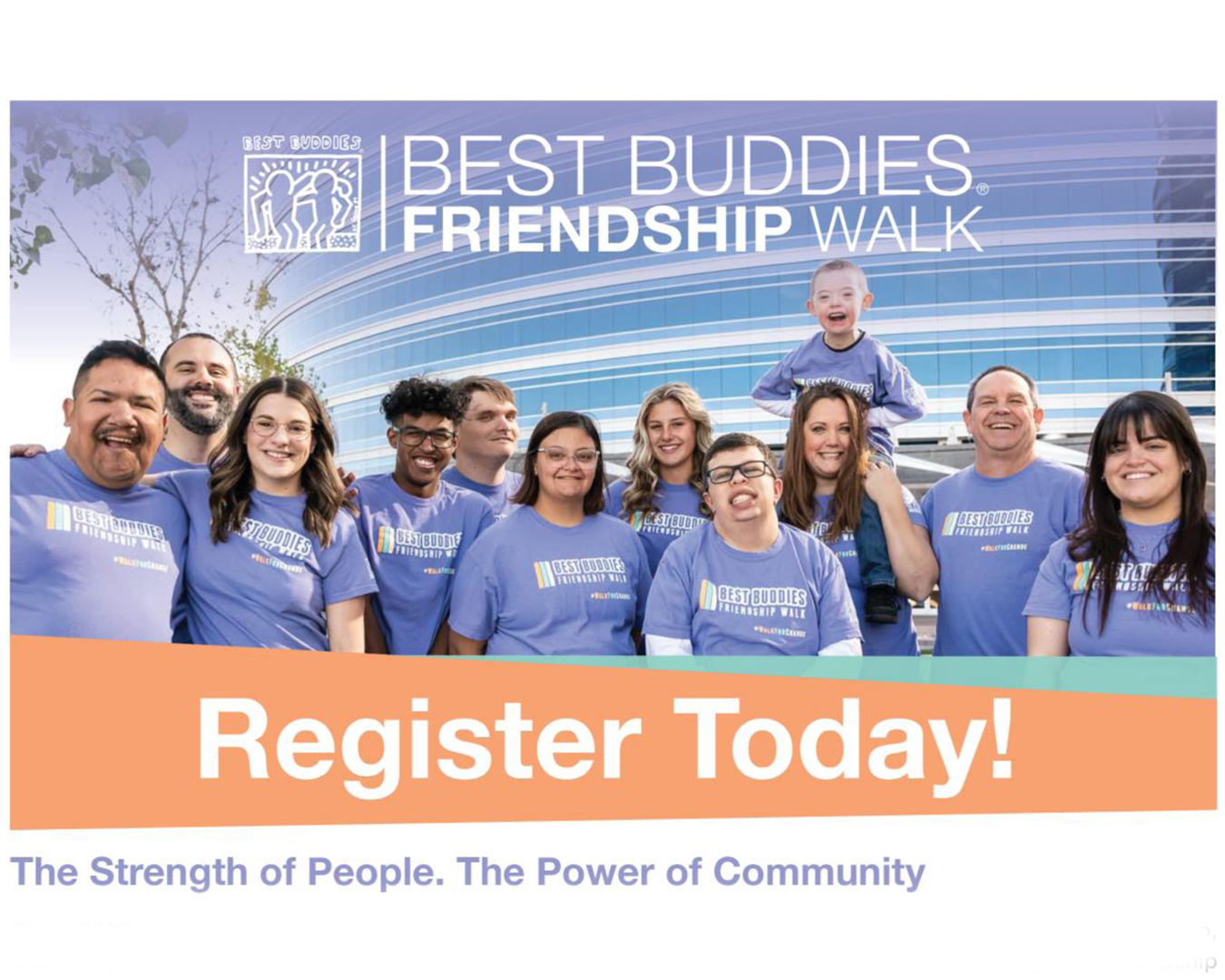
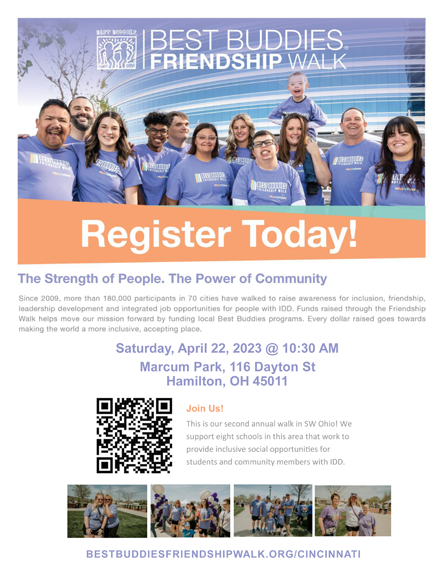
    Best Buddies International, a groundbreaking nonprofit founded in 1989 by Anthony K. Shriver to establish a global volunteer movement that creates opportunities for one-to-one friendships, integrated employment, leadership development, and inclusive living for people with intellectual and developmental disabilities (IDD), has announced that the Best Buddies Friendship Walk will take place April 22, 2023, at Marcum Park in Hamilton for the second time in Southwest Ohio.

    Since 2009 more than 250,000 participants have walked in over 60 cities and raised more than $24 million for Best Buddies. 

    The Friendship Walk is coming together out of a need for funding in Southwest Ohio. Program numbers have grown significantly, creating a need for more support.

    “Our Friendship Walks are one of Best Buddies’ most celebrated events, bringing communities together where they can experience our mission in action and engage with our program participants,” said Anthony K. Shriver, Founder, Chairman & CEO of Best Buddies International. “I am beyond grateful that the important work of this organization will continue, thanks to our participants, volunteers, partners, and the entire community. I am confident that we will continue empowering people with special abilities, connecting advocates, and mobilizing our supporters to create a more inclusive world.”

    Best Buddies in Ohio anticipates more than 100 participants lacing up their shoes to walk for inclusion, all working to surpass the 2023 fundraising goal of $35,000. Registration begins at 10:30 AM, and the Walk commences at 11:15 AM at Marcum Park, 116 Dayton Street in Hamilton.

    Following the Walk, please join Best Buddies for a day of fun, family, wellness, and friendship. 

    Proceeds from the Friendship Walk are fundamental in supporting state programs that provide one-to-one friendships, integrated employment, leadership development, and inclusive living. These programs can be found in all 50 states and will create promising opportunities for more than 350,000 people this year.

    Walk for inclusion. Walk for friendship. Walk for a better Southwest Ohio! 

    ABOUT BEST BUDDIES INTERNATIONAL:

    Best Buddies® is a nonprofit 501(c)(3) organization dedicated to establishing a global volunteer movement that creates opportunities for one-to-one friendships, integrated employment, leadership development and inclusive living for people with intellectual and developmental disabilities.

    Founded in 1989 by Anthony K. Shriver, Best Buddies is a vibrant organization that has grown from one original chapter to nearly 2,900 middle school, high school, and college chapters worldwide.

    Today, Best Buddies’ nine formal programs — Middle Schools, High Schools, Colleges, Citizens, e-Buddies®, Jobs, Ambassadors, Promoters, and Inclusive Living— engage participants in each of the 50 states and in 56 countries, positively impacting the lives of nearly 700,000 people with and without disabilities around the world.

    In many cases, due to their involvement with Best Buddies, people with intellectual and developmental disabilities secure rewarding jobs, live on their own, become inspirational leaders, and make lifelong friendships.

    For more information, please visit www.bestbuddies.org/ohio, www.facebook.com/bestbuddiesohio, or www.twitter.com/bestbuddiesohio

    For more information about the Best Buddies Friendship Walk and/or media inquiries, please contact:

    Catlin Skufca
    614.928.3383
    catlinskufca@bestbuddies.org

  • Ohio Medicaid to resume regular eligibility operations and encourages enrollees to update their contact information

    Ohio Medicaid to resume regular eligibility operations and encourages enrollees to update their contact information

    by David Miller

    As reported in the Ohio Capital Journal, Ohio Medicaid currently provides health care coverage to more than 3.1 million Ohioans and once the federal government declares an end to the Public Health Emergency, Medicaid will resume its normal eligibility review process.

    That date is now April 1 and this means that all eligible Medicaid members will have to renew their Medicaid coverage or risk losing it.

    The Ohio Department of Medicaid (ODM) calls it “imperative” that Medicaid members keep their contact information up to date with county departments of job and family services and check their mail and respond to requests for information immediately.

    The Journal reported on December 20 that, “Declaring that ‘we have returned to life as normal,’ Ohio Gov. Mike DeWine joined 24 other Republican governors in calling on President Biden to let the federally declared Public Health Emergency for COVID expire in April.”

    Ohio Medicaid currently has a “COVID-19 Unwinding” website.

    “Every state’s match was increased by 6.2% under the first federal COVID-19 relief package, with the caveat that states agree not to kick anyone off Medicaid while the public health emergency is in place, even if their income once again rises above the eligibility limit.” – Ohio Capital Journal.

    Ohio Department of Medicaid (ODM) Director Maureen Corcoran is encouraging Ohio’s Medicaid members to take necessary steps to ensure continued health coverage for themselves and their families

    “Now that the federal government has announced this change, all Ohio Medicaid members will have their eligibility re-determined and if found ineligible, disenrolled from the program for the first time in three years,” said Director Corcoran. “Our goals are to ensure that Medicaid eligible Ohioans will have the tools they need to maintain their healthcare coverage and not risk a gap in service, and that Ohioans no longer eligible for Medicaid can smoothly transition to other affordable healthcare options.”

    It is critical that Medicaid members keep their contact information up-to-date and respond to all requests for information. Ohio’s unwinding will occur over a 12-month period of time. Some renewals will be automatic based on extensive data comparisons while other members will receive the usual eligibility packet and work with their county department of job and family services to complete it manually.

    In alignment with previous department policy, children under the age of 19 retain their coverage for twelve months from the date of their initial eligibility determination or most recent renewal.

    To assist members, providers and stakeholders prepare for this process, the ODM has a dedicated webpage that houses information on the renewal process, key steps consumers should take, key message, frequently asked questions and other additional resources. Individuals are also encouraged to reach out to their county department of job and family services (CDJFS) with any questions or they can use Medicaid’s eligibility tool on the website to check their eligibility status.

    Background

    In March 2020, Congress passed the Families First Coronavirus Response Act (FFCRA), which among other things, provided states with enhanced federal matching dollars for their Medicaid programs. In exchange for these dollars, states were prohibited from disenrolling members from Medicaid, even if they were found to be ineligible. This was to ensure members did not lose vital healthcare coverage during the pandemic. Congress passed the Consolidated Appropriations Act in December, decoupling the end of the federal public health emergency from the continuous coverage requirement.