Tag: loveland ohio

  • Who doesn’t like to laugh?

    Who doesn’t like to laugh?

    by CeeCee Collins

    This article seemed timely as we enter the “darker days,” of the year. Some people tell me they get seasonal affective disorder where they feel like they are getting up, going to work, coming home, taking care of family, and then repeating (think the movie Groundhog Day).

    The repetitive nature of not doing anything for yourself or interesting can start to take a toll and you become depressed.

    This has snuck up on me a few times. I do try to combat the SAD feeling by lining up activities and experiences that I’ve not tried before. Some ideas are a cooking class (Out of Thyme), a painting class-this saved me during Covid, and I did like 3 classes, Lemons and Limes offers many different types of learning experiences. You could try a new gym-check out Hotworx-for a warm to your bones work out or Activate Brain and Body to wake your brain up while working out, or Power Ryde for a very stimulating stationary bike riding experience.

    My husband and I have been doing some symphony experiences. We went to a really cool one with a James Bond theme.

    The article included today is about laughter. Who doesn’t like to laugh? When I have a good laugh, I think wow, when was the last time I’ve laughed that hard?!? It’s not enough! I’m watching a dark comedy called Afterlife with Ricky Gervais-stay with it. It is funny!

    I hope you find time to laugh and not take things too seriously. We should all have fun!

    Happy Thanksgiving!

  • Ohio, other states sitting on huge piles of money, new report says

    Ohio, other states sitting on huge piles of money, new report says

    BY: MARTY SCHLADEN – Ohio Capital Journal

    Ohio has enough in its rainy day fund to operate the state government for 35 days on that money and nothing else. If you factor in the money it has in other unexpended balances, the number of days grows to 73, according to a report released last week by the Pew Charitable Trusts.

    It’s part of a trend in which states are sitting on reserves that are at or near record levels after states got unprecedented federal assistance during the coronavirus pandemic while their revenue collections didn’t drop off as much as they feared. In 21 states — including Ohio — collections even exceeded pre-pandemic growth.

    Governments aren’t banks and their basic role isn’t to sit on huge reserves of taxpayer money. But today’s big reserves might come in handy in the not-too-distant future. Government data released Thursday said that gross domestic product grew at an annualized rate of 2.6% in the second quarter, but experts warned that other signs of a coming recession loom.

    As anyone who watched government finance during the Great Recession between 2007 and 2009 knows, in such circumstances tax collections can plummet, leaving state and local governments to face excruciating choices for years.

    “States use reserves and balances to manage budgetary uncertainty, including revenue forecasting errors, budget gaps during economic downturns, and other unforeseen emergencies, such as natural disasters,” the Pew report said. “This financial cushion can soften the need for spending cuts or tax increases when states need to balance their budgets.”

    In addition, large cash reserves can give states and local governments better credit ratings, allowing them to float bonds and otherwise borrow at better rates. 

    “For example, Fitch Ratings upgraded Michigan’s credit rating in July 2022, citing the state’s buildup of reserve levels as part of its rationale,” the report said.

    However, the amounts states are sitting on can be eye-popping. For purposes of comparison, Pew expresses them in terms of the number of days states can operate solely on their reserves. Those amounts range from 350 days for Wyoming to 12 for Illinois.

    At 71 days, Ohio comes in a little below the 50-state median of 89 days.

    In dollar amounts, Ohio is estimated to have $5.5 billion in reserves for 2022. That’s far in excess of any year since at least 2000 except for last year, when reserves totaled $7.4 billion, according to the Pew report.

    And those amounts don’t count unexpended federal coronavirus dollars to the states. This summer, Governing Magazine reported that at the end of 2021, states had spent just 27% of those funds. 

    In August, Cleveland.com reported that Ohio had spent nearly two-thirds of its $5.4 billion in American Rescue Plan funds, primarily repaying an unemployment loan, on law enforcement and sewer grants, and on incentives for the Intel chip plant.

    Meanwhile, other pressing needs only partially have been met. 

    Ohio’s foodbanks say they’re desperate for supplies and infrastructure. In May they requested $50 million in emergency funding and have made an overall request of more than $100 million to also upgrade their infrastructure.

    So far all they’ve gotten from the state is $15 million in coronavirus funds that Gov. Mike DeWine announced earlier this month.

    Follow Marty Schladen on Twitter.

  • Moving Halloween to Saturdays

    Moving Halloween to Saturdays

    by David Miller

    Let’s return ‘All Hallows’ Eve to the Church where it belongs and has meaning, “witch” is not about candy, costumes, and ghouls. It’s religious to honor the “saints” who have gone to heaven, not hell.

    The religious holiday has always belonged to them anyway.

    The secular Halloween is a 2000-year-old pagan festival that celebrated Summer’s end by believing the dead could walk among us.

    We 2022 pagans and heathens celebrate Halloween by walking like the dead or otherwise scaring little innocent children ghoulishly and then ease our guilt by rewarding them with sugary or chocolatey treats. And, it works because we in turn allow our children to enter a fantasy world of costume play by going house to house begging to be scared and being rewarded for it.

    All Hallows’ Eve, the religious event, is always on October 31, and November 1 is All Saints Day.

    Halloween (Trick or Treat) is “officially” declared by local governments between certain hours each year on October 31, and six out of seven years the day is either on a work or school day or when the next morning is either a work or school day. They choose dangerous dark hours when children should not be walking the streets in hard-to-see costumes many of “witch” are hard to see out of.

    Celebrating Halloween on the last Saturday of October would allow the traditional parades through subdivisions. And, let children and pets “trick or treat” in other neighborhoods, begging between the hours of 4-6 PM. It would allow the backyard unveiling of the bucket contents around a bonfire complete with hotdogs and smores.

    Then when the children pass out from exhaustion and their sugar highs, the adults can continue partying late into the night acquiring the hangover every pagan will have in the morning. The difference is that the next day is not a school or a work day. The non-heathens will still be in good shape to attend church in the morning.

    Saturday Halloweens would allow trick-or-treating to begin in the daylight hours, eliminating the need for costume safety alterations and flashlights.

    It eliminates the stress of hastily heading home from school and work preparing or buying dinner, doing homework, and preparing school lunches. Who needs cranky children and their parents?

    Gets children off the street before most drivers begin drinking.

    A developmental disability friendlier day.

    You can throw more elaborate neighborhood parties.

    Halloween deserves its own full-blown witching day brewed with more family fun.

    An interesting fact is that Halloween began in this country when folks went door to door asking for prayers. Let’s make this year the day we go door to door praying that “Halloween Saturday” becomes a new tradition by urging our local governments to wake up from the dead. And since Election Day follows so soon, treat them with a “NO” vote if they don’t agree.

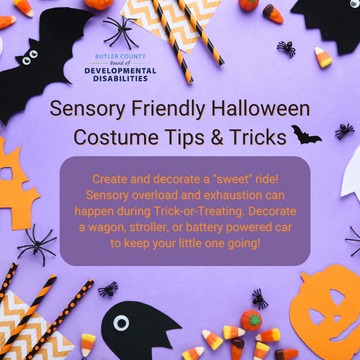
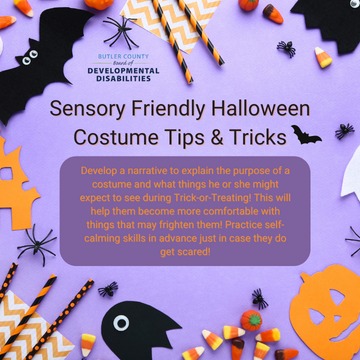
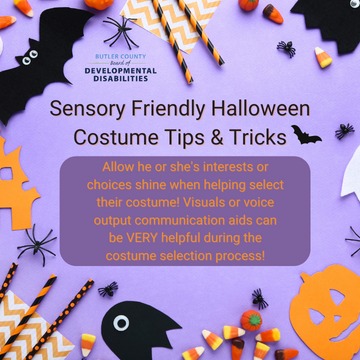
  • “Sensory Friendly Halloween Costume Tips & Tricks”

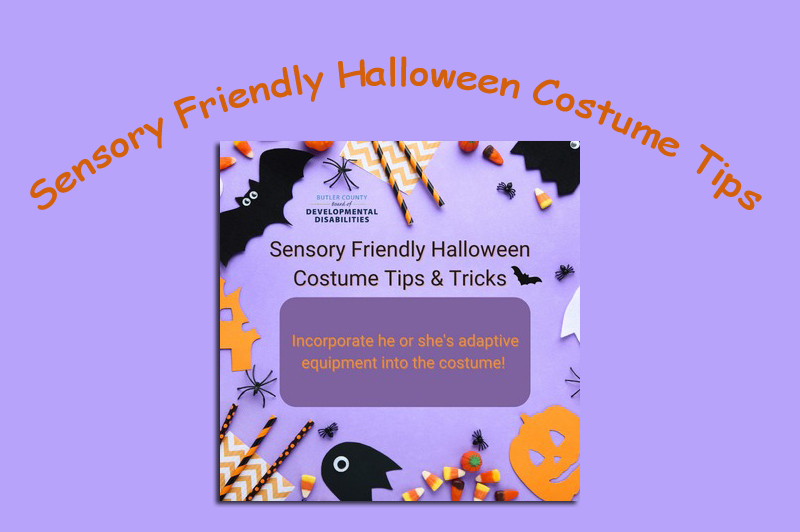
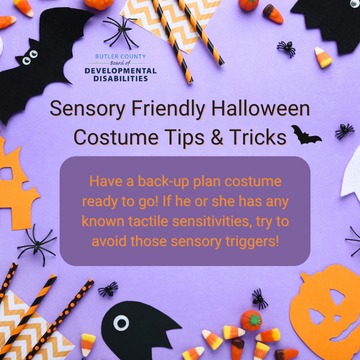
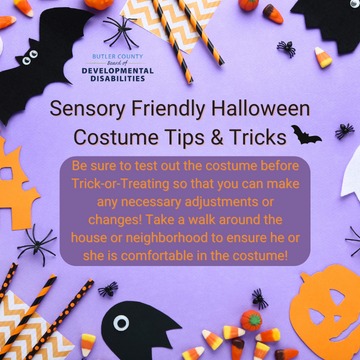
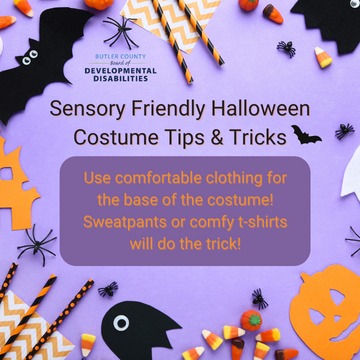
    “Sensory Friendly Halloween Costume Tips & Tricks”

    From Cassie Mattia and the Butler County Board of Developmental Disabilities

    With Trick-or-Treat right around the corner we thought it would be the perfect time to release a “Sensory Friendly Halloween Costume Tips & Tricks” Guide so that your child or loved one can enjoy the big night comfortably! Trick-or-Treating can be full of sensory triggers so making sure you take the time to prepare in advance with your child or loved one will ensure a night full of Halloween fun!

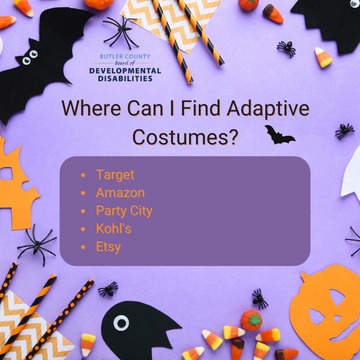
    We included where you can find sensory and adaptive friendly costumes too! All you have to do is go to the businesses’ websites that we included and in the search engine type in “adaptive costumes!”

  • Paying the disabled like everyone else would reduce poverty, economists say

    Paying the disabled like everyone else would reduce poverty, economists say

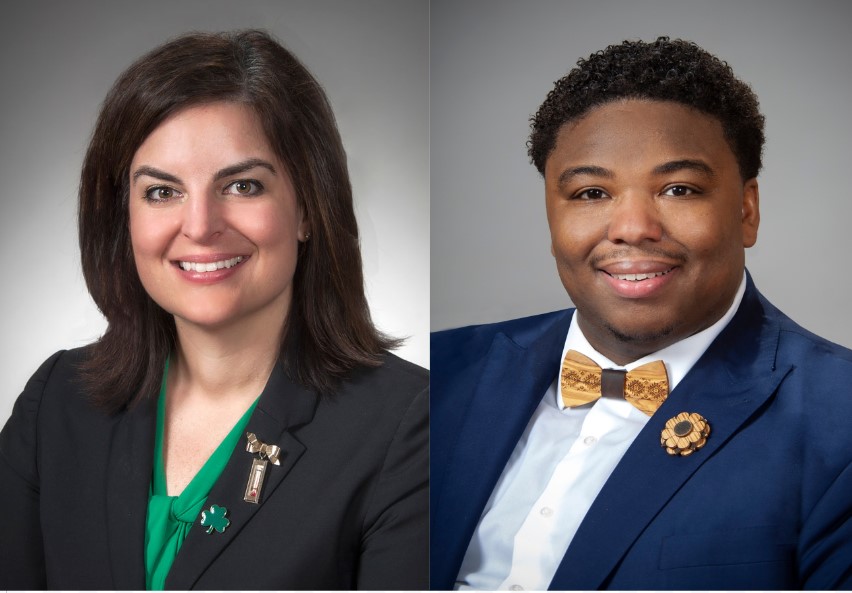
    Ohio Reps. Brigid Kelly, D-Cincinnati, and Dontavius Jerrells, D-Columbus. Official photos.

    BY: MARTY SCHLADEN – Ohio Capital Journal

    Ohio’s minimum wage is set to increase in January from $9.30 an hour to $10.10, but unless the law changes the disabled will be left far behind.

    They can currently earn the state’s “subminimum” wage of $4.25 an hour and can be paid substantially less than that, NBC 4 reported. Now Ohio Reps. Brigid Kelly, D-Cincinnati, and Dontavius Jerrells, D-Columbus want to raise it to where it will be for most other workers.

    That would lift some people out of poverty, a majority of a panel of Ohio economists said earlier this week. But a majority was also uncertain whether it would be an overall help to the state economy.

    In a survey conducted by Scioto Analysis, 12 of 18 economists said the measure would reduce poverty. Three disagreed and three were uncertain or had no opinion.

    Four economists agreed that paying the disabled the regular minimum wage would be good for the overall economy. Four disagreed and 10 were either uncertain or had no opinion.

    In the comments that accompany the survey, Youngstown State University economist Albert Sumell said increasing minimum wages for the disabled is no silver bullet, but it would be beneficial.

    “The effect will be modest but clearly some individuals with disabilities would benefit,” he said.

    On the other hand, Kent State University economist Curtis Reynolds questioned whether subminimum wages were what prompted some employers to hire disabled workers in the first place.

    “The challenge, of course, is whether individuals will still have job opportunities at the higher wage,” wrote Reynolds, who said he was uncertain about the effect of raising the wages. “If yes, then the higher minimum wage would reduce poverty. If not, then it will not reduce poverty. I am not sure which will happen for this population (which has not been studied as much in research on minimum wage policies).”

    The economists’ uncertainty about whether raising minimum wages for the disabled would grow the economy was even more pronounced. Some of the uncertainty stemmed from the relatively small number of disabled workers and how little minimum-wage workers of any group earn.

    But some of the economists argued that there are other reasons for undertaking the increase.

    “I think the main goal of minimum wages is to create equitable growth and dignity for workers,” wrote Jonathan Andreas of Bluffton University. “I’d be in favor of more equity and dignity even if it caused a little less growth, but the research on minimum wages generally finds that it doesn’t cause problems so it looks like a way to increase equity without hurting growth. I’ve never seen research about the minimum wage for people with disabilities so I haven’t seen enough information to know.”

    Follow Marty Schladen on Twitter.

  • Mahi Sheth wants you to meet Loveland’s new Chief of law enforcement

    Mahi Sheth wants you to meet Loveland’s new Chief of law enforcement

    by David Miller

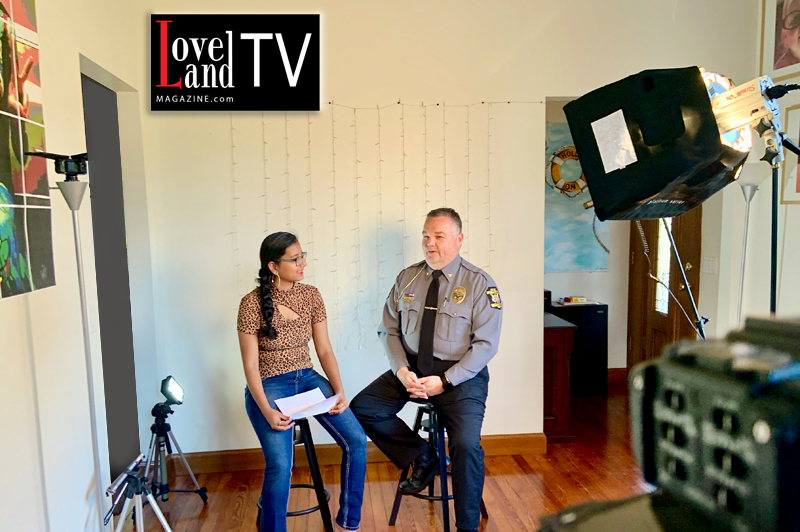
    Loveland, Ohio – On Saturday, Loveland Chief of Police Michael Gabrielson generously gave us some time and visited the LOVELAND MAGAZINE TV studio to be interviewed by Reporter Mahi Sheth.

    Sheth asked the Chief about his childhood, educational background, what led him to his career in law enforcement, and what was his toughest case as an undercover cop.

    Also:

    Sheth: “What should a police officer do no matter what?

    Gabrielson: “We give officers two badges, one for their chest and one for their hat. One badge is for their…”

    Her final question was a personal one as she is interested in becoming an FBI agent.


  • Make it a Halloween that’s Inclusive of  Everyone

    Make it a Halloween that’s Inclusive of Everyone

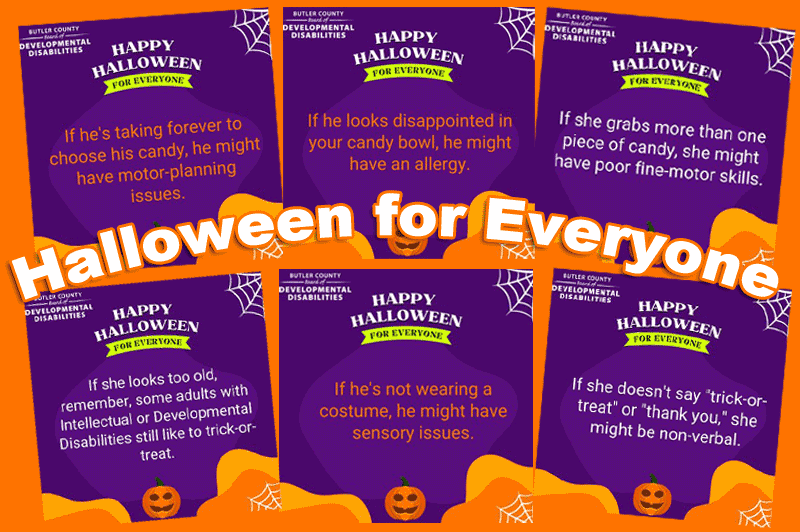
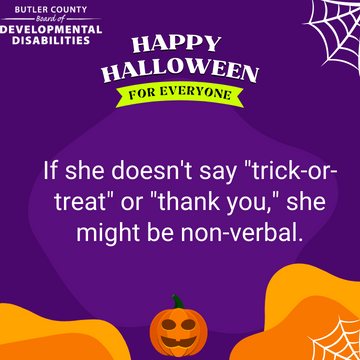
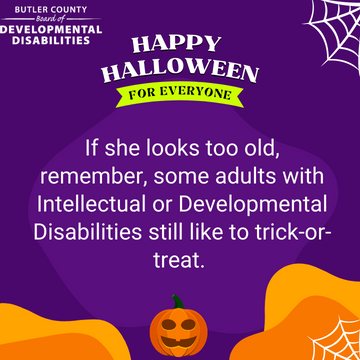
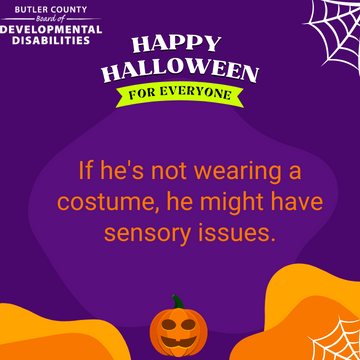
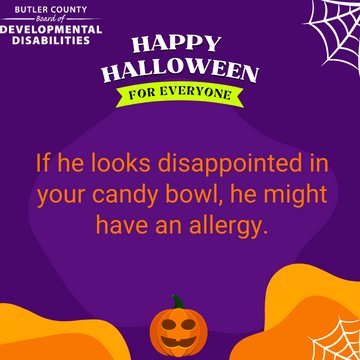
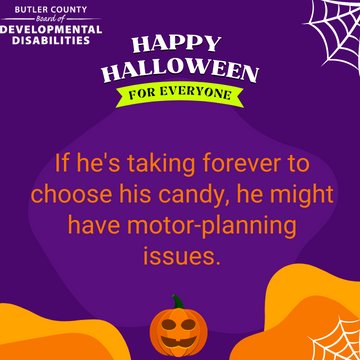
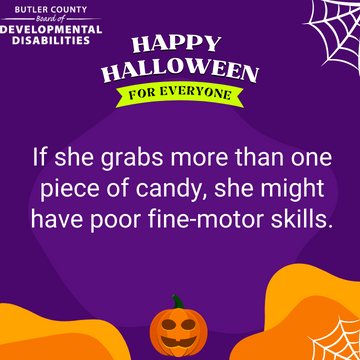
    These kind and thoughtful messages were a collaborative project by Patricia Dawson and Cassie Mattia at the Butler County Department of Developmental Disabilities.

    They said, “Halloween is nearly here and we want you to be prepared for our “ghouls and goblins” on Trick-or-Treat night! Be sure to look over our ‘Happy Halloween for EVERYONE’ guide so those with developmental disabilities can have a fun-filled night of Trick-or-Treating too!

  • [PSA] How to vote in Ohio if you have a disability

    [PSA] How to vote in Ohio if you have a disability

    Contact an ADA Coordinator

    APPLICATION FOR ABSENT VOTER’S BALLOT BY A VOTER WITH A DISABILITY & REQUEST TO USE REMOTE BALLOT MARKING SYSTEM

    RESOURCES FOR OHIO VOTERS WITH DISABILITIES

    COUNTY BOARDS OF ELECTIONS DIRECTORY

    Certain individuals with a personal illness, physical disability, or infirmity may be eligible to have a provisional ballot delivered to them. Please see Directive 2016-41 for more information(opens in a new window).


    MYTH: PEOPLE WITH DISABILITIES CANNOT BRING SOMEONE WITH THEM TO HELP THEM VOTE.

    TRUTH:
    If you cannot mark your ballot or if you need assistance because of your disability, you may bring someone with you to help you vote, or you may ask for assistance from precinct election officials. You may ask anyone to help you vote, except for the following people:

    • Your employer
    • An agent of your employer
    • An agent of your union
    • Any candidate whose name appears on the ballot in your precinct.

    You may also get help in marking your ballot from precinct election officials from two different political parties. By law, no one who helps you vote can tell you how to mark your ballot or provide information to others about how you voted. (R.C. 3505.24(opens in a new window))

    MYTH: ABSENTEE BALLOTS DO NOT GET COUNTED.

    TRUTH:
    All absentee ballots that are received on time and meet Ohio’s legal requirements will be counted and included in the official election returns.

    MYTH: ONLY DESIGNATED POLLING LOCATIONS ARE ACCESSIBLE.

    TRUTH:
    In Ohio, all voting locations must be made accessible for people with disabilities. Under state and federal law, voters with disabilities must be given the same opportunity for access and participation as any other voter.

    The Americans with Disabilities Act (ADA) protects people with disabilities from receiving unequal treatment within state and local government services, programs, and activities. (ADA, Title II)  This law protects your right to vote by making sure that voters with disabilities have access to:

    • Accessible parking
    • An accessible route to the  entrance
    • An accessible entrance
    • An accessible route  to the voting area
    • Voting procedures
    • Voting machines

    The Help American Vote Act (HAVA) protects the right of people with disabilities to vote by making sure that:

    • Voting locations are easy to get to and to use.
    • People who are blind or have problems seeing get the help they need.
    • Voting is private and personal.
    • Each polling location has an accessible voting machine.

    Ohio law protects your right to vote by requiring:

    • Voting locations to be free of any barriers to entrances or exits.
    • Voting locations to have ramps, wide doors, and accessible parking.

    MYTH: PEOPLE WHO HAVE A GUARDIAN ARE NOT ALLOWED TO VOTE.

    TRUTH:
    Having a guardian does not take away a person’s right to vote. As long as you meet eligibility requirements and have not been declared incompetent for voting purposes by a probate court, you are qualified to register and vote.

    MYTH: NURSING HOME RESIDENTS ARE NOT ALLOWED TO VOTE.

    TRUTH:
    If a person has a disability and is confined to a public or private institution, the county board of elections can deliver a ballot to them. Two election officials of different political parties will deliver the ballot and return the ballot to the board of elections. Voting with a mail-in absentee ballot is also an option. Contact your local board of elections to receive details regarding their process.

    MYTH: VOTERS NEED TO HAVE A REASON TO VOTE ABSENTEE BY MAIL OR ABSENTEE IN-PERSON.

    TRUTH:
    In Ohio, voters do not need to state a reason to vote absentee. Absentee voting is an option for all Ohio registered voters. A ballot can be requested by mail or voted in person at a county board of elections or the designated early voting location.

    MYTH: POLLING LOCATIONS DO NOT HAVE ACCESSIBLE VOTING MACHINES.

    TRUTH:
    The Help America Vote Act requires each polling location to have one voting machine that is accessible for people with disabilities, including non-visual accessibility for the blind and visually-impaired.

    In Ohio, every polling location is required to have a voting machine that is accessible to individuals with disabilities. These machines include features like audio ballots, Braille touch pads, large print/zoom features, and height and tilt adjustments on the screens. When you arrive at your polling location, please let the poll workers know if you would like to use the ADA compliant voting machines.

    MYTH: A DRIVER’S LICENSE IS REQUIRED TO VOTE.

    TRUTH:
    All voters must bring acceptable identification to the polls in order to verify identity. Acceptable identification includes a current and valid photo identification; military identification; or a copy of a current (within the last 12 months) utility bill (including cell phone bill), bank statement, government check, paycheck, or other government document, other than a voter registration acknowledgement notification mailed by the board of elections, that shows the voter’s name and current address.

    MYTH: I CANNOT USE A “POWER OF ATTORNEY.”

    TRUTH: Even though a “Power of Attorney” cannot sign your name to your voter registration, if by reason of disability you are unable to physically sign your name or affix your mark to the application, you may appoint an “attorney-in-fact” in accordance with the specific requirements of R.C. 3501.382. Your attorney-in-fact then may sign a voter registration application on your behalf, but only at your direction and in your presence. Contact your county board of elections or the Secretary of State’s office for the proper forms necessary to designate an “attorney-in-fact” for this purpose.

    MYTH: I CANNOT REGISTER IF I DO NOT HAVE A TRADITIONAL SIGNATURE.

    TRUTH: If you are unable to sign your own name and have no other legal mark, make an “X,” if possible, on the application signature line. The person who witnessed you making that mark must write his or her name beneath the signature line.

    If you are unable to make an “X,” you must indicate in some manner to the person assisting you that you want to register to vote. The person registering you must sign the application form and attest that you indicated that you want to register to vote.

    Generally, signing or affixing a signature to an election-related document requires a person’s written, cursive-style legal mark written in that person’s own hand. However, a voter with a disability may personally affix his or her signature through the use of a reasonable accommodation, including the use of assistive technology or an augmentative device such as a signature stamp. See R.C. 3501.011, 3501.382(F) and related OAG 2015-012.

    MYTH: I MAY NOT UTILIZE CURBSIDE VOTING.

    TRUTH: At any polling place that is exempt from the accessibility requirements, if you have a disability and are  unable to enter the polling place, you may vote curbside. Two precinct election officials from the major political parties will bring a ballot to you. You may sit in your car and vote, or you may vote at the door of the building.

  • “Special paper.” Ohio Auditor floats theory of election fraud

    “Special paper.” Ohio Auditor floats theory of election fraud

    BY: MARTY SCHLADEN – Ohio Capital Journal

    Ohio Auditor Keith Faber last Tuesday told members of the Westerville Tea Party that it was unlikely that widespread fraud occurs in Ohio elections.

    But that didn’t stop him from holding out a sinister possibility: that the Cuyahoga County Board of Elections might be diverting special voting-machine paper to other states where unscrupulous elements might use them to produce unsolicited, fraudulent ballots.

    For his part, the director of the board of elections there said his office was doing no such thing and that the state auditor’s office had never contacted his agency about the matter.

    With Republicans holding all statewide offices except the U.S. Senate seat occupied by Sherrod Brown, a Democrat, officials like Faber are in a tight spot when it comes to election fraud.

    Former President Donald Trump continues to falsely claim that he was cheated out of the presidency in 2020 by a rigged election. And now, other Republican candidates are mimicking his past behavior by refusing to say whether they’ll accept the results if they lose on Nov. 8.

    Experts say such talk is crippling our democracy by undermining faith in its most basic process. Indeed, about 70% of Republicans believe the 2020 presidential election was rigged despite Trump’s epic failure to produce any evidence of that.

    So Ohio’s elected Republicans have a base that’s deeply skeptical of elections at the same time that those officials are running them. 

    Secretary of State Frank LaRose, the official responsible for administering elections, has hyped the possibility of cheating while simultaneously touting how extremely rare it’s been in elections he’s run. In February, LaRose slammed the media for supposedly downplaying voter fraud just after he found just the possibility of one fraudulent vote for every 222,000 cast in Ohio in 2020.

    Faber, the state auditor, seemed to be trying to take a similar tack last week when a member of the Tea Party audience asked him if he audited elections.

    According to an audio recording of the session, Faber said that it was the job of the secretary of state to audit elections, but the state auditor could look at other things handled by county boards of election, such as their money. He added that his office investigated some of those matters in the wake of the 2020 election.

    Faber told the crowd that while he believes it’s hard to cheat in Ohio elections, that might not be the case elsewhere.

    “What I found out is the paper, the paper we use to vote in Ohio, OK, is special paper,” he said. “You need special paper to run the machines. But there really wasn’t ever any inventory done on the paper, OK? And so that supply if you audit that, we’re going to start doing a count. If you ordered 100 (thousand) sheets of paper and you only voted 20,000 people, you better have 80,000 sheets left.”

    He added, “And so we started asking those questions. And I wasn’t really worried because of the difficulty in Ohio of creating extra fake ballots because of the controls. But there was nothing to say the Cuyahoga County Board of Elections who ordered a million sheets of paper didn’t somehow quietly drop off 50,000 of them over here in (another state.) Because the paper is the same from machine to machine and state to state and so we started asking those questions. And I talked to a number of people at local boards of elections and said if you’re going to cheat, what would you do? And so we started looking at that. So the short answer is no. I don’t audit the election.” 

    Faber’s office was asked if it will audit voting-machine paper used in the Nov. 8 election, and if it did, whether it would do so in all 88 Ohio counties. 

    “The Auditor of State’s Office regularly audits all of Ohio’s counties for fiscal and operational controls,” the emailed reply said. “These engagements include boards of elections. These most recent audits included an examination, after consultation with the Secretary of State’s Office, of a number of board of elections’ required policies and procedures. While no significant findings were issued, a number of minor discrepancies were identified at boards of elections across Ohio. Those discrepancies and the Auditor’s recommendations to address them are included in counties’ publicly accessible audit reports.”

    Faber’s staff was also asked whether he had any reason to suspect that Cuyahoga County — the most racially and ethnically diverse in Ohio — had or was planning to sneak voting-machine paper out of state for use in fraudulent voting.

    The communications staff didn’t address that question. Nor did it address whether there was any evidence that the kind of voting fraud Faber described had ever been done anywhere in the United States.

    Anthony Perlatti, director of Cuyahoga County Board of Elections, said in a phone interview Tuesday that his office isn’t handing ballot paper in the way Faber described. He said his agency uses a third-party vendor to print ballots.

    “In terms of having piles and piles of blank ballot stock at our offices, we don’t have that,” he said, explaining that the vendor prints off of massive rolls of paper. “I’ve never heard of people sending blank ballot stock elsewhere for people to try to manufacture ballots. It doesn’t make any sense to me. We definitely don’t do it in Cuyahoga County.”

    Perlatti added that his agency keeps track of the ballots it handles.

    “We send (the already-printed ballots) out to the polling locations,” he said. “When they come back, we do an inventory of what have that is unused and what we haven that is used, so this doesn’t really make a whole lost of sense to me.”

    Asked if Faber’s office contacted the Cuyahoga County Board of Elections to learn how it uses ballot stock, Perlatti said, “No. We really, from an elections standpoint, we really don’t have much interaction at all with the auditor’s office. The auditor’s office comes in more so with county in general on things like payroll and county procurement.”

    Faber’s office did say that the state auditor believed the 2020 presidential election was on the up and up. Faber “has consistently stated that Ohio’s elections are some of the best run in the country and that Joe Biden is the President of the United States,” his office said.

    To the Ohio Democratic Party, Faber’s statements to the Westerville Tea Party amounted to pandering.

    “Add Keith Faber to the list of GOP politicians who are pandering to MAGA Republicans and dabbling in conspiracy theories in order to further their own political ambitions,” spokesman Matt Keyes said in an email. “Keith Faber knows better, but is more focused on shamefully clinging to power than being honest with the voters of Ohio.” 

    Trump-driven falsehoods about election integrity have led to widespread attacks on election workers, including “terroristic threats.” But Perlatti said that elections officials are “unique people.”

    “We have tremendous pride in our work,” he said. “We have tremendous integrity in what we do. We know that we’re doing the right thing and doing it with the product we produce, which is an accurate, correct, open, accessible, fair election which is one of the fundamental things that this country is based upon.”

    Follow Marty Schladen on Twitter.

  • Prescription Drug Take Back Day Saturday October 29

    Prescription Drug Take Back Day Saturday October 29

    Loveland Safety Center

    126 South Lebanon Rd, Loveland, OH 45140

    The Next National Prescription Drug Take Back Day is October 29, 2022, 10 AM to 2 PM

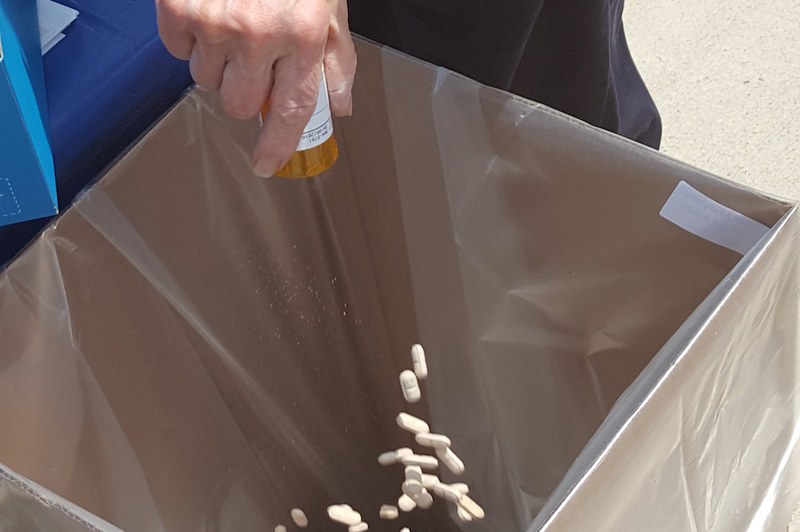
    Loveland, Ohio – The National Prescription Drug Take Back Day aims to provide a safe, convenient, and responsible means of disposing of prescription drugs, while also educating the general public about the potential for abuse of medications.

    According to the 2015 National Survey on Drug Use and Health, an estimated 6.4 million Americans abuse controlled prescription drugs each year. Most abused prescription drugs are obtained from family and friends, many times from the home medicine cabinet. Having unused medicine at home also increases the risk of accidental drug poisoning, especially among children.

    Misuse of prescription drugs can also lead people down a path to heroin addiction. That makes it even more critical to properly dispose of unused drugs.

    If you have leftover prescriptions:

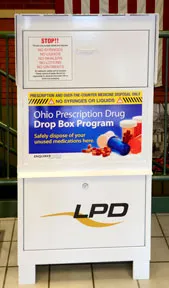
    • Safely dispose of the medications using a prescription drug drop box. To find a location near you use the link below.
    • Scratch out all identifying information on the vial to make it unreadable to protect your privacy.
    • Do not flush medicines down the sink or toilet unless the label or patient information that accompanied the medicine specifically instructs you to do so.

    Search for another site near you…