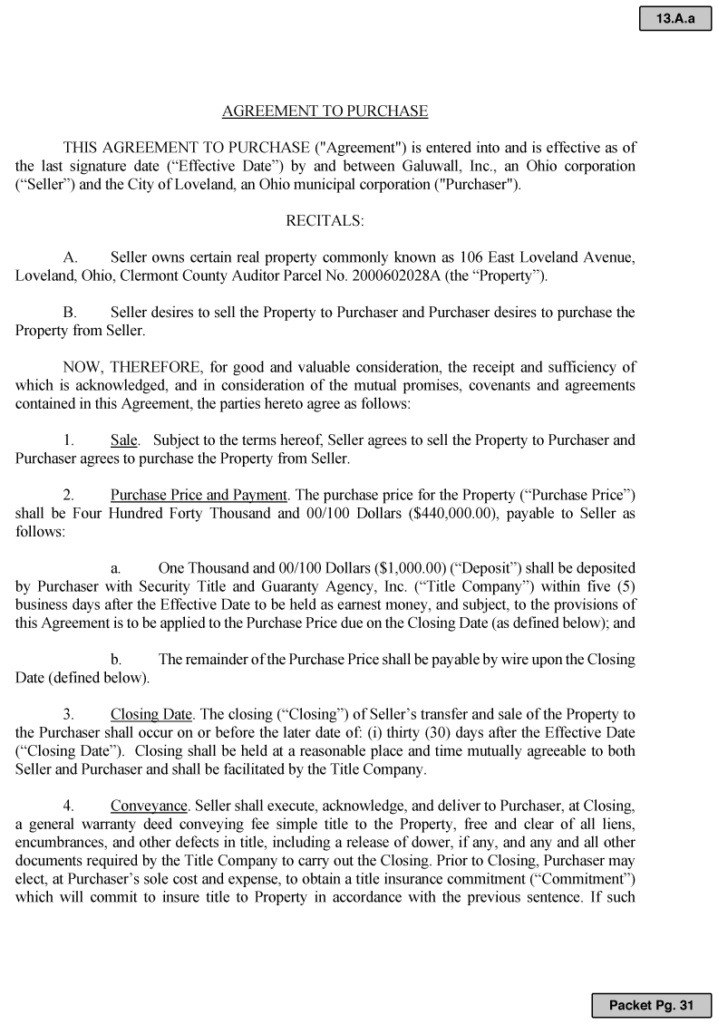
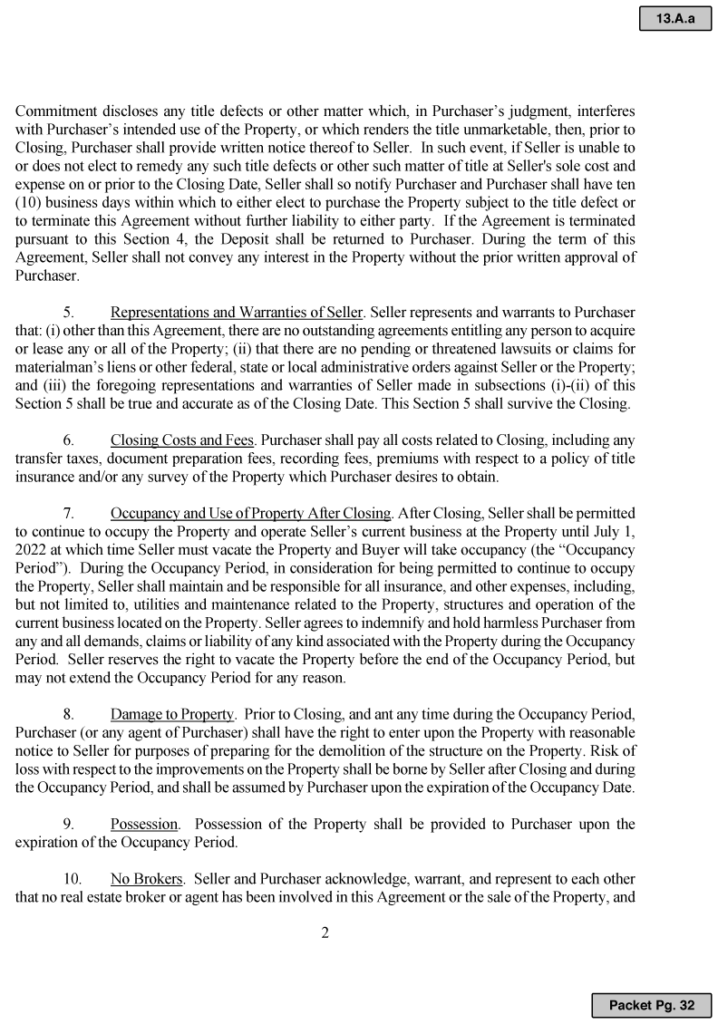
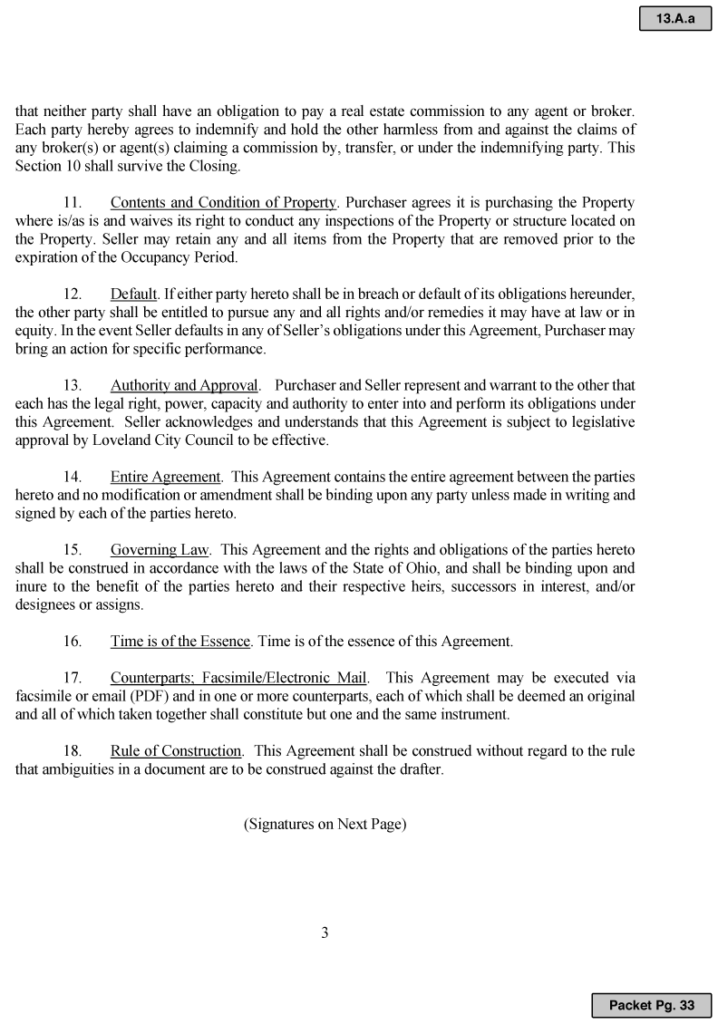
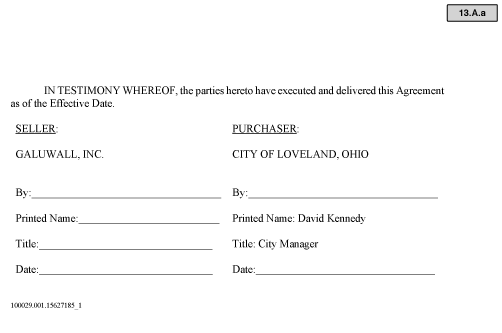
Loveland, Ohio – Last night by a unanimous “emergency” vote, City Council voted to allow City Manager Dave Kennedy to proceed with the purchase of the Mobil gas station at the corner of West Loveland and State Route 48 in Historic Downtown Loveland.
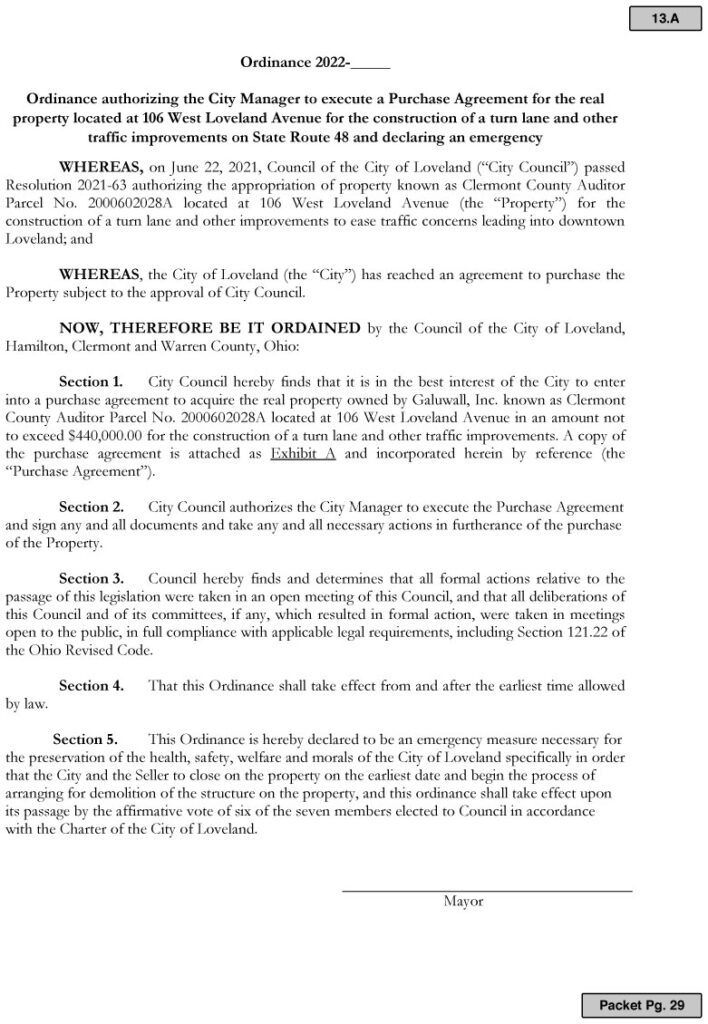
The ordinance authorizes the City Manager to execute a purchase agreement for the property located at 106 West Loveland Avenue for the construction of a turn lane and other traffic improvements.
You can read the background and details of the purchase here:
In this LOVELAND MAGAZINE TV segment, you can watch Kennedy explain why the Ordinance was declared an “emergency”, some of the financing of the project, how tax increment financing will be used, the turn lane, and a pocket park he intends to construct on the site.
Sign up to Sponsor or Participate in the 17th Annual Golf Outing
by Cassie Mattia
Loveland, Ohio – Summer is quickly approaching which means it’s nearly time for Paxton’s Grill Annual Golf Outing! This will mark the 17th year that Paxton’s has teamed up with CancerFree KIDS to “eradicate cancer as a life-threatening disease in children by funding promising research that might otherwise go unfunded.” This year the golf outing has not only been extended to three days but the donation goal has also risen as last year the Annual Golf Outing raised $85,550 for CancerFree KIDS.
“Our goal this year is to reach $100,000.00,” the Owner of Paxton’s Grill Ralph Dunnigan said, “Your support of this amazing mission by playing in and/or sponsoring this year’s expanded event is greatly appreciated. Last year we raised more than $85,000 (shattering the previous year’s record) which again will fully fund a CancerFree KIDS research grant at Cincinnati Children’s Hospital. Since the inception of this event, we have raised close to $500,000 with the goal this year to exceed our 2021 total and reach the six-figure mark,” Dunnigan added.
Paxton’s Grill 17th Annual Golf Outing benefiting CancerFree KIDS will be held on Friday, June 10th, and Saturday, June 11th at Hickory Woods Golf Course in Loveland, Ohio. The new addition of the third day will be held on Monday, June 13th at Oasis Golf Club.
Last year, CancerFree Kids was presented with a check for $85,550 from the amazing Paxton’s Grill Golf Outing committee. CancerFree KIDS responded by saying, “We want to extend a huge thank you and congratulations to the committee for their hard work in planning another successful event and raising a record amount this year! You are truly giving kids a chance to grow up!”
There are plenty of sponsorship opportunities to choose from for this year’s Golf Outing Benefit according to Dunnigan. “Please call me if you have any questions! My number is 513-277-9119.”
If you would like to become a sponsor for this unbelievable Loveland benefit or you would like to register to be a golfer, both forms can be downloaded and filled out below! If you would like to donate now to Paxton’s Grill Annual Golf Outing click here.
Sponsorship form can be downloaded by clicking HERE.
Golfer Registration form can be downloaded by clicking HERE.
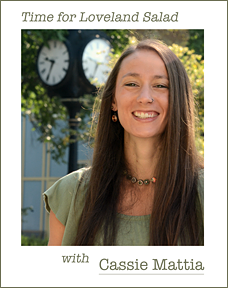
For the latest local event updates stay tuned to the Loveland Salad With ME, Cassie Mattia!
On Monday, Representatives Adam Bird and Don Jones introduced Ohio House Bill 583, legislation to tighten regulations on educator licensing for substitute teachers. The bill increases the educational threshold for substitute teachers from a more broad requirement of a “post-secondary” degree to a more specific “bachelor’s” degree while creating some exceptions to this rule.
The exceptions the bill puts forth are mainly age-related: allowing people with associate’s degrees and at least 21 years since birth to be a long-term substitute teacher, allowing people who served in the military and who have elapsed 21 years since birth to be a long-term substitute teacher, allowing people with sufficient bachelor’s degree coursework and who have spent 21 years on earth to be a substitute teacher. The bill also allows people who have spent five years as an educational assistant to be a long-term substitute.
The bill also authorizes the state board of education to create rules for issuing educator licenses for people who do not hold bachelor’s degrees that can be used for a year.
While the section that allows the state board of education to set rules for temporary licenses could result in a loosening of licensing requirements, overall the bill represents a tightening of licensing requirements for substitute teachers. Rather than just requiring a post-secondary degree, which could include associate’s or other non-bachelor’s degrees, the new bill raises the requirement for substitute teacher licensure to those who hold bachelor’s degrees then carves out specific exceptions for people without bachelor’s degrees.
Increasing requirements for substitute licensure could have a few different impacts. The central goal is likely to improve quality of education provided by substitute teachers. Presumably, someone with a bachelor’s degree can provide better quality education than someone without one, with obvious exceptions, for example people without bachelor’s degrees who are trained in education compared to people with bachelor’s degrees in other fields.
Unfortunately, little evidence exists to confirm to us that degree attainment will lead to better teachers. While there is limited evidence that having a math or science degree may help with math or science teaching, degree attainment overall has not been definitively linked to better outcomes for students. If we can’t find this evidence for teachers, we should be even more dubious about a supposed connection between degree attainment and student outcomes for substitute teachers.
On top of this, the bill will likely have labor market impacts for educators. Tightening requirements for substitute teachers will decrease the supply of qualified substitute teachers, which will drive up the wage needed to attract them as schools vie for a shrinking pool of substitutes. This effect could be stronger than it would be for teachers since substitutes are often actively considering competing offers from different schools, thus making their options more competitive than teachers.
On top of this, making it harder to hire substitutes could create perverse incentives for schools. If substitute teachers are more scarce or expensive, it could cause administrators to limit the ability of teachers to take sick days or otherwise take time off.
While raising the bar for substitute teachers makes intuitive sense, interventions like this need to be based on evidence, and the evidence of the impact of degree attainment on substitute teachers is basically nonexistent. We can hope that if substitute teachers are required to have higher educational attainment than before, that we would at least build in funds to assess the intervention after it is implemented.
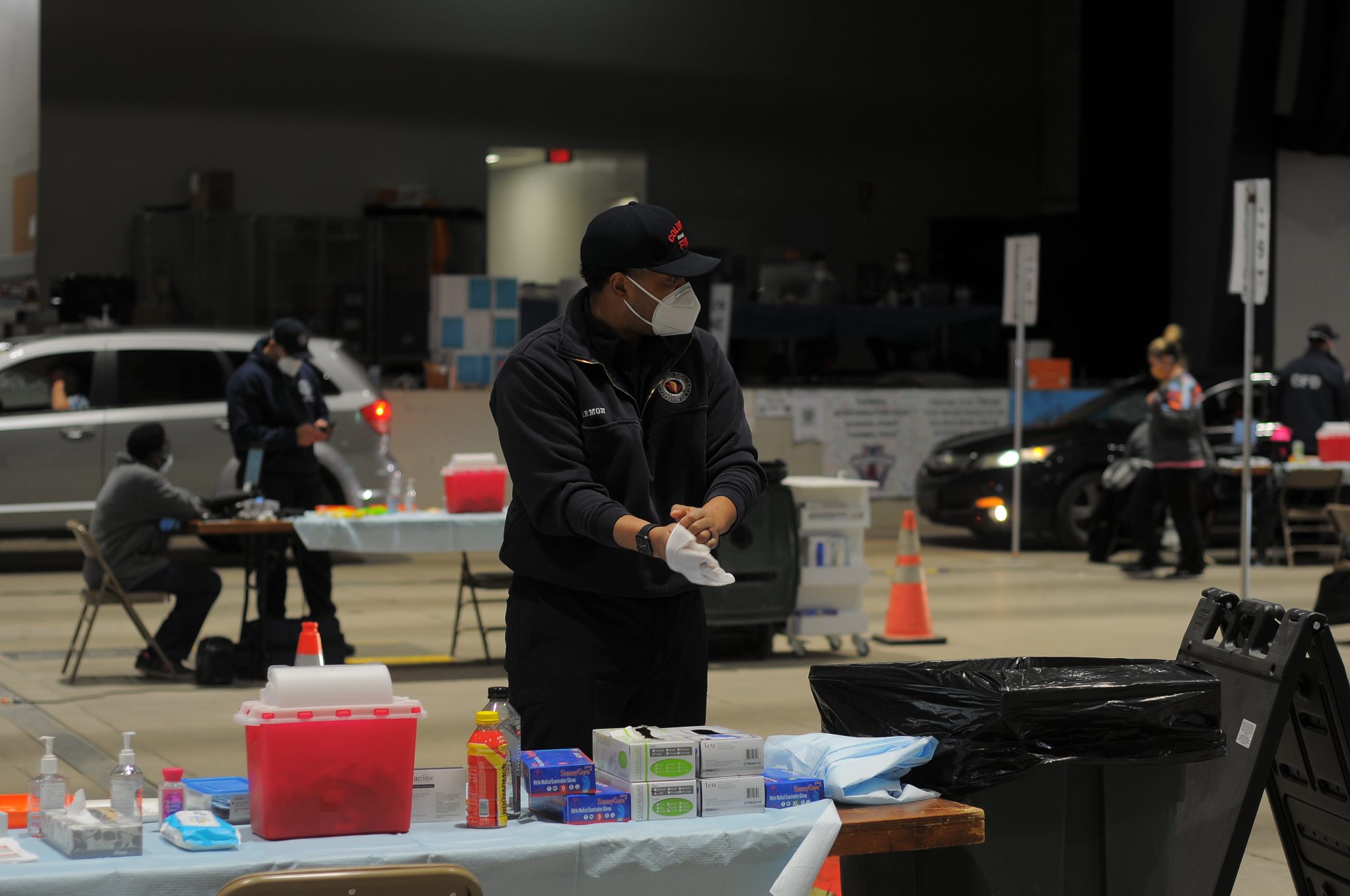
A Columbus Fire Department member dons gloves while working at a mass vaccination site at the Celeste Center in Columbus. Photo by Jake Zuckerman, Ohio Capital Journal.
Ohio’s COVID-19 vaccination campaign has hit a new lull after two months of record low numbers of residents getting vaccinated.
While the concept of diminishing marginal returns would suggest this is to be expected, Ohio remains under-vaccinated on a national and international scale. Just 62% of state residents are vaccine-started, and 57% are vaccine completed.
Ranked by state, Ohio is the 8th least vaccine-started in the nation and the 17th least fully-vaccinated, according to data from The New York Times. Americans nationally, despite widespread access to vaccines, are about 76% vaccine-started. That’s below a list of countries both wealthy and poor including Cuba (94%), Chile (93%), Canada (86%) and Vietnam (81%), according to Our World in Data, a global, public dataset tracking the pandemic. Ohio is about as vaccine-started as Pakistan (63%).
While COVID-19 cases, hospitalizations and deaths are significantly down from the winter surge, vaccination is still key for the present and future. It provides powerful, direct protection to the recipient. It also, when enough people in a community are vaccinated, provides indirect protection for those who aren’t vaccinated or have weaker immune systems.
The consequences of the low vaccination rate are simple and lethal. About 22,000 Ohioans have died of COVID-19 since Jan. 1, 2021. About 95% of them were unvaccinated. In the same period, 64,000 Ohioans were hospitalized with the disease. About 93.5% of them were unvaccinated.
At the more local level, more than half of Ohio’s 88 counties harbor populations where less than 1 in 2 residents are vaccinated, according to an analysis of state data. These counties tend to be more rural and Appalachian.
Like other frontiers of the pandemic, vaccination became mired in partisan politics with real human consequences. On average, former President Donald Trump won 53% of the vote share statewide in the 2020 elections. But in Ohio counties that are less than 50% vaccinated, Trump won on average 74% of the votes.
While COVID-19 deaths concentrated in populous, urban centers early in the pandemic, the paradigm shifted after vaccines became available, according to the Pew Research Center. By late 2021, death rates in the counties Trump won most decisively were about four times those of President Joe Biden’s winningest counties.
On a statewide basis, older Ohioans are vaccinated at significantly higher rates than their younger counterparts. For instance, those 65 and older are between 80% and 85% vaccinated. Those aged 20 to 49 are between 51% and 63% vaccinated.
Source: Ohio Department of Health. Graph by Jake Zuckerman.
Ohio schools require vaccination as a term of enrollment against a broad spectrum of infectious diseases like measles and chicken pox, yielding immunization coverage between about 75% to 95% depending on the disease.
However, the conservative state legislature has signaled an unlikeliness to mandate coronavirus vaccination.
Republicans in both chambers of the General Assembly passed legislation in 2021 blocking schools and colleges from mandating receipt of COVID-19 vaccines that are only federally approved on an emergency basis. Both the Moderna and Pfizer vaccine have since received full federal approval.
The Ohio House passed legislation prohibiting a wide range of employers, businesses and schools from requiring receipt of any vaccine, not just the COVID-19 vaccine. The Senate has not voted on the bill.
Imagine a gender equal world. A world free of bias, stereotypes and discrimination. A world that’s diverse, equitable, and inclusive. A world where difference is valued and celebrated. Together we can forge women’s equality. Collectively we can all #BreakTheBias.
David Miller is the Founder of Loveland Magazine
by David Miller
Cassie Mattia as a six-year-old had a passion to be a writer. Her love for the written word along with pursuing and achieving college degrees in Journalism, Business, and English led her to reach yet another milestone on June 25, 2021; when she became an “Equal Co-Owner” of Loveland Magazine.
No business has ever been so fortunate as to have Cassie Mattia knock on their door and say, “I’d like to work for you.”
Cassie is now an equal Co-Owner of the newspaper, Associate Editor, and Director of Marketing. Her positive can-do attitude intelligence, and hard work guide every decision we now make.
Loveland Magazine hopes to always thrive in and contribute to a nurturing environment for Loveland, one of equality and empathy. Cassie Mattia’s love for our community and its people will certainly keep us moving in that direction. Her positivity and compassion are contagious.
Thank you Cassie for propelling us into the future as we head into our 18th year. Our future is awfully bright with you here helping to lead us, and there aren’t adequate words to express my gratitude.
Loveland, Ohio – It’s so important to stay connected with your community and the local businesses surrounding your community! In just two days you will have the opportunity to see what local businesses and organizations have in store for 2022 at the Little Miami River Chamber Alliance (LMRCA) Business Expo!
On Thursday, March 10th from 4-7 p.m. at the Little Miami Brewing Event Center the LMRCA will be hosting the Annual Business Expo where members of the community and local businesses will be able to come together to interact and make new connections! The expo is completely open to the public and free for those who would like to attend. The 2022 Business Expo will include opportunities to:
network with many local businesses and entrepreneurs
establish new contacts
interact with top local businesses and industry leaders
acquire qualified and targeted sales leads
HAVE A LOT OF FUN!
If you happen to be one of the first 50 people to attend the Business Expo you will be rewarded with a free beer tasting and will be entered into a raffle!
Local businesses or entrepreneurs who want to be a part of the LMRCA Business Expo can sign up to grab a booth, which includes a table and 2 chairs, for $200. If your business is a member of the LMRCA the booth fee is $150. The LMRCA is offering Premium Booth Placement for only an additional $50. Booth spaces are very limited so if you are interested in joining one of the best networking events of the year please contact Meredith Taylor or scan the QR code at the bottom of the page to register as soon as possible!
The LMRCA 2022 Business Expo is not only a great place to showcase your business but it is also the perfect event to build your business and gain new customers! Be sure to put the Business Expo in your calendars as you don’t want to miss out on this fun networking event!
Here is Your EXPO Passport with all the Participating Businesses
Loveland, Ohio – A public hearing by the Loveland Planning and Zoning Commission on the Drees Homes request to re-zone the Grailville property has been rescheduled to Thursday, March 17th at 7 PM. The meeting will be held in the Council Chamber at City Hall, 120 West Loveland Avenue.
The proposed development of the Grailville site by the Drees Company includes 74 patio homes and 135 traditional-style homes totaling 209 lots. The land is situated between O’Bannonville Road and State Route 48 in Clermont County. The site is approximately 111 acres.
Loveland, Ohio – At Tuesday’s meeting, Council will hear the first reading of an ordinance to purchase the Mobil Gas Station at the corner of West Loveland and State Route 48.
The ordinance will authorize the City Manager to execute a purchase agreement for the property located at 106 West Loveland Avenue for the construction of a turn lane and other traffic improvements on State Route 48 – “and declaring an emergency”.
The ordinance says the final purchase is not to exceed $440,000.00.
Loveland, Ohio – On Thursday, February 24 the Loveland High Wind Ensemble performed Incantation and Dance (John Barnes Chance) during their Mid-Winter Concert.
Symmes Township – The Loveland Symmes Fire Department will be going door-to-door from March through August to promote the importance of smoke detectors. Residents can have their smoke detectors tested, batteries replaced, or receive a new smoke detector at no cost.
The Fire Department will also be installing smoke detectors for the hearing impaired.
Funding for this project is through a FEMA Fire Prevention grant. If you are not home when they stop by, they will leave a note at your door and come back at a later time.