Loveland, Ohio – These events will be your chance to personally meet the local politicians who want to be part of the teams leading the Loveland City School District and Loveland City Council for the next 1,440 days. Four-long years, so this is important!
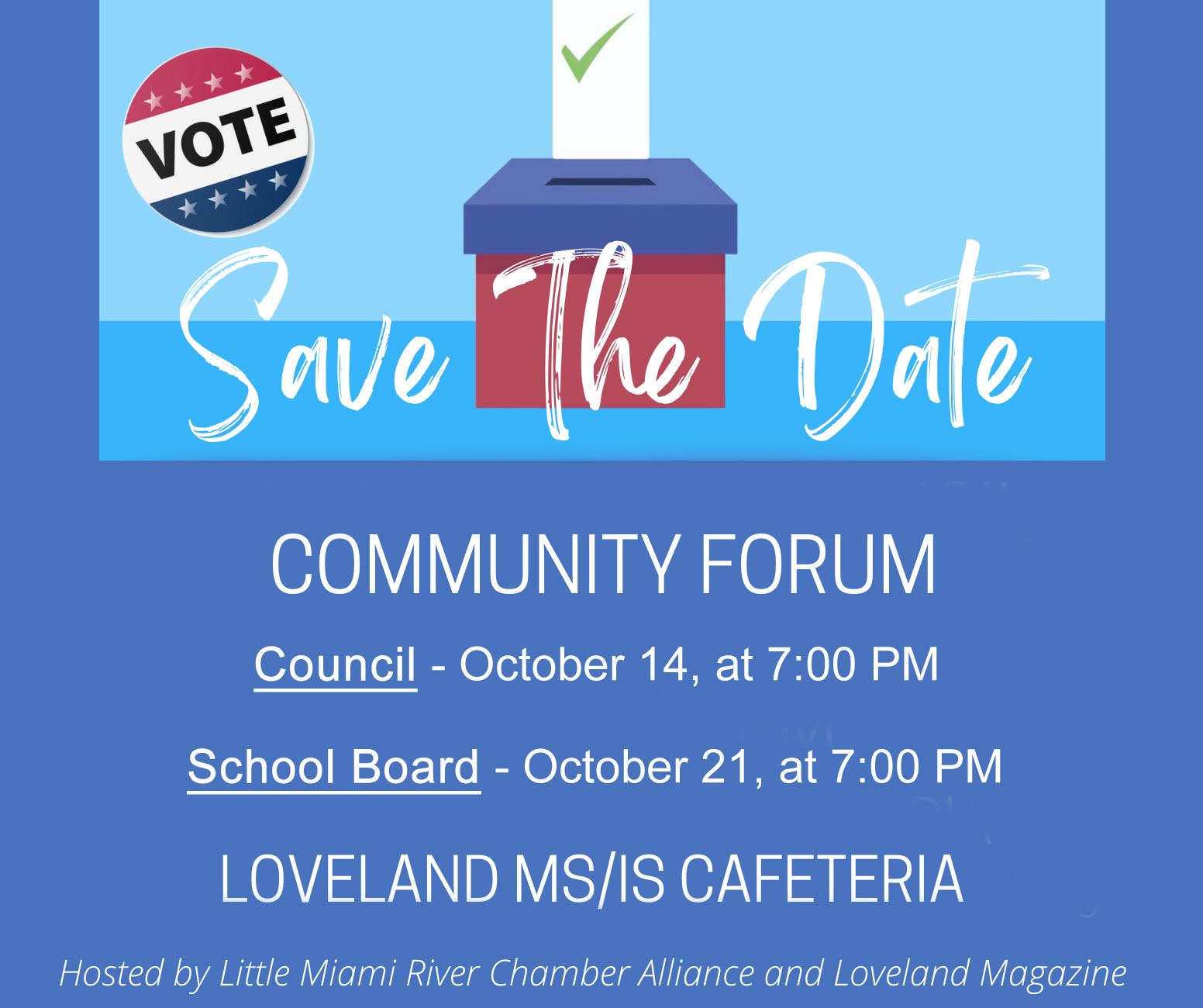
On October 21 the Little Miami River Chamber Alliance, Loveland Magazine, and LOVELAND MAGAZINE TV will host the contenders for seats on the school board, and on October 14 they will bring together on a public stage your job applicants for Loveland City Council.
City Council – October 14, at 7:00 PM at the Loveland Middle School/Intermediate School Cafeteria.
School Board – October 21, at 7:00 PM at the Loveland Middle School/Intermediate School Cafeteria.
Will there be undisputed champs?
Election fans can see if the contenders roll with the punches, stick and move, or have promises that pack a punch. Will you see any future respected political figures or elder statesmen/women?
Both of these heavyweight championship Forums will be broadcast “LIVE” on the Loveland Magazine FaceBook Page. It’s not Pay-per-View and tickets are not required – it’s totally FREE!
Who knows, there might be some highfalutin’ good ideas that come from one or more of these candidates that can transform Loveland. There will almost certainly be some re-hashing the past but that will be OK if it leads to knowledge of what the future might hold.
Politicians routinely offer more promises than they keep, however hearing them straight from their mouths is the start of holding them accountable. Meeting them in person is always better than voting based on the number of yard signs and you can be a political influencer if you can say, “I actually heard her say it!”
If you cannot attend in person or chose to be inside the safety of your own home you may want to tune in LIVE to be in-the-know.
The format will follow the same as in the past:
To begin, candidates will each present their platform for 2 minutes and tell you why they are running for office.
Questions will be asked for 60 minutes allowing each candidate two minutes to reply or pass.
After 60 minutes candidates are asked to close with 2-minute speeches.
Voters can throw their written questions into the octagon and all questions will be screened for duplicity by independent ring-side judges. The emcees will ask as many of the questions as time allows in the 60 minutes.
You the registered voters of the City of Loveland and the Loveland City School District however will be the crucial and critically important judges come November 2 so reserve your ring-side seat by saving these dates.
August 23 – Write-in candidates must file declarations of intent by 4 p.m. (72 days before general election
September 17 – Military & Overseas Absentee Voting begins (46 Days Before Election Day)
October 4 – Deadline for voter registration for Nov. 2 general election (30 days before general election)*
October 5 – Early In-Person Voting begins and includes the Saturday, Sunday and the Monday before Election Day
October 5 – Absentee Voting By Mail begins (28 Days Before Election Day)
October 11 – Board of Elections Closed to In-Person Voting (Columbus Day).
October 30 – Applications for absentee ballots to be mailed for Nov. 2 general election must be received by boards of elections by noon (3 days before general election)
November 2 – General Election Day. Polls open at 6:30 AM and close at 7:30 PM.
Throughout the years, men and women in our armed forces have made great sacrifices to protect our freedom and democracy. Today, the courageous members of our military branches continue to serve our country so we all can enjoy one of our most sacred rights – the right to vote. Through the I Vote in Honor of a Veteran initiative, you can demonstrate the pride you feel for a veteran or servicemember and, at the same time, encourage others to vote on Election Day.
Wear an I Vote in Honor of a Veteran pin on Election Day to show your appreciation to those men and women who made it possible for you to exercise your right to vote.
To get your pin, click this LINK to submit a testimonial about how they’ve inspired you will be sent one.
Sue Klebold attempts to reconcile how the son she affectionately referred to as “Sunshine Boy” became a school shooter. This documentary brings light to the importance of mental health being taught to young children and the movement underway to take this issue seriously.
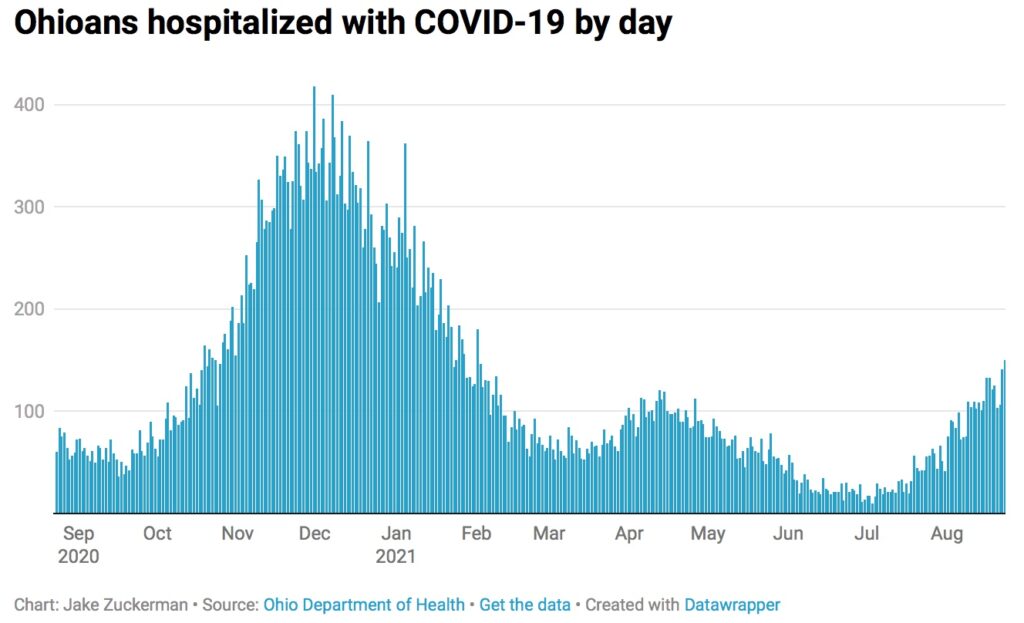
More than 3,000 Ohioans per day are contracting COVID-19 on average, the highest the rate has been since early February.
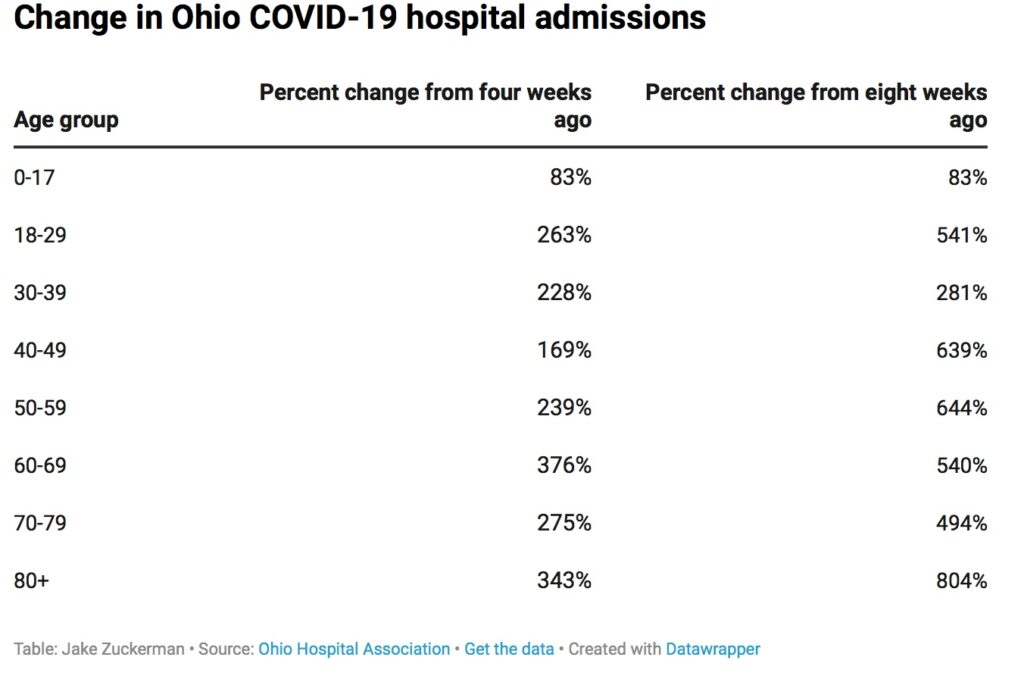
Over the last month, hospitalizations increased by between 83% and 375% by age group, according to data from the Ohio Hospital Association.
As children go back to school, more students are testing positive. Comparing the week of July 4 with the week of August 25, COVID-19 infections leapt by 909% among all Ohioans and 827% among school-age Ohioans, according to separate data from the Ohio Department of Health.
While vaccination has modestly picked up pace, Ohio’s coverage sags well below the national average. About 52% of the state has received at least one vaccine dose, compared to 61% nationally, according to a New York Times data tracker. Only 12 states have a lower rate.
The state’s hottest spots for infection are toward the southern border, where the vaccination rate sits between 30% and 40%.
All told, more than 65,000 Ohioans have been hospitalized with COVID-19. More than 20,700 have died.
“With many districts going back to school last week, the number of illnesses from Monday, Aug. 23 is troubling,” said ODH Director Dr. Bruce Vanderhoff in a news release. “As students statewide continue to return to their classrooms, this high figure should be yet another indicator to parents and families that the best protection from COVID-19 is for those 12 and older to choose to be vaccinated, and for those who aren’t vaccinated to wear masks.”
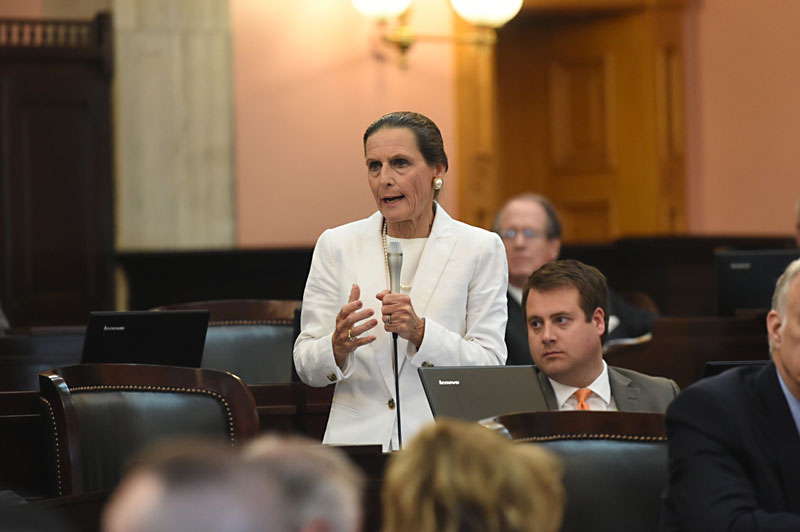
In the photo above is Rep. Schmidt speaking on the House floor regarding transgender women in sports. (Photo from Ohio House of Representatives)
State Reps. Jean Schmidt (R-Loveland) and Mike Loychik (R-Bazetta) announced on August 25 they have introduced House Bill 400, which would prohibit public schools from mandating students to wear a mask. The bill introduction comes as statewide concerns from parents have heightened as several public schools have implemented school mask mandates for children.
The Loveland City School District has mandated mask wearing for teachers, staff, all visitors, and all students below 7th grade when inside buildings. The 7-12 students are exempt from Loveland’s mask mandate.
“I’ve seen and heard constituent concerns across my district from these mask orders from public schools receiving public taxpayer dollars,” said Loychik. “Through this bill, we are reiterating their opposition as it should be up to the discretion of parents on whether their kids should wear a mask or not.”
House Bill 400 only pertains to students wearing masks and does not prohibit faculty, staff, and guests from wearing masks or from the school imposing a mandate on them, according to Schmidt’s press release about her sponsorship.
Schmidt is sponsoring the bill amid local residents upset over certain schools implementing student mask mandates.
“I’m disheartened that local school boards are mandating masks for students within the 65th House District and across our state,” said Schmidt. “I anticipate working with Rep. Loychik and several interested parties closely in the coming weeks to move this bill forward in the Legislature to address these rising concerns of Ohioans.”
The incentive is being expanded as children return to classrooms and COVID-19 cases rise dramatically in Ohio and nationwide, with the Delta variant becoming the dominant strain identified in new cases. Delta also appears more highly transmissible than previous variants and more likely to infect younger adults and children.
“Getting students 12 and up vaccinated will provide peace of mind to parents, caregivers and educators,” said Kelly O’Reilly, president and chief executive officer of the Ohio Association of Health Plans. “Vaccination is the surest way to protect teens against COVID-19.”
Working together, Ohio’s Medicaid Managed Care plans — Aetna, Buckeye Health Plan, CareSource, Molina Healthcare, Paramount Advantage and UnitedHealthcare — have made finding and getting the vaccine easier than ever with Vax on the Spot(www.covidvaxonthespot.com), a website with information on community vaccine events and walk-in opportunities at pharmacies. The site also gives details on how members can get the $100 incentive. In some locations, including many pharmacies and Federally Qualified Health Centers, gift cards are available on-site.
The campaign and the incentive are working. Ohio Medicaid Director Maureen Corcoran announced recently that the number of Medicaid members getting their first dose rose by 49% in the first week of August compared with the week before.
Since Gov. Mike DeWine challenged the Medicaid Managed Care plans in June to do more to encourage vaccination, Ohio has seen a 57% increase in the number of Medicaid members who have completed vaccination. As of Aug. 8, the number that had received at least one shot was more than 800,000.
Medicaid vaccine gift cards will continue to be available to eligible Ohioans through Dec. 31, 2021.
According to the health plans’ medical directors, shrinking the population of unvaccinated people is the most important front in the battle to contain the pandemic. So far, available vaccines have proven highly effective at preventing people from contracting COVID-19 and even more effective at preventing serious illness and hospitalization, even among Delta cases. According to the U.S. Centers for Disease Control and Prevention, almost everyone — 97% — who contracts a COVID-19 case serious enough to require hospitalization is unvaccinated.
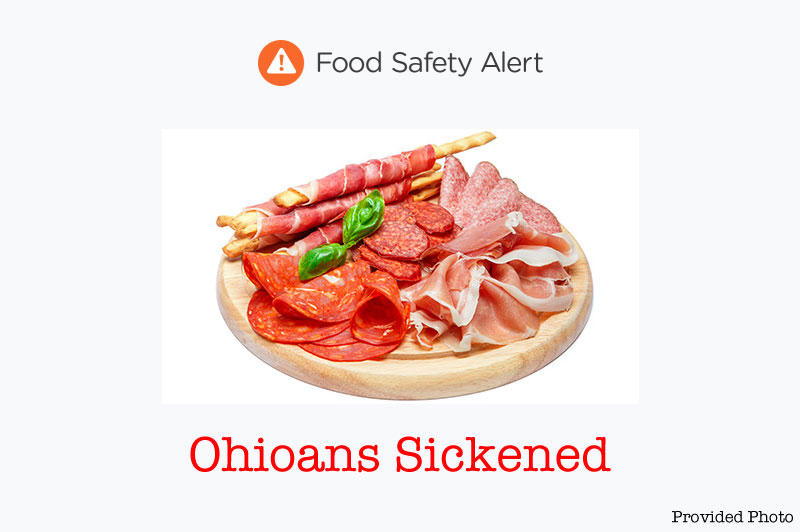
Can include uncured salami, prosciutto, coppa, or soppressata
With “best by” dates on or before February 11, 2022
This does not include Italian-style meats sliced at a deli
Ill people reported eating Fratelli Beretta brand Uncured Antipasto trays before they got sick. The investigation is ongoing to determine if additional products are linked to illness.What Everyone Should Do
Do not eat these products.
Throw them away, even if some of them were eaten and no one got sick.
If you don’t know the brand of prepackaged Italian-style meats you have at home, don’t eat them and throw them away.
Wash items, containers, and surfaces that may have touched the products using hot soapy water or a dishwasher.
Call your healthcare provider if you have any of these severe Salmonella symptoms:
Diarrhea and a fever higher than 102°F
Diarrhea for more than 3 days that is not improving
Bloody diarrhea
So much vomiting that you cannot keep liquids down
Signs of dehydration, such as:
Not peeing much
Dry mouth and throat
Feeling dizzy when standing up
What Businesses Should Do
Do not sell or serve these products.
Italian-style meats sliced at a deli are not affected by this advisory.
Wash and sanitize containers and surfaces that may have come in contact with them.
Symptoms of Salmonella
Most people infected with Salmonella experience diarrhea, fever, and stomach cramps.
Symptoms usually start 6 hours to 6 days after swallowing the bacteria.
Most people recover without treatment after 4 to 7 days.
Some people—especially children younger than 5 years, adults 65 years and older, and people with weakened immune systems—may experience more severe illnesses that require medical treatment or hospitalization.
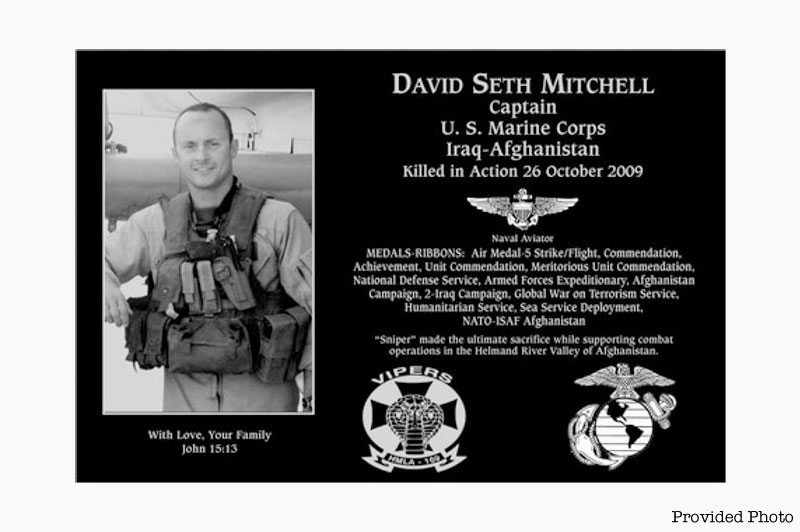
by the family and friends of Captain Seth Mitchell
Happy summer 2021 contributors to the Seth Mitchell Hero 5K. We hope your summer is going well. We are all blessed that it is going differently than last year! As always we want to keep you updated on how your investment in the scholarship campaigns are going.
Due to Covid 19 we held the 5K virtually in 2020. You guys made the event fun and meaningful. We had over 100 participants and raised a significant amount of funds, even for a challenging year.
Our scholarship committee thanks you. Each year we hope to raise enough to fund scholarships for deserving seniors from Loveland High School where Seth graduated in 1997. Because of you, we have been successful again.
Let us introduce the recipients for 2021.
Teri Clark and Madeline Schamel (provided photos)
The Seth Mitchell Memorial Scholarship: Teri Clark has a keen interest in science and math. According to her application essay, her goal is to “treat my friends the same way Seth treated his friends, with kindness and loyalty”. Teri said that she was humbled by the opportunity to apply for the scholarship in Seth’s name. In our interview with Teri we found that she has overcome personal hardships that strengthened her and helped her find a passion to serve others by pursuing a career in the medical field.
Let Us Never Forget/Mitchell Family Scholarship: Madeline Schamel has used hard work, positivity and determination to overcome medical challenges during her high school years. One letter of reference said of Maddie, “while many teenagers facing those obstacles would choose flight, Maddie embraced the uncertainty and fights with poise and maturity beyond her years”.
Like Seth, these young women are known for hard work, determination, selflessness, kindness and loyalty. We are proud to have them pursue their dreams with a financial boost from all of you that have contributed to the Hero 5k in honor of Seth’s service and sacrifice.
Lastly, we do want to announce that the 12th Annual Cpt. Seth Mitchell Hero 5K (www.sethmitchellhero5k.org) will be held on October 16 at 11 AM in beautiful Nisbet Park in Historic Downtown Loveland Ohio.
We will also offer a virtual run again. You’ll be able to do your run/walk during the month of October from any location. The website will open soon for registrations and donations.
Thank you all and blessings be upon you,
Steve, Connie and Drew Mitchell, Family of Captain Seth Mitchell, USMC
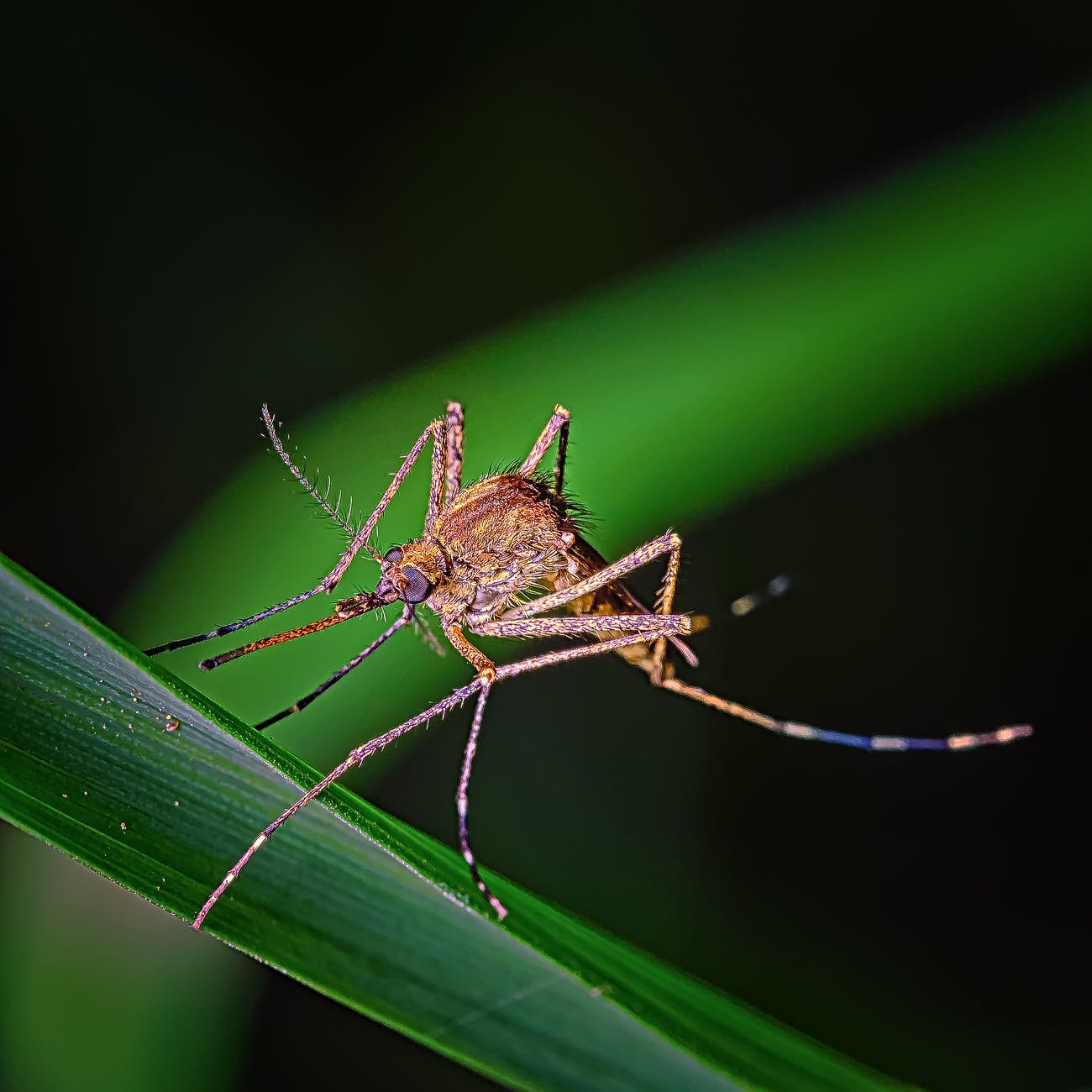
Hamilton County is reminding everyone to continue to take summertime precautions against mosquito bites after mosquitoes that were recently trapped at the Columbia Township compost facility on Hill and Dale Dr. tested positive for West Nile virus (WNV). West Nile Virus is a viral disease that can be passed from mosquitoes to humans. Hamilton County Public Health (HCPH) maintains traps throughout the County during the summer to test for the presence of disease. While this is the first positive identification in HCPH’s jurisdiction, other positive pools have been identified elsewhere in the County.
People over age 50 have the highest risk of developing severe WNV infections
Hamilton County Public Health staff will be conducting surveillance activities in the neighborhoods and commercial areas around where the mosquitoes were collected. They will be looking for areas of standing water, applying larvicide, making sure swimming pools are operating properly and advising residents on precautions they can take to avoid mosquito bites.
“We can all take action to eliminate mosquito breeding sites and take precautions to avoid mosquito bites,” Greg Kesterman, Hamilton County Health Commissioner says. “West Nile was first identified in Ohio in 2001, so it’s not new to our area, but we like to take the opportunity to remind everyone to take precautions.”
Hamilton County Public Health advises all Hamilton County residents to DRAIN, DUNK and PROTECT in an effort to reduce the mosquito population and prevent West Nile Virus:
DRAIN
Look for and drain sources of standing water on your property – litter, tires, buckets, flower pots, wading pools and similar items that could create standing water and become mosquito breeding sites.
Frequently change water in bird baths and pet bowls.
Drain small puddles after heavy rainstorms.
DUNK
Apply mosquito larvicide, sometimes called mosquito “dunks,” to areas of standing water that cannot be drained. The “dunks” are environmentally safe and won’t harm pets. Purchase them at your local hardware store.
PROTECT
Cut your grass and trim shrubbery.
Make sure screens in windows and doors are tight-fitting and free from defect.
Wear long sleeves and pants during peak mosquito hours – dawn and dusk.
Use an EPA-registered insect repellent such as those containing DEET, picaridin or oil of lemon or eucalyptus. Always follow the directions on the package.
WNV is a viral disease affecting the central nervous system that can be transmitted to humans by mosquitoes. It is important to note that most people who are bitten by an infected mosquito will never become sick. Everyone, however, should be aware of the symptoms of WNV. Symptoms may develop two to 14 days after someone is bitten by an infected mosquito.
No Symptoms in Most People. Approximately 70-80 percent of people who are infected with WNV will not show any symptoms at all.
Milder Symptoms in Some People. Up to 20 percent of the people who become infected will display symptoms which can include fever, headache, and body aches, nausea, vomiting, and sometimes swollen lymph glands or a skin rash on the chest, stomach and back. Symptoms can last for as short as a few days, though even healthy people have been sick for several weeks.
Serious Symptoms in a Few People. Less than one percent of people infected with WNV will develop severe illness. The severe symptoms can include high fever, headache, neck stiffness, stupor, disorientation, coma, tremors, convulsions, muscle weakness, vision loss, numbness and paralysis. These symptoms may last several weeks, and neurological effects may be permanent.
While all residents of areas where virus activity has been identified are at risk, people over age 50 have the highest risk of developing severe WNV infections. Anyone experiencing any of these symptoms should contact their healthcare provider for evaluation.
For more information on West Nile Virus, please contact Hamilton County Public Health at (513) 946-7800 or visit us online at www.hamiltoncountyhealth.org.
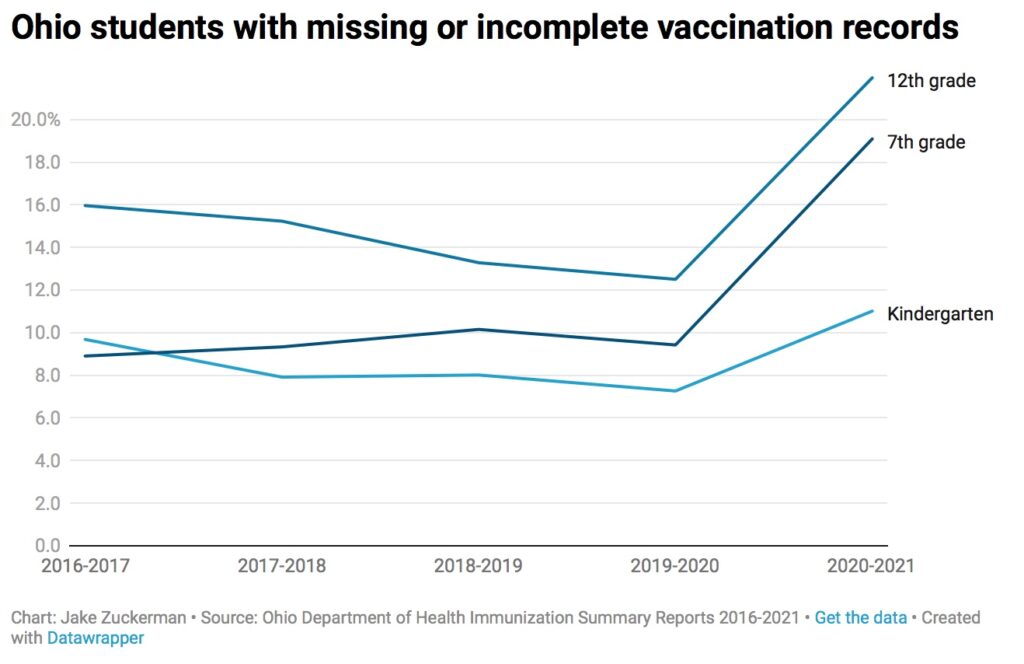
School vaccination records were missing or incomplete among roughly 1 in 5 sampled Ohio middle and high school students last year, despite state law requiring local boards of education to track immunizations records of all enrolled students.
All Ohio students, per state law, must be vaccinated against mumps, tetanus, polio, measles, Hepatitis B, chicken pox and meningococcal diseases. They can claim exemptions in writing due to natural immunity from prior infection; a medical contraindication; or for “reasons of conscience, including religious convictions.”
Though the law requires local boards of education to keep immunization summaries available on request for inquiring parents, schools statewide are failing to track vaccination among tens of thousands of students.
“The question is, why are the schools not collecting this data?” said Madhav Bhatta, an epidemiologist at Kent State University. “If it’s required by law that every child either get vaccinated or have a medical exemption … then why is there missing data?”
In the 2020-2021 school year, when a nascent pandemic shuttered schools and doctors’ offices, only 76% of 12th grade students submitted proof of receiving the meningococcal vaccine, according to immunization data obtained in a public records request from the Ohio Department of Health. The vaccine protects against meningitis and other, sometimes-lethal illnesses caused by the same bacteria.
About 22% of 12th graders had no exemption on file, leaving the picture unclear whether communities have high enough vaccination coverage to protect students.
That same year, only 78% of 7th grade school students statewide showed proof of receiving all vaccinations. Data was missing or incomplete on 19% of all 7th graders.
The missing data spans beyond the threshold for herd immunity for some vaccines. For instance, in the 2019-2020 year, 7.2% of kindergarteners and 9.4% of 7th grade students didn’t have all vaccination records or exemptions on file.
According to the World Health Organization, a community loses “herd immunity” — a threshold of community protection where a disease lacks viable hosts to spread — against measles when coverage falls below 95%. About 2.5% of students claimed a “conscience” objection, and a fraction of a percent claimed medical contraindications — which means they have diagnosed conditions where certain medical treatments such as a vaccine may cause harm.
“If [students with incomplete data] don’t have it on file because they are not vaccinated, that’s a problem,” Bhatta said. “We want as high a level of vaccination as possible to reduce the risk of transmission within a community.”
CDC research shows childhood immunization rates dropped significantly in 2020. However, the problem predates the pandemic. State data shows between 7.2% and 12.5% of sampled Ohio students did not show proof of vaccination or claim any exemption in 2019-2020 either.
The reports also lack data on vaccination by race or socioeconomic status, two major social determinants of health.
When contacted, different state agencies passed the blame or pointed fingers at county school boards, which are responsible for collecting data at the local level.
The COVID-19 vaccine data stands in stark contrast to the roughly 3% of public-school students who formally claim a nonmedical exemption year over year, raising more questions about the missing data.
Concerns about outbreaks of rare diseases among unvaccinated communities isn’t just a hypothetical.
Widespread vaccination eradicated measles in the U.S., but the virus can cause outbreaks when a host imports and spreads it among unvaccinated people. In early 2014, two unvaccinated Amish men returned to Knox County from the Philippines, unknowingly carrying measles, a highly infectious but vaccine-preventable disease. Amish communities tend to abstain from vaccination.
The two men seeded an outbreak that caused 383 infections in nine counties over four months, according to a report in the New England Journal of Medicine. About 90% of the victims were unvaccinated. Health officials mounted an awareness campaign and surged in more than 12,000 MMR vaccine doses for some 10,600 people to eventually smother the outbreak.
Researchers also note that unvaccinated people are not randomly distributed. Rather, they tend to concentrate in certain areas. Thus, statewide vaccination numbers can mask the vulnerability of some specific counties.
The missing data is a “significant concern,” according to Amy Bush Stevens, vice president of the Health Policy Institute of Ohio.
HPIO analyzed the data obtained from the Ohio Department of Health. According to its analysis, students in non-Appalachian, rural communities are most likely to claim exemptions to vaccination mandates. Students in metropolitan counties are most likely to not submit their vaccination records.
Screenshot from Health Policy Institute of Ohio analysis of Ohio Department of Health Immunization Summary Report data.
The missing data blurs a critical picture of whether students are protected, she said.
“Childhood vaccinations are a highly effective way to prevent infectious diseases among kids that have killed many children in the past,” she said.
Who’s to blame?
The law requires local boards of education to provide a summary of student immunizations to the state health director every year.
When contacted, both the Ohio Department of Education and the Ohio Department of Health sidestepped blame and pointed at the local schools.
Alicia Shoults, an ODH spokeswoman, said ODH provides funds for local health departments to do “assessment site visits for compliance.” The pandemic, however, limited this practice, and officials are still reviewing data to determine why so many students’ immunization records were missing last year.
“Ultimately, at the local level, schools are responsible for enforcement,” she said.
The Ohio Capital Journal requested data on school vaccination exemptions in May from the Ohio Department of Education. Spokeswoman Mandy Minick initially stated no such data exists. When asked about the data later obtained from ODH, its missing components, and the state law that requires it, she deflected blame.
The law prescribes roles to local schools and the state health director, not ODE, she said.
“The Department of Education does not have a prescribed role in the collection of this data,” Minick said.
A spokesman for the Ohio School Boards Association reviewed the immunization data but said he didn’t have anything to add.
OCJ contacted six county school boards overseeing schools with high rates of incomplete data. Only Youngstown City School District responded.
Of 152 seniors at Chaney High School in 2020-2021, 122 didn’t submit proof of vaccination or notice of exemption for the meningococcal vaccine — the only vaccine students must receive while in high school.
In the 2018-2019 school year (the 2019-2020 data is not broken out by high school), 89 of 158 students were missing meningococcal vaccine records.
If a meningitis outbreak emerged, officials wouldn’t immediately know who’s protected and who isn’t, costing precious time as vaccines are surged in.
Denise Dick, communications director for Youngstown City Schools, said while the pandemic worsened things, there has been a historical problem getting families to submit paperwork related to vaccination. However, the district is establishing in-school, optional vaccination appointments for a full spectrum of shots.
No one is forced to vaccinate, she said, but the goal is to make it as easy as possible for students. In the meantime, she acknowledged the district is flying blind as far as protection against infectious disease.
“Whether they’re not getting them, or they’re not giving us the record, we just don’t know that,” she said.
Solutions?
Amy Bush Stevens, from HPIO, has the fixes large and small.
On the mechanical side, HPIO analyzed a 2012 CDC survey of states and found Ohio is one of 18 states that doesn’t require health care providers and payers to report immunization data.
Some choose to, but others don’t. Mandatory reporting, she said, would clear the air on who’s vaccinated and who isn’t. (An ODH spokeswoman did not respond to an interview request with an administrator of ImpactSIIS, the state’s immunization information system.)
The current system, Stevens said, puts the burden on parents to submit records. For parents, especially those with lower incomes who move more often or change physicians, it’s too easy for documentation to get lost in the shuffle.
Another idea: tie reimbursement funding from Medicaid managed care plans more strongly to vaccination rates. More vaccination now equals lower costs of care down the line. And more outreach to eligible families to the Children’s Health Insurance Plan, which covers childhood vaccination, would help as the rate of uninsured children ticks up in Ohio.
And then there are structural changes. Public health departments are chronically underfunded in Ohio and one of the few fail safes for low-income, undocumented, or uninsured families. The Columbus Dispatch reported last year that Ohio spends less per capita on public health than all but three states.
“Anything we can do to increase the public health workforce will help with that and make sure that kids with no other source of care get their childhood immunizations,” Stevens said.
Other pending legislation would ban “vaccine passports” related to COVID-19. Discussion of the bills among proponents often dubiously characterizes a heavy-handed government forcing vaccines on the unwilling.
Among health experts, however, the reality is simple: Less vaccination equals more infectious disease.
“If you don’t rely on the school system to report — that’s the only way we could get a semblance of aggregated data,” Bhatta said.