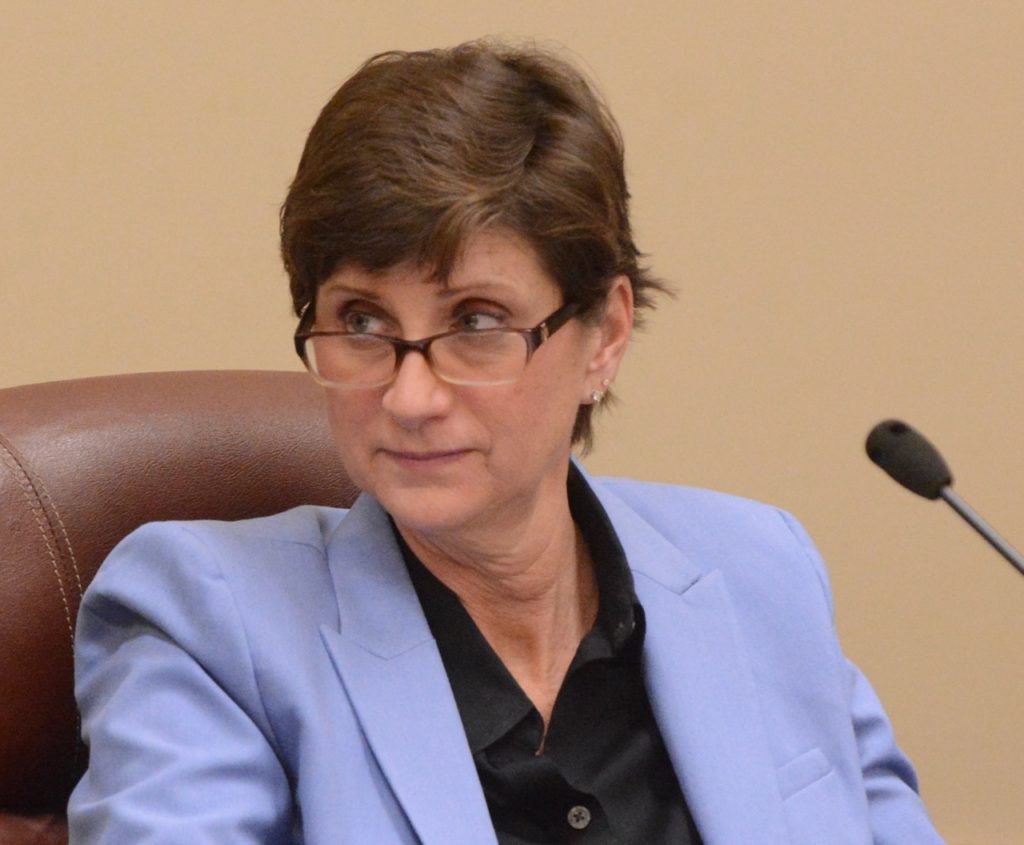
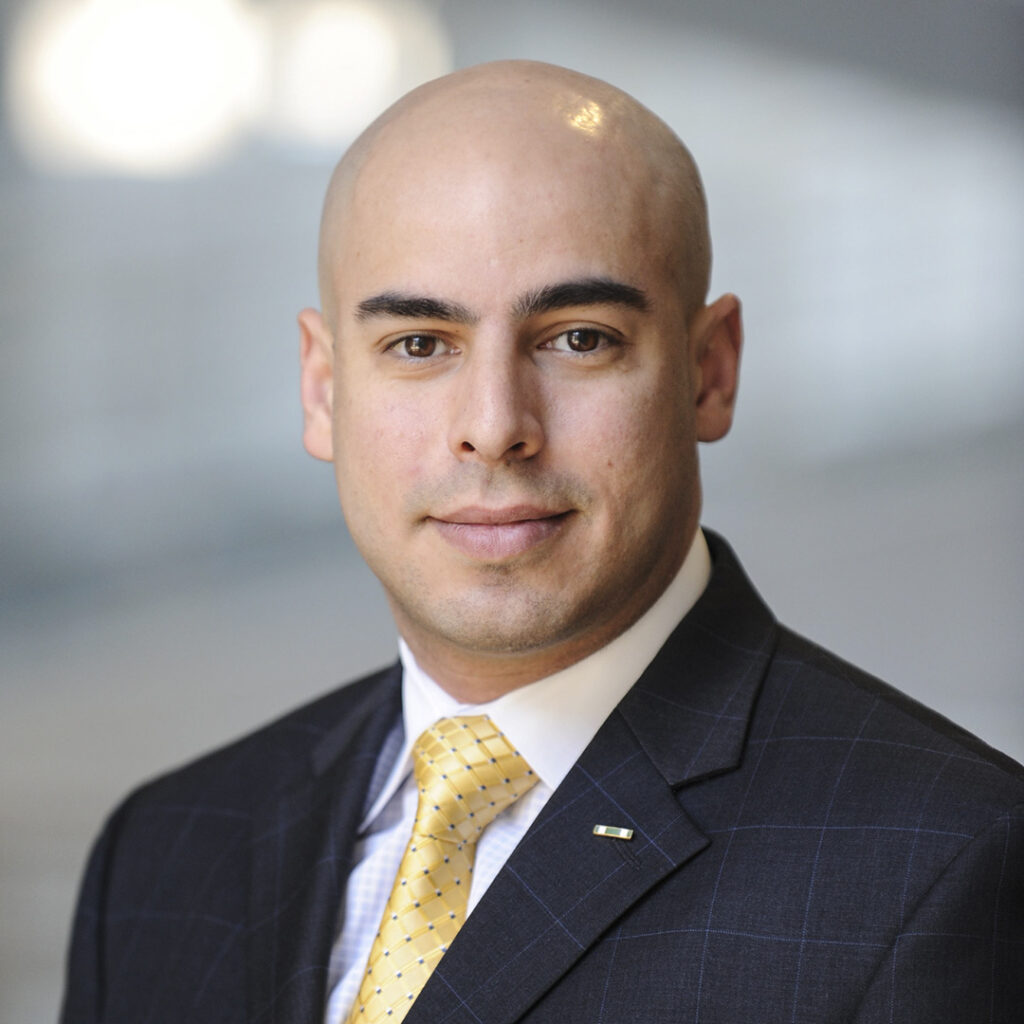
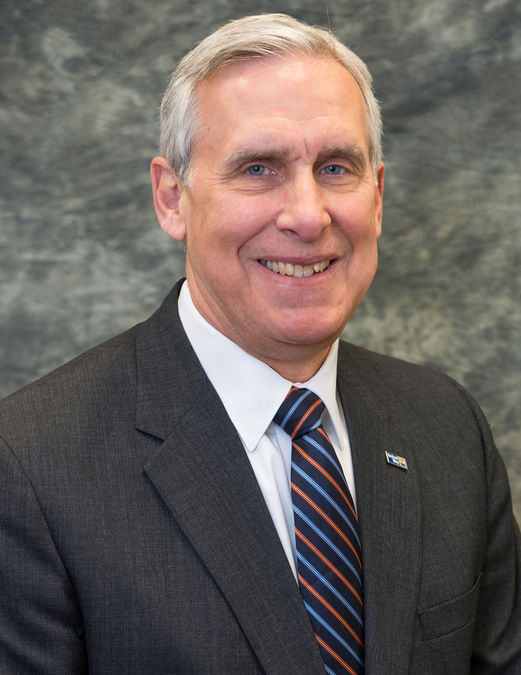
Dr. Stephanie K. Siddens Photo by the Ohio Department of Education
A new interim state superintendent will hold down the fort at the Ohio Department of Education, following the departure of the previous interim superintendent.
Dr. Stephanie K. Siddens, currently the senior executive for the state’s Center for Student Supports, will take over in September, after current superintendent Paolo DeMaria officially retires. The Ohio State Board of Education approved Siddens as interim head at a special meeting on Monday.
Siddens has been with the Ohio Department of Education since 2006, working as assistant director and director for the Office of Early Learning and School Readiness, and as senior executive director for the Center for Curriculum and Assessment, before taking her current job.
Deputy State Superintendent John Richard had previously been picked by the state school board to fill the interim spot, but on August 10, Richard announced he’d be leaving the department.
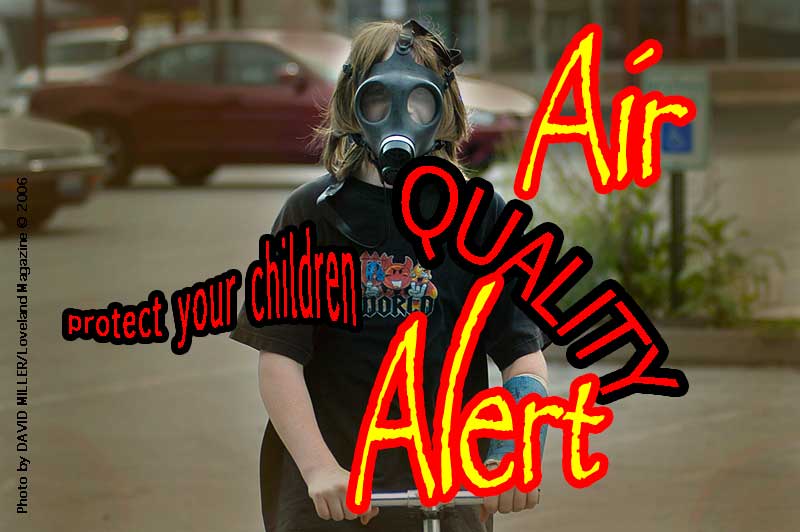
Loveland, Ohio – The Southwest Ohio Air Quality Agency has issued an Air Quality Alert for Wednesday, August 25 for the Loveland, Ohio Area.
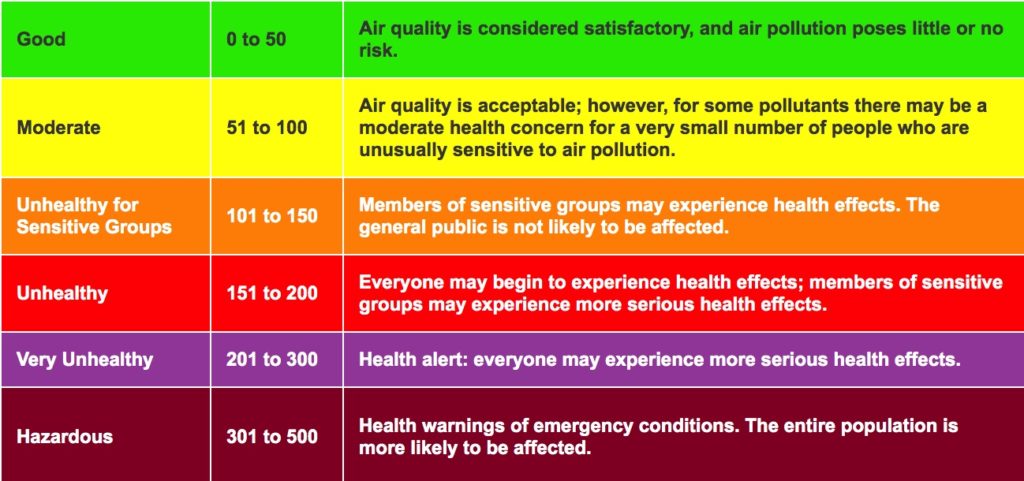
The Air Quality Index is predicted to reach 105.
The Agency expects to see levels of ozone in the “unhealthy for sensitive groups” range on the Air Quality Index.
Active children and adults, and people with respiratory diseases, such as asthma, should be avoiding all outdoor exertion; everyone else, especially children, should limit outdoor exertion.
Activities for children, who can be especially harmed by high levels of ozone because of their developing lungs and that some activities such as sports result in them breathing in quite a large amount of the chemical irritants should be suspended.
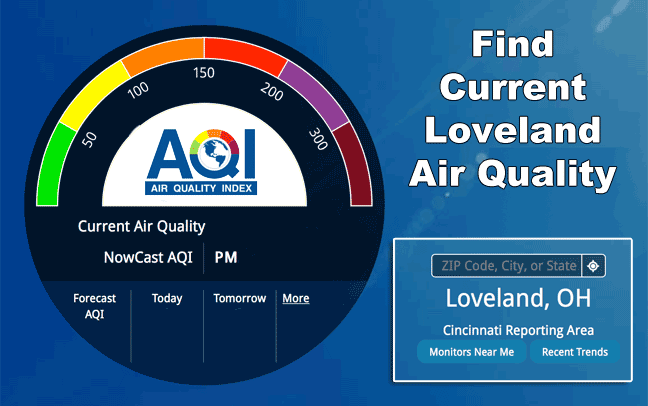
To keep informed about Loveland’s hour-by-hour air quality you can always look for this image on our Home Page or use this LINK.
On Air Quality Alert days, everyone can help reduce ozone formation by taking the following actions:
• Take the bus, carpool, bike, or walk instead of drive.
• Refuel your vehicle after 8 p.m.; do not top off when refueling and tighten the gas cap.
• Do not idle your vehicle; exhaust contributes considerably to ozone formation.
• Combine trips or eliminating unnecessary vehicle trips.
• Keep your vehicle maintained with properly inflated tires and timely oil changes.
• Avoid use of gasoline-powered lawn equipment on Air Quality Alert days.
• Avoid use of oil-based paints and stains on Air Quality Alert days.
• Never burn leaves or other yard trimmings.
• Suspend use of fire pits, campfires and charcoal grills on Air Quality Alert days.
• Conserve electricity by turning out lights and unplugging unused appliances and electronics.
Loveland, Ohio – “I have reviewed the CED application and the benefits it represents to the Loveland Madeira Road Business Corridor. Based on this review, I am submitting the application to City Council with a recommendation of approval and request that City Council schedule a public hearing to be held on September 28, 2021, to allow for public comment on the application,” Mayor Kathy Bailey said in a recent memo to Council.
Loveland Mayor Kathy Bailey (Loveland Magazine File Photo)
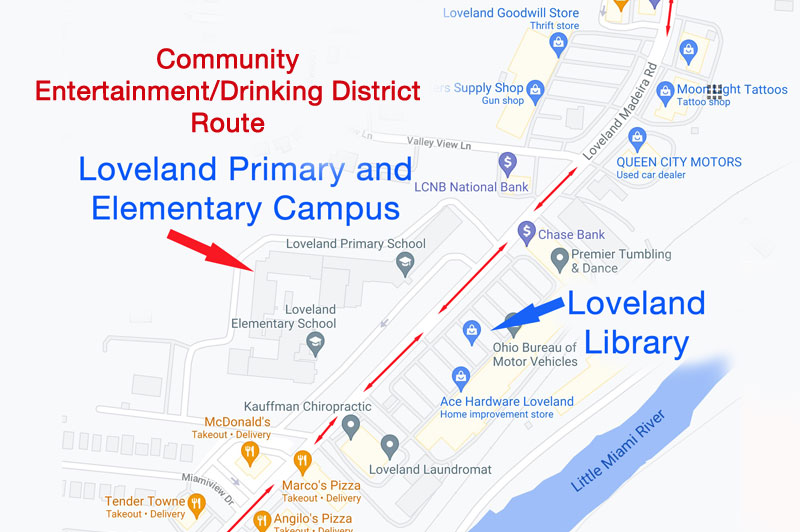
The drinking district, or “Community Entertainment District” (CED) within the Loveland Madeira Road business corridor would create 10 new D-5J liquor permits.
At the August 24 council meeting, City Manager Dave Kennedy described the effort as a new pool of liquor licenses, called D5-J, “…to help create a long and sustained turnaround for the Loveland Madeira Road business corridor.” He said it could expand the corridor’s opportunities for dining and entertainment-type businesses.
Mr. Kennedy added that, if a CED is created, a D5-J would cost the applicant a $100 processing fee and a permit fee of $2,344, a savings of $27,000.
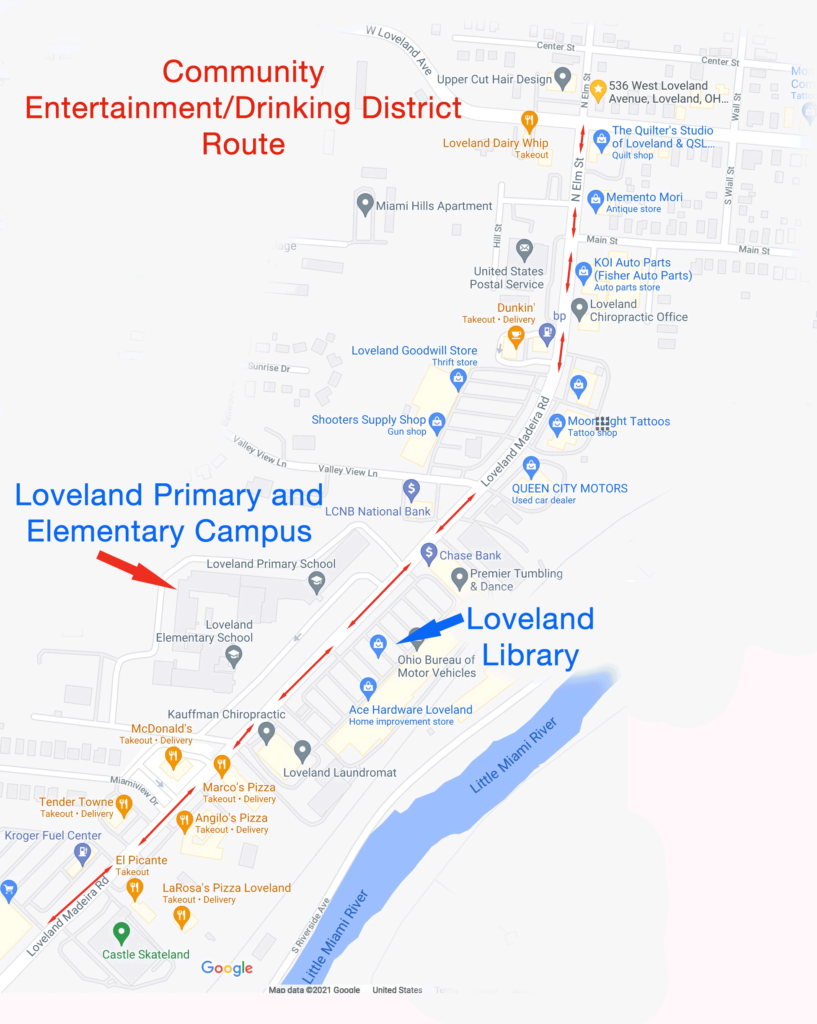
The proposed district would encompass 54.029 acres between the intersection of West Loveland Avenue to Kroger, including all of the city’s Chestnut Street parcels. If approved, it would allow for ten D5-J liquor permits to be available in the district. The City council must: approve or disapprove the application.
If Council moves forward with the process they will set a date and time for a public hearing regarding the application.
Kennedy told Council that the CED could easily be expanded in the future. He said there would be a maximum of fifteen D5-J licenses in one district.
Nearly two in three age-eligible teenagers remain unvaccinated against COVID-19 as summer ends and the disease looms over its third consecutive school year.
Spokespersons for the state departments of health and education said they did not know what percentage of students enrolled in public schools are vaccinated.
However, looking at the total population (which would include homeschooled students), more than 62% remain unvaccinated.
“As of today, there are 390,903 Ohioans age 12-18 who have started the vaccination process,” said Ohio Department of Health spokeswoman Alicia Shoults. “This represents 37.5% of that age group.”
Despite plans to attend classes in close contact with their peers several days per week, teenagers are the least vaccinated age cohort — surpassing 20-29-year-olds (44%) and 30-39-year-olds (51%).
The Pfizer/BioNTech vaccine was authorized for use in people aged 16-and-up in mid-December, though most states restricted access for elder and sicker residents through early 2021. The U.S. Food and Drug Administration authorized its use on children 12-15 on May 11.
At a press conference last week, Gov. Mike DeWine said a communal goal of keeping students in school for in-person learning is “threatened” by the hyper-transmissible Delta variant of COVID-19. He repeated a recommendation from ODH that students either seek vaccination or wear a mask at school.
“The best way to make sure a child can stay in school and not have his or her classes interrupted, is for that child to be vaccinated,” he said. “If that child cannot be vaccinated, the best way to ensure a good school year for that child is for that child to wear a mask while in class.”
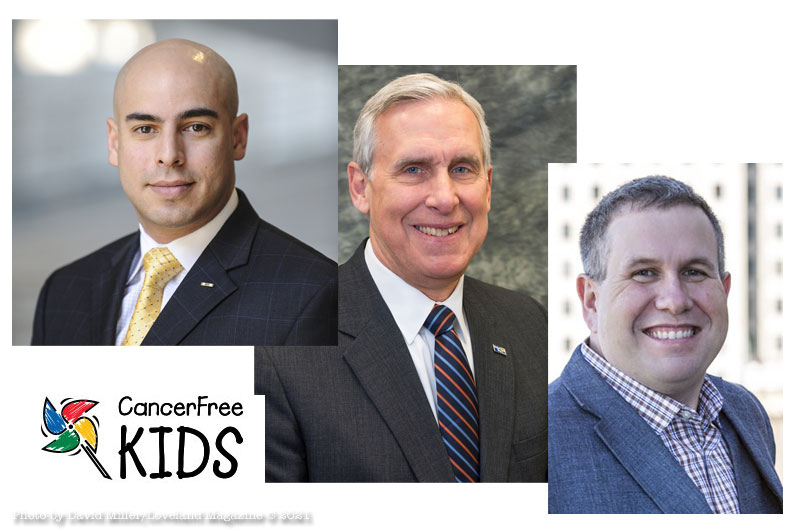
Loveland, Ohio – CancerFree KIDS has appointed three new members to its Board of Trustees in a move to “grow more relationships with Greater Cincinnati’s business community and expand its impact in pediatric cancer research”.
Tom Simpson, chief operating officer, Cincinnati Bell, Inc
Javier Diaz, vice president, Cancer & Blood Institute at Cincinnati Children’s Hospital Medical Center
Rob Reifsnyder, chief executive officer (retired), United Way of Greater Cincinnati
“We are strategically putting the pieces together to help take CancerFree KIDS to the next level,” says Al Early, vice president and principal of consulting services, CBTS, and incoming board chair for CancerFree KIDS. “With Javier, Rob, and Tom, we can stay closely aligned with emerging research opportunities while reaching more of Cincinnati’s business leaders and growing the support for vital pediatric cancer initiatives.”
Diaz, Reifsnyder, and Simpson join a board that has also recently seen a change in leadership.
Al Early replaces CancerFree KIDS Founder Ellen Flannery as the new board chair.
In addition to Early’s new role, Kelly Holden, partner, DBL Law has been named vice-chair and Greg Carroll, director, technical support center office of ground water, U.S. Environmental Protection Agency has been named treasurer.
“CancerFree KIDS is a tremendous partner to Ohio cancer researchers,” says Diaz. “I’m excited to join a team that is so clear in its mission to apply revolutionary research to cure high-risk and relapsed cancer in children. Thanks to CancerFree KIDS and the research it has funded, there are kids who are right now enjoying longer, happy lives. I am grateful for this opportunity to help CancerFree KIDS grow these important efforts.”
Founded in 2002, CancerFree KIDS has invested more than $7 million since its inception to fund high-risk, high- reward research initiatives at Cincinnati Children’s Hospital Medical Center in Avondale and Nationwide Children’s Hospital in Columbus. The studies intend to find cures and gentler treatments to help children better cope with the pains and challenges of fighting cancer. In most cases, this research would go unfunded without the support of CancerFree KIDS.
Visit www.cancerfreekids.org to learn more about the organization’s mission and work to fight childhood cancer.
Loveland, Ohio – The 12th Annual Captain Seth Mitchell Hero 5k will take place in Nisbet Park on Saturday, October 16. Hope to see you then to revise this great Loveland tradition.
Last year’s event was “virtual” but the race to raise funds for The Seth Mitchell scholarship programs this year in live and in person in Historic Downtown Loveland on the Loveland Bike Trail along the State and National Scenic Little Miami River.
Seth Mitchell, a captain and pilot in the United States Marine Corps and a 1997 Loveland High School graduate, was killed in action in Afghanistan in October 2009. Seth contributed greatly to the Loveland community in his youth… he served as a leader and role model on the varsity football team, was voted to be Class President his senior year, and was named “Mr. Personality” by his peers. He was well loved here. After graduating, he took that same sense of service and loyalty into all that he did: as a son, a brother, a friend, a leader in the Marines.
In other words, Seth was a hero for all.
We are a group of Seth Mitchell’s high school classmates, who miss our friend and want to keep his memory alive. We represent the many people who Seth made an impression on with his sense of humor, kind heart, and loyal friendship. As we organize this 5k Race and the scholarship memorial fund, we are motivated by one enduring inspiration: to live each day a little more honorably, kindly, and humbly… just like Seth.
Dear friends, we hope you are well, safe and doing all you can to blunt the force of the pandemic surrounding us. We are truly in unchartered water. Our prayers are with you. As you probably guessed we were unable to do personal on site interviews with our 2020 Seth Mitchell scholarship applicants. However we summoned the help from some younger folks and proceeded with the interviews through Google Hangout!! Yep, Steve and Connie on Google Hangout. Who’d of thought that? Loveland High School also did not have their annual Senior Night on May 13, so the scholarships were awarded virtually. We had 18 applicants this year and personally interviewed six before awarding the two scholarships detailed below. Your scholarship committee consisting of Greg Carpinello, Damien Cook, Mollie Schrichten, Marisa Sobb, (all friends of Seth and ’97 LHS graduates) Connie and I, take seriously the process to recruit, interview and select candidates. All the kids were deserving and we are especially proud of the recipients.
So here goes: The Let Us Never Forget Seth Mitchell scholarship ($3500.00) is a partnership between the Mitchell Family and the Let Us Never Forget Scholarship Foundation (yellowribbonsupportcenter.com). Jordan Collins (above left) is the 2020 recipient and she has a spirit similar to Seth. She was/is involved in many theatrical and musical productions, is a National Honor Society member, volunteers through Mom’s Hope and works part time. Jordan will be paying a large part of her college costs. She has a “do something” attitude, a strong work ethic and knows no stranger, being kind to all. She is not afraid to fail in the pursuit of her dreams and is strong in the face of adversity. She hopes to pursue her theatrical dreams at Syracuse University.
The Seth Mitchell Memorial Scholarship ($3,500.00) is funded by the Seth Mitchell Hero 5k (sethmitchell5k.org). This annual event is in its 11th year in downtown Loveland, OH and is ran by Seth’s friends named above. The goal of the scholarship is to keep Seth’s spirit and story alive. Caroline Ginder (above right) is the 2020 recipient of the Memorial Scholarship. Caroline was described by one of her references a “being self motivated and goal oriented…and a fine example of caring more about their teammate than herself”. She participated in many school events such as Tiger’s Inc., soccer, NEST and is a National Honor Society member. Caroline will attend Ohio State University where she will pursue medicine. She hopes to someday be a part of Doctors Without Borders. Like Jordan, Caroline is paying a share of her college costs.
Thank you for your support, prayers and investment in our scholarships through the last eleven years.
Steve and Connie Mitchell Parents, Capt. D. Seth Mitchell, USMC KIA 10/26/2009, Helmand Province, Afghanistan Let Us Never Forget
Loveland, Ohio – On August 14 the Time Stamp band performed 80’s and 90’s rock and roll covers at the Town Fountain and railroad station in Historic Downtown Loveland.
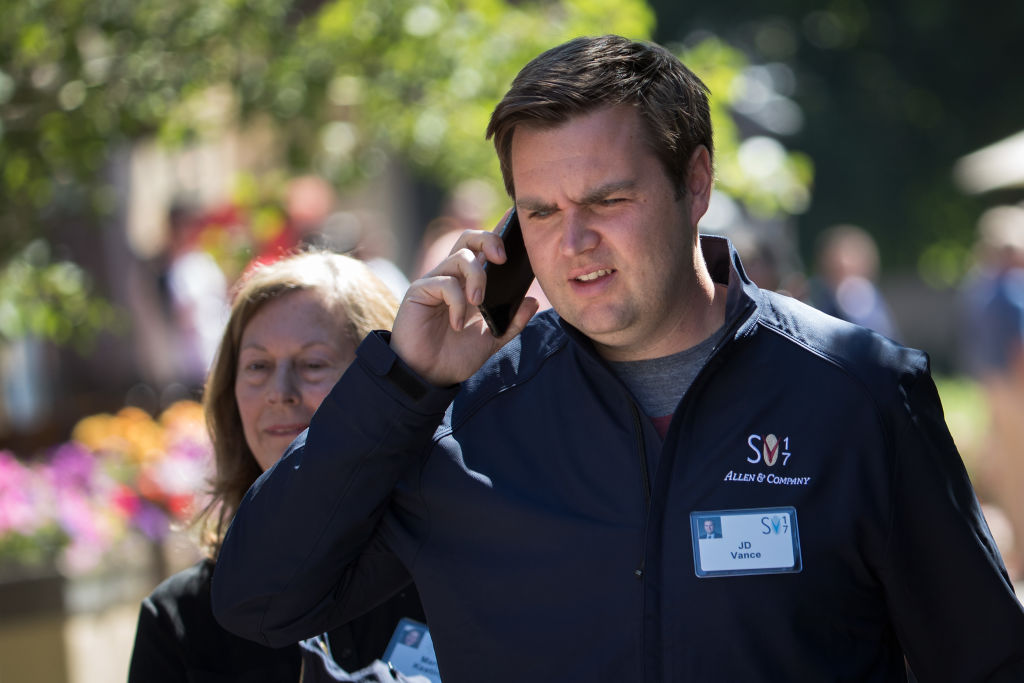
JD Vance, venture capitalist and author of ‘Hillbilly Elegy,” in 2017. (Photo by Drew Angerer/Getty Images).
COMMENTARY
MARILOU JOHANEK and Ohio Capital Journal
The last time I spoke with J.D. Vance, he was living the good life as an elite West Coast venture capitalist in Silicon Valley. He was a baby-faced investor from southern Ohio who was basking in the unexpected sensation of his newly published bestseller. Everybody had to get their hands on his memoir for what it might explain about the inexplicable presidential appeal of a former reality TV star. Vance’s book about his self-described hillbilly roots promised insights into why a dirt-poor, down on its luck demographic was swooning over a billionaire celebrity who wouldn’t be caught dead in Appalachia.
At the time I wrote for a newspaper in a blue-collar Ohio town whose glory days as a manufacturing mecca — like Vance’s hollowed-out hometown near Cincy — were long gone. So, I invited the author to connect with an Ohio audience that might relate to his story. He called from his office in San Francisco, and we spoke for over an hour. Recently, I went back to look at the transcript of that conversation to make sure it was the same Vance who now wants to be Ohio’s next U.S. Senator.
The senatorial candidate looks and sounds like the J.D. Vance I interviewed, save for the full Midwestern beard he’s sporting, but something’s very different. The Vance appearing — on any FOX show that will have him — is passing himself off as a fawning Trump acolyte and far right culture warrior. Who the heck is thatguy and what did he do with the thoughtful conservative I questioned who castigated another charlatan for pulling off a similar con to become president?
The 37-year-old moved back to Ohio, bought a sprawling million-dollar estate in a tony neighborhood in the Queen City and decided to boost his profile with a vain bid for national office. To that end, however, the 2021 version of Vance has sidled up to the infamous Mar-a-Lago insurrectionist, hobnobbed with big money donors on the coasts and rebranded himself as an alt-right grievance peddler. This character jumped right into the smarmy attack mode of the extreme right, owning the “degenerate liberals,” deriding the “party of childless people,” (what??) disparaging desperate immigrants as “dirty” drug traffickers threatening to overrun Ohio, dismissing critical race theory as “crap” parents don’t want in their schools, defending a white supremacist banned from Twitter for inciting violence and, of course, discounting life-saving measures during a surging pandemic as nefarious “efforts to control our lives.”
Candidate Vance opined that: “Obesity is a far more serious public health crisis than Covid,” and sardonically asked, “Should we mandate that no one be allow to eat fried chicken?” He parroted the insanity of right-wing Republicans that COVID “is not the only bad thing” and “people don’t trust (life-saving) vaccines because our public health authorities are understood, reasonably, to be political hacks who don’t know what they’re doing.” Besides, he added, brushing over 600,000 dead Americans, “what about basic bodily liberty?”
Seriously, whoisthis guy and why is he embracing the ugly scorch and burn tactics of the fearmongers and scapegoaters that 2016 Vance denounced as divisive and dangerous? Back then he told me, “Trump voters can be encouraged to look at their fellow countrymen as fellow citizens and that’s good. Or they can be made to think of them as scapegoats for all their problems and [that’s] the reason I am so against Donald Trump.” He [Trump] is pulling “a significant portion of the white working class” into a “more racist direction,” concluded Vance.
“He’s changing the political conversation in a way that makes it less likely for people to think of Black folks and Mexicans as countrymen” and instead “think of those people” as the ones to blame for everything that’s wrong in white America. “Racism is definitely a part of the Trump phenomenon,” said Vance. “The David Dukes of the world…[are] absolutely a part of the Trump movement. And I think to his great discredit, Trump hasn’t disavowed these people as strongly as he should. I really believe that Trump bears a lot of blame… we are seeing an unprecedented level of racial resentment and racialized rhetoric in this [2016] election.”
But Candidate Vance is blowing the same dog whistles he once disavowed from a candidate he derided as a “moral disaster.” Trump’s personal conduct alone, Vance said, “would have been so offensive to my [Appalachian] grandmother that she would have hated it… there’s no way she would have voted for him.” Vance confided he was disappointed in religious leaders “who have made a lot of apologies for Trump’s behavior…if Barack Obama, who by all accounts is an incredible family man, if he had fathered five children from three women…there would be a lot of religious conservatives all over him…”
“I don’t think it’s totally out of bounds to say we should hold our presidents up to a certain moral standard…and it’s just astonishing to me that we haven’t done the same thing for Donald Trump,” Vance told me. That was before Trump was elected and the serial corruption, deceit, dishonor and damage commenced. Before his first impeachment for trying to rig the 2020 election in exchange for foreign aid and his second impeachment for inciting an insurrection against his own government to steal an election he lost.
It was also before J.D. Vance pulled a 180 on his former self. The young writer I talked to over four years ago was different. He was authentic, unafraid to chastise his community for its “lack of agency” and “a feeling that you have little control over your life and a willingness to blame everyone but yourself.” It was personal for Vance, whose mother was in the same rut. “I don’t blame Mom for the way she lived her life. I don’t blame her for the addiction. I don’t blame her for the way she sometimes treated me and my sister. What I would blame Mom for is if she stopped trying.”
That J.D. Vance was nothing like the Ohio Senate candidate blaming everyone else today. That actor is degrading all the people MAGA supporters love to hate — from rich educated elitists (like himself) to the mainstream media, Brown immigrants and Black Lives Matter protestors. So, which J.D. Vance is the real deal, and which one is running a clumsy con as a faux extremist to pursue an open Senate seat in Ohio?
You know. Ohio voters can spot the phony a mile away.
Top U.S. health officials announced a plan Wednesday to begin offering COVID-19 booster shots to Americans starting Sept. 20, with the scheduling of the additional shot to be based on when a person was fully vaccinated.
The new round of jabs will be extended to those who received the two-dose vaccine from either Pfizer or Moderna, and can be taken eight months after an individual’s second dose.
Dr. Vivek Murthy, the U.S. surgeon general, told reporters Wednesday that recent data makes clear that while the current COVID-19 vaccines have been highly effective against severe disease, hospitalization and death, the protection against mild and moderate disease has appeared to decrease over time.
“This is likely due to both waning immunity and the strength of the widespread delta variant,” Murthy said, adding that health officials are concerned that the decline in immunity could reduce protection against severe disease and death in the months ahead.
The more than 13 million Americans who received the one-dose shot from Johnson & Johnson may also need boosters, but will not yet be eligible.
Federal health officials said they are awaiting data from J&J in the next few weeks before urging additional doses. The J&J shot wasn’t approved until March, so those who received it will not hit eight months past inoculation until November.
The new booster rollout plan is subject to formal authorization from the Food and Drug Administration and the Centers for Disease Control and Prevention’s vaccine panel.
Those agencies will hold public meetings before the booster rollout can begin. But officials said they were detailing the booster plan ahead of those meetings in part to give state and local health officials time to prepare for another wave of vaccination logistics.
State and local health officials again under pressure
The plan for offering a third shot puts yet another layer of pressure on state and local health departments that have carried out the massive vaccination campaign.
Those officials are still seeking to boost vaccination rates that have lagged in certain regions amid skepticism and misinformation. Meanwhile, vaccine manufacturers are expected this fall to seek approval for administering shots to children under 12, who so far have not been eligible.
During Wednesday’s news briefing, Dr. Rochelle Walensky, the CDC director, cited several new studies that tracked vaccine effectiveness, including among New Yorkers across age groups and another following case counts from nursing homes.
Those studies have shown that protection against severe infection has held up but not against milder infections, she said, adding that other countries, such as Israel, also are starting to see “worsening outcomes.”
“In the context of all of these studies, different cohorts, different settings across the country, and our international colleagues, we’ve made the decision to plan for these booster doses,” Walensky said.
The booster shots will be available at roughly 80,000 sites nationally, including 40,000 local pharmacies. As with the other COVID-19 shots, the boosters will be free of charge.
The CDC had already approved a third COVID-19 shot for some immunocompromised individuals, who may not have received strong protection from the initial doses of the vaccine.
While the booster plan does not specifically mention other categories of individuals to receive a priority for boosters, the initial vaccine rollout did put certain groups first in line. So the first individuals to hit eight months after their second shot should be those in the earliest priority categories, such as health care workers and nursing home residents.
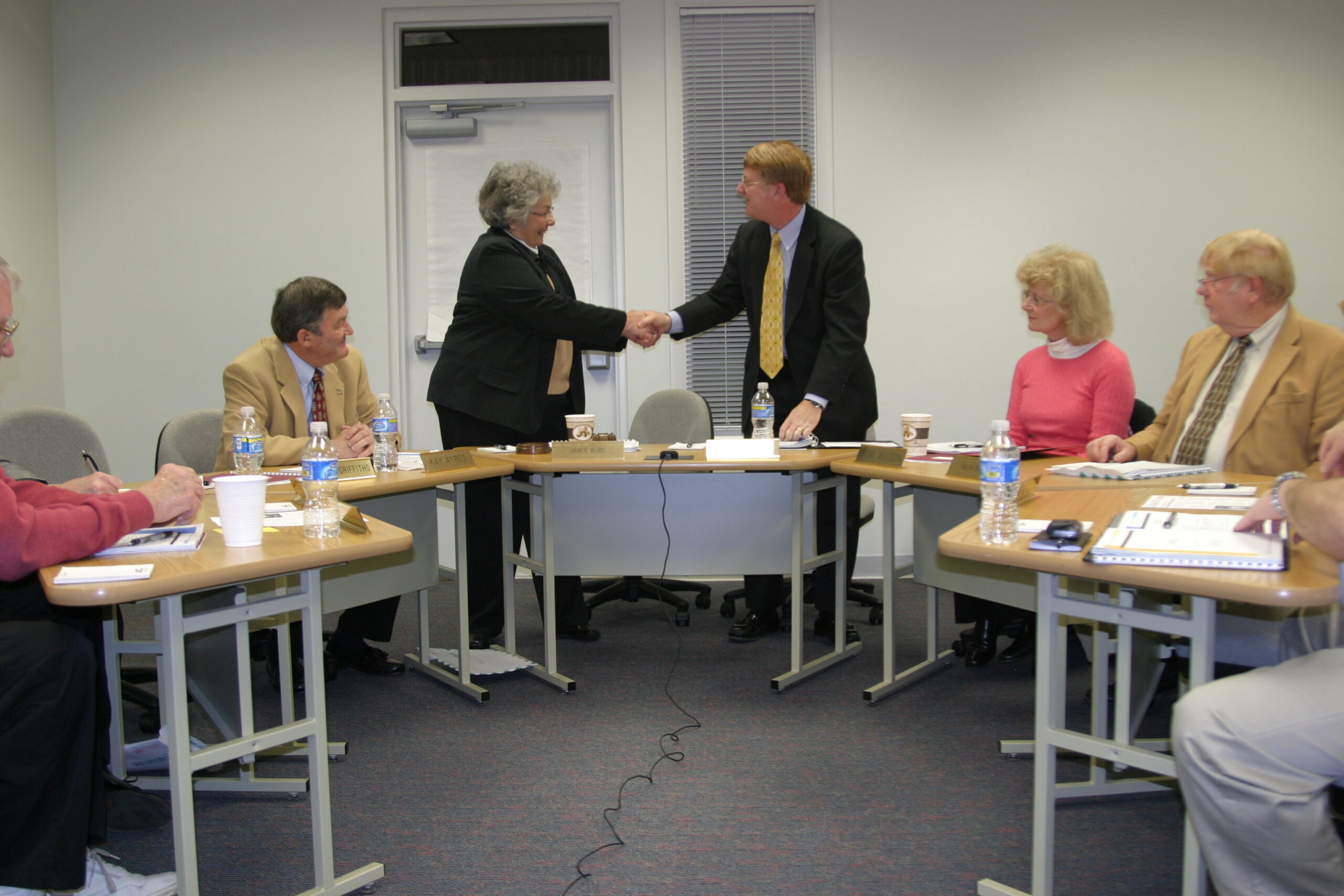
SSCC President Dr. Kevin Boys, standing at right, shakes hands with former Board of Trustees member, the late Kay Ayres, at his first board meeting in 2010.
Southern State Community College (SSCC) President Dr. Kevin Boys on Wednesday announced his retirement from the college effective June of next year.
Prior to his presidency, Boys served for 31 years in K-12 education as a teacher, principal and superintendent in Loveland and Sycamore school districts. Boys was employed in Loveland from July 1, 2002 through December 2009.
The announcement signals the end of more than a decade of Boys’ leadership at Southern State.
Boys provided his letter of resignation for the purpose of retirement to the SSCC Board of Trustees at its regular meeting on August 18, setting his final day for June 30, 2022 to provide time for the board to find a replacement.
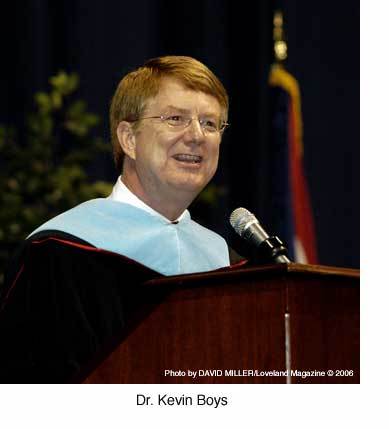
Dr. Kevin Boys addressing the 2006 Graduating Class of Loveland High School. (Loveland Magazine File Photo)
Boys has led the college since Jan. 1, 2010. During his tenure, he served under Ohio governors Ted Strickland, John Kasich and Mike DeWine. Both of Boys’ children attended and graduated from Southern State during his presidency. He resides in Clinton County.
Boys said in his retirement letter that he had planned to retire in 2020, but the COVID-19 pandemic prompted him to remain in leadership for an additional year beyond his contract.
“I felt it imperative that I stay to see us through the many challenges that this pandemic has brought our way,” he said. “It will be time for fresh leadership to take on new challenges as the college recovers from the pandemic and explores new opportunities to further its important mission.”
Boys said SSCC’s graduates range in age from the early teen years to well into a late age, and many would not have pursued a college degree if the college was not here for them.
“That has motivated me and brought joy to me nearly every day,” he said.
Boys also served as co-chair of the Higher Education Funding Commission with President Rod McDavis, devising a plan to distribute substantial capital funding to the state’s public colleges and university systems. Additionally, Boys served on the board of directors of the American Association of Community Colleges, and as Vice-chair of the Ohio Association of Community Colleges.
Boys graduated from the inaugural class of Leadership Adams and the 25th class of Leadership Clinton.
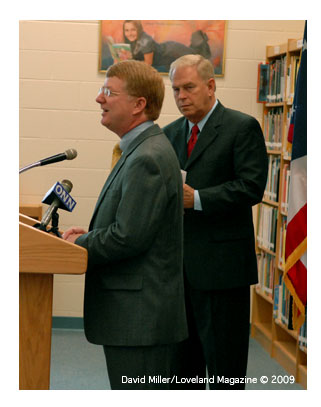
Dr. Kevin Boys introduced Ohio Govenor Ted Strickland at the Loveland Intermediate School in 2009 when Strickland announced his State budget and school reform. (Loveland Magazine File Photo)
Boys has served on the Highland County Chamber of Commerce Board for 10 years and is currently the chair of the Community Colleges of Appalachia, a membership group of 80 colleges throughout the Appalachian region. He is also a board member of the Rural Community College Alliance.
“It truly has been the honor of my life and pinnacle of my 42 years in public education to have served alongside you in providing accessible, affordable, and high-quality education to the citizens throughout these counties in Southern Ohio,” he said in his resignation letter.
Boys thanked the Board of Trustees, both current and past, who served as stewards of the institution, as well as dedicated faculty, staff and administrators.
“Southern State Community College is in good hands,” he said.
SSCC Board of Trustees Clinton County Chairman Brian Prickett wished Boys well in retirement and thanked him for his service to the college.
“I wish him well as he moves to the next phase of his life in retirement,” Prickett said. “His calm, professional demeanor in many recent trying situations is going to be missed. He is a true leader, and the school’s going to have to work very hard to replace his knowledge and his visibility to lead folks as we move forward and grow.”
Boys told Loveland Magazine, “I regard my years in Loveland with great fondness.” He and his wife now live in Wilmington. “We have neighbors close on both sides but we overlook our pond and the farm behind complete with red barn. We’re not sure what we’ll do in retirement, but for now we’ll enjoy the country.”
Boys said in retirement he plans to pick up playing his mandolin again, travel and “catch my breath.”
“I also plan to take my morning walks a little later in the morning,” he said.