
Tag: MEGAN HENRY

  • Ohio lawmakers are trying once again to remove slavery from state’s constitution

    Ohio lawmakers are trying once again to remove slavery from state’s constitution

    Juneteenth flag. (Getty images)

    By:  Ohio Capital Journal

    Ohio Democratic lawmakers want to eradicate slavery from the Ohio Constitution.

    State Reps. Dontavius Jarrells, D-Columbus, and Veronica Sims, D-Akron, are working on a joint resolution that would remove slavery from the state’s foundational document.

    “This isn’t political,” Jarrells said Wednesday during an Ohio Legislative Black Caucus press conference. “This isn’t personal. This is a moral overdue journey to change our constitution once and for all. Other states have already done it. We simply want Ohio to live up to this promise of freedom.”

    GET THE MORNING HEADLINES.


    The 13th Amendment to the U.S. Constitution abolished slavery and involuntary servitude, except as punishment for being convicted of a crime. The Ohio Constitution currently says “There shall be no slavery in this state; nor involuntary servitude, unless for the punishment of crime.”

    Seven states have removed the slavery loophole from their constitution — Alabama, Oregon, Tennessee, Vermont, Utah, Colorado, and Nebraska, according to the Abolish Slavery National Network.

    “I submit that slavery and or involuntary servitude in any shape, form or fashion, should be disembodied from the sacred pages of the founding document of our great state,” Sims said. “It is time to remove any exception under any circumstances, slavery is a vile, despicable imposition upon another human being.”

    This is not the first time there have been legislative attempts in Ohio to remove slavery from the state’s constitution. Jarrells had a bipartisan joint resolution that was unable to get out of committee during the last General Assembly. A Senate Joint Resolution was also unsuccessful back in 2020.

    If the House and Senate pass the new joint resolution, it would go to the statewide ballot for the voters to decide.

    Wednesday’s press conference was hosted by members of the Ohio Legislative Black Caucus in honor of Juneteenth, a federal holiday Thursday remembering the end of slavery in the United States on June 19, 1865 — two years after the Emancipation Proclamation.

    “Juneteenth signifies the end of slavery, and it’s a time to celebrate,” said State Rep. Terrence Upchurch, D-Cleveland. “Although we are proud of the progress we have made, that does not negate the fact that there are still several challenges Black Ohioans face across the state. People are still struggling with finding housing, healthy foods, good paying jobs, satisfactory education, fair treatment in the justice system, and so much more.”

    Jarrells introduced House Bill 306 last month, also known as the Enact the Hate Crime Act.

    “It empowers victims with real civil remedies and gives law enforcement clear, enforceable tools to hold perpetrators accountable,” he said. “This bill says that every single person in this state deserves to live without fear, and if you are targeted for who you are, this state will stand with you.”

    State Rep. Darnell T. Brewer, D-Cleveland, talked about recent gun legislation he is working on.

    “Gun violence is devastating our communities,” he said. “We can no longer afford to be silent or inactive.”

    Black youth are 11 times more likely to die from firearm homicide than their white peers, according to Brady: United Against Gun Violence.

    Brewer said he plans on introducing a resolution to encourage responsible gun ownership by promoting safe storage practices to prevent children from accessing guns and a resolution on safe firearm storage education.

    “Gun violence is not just an emergency,” he said. “It’s a daily reality.”Infant mortality, when a child dies before their first birthday, is higher for Black babies compared to white babies. The national infant mortality rate is 5.5 per 1,000 live births for babies and 10.9 for Black babies, according to the Centers for Disease Control and Prevention. The infant mortality rate for Ohio Black babies in 2022 was 13.4 per 1,000 live births.

    “Why do we stop caring about babies after they’re born?” State Rep. Derrick Hall, D-Akron, asked.

    State Rep. Ismail Mohamed, D-Columbus, talked about House Bill 281, a bill that would withhold Medicaid funding from hospitals that do not cooperate with the United States Immigration and Customs Enforcement. State Rep. Josh Williams, R-Sylvania Twp., introduced the bill last month.

    “What this bill does is essentially force medical providers to choose between honoring your oath as medical providers or complying with the state’s political agenda,” Mohamed said. “It will discourage immigrant communities from seeking life saving treatment care out of fear.”

    Mohamed also talked about House Bill 1, a piece of legislation that would place restrictions on foreign ownership of land. State Reps. Angie King, R-Celina, and Roy Klopfenstein, R-Haviland, introduced the bill earlier this year.

    “It is arbitrary,” Mohamed said. “It is discriminatory in its face, and will negatively impact economic development in the state of Ohio.”

    Follow Capital Journal Reporter Megan Henry on Bluesky.


    Megan Henry
    Megan Henry

    Megan Henry is a reporter for the Ohio Capital Journal and has spent the past five years reporting in Ohio on various topics including education, healthcare, business and crime. She previously worked at The Columbus Dispatch, part of the USA Today Network.

    Ohio Capital Journal is part of States Newsroom, the nation’s largest state-focused nonprofit news organization.

    MORE FROM AUTHOR

  • New report identifies anti-LGBTQ+ incidents in Ohio

    New report identifies anti-LGBTQ+ incidents in Ohio

    Includes incidents outside Great American Ballpark.

    Close-Up of rainbow flag with crowd In background during LGBT Pride Parade. Getty Images.

    By:  – Ohio Capital Journal

    Nearly 50 anti-LGBTQ incidents happened in Ohio in a year, according to a new report by the Gay and Lesbian Alliance Against Defamation.

    GLAAD’s Anti-LGBTQ Extremism Reporting Tracker (ALERT) documented 932 anti-LGBTQ incidents nationwide from May 1, 2024 to May 1, 2025. A little more than half of all nationwide incidents targeted transgender and gender non-conforming people.

    GET THE MORNING HEADLINES.


    These incidents led to 84 injuries (including one in Ohio) and 10 deaths, according to the report.

    ALERT tracked these incidents through self-reports, media, social media posts and data sharing from partner organizations and law enforcement.

    “This year, rollbacks in LGBTQ visibility and challenges to our rights are coupled with a sharp rise in anti-LGBTQ rhetoric and disinformation across social media and political campaigns,” GLAAD President & CEO Sarah Kate Ellis said in a statement. “It’s only through awareness, collective action, and community that we can turn the tide toward greater safety and acceptance.”

    The ACLU is currently tracking nearly 600 anti-LGBTQ bills nationwide, some of which are in Ohio.

    Ohio incidents

    Nearly half of the incidents in Ohio involved the Dayton Street Preachers hosting anti-LGBTQ protests at universities, events, street corners, Pride events, or outside the Great American Ballpark in Cincinnati.

    Many of the Ohio incidents involved Pride flags being stolen last summer.

    A transgender woman was injured while bartending a drag show in Columbus last July, according to the report. A man disrupted the show and was kicked out by the bartender, but the man punched the bartender and kicked down the glass door while yelling homophobic slurs, according to NBC4.

    Back in March, someone threatened to shoot up an upcoming drag show event in Columbus in the comments of a Facebook event, according to the report.

    Ohio bills

    In terms of anti-LGBTQ legislation, some anti-LGBTQ laws took effect in Ohio earlier this year, including banning Ohio transgender students from using school bathrooms and locker rooms that align with their gender identity. It also bans students from sharing overnight accommodations with people of the opposite sex from their assigned sex at birth at a K-12 school.

    Republicans have introduced other measures targeting the LGBTQ community this year.

    Ohio House Bill 190 would prohibit school employees from calling a student a name that is not listed on their birth certificate and would ban them from using pronouns that do not align with their biological sex.

    Ohio House Bill 172 would not allow minors age 14 and older to receive mental health services without parental consent. Currently, mental health professionals are permitted to provide outpatient mental health services to minors 14 and older on a temporary basis without parental consent.

    State Rep. Johnathan Newman, R-Troy, introduced both bills and said H.B. 172 is a follow-up to a law that took effect earlier this year that requires educators out a student’s sexuality to their parents.

    House Bill 249 would ban drag performers from performing anywhere that isn’t considered a designated adult entertainment facility.

    On the Democratic side, state Reps. Eric Synenberg and Anita Somani recently introduced the Marriage Equality Act which would place put a constitutional amendment on the November 2026 ballot that would enshrine marriage equality in the state constitution. This is in response to a constitutional amendment Ohioans passed in 2004 that defines marriage as “only a union between one man and one woman.”

    Follow Capital Journal Reporter Megan Henry on Bluesky.


    Megan Henry
    Megan Henry

    Megan Henry is a reporter for the Ohio Capital Journal and has spent the past five years reporting in Ohio on various topics including education, healthcare, business and crime. She previously worked at The Columbus Dispatch, part of the USA Today Network.

    Ohio Capital Journal is part of States Newsroom, the nation’s largest state-focused nonprofit news organization.

    MORE FROM AUTHOR

  • Ohio Senate Democrats hope to fully fund public schools, not fund Browns stadium in state budget

    Ohio Senate Democrats hope to fully fund public schools, not fund Browns stadium in state budget

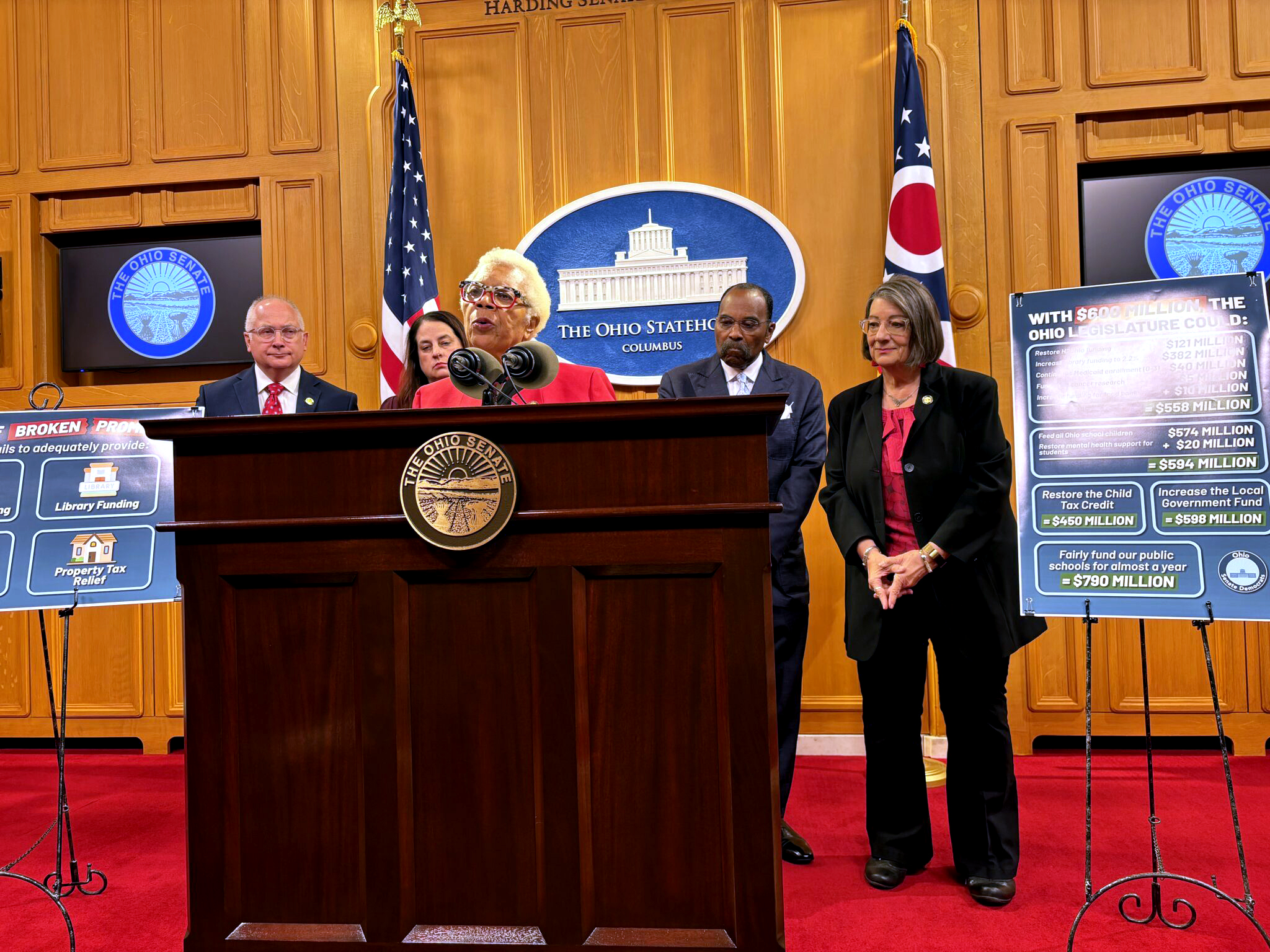
    Ohio state Sen. Paula Hicks-Hudson, D-Toledo, and other members of the Senate Democratic Caucus discuss the amendments they submitted to the state’s two-year operating budget. (Photo by Megan Henry, Ohio Capital Journal).

    By: Ohio Capital Journal

    Ohio Senate Democrats have submitted 423 amendments to the two-year state operating budget — including one removing the $600 million bond package for a new Cleveland Browns stadium in Brook Park, and one to fully fund public schools.

    The Ohio House passed their version of the budget last month and the Senate is currently working on the budget, which Ohio Gov. Mike DeWine must sign into law by June 30.

    GET THE MORNING HEADLINES.


    “This budget steals from our children by defunding public schools, transfers money for health care and libraries to rich benefactors, all the while failing to address the needs of hard working everyday Ohioans,” Senate Minority Leader Nickie J. Antonio, D-Lakewood, said Tuesday during a press conference.

    “This Republican budget prioritizes partisan agendas and handouts to the wealthy and well-connected, also through vouchers, tax breaks, and a stadium giveaway to the tune of more than half a billion dollars, all paid for by the working class,” she said.

    The Senate Democrats had a few different ideas for how $600 million can be spent — a direct shot at how the Ohio House Republicans added a bond package for a new Cleveland Browns stadium for that same amount in their version of the budget.

    Republicans hold a 24-9 supermajority in the Ohio Senate, giving Democrats very little power to enact any of their priorities. Nevertheless, Democratic lawmakers laid out their vision of what the state could be doing differently.

    The Ohio legislature could restore H2Ohio funding for $121 million, increase library funding to 2.2% for $382 million, offer continuous Medicaid expansion enrollment for $40 million, fund child cancer research for $5 million, and increase funding for food banks for $10 million (which totals to $558 million), Antonio said.

    Or lawmakers could feed all Ohio school children for $574 million and restore mental health support for students for $20 million, Antonio said.

    The legislature could restore the Child Tax Credit for $450 million, increase the Local Government Fund by $598 million, and fairly fund public schools for almost a year for $790 million, Antonio said.

    “If I were queen of the world, all these things would be part of our general fund budget,” she said.

    If $600 million is bonded out for a sports franchise, “Ohioans are still on the hook for that money in the long run,” Antonio said.

    DeWine originally proposed doubling the tax on sports betting from 20% to 40% with proceeds going to fund professional sports stadiums and Ohio youth sports.

    “I thought what the governor proposed originally was actually a better way to go because the funds were coming from outside entities,” Antonio said. “It has the whole state in mind, not just one group in one part of the state.”

    She said she would “be much more supportive” of an amendment along those lines.

    School funding

    To fully fund public schools based on statistics from the Fair School Funding Plan from 2021, schools would need an additional $666 million in funding (more now with inflation), but the proposed budget only gives them about $226 million.

    “It breaks the promise we’ve made for our children in public schools by abandoning fully funding the Fair School Funding Plan,” Antonio said.

    The Cupp-Paterson Fair School Funding Plan from 2021 was supposed to take six years and was meant to change how public dollars are provided to K-12 schools by giving additional support to local districts so they can rely less on property taxes.

    The first two years were partially fully funded and the second two years were fully funded. There are two more years left.

    “Our caucus has submitted amendments that would fully fund the fair school funding plan,”  Antonio said.

    The Senate Democratic amendments would also increase the state minimum teacher salary from $35,000 to $50,000, she said.

    Additional amendments

    Ohio Senate Democrats added an amendment to restore DeWine’s proposed $1,000 child care tax credit and another that would remove the language the Ohio House added to the budget that would make changes to the Ohio Housing Trust Fund.

    The Housing Trust is funded by a portion of the fees collected by county recorders, with half of the fees staying with the county and the other half going back to the fund — which requires at least 50% of the funds be spent in non-urban areas.

    The House budget proposal would remove the requirement for county recorders to send the state Department of Development money to reallocate the funds — something housing advocates say make it less effective across the state.

    “Rural areas would also be most impacted by the potential blocks of housing services as well, but all Ohio communities will see service disruption and increases in homelessness and decrease in access to affordable housing,” said Ohio state Sen. Paula Hicks-Hudson, D-Toledo.

    Ohioans deserve better from the state budget, Antonio said.

    “I think a whole lot of everyday Ohioans are going to be very surprised and have a whole lot of buyer’s remorse when they find out what it is that these people are doing on their behalf,”  Antonio said when asked about the Republican supermajority in the Statehouse.

    Follow Capital Journal Reporter Megan Henry on Bluesky.
    Megan Henry
    Megan Henry

    Megan Henry is a reporter for the Ohio Capital Journal and has spent the past five years reporting in Ohio on various topics including education, healthcare, business and crime. She previously worked at The Columbus Dispatch, part of the USA Today Network.

    Ohio Capital Journal is part of States Newsroom, the nation’s largest state-focused nonprofit news organization.

    MORE FROM AUTHOR

  • Ohio private college presidents ask to get rid of proposed changes to Governor’s Merit Scholarship

    Ohio private college presidents ask to get rid of proposed changes to Governor’s Merit Scholarship

    Getty Images

    By:  Ohio Capital Journel

    Ohio private college presidents slammed proposed requirements for participating in the Governor’s Merit Scholarship that were added to the House’s version of the two-year operating budget during testimony in the Senate Higher Education Committee.

    The committee had four hearings on the budget, which Senate lawmakers are currently working on. The Ohio House passed the budget last month and Ohio Gov. Mike DeWine must sign the budget by June 30.

    GET THE MORNING HEADLINES.


    Todd Jones, president and general counsel of the Association of Independent Colleges and Universities of Ohio (AICUO), spoke out against provisions the Ohio House added to the budget regarding new requirements for private colleges if they want to continue to participate in the Governor’s Merit Scholarship, which gives the top 5% of each high school graduating class a $5,000 scholarship each year to go to an Ohio college or university.

    Under the new changes made in the House, private colleges would also have to accept the top 10% of Ohio’s graduating class and comply with parts of Senate Bill 1 — Ohio’s new higher education law that bans diversity and inclusion efforts and regulates classroom discussion, among other things.

    “I want to be clear that our concerns are not about DEI and SB 1,” Jones said. “Our concerns are about the very nature of our institutions and what it means to be a private, nonprofit institution. … When the state dictates our missions, board structures, curriculum, hiring practices, workloads, and public engagement, the autonomy that defines nonprofit institutions disappears.”

    Tiffin University President Lillian Schumacher said the S.B. 1 mandates would increase operational costs without improving educational outcomes.

    “For many institutions, these new burdens could lead to closures, reduced financial aid, higher tuition, and a reduction in critical educational services for students,” she said in her testimony.

    Forcing private colleges and universities to accept the top 10% of Ohio’s graduating class would create challenges for those institutions, Chancellor of the Ohio Department of Higher Education Mike Duffey said.

    “Public universities have the infrastructure with branch campuses, large-scale facilities, and state funding to absorb enrollment increases,” Jones said. “Independent institutions operate on much smaller scales.”

    Eight AICUO institutions function out of a single academic building, he said.

    “Imposing this mandate without providing financial or logistical support places an impractical burden on private colleges,” Jones said.

    Being able to welcome an additional influx of students depends on various factors including the students’ major, housing and financial needs, University of Findlay President Kathy Fell said.

    “I know we all agree that students will not benefit from this opportunity if approbate supports and resources for success are not available,” she said in her testimony.

    Aultman College President Jean Paddock said the 10% acceptance mandate would not be possible in healthcare programs that are limited to a capped number of seats.

    “With a nursing shortage well documented, sending our best and brightest who want to enter the healthcare field to other states is the opposite of what we want,” Paddock said in her testimony.

    The Governor’s Merit Scholarship was enacted through the last state budget two years ago and 76% of the state’s 6,250 eligible students from the class of 2024 accepted the scholarship. The acceptance rate was 100% in Hocking, Holmes, Putnam, Adams, Monroe, Noble, and Vinton counties, Duffey said.

    In the second year of the scholarship, 87% of Ohio students accepted the scholarship and 11 rural counties had a 100% acceptance rate, Duffey said.

    Ohio Sen. Jane Timken, R-Jackson Township, said she has received several inquiries from private colleges and universities with concerns about the Governor’s Merit Scholarship requirements being linked to compliance with parts of S.B. 1.

    “Clearly we would lose some students if they weren’t able to access those funds,” Duffey said.

    The budget currently allocates $47 million for fiscal year 2026 and $70 million for fiscal year 2027 for the Governor’s Merit Scholarship.

    Follow Capital Journal Reporter Megan Henry on Bluesky.

    EDITOR’S NOTE:

    These Loveland High School seniors earned a Governor’s Merit Scholarship. Only the top 5% of Ohio high school students are eligible for this scholarship, worth up to $5,000 toward tuition at an Ohio college or university.

    • Olivia Bast
    • McKenzie Dunlap
    • Chloe Finkler
    • Luis Garcia Saucedo
    • Daniel Gomez Carrillo
    • Jacob Hentz
    • Alyse Knapschaefer
    • Mackenzie Liu
    • Carter Lucas
    • CJ Margraf
    • Isaiah Marx
    • Jonas Moore
    • Tyler Roberts
    • Benjamin Tibbs
    • Sophia Yurovski

    Megan Henry
    Megan Henry

    Megan Henry is a reporter for the Ohio Capital Journal and has spent the past five years reporting in Ohio on various topics including education, healthcare, business and crime. She previously worked at The Columbus Dispatch, part of the USA Today Network.

    Ohio Capital Journal is part of States Newsroom, the nation’s largest state-focused nonprofit news organization.

    MORE FROM AUTHOR

  • Ohio lawmakers introduce bipartisan bill that would help college students combat food insecurity

    Ohio lawmakers introduce bipartisan bill that would help college students combat food insecurity

    Stock image of a food pantry courtesy Hurlburt Field.

    Ohio House Reps. Sean Patrick Brennan, D-Parma, and Jim Hoops, R-Napoleon, introduced Enact the Hunger Free Campus Act earlier this year.

    By: Ohio Capital Journal

    A proposed bipartisan bill would help Ohio college students struggling with food insecurity.

    Ohio House Reps. Sean Patrick Brennan, D-Parma, and Jim Hoops, R-Napoleon, introduced Enact the Hunger Free Campus Act earlier this year and it had sponsor testimony Tuesday in the Ohio House Workforce and Higher Education Committee meeting.

    Ohio House Bill 157 would require the Chancellor of Higher Education to create the Hunger-Free Campus Grant Program and award hunger-free campus grants which could, for example, create an on-campus food pantry or a partnership with a local bank, provide students information about SNAP, have an emergency assistance grant available to students, or have a student meal plan credit donation program.

    GET THE MORNING HEADLINES.


    “A Hunger Free Campus program addresses these challenges directly by providing accessible resources and support systems tailored to meet students’ nutritional needs free from stigma,” Brennan said. “Such initiatives ensure that no student has to choose between paying the electric bill or buying textbooks or groceries, allowing them to concentrate fully on their education.”

    H.B. 157 would appropriate $625,000 for fiscal year 2026 and 2027 for the program.

    Some universities across the state have a food pantry on campus for students, but how they operate varies, Brennan said.

    “There is not consistency on where the pantries live, the size, what is offered, what department they are under, and what you have to prove in order to utilize them,” he said. “Sometimes it’s a single staff member going to the local grocer on their day off to buy things for the pantry.”

    Food insecurity is often an overlooked issue that affects many college students, Brennan said.

    “Rising costs are making it tougher for students to find sustainable and affordable food options, especially for the growing number of non-traditional students with children,” he said.

    Food insecurity is an issue that goes beyond hunger, Brennan said.

    About 23% of college students experienced food insecurity in 2020 and 59% of food-insecure students potentially eligible for SNAP did not report receiving benefits, according to a report released last summer by the U.S. Government Accountability Office.

    A survey conducted last year at Ohio State University showed that nearly one out of every three Ohio State students is food insecure, according to the student newspaper The Lantern.

    Food insecurity means a household has limited or uncertain access to enough food to meet their needs, according to the U.S. Department of Agriculture.

    “It affects students’ academic performance, mental health, and overall well-being,” Brennan said. “When students are unsure where their next meal will come from, they struggle to focus in class, perform poorly on exams, and are more likely to drop out.”

    Similar legislation has passed in California, Washington, Oklahoma, Illinois, Louisiana, Minnesota, Pennsylvania, Maryland, and Massachusetts.

    “This bill will place Ohio at the forefront of tackling food insecurity in America and serve once again as a beacon by which more states will soon emulate,” Hoops said.

    Brennan introduced a similar bill in the previous general assembly, but it only had sponsor testimony.

    Members of the committee had positive things to say about H.B. 157.

    “I remember working in college full-time, but still it was difficult to afford food alongside my medicine, and so this is, no doubt, hopefully passes and will support a lot of students,” said state Rep. Munira Abdullahi, D-Columbus.

    State Rep. Beryl Brown Piccolantonio, D-Gahanna, asked Brennan and Hoops about the importance of students being nourished in order to learn.

    “If you don’t have a full belly, the last thing you’re thinking about is loading the three branches of government,” Brennan said. “The same would be true for anyone, for that matter, whether you’re an elementary school kid, a middle school, a high school, or in our higher ed classrooms.”

    State Rep. Kevin Ritter, R-Marietta, asked where the line is?

    “Just because we can do it, should we do it?” he asked.

    Brennan responded by saying he views this bill as an investment in young people.

    “When we invest in people that are hard-working and want to move ahead and climb that socioeconomic ladder, it’s going to save us in the long run,” he said.

    Follow Capital Journal Reporter Megan Henry on Bluesky.


    Megan Henry
    Megan Henry

    Megan Henry is a reporter for the Ohio Capital Journal and has spent the past five years reporting in Ohio on various topics including education, healthcare, business and crime. She previously worked at The Columbus Dispatch, part of the USA Today Network.

    Ohio Capital Journal is part of States Newsroom, the nation’s largest state-focused nonprofit news organization.

    MORE FROM AUTHOR

  • Opponents speak out for more than three hours against making changes to Ohio’s marijuana law

    Opponents speak out for more than three hours against making changes to Ohio’s marijuana law

    Stock photo from Getty Images.

    House Bill 160 would reduce the THC levels in marijuana extracts from a maximum of 90% down to a maximum of 70%, cap the number of marijuana dispensaries to 350, and reallocate the bulk of marijuana revenue to the state’s General Revenue Fund.

    By:  Ohio Capital Journal

    More than 20 people spoke out against a bill that would change Ohio’s marijuana law.

    Thirty-five people submitted opponent testimony against Ohio House Bill 160, which would reduce THC levels and redirect most of the tax revenue. State Rep. Brian Stewart, R-Ashville, introduced the bill two months ago and opponents testified against the bill for more than three hours during Wednesday’s House Judiciary Committee meeting.

    “H.B. 160 imposes a litany of negative changes on cannabis users, consumers, growers, and professionals to dismantle key parts of current Ohio law enacted by your constituents,” said Gary Daniels, ACLU of Ohio’s legislative director. “At worst, these changes can be interpreted as purposeful, designed to kneecap Issue 2. At the least, these changes fundamentally handicap the purchase, use, transportation, and sale of cannabis in the state.”

    GET THE MORNING HEADLINES.


    Ohioans passed a citizen-initiated law to legalize recreational marijuana in 2023 with 57% of the vote, and sales started in August 2024. Ohio lawmakers can change the law since it passed as a citizen initiative. The state’s total recreational marijuana sales were $479,219,877 as of April 26, according to the Ohio Department of Commerce Division of Cannabis Control.

    H.B. 160 would reduce the THC levels in marijuana extracts from a maximum of 90% down to a maximum of 70%, cap the number of marijuana dispensaries at 350, and reallocate the bulk of marijuana tax revenue to the state’s General Revenue Fund. It would ban using marijuana in public spaces and offer expungement for prior convictions for marijuana related offenses.

    “I think this bill represents the most thoughtful of the approaches we’ve seen from legislators,” said state Rep. Jamie Callender, R-Concord. “If we could find some common ground, I think the sponsor has mentioned that he wants to have a fairly stripped down bill.”

    H.B. 160 would repeal the Cannabis Social Equity and Jobs Program, which was enacted through the passage of Issue 2. The bill also has an intoxicating hemp provision that would require every THC product to only be sold at Ohio’s regulated marijuana dispensaries.

    During the committee meeting, Callender held up an intoxicating hemp product he recently purchased with the Hawaiian Punch logo on it.

     State Rep. Jamie Callender, R-Concord, holds up an intoxicating hemp product during the Ohio House Judiciary Committee meeting on May 7, 2025. (Screenshot). 

    “This is to show that there is some common ground,” Callender said. “1,000 milligrams of THC, 96.1% THC.  … No ID required to purchase, no ID required to go into the location. … We don’t want children having access. We don’t want false labeling.”

    The bill would also make it illegal to purchase marijuana in another state and bring it back to Ohio.

    “But Ohioans can still return home from their favorite out-of-state microbrewery with a can, six pack, or entire keg of beer,” Daniels.

    Many of the opponents were not shy about pointing this out.

    “The Issue 2 campaign was called Regulate Cannabis Like Alcohol,”said Karen O’Keefe, Marijuana Policy Project’s director of state policies. “Yet H.B. 160’s unnecessary and onerous restrictions on cannabis in no way resemble how alcohol is regulated. … Would you ban possessing bourbon purchased in Kentucky?”

    Opponents questioned where they would be legally allowed to use marijuana if the bill passed.

    “If people can’t consume at home-and sharing at a friend’s house becomes illegal, where are they supposed to consume safely?” asked Anthony D. Riley, founder of Ohio Cannabis Live and the Ohio Cannabis Expo.

    Those opposed to the intoxicating hemp provisions are worried about the ramifications of limiting sales to only marijuana dispensaries.

    “We have concerns that the language in S.B. 160 would ban most types of legal hemp products from retail sales, reducing access for consumers,” said Ohio Grocers Association President Kristin Mullins.

    Instead, she wants lawmakers to incorporate regulatory oversight such as age-restricting products and product labeling.

    Ohio Senate marijuana bill

    The Ohio Senate passed their own version of a bill that would overhaul the state’s marijuana law back in February — shortly before the House introduced their bill.

    There are some similarities between the bills such as lowering THC levels, requiring marijuana only be used in a private residence, and capping dispensaries at 350.

    One of the biggest differences with Senate Bill 56 is limiting Ohio’s home grow from 12 plants down to six. The bill would also combine the state’s medical and recreational marijuana programs under the Division of Cannabis Control.

    S.B. 56 has yet to have a hearing over in the House.

    Follow Capital Journal Reporter Megan Henry on Bluesky.


    Megan Henry
    Megan Henry

    Megan Henry is a reporter for the Ohio Capital Journal and has spent the past five years reporting in Ohio on various topics including education, healthcare, business and crime. She previously worked at The Columbus Dispatch, part of the USA Today Network.

    Ohio Capital Journal is part of States Newsroom, the nation’s largest state-focused nonprofit news organization.

    MORE FROM AUTHOR

  • Ohio House lawmakers introduce companion bill that would ban DEI in K-12 schools

    Ohio House lawmakers introduce companion bill that would ban DEI in K-12 schools

     (Photo by Michael Loccisano/Getty Images)

    By:  Ohio Capital Journal

    Ohio House Republicans are trying to ban diversity and inclusion in K-12 schools.

    House Reps. Beth Lear, R-Galena, and Josh Williams, R-Sylvania Township, recently introduced House Bill 155. This is a companion bill to Ohio Senate Bill 113, which has had two hearings so far in the Senate Education Committee.

    GET THE MORNING HEADLINES.


    Both bills would require every local board of education in the state to adopt a policy that would end any current diversity and inclusion offices or departments and ban any diversity, equity, and inclusion orientation or training. It would also prevent the creation of any new such offices or departments and using DEI in job descriptions.

    Lear and Williams recently gave sponsor testimony on their bill to the Ohio House Education Committee.

    “The increasing incorporation of DEI programs has shifted the focus from educational fundamentals to ideological indoctrination,” Lear said. “These initiatives prioritize identity over ability, promote racial preferences over fairness, and undermine the principle of equal opportunity for all students.”

    The pair of Republican lawmakers argued banning DEI would cause less division among students.

    “Through legislation like this, we hope to cultivate an educational environment that promotes unity and harmony among students, focusing on our commonalities rather than differences,” Williams said. “By treating all of our students and staff the same, we can allow our educators to focus on core academic subjects and ensure high-quality outcomes for every student in Ohio.”

    Education committee members — on both sides of the aisle — peppered the lawmakers with questions for about 40 minutes.

    “DEI is toxic,” said state Rep. Kevin Ritter, R-Marietta. “The sooner it’s out of our schools, the better. With that in mind, prohibition without consequences is meaningless.”

    Lear said they plan on adding enforcement measures to the bill in the coming weeks through an amendment.

    Some of the Democratic lawmakers pointed out how the bill doesn’t define DEI.

    “How is a school supposed to figure out what that means?” state Rep. Phil Robinson, Jr., D-Solon, asked.

    Williams said he wouldn’t give a narrow definition of DEI.

    “The easiest way to answer that is to teach the subjects you are supposed to teach,” Williams said when Robinson pressed him on the question. “You don’t need to infuse DEI into the curriculum.”

    State Rep. Sean Brennan, D-Parma, continued to ask for a definition of DEI.

    “If we don’t define what DEI is, how can we expect teachers to not mistakenly break the law?” he asked.

    Williams said it would ultimately be up to the individual school boards to come up with a policy.

    “We’re not trying to make a cookie-cutter system,” he said.

    This bill comes as two federal lawsuits by the ACLU and the National Education Association are challenging the Trump administration’s attempt to ban DEI programs in K-12 schools.

    “How do you craft legislation when it’s a little bit unclear right now from the federal government where things stand?” asked state Rep. Beryl Brown Piccolantonio, D-Gahanna.

    Williams, who is a lawyer, said he knows lawsuits can take a while and is “not willing to allow school districts to continue to indoctrinate children for the next four to six years while those lawsuits pend, just because somebody wanted to file a lawsuit.”

    Follow Capital Journal Reporter Megan Henry on Bluesky.


    Megan Henry
    Megan Henry

    Megan Henry is a reporter for the Ohio Capital Journal and has spent the past five years reporting in Ohio on various topics including education, healthcare, business and crime. She previously worked at The Columbus Dispatch, part of the USA Today Network.

    Ohio Capital Journal is part of States Newsroom, the nation’s largest state-focused nonprofit news organization.

    MORE FROM AUTHOR

  • Ohio housing advocates want lawmakers to nix budget language that alters affordable housing funding

    Ohio housing advocates want lawmakers to nix budget language that alters affordable housing funding

    Stock photo from Getty Images.

    By:  Ohio Capital Journal

    Housing advocates are urging Ohio senators to remove an amendment from the state’s two-year operating budget that would significantly affect a source of funding for local homelessness and affordable housing programs.

    The Ohio House added language to their version of the budget that would change the Ohio Housing Trust Fund. The Ohio Senate is currently working on the budget and will send it back to Ohio Gov. Mike DeWine, who must sign it into law by June 30.

    GET THE MORNING HEADLINES.


    “The Ohio Housing Trust Fund is the primary source of state funding for local homelessness, emergency home repair and affordable housing development,” the Coalition on Homelessness and Housing in Ohio’s executive director Amy Riegel said during a press conference Thursday. “We see that making any type of change and overhauling it would be drastic and would make huge ripple impacts across the state.”

    The trust fund was created in 1991 and is administered by the Ohio Department of Development. It is funded by a portion of the fees collected by county recorders, with half of the fees staying with the county and the other half going back to the fund — which requires at least 50% of the funds be spent in non-urban areas.

    The House budget proposal would remove the requirement for county recorders to send the state Department of Development money to reallocate the funds, making it less effective across the state.

    “This would leave counties with only the funds that they are able to collect, which creates a drastic impact on communities where they might not be collecting as many revenues as other counties,” Riegel said. “Shifting to a county-by-county approach will negatively impact folks who are struggling to just keep her roof over their heads.”

    Robert Bender, CEO of the Provident Companies, is concerned counties could lose their leveraging ability and wouldn’t have the capacity to administer funds.

    “We have an easy solution: just don’t mess with it,” he said. “This is really elected officials who don’t have enough information trying to tinker with something to make it better when it’s going to make it worse.”

    The Housing Trust Fund provided emergency shelter for more than 27,000 Ohioans last year, Riegel said.

    “That’s just one year,” Riegel said. “Multiply that by the last 23 years, and you can see this has a huge impact across our state.”

    Housing advocates asked House lawmakers why the amendment was added, but Riegel said the rationale behind it remains unclear. Now, they are talking to Ohio senators about trying to remove the amendment.

    “We have heard from many of them that they do support removing the language … however, it is the decision of the entire body of how to move forward,” Riegel said.

    Habitat for Humanity of Ohio’s Executive Director Ryan Miller said they serve primarily populations of people who have paid off their homes, are living on fixed incomes and dealing with health issues.

    “They have no other option, and we must keep the current funding structure in place to let them live in dignity and peace,” he said.

    The trust fund is one of the most effective tools to reduce homelessness, said Becky Eddy, chief community development officer for the Integrated Services for Behavioral Health.

    “The current regional approach isn’t broken,” she said. “Shifting to a fractured county-by-county model would slow things down, drive the administrative costs and ultimately increase homelessness across the state.”

    Follow Capital Journal Reporter Megan Henry on Bluesky.


    Megan Henry
    Megan Henry

    Megan Henry is a reporter for the Ohio Capital Journal and has spent the past five years reporting in Ohio on various topics including education, healthcare, business and crime. She previously worked at The Columbus Dispatch, part of the USA Today Network.

    Ohio Capital Journal is part of States Newsroom, the nation’s largest state-focused nonprofit news organization.

    MORE FROM AUTHOR

  • Ohio University to close Pride Center, Women’s Center and Multicultural Center due to new law

    Ohio University to close Pride Center, Women’s Center and Multicultural Center due to new law

    Alumni Gateway at Ohio University in Athens, Ohio. (Stock photo from Getty Images.)

    By:  Ohio Capital Journal

    Ohio University will close the Pride Center, the Women’s Center and the Multicultural Center in response to a new higher education law banning diversity efforts that takes effect this summer, the university president announced Tuesday.

    OU will sunset the Division of Diversity and Inclusion — which includes those three centers — “over the next several weeks,” Ohio University President Lori Stewart Gonzalez said in a statement.

    GET THE MORNING HEADLINES.


    There is no definitive date for when the division or the centers will close, but the centers will not be open beyond when the law takes effect on June 23, according to university spokesperson Dan Pittman.

    “Work managed by the division that remains within the law will be moved to other areas of the university,” the university said.

    State Sen. Jerry Cirino, R-Kirtland, introduced Senate Bill 1 at the end of January, it quickly passed both chambers and Gov. Mike DeWine signed it into law on March 28. Youngstown State University faculty are trying to get a referendum on the November ballot to block S.B. 1. The law affects Ohio’s public universities and community colleges.

    The new law will also prohibit faculty strikes, regulate classroom discussion of “controversial” topics, create post-tenure reviews, put diversity scholarships at risk, create a retrenchment provision that blocks unions from negotiating on tenure, shorten university board of trustees terms from nine years down to six years, and require students take an American history course, among other things.

    “We must continue to ensure every person we invite to be a part of our university community finds their place here and develops connections,” Gonzalez said in her letter to the university. “Without forgetting that essential commitment, we must also follow the law.”

    All employee positions within the Division of Diversity and Inclusion will be eliminated. The three centers have eight full-time staffers, according to their websites. The centers also have student workers.

    “Employees will continue in their current roles for the next several weeks and will be given the opportunity to interview for any open university position for which they apply and meet minimum qualifications,” Gonzalez said.

    Employees who don’t continue to work at OU will receive full separation benefits, according to the university.

    Support for the university’s Templeton, Urban, Appalachian, and Margaret Boyd Scholars programs will move under the Honors Tutorial College.

    Ohio University’s Heritage College of Osteopathic Medicine’s Office of Inclusion will also close because of the new law.

    The university said it will be reaching out to students, faculty and staff for their input on inclusion and belonging moving forward.

    “I want to be clear that the task ahead for all of us is not to look for ways to recreate the same approaches under a different name,” Gonzalez said. “Rather, the charge is to invent something new that meets the moment and delivers results for our students.”

    The Capital Journal previously reported on how OU student Audrey Ansel has been preparing for Ohio University’s Pride Center to likely close as a result of the law.

    This comes as Ohio’s public universities are in the midst of figuring out how the controversial law affects them. The University of Toledo recently announced they are suspending nine undergraduate programs in response to S.B. 1.

    Follow Capital Journal Reporter Megan Henry on Bluesky.


    Megan Henry
    Megan Henry

    Megan Henry is a reporter for the Ohio Capital Journal and has spent the past five years reporting in Ohio on various topics including education, healthcare, business and crime. She previously worked at The Columbus Dispatch, part of the USA Today Network.

    Ohio Capital Journal is part of States Newsroom, the nation’s largest state-focused nonprofit news organization.

    MORE FROM AUTHOR

  • Ohio Republicans celebrate Trump’s executive order to get rid of the Department of Education

    Ohio Republicans celebrate Trump’s executive order to get rid of the Department of Education

    The executive order does not automatically close the Department of Education since eliminating a federal agency requires congressional approval.

    By:  Ohio Capital Journal

    Ohio Republicans praised President Donald Trump’s executive order to dismantle the U.S. Department of Education.

    Ohio Gov. Mike DeWine joined other Republican governors in attending Trump’s signing of the executive order Thursday afternoon at the White House. The executive order does not automatically close the department since eliminating a federal agency requires congressional approval.

    “I joined President Trump and several fellow governors at the White House in support of the president’s proposal to return education back to the states,” DeWine said in a statement posted on X, formerly known as Twitter. “By giving states more authority over education, we will have the flexibility to focus our effort on tailoring an educational experience that is best for our children and meets Ohio’s needs, rather than trying to chase federal priorities.”

    The Ohio Department of Education and Workforce said the department agrees with DeWine’s statement, said ODEW spokesperson Lacey Snoke.

    DEW agrees with Governor DeWine’s statement following yesterday’s announcement.

    GET THE MORNING HEADLINES.


    Ohio Senate President Rob McColley, R-Napoleon, said Trump’s executive order is long overdue.


    “Education policy belongs in the states and the federal government’s ‘one size fits all’ meddling has hurt our country for decades,” McColley said in a statement. “President Trump’s order will allow our 50 laboratories of democracy to deliver innovative solutions that meet each state’s unique needs.”

    The Department of Education was established as a cabinet-level agency by Congress in 1979 under President Jimmy Carter and it doesn’t determine what is taught in schools. Instead, learning standards are set at the state level and curriculum is adopted by local school boards.

    The department allocates Title I funds, which are federal funds given to school districts with a high percentage of low-income students, and administers the Individuals with Disabilities Education Act (IDEA), a law guaranteeing a free public education for children with disabilities.

    Ohio school districts on average receive about 10% of their revenue from the federal government, Ohio Education Association President Scott DiMauro said. About 90% of Ohio students attended public school during the 2023-24 school year, according to the Ohio Department of Education and Workforce.

    “Every single student in Ohio will pay the price for the move to dismantle the U.S. Department of Education,” DiMauro said in a statement. “Any measures to stop the vital work of Department employees to serve Ohio’s students or to reduce federal education funding will cause terrible harm to our students, our state, and our future.”

    About 16% of Ohio public school students had a disability during the 2023-24 school year, according to the Ohio education department.

    “Anyone who cares for a child who has struggled in school because of a disability or had to advocate for access to school services or opportunities should be concerned with the actions of the federal and state governments, regardless of political affiliation or how one voted in the last election,” Policy Matters Ohio Executive Director Hannah Halbert said in a statement.

    Abolishing the Department of Education will mean chaos and uncertainty for Ohio schools, Ohio Federation of Teachers President Melissa Cropper said.

    “The need for federal funding and support for public education will be even more critical if our upcoming state budget cuts school funding, as Governor DeWine’s own budget proposal does with $103 million in cuts to public school districts,” she said in a statement.

    The department announced earlier this month that about half of its staff was going to be laid off as part of the department’s “final mission.”

    Follow Capital Journal Reporter Megan Henry on Bluesky.

    YOU MAKE OUR WORK POSSIBLE.

    _______________
    Megan Henry
    Megan Henry

    Megan Henry is a reporter for the Ohio Capital Journal and has spent the past five years reporting in Ohio on various topics including education, healthcare, business and crime. She previously worked at The Columbus Dispatch, part of the USA Today Network.

    Ohio Capital Journal is part of States Newsroom, the nation’s largest state-focused nonprofit news organization.

    MORE FROM AUTHOR