Loveland, Ohio – The Loveland City School District will be closed tomorrow, Friday, February 4th.
Tag: miami township
-

Loveland man arrested for loud nightly booms
Miami Township, Ohio – The Miami Township Police have arrested a 25-year-old Loveland man for disorderly conduct and Illegally setting off fireworks. The man is suspected to be responsible for the loud “booms” heard in Northern Miami Township.
In announcing the arrest, Chief of Police Mike Mills said, “The unexplained booms had residents on edge over the last few months and was the subject of several news stories.”
According to Mills, the man was setting off high-grade explosive fireworks causing the loud booms in the valley, resonating up and through Miami Township, Loveland, and Symmes Township.
Mills added, “Mystery solved.”
-

Christmas Tree Recycling in Miami Township
Miami Township, Ohio – Christmas tree recycling starts on December 26th and ends on January 31st.
The drop-off locations are at Miami Meadows Park at 1546 State Route 131 and Paxton Ramsey Park at 6265 Price Rd.
The Township says that the Drop-off areas will be clearly marked at the parks.
Questions? Call the Service Department at (513) 248-3728 for more information.
-

Journalism in middle America got communities through the pandemic
Stock photo from Getty Images.
EDITOR’S NOTE:
We are pleased people are now researching the Pandemic and how local newspapers survived. Some didn’t. Loveland Magazine did survive, and it was pure everyday persistence, sacrifice, and a dedication to staying alive (literally), and as a local Newspaper. We were early declared “Essential Workers” however that declaration did not provide us anything as the designation was quickly ignored at every level of government when they dolled out relief dollars and the help they could have provided. We stood in line with everyone else at the chance to apply for PPE funds, etc., and at times we were at the back of the lines for eligibility. We were still standing when our own City bought new high-tech water fountains with the COVID relief funds they received. Much of what you read here though is how we did it. What this story misses is an incredible effort it took for local papers in smaller communities to find accurate specific COVID 19 data in a hometown like ours that is in three counties with each county reporting in different formats and on different days of the week.
By William Thomas Mari, Louisiana State University
News of the pandemic’s devastating effect on journalism was conveyed by headlines across the nation telling of newsroom closures, layoffs and furloughs.
Journalism was in trouble in 2020. In fact, it had been in trouble for a while.
But how did so many local news organizations – especially newspapers – manage to survive the pandemic? Weeklies beefed up their daily online news coverage, business models were blown up and existing rationales for why journalism matters became more than theoretical to rural journalists.
Their determination to survive and serve as a public health lifeline for their communities fueled an oral history project that my colleague Teri Finnemanand I conducted, interviewing 28 journalists across seven states in the middle of the country. We learned how locally owned and family-owned newspapers made it through COVID-19.
“There’ve been times that we’ve had to reach out to mayors and different cities and communities across the state … to make sure that … they knew that [journalists] were deemed essential workers,” said Ashley Wimberley, executive director of the Arkansas Press Association. That label exempted news workers from stay-at-home orders and designated them as critically needed by their communities.
There were no easy answers. Not in Louisiana, where I teach journalism at Lousiana State University. Not anywhere.
Telling the history
Oral history grabs the first impressions of history for those living now, looking back at what just happened. It helps people understand the present and how to move forward, out of a crisis. But it also records events for scholars and citizens in the future.
“Always remember that when you’re putting those stories in your newspaper, that you are printing your community’s history,” Amy Johnson, the publisher of the Springview Herald in Nebraska, told us.
Benny Polacca of the Osage News in Oklahoma told us something similar: He encouraged journalists covering some future pandemic to “do your due diligence in order to come to some type of understanding, some type of argument, some type of focus, if you were going to be reporting or researching the time of COVID-19.”
Often, it’s journalism on the coasts that gets the attention of researchers. The New York Times, The Washington Post, the Los Angeles Times – these big news organizations are written about constantly.
By talking to journalists in North Dakota, South Dakota, Nebraska, Kansas, Oklahoma, Arkansas and Louisiana, our project pushed back against this tendency to ignore the middle of the nation and its important journalism. As a kind of new essential worker, journalists found themselves in charge of explaining complicated guidance from state and local officials about COVID-19, how schools would work and where to get help.
“I hope that, through this, that our role as journalism, they [the public] realize how important it is that the information we put out, you know, how it affects them every day,” Johnson said.
Kansas Press Association Executive Director Emily Bradbury had a message for these journalists who were working for news organizations increasingly threatened with being shut down: “I want them to know that in the midst of an emergency, in the midst of what can seem like a hopeless situation, when they look at their financials, that what they’re doing is important. And what they’re doing matters, and that no one else can do what they do, and they look out for their communities like no one else.”
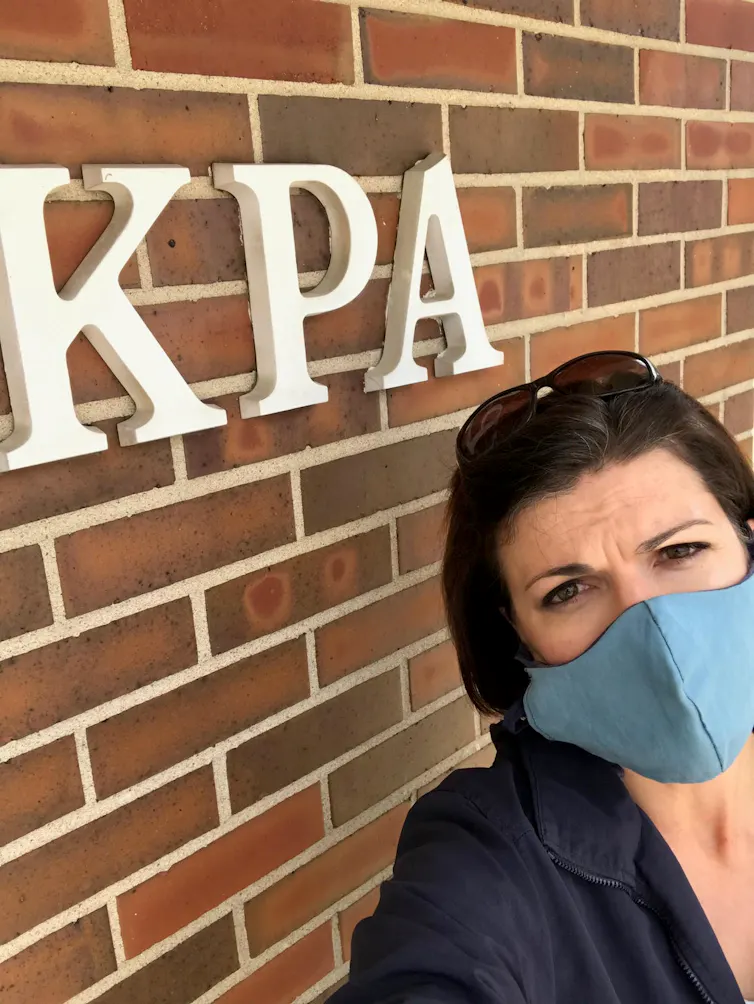
Emily Bradbury, Kansas Press Association Executive Director, tells reporters that ‘what they’re doing is important. And what they’re doing matters…and they look out for their communities like no one else.’ Will Mari and Teri Finneman, Author provided photo. Loans, side hustles and deals
Reporters and editors found new ways of paying the bills. That meant accepting government subsidies in the form of Paycheck Protection Program loans. It meant, for some, going door to door and asking readers to subscribe, or keep subscribing. It meant consolidating newspapers, putting out more online editions, or taking pay cuts.
“People just don’t understand. It costs a lot of money and time to do this, and I just wish we – there was more value or people appreciate it or understood the value and the cost of really providing this service,” said Bonita Gooch, the publisher of The Community Voice, a Black newspaper based in Wichita, Kansas.
Some publishers took on side hustles to bring in revenue, creating ad copy for local business or doing marketing work.
At The Kingfisher Times & Free Press in Oklahoma, for example, Christine Reid, the paper’s editor, created ads for a local vocational-technical school. “I’ve also tried to use that as an avenue to … generate more ads for the newspaper,” Reid said.
Some papers worked out advertising deals with local businesses as consumers shopped more locally.
Local publishers did whatever it took to stay afloat. As some of our initial findings have shown, that showed both opportunity and hesitancy about change.
“We’re gonna have to rely less on advertising revenue and more on subscription revenue, and so we’ve got to make sure we’re offering a unique product that they want to pay for,” said Letti Lister, the president and publisher of the Black Hills Pioneer in Spearfish, South Dakota.
We saw tentative signs of hope, as journalists got financial and moral support from their readers during a fraught election. “If anything, it’s rallied the troops, if you will, in our community because they trust us, they know that we’re going to report the news in a timely manner and keep the public up to date,” said Amy Wobbema, publisher of the New Rockford Transcript in North Dakota. Arguably most coverage was calm and steady.
But there was still hesitancy over what newspapers had to do to adapt. Some journalists are uncomfortable with receiving government funding and would rather rely on community support.
As South Dakota Newspaper Association Executive Director Dave Bordewyk put it: “Sort of, ‘Look, contribute to our newspaper … because if you value that importance of local news and journalism, then we need your support beyond just subscribing to the newspaper or advertising, which has gone away.’”
Ultimately, the pandemic showed that more research needs to be done on journalism in rural areas – we managed to talk to only a fraction of the total number of small-town journalists and publishers. Other scholars have already learned that local journalism helps reduce violent partisanship and reinforces institutions. To be clear, scholars have defined violent partisanship as the willingness to resort to physical altercations to resolve disputes – good local journalism channels that energy toward peaceful, democratic ends. Other scholars have found that institutions like local courts and governments get increased legitimacy as a result of local news. More sustained scholarly attention will likely turn up other benefits that the public isn’t yet aware of.
“That’s what we hope. What I hope comes out of this is that readers can understand that, and can … have a renewed value on what that [local] publication has done for their community during this pandemic,” Bradbury told us.
William Thomas Mari, Assistant Professor of Media law and Media History, Louisiana State University
This article is republished from The Conversation under a Creative Commons license. Read the original article.
-
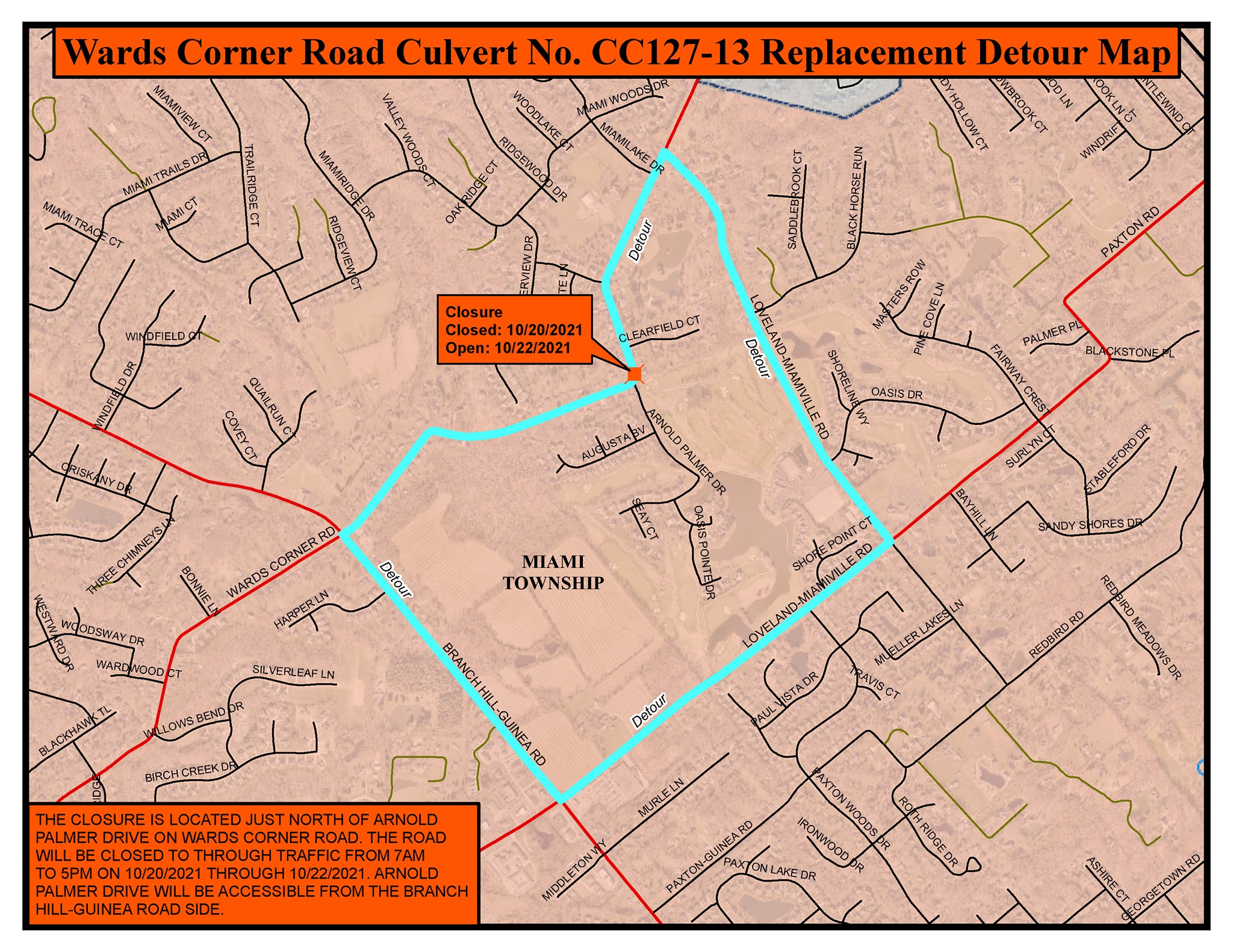
Wards Corner Road at Arnold Palmer Drive to close October 20 thru 22
Miami Township, Ohio – The replacement of a culvert will require the closure of Wards Corner Road in Miami Township. The closure is located just north of Arnold Palmer Drive on Wards Corner Road.
The road will be closed to through traffic from 7 AM to 5 PM on Wednesday, October 20 through Friday, October 22.
Arnold Palmer Drive will be accessible from the Branch Hill-Guinea Road side during this clousre.
This closure will not go into effect until the previous closure on Wards Corner Road has been completed.
-
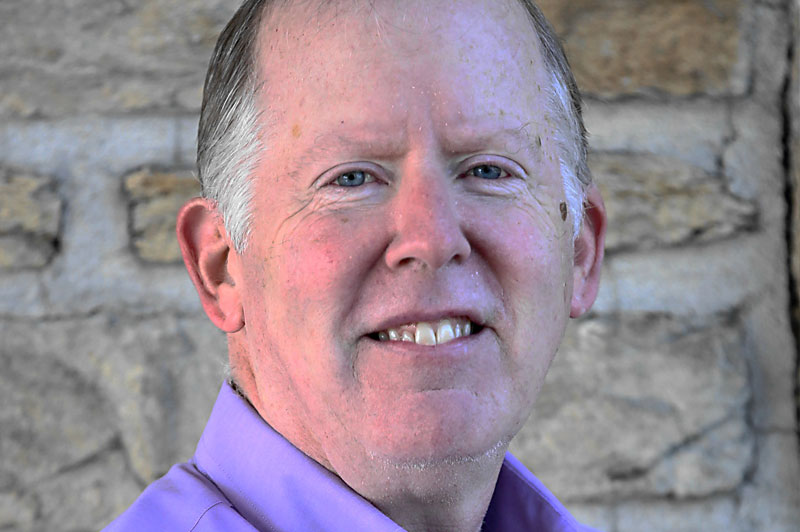
A Good Sign for Loveland Schools: A Robust Election Season
By Elliot Grossman, Candidate for Loveland City School Board
The races for the Loveland School Board have strengthened my faith in democracy. For at least two decades, most candidates for the school board had run without challengers. That means the community didn’t have much of a choice of candidates. It also meant there was minimal discussion about the issues facing the school district.
This year, there are nine candidates for four seats. The exchanges of ideas among the candidates and voters have been robust. That shows people care deeply about the school district.
Once the winners have been announced, the community’s focus will shift to helping the school district move forward. Better times are ahead for the Loveland Schools, our community and our children.
My campaign is about hope, optimism and restoring trust. This is a great school district. It’s a big reason my wife and I moved to the Loveland area.
But it’s gotten off track with some poor decisions by leaders. The problem is that those poor decisions have led to damaged relationships with the community
Now, the district’s number one goal needs to be restoring trust. Without trust, the community won’t provide enough resources to the district. Without enough resources, the students will not get the education they deserve.
How do we restore trust? I have a plan:
- First, the district needs to embark on a thorough and formal listening process — seeking out voices from throughout the community — to learn what type of school district the community wants. What are the community’s priorities for the district? For a decade, a Butler County school district has held what they call Community Conversations. They’re led by a neutral facilitator. We need to do that here. Communication needs to be a two-way process. Systems need to be set up to listen to parents, students, staff and the community on an ongoing basis. These conversations are about building a partnership with the community.
- Second, after we’re sure we’ve sought out voices from throughout the community, we need to do a scientific survey to gauge voter sentiment before putting another levy on the ballot. We shouldn’t guess about whether a levy would pass. That could do even more damage if it fails.
I’m a strong supporter of public schools. I attended public schools from kindergarten through 12th grade. I believe public schools are a great equalizer. They give children from all walks of life opportunities. I’ve given a big part of my career and civic life to supporting public schools. I have a daughter in the Loveland Schools. So I want the schools to thrive. But I’m not going to make decisions with just the students in mind. I will always make decisions with the best interests of the students and the taxpayers in mind.
How can I be so sure that we can turn things around? I’ve seen this situation before. Professionally, I’ve provided communication and community engagement services to school districts. In fact, I’m the only candidate who has provided professional communication and community engagement services to school districts.
I’ve attended hundreds of meetings of school boards and local governments in various communities as a news reporter and consultant to school districts for several decades. Additionally, I’ve attended meetings of the Loveland School Board as a parent, taxpayer and now candidate. I’ve learned what works and doesn’t work in school districts. I will bring those insights and ideas to the Loveland School Board.
A school district in western Hamilton county had failed two consecutive levies. I spent a year helping that district with communication and community engagement. With great leadership by a new superintendent, they passed a levy and just a few months ago they opened new schools. But again, I’m not saying we need new schools here. That’s up to the community.
Here’s another example about why we should have hope and optimism. This example shows the importance of setting priorities with our school district budget at a time when the district’s funds are stretched so thin.
For the first time this fall, the Loveland Schools are offering full-day kindergarten to all families who want it for their children. Significantly, the district expanded its kindergarten spots without additional salary costs. After a retirement, district leaders moved a teaching position to the Loveland Early Childhood Center as enrollment numbers changed in the upper grades. It’s all a matter of setting priorities with limited funds.
I know what needs to be done to move the district forward. I have the experience, the determination and the ability to listen to unite the community.
I hope you’ll vote for me.
-
![[Video] Do you know this man?](https://lovelandmagazine.com/wp-content/uploads/2021/06/car-theft.jpg)
[Video] Do you know this man?
Miami Township, Ohio – The Miami Township Police are asking, “Do you know who this is?” They say he likes to take long walks in the “Buckwheat corridor” of the Township to steal things.
The department said on FaceBook that residents have experienced an unusual amount of theft from vehicles and are asking the public to call Detective Higgins at 513-965-6873 if you know who this man is.
-
Miami Township dog park re-opens
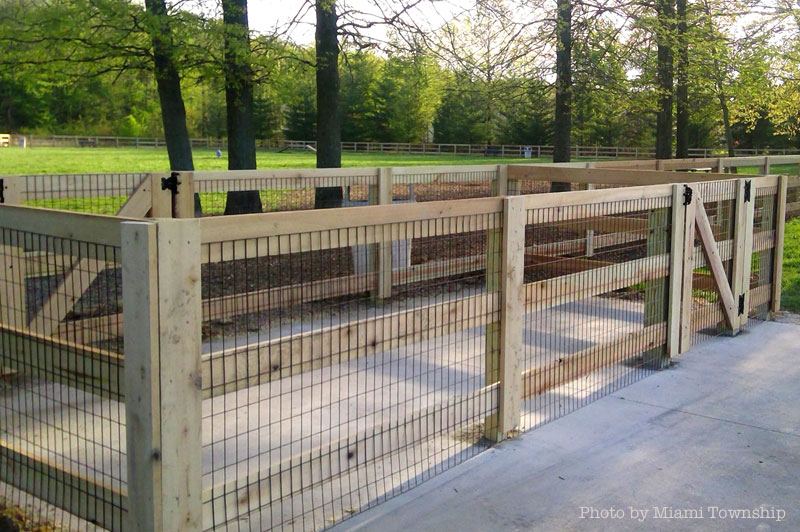
Miami Township, Ohio – In a faceBook post today, the Township said, “Due to a successful grant application, Miami Township is able to bring some of your Clermont County Parks Levy tax money back to the Township.” The grant was used to pay for 75% of the cost to replace the worn and aging chain link fence around the dog park within Miami Meadows Park.
The new fence is a three rail “Kentucky Board” fence with a heavy duty wire fence liner. The dog park was closed until it was completed.
The fence replacement is complete and the park is open for fun.
1546 State Route 131 • 45150
Field Status Hotline: (513) 248.5513Miami Meadows Park, the crown jewel in the Miami Township park system, is approximately 200 acres of idealic recreational and green space. Miami Meadows Park offers numerous soccer, football and baseball fields, basketball courts, walking trails, a playground area and two picnic shelters. There is a dog park and a beautiful lake that is used on a “catch and release” basis for fishing by residents.
A major portion of the park is declared a wetland and reserved for wildlife habitat.
-

Do you know: The man who used his wife’s fortune to fund the freedom of over 1,400 slaves.
by Barbara Kyles

Do you know that Thomas Garrett unabashedly gave life to his abolitionist ideals?
Please read more about Garrett at Black Then…
And read even more about this leader of abolitionism at Wikipedia, the free encyclopedia…
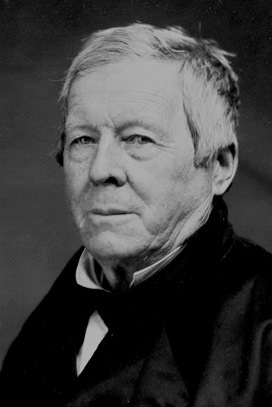
Thomas Garrett ambrotype c1850 from Wikipedia -
Do you know: DAVID RUGGLES, AN AGGRESSIVE ABOLITIONIST WOULD FORCE HIS WAY INTO HOMES
by Barbara Kyles
Do you know that David Ruggles was an aggressive abolitionist who would force his way into homes to inform slaves that they were free?
He also did his part by first opening a bookshop that was burned to the ground.
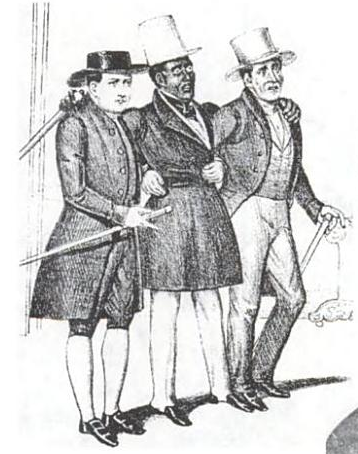
Portrait of David Ruggles (center) with Isaac T. Hopper (left) and Barney Corse (right) confronting John P. Darg in 1838 (Artist unknown) Read more about Ruggles at Black Then – Discovering our history…