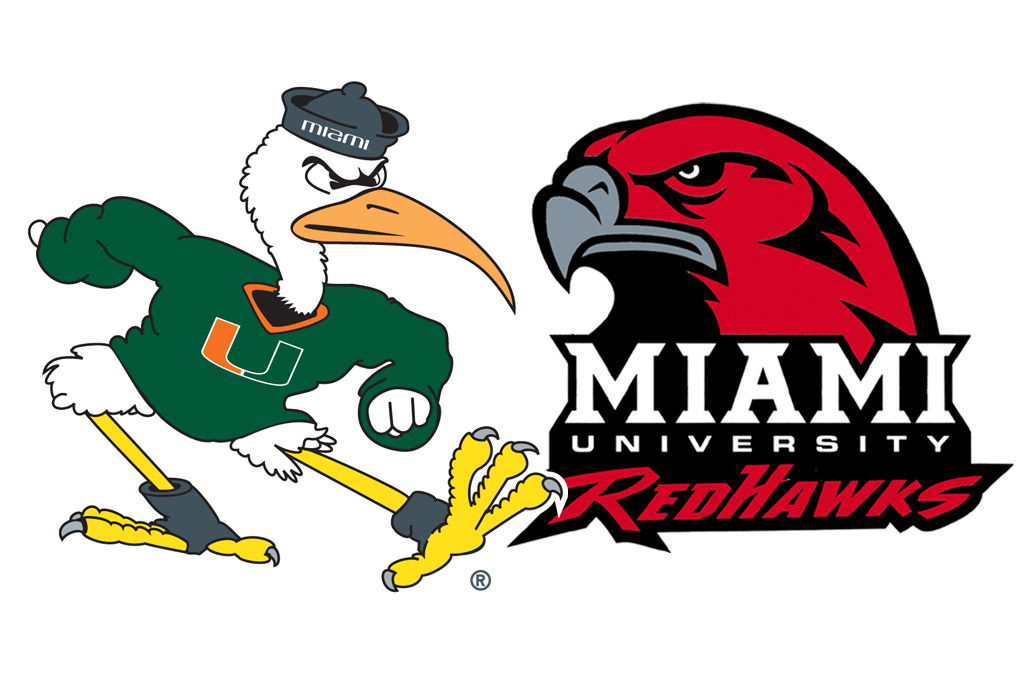
OXFORD, OH – Heaven help the announcer when Miami University plays the University of Miami in football on September 1st.
“Miami is within sight of Miami’s end zone with two downs to go. Miami calls a timeout.”
Huh?
The game will be played in Coral Gables, Florida and you can listen on the ACC Network Radio and the Miami Radio Network.
The confusion isn’t our fault. We tried to persuade the Florida school to change its name after it was chartered in 1925 — 116 years after Miami University’s charter. When I say “we,” I mean the Miami University president at the time, Raymond M. Hughes, Class of 1893, and several Miamians.
In a Feb. 10, 1927, letter to President Hughes, alumnus George Shuman shared a letter of protest that he was sending to the president and trustees of the Florida institution. Shuman went on to propose that President Hughes “have Miami students all over the country send in their protest against the use of the Miami name by any other university.”
In his protest, Shuman stated that he felt the University of Miami was “doing a very great injustice to my alma mater in stealing the name.” He suggested changing to Everglades University or the University of Southern Florida.
Shuman doesn’t explain what motivated his protest. However, a letter sent to President Hughes six days later by another alumnus referenced a protest by Alfred H. Upham, Class of 1897 and 1898, in the February 1927 Bulletin, the alumni magazine of its day. At the time he submitted his letter to the editor, Upham was president of the University of Idaho. He would become president of Miami University a year later.
In his introduction, Upham wrote, “Since the first announcements, more than a year ago, regarding the new University of Miami in Florida, I have looked in vain for even the mildest protest from the alumni and friends of our own Miami University.
“Presumably names of collegiate institutions are not copyrighted and these good citizens of Florida have the legal right to adopt such a name as they choose. But they certainly have not much moral right to usurp the name of a university which has established itself by more than a century of sound scholarship and effective educational service.
“Generations before the now famous winter metropolis of fashion was even heard of, Miami University was established, taking its name from the rivers which in turn had been named for a local Indian tribe.”
Near his conclusion, Upham wrote, “There are so many perfectly good names for a new and aspiring university. What justification or justice is there in appropriating one that has made its place in the academic world through more than a century of achievement?”
Phillip Shriver, president of Miami from 1965-1981, and forever the historian, kept the series of letters in his papers. They eventually ended up with President Shriver’s son, R. Scott ’78 MEd ’95, who located them last month and shared them with Tom Fey ’68 of Oxford, Ohio.
In a Feb. 21, 1927, letter to another frustrated alumnus, President Hughes wrote, “I have voiced the sentiments of the alumni to the president of University of Miami. As I told you, I do not think we have any right in the matter, but undoubtedly large confusion will arise from this joint use of the same name, which will be very embarrassing in the educational field.”
The University of Miami’s leader, Bowman F. Ashe, president from 1926-1952, was both sympathetic and apologetic. In a March 5, 1929, letter to Miami University’s new president, A.H. Upham, he wrote:
“I had some correspondence two years ago with President Hughes about the matter, and the Board seriously considered changing the name to the University of Southern Florida. The difficulty in that is that it would again raise some confusion in connection with our state university, and it might also have some effect upon municipal appropriations which we receive from the city of Miami.
“We are now, so far as possible, in our own publications, using the full name ‘The University of Miami, Florida.’
“May I assure you that I will do everything possible to prevent the confusion of the names, and it is possible that at some future time there may even be a change in the name here which would end the confusion for all time.”
And here we are, nearly 100 years later, and the confusion continues.
Loveland, Ohio – Due to the resignation of board member Kevin Daugherty, the Loveland Board of Education met on 17 June to fill his seat for the remainder of his term, which is through the end of the current calendar year, December 31, 2023.
The Board entered into an executive session to conduct phone interviews with the following candidates:
Josh Hendrickson
Christina Jeranek
Anna Bunker
Lynn Mangan
Elaine Hipps
Marcia Neumann
Brad Goldie
Roger Talyor
Elliot Grossman
Carly Tamborski
Brain Tibbs
After the executive session ended, Board President Dr. Kathryn Lorenz said that instead of choosing a candidate who said they would run for election in November, they chose a candidate who indicated they would not be seeking a permanent seat on the Board.
Lorenz, Rev. Jonathan Eilert, Dr. Eric Schwetschenau, and Eileen Washburn voted to appoint Dr. Brad Goldie to the vacant position.
Goldie is an Assistant Professor of Finance at Miami University and serves on the District Finance Committee.
The Ohio Senate passed a bill Wednesday that would create “intellectual diversity” centers at Ohio State University, the University of Toledo, Miami University, Cleveland State University, and the University of Cincinnati.
The party line vote came after an amendment was added during the Senate session that tacks on Miami, Cleveland State, and Cincinnati to Senate Bill 117. The bill now moves to the House for committee consideration.
SB 117 would create the Salmon P. Chase Center for Civics, Culture, and Society at Ohio State University’s College of Public Affairs and the Institute of American Constitutional Thought and Leadership at the University of Toledo’s College of Law. It would also now create centers for civics, culture and society at Miami, Cleveland State and Cincinnati.
“The (Ohio State) center will educate students by means of free, open and rigorous intellectual inquiry, to seek truth, equip students with the skills they need to reach their own informed conclusions in matters of social and political importance,” said Sen. Jerry Cirino, R-Kirtland, one of the bill’s sponsors.
SB 117 amendment
Many Senate Democrats slammed SB 117 and the amendment during Wednesday’s session.
“SB 117 is forcing the installation of conservative think-tanks at our public universities across the state of Ohio and they are using taxpayer money to do it,” said state Sen. Bill DeMora, D-Columbus.
“The amendment is atrocious,” said Sen. Catherine Ingram, D-Cincinnati.
Miami and Cleveland State were not aware of the potential amendment adding them to the bill before Wednesday afternoon’s Senate Session.
“They had absolutely no idea,” Senate Minority Leader Nickie Antonio, D-Lakewood, told reporters when she reached out to her alma mater Cleveland State. “They did not ask for it … and are very concerned about this being imposed on them.”
State Sen. Kent Smith, D-Euclid, did something similar with his alma maters Miami and Cleveland State, and both institutions of higher education said this was the first time they were hearing about the amendment.
“Committees are the best forums for thoroughly studying bills,” he said.
Senate President Matt Huffman said making the amendment on the Senate floor was not ideal.
“Certainly that’s not the best way to do these things,” he said to reporters. “I don’t like substantive floor amendments. We’re at a lengthy legislative break. Secondly, the House in their negotiations of essentially, at least for the moment, have rejected the concept of this higher education reform that we want to have. And so what we really want to do is tee these things up.”
The amendments also clarified that both these centers are “independent academic units in their respective universities,” Cirino said.
COLUMBUS, Ohio — JUNE 15: Senate Majority Floor Leader Rob McColley, R-Napoleon, speaks during the Ohio Senate session, June 15, 2023, at the Statehouse in Columbus, Ohio. (Photo by Graham Stokes for Ohio Capital Journal)
He introduced the bill in May along with Sen. Rob McColley, R-Napoleon — arguing that university faculty are predominantly liberal.
But McColley insisted Wednesday that SB 117 is not a conservative takeover of higher education.
“There is not a single letter, there is not a single word, there is not a single phrase that requires this to teach conservative principles,” he said. “The University of Toledo Law is supportive of this. The Ohio State University does not oppose this either.”
State Sen. Andrew Brenner, R-Delaware, said college students do want these centers, but are afraid to speak out.
“If they speak out, they are afraid it might impact their academic career,” he claimed.
The bill would give UT $1 million in fiscal year 2024 and $2 million in fiscal year 2025 for the Institute, and Ohio State $5 million in fiscal years 2024 and 2025 for the Center.
The bill’s amendment would each give Miami, Cleveland, and Cincinnati $2 million each fiscal year to support the centers, Cirino said.
McColley clarified that what’s in the proposed budget when it comes to SB 117 doesn’t include the three new universities that were added to the bill through Wednesday’s amendment.
The Ohio House has pushed back on the higher education bills being added to the budget.
“We’re maybe not going to get 117 in the budget,” Huffman said. “You don’t know what the deal is until there’s a deal. So we’re just putting 117 forward as a bill.”
Senate Bill 83, also introduced by Cirino and which would overhaul higher education, was added to the budget by the Senate.
Among other things, SB 83 would ban university staff and employees from striking, college students would be forced to take certain American history courses, professor tenure would be based around “bias,” and mandatory diversity, equity and inclusion training would be prohibited, with only specific exemptions.
“The House are not fans of 83,” Huffman said. “I think we’ve offered a pretty good higher education package that they rejected.”
While the constitutional deadline for Ohio Gov. Mike DeWine to sign the budget is Friday, it seems unclear at this point if that is actually going to happen.
“I’m optimistic and I think we’ll see what happens on Friday,” Huffmann said.
Lee Strang
Professor Lee Strang is the John W. Stoepler Professor of Law & Values at the University of Toledo Law School. (Photo from University of Toledo website.)
UT Law Professor Lee Strang first got the idea for the Institute of American Constitutional Thought and Leadership in 2019 after visiting the Georgetown Center for the Constitution and Princeton University’s James Madison Program.
Megan Henry is a reporter for the Ohio Capital Journal and has spent the last five years reporting on various topics including education, healthcare, business and crime at The Columbus Dispatch, part of the USA Today Network.
Oxford, Ohio – The Juneteenth holiday, commemorates the date enslaved Black people in Galveston, Texas learned of their emancipation, more than two years after the proclamation was issued. The holiday has long been celebrated by African Americans. In 2021, President Joe Biden signed legislation establishing Juneteenth as a federal holiday. Miami University will observe Juneteenth on Monday, June 19.
Rodney Coates, professor of Critical Race and Ethnic Studies in the Department of Global and Intercultural Studies at Miami University, provided a list of curated books to become better acquainted with the history and meaning of Junteenth.
Coates has selected three books that he references as voices of liberation and jubilation. “A Voice from the South,” “The Souls of Black Folks,” and “I Know Why the Caged Bird Sings.”
Coates provides a brief synopsis of each:
No voice is as proactive, clear, and poignant as that of Anna Julia Cooper, writing her classic, “A Voice from the South,” 21 years after the end of the Civil War, 142 years ago. Her message — the plight, reality, and future of Black people — depended upon the Black woman’s success. For too long, the Church and clergy, the politicians and educators, and even the Black man thwarted these efforts by placing constraints upon the Black woman’s hopes, dreams, and opportunities. Cooper’s “Voice” provides a clarion call not to look back with inflated conceit, but to glean wisdom from experiences, to capture the spiritual essence of our being and to look to the future with hope and trust. This Voice shrugged condescension and victimhood yet shouted determination and “the radical amelioration,” liberation, and regeneration of the Black woman and community. Cooper ends with hope, believing black women shall arrive at the “promised land.”
Almost a decade after Cooper’s “Voice” was published, W.E.B. Du Bois published “The Souls of Black Folks.” This collection of essays articulated Du Bois’ dreams toward an action plan for Black freedom in the 20th century. He began with a question, “What is it like to be a problem?” A problem complicated by prejudice, lawlessness, and ruthless competition. What is it like to be a Black and an American, two unreconciled selves, two paradoxes, two ends of a spectrum — in one body? Forty years after the promise of emancipation, freedom was still illusive to the freedman. Constantly vilified and condemned, over policed and undervalued, within just one generation, Blacks crafted institutions that provided escapes from the prison of poverty, mediocrity, and complacency. Yet, the soul of Black folks, the spiritual strivings of a people, was made manifest as they went from enslaved person to free, from forced laborers to skilled artisans and farmers. They created thousands of business people, clergy, teachers, and doctors in the process.
While Black history is marked by progress, resilience, and perseverance, it is easy to ignore the trials, tribulations, and suffering endured by many Blacks over the ages. Maya Angelou’s “I Know Why the Caged Bird Sings” reminds us that it is not always a bed of roses. This is particularly true in this autobiographical work that traces a life often interrupted by tragedy, moving from kin to kin, grandparents to separated parents, and back to grandparents. Being the ugly duckling, battered and abused (sexually, mentally, and spiritually). But after being raped, pregnant, and disgraced, she continued onward. She did not allow these obstacles to drag her into hopelessness and despair. Head held high, she continued to pursue her path, gave birth to a marvelous son, graduated from high school, and the rest is history. So why can the caged bird sing? She dreams of freedom.
Lastly, while reading and contemplating the meaning of the Juneteenth holiday, listen to “Blackbird” written by Paul McCartney and featured on the Beatles’ iconic White Album in 1968. A young McCartney was inspired to write the song after meeting civil rights pioneers Thelma Mothershed Wair and Elizabeth Eckford. Wair and Eckford are two members of the Little Rock Nine, a group of nine black students who faced discrimination and the lasting impact of segregation after enrolling in the all-white Little Rock Central High School in 1957, following the Supreme Court’s Brown v. Board of Education decision.
“Blackbird singing in the dead of night. Take these broken wings and learn to fly. All your life. You were only waiting for this moment to arise. Blackbird singing in the dead of night. Take these sunken eyes and learn to see. All your life. You were only waiting for this moment to be free.” McCartney (1968).
Sam Cao, 17, at left, seen with Sam Lawrence, 19, at right. The two teenaged Sams are running as Democrats for seats in the Ohio House. Source: Sam Lawrence.
Sam Cao worked out a plan with his principal and superintendent. They had to figure out how Cao could potentially balance constituent work in the Ohio House of Representatives with classwork at Mason High School.
At Miami University, Sam Lawrence mulled a similar plan for his upcoming sophomore year. Ohio University’s Rhyan Goodman is likely doing the same for his junior year.
The three Democrats would be quite young for elected office. Cao is 17 but turns 18 before Election Day, which allows him to run; Lawrence is 19; Goodman was 19 when he announced his run in February.
If elected, they could shape state policy on everything from Ohio’s $74 billion biennial budget, civil and criminal justice, women’s rights, gun policy and countless others. All three are running in districts where Republicans have recently won with commanding margins, leaving them with uphill paths to office.
They can serve in wars and vote. They can’t lawfully buy a drink. And they don’t think their age should preclude them from public office.
“The one thing I’d like to point out is it’s not no experience; it’s different experience,” Lawrence said.
“I would like to ask every one of our legislators if they were attending school while all these terrible school shootings are happening. They were not in school when we had these high-powered assault weapons that could mow down tens of children at a time. Those people don’t have those life experiences.”
Some current incumbents started their terms just a few years older. Sen. Niraj Antani, R-Miamisburg, started in the House in 2018 at 23 years old. Rep. Jena Powell, R-Arcanum, first won in 2018 at 24. Rep. Thomas Hall, R-Madison Twp., won office in 2020 at 25. Rep. Bride Rose Sweeney, D-Cleveland, won in 2018 at 26.
Several (older) Democrats asked about the youthful insurgents rebuffed concerns of a lack of life or work experience from the candidates. They also rejected the trend as any signs of a party unable to attract more established candidates. Instead, they characterized it as a reflection of members of a new generation who are aghast at increasingly extreme legislation coming from the Statehouse and inspired enough to seek to affect change on their own.
“They’re going to be limited based on their life experiences, but at the same time, there is something romantic about it,” said Dennis Willard, a Democratic political consultant.
“In a sane world, this might seem insane. But were not living in a sane world with the Ohio Legislature. I know who I’d vote for.”
There’s some historical precedent too. U.S. Sen. Sherrod Brown, the dean of Ohio’s struggling Democratic Party, won his first state House race at 21 in 1974. In 2000, 18-year-old Derrick Seaver won a seat as a Democrat (he switched parties a few years later).
In an interview, Seaver, now 40 and the director of the San Jose Chamber of Commerce, expressed ambivalence about teenagers running for office. Youth has its perks — young people can be listeners and learners who bring new perspectives to older and pastier general assemblies. Plus, the media attention they attract can make the difference in tough races.
However, they’re less situated to understand the nuances or interconnectedness of public policy, he said. Plus, if they lose an election, they don’t have a college degree or developed work experience to fall back on.
“I will say that since that time, and I don’t want this to come across as discouraging, but certainly I feel that maybe I should have waited until I was older,” he said.
Sam Cao
Ohio’s new 56th House District contains swaths of Warren County including the cities of Lebanon and Mason. More than 62% of its voters are Republican, according to Dave’s Redistricting App.
Cao grew frustrated when COVID-19 grew so prevalent in the county that his high school closed its doors when it ran out of healthy substitute teachers. He tried to contact Zeltwanger, to no avail. Then he tried to contact the Democrat running for the seat, only to learn no such person exists. He credits his AP Government teacher with encouraging him to take a shot for himself.
To prepare, he’s looking to history. For one, there are his role models — Brown, the U.S. Senator; Robert Kennedy, the liberal icon and former U.S. Attorney General; and William Proxmire, another U.S. Senator who famously replaced the demagogic Sen. Joe McCarthy and declared his predecessor a “disgrace to Wisconsin, to the Senate, and to America.”
Cao has also been seeking guidance from the last four Democrats who tried and failed to win the seat.
“You know what you’re entering, kid?” he said, relaying their advice.
“We call this the arena for a reason. You’re a minnow. And sharks come in. These legislators at the Statehouse, they’re not playing with you. They could eat you up.”
His path to the general election ballot is no guarantee — he’s facing Joy Bennett, a freelance writer, in the looming Aug. 2 primary.
In an interview, he boiled his policy goals down to three items. For one, he wants to vote against abortion restrictions and gun rights expansions, which are likely to come in the GOP-dominated legislature. For two, he wants to improve the state’s infrastructure — one example being a lack of roads leading to his own high school, the largest in the state, causing regular traffic jams. Third, he wants to support legislation introduced by Sen. Tina Maharath (another young and Asian-American Democratic lawmaker) to develop curriculum teaching Asian-American history in school classrooms.
“Look beyond our age,” Cao said. “I know our age is like, the wow factor or the pizazz factor about who we are as candidates, but I want you to look at the policies. I want you to look at what values we stand for.”
Sam Lawrence, at left, and Sam Cao at right. Source: Sam Lawrence.
Sam Lawrence
In Hamilton County, Lawrence is running against Rep. Sara Carruthers, a two-term incumbent Republican. It’s a similarly tough district for Democrats — more than 60% of its voters are registered Republicans, according to Dave’s Redistricting App.
His goals in office include protecting abortion access for women, legalizing and taxing marijuana for recreational use, bringing intrastate train access to Ohio, and expanding clean energy generation like wind and solar in Ohio.
He said a House full of only 19-year-olds would likely destroy the state. But having a few of them around has its value — who better to represent the interests of young Ohioans? Who better to understand the realities of seeking student loans in an inflationary economy? Or evaluating recently passed legislation that allows teachers to carry arms in Ohio, which he called “incredibly unpopular” among young people.
He considers former presidential candidate and current U.S. Secretary of Transportation Pete Buttigieg a role model. He has knocked on doors for House Minority Leader Allison Russo, D-Columbus, and volunteered for Congressman Tim Ryan’s U.S. Senate Campaign as well.
“Something everyone should know about us: We are taking this extremely seriously,” he said. “There is a reason that this Democratic process is in place. There is a reason that, by law, you are allowed to run at my age. There is a reason that people have won at my age. I think we should test that theory.”
Rhyan Goodman
Of the three teenagers, Goodman has the best shot at winning as far as the raw demographics go. His Athens County district splits 52-45 for Republicans.
He’ll face Rep. Jay Edwards, R-Nelsonville, a successful fundraiser and former member of House leadership seeking his fourth term in office. Edwards has won in a landslide every election since 2016.
Goodman doesn’t have any campaign website that could be located. He did not respond to calls or text messages seeking an interview.
His nascent political career has already met scandal. In April, he resigned from Ohio University’s student senate before facing an impeachment trial. According to The New Political, a student publication, Goodman was accused of coordinating an effort to remove former Treasurer Simar Kalkat from her position. He allegedly encouraged student senators to accuse Kalkat of intimidation.
Residential students not expected to “move-in” until the week of September 14
Dear Miami University Community:
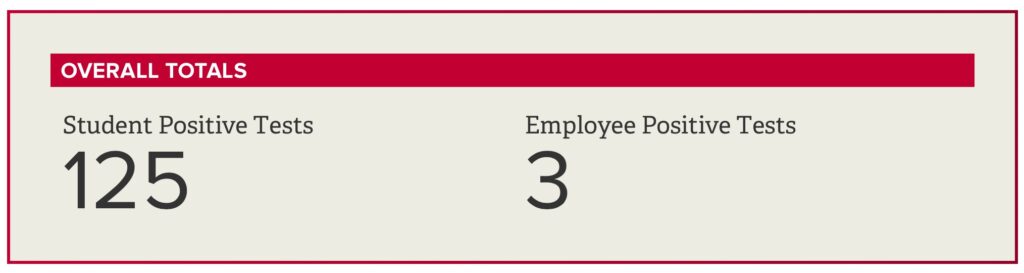
Today the Butler County General Health District (BCGHD) and Miami University issued a joint message urging our students to avoid travel and large gatherings this holiday weekend. I want to strongly affirm this message. We have updated our COVID-19 Case Reporting Dashboard with the numbers affecting campus. These numbers continue to reflect a concerning spread in cases in Oxford, and both travel and gatherings put oneself and others at risk, here or in the communities they might visit.
Our ability to have residential students move-in the week of September 14 and to begin our in-person and hybrid classes on September 21 depends on our ability to stop the increasing spread of the virus. This means each of us must comply with all of the Healthy Together standards by wearing face masks; maintaining physical distancing; quarantining or isolating when needed; and avoiding gatherings of 10 persons or more. This is the only way to stop the spread. The health of all of us depends on each of us.
As we look ahead, we are monitoring several key metrics: number of daily positives; positivity rate on surveillance testing; compliance around social distancing and masks in our community; hospitalizations (right now we do not have any); participation in contact tracing; compliance with quarantine and isolation orders and protocols; and our capacity within our community to handle caseloads. Our decision also will depend upon the ability to maintain a healthy workforce to serve our students. As we consider all of these variables, we must also stay mindful of the health and safety of the entire Oxford community.
We continue to take aggressive measures to prevent this pandemic from impacting our plans for the remainder of the semester. Our ability to return to our campuses is directly dependent on individual compliance with our adherence to the Healthy Together standards.
Should we need to make a change to our fall operational plans, we will communicate that no later than Wednesday, September 9.
Let’s all do our part to protect our own health and the health of others. I wish to thank our students and families for their patience, our faculty and staff for their commitment, and our alumni and friends for their support. We all want to be Healthy Together and to be together on our campuses.
Oxford, Ohio – Following our report of 4 days ago that since the start of classes, that they had 10 positive COVID-19 tests among students and 2 among employees on the Oxford campus, Miami University now has announced that it learned on August 24, that twenty-seven student-athletes from various teams have now tested positive for COVID-19.
Fall classes began on Monday, August 17, mostly remote, with graduate students and some programs in person. Students who will be living off campus have been encouraged to stay home, if they can, until face-to-face courses start on Monday, September 21.
The university said, “Many, but not all, had attended an off-campus social gathering, over a week ago. The Butler County General Health District “out of an abundance of caution” is quarantining all Miami University student-athletes who have returned to Oxford, and any coaches and staff who were in contact with them.
The Butler County General Health District issued the blanket quarantine order to ensure no student-athletes would be missed through the normal method of contact tracing.
In the announcement by the university, Jennifer Bailer, Health Commissioner for Butler County General Health District, said, “As we know, the COVID-19 virus can spread quickly between people and infect groups of people in a hurry. This disease is serious. In young adults it is often mild, but has the potential to become critical for those with underlying disease or other risk factors.”
“One of the main functions of public health is to identify persons who have been in contact with COVID-19 cases as quickly as possible and ask them to quarantine for 14 days and monitor themselves for symptoms. This helps in preventing the disease to spread any further,” stated Bailer.
“My concern for the health of all of our student-athletes is paramount,” said David Sayler, director of athletics. “I am disappointed that poor judgment has led to this quarantine order and put in jeopardy our efforts to have our teams study and practice together.”
The announcement by the university did not say the total number of student-athletes who have been ordered to quarantine.
Oxford, Ohio – Miami University President Gregory Crawford said in an announcement Friday, “This week we have all been witnessing a troubling spread of COVID-19 on university campuses across the nation, and we will continue to monitor developments as many more schools begin to reopen next week so we can learn from their challenges and decisions.”
Miami University President Gregory Crawford(Photo Miami University)
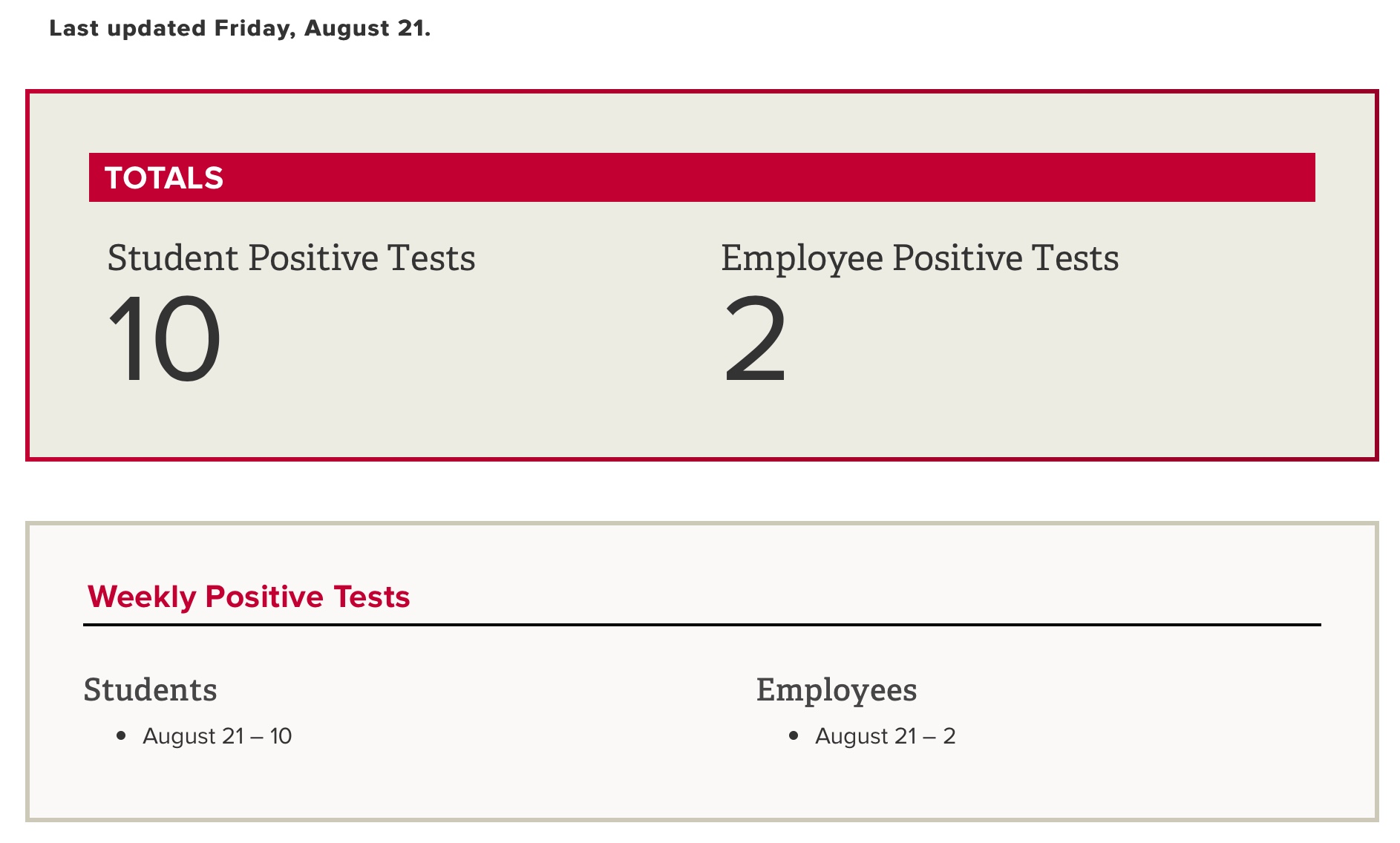
Along with the statement Crawford reported that on the Oxford campus, since the start of classes, they have had 10 positive COVID-19 tests among students and 2 among employees.
Miami has now created a dashboard to track positive results from tests conducted at the Employee Health Center and Student Health Service managed by TriHealth.
The announcement also introduced a symptom tracking app, Campus Clear (available for download from the app store on a mobile device), which must be completed daily if coming to campus. An illness/absence reporting system is also in place to help track potential outbreaks in the Oxford community.
Buildings on all campuses have reopened. Miami has begun to phase-in on-campus operations, and in the coming weeks students will be returning in stages.
Fall classes began on Monday, August 17, mostly remote, with graduate students and some programs in person.
Classrooms are organized to maintain six-foot physical distancing, and cleaning materials are available to clean desks and common spaces before and after each use.
Students who will be living off campus are encouraged to stay home, if they can, until face-to-face courses start on Monday, September 21. All students are expected to follow health and safety protocols, “like those in our residence halls, in their off-campus living arrangements.”
All returning students must sign the Healthy Together Community Pledge, committing to take responsibility for their health and others’ through recommended precautions to help prevent the spread of COVID-19 on campus and in the community. The pledge focuses on preventative measures such as social distancing, face coverings, cleaning practices, handwashing and sanitation, daily symptom assessment, limiting indoor or outdoor gatherings to fewer than 10 people, and not attending or hosting any gathering where physical distancing is not possible. It also asks students to pledge to participate in testing, contact tracing, and quarantine or isolation if they or their close contacts become ill with COVID-19.
The phased-in strategy will culminate with the students residing on campus moving into the residence halls during the week of September 14. Face-to-face and hybrid offerings will begin on campus on Monday, September 21.
Some of Ohio’s colleges and universities have begun moving students in, but the navigation of a school year amid a pandemic is still a balancing act.
For Miami University, classes began this week, with all undergraduate courses online or remote. The plan is to keep it that way until at least Sept. 21, according to the plan posted to the school’s website.
“When we began planning last spring, we had hoped that the COVID-19 pandemic would be in significant decline before classes were scheduled to begin,” Miami president Greg Crawford told students. “Instead, cases are rising in many states. With 40% of our Oxford students coming from outside Ohio, we’ve been monitoring the situation closely.”
Those that are on campus are required to wear masks, and as students come back, they can be reported to the Office of Community Standards if they repeatedly refuse to comply with an instructor’s direction to use a mask or face covering.
Mask requirements are the norm among Ohio’s public colleges and universities, as are 14-day quarantines for students coming from states considered COVID-19 hotspots.
Also the norm this school year are phased reopenings, like those at The Ohio State University, Ohio University, Kent State University, Shawnee State University, Cleveland State University, and the University of Cincinnati.
The first move-in dates for UC, Aug. 14 and 15 were considered “drop-off only,” meaning students could bring their stuff to campus, but then had to return home until the 16th.
Another regular part of public colleges’ and universities’ schedules is a return to at least some form of in-person class instruction that ends after Thanksgiving break. The last two weeks, including final exams, will be taken remotely at OSU, Central State University, UC, KSU and Wright State University, among others.
Kent State and the University of Toledo have eliminated their fall break to allow students to receive a full semester despite adjusted opening dates.
Toledo said they adjusted their Fall semester “based on the possibility of having a second wave of COVID-19 in late fall,” taking into account CDC data on the pandemic and state recommendations for higher education.
Bowling Green State University went so far as to cancel their Winter 2021 session and provide a $1,500 credit for the first 2,000 students who cancelled their housing assignment before the school year began this week.
“It is important you understand that we are HIGHLY encouraging you not to live on campus this fall,” information on the university’s COVID-19 plan page stated.
BGSU started their staggered move-in this week for those that had no other option than to take up residence, and are set to begin classes on Aug. 31. Students there will also be online only beginning Nov. 30.
OU phased in their reopening by allowing certain graduates and undergraduates “in a carefully selected set of academic programs” to begin their time on campus. Most students will begin remotely on Aug. 24, but students like third-year students in the College of Health Sciences and Professions’ nursing program and juniors and seniors in the Army Reserve Officer Training Corps (ROTC) are eligible to participate in the university’s first phase of schooling.
Universities throughout the state sticking with in-person instruction have instituted class-size reductions, along with “hybrid-remote” forms of teaching. Central State spelled out a “cohort attendance” model in its reopening plan, which would break large classes into groups, with the cohorts attending classes on alternating days. This model goes along with a 50% reduction in class sizes, something Wright State anticipates as part of its plan as well.
“At this time, the university conservatively estimates that one-third of classes will have in-person components while the majority of in-person classes will also deliver all content remotely to provide flexibility to students who are unable or do not feel comfortable returning to campus,” said Wright State president Susan Edwards in a letter to the university community.
Many of Ohio’s public higher education institutions have also created pledges for students connected to prevention of coronavirus, and in some cases can spur disciplinary action if not signed.
Testing and contact tracing for COVID-19 are a regular part of all public school plans, though the ways in which the testing is done vary from school to school.
The spring semester plan is still to be determined for most schools. The University of Akron plans to continue hybrid online and in-person instruction into the spring, but others are still watching the success of their fall semesters to plan for the future.
“Decisions are forthcoming,” stated the UC reopening plan.
Susan Tebben is an award-winning journalist with a decade of experience covering Ohio news, including courts and crime, Appalachian social issues, government, education, diversity and culture. She has worked for The Newark Advocate, The Glasgow Daily Times, The Athens Messenger, and WOUB Public Media. She has also had work featured on National Public Radio.









 Today the Butler County General Health District (BCGHD) and Miami University issued a
![[12 positive cases] COVID-19 Oxford Campus Dashboard now available](https://lovelandmagazine.com/wp-content/uploads/2020/08/EZWQ_4AXkAAzUIf.jpeg)