Tag: Mihaela Manova

  • School District delays return to full in-person learning for PK-4 students

    School District delays return to full in-person learning for PK-4 students

    Loveland, Ohio – After learning from Loveland Magazine of the number of COVID 19 cases at the Loveland Health Care Center (Cumulative cases of COVID 19 at Loveland Health Care go from 60 to 85) and citing that Hamilton and Clermont Counties have returned to the RED “Very High Exposure and Spread” level of the Ohio Public Health Advisory System the Loveland School District has just announced that the return to a full in-person learning schedule for PK-4 students will be delayed. They have decided to “temporarily pause any changes and remain on the blended learning model for now for all students, to allow us additional time to evaluate.”

    The Board of Education had previously approved (September 22) that PK-4 grades would return on Monday, October 5 to a full in-person learning schedule. (Board approves schedule for 5-day full capacity learning)

    “Transportation will not change at any grade level including grades 5-8 as has been communicated this week. Next week will operate like this week,” the District said in a release.

    The District also said, “The time is not right to take a step toward bringing more students together. Maintaining the schedule that our families, students and teachers have been operating under will allow us to maintain student and staff safety while we await more data.”

    The District said in a release. “After the state updates their COVID-19 data on Thursday of next week, a decision will be made about our PK-4 and grades 5-8 students and whether to continue on blended learning or transition to full capacity (5-day) in-person for those grades beginning Monday, October 12,” the release also said.

    “We have 11 red counties, which is more than we’ve seen at any point in September,” said Governor DeWine on Thursday. “Although many Ohioans are working hard to keep this virus in check, unfortunately, we are seeing a rebound in some areas of the state. This pandemic isn’t over, so please continue to stay home if you’re sick, wear a mask when you’re out, and keep at least six feet between you and those outside of your household.”

    On Thursday DeWine also announced:

    There are 155,314 confirmed and probable cases of COVID-19 in Ohio and 4,817 confirmed and probable COVID-19 deaths. A total of 15,606 people have been hospitalized, including 3,297 admissions to intensive care units. In-depth data can be accessed by visiting coronavirus.ohio.gov

    There is no change for the Loveland Remote Learning Academy.

    Below is the timeline to return to full capacity (5-day) in-person previously approved (September 22) and is apparently completely put on pause after today’s announcement:


  • Power company says utility commission has no power to investigate role in bailout scandal

    Power company says utility commission has no power to investigate role in bailout scandal

    An Akron-based utility company that figures prominently in a massive nuclear bailout scandal is saying that state regulators don’t have the authority to investigate whether the company improperly financed the bailout effort.

    Over the past week, FirstEnergy Corp. has filed two documents with the Public Utilities Commission of Ohio saying that the commission and the state’s consumer representative don’t have standing to investigate whether FirstEnergy and affiliated companies improperly used ratepayer money in what has been called the largest bribery scandal in state history. 

    Marty Schladen

    Marty Schladen has been a reporter for decades, working in Indiana, Texas and other places before returning to his native Ohio to work at The Columbus Dispatch in 2017. He’s won state and national journalism awards for investigations into utility regulation, public corruption, the environment, prescription drug spending and other matters.

    Federal prosecutors say $60 million in utility money was used to pass a $1.3 billion nuclear bailout into law. But FirstEnergy says the utility commission lacks the authority to investigate whether it improperly used ratepayer funds in the affair.

    “The commission lacks any statutory basis to conduct an investigation of FirstEnergy Corp. with respect to the alleged expenditures or to order FirstEnergy Corp. to show cause that it has not violated Ohio utility law,” FirstEnegy said in a Sept. 23 filing. 

    It was in response to an order by the utility commission that it show “that the costs of any political or charitable spending in support of (the bailout bill), or the subsequent referendum effort, were not included, directly or indirectly, in any rates or charges paid by ratepayers in this state.” 

    Federal prosecutors in July charged then-House Speaker Larry Householder and four associates with using $60 million from FirstEnergy and related interests in a scheme to make Householder speaker and pass a $1.3 bailout of two failing nuclear plants owned by FirstEnergy Solutions, a successor company to FirstEnergy Corp.

    The effort was successful, although there is an effort in the legislature to repeal it before the charge hits ratepayers’ bills on Jan. 1.

    FirstEnergy and associated companies haven’t been charged, but in announcing criminal charges against Householder, U.S. Attorney David M. DeVillers stressed that the investigation was far from over. An affidavit supporting the criminal complaint also refers repeatedly to “Company A,” or FirstEnergy, and it makes reference to its CEO.

    In addition, Ohio Attorney General Dave Yost last week filed a civil suit that names FirstEnergy, a subsidiary and its successors — as well as Householder and his associates — as defendants.

    The Ohio Consumers’ Counsel, the state’s official consumer representative in utility matters, has asked for an independent investigation into whether FirstEnergy improperly used ratepayer funds in the dark-money scheme to pass House Bill 6, the bailout legislation. The agency was disappointed when the utilities commission only directed the company to show that it had not acted improperly.

    But even that is too much for FirstEnergy.

    In documents filed on Monday with the utility commission, it said it was legally entitled to a reasonable profit. The company also seemed to argue that what it did with much of its money was nobody’s business.

    “Beyond the investment necessary to provide adequate service, a public utility may spend its funds in the best interests of the utility as determined by its management.,” the company argued, later adding, “To the extent the Companies use a portion of their revenues to make political or charitable contributions, this is not improper or illegal.”

  • Section of Price Road will close Oct. 12 through Nov. 6

    Section of Price Road will close Oct. 12 through Nov. 6

    Miami Township, Ohio – Landslide repairs will require the closure of Price Road in Miami Township according to the Clermont County Engineer.

    The closure is located between 5970 and 6040 Price Road.
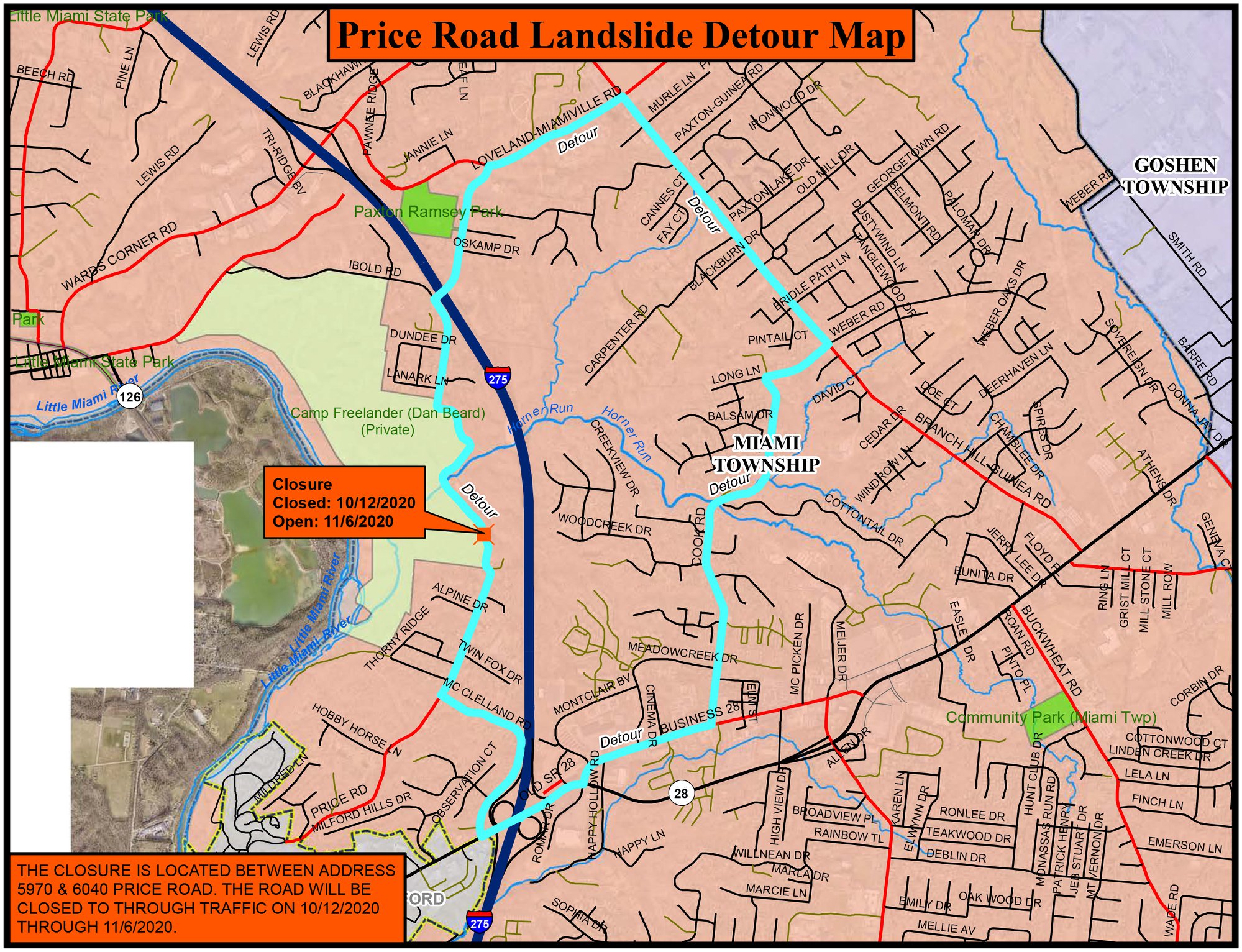

    The road will be closed to through traffic on Monday, October 12, through Friday, November 6.

    Right-click to open map in a new tab or window to see a larger view. The length of the detour is a little over 8-miles.

  • Maintain electric and natural gas service by using a “Winter Reconnect Order”

    Maintain electric and natural gas service by using a “Winter Reconnect Order”

    A Winter Reconnect Order is issued by the Public Utilities Commission of Ohio (PUCO) on an annual basis. The order allows residential customers who are disconnected or are threatened with disconnection to pay a maximum amount of $175 to have their service restored or maintained.

    Who is eligible to use the Winter Reconnect Order?

    Any residential customer who is served by a regulated utility company, regardless of income, may use the Winter Reconnect Order, to establish, maintain or restore service. Customers that have multiple residential accounts may only utilize the winter reconnection order at their primary residence.

    Who offers the Winter Reconnect Order?

    All regulated natural gas and electric companies must comply with the Winter Reconnect Order. To see the full list of regulated utility companies in Ohio, CLICK HERE.

    When can the Winter Reconnect Order be used?

    The Winter Reconnect Order may be used once per winter heating season, typically mid October through April 15.

    How can a customer sign up for the Winter Reconnect Order?

    There is no sign up required. Customers can simply contact their utility and mention the Winter Reconnect Order. Regulated utilities in Ohio are familiar with the order and will be able to guide consumers through the process.

    How much is a customer required to pay with the Winter Reconnect Order?

    If a residential customer’s service has been disconnected for non-payment or is threatened with disconnection, he or she may pay the required $175, and if applicable, a reconnection fee of no more than $36 up front to restore service and follow the company’s procedures to get reconnected. If paying at an authorized agent, the customer will also need to call their utility with the receipt number to report the payment.

    The Winter Reconnect Order payment of $175 can be split between two regulated utility companies if both utilities have been disconnected or are threatened with disconnection. Customers requesting to use a split payment must contact both of their regulated utility companies.

    Customers requesting new natural gas or electric service, who have no previous balance with their utility, may establish service under the winter reconnect order by paying $175, rather than paying the required security deposit. Such customers may have the remaining balance of the security deposit added to their next month’s bill.

    What is a reconnection charge?

    If your utility has a reconnection charge, it is a fee that must be paid before service can begin again. The PUCO approves a reconnection charge for each utility company and the utility is not allowed to charge more than the set amount. Any company that does not have a reconnection charge may not assess one. If the company’s approved reconnection charge is greater than $36, the remaining amount of the reconnection charge may be added to their next month’s bill.

    Can the $175 payment be made by a third party?

    Yes. Customers who are at or below 175 percent of the , may be eligible to receive funds through the (HEAP) Winter Crisis program. For a complete list of HEAP providers please contact (800) 282-0880.

    What if the customer owes more than $175 to the utility company?

    Regardless of how much a consumer may owe a utility, if they make the $175 payment, plus a reconnection fee of no more than $36, the utility must restore or maintain their service. Customers who utilize the Winter Reconnect Order are required to enroll on an extended payment plan.

    Can the utility company require a security deposit before reconnecting service?

    Yes. However, the total amount the company may require a customer to pay to maintain or reestablish service, including the security deposit, may not exceed the Winter Reconnect Order amount of $175, plus a reconnection fee of no more than $36. If the security deposit exceeds the Winter Reconnect Order and any applicable reconnection fee, the remaining amount of the security deposit may be added to the next month’s bill.

  • Mario Ferreri, Jake Terrell, and Brendan McPheron are Broadcom Masters

    Mario Ferreri, Jake Terrell, and Brendan McPheron are Broadcom Masters

    Loveland, Ohio – Three St. Columban students earned Broadcom Masters Top 300 recognition for their science fair projects last year. Mario Ferreri is in 8th grade this year and Jake Terrell and Brendan McPheron are now high school freshmen.

    Ben McPheron is the junior high science teacher who guided the students as they created their projects.

    Broadcom Foundation and Society for Science & the Public has announced the Top 300 MASTERS in their 10th annual Broadcom MASTERS. The program claims it is the nation’s premier Science, Technology, Engineering and Math (STEM) competition for middle school students. They seeks to inspire young scientists, engineers and innovators to solve the grand challenges of the 21st century.

    Each of the Top 300 MASTERS will receive a $125 award from DoD STEM. With this new prize, the Department of Defense continues its support of youth in STEM, working towards a more diverse pipeline of highly qualified STEM professionals in the future.

    The Top 300 MASTERS were selected from the largest pool of applicants the competition has seen, with 3,476 students from 42 states and Puerto Rico.

    Science fairs across the country had to cancel their competitions in the spring of 2020 because of the COVID-19 pandemic. In reaction, the Society and Broadcom Foundation opened up the Broadcom MASTERS competition to any student who registered to compete in a Society-affiliated science fair. Previously, only students who are named in the top 10% of their science fair were eligible to enter.

    “Every Middle School student who had the passion and fortitude to complete his or her science or engineering project with hardships imposed to schooling and research is a hero and heroine in our eyes, and the Top 300 Broadcom MASTERS semifinalists exemplify their remarkable grit,” said Paula Golden, President of Broadcom Foundation. “They inspire us all and give us hope for the future.”

    In addition to the $125 cash prize, the Top 300 Broadcom MASTERS received a prize package containing an award ribbon; semifinalist certificate of accomplishment; Broadcom MASTERS backpack; a Broadcom MASTERS decal; a specialized Invention Journal, courtesy of The Lemelson Foundation; a one-year subscription to Wolfram Mathematica software, courtesy of Wolfram Research; a special prize from Jeff Glassman, CEO of Covington Capital Management; and a one-year family digital subscription to Science News magazine. In recognition of the role that teachers play in the success of their students, each designated teacher also will receive a Broadcom MASTERS tote bag; a special edition booklet of Science News for Students’ Invention & Innovation articles from The Lemelson Foundation; and a one-year digital subscription to Science News magazine.


  • Cumulative cases of COVID 19 at Loveland Health Care go from 60 to 85

    Cumulative cases of COVID 19 at Loveland Health Care go from 60 to 85

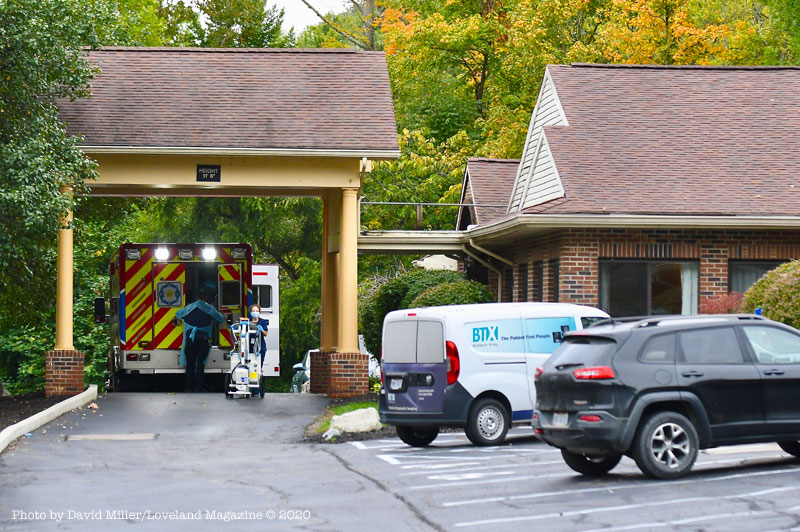
    Loveland, Ohio – The Ohio Department of Health released new data for COVID 19 cases at the Loveland Health Care Center (LHCC) today revealing the total cumulative cases of COVID 19 at LHCC went from 60 to 85 in the past week. The health department releases data each Wednesday.


    The numbers Loveland Magazine reported yesterday which was from the previous week’s report was 37 residents and 11 staff members with COVID 19 at LHCC. The cumulative case report revealed 39 residents and 21 staff members have had the virus. That was a total 60 of cumulative cases.

    Today’s report is 4 residents and 0 staff members with COVID 19 at LHCC, however, today’s cumulative case report reveals 64 residents and 21 staff members have had the virus. That total is 85 cumulative cases.

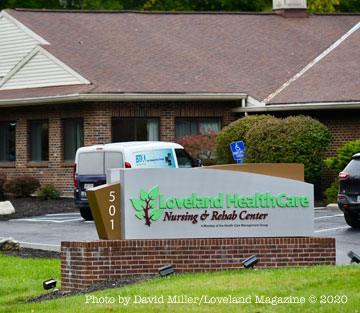
    LHCC is a 99-bed nursing home located at 501 North Second Street (St. Rt. 48) in Loveland.

    BACKGROUND

  • Media statement from the Loveland Health Care Center about COVID 19 “crisis”

    Media statement from the Loveland Health Care Center about COVID 19 “crisis”

    We know that this crisis is particularly challenging for our residents and their families. – Greg Miller

    Loveland, Ohio – After Loveland Magazine learned of the high number of COVID 19 cases at the Loveland Health Care Center, their spokesperson Greg Miller with Health Care Management Group said he would send an email response to our questions. (60 cases of COVID 19 at Loveland Health Care Center)

    Miller responded by sending this statement to Loveland Magazine this evening at 8:01 PM.


    Loveland Health Care Center

    MEDIA STATEMENT

    September 29, 2020

    Our facility appreciates the interest in the COVID-19 status of our residents. We can confirm that we do have staff and/or residents who have tested positive, or who are deemed positive, for COVID-19.

    Please note that out of respect to those impacted and, in accordance with privacy laws, we will not be sharing any details regarding the positive cases publicly.

    When these cases first developed, we notified our residents and their families, and we immediately involved the appropriate authorities. We continue to work with our local and state departments of health to monitor our active cases, and we have a plan in place to try to limit additional exposures. Our plan includes continuing our no visitor policy, enhanced health screening of residents and staff, and other measures informed by guidance from federal agencies, such as the Centers for Disease Control (CDC). New cases are reported to residents, families and local and federal agencies as required by law. 

    We know that this crisis is particularly challenging for our residents and their families. We empathize with their feelings of separation and vulnerability, and we want to thank them for their ongoing support and trust. The positive energy they provide to us every day is invaluable.

    We also want to thank and acknowledge our heroic staff. While many people are staying home during this crisis, our staff show up every day to do the essential work of caring for our vulnerable residents with dedication and purpose for the greater good.

    Thank you as well to our broader community for your concern for the well-being of our residents and our staff. It means so much to us to have the backing of our community at this difficult time.


    Here are the questions posed to Miller earlier this afternoon:

    How many patients are normally at LHCC? (bed count?)

    How many staff are normally at LHCC?

    The stats from the Ohio Department of Health from the last reporting date (9/23/20)are – 37 residents and 11 staff members with COVID 19. The cumulative case report reveals 39 residents and 21 staff members.

    • Are those the current numbers?

    • Has the count increased since that report (9/23/20)?

    • Can you give an update on the numbers as of today?

    • Can you tell us how you or LHCC reports cases? Who do you report to? Ohio Department of Health? Hamilton County Health? Warren County Health? Other?

    • Have there been deaths from COVID 19 among residents or staff?

    • It is our understanding that Ohio has eased visiting restrictions for Ohio nursing homes. Have you eased or otherwise changed visiting protocol at LHCC in light of the State’s new orders or the case count at LHCC?

    • Are you currently accepting new residents?


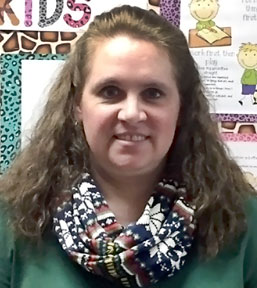
  • Heidi Weber is excited for her 3rd graders and the amazing skills they are learning!

    Heidi Weber is excited for her 3rd graders and the amazing skills they are learning!

    Provided Photo

    by Heidi Weber

    Hello! I am responding to your request to hear from teachers about Loveland Online learning. (Tell Us: How is remote learning going in the Loveland District)

    I am teaching 3rd grade through our online academy. I want to share that I am having a great deal of success because of the training opportunities made available through the district instructional technology coaches for years. While these coaches were lost due to cuts from the levy failure, our coaches offered training in many tech skills including the use of Google tools. They even offered support becoming certified as a Level 1 Google educator.

    I was able to take advantage of the training offered by the district for years and I earned this certification. The training helped me be highly skilled in the use of Google tools and applications in my classroom prior to COVID. This has made online teaching smoother for myself and my students. My skill with the tools has helped me teach these skills to my students and after 4 weeks, they are confident and capable learners!

    I am also supporting several children on IEPs. Between myself, an intervention specialist, and one of our paraprofessionals working remotely, my students have access to an adult all day long. I’ve created a schedule that links every meet into it for ease of access for families. I believe that all of my learners are thriving because technology lets me adapt for their needs in many ways such as providing audio recordings of directions or videos that students can pause or review again. You can’t put a live teacher on pause or listen again! So in many ways, I find the environment more supportive.

    It has been about re-imagining what we do as educators. There hasn’t been anything that I would have done in person that I haven’t figured out how to adapt to remote learning.

    My goal has been for students to be independent so that all I need parents to do is make sure there is a strong solid connection and devices that work at home (and if they don’t, we work with the district to help figure that too). If a child struggles with a task, then I figure out how to adapt it or support them more. I wouldn’t expect a parent to come to school and ‘teach’ their child under normal circumstances, so why would I ask them to ‘teach’ at home?

    I am excited for my 3rd graders and the amazing skills we are learning! I think we are ROCKING it!

    Sincerely,

    Heidi Weber