Tag: naloxone

  • Governor DeWine Announces New Effort to Improve Care Coordination and Reduce Fatal Drug Overdoses

    Governor DeWine Announces New Effort to Improve Care Coordination and Reduce Fatal Drug Overdoses

    Columbus, Ohio – Ohio Governor Mike DeWine and Ohio Board of Pharmacy Executive Director Steven Schierholt announced today that Ohio’s prescription drug monitoring program, known as the Ohio Automated Rx Reporting System (OARRS), will begin alerting healthcare providers about patients who have experienced a non-fatal drug overdose. These alerts are intended to improve care coordination and promote access to medication for opioid use disorder and other tools to prevent fatal overdoses.

    “The goal of this alert is to give us an extra chance to save someone’s life,” said Governor DeWine. “The research shows us that people who have recently experienced a non-fatal overdose are at a higher risk to overdose again in the near future, and that they often have regular interactions with the healthcare system – including pharmacists and prescribers. This new alert system will be a valuable tool allowing our healthcare providers the opportunity to educate and offer treatment and prevention options to these individuals before a tragedy occurs.”

    The data provided to OARRS is being reported by Ohio hospitals via the Ohio Department of Health because of a rule change announced by Governor DeWine earlier this year.  Using this data, the OARRS system will now flag for prescribers and pharmacists of any patient who experienced a non-fatal drug overdose and was discharged from an Ohio emergency department on or after April 8, 2024. The alerts will only be available for OARRS users who are prescribers and pharmacists.

    “Data from state prescription drug monitoring programs, such as OARRS, continues to be an invaluable resource for healthcare providers,” said Ohio Board of Pharmacy Executive Director Steven W. Schierholt. “With this alert, we are encouraging prescribers and pharmacists to engage with their patients and offer proven interventions that will prevent fatal drug overdoses in the future.”

    Among Ohioans who died in 2022 from an unintentional drug overdose, at least 32% experienced a prior non-fatal overdose. Among the same population, 26% received a prescription for a controlled substance from a healthcare provider within 60 days of their death. These interactions with the healthcare system reinforce the need to ensure high-risk patients have access to interventions such as overdose reversal medications (e.g., naloxone) and medication for opioid use disorder.

    Established in 2006, OARRS is a statewide database that collects information on all prescriptions for controlled substances that are dispensed by pharmacies or furnished by prescribers in Ohio. To assist healthcare providers in using this new alert, the Board of Pharmacy has developed training materials that can be accessed by visiting: Pharmacy.Ohio.gov/NFOD.

    According to DeWine, “This new alert system is another example of Governor DeWine’s ongoing and comprehensive efforts to prevent overdose deaths and fight drug addiction. Ohio’s coordinated efforts are achieving encouraging results.”

    Governor DeWine recently announced newly verified data from the Ohio Department of Health (ODH), demonstrating that Ohio experienced a 9% decline in the number of overdose deaths last year.

    ODH’s 2023 Ohio Unintentional Drug Overdose Report also shows that Ohio has now outperformed national overdose death trends for two years in a row. In 2023, Ohio’s 9% decrease in overdose deaths was better than the 2% decrease seen nationwide. In 2022, Ohio’s 5% decrease in overdose deaths was better than the 1% increase seen nationwide.

  • Loveland Magazine carries Narcan (Naloxone) at work and in “Company Car”

    Loveland Magazine carries Narcan (Naloxone) at work and in “Company Car”

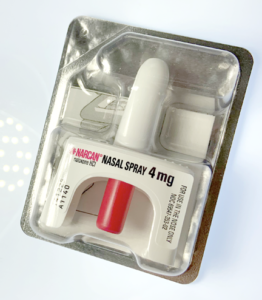
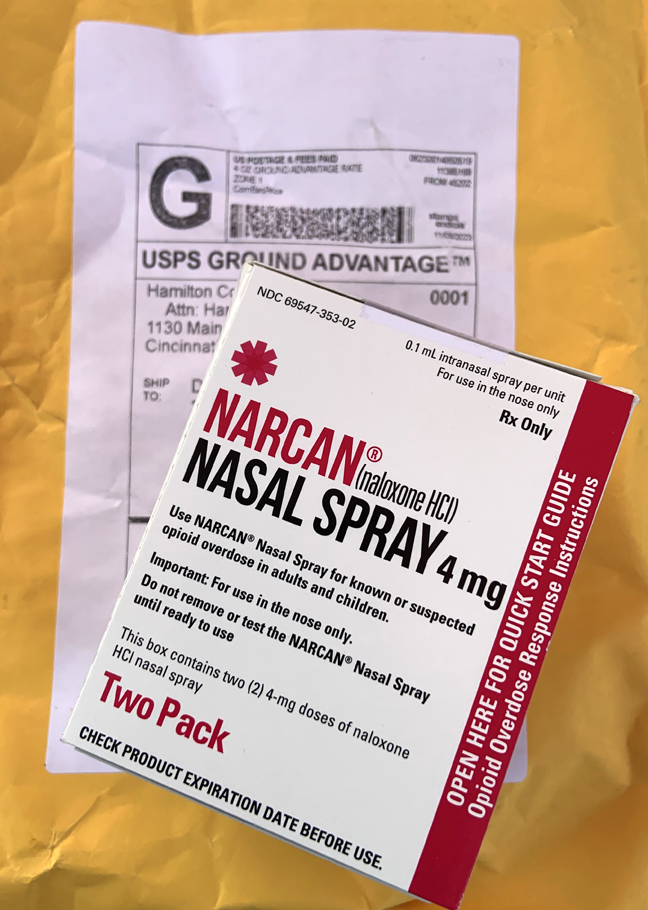
    One of the doses of Narcan Spray Loveland Magazine received free through the mail.

    Removing the Stigma

    Loveland, Ohio – Overdoses can happen in a moment and we know having Narcan (Naloxone) handy can save a life.

    Loveland Magazine will now be carrying Narcan in the “Company Car” as well as having it stocked at our office.

    Get Free NARCAN (Naloxone)

    If you are in Ohio, you can get Narcan for yourself, someone you know, or your organization. Help save lives!

    Using this LINK, Loveland Magazine received a two-pack box of Narcan Nasal Spray. It only took a few clicks, a few days, and it was totally FREE.

    What Is Naloxone?

    Naloxone is a medication that can reverse an overdose caused by an opioid drug (heroin, illegal fentanyl, or prescription pain medications). When administered during an overdose, naloxone blocks the effects of opioids on the brain and quickly restores breathing. Naloxone is marked under various trademarks, including NARCAN®

    Naloxone has been used safely by emergency medical professionals for more than 40 years and has only one important function: to stop overdose death by reversing the effects of opioids. Naloxone is a safe, non-controlled drug and has no potential for abuse.

    If naloxone is given to a person who is not going through an opioid overdose, it is harmless. If naloxone is given to a person who is dependent on opioids, it will cause withdrawal symptoms. Withdrawal, although uncomfortable, is not life-threatening.

    This video shows how to give naloxone nasal spray (brand name Narcan®) in an opioid overdose situation.

    Also, learn how to administer naloxone by watching this video from the Ohio Department of Health.


  • NARCAN (Naloxone) available to Hamilton County (OH) residents at NO CHARGE

    NARCAN (Naloxone) available to Hamilton County (OH) residents at NO CHARGE

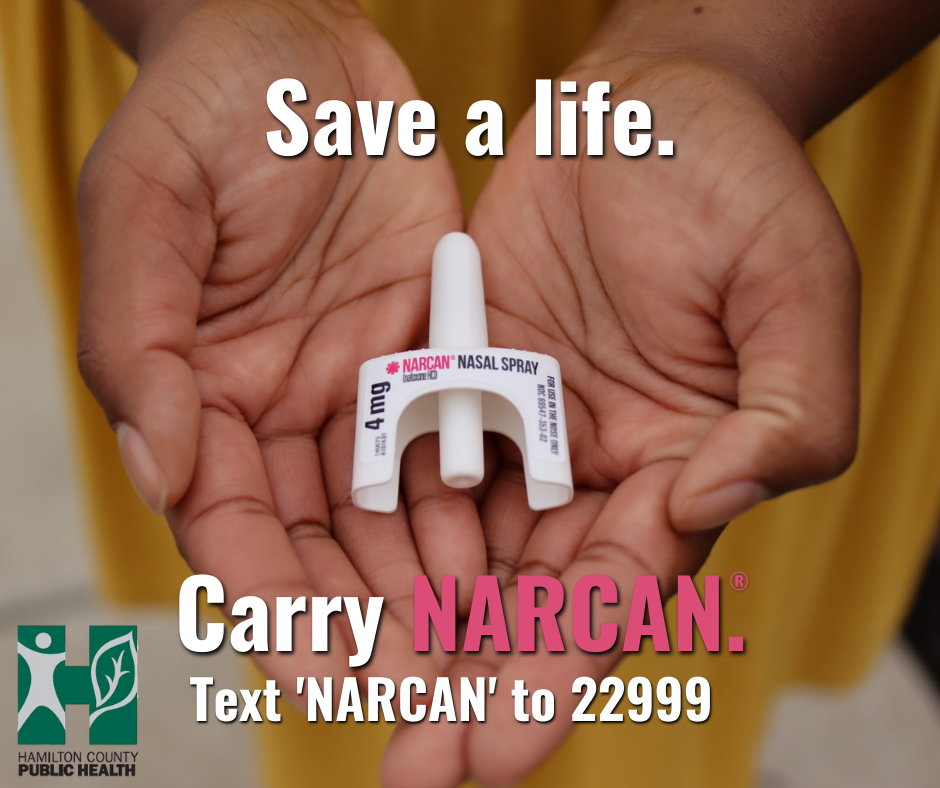
    Hamilton County Public Health, through the NARCAN® Distribution Collaborative (NDC), is making NARCAN® (Naloxone) available to Hamilton County (OH) residents at NO CHARGE. We are also distributing NARCAN® in the Hamilton County Public Health Clinic by appointment. The Hamilton County Public Health Clinic is located at 184 E. McMillan St. Cincinnati, OH 45219. If you would like to make an appointment for a NARCAN® training or would like more information on NARCAN® distribution, please contact NDC staff at 513-309-1522 or narcan@hamilton-co.org.


    NARCAN® by Mail

    HCPH is now offering free mail order NARCAN® to Hamilton County (OH) residents. To obtain a kit through the mail please click this link. If you live outside Hamilton County (OH), visit your local health department to find out where you can find NARCAN® in your area.


    Project DAWN

    Project DAWN – Deaths Avoided With Naloxone — is a community-based overdose education and naloxone distribution program. Project DAWN participants receive training on:

    • Recognizing the signs and symptoms of overdose
    • Distinguishing between different types of overdose
    • Performing rescue breathing
    • Calling emergency medical services
    • Administering intranasal Naloxone

    For more information on Project DAWN, click here: https://www.odh.ohio.gov

  • Calls to Clermont County 528-SAVE crisis hotline increase

    Calls to Clermont County 528-SAVE crisis hotline increase

    Help is available 24/7 through the Clermont County Crisis Hotline at 528-SAVE (7283).  The Hotline is staffed by trained and licensed mental health providers who can assist with connection to needed services.  There is also a crisis text line that can be accessed 24/7.  Text the keyword “4hope” to 741 741.

    Ongoing stress due to the pandemic has contributed to increased calls to the Clermont County 528-SAVE Crisis Hotline over the past several months. The Clermont County Crisis Hotline has seen a 21-percent increase in the number of calls in the fiscal year that ended June 30, 2020, as compared to the previous 12 months. The hotline has also seen an increase in the number of suicidal/crisis calls.

    “The long-term impact of the COVID-19 pandemic is starting to take its toll,” said Lee Ann Watson, associate director, Clermont County Mental Health & Recovery Board. “This has been a challenging time for nearly everyone, especially those with possible underlying behavioral health concerns.”

    Clermont County has the second-highest suicide rate in Southwest Ohio and is 13th in the state per 100,000 for suicide deaths. Fortunately, there has not been an increase in suicide deaths in 2020.  People appear to be reaching out for help more than in previous years.  But there is still a reason for concern. While the suicide deaths have decreased in 2020, one death by suicide is too many.

    Watson asks people to recognize warning signs and know how to reach out for help.  It is important to know the warning signs and the resources to seek help because likely people who are depressed and at risk for suicide are not often motivated to seek help. Losses such as the end of a relationship, death of a loved one, or loss of employment, all of which are situations that can be occurring during COVID-19, can increase the risk for depression.

    Common Warning Signs of Acute Suicide Risk

    The following are not always communicated directly or outwardly:

    • Threatening to hurt or kill him or herself, or talking of wanting to hurt or kill him/herself; and or,
    • Looking for ways to kill him/herself by seeking access to firearms, available pills, or other means; and/or,
    • Talking or writing about death, dying or suicide, when these actions are out of the ordinary.

    Additional Warning Signs:

    • Increased substance (alcohol or drug) use
    • No reason for living; no sense of purpose in life
    • Anxiety, agitation, unable to sleep or sleeping all of the time
    • Feeling trapped – like there’s no way out
    • Hopelessness
    • Withdrawal from friends, family, and society
    • Rage, uncontrolled anger, seeking revenge
    • Acting reckless or engaging in risky activities, seemingly without thinking
    • Dramatic mood changes
    • Giving away prized possessions or seeking long-term care for pets

    (Source: American Association of Suicidology)

    Help is available 24/7 through the Clermont County Crisis Hotline at 528-SAVE (7283).  The Hotline is staffed by trained and licensed mental health providers who can assist with connection to needed services.  There is also a crisis text line that can be accessed 24/7.  Text the keyword “4hope” to 741 741.   

    High-risk groups: Men, those 65 and older
    Middle-aged men and individuals over the age of 65 comprise high-risk groups in Clermont County, similar to national trends. Men have always had a higher rate of suicide death than females, but the number of males dying from suicide has significantly increased. During 2019, 37-percent of the suicide deaths were men between the ages of 40-59.  This is a 100-percent increase in the number of deaths in 2019 of this age group compared to 2018.  In 2020, 88 percent of the suicide deaths were men.  Of those, 23 percent were aged 40-49, and 26 percent were aged 60-69.

    While it is often difficult for men to reach out for help, it is important for men to remember that now more than ever “it is ok not to be ok” and that feeling overwhelmed is not a sign of weakness.  Seeking help is a sign of strength.  Mental health professionals are available to assist with the specific needs and concerns of men.  Further, a 2019 study published in the Journal of Mental Health found that receiving support from a trusted and respected friend can be an effective suicide prevention strategy for men. Forming connections with other people who are going through the same thing can also be helpful.

    The Clermont County Suicide Prevention Coalition is working to decrease suicide in our County through increasing knowledge of warning signs, and availability of treatment. If you are interested in joining the Coalition, please contact Lee Ann Watson at (513) 732-5400.

    Number of overdose deaths decline; meth use increases

    With regard to unintentional fatal overdose deaths, Clermont County has seen a decrease in deaths over the past three years.

    The decrease in deaths can be partially attributed to the widespread distribution of Naloxone to county residents. While the overdose deaths have decreased, nonfatal overdoses are still occurring in Clermont County, albeit less than in previous years.

    Regarding non-fatal overdoses, the County was ranked 16th in the state in 2019 for the number of Naloxone administrations (387 doses; Ohio EMS, 2019). This ranking is based on the number of administrations, not by population. For the first three quarters in 2020, Clermont is ranked 17th in the state for the number of Naloxone administrations (315; Ohio EMS, 2020). The number of administrations is underreported since not all the EMS departments in Clermont County report the use of Naloxone, and the figures do not include the Naloxone utilized by law enforcement.

    Clermont County saw a surge in nonfatal overdoses in the summer months of 2020, but the overdoses have now decreased to lower than in the previous year.  There continue to be “hot spots” in Clermont County where overdoses are occurring:  Union Township; New Richmond and Felicity.

    The use of stimulants, particularly methamphetamine, has substantially increased in Clermont County. The degree of complexity related to stimulant misuse has impacted the county. A large portion of the homicides in 2019 was related to stimulant misuse. Individuals on meth can have extreme paranoia and often aggressive behavior, and difficult to engage in treatment.

    The CCMHRB’s substance use disorder treatment provider has seen an increase in treatment admissions for stimulant misuse in the last year (14 percent), and the local hospital also reports an increase in the rate of admissions to the Emergency Department (ED) and the behavioral health unit due to meth misuse.

    Individuals who are brought into the ED under the influence of meth most often have to be admitted to the behavioral health unit. Those stays are often long since it is taking several days for the individual to clear.

    Clermont County Children’s Protective Services has also reported a substantial increase in the number of children in custody due to stimulant use disorders. In 2019, more than 30 percent of the cases were related to methamphetamine.  The number of cases has increased in 2020 as reported by CPS.

    Stimulant misuse differs greatly from opioid misuse.  Due to the nature of the drug, individuals actively using stimulants are often not able to engage in discussions related to treatment, and therefore outreach to attempt to engage them in treatment is not successful as it has been for individuals using opioids.  Further, many individuals with a stimulant use disorder do not believe they have an addiction, and therefore do not voluntarily enroll in treatment.  The CCMHRB’s contract substance use disorder treatment provider reports that in 2019, 21 percent of clients identified stimulants as their primary drug of choice, while 34 percent identified opioids as their primary drug of choice.


  • Syringe services program begins in Clermont County

    Syringe services program begins in Clermont County

    Mercy Clermont Hospital and Clermont County Public Health have partnered to offer a free syringe services program starting March 1.
     
    The Exchange Project van, which is operated by Hamilton County Public Health, will visit the Clermont Hospital campus every Thursday from 10 a.m.-1 p.m. The hospital is located at 3000 Hospital Drive, Batavia, Ohio 45103.
     
    The program also offers testing and referral to treatment for HIV and Hepatitis C, education on prevention of infection and an access point to substance use disorder counseling and treatment programs. The program also provides naloxone, also known as Narcan, an opiate overdose reversal medication. Read more here.