Tag: November ballot

  • Symmes Township Parks Levy on the November ballot

    Symmes Township Parks Levy on the November ballot

    Symmes Township, Ohio – Symmes Township Trustees have voted to place a .5 mill levy on the November ballot. The proposed levy will generate $477,000 each year for the next 5 years (2025-2029) and cost an additional $18.00 per $100,000 of valuation per residence.

    The levy will be used to pay for capital improvements to all township parks.

  • Signatures certified: Ohio anti-gerrymandering amendment on its way to November ballot

    Signatures certified: Ohio anti-gerrymandering amendment on its way to November ballot

    BY:  Ohio Capital Journal

    A proposed anti-gerrymandering amendment in Ohio that would remove politicians from the redistricting process in favor of a citizens commission has gathered enough signatures to proceed to voters on the November ballot.

    The Ohio Secretary of State’s Office certified 535,005 signatures for the Citizens Not Politicians ballot initiative that would create an independent redistricting commission and replace the Ohio Redistricting Commission made up entirely of elected officials.

    The coalition of voting rights groups and anti-gerrymandering advocates who made up Citizens Not Politicians submitted more than 731,000 signatures on July 1, well above the required 413,487. The Secretary of State’s Office reviewed the signatures for duplicate or invalid signatures, finalizing the total on Tuesday.

    The office also said the initiative received signatures from 58 of the 88 counties, and at least 5% of the total vote cast for governor in the last gubernatorial election. Ohio law requires measures to have signatures in at least 44 counties.

    “This certification is a historic step towards restoring fairness in Ohio’s electoral process,” retired Ohio Supreme Court Chief Justice Maureen O’Connor said in a CNP statement after the signatures were certified.

    The former chief justice came on to the effort early in the process after leaving the Ohio Supreme Court due to age limits. As a member the state’s highest court, she was part of a majority that rejected six maps, both Ohio Statehouse and congressional, adopted by the Ohio Redistricting Commission, which includes the governor, auditor of state, and secretary of state, along with legislative leaders, all of whom are elected officials, as dictated by the current redistricting laws.

    O’Connor told supporters at a rally when the signatures were submitted to the Secretary of State’s Office that the measure was “one of the most widely supported citizen-initiated constitutional amendments in Ohio’s history.”

    The initiative now heads to the Ohio Ballot Board, led by Secretary of State Frank LaRose, where the language of the initiative will be reviewed, and can be changed as it was with last November’s Issue 1 abortion amendment.

    According to CNP, the ballot board, which has not yet scheduled the meeting for the measure’s consideration, has until Aug. 22 to “write and adopt the language that will appear on the Nov. 5 ballot” based on constitutional requirements to “properly identify the substance of the proposal to be voted on.”

    “We are confident that Ohio voters will see simple, accurate language when they go to the polls on Nov. 5 to vote for this amendment,” O’Connor said in the CNP statement.

    In addition to creating a 15-member independent redistricting commission, the constitutional amendment would ban current or former politicians and party officials, along with lobbyists from having a seat on the commission, and “require the creation of fair and impartial districts, prohibiting any drawing of voting districts that discriminate against or favor any political party or individual politician,” according to the coalition.

    Supporters also say the amendment would create a more transparent process than has been seen in past redistricting efforts.

    Opponents of the measure include Ohio Senate President Matt Huffman, who took during a post-primary event by the Ohio Chamber of Commerce to make the case against the effort.

    He argued the new process would provoke an “extraordinary” amount of legal challenges, and he also defended the current process.

    “When allowed to work in the summer of 2023, (the redistricting process) did work,” Huffman said in March.

    After ballot board approval, the initiative will then be included in the November ballot issues statewide.


    Susan Tebben
    SUSAN TEBBEN

    Susan Tebben is an award-winning journalist with a decade of experience covering Ohio news, including courts and crime, Appalachian social issues, government, education, diversity and culture. She has worked for The Newark Advocate, The Glasgow (KY) Daily Times, The Athens Messenger, and WOUB Public Media. She has also had work featured on National Public Radio.

    Ohio Capital Journal is part of States Newsroom, the nation’s largest state-focused nonprofit news organization.

    MORE FROM AUTHOR


  • Abortion rights groups ask Ohio Supreme Court to order full amendment text for November ballots

    Abortion rights groups ask Ohio Supreme Court to order full amendment text for November ballots

    “Gavel,” a sculpture by Andrew F. Scott, outside the Supreme Court of Ohio. Credit: Sam Howzit/Creative Commons.

    BY:  Ohio Capital Journal

    In the fight against Ohio Ballot Board language that reproductive rights groups say is deceptive, an attorney has asked the Ohio Supreme Court to order the full text of the proposed amendment to be used on November ballots.

    The Ohio Ballot Board approved language last month for voters to see on their ballots that took out specific details of the amendment, such as protections for miscarriage care and contraception.

    The language was ostensibly meant to summarize Issue 1, a proposed amendment that would add abortion and reproductive rights into the state constitution, but those who created the proposed amendment say the summary approved by the ballot board in a 3-2 vote misleads voters and adds biased terms like “unborn child” instead of the medically accurate term “fetus.”

    In a filing this week, attorney Don McTigue asked the Ohio Supreme Court to send the Ohio Ballot Board back to the drawing board, specifically to “prescribe that the amendment’s full text be used as the ballot language.”

    “The Ballot Board’s prescribed language misleads the voters about ‘what they are being asked to vote on’ and engages in improper ‘persuasive argument … against’ the Amendment,” McTigue wrote, citing previous Ohio Supreme Court languages.

    The summary language has various defects, according to the abortion rights groups, including misleading voters about “what right the amendment would create,” what restrictions the amendment would create, “whether and to what degree” the proposal would continue a pregnancy, a physician’s discretion regarding fetal viability, and “how the amendment would limit state regulation.”

    “Each of these defects violates the constitution and laws of the state of Ohio, and cannot survive under this court’s precedents,” McTigue wrote.

    Along with the alleged defects, the brief says the ballot board’s summary changes language enough to alter the meaning of the amendment and give false information to voters.

    The summary language states that the amendment would “always allow an unborn child to be aborted at any stage of pregnancy, regardless of viability if, in the treating physician’s determination, the abortion is necessary to protect the pregnant woman’s life or health.”

    “To the contrary, if the amendment were adopted, such an abortion would not be allowed insofar as the pregnant patient objected to it,” McTigue wrote. “In that case, the pregnant person would have an individual right to decide to continue [their] own pregnancy.”

    He also argued that the majority that voted for the summary language included two people who have been working against the measure. One of which, state Sen. Theresa Gavarone, took time during the board meeting in which the summary language was considered, to call the amendment “dangerous” and commit to campaigning against the measure.

    “Gavarone attacked the substance of the amendment itself as ‘an abomination,’ and asserted that the amendment entailed an ‘assault on parental rights,” the court filing noted.

    Ohio Secretary of State Frank LaRose, who leads the ballot board, has also been a vocal opponent of the proposed amendment, posting on social media with anti-abortion groups, and working on a failed constitutional amendment to raise the threshold to approve amendments specifically to block the abortion rights measure.

    “This context, together with the ballot language’s length and many defects, makes clear that the board majority’s personal opposition to the amendment infected the ballot board’s exercise of authority,” McTigue told the court.

    The Ohio Attorney General’s Office, who represents the ballot board in legal proceedings, denied wrongdoing by the board in response to the lawsuit.

    Susan Tebben
    SUSAN TEBBEN

    Susan Tebben is an award-winning journalist with a decade of experience covering Ohio news, including courts and crime, Appalachian social issues, government, education, diversity and culture. She has worked for The Newark Advocate, The Glasgow (KY) Daily Times, The Athens Messenger, and WOUB Public Media. She has also had work featured on National Public Radio.

    MORE FROM AUTHOR

  • Abortion amendment ballot language submitted, Ballot Board set to meet Thursday

    Abortion amendment ballot language submitted, Ballot Board set to meet Thursday

    Abortion rights groups request full text on November ballots

    BY:  Ohio Capital Journal

    Gearing up for an Ohio Ballot Board meeting where constitutional amendment language regarding reproductive health will be considered, groups pushing for the measure want to see the entire text of the amendment on November ballots.

    In a letter received by the Ohio Secretary of State on Monday, attorney Donald McTigue represented petitioners for the constitutional amendment in asking the board to use full text of the proposed amendment or a condensed version, so that voters can read the entire thing on their ballots in the general election this year.

    “By using the full text, voters will see for themselves the language they are being asked to approve and can make a free and independent decision on this fundamental question,” McTigue wrote.

    The abortion rights groups also argued that, in using the full text, “there can be no dispute about whether legal standards have been satisfied or whether the condensed text misleads, deceives or defrauds voters,” according to the letter.

    The ballot measure’s title, as submitted by the groups for approval by the ballot board, is “To Establish the Right to Reproductive Freedom with Protections for Health and Safety.”

    Because of the rejection of Issue 1 earlier this month at the polls, which would have raised the threshold to approve a constitutional amendment, a simple majority is needed to pass the measure.

    In the language of the amendment, it specifies that “every individual has a right to make and carry out one’s own reproductive decisions, including but not limited to” contraception, fertility treatments, pregnancy, miscarriage care and abortion.

    It prohibits the state from doing anything to “directly or indirectly burden, penalize, prohibit, interfere with or discriminate against” the exercise of the rights in the amendment, or those who assist in the exercise of the rights.

    The amendment makes exceptions in terms of abortion, in which it would be “prohibited after fetal viability.”

    “But in no case may such an abortion be prohibited if in the professional judgment of the pregnant patient’s treating physician it is necessary to protect the pregnant patient’s life or health,” the amendment states.

    “Any attempt to alter wording away from the text of the amendment should be seen for what it is: an attempt to confuse and mislead voters,” said Lauren Blauvelt, of Ohioans United for Reproductive Rights, in a statement announcing the submission of the ballot language.

    Opposition groups have claimed the amendment would impact parental rights and allow “late-term abortion,” neither of which are included in the language submitted to the ballot board. “Late-term abortion” is not considered a legitimate medical term.

    Two different lawsuits attempting to keep the amendment from going before voters have been rejected by the Ohio Supreme Court.

    Most recently, a former state legislator and a Catholic Ohio resident asked that the measure be blocked because it was unclear what laws it sought to change. A separate previous lawsuit argued the Ohio Ballot Board abused its power by improperly considering, and thus moving the ballot measure forward so that signatures could be collected in support of it.

    That signature collection amounted to nearly 500,000 valid Ohio voter signatures, which allowed the measure to head to the ballot.

    Another abortion-related lawsuit is still in the process of making it through the state’s highest court. That lawsuit was filed by Ohio Attorney General Dave Yost, challenging a Hamilton County court’s right to pause a six-week abortion ban implemented almost immediately after the Dobbs decision overturned Roe v. Wade.

    That law was passed in 2019, but has since been entangled in court cases. It bans abortion after six weeks gestation and was in place for several months following the Dobbs decision before being halted by the courts.

    The Ohio Ballot Board is scheduled to consider and vote on the language on Thursday, where they will also consider language regarding a proposed statute for recreational marijuana.


    Susan Tebben
    SUSAN TEBBEN

    Susan Tebben is an award-winning journalist with a decade of experience covering Ohio news, including courts and crime, Appalachian social issues, government, education, diversity and culture. She has worked for The Newark Advocate, The Glasgow (KY) Daily Times, The Athens Messenger, and WOUB Public Media. She has also had work featured on National Public Radio.

    MORE FROM AUTHOR

    ___________________
    [pdf-embedder url=”https://lovelandmagazine.com/wp-content/uploads/2023/08/The-Right-to-Reproductive-Freedom-with-Protections-for-Health-and-Safety.pdf”]
  • Proposed recreational marijuana law is headed to the November ballot in Ohio

    Proposed recreational marijuana law is headed to the November ballot in Ohio

    BY:  Ohio Capital Journal

    A proposed recreational marijuana law will be on Ohio’s November ballot after all.

    The Secretary of State’s office verified 4,405 additional valid petition signatures — bringing the grand total to 127,772, Secretary of State Frank LaRose said Wednesday in a letter to the campaign. 124,046 signatures were needed.

    The Coalition to Regulate Marijuana like Alcohol’s statute initiative would legalize and regulate cultivation, manufacturing, testing and sale of marijuana to Ohioans 21 and up. It would also legalize home grow for Ohioans 21 and up with a limit of six plants per person and 12 plants per residence, and impose a 10% tax at the point of sale for each transaction.

    “We are grateful to the thousands of Ohioans who helped us get to this point and are excited to bring our proposal to regulate marijuana like alcohol before Ohio voters this coming Election Day,” spokesperson Tom Haren said.

    This comes after the coalition initially came up just short of collecting enough valid signatures. The coalition submitted 223,176 signatures in July, but only 123,367 were found to be valid signatures. They recently submitted 6,545 additional signatures after the 10-day cure period.

    Hamilton County submitted the most valid signatures with 1,914. Next was Franklin County with 711 and Montgomery County with 626.

    Twenty-three states and Washington D.C. have legalized the recreational use and sale of cannabis.

    The proposed marijuana statute will be on Nov. 7’s ballot alongside the reproductive rights amendment.

    Follow OCJ Reporter Megan Henry on Twitter.


    Megan Henry
    MEGAN HENRY

    Megan Henry is a reporter for the Ohio Capital Journal and has spent the past five years reporting in Ohio on various topics including education, healthcare, business and crime. She previously worked at The Columbus Dispatch, part of the USA Today Network.

    MORE FROM AUTHOR

  • Ohio abortion rights amendment a go for November ballot

    Ohio abortion rights amendment a go for November ballot

    495,938 valid signatures certified to bring proposal to Ohio voters

    BY:  Ohio Capital Journal

    An abortion rights amendment proposed for the Ohio Constitution was certified on Tuesday to go forward for consideration by voters in November as nearly 500,000 signatures in support were verified by the Secretary of State’s office.

    In a letter to the campaign that collected signatures to put the ballot measure to Ohioans this year, Secretary of State Frank LaRose said 495,938 valid signatures were recorded, and a total of 55 counties fulfilled the percentage requirements for verification.

    “Therefore, in the absence of judicial direction to the contrary, I will direct the boards of election to place the proposed amendment on the November 7, 2023, general election ballot,” LaRose wrote.

    When advocates turned their boxes of signatures in to the secretary of state’s office on the July 5 deadline, they reported more than 700,000 signatures were submitted to be verified statewide.

    Despite the lower number, the final tally is well above Ohio’s legal requirements to put an amendment proposal on the ballot.

    Based on current law, abortion rights advocates needed to collect 413,487 signatures in 44 of 88 counties, a number based on election results from the last governor’s race.

    Ohioans United for Reproductive Rights (OURR), a coalition of groups supporting the the codification of abortion rights in the state constitution, celebrated the news, but also set their sights on another hurdle at the ballot: Issue 1, hitting voters next month in the August 8 primary.

    Issue 1 would make it harder for Ohio voters to amend the constitution by raising the threshold from a simple majority to 60%. If passed, Issue 1 would require the abortion ballot measure to meet that threshold.

    It would also require proposals made after January 1, 2024, to meet signature requirements in all 88 counties instead of the current requirement of 44 counties.

    “Now that the petition drive is complete, we’re eager to continue the campaign to enshrine those rights in Ohio’s constitution and ensure that Ohioans will never again be subject to draconian reproductive health care policies imposed by extremists,” wrote Lauren Blauvelt and Dr. Lauren Beene, executive committee members for the OURR, in a statement.

    “This is a major step for Ohio, but it’s bigger than just one state,” said Kimberly Inez McGuire, executive director for Unite for Reproductive and Gender Equity. “This is about reversing the tide of abortion bans and securing a better future for us all.”

    GOP leaders including LaRose have admitted Issue 1 supporters are motivated by their desire to stop the abortion rights amendment.

    The campaign standing in opposition to the abortion amendment, Protect Women Ohio, and anti-abortion lobby Ohio Right to Life, decried the new development, pushing ahead with their efforts to block the amendment from passage.

    Peter Range, CEO of Ohio Right to Life, called the amendment “anti-life,” and said it is “even more imperative that every pro-life Ohioan votes yes on Issue 1 this August to ensure that our constitution, our preborn and our families are protected,” according to a statement sent by the group.

    Protect Women Ohio said they have spent “an initial” $8 million on TV, radio and digital ads in support of Issue 1, and against the November abortion amendment.

    With the amendment now allowed to go to the ballot, the Ohio Ballot Board chaired by LaRose will draft the language voters will read about the measure on their ballots.

    Recent polls show 57.6% of Ohioans support the abortion rights amendment, while 32.4% oppose it and 10% are undecided. On the Aug. 8 Issue 1 effort to change the threshold for passage of amendments from 50% to 60%, another recent poll showed 57.2% of Ohioans oppose Issue 1, while 26% support it, and 17% are undecided.


    Susan Tebben
    SUSAN TEBBEN

    Susan Tebben is an award-winning journalist with a decade of experience covering Ohio news, including courts and crime, Appalachian social issues, government, education, diversity and culture. She has worked for The Newark Advocate, The Glasgow (KY) Daily Times, The Athens Messenger, and WOUB Public Media. She has also had work featured on National Public Radio.

    MORE FROM AUTHOR

    ____________________

    Related Loveland Magazine Interview:

  • Gathering signatures to put abortion amendment on November ballot is ‘going very well’

    Gathering signatures to put abortion amendment on November ballot is ‘going very well’

    Abortion rights groups attempting to get the measure on the ballot need to get 413,000 signatures by July 5.

    BY: Ohio Capital Journal

    Less than two weeks until the deadline, Ohio Physicians for Reproductive Rights is saying abortion right advocates will get the signatures needed to put a measure on the November ballot that would enshrine abortion rights in the Ohio Constitution.

    Abortion advocates attempting to get the amendment on the ballot need to collect 413,000 signatures by July 5.

    “The signature gathering effort has been going very well and we are on track to be successful,” Dr. Lauren Beene, OPRR co-founder and general pediatrician in Northeast Ohio, said Thursday during a media call. “We will have reached our goals to be able to submit before the deadline coming up in July.”

    OPRR said they were unable to quantify how many signatures have been gathered so far because the number constantly changes.

    “We’re actually in the verification and counting phase right now,” Beene said.

    This comes as the one-year anniversary of the Dobbs decision nears, which overturned Roe v. Wade and gave states the power to regulate abortion access. OPRR, which formed after the Dobbs decision, has grown to more than 4,000 individual healthcare members.

    Abortion is currently legal in Ohio up to 21 weeks as the six-week abortion ban is held up in court.

    Issue 1

    Before the November election, abortion advocates first must look to the Aug. 8 special election when Ohioans will vote on Issue 1, which would raise the threshold for a constitutional amendment to pass from a simple majority of 50% plus one to 60%.

    Ohio Secretary of State Frank LaRose recently said Issue 1 is, “100% about keeping a radical pro-abortion amendment out of our constitution.”

    “Issue 1 is obviously extremely important to us,” OPRR co-founder and pulmonologist Dr. Marcela Azevedo said. It is targeted towards our issue. … We are pretty aware that this is just another desperate attempt to thwart the will of voters with a goal of ending majority rule and transferring the power from the people to politicians and lobbyists in Columbus. This constitutional amendment is just another ploy.”

    Heartbeat bill

    After the Dobbs decision last June, Ohio’s six-week abortion ban was in place for about 11 weeks until a Hamilton County judge put a temporary restraining order on the heartbeat bill.

    “Living under a time period where you’re doing the right thing for patients and it’s illegal was not something I would have thought it would have experienced in my career,” said Dr. Amy Burkett, a board-certified OB/GYN in northeast Ohio and OPRR member. “Doing the right thing was not supported by my state legislature.”

    That’s how the constitutional amendment was born.

    “Our solution to the ambiguity and confusing nature of the poorly written heartbeat ban is our constitutional amendment right,” Beene said. “What we are putting forth what people have been coming out of the woodwork to sign.”

    She said the decision for someone to get an abortion should be between them and their doctor.

    “You have to make sure what’s most important is that when our patients need access to care, that access to care is available and available immediately,” Beene said.

    OPRR members said it’s tough to quantify how many people were referred out of state by Ohio doctors while the six-week ban was in place, but said it’s not always possible for patients to go out of state.

    “That’s a huge burden to patients to have to go somewhere else for the care that’s considered evidence based health care,” Burkett said. “They need funds for travel. If it’s overnight they’re missing more work, they may need childcare.”

    Ohio had 21,813 abortions in 2021, according to the Ohio Department of Health.

    Follow OCJ Reporter Megan Henry on Twitter.


    Megan Henry
    MEGAN HENRY

    Megan Henry is a reporter for the Ohio Capital Journal and has spent the last five years reporting on various topics including education, healthcare, business and crime at The Columbus Dispatch, part of the USA Today Network.

    MORE FROM AUTHOR

  • Ohio abortion rights groups merge and set sights for amendment on November ballot

    Ohio abortion rights groups merge and set sights for amendment on November ballot

    Getty Image

    BY: SUSAN TEBBEN – Ohio Capital Journal

    Two groups who had already committed to separate efforts to get reproductive rights in the hands of Ohio voters have now merged and set an end goal: abortion access on the November ballot.

    Ohioans for Reproductive Freedom and Ohio Physicians for Reproductive Rights announced Thursday that they are joining together to “file language with the Ohio Attorney General to place a citizen-initiated constitutional amendment to restore and protect reproductive rights and abortion access on the November 2023 statewide general election ballot.”

    “This grassroots initiative – by and for the people of Ohio – is foundational to ensuring access to abortion and the right to bodily autonomy, not only for ourselves, but for generations to come,” said Kellie Copeland, executive director of Pro-Choice Ohio and member of Ohioans for Reproductive Freedom, said in the announcement.

    The groups said the constitutional amendment will look similar to a Michigan amendment which voters approved in November 2022.

    After the amendment is drafted and reviewed by the state Attorney General and Ohio Ballot Board, the groups plan to circulate petitions to place the issue on the ballot.

    Rumblings of a constitutional amendment have been floating for months now, spurred on by the Dobbs v. Jackson Women’s Health Organization case, in which the U.S. Supreme Court overturned decades old nationwide rights to abortion nationwide in Roe v. Wade.

    Placing the measure on the 2023 ballot was called a “moral imperative” which “offers the best prospects for success,” according to Dr. Lauren Beene, executive director of the OPRR.

    “The lives and health of Ohioans have been at risk since Roe was overturned,” Beene said in a statement. “That is why we must seize the earliest possible opportunity to ensure that doctors and patients, rather than politicians and the government, are empowered to make decisions about pregnancy, contraception and abortion.”

    The move comes as some abortion rights advocates are ramping up legal efforts to protect patients and physicians seeking abortion care or advice, along with a battle involving Ohio’s Attorney General Dave Yost to keep abortion pills from being distributed through the mail or at national pharmacies, and a new study that showed abortion clinics find it more and more difficult to comply with laws on the subject because of bureaucratic discretion.

    The ballot measure might have another issue if in-fighting within the state’s Republican caucus continues. One side of the caucus is promoting the controversial legislation that would raise the threshold to approve constitutional amendments, while House Speaker Jason Stephens didn’t list it as one of the priority bills he and his faction unveiled on Wednesday.

    Republicans on both sides of the aisle have expressed interest in legislative prohibitions to abortion since the downfall of Roe, and both sides are awaiting the resolution of a court case under which a six-week abortion ban is paused indefinitely as appeals go through.


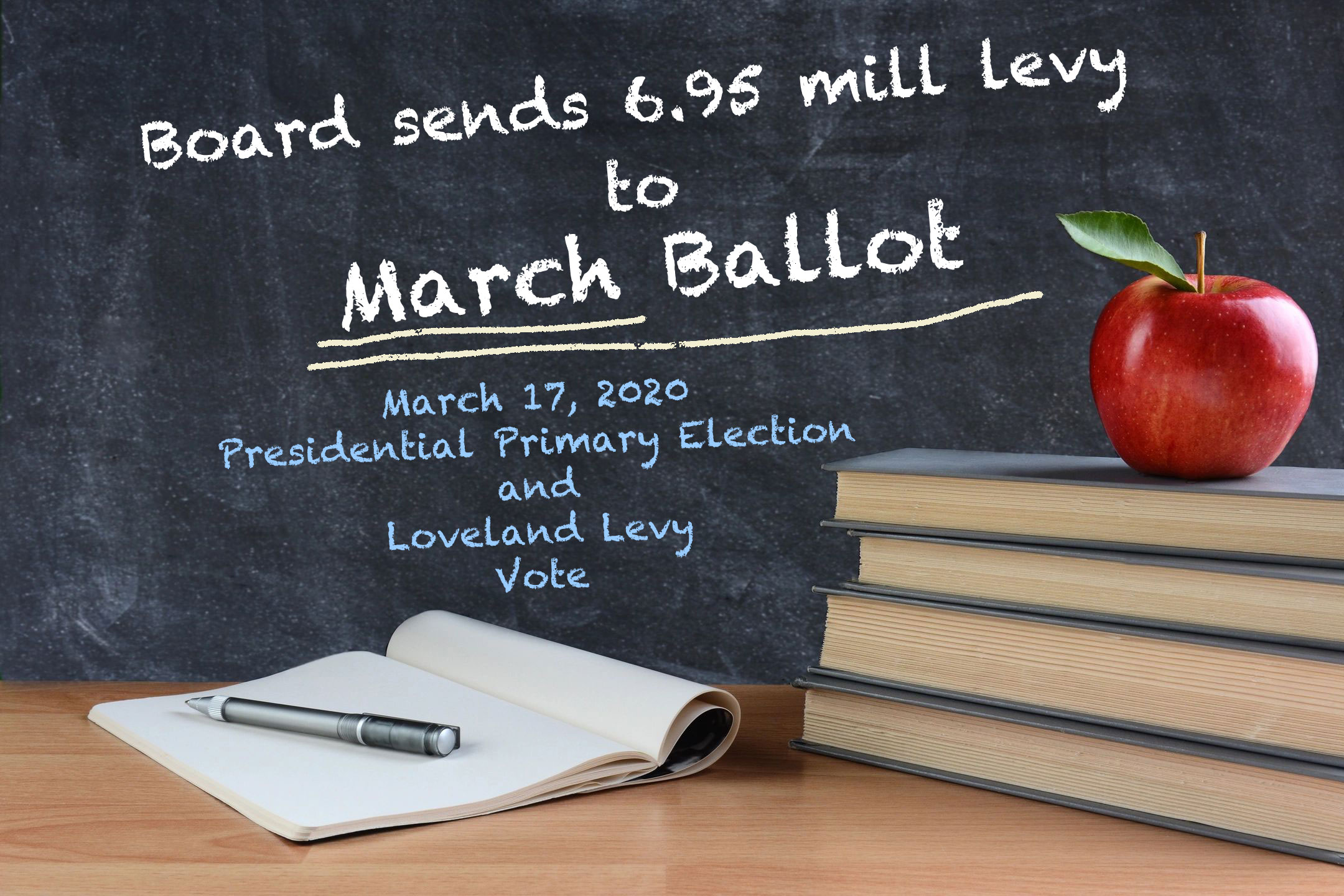
  • Board moves to place 6.95 mills on the March 2020 ballot

    Board moves to place 6.95 mills on the March 2020 ballot

    Loveland, Ohio – The Loveland Board of Education met on Tuesday, December 17 and unanimously passed a resolution to place an operating levy of 6.95 mills on the March 2020 ballot. The deadline to file the resolution with the Hamilton County Board of Elections is today, December 18.

    Neither Board Superintendent Amy Crouse or Treasurer/CFO Kevin Hawley wanted to speak to Loveland Magazine after the meeting, so details of the implications of the levy are sketchy. Neither Crouse or Hawley would discuss the budget cuts they are proposing or the amount the levy would provide the District. However, Crouse did say last week in a press release, “Approximately $2.7 million dollars of budget cuts will be made in conjunction with the levy. They will include a combination of reductions in the instructional cycle budget (textbooks, etc.), staff, and contracted services, among others.”

    Last week’s press release also said:

    The 6.95 millage levy translates into approximately $20/month ($243 annually) per $100,000 of appraised home value as determined by the county auditor.

    Below is a LOVELAND MAGAZINE TV video of the 14-minute meeting.

    In the interview below Dale Friemoth, a member of the

    Loveland Voice on Facebook: “Voter Oversight, Involvement, Concern for Education.”

    District Ad Hoc Advisory committee that was appointed to discuss how the District should move forward after the defeat of a combined operating and bond issue that was on the November ballot discusses the Board’s vote. He talked about the new levy and also about a new community organization that has formed, Loveland Voice. Friemoth said they will meet soon to discuss their actions going forward. One thing he stressed is that he feels that the Board must take purchasing the Grailville land off the table at their next meeting if they want voter support for the new levy.

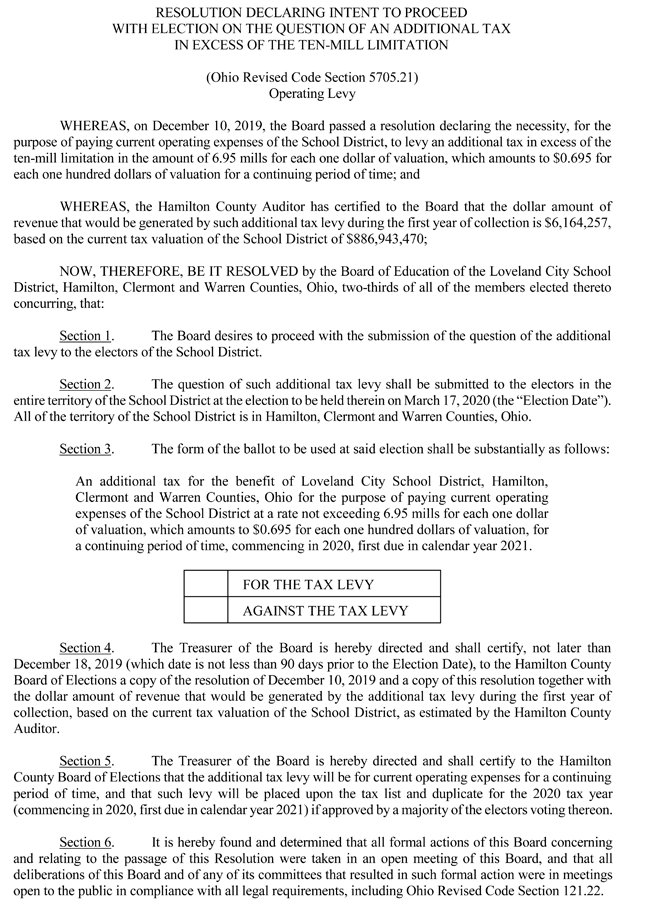
    Below is the Resolution that was to be delivered to the Hamilton County Board of Elections today.


  • School Board meets Tuesday for March levy vote

    School Board meets Tuesday for March levy vote

    Board members, Michele Pettit, Ned Portune, Eileen Washburn, President Art Jarvis, and Vice President Kathryn Lorenz

    Loveland, Ohio – The Loveland City School District has called a special meeting for Tuesday, December 17. This meeting will be held to consider a “resolution to proceed” in order to place a March operating levy on the ballot.

    The Board will also go into executive session to discuss employment matters.

    The 6 PM meeting is in the Loveland Intermediate and Middle School’s Media Center at 757 S. Lebanon Road.


    Treasurer Resolutions
    Approve a resolution declaring intent to proceed with election on the question of an additional tax in excess of the 10 mill limitation and certifying the same to the board of elections per ORC 5705.21.


    The Board of Education met on Tuesday, December 10, and passed a resolution of necessity to place an operating levy of 6.95 mills on the March 2020 ballot. The decision was five weeks after a failed combined operating and permanent improvement/bond issue on November 5.

    According to a press release issued by the Distric, the 6.95 millage levy translates into approximately $20/month ($243 annually) per $100,000 of appraised home value as determined by the county auditor. The board is to have the millage amount certified by the county auditor and intends to pass a resolution to proceed on December 17. The deadline to submit ballot language to the county boards of elections is December 18.