Symmes Township, Ohio – If you plan to vote in person during the November election and vote at the Symmes Township Library (Precinct H), your new temporary voting venue will be at the Symmes Township Safety Services Center. The Board of Elections selected the site while the new library is under construction.
Tag: november election
-

Three Ohio Supreme Court races on the November ballot will have a huge impact in the coming years
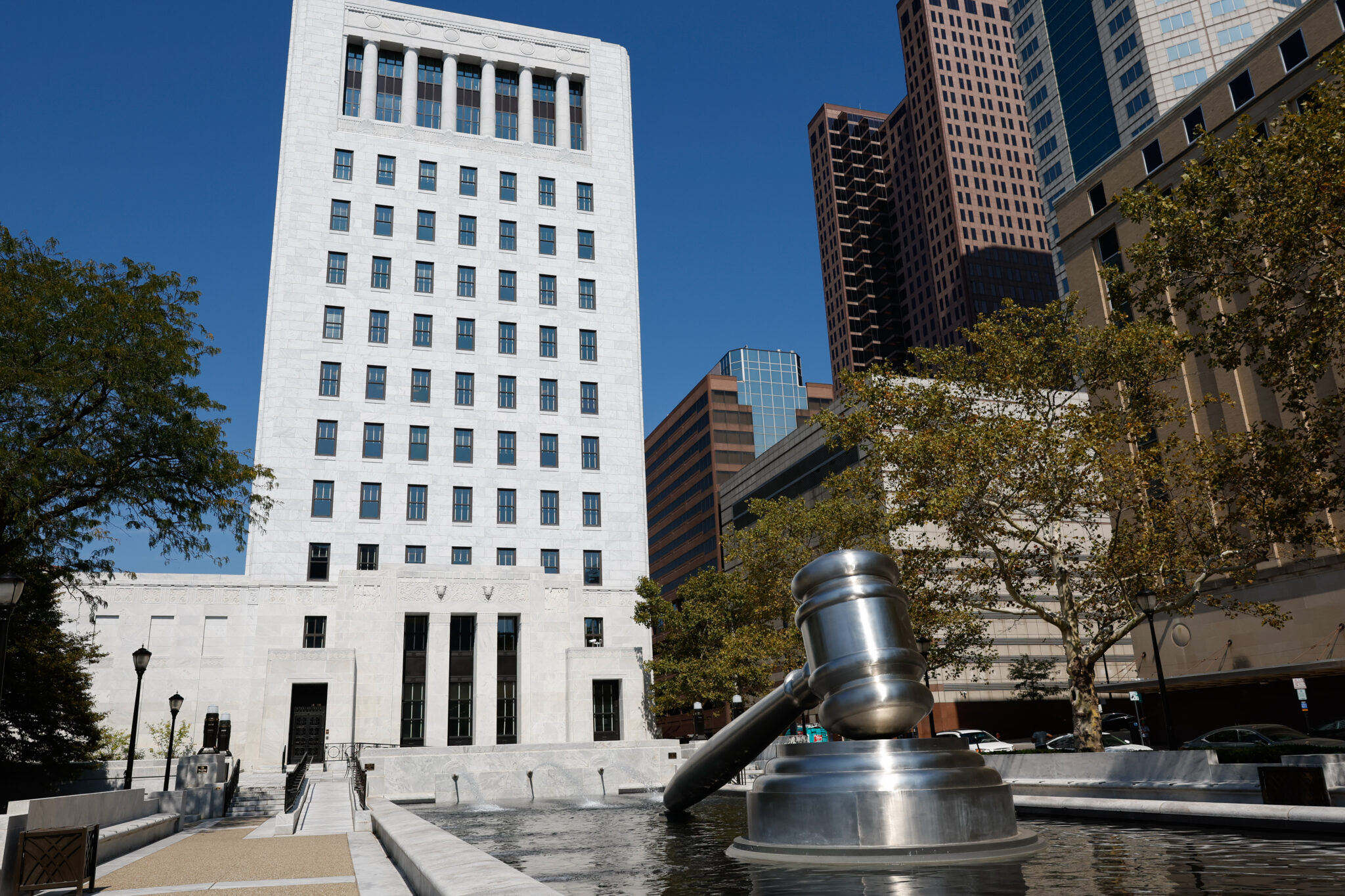
The Gavel outside the Supreme Court of the State of Ohio, September 20, 2023, at 65 S. Front Street, Columbus, Ohio. (Photo by Graham Stokes for Ohio Capital Journal. Republish photo only with original article.)
Ohio’s highest court currently has a 4-3 Republican majority
Three Ohio Supreme Court seats will be up for grabs during the November election. The outcomes will decide the balance of the court and have major impacts on a wide variety of issues that affect the lives of Ohioans, from education and environmental issues to gerrymandering and elections to civil and reproductive rights.
Partisan labels were added to the previously-nonpartisan races by the state legislature in 2021.
This year, incumbent Democratic Justice Michael P. Donnelly is being challenged by Republican Hamilton County Court of Common Pleas Judge Megan Shanahan.
Incumbent Democrat Justice Melody Stewart is being challenged by incumbent Republican Justice Joseph Deters, who opted not to run for his current seat and decided to go up against Stewart.
Vying for Deters’ open seat is Democratic candidate Lisa Forbes, of the Eighth District Court of Appeals, and Republican candidate Dan Hawkins, of the Franklin County Court of Common Pleas.
Deters decided to run for a full-term seat by challenging Stewart, rather than a partial term for the seat Ohio Gov. Mike DeWine appointed him to on Jan. 7, 2023. Because of this, whichever candidate wins Deters’ current seat will have to run again in 2026 for a full six-year term.
Ohio’s highest court currently has a 4-3 Republican majority. If all three Republicans are elected, the Republicans would hold all but one seat on the bench, for a 6-1 majority. On the flip side, if all three Democrats win their elections, the Democrats would hold a 4-3 majority. The Ohio Supreme Court has been under Republican control since 1986.
Democratic Justice Jennifer Brunner’s seat will be up in 2026. Republican Chief Justice Sharon Kennedy, Republican Justice Pat DeWine and Republican Justice Pat Fischer’s seats will be up in 2028.
The Ohio Supreme Court could make decisions on a plethora of critical issues: reproductive rights, gerrymandering, school vouchers, home rule, and environmental issues, among others.
“If there’s a law around it, it could end up in the Supreme Court and have a real, tangible impact on each of our lives,” said Elisabeth Warner, spokesperson for the League of Women Voters of Ohio.
Even though 57% of Ohio voters approved an amendment last year to enshrine reproductive rights in the state’s constitution, the court will inevitably rule on abortion access.
“There are still a lot of anti-abortion laws on the books, so that’s something that the Supreme Court is going to be ruling on,” Warner said.
Ohio’s anti-abortion laws were not automatically nullified when last year’s amendment passed, so abortion advocates are working to undo those laws.
Franklin County Court of Common Pleas recently issued a temporary pause on Ohio’s 24-hour waiting period and the minimum two in-person visits required before an abortion.
Another lawsuit is currently pending in Hamilton County Court of Common Pleas over whether Ohio’s six-week abortion ban is unconstitutional after voters passed last year’s amendment.
Those lawsuits will likely make their way to the Ohio Supreme Court — meaning the seven justices will end up deciding to what extent reproductive rights are protected.
“At the end of the day, the Ohio Supreme Court will determine whatever’s in the Ohio Constitution that voters put into the Ohio Constitution,” said Catherine Turcer, Common Cause Ohio’s executive director. “It is interpreted by the Ohio Supreme Court.”
The Ohio Supreme Court has made many rulings on redistricting before and it will likely come before the court again — especially with the amendment on this year’s ballot to create a citizen commission to redraw districts.
A lawsuit against school vouchers is making its way through the court system and will likely go before the state’s high court.
Even boneless chicken wings wound up in front of Ohio’s seven justices. The court recently made national headlines with their 4-3 ruling that boneless chicken wings can have bones in them — appearing in a bit on “The Late Show with Stephen Colbert.”
Turcer and Warner both criticized the 2021 law that requires party affiliation listed on the ballot for Ohio Supreme Court candidates. More than 1 million Ohio voters left the two Supreme Court races blank during the 2020 election.
“We shouldn’t actually be thinking Democrats and Republicans because at the end of the day, what you want is a referee who’s independent and impartial,” Turcer said.
Follow OCJ Reporter Megan Henry on X.
Megan Henry
-

Guest Column: Deep concerns about vacant School Board replacement process

Eileen Washburn (Loveland Schools Photo) By Eileen Washburn
Dear Members of the Loveland City School District Community,
I write to you today as an individual member of the Loveland City School District School Board to share my deep concerns about the recent appointment process to fill a vacant school board seat. While I represent just one voice among our board members, it is vital for me to articulate my perspective on this issue as it pertains to the core principles of fairness, impartiality, and the integrity of the democratic processes that underlie our educational institution. (Hamilton County Probate Judge Ralph Winkler appoints Linda Cecil to vacant School Board seat)
The situation at hand stemmed from the school board’s appointment of Dr. Brad Goldie to the vacant school board seat. Unfortunately, due to an unforeseen glitch in the process, Mr. Goldie was unable to assume the position, and by state law, the seat appointment was redirected to probate court. I want to emphasize that Mr. Goldie is eminently qualified, having dedicated countless hours to improving the financial health of our district. Furthermore, he is not a candidate in the upcoming November election, distinguishing him from other applicants.
Recognizing the significance of this matter, our School Board took the proactive step of sending a detailed letter to Hamilton County Probate Judge Ralph Winkler, outlining the background, circumstances, and our earnest intent in making this appointment. Regrettably, it appears that our intent, as representatives elected by district voters, was not taken into consideration by Judge Winkler.
It is crucial that the appointment of a school board member be conducted in a manner that prioritizes qualifications, experience, and a steadfast dedication to our students and their families. As stewards of our educational system, the decisions we make have a profound impact on the educational experiences of our children. Thus, our foremost duty is to ensure that these decisions are guided by the best interests of our students.
One of the fundamental tenets that govern our actions is impartiality, particularly during an election season, to safeguard our board from undue political influences. This commitment to impartiality is vital to maintaining the integrity of our educational institution.
In response to concerns, Judge Winkler has conveyed in email correspondence that he made the best decision possible under the constraints of the law. However, it is worth noting that he did not engage in conversations with the applicants, their references, or any current board members, raising questions about the comprehensiveness of the decision-making process.
As individual school board members, we take immense pride in serving in non-partisan positions and remain dedicated to focusing exclusively on the educational needs of our students, free from political biases or external influences.
I want to assure our community that my commitment to delivering an exceptional education to our students remains unwavering. I will continue to work tirelessly to uphold the values that have made our school district a source of pride for our community.
Sincerely,
Eileen Washburn
Loveland City School District Individual School Board Member -

Ohio Ballot Board sets language for proposed recreational marijuana law
The Ohio Ballot Board unanimously voted Thursday to solidify the language voters will see for the proposed recreational marijuana law in the November election.
The Coalition to Regulate Marijuana like Alcohol is backing the ballot proposal which would legalize and regulate cultivation, manufacturing, testing and the sale of marijuana to Ohioans 21 and up. It would also legalize home grow for Ohioans 21 and up with a limit of six plants per person and 12 plants per residence, and impose a 10% tax at the point of sale for each transaction.
“Unanimous approval by the bipartisan ballot board should assure voters that ‘What they see is what they’ll get’,” Coalition to Regulate Marijuana like Alcohol spokesperson Tom Haren said in a statement. “That means: hundreds of millions of dollars in new revenue and stringent regulation like we already have in our existing medical marijuana market. We are looking forward to putting the illicit market out of business this November.”
The proposal will be State Issue 2 on the Nov. 7 election.
No one spoke during the public comment portion of Thursday’s meeting in regards to Issue 2 nor was there discussion about it among the five-person Ballot Board, chaired by Ohio Secretary of State Frank LaRose. State Rep. Elliot Forhan, D-South Euclid, citizen William N. Morgan, Sens. Theresa Gavarone, R-Bowling Green and Paula Hicks-Hudson, D-Toledo are also on the board.
The Ballot Board determines what language voters will see on ballot.
After originally not getting enough valid signatures, CRMA ended up collecting more than enough after the 10-day cure period, winding up with 127,772 valid signatures — 3,000 more than needed to get on the ballot.
The ballot language

COLUMBUS, Ohio — AUGUST 24: The Ohio Ballot Board meeting to certify the language for Issue 1, the proposed constitutional amendment entitled “The Right to Reproductive Freedom with Protections for Health and Safety” and Issue 2 entitled “An Act to Control and Regulate Adult Use Cannabis,” August 24, 2023, at the Ohio Statehouse in Columbus, Ohio. (Photo by Graham Stokes for Ohio Capital Journal) The proposed law would establish the Division of Cannabis Control within the Department of Commerce which would “regulate, investigate, and penalize adult use cannabis operators, adult use testing laboratories and individuals required to be licensed.”
It would create five funds in the state treasury: the adult use tax fund, the cannabis social equity and jobs fund; the host community cannabis fund; the substance abuse and addiction fund, and the division of cannabis control and tax commissioner fund.
Landlords or an employer would have the authority “to prohibit the adult use of cannabis in certain circumstances, and prohibit the operation of a motor vehicle while using or under the influence of adult use cannabis and from using any other combustible adult use cannabis while a passenger in a motor vehicle.”
The proposed law would require the Division of Cannabis Control to enter into an agreement with the Department of Mental Health and Addiction Services to establish a program for cannabis addiction services.
Follow OCJ Reporter Megan Henry on Twitter.
MEGAN HENRY


![[Coming] City Council swearing in ceremony and selection of Mayor and Vice-Mayor](https://lovelandmagazine.com/wp-content/uploads/2019/12/feature-mihaela-on-video-camera.jpg)