Tag: Ohio constitution

  • Redistricting commission punts again, defies court order

    Redistricting commission punts again, defies court order

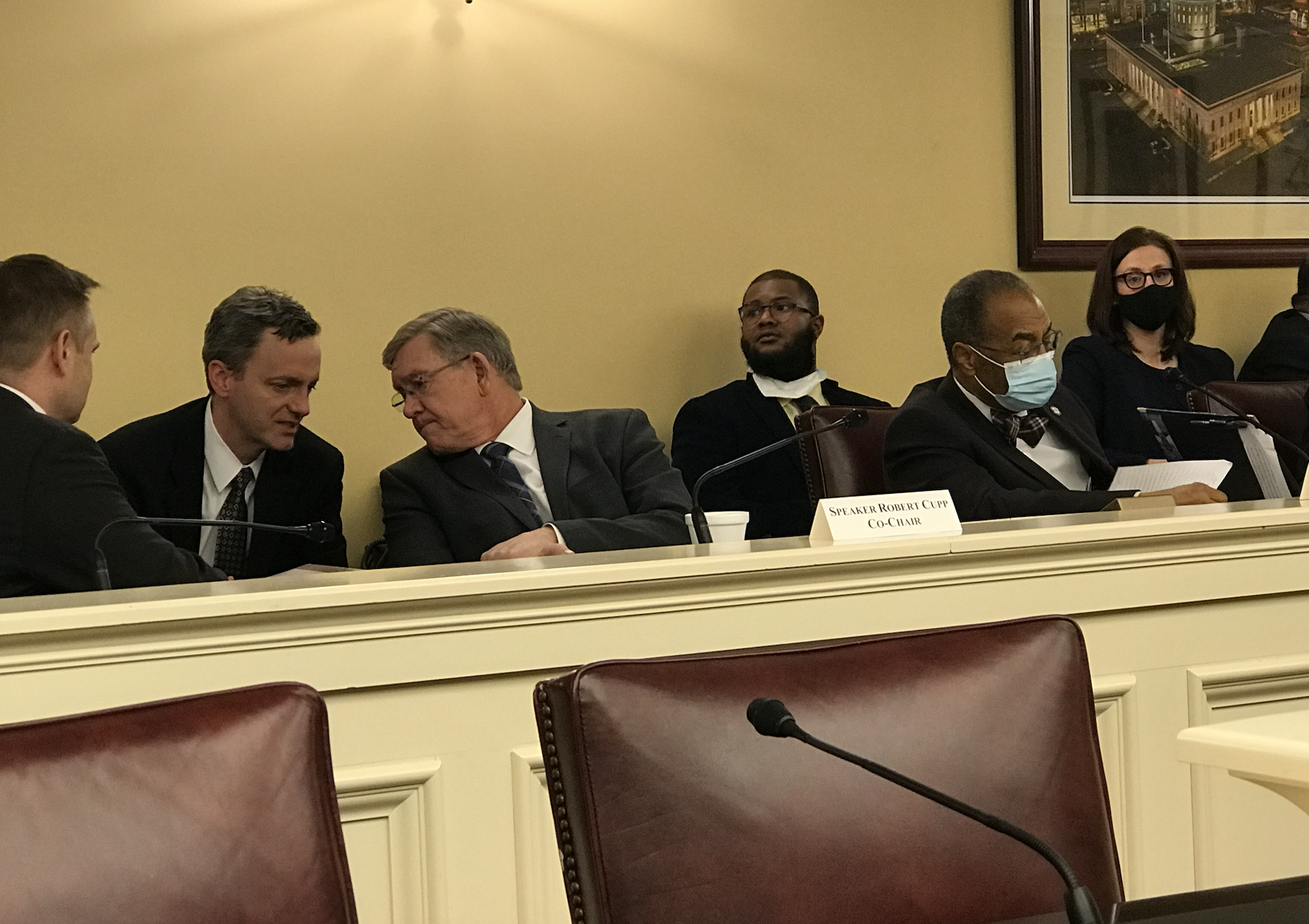
    The Ohio Redistricting Commission co-chairs, House Speaker Bob Cupp, second from left, and state Sen. Vernon Sykes, second from right, prepare to restart the Ohio Redistricting Commission meeting on Thursday after a recess. The ORC adjourned the meeting without sending a new legislative redistricting map to the Ohio Supreme Court, as they ordered it to do. (Photo: Susan Tebben, OCJ)

    BY: SUSAN TEBBEN –  Ohio Capital Journal


    Heated questioning and behind-the-scenes discussions between Ohio Redistricting commissioners led to a deadline-breaking decision to make no decision Thursday after the Ohio Supreme Court rejected two previous attempts at Statehouse maps as unconstitutional gerrymanders.

    The Ohio Redistricting Commission could now face contempt of court, and the state faces a constitutional crisis after the commission adjourned without adopting a legislative redistricting map to submit by their court-ordered Thursday midnight deadline.

    The GOP members of the commission, of which there are five, did not present a map during Thursday’s meeting. Senate President Matt Huffman, who did most of the talking for the majority party, said there was no reason to, because mapmakers had told commissioners that they could not comply with the supreme court’s directives and all the redistricting provisions of the constitution simultaneously.

    “Under these circumstances, I don’t believe the commission is able to ascertain a General Assembly district plan,” Huffman told the commission before they adjourned.

    Gov. Mike DeWine only spoke at one point during the meeting, which was as the impasse became clear, and a map did not appear to be forthcoming.

    He did not agree that the commission could leave without bringing a map before the court, and did not think that was what the commission should do anyway.

    “I don’t think we have the luxury of saying we’re just quitting,” DeWine said.

    After the meeting adjourned, DeWine doubled down on his opinion that the commission had an obligation, and a legal one at that, to produce some sort of map for the state’s high court to consider.

    I think it is a mistake for this commission to stop and basically say that we’re at an impasse. I don’t think that is an option that the law gives us.

    – Ohio Gov. Mike DeWine

    The commission was offered a map by the two Democrats on it with a 54-45 partisan breakdown, but GOP members voted down the measure along party lines after lengthy and tense criticism by Republicans, for the most part Senate President Matt Huffman.

    Taking the brunt of GOP criticism was House Minority Leader Allison Russo, who made the motion for the commission to accept the Democratic drawn maps.

    Huffman took the commission through the Democrats’ maps region by region, pointing out different GOP-incumbent districts that he said violated the constitutional provision prohibiting the favoring or disfavoring of one political party over another.

    He accused the Democratic caucus of racial gerrymandering in a few districts, specifically the Ohio Senate’s 25th District, made up mostly of Lake County, and House District 44, covering Ottawa and parts of Lucas County. Huffman accused the Democrats of gerrymandering by redrawing the districts and the communities therein to favor their candidates.

    Russo denied any existence of “packing and cracking,” the strategy of packing communities into a smaller area than necessary to benefit one party or another, or spreading a community out among a larger space than necessary to dilute its voting power.

    “What you’re asserting is just simply false,” Russo said.

    Throughout the meeting, she parried with Huffman and other Republicans, consistently asking the commission members to spell out specific constitutional violations in the Democratic maps.

    “If you have a map to propose that achieves this or suggestions to propose that address some of these concerns that you have, so far I have not yet seen a constitutional violation,” Russo said.

    When asked by Russo if the GOP had a map proposal to bring before the commission, Huffman hedged, saying he needed to finish his questions and “see how it goes.”

    He brought up the idea to “let the public decide” on the Democratic maps as he continued his dissection of the map, but said there were hours of testimony to refer to in lieu of more public hearings.

    “I’m not proposing additional public input,” Huffman said.

    What’s next?

    After the commission adjourned without doing as the Ohio Supreme Court asked, legislative leaders didn’t have a plan as to what would come next.

    “I don’t know; I don’t have a next step,” Huffman said.

    Cupp, a former Ohio Supreme Court justice himself, refused to speculate on what the courts might do, but said the commission will “try to keep working and if there’s some ideas that come forward on how to develop a legislative district map,” he said, the commission “would work very hard to do that.”

    Auditor Keith Faber made a motion to change the rules of the commission well into Thursday evening, after the commission went into a recess to discuss the Democrats’ presentation. The change, which was passed 6-1 with only Russo voting against the motion, allows the commission to reconvene at the request of three members of the commission. Those members do not have to be the co-chairs, and it does not have to be a bipartisan request.

    Co-chair state Sen. Vernon Sykes, D-Akron, confirmed that the court can not adopt the maps themselves, but as far as what happens next, he, too, was in the dark.

    He did, however, say it is possible the commission members could be held in contempt of court for failing to follow a court order.

    “I believe that is a possibility,” Sykes said.

    When asked if he would be okay with that happening as a consequence, he said he is “okay with us moving forward, whatever can be done to help us move forward.”

    When pressed on if that included contempt: “Including whatever we can do.”

    Constitutional scholars remain uncertain about the next steps of the process, mostly because the state hasn’t gone through it before.

    “This is a new process, and Ohio voters clearly wanted more collaboration and a more bipartisan process than we’ve seen so far,” said Mike Gentithes, associate professor who teaches constitutional law at the University of Akron.

    The University of Akron’s Seiberling Chair of Constitutional Law, Dr. Tracy Thomas, gave the outside perspective on the situation, saying it was “likely to end up in the courts for a while regardless of the outcome today.”

    Several states have invalidated maps because of partisan favoritism and sent them back for revisions without a solution for a stalemate.

    “In the absence of some constitutional mandate or overriding federal legislation, which we don’t really have, the line-drawing is part of the political process and subject to the usual majoritarian control,” Thomas told the OCJ.

    The Ohio Supreme Court is not likely to let this lack of action slide, in Gentithes’ opinion, and this could potentially lead to yet another overhaul of the process, since it seems the incentive to have 10-year maps with bipartisan agreement didn’t have the desired effect.

    “That might teach us how to restructure an amendment to actually have some teeth,” Gentithes said.

    The primary election is an entirely different bear, and Secretary of State Frank LaRose spent his short time speaking at the commission meeting impressing upon the commission the urgency of making decisions.

    “This challenge is not one that can be met with creativity, and grit and tenacity … instead this one is simply dictated by logistical deadlines,” LaRose said.

    Adding to the threat of legal trouble for the commission, without district lines, LaRose said the commission is in danger of missing a federal deadline to send absentee ballots to Ohio citizens who are overseas or in the military.

    “We are dangerously close to possibly violating federal law,” LaRose said.

    Cupp chuckled at a question about whether or not he accepted the idea of breaking federal law, saying, “I’m not okay with breaking any law.”

    The primary date is unlikely to change, in his mind, because of a lack of support for the idea in his chamber.

    “I don’t think in the House that there is a majority vote for moving the primary election at this time,” Cupp said. “Let alone, the two-thirds vote we would need for it to happen immediately.”
  • Ohio Supreme Court invalidates legislative maps for second time

    Ohio Supreme Court invalidates legislative maps for second time

    BY: SUSAN TEBBEN  Ohio Capital Journal

    The Ohio Supreme Court has sent back the state’s legislative redistricting maps yet again, rebuffing GOP claims that they attempted to bring about a partisan balance.

    “The (Ohio Redistricting Commission’s) choice to avoid a more proportional plan for no explicable reason points unavoidably toward an intent to favor the Republican Party,” the majority wrote in a Monday ruling.

    In a 4-3 split, Chief Justice Maureen O’Connor, Justice Michael Donnelly, Justice Melody Stewart and Justice Jennifer Brunner ordered that the Ohio Redistricting Commission convene for the third time and “draft and adopt an entirely new General Assembly-district plan that conforms with the Ohio Constitution.”

    The ORC now has until Feb. 17 to file a new plan with the Ohio Secretary of State’s office, and a copy with the court by the next morning.

    “We retain jurisdiction for the purpose of reviewing the new plan,” the majority stated in the Monday opinion.

    The court previously rejected the map approved by the commission in September, giving the ORC 10 days to revise the maps. After adopting a new map with a 5-2 party-line vote, the group sent the court a map with a 57-42 split in the House, and a 20-13 split, keeping the GOP majority in both chambers. Several districts were considered “toss up” districts, despite the GOP calling them “Democratic leaning” during their map presentation.

    The GOP said they had made their best attempt at meeting the 54-46 split the supreme court had asked for, with House Speaker and commission co-chair Bob Cupp saying the court was not asking for perfection, but for an attempt at less partisanship.

    The court called up the partisanship standard in their majority opinion on the revised maps, once again observing that the maps were made with GOP favoritism in mind.

    The majority torched mapmakers Ray DiRossi and Blake Springhetti for using the previously invalidated map as a starting point for the revised map, and said that was not what the court wanted when they struck down those maps.

    “DiRossi and Springhetti started with the same plan that we invalidated and then merely adjusted certain districts just enough so that they could nominally be reclassified as ‘Democratic-leaning,” the majority of the court wrote.

    It was clear, according to supreme court justices, that the commission knew the approach of starting with the invalidated map and switching some competitive Republican districts to competitive Dem-leaning districts “would have the dual effect of eliminating weak Republican districts and creating weak Democratic districts.”

    “This was not the process that our decision contemplates, and the commission’s awareness of the partisan effects supports an ‘inference of predominant partisan intent’ similar to the one we found with respect to the original plan,” the majority justices wrote.

    Justices Sharon Kennedy, Patrick DeWine and Patrick Fischer all dissented for many of the same reasons they disagreed with the majority in invalidating the previous legislative maps.

    “It is apparent that in disregard of constitutional standards, four members of this court have now commandeered the redistricting process and that they will continue to reject any General Assembly-district plan until they get the plan they want,” Kennedy and DeWine wrote.

    Kennedy and DeWine argued that the court overextended its power in invalidating the map as a whole, and that the revised map, in their eyes, does not violate the partisanship standard within the constitution. They said the court should “not demand exact proportionality when there is scant evidence that it is possible to draw districts that are exactly proportional to the partisan preferences of Ohio voters” without violating other constitutional map-drawing requirements.

    DeWine, who is the son of ORC member and Governor Mike DeWine, chose not to recuse himself from the case, saying he saw no conflict of interest in judging the case.

    Fischer agreed in a separate dissent that the majority “does not follow the text of the Ohio Constitution.”

    “The majority opinion again attempts to exercise authority not granted to this court by the state Constitution,” Fischer wrote.

    Because the majority opinion does not allow the map to stand as a four-year map, as the constitution states happens with a simple majority vote for adoption, Fischer said invalidating the maps “impinges upon the citizens’ right to vote in two General Assembly elections according to the terms of (redistricting constitutional amendment) Article XI.”

    He also argued that the constitution does not define the “threshold to having been drawn ‘primarily to favor’ a political party,” yet another reason he said the court should not be making the blanket decision to invalidate the maps.

    Fischer accused the majority justices of being “seemingly more interested in making policy than enforcing the Constitution’s text as written.”

    Objections will be allowed in this third attempt, just as they were in the second revision of the map. Those wanting to file an objection to the map have three days after the plan is filed with the court.

  • Ohio Republicans go full Calhoun on nullification. Never go full Calhoun

    Ohio Republicans go full Calhoun on nullification. Never go full Calhoun

    Commentary by David C. DeWitt from Ohio Capital Journal


    Ohio Republicans in the state legislature have apparently decided to go full Calhoun with a proposed bill attempting to nullify not only any federal gun laws they don’t like but also any court rulings related to gun laws with which they disagree.

    They do not possess the power to do this under the U.S. Constitution, the Ohio Constitution, or precedent set by the U.S. Supreme Court, the highest court in the land that some Ohio Republicans seemingly believe they have the power to flout. Again, they do not.

    As they’ve spent much of the COVID-19 pandemic wailing ignorantly in misunderstanding about the separation of powers in the Constitution and the checks and balances among government branches, they’ve turned most recently to proposing and passing laws defying these elemental aspects of American civics.

    Take first Ohio Senate Bill 22, which bestowed upon the state legislature veto authority over executive branch emergency and public health orders by concurrent resolution. Statehouse Republicans declared this was a response to the executive branch allegedly overstepping its authority — the authority the legislative branch itself gave the executive branch through law more than a hundred years ago — and their solution was to overstep their own authority.

    You see, the Ohio Constitution requires the General Assembly to actually pass law to exercise the power of law, not resolution. Laws must be signed by a governor, or a governor’s veto overridden by the legislature, in order to be enacted. This is an intentionally cumbersome process. A resolution requires neither. So simply ignoring the Ohio Constitution relieves them of this constitutional burden. The non-partisan Legislative Services Commission warned Republicans of the unconstitutionality of their proposal, and they ignored the LSC too.

    This middle finger in the face of the Ohio Constitution was even shepherded through the Ohio House by current speaker and former Ohio Supreme Court Justice Bob Cupp, who should definitely know better.

    Why did they do this? They do have the authority to rewrite law if they so wish. They could rewrite Ohio Revised Code and override the governor’s veto in doing so just as well. But apparently ignoring constitutionality was easier. This middle finger in the face of the Ohio Constitution was even shepherded through the Ohio House by current speaker and former Ohio Supreme Court Justice Bob Cupp, who should definitely know better.

    Now comes House Bill 62 that seeks to declare any federal law, executive order, administrative action, or court ruling to be “null, void, and of no effect in this state” if it infringes upon the Second Amendment. This attempt by a state legislature to overrule federal law and courts is called nullification, and as a concept, it has never once been upheld in federal court in American history. Its most ignominious test came when the state of South Carolina attempted to nullify federal tariff law in 1832-33, led by slaver and slavery advocate John C. Calhoun.

    Courts at the state and federal level, including the U.S. Supreme Court, repeatedly have declared that under the Supremacy Clause of the U.S. Constitution, federal law is superior to state law, and that under Article III of the U.S. Constitution, the federal judiciary has the final power to interpret the Constitution. Ohio even lost its own fight over nullification in a battle against the Bank of the United States in 1824.

    But Ohio Statehouse Republicans’ self-contradictory views of home rule and local control appear to be based exclusively on their own political whims and no discernable standards or principles for the exercise of self-government.

    Plastic bags? According to the General Assembly, local government has no right to home rule or local control in regulating them. Nor, say Ohio Republicans, can locals decide against allowing the fossil fuel industry to run amok in their communities, injecting waste into their land while these fracking wells provide zero economic benefit to the area affected. But sustainable energy is a severe threat to home rule, the foulest tyranny, according to the Ohio General Assembly and its blissful lack of self-awareness.

    And how can we forget the gun issue itself? Ohio Statehouse Republicans appear to believe that the state can trump federal laws relating to guns and ignore any and all courts, but Ohio cities have stepped high above their station indeed for attempting to regulate guns themselves without the General Assembly’s approval.

    Power for me and not for thee appears to be Statehouse Republicans’ only real governmental operating ethos.

    Power for me and not for thee appears to be Statehouse Republicans’ only real governmental operating ethos.

    While the self-contradictions on the roles of levels of government show a political agenda with no consistent civic principles behind it, the real failure here is to take any sort of thoughtful long-view. I can only imagine their caterwauling if Statehouse Republicans were the victims of this kind of power grab instead of the perpetrators. I don’t even have to imagine it. Former Ohio Gov. John Kasich ate Statehouse Republicans’ lunch by using executive power to expand Medicaid in Ohio under the Affordable Care Act against their wishes.

    But let’s say Ohio Republicans don’t manage a permanent supermajority in the Statehouse, and that some day, perhaps decades from now, a Democratic General Assembly declares itself above the authority of the courts to decide issues of religious freedom, or abortion rights, or LGBTQ rights, or gun rights. Do you think Ohio Republicans would humbly accept the consequences of the path they’ve endorsed and chosen, or do you think they’d play the shameless hypocrite and contradict themselves entirely? I know my bet.

    It’s hard to take people seriously who do not take themselves nor the basics of American civics seriously.

    Due to extreme gerrymandering and the extremist and corrupt politics it breeds, however, Ohioans will be forced to continue to endure for some time longer a General Assembly that sees a radical faction of one political party and high-dollar donor special interests as their only true constituencies.

    The rest of us and our pesky constitutions, judicial precedents, rule of law, checks and balances, and separation of powers be damned.

  • The City of Loveland educates through the mail!

    The City of Loveland educates through the mail!

    Loveland Magazine writer Cassie Mattia lives in Historic Downtown

    Loveland, Ohio As election day quickly approaches the City of Loveland wants to be sure that all Loveland voters are not only aware but educated on the issues they will be voting on come November 5th!

    If you are a Loveland resident and you haven’t yet seen a packet from the City of Loveland addressing the proposed changes to the City’s Charter, well Loveland Magazine has it all right here! Below is a short description of what you will see in the packet of proposed changes to the City Charter, how the changes came about, and why these changes are being proposed.

    The 411 from City Hall:

    “On the November 5 ballot, you will be asked to consider amendments to the Loveland City Charter. The Charter is our City’s constitution. It defines how the City of Loveland is organized and how it functions and can only be changed by a vote of Loveland citizens. Loveland’s first Charter was approved by the voters in 1961, and throughout the years, revisions have been made, with the last round of revisions being approved by the voters in 2003. In 2018, Loveland City Council determined that our Charter needed to be reviewed, as most communities review their charters at least every ten years. City Council appointed a Charter Review Commission on February 27, 2018, and the members met twice a month for over a year to review each section of the charter. Additional background on the proposed amendments is available on the City’s website within the Commission’s meeting minutes. The Commission accepted public comments at every meeting and held a formal public hearing on May 22, 2019, to receive public input before submitting the proposed Charter Amendments to City Council for consideration. On July 9, 2019, the Charter Amendments were presented to City Council and a second public hearing was held to receive public comments. Following the public hearing, City Council adopted Ordinance 2019-61, which approved the submission of the proposed Charter Amendments to electors on the November 5 general election ballot. The proposed Charter Amendments are presented in a format that allows you to easily see the current charter language in the left column and the proposed changes within the right column. Many sections were not subject to changes. These proposed changes are being mailed to all registered voters in the City as required by Article XVIII Section 9 of the Ohio Constitution. All Loveland citizens are encouraged to vote in the November 5, 2019, general election which will include these proposed changes to our Charter.”


    Councilman Ted Phelps chaired the Charter Review Commission and we asked him to tell our readers the major changes that people should pay attention to when they review the proposal:

    First, the Charter was last amended in 2003.  One of the major things appearing in this year’s changes, is a requirement that at least once every 10 years, the City appoint a Charter Review Commission to review and recommend changes to Council (12.09).  This way, we will hopefully avoid long periods of time passing, like the 16 years since the last revision, which tends to give rise to a back-log of changes and the inefficiencies which accompany not doing so sooner.  Similarly, another change now being proposed is to require at least every 10 years, the City review its Master Plan (2.10).  This too will avoid City planning becoming stale or obsolete and will help Loveland to assess and reassess its direction in a more timely and productive manner.

    Another substantive change on the ballot this year seeks to address what happens when there is a vacancy in the office of Mayor.  This situation arose just a few years back and the City was without a Mayor for multiple months until the general election.  Under the revisions proposed to Section 2.06, that won’t happen as again as the revision makes clear that the Vice-Mayor becomes the Mayor for the unexpired term, unless the Vice-Mayor declines to do so and then Council by majority vote will select the new Mayor.

    There are also proposed changes to the Director of Finance position as currently the Director of Finance is chosen by Council.  The revisions (5.02, 5.06 and 9.06) will allow for the City Manager to choose the Finance Director subject to approval by Council.  Removal of the Finance Director will also be subject to Council approval.  These proposed changes seek to streamline matters and make more efficient not only the selection process for the Finance Director position but the changes also seek to align the Charter with the reality that the City Manager has and must continue to have a close and highly functional relationship with the Finance Director.  Council maintains a checks and balances role as again, both the actual selection and any removal of the Finance Director can only be done with Council approval.

    Finally, other important revisions seek to conform current roles and responsibilities of the Clerk of Council (2.08), clarify how the City is to publish ordinances and resolutions allowing for utilization of the City’s website to do so (3.04) and remove the residency requirement for the City Manager in conformity with current Ohio law (4.01).  One other beneficial change is to clarify when Council begins its term of office (2.04).  As you know, every two years when there is a general election, Council is to hold its organization meeting to elect the Mayor and Vice-Mayor and under the current Charter that meeting has to take place on the first Monday in December even if the recount winner has not yet been determined by the Board of Elections.  The changes to 2.04 make sure that Council’s first organization meeting following the general election takes place only after the recount process is finalized.


    Click on the link below to read through the proposed changes to the City’s Charter.

    https://lovelandoh.gov/DocumentCenter/View/1313/Proposed-Charter-Amendments-2019


    If you find this story useful and helpful in your daily life…