Tag: Ohio Consumers’ Counsel

  • FirstEnergy seeks $1.4 billion more from Ohio ratepayers. Watchdog objects

    FirstEnergy seeks $1.4 billion more from Ohio ratepayers. Watchdog objects

    Getty Images

    BY:  Ohio Capital Journal

    Even as its former top executives await possible criminal charges for gouging ratepayers, Akron-based FirstEnergy is seeking a $1.4 billion rate increase. The state’s consumer watchdog objects, saying the company’s profits are higher than normal and that it should use a more thorough process to prove that it really needs the money.

    The electric utility is seeking the increase as part of its “electric security plan” — a package of investments aimed at improving reliability and efficiency.

    “Our plan will build on the significant enhancements we’ve made to reinforce the grid against progressively stronger storms,” a statement on the FirstEnergy website quotes Patricia Mullin, acting president of FirstEnergy’s Ohio operations, as saying. “We’re committed to making the right investments to ensure a modern, more reliable grid while also keeping electric bills affordable, and we will continue working with interested stakeholders to ensure an open and thorough review of our proposal.”

    However, the state’s consumer watchdog, the Ohio Consumers’ Counsel, is objecting to the proposal on several grounds. For example, OCC contends that FirstEnergy is already highly profitable and shouldn’t need more of the ratepayers money.

    That’s not true, FirstEnergy spokeswoman Lauren Siburkis said in an email.

    “Our most recently disclosed return on equity in Ohio (shared during the third quarter earnings call) shows that to be 6.2%, which is much lower than the recently authorized returns in Ohio of 9.5% to 10%,” she said.

    However, the company, which operates in several states, appears to be doing quite well overall. In its third-quarter financial disclosure, the company reported that so far this year its per share earnings are up 17% over last year.

    OCC, the consumer watchdog, also objects to the mechanism through which FirstEnergy is seeking the rate hike. It’s asking the Public Utilities Commission of Ohio to approve “riders” in a process that isn’t as rigorous as a full “rate case.” That’s when regulators and others scrutinize many aspects of a utility’s operations and its books to ensure they’re not unfairly profiting from the monopolies that regulators grant them.

    FirstEnergy has abused the rider process in the past. As part of a huge bribery and money-laundering scandal, the company in 2019 received a “decoupling rider” that allowed the company to bill customers tens of millions to cover shortfalls in revenue.

    Chuck Jones, then the company’s CEO, boasted to investors that the rider made the company “somewhat recession-proof.” The rider was repealed after FirstEnergy admitted wrongdoing in a deferred prosecution agreement.

    OCC is arguing that going through a full rate case is the best way to prevent mischief and inefficiency.

    “Reliance on an excessive number of trackers, riders and other special regulatory mechanisms decreases a utility’s incentive to manage all aspects of its business in a cost-effective manner,” regulatory auditing expert Greg Meyer said in testimony to the regulatory commission that OCC sent to reporters last week. “FirstEnergy seems to ignore the fact that under its proposed (electric security plan), FirstEnergy’s consumers will be required to pay for energy-efficiency programs, demand-response programs and the multiple riders, in between base rate cases. These charges will add costs to the bills of FirstEnergy’s consumers without a review of all the relevant factors of FirstEnergy’s operations.”

    Asked why FirstEnergy didn’t seek the rate hike as part of a full rate case, Siburkis seemed to say FirstEnergy couldn’t wait six months, when one is scheduled.

    “The settlement we reached in 2021, which received the PUCO’s approval and delivered $306 million in customer benefits, explicitly requires us to submit the rate case in May 2024, no sooner and no later,” she said.

    That settlement was a deferred prosecution agreement in which FirstEnergy ponied up $230 million in fines and said that in addition to other bad acts, Jones and former Vice President Michael Dowling bribed Sam Randazzo — Gov. Mike DeWine’s first appointment to chair the PUCO — $4.3 million in exchange for regulatory and other favors.

    Jones and Dowling were fired and Randazzo resigned. All three men deny wrongdoing, but in court filings, they have acknowledged that federal law enforcement is investigating their conduct.

    Four already have been convicted over their participation in the scandal. Former Ohio House Speaker Larry Householder in June was sentenced to 20 years in federal prison for shepherding the corrupt utility bailout through the legislature. Former state GOP Chairman Matt Borges was sentenced to five years for playing a lesser role, and two others have pleaded guilty and await sentencing.

    For six weeks early this year, federal prosecutors put on a mountain of evidence in a Cincinnati courtroom about how FirstEnergy spent more than $60 million helping Householder bribe and bully through a $1.3 billion utility bailout that benefitted that company far more than any other utility.

    Now it’s asking for almost the same amount without going through the most rigorous regulatory scrutiny. Asked why ratepayers should trust FirstEnergy’s claims, Siburkis said the company has turned the page on its ugly recent past.

    “FirstEnergy has accepted responsibility for its actions related to House Bill 6 and has taken significant steps to put past issues behind us,” she said. “Today, we are a different, stronger company with a sound strategy and focused on a bright future.”

    Marty Schladen
    MARTY SCHLADEN

    Marty Schladen has been a reporter for decades, working in Indiana, Texas and other places before returning to his native Ohio to work at The Columbus Dispatch in 2017. He’s won state and national journalism awards for investigations into utility regulation, public corruption, the environment, prescription drug spending and other matters.

    MORE FROM AUTHOR

  • Manufacturers, consumers blast plan to make ratepayers subsidize charging stations

    Manufacturers, consumers blast plan to make ratepayers subsidize charging stations

    An electric vehicle charging station. Photo courtesy Wikimedia Commons.

    BY:  Ohio Capital Journal

    The number of electric vehicles on U.S. roadways is expected to ramp up dramatically in the coming years, and with it the number of charging stations will have to grow as well.

    Now groups representing Ohio utility consumers and manufacturers are trying to kill a plan that would force ratepayers to finance the electricity infrastructure needed to serve those charging stations. The people who will be profiting from those stations or the utilities themselves should bear those costs, they said.

    In addition, they said, the way the language is written “is generally lacking in consumer protections.” That’s famously been a problem with Ohio utilities and the agency that’s supposed to be regulating them.

    A provision in House Bill 33, a draft state budget, would allow monopoly utilities to impose higher rates to fund economic-development activities such as supplying EV stations even though subsidies for such activities are already available from the state and local governments, the advocates said.

    “The federal government is making substantial funds available to local governments for electric vehicle charging stations,” Maureen Willis, legal director for the Ohio Consumers’ Counsel, told the House Finance Committee last week, according to a written copy of her testimony. “That is occurring under the federal infrastructure bill. Ohio’s share of the funding is significant.”

    The growth in sales of electric vehicles through the rest of the decade is expected to be enormous — going from 4.6 of all new passenger-vehicle sales in 2021 to a projected 40% to 50% in 2030, the U.S. Bureau of Labor Statistics reports.

    Driving such high expectations are a $7,500 tax credit for electric vehicles under last year’s Inflation Reduction Act. And earlier this month, President Joe Biden proposed two new EPA rules aimed at dramatically reducing greenhouse-gas emissions from vehicles by 2030.

    And, because nobody wants to drive a battery powered vehicle out into the boonies without being sure they’ll be able to charge it, $7.5 billion was built into last year’s Bipartisan Infrastructure Law to subsidize building out a national network of charging stations.

    Building out the system might seem laudable in the face of catastrophic climate change. But Ohio’s electric utilities and the Public Utilities Commission that’s supposed to be regulating them have a history of abusing ratepayers.

    The PUCO has allowed more than $1 billion in rate hikes that were later ruled illegal by the state Supreme Court. But, because of the way the “riders” were written, there’s no way to make the utilities refund the money. In one instance, Akron-based FirstEnergy collected $460 million and then couldn’t show whether the money was spent on bribes, much less whether any of it was spent on its stated purpose.

    And, speaking of bribes, the PUCO and a very recent employee in 2019 drafted a bailout law that was at the center of a scandal in which FirstEnergy and AEP spent $61 million to help pass a $1.3 billion bailout. Former House Speaker Larry Householder and former Ohio GOP Chairman Matt Borges last month were convicted of racketeering in the matter.

    Now, consumer and manufacturing representatives say, someone is again trying to give Ohio utilities broad latitude to raise rates on their customers.

    Ryan Augsburger, president of the Ohio Manufacturers’ Association, this week told the House Finance Committee that the provision in the draft budget would allow Ohio utilities to collect from ratepayers for expenses that taxpayers are already subsidizing. And, he said, the wording of the provision is so loose that utilities would have great flexibility in applying it.

    “The electric utilities are already poised to benefit from recovery of costs associated with infrastructure expansion,” Augsburger said, according to a written copy of his comments. “This new language grants electric utilities swift cost recovery from customers for all net costs associated with infrastructure development and economic development projects… Cost recovery from customers is to make the electric utility whole after (the utilities) have already received funds from the All Ohio Future Fund for the economic development projects.”

    Willis of the Consumers’ Counsel said the language allowing for utility increases “is generally lacking in consumer protections.”

    ___________________________

    MARTY SCHLADEN

    Marty Schladen has been a reporter for decades, working in Indiana, Texas and other places before returning to his native Ohio to work at The Columbus Dispatch in 2017. He’s won state and national journalism awards for investigations into utility regulation, public corruption, the environment, prescription drug spending and other matters.

    MORE FROM AUTHOR

  • Utility regulator accused of taking a bribe helped write bill targeting watchdog

    Utility regulator accused of taking a bribe helped write bill targeting watchdog

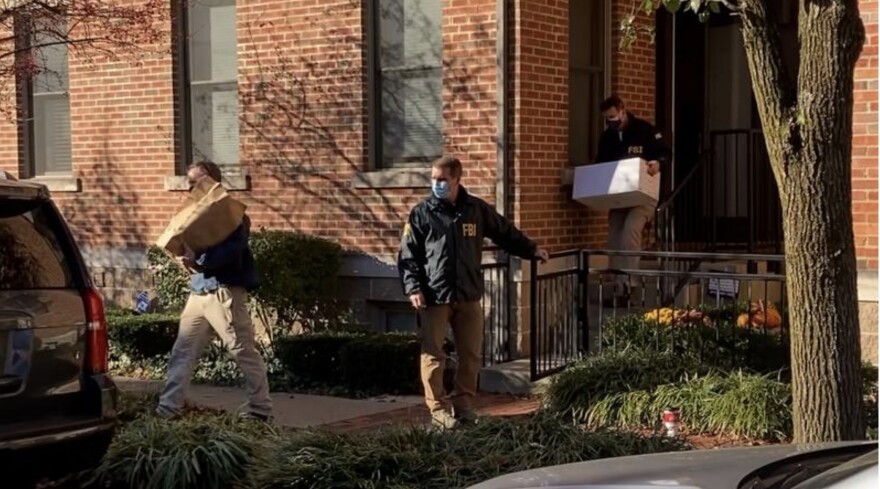
    FBI agents remove boxes of materials from PUCO Chairman Sam Randazzo’s condo in Columbus Nov. 17, 2020. Photo courtesy of Daniel Konik/Statehouse News Bureau.

    BY: JAKE ZUCKERMAN Ohio Capital Journal

    Ohio’s former top utility regulator, who was accused of taking a $4.3 million bribe, quietly spent months helping write a sweeping energy bill that targeted a state watchdog agency that advocates for Ohio’s residential electric customers, records show.

    Emails that the Public Utilities Commission of Ohio gave in response to two FBI subpoenas show its former chairman, Sam Randazzo, conferred with the bill sponsor and helped draft legislative language. The bill would have limited the reach of the Ohio Consumers’ Counsel and given often-hostile state legislators control of its board.

    The OCC appears at PUCO cases and advocates for residential ratepayers’ interests, which often run counter to those of investor-owned utility companies and industrial-scale energy customers. The agency’s efforts have led to millions in refunds to consumers, including $306 million from FirstEnergy Corp. last year to settle a lawsuit against the company for charging an unlawful profit margin on its customers.

    Akron-based FirstEnergy told prosecutors last summer that it paid a business owned by Randazzo $4.3 million before his 2019 appointment in exchange for “official actions.” The company also said it gave a nonprofit secretly controlled by then-GOP House Speaker Larry Householder $60 million to help pass House Bill 6 — energy legislation worth an estimated $1.3 billion to FirstEnergy. Householder has pleaded not guilty and awaits trial. Randazzo has not been charged with a crime.

    Records released earlier this year showed some of Randazzo’s behind-the-scenes lobbying work on HB 6. The records released last week show his influence spanned further.

    In May 2020, Rep. Nino Vitale, R-Urbana, introduced the text of House Bill 246. The bill would have narrowed the scope of cases the OCC can join and subject the agency to “any reasonable conditions that the commission deems necessary to avoid duplication, repetition or delay.” It also gives state lawmakers appointment power over six of nine seats on the OCC’s board.

    The legislation contained a sweep of other changes as well, including creating new ways for utilities to set their prices, modifying setback rules for wind farms, and allowing the Ohio Power Siting Board to create new setback requirements for solar energy sites.

    In the six months before Vitale unveiled the bill, Randazzo and PUCO staff met with Vitale, drafted elements of the legislation, and helped edit Vitale’s introductory testimony to lawmakers, the subpoenaed emails show. The emails don’t show Randazzo addressing the OCC provisions directly. But in a statement through his attorney, Randazzo equivocated when asked if he drafted or advised on the section.

    “If so but having no recollection of either writing or advising any such language, it would only have been as the result of a request from the legislature,” he said. “It is likely that the utilities had input.”

     Sam Randazzo, then a private sector attorney, testifies before the PUCO in March 2018. Source: The Ohio Channel.

    The PUCO released the emails after the Ohio Capital Journal filed a public records request and an eventual lawsuit seeking them.

    Around Thanksgiving of 2019, Randazzo asked to meet with Maura McClelland, a policy adviser and attorney at the PUCO, to meet and discuss the language of the bill’s “ratemaking piece.”

    HB 246 created a new option for utilities to set prices called “alternative rate plans.” According to nonpartisan analysts with the state Legislative Service Commission, the plans can take into account aspects of fair energy pricing that the current model misses like efforts for energy efficiency or cash flow problems from the companies.

    “In general, alternative rate plans could lead to higher prices paid by ratepayers,” the LSC analysts wrote. “But presumably, PUCO would only approve those higher costs after examining aggregate effects in accomplishing its policy objectives.”

    HB 246 would also allow the PUCO to consolidate parties that it determines have “sufficiently common interests” to speed up cases.

    In a memorandum opposing the bill, the Ohio Manufacturers’ Association said the legislation would block its members from meaningful participation at the PUCO. The manufacturers argued the bill in several areas consistently gives utilities the upper hand over their customers, especially via the ratemaking proposal.

    “The bill is opaque and no clear reasoning exists for why its proposed changes are needed,” the memorandum states.

    Roger Sugarman, an attorney representing Randazzo, said via email that neither Randazzo nor the PUCO were the driving force behind the bill. He said he couldn’t determine if the LSC’s analysis is correct without more details.

    “Without knowing what type of alternative rate plan, or the object of your question and the statutory conditions required to secure PUCO approval, it is not possible to evaluate the LSC analysis,” he said. “In general, rate applications filed by utilities, whether alternative or traditional, lead to higher rates; the question is usually about how much higher.”

    He said some pieces of the bill wouldn’t have affected much change versus current law. Plus, the bill all but died after its first hearing. Randazzo’s time “was occupied by more pressing and important things than HB 246.”

    FBI agents arrested Householder and charged him with racketeering in June 2020. He awaits trial. Agents raided Randazzo’s condo months later. In July 2021, FirstEnergy signed a deferred prosecution agreement with the U.S. Department of Justice. It agreed to pay a $230 million penalty and cooperate with the ongoing investigation into HB 6 to possibly avert a charge of wire fraud.

    In a statement of facts paired with the agreement, FirstEnergy said it paid companies controlled by Randazzo $4.3 million in exchange for official action. The company said it hired Randazzo as a consultant and paid him a total of about $22 million since 2010.

    Before starting in state government, Randazzo represented industrial scale energy users before the PUCO. He spent years fighting against Ohio energy policies that forced utilities to include more renewable energy in their mixes or make their customers’ homes more energy efficient. He also represented subsidiaries of both CenterPoint Energy and Dominion Energy as a lobbyist, as well as a group of citizens opposing a wind farm in Huron County.

    Vitale drew significant media attention via outrageous claims including that Bill Gates invented the novel coronavirus or that Gov. Mike DeWine was bringing “FEMA Concentration Camps” to Ohio in relation to the pandemic. (Randazzo said his position on COVID “pulled in a very direction” than Vitale’s.)

    Vitale also, perhaps more subtly, helped guide HB 6 from legislation to law. He co-sponsored the bill and chaired the House Energy and Natural Resources committee that reviewed it. He first won office with $7,700 in financial backing from Householder’s campaign committee. He voted for HB 6 in 2019 and against repealing it after Householder’s arrest. He was one of 21 lawmakers who voted against expelling Householder from office.

    Vitale didn’t respond to a phone call or emails to his personal and official accounts.

     State Rep. Nino Vitale, R-Urbana. Photo from Ohio House website.

    “As you all know, anyone can be indicted for anything. Anything,” he said in a floor speech last year defending Householder.

    “However, that person deserves to go in front of a jury of their peers and prove their case. They might be guilty, they might not … That’s what makes us different from a communist country.”

    Federal prosecutors alleged that Householder secretly controlled a nonprofit organization that received $60 million from FirstEnergy. He used the money to elect a slate of candidates who would vote him into the House Speaker’s office and in turn support HB 6. He’s also accused of spending the money for personal use. Two alleged conspirators, including Householder’s former political adviser, have pleaded guilty.

    When the anti-OCC bill dropped, few knew or suspected of either Randazzo’s financial ties with FirstEnergy or his lobbying work on the bill. However, after Householder’s arrest and the raid on Randazzo’s home, some raised interest in ensuring the bill’s quick death.

    “This bill is a danger to anyone in Ohio who pays a utility bill and it remains on the Ohio House docket as a direct attack on the OCC and all Ohio residential utility customers,” wrote former Democratic State Senator Leigh Herington in a November 2020 op-ed in the Columbus Dispatch.

    He suggested the legislation was simple retaliation for the OCC’s opposition to House Bill 6 and another bill that allows FirstEnergy a more favorable accounting formula to determine if its collections from customers are “significantly excessive.” (The OCJ previously reported Randazzo lobbied on that legislation as well.)

    Utility companies spend big and wield considerable sway in Ohio politics. As Herington noted, the OCC has seen its size dwindle over the years. Its budget dropped from $9.3 million in 2011 to $5.5 million in 2020.

    The OCC also suggested the bill was retaliatory in nature due to its opposition to HB 6. Vitale’s bill, the agency said in a resolution, would “weaken the independence” of the board as well as its “utility watchdog role.”

    A PUCO spokesman said the emails only show the PUCO working on language related to the agency and the state Power Siting Board. He said he didn’t know why Randazzo and Vitale communicated through personal email accounts.

    “The PUCO does not take a position on proposed legislation,” he said. “We will always be responsive to inquiries from members of the General Assembly as they go through the legislative process.”

  • Millions of Ohioans facing home gas and electric rate hikes

    Millions of Ohioans facing home gas and electric rate hikes

    Duke’s parent company made $820 million in profit in the first quarter of 2022 after netting about $3.6 billion last year. It paid its shareholders $3.1 billion in dividends in 2021 and paid its CEO $16.4 million in salary.

    BY: JAKE ZUCKERMAN Ohio Capital Journal

    Ohio utility companies have asked state regulators for permission to raise home gas, electric and water costs on more than 2.75 million Ohio customers.

    Those charges could be spread between customers of Columbia Gas, AES Ohio, Duke Energy, and Aqua Ohio. The utilities, all investor-owned, are collectively asking for another $400 million in annual charges.

    Any base rate increases require the approval of the Public Utilities Commission of Ohio, which is headed by five commissioners chosen by the governor for five-year terms. The PUCO’s staff review the companies’ requests and pose recommendations to the commissioners, who decide what the utilities can ultimately charge their customers.

    The utilities’ requests come in an inflationary period — consumer prices are up 8.6% over the year ending May 2022 and unleaded gas costs just below $5 per gallon. Last week, the head of the U.S. Federal Reserve said a recession is a possibility.

    “It is bad timing for utilities to be seeking rate increases at the PUCO, with consumers already hurting from soaring energy prices and inflation,” said Bruce Weston, executive director of the Ohio Consumers’ Counsel, a state agency that represents residential ratepayers in PUCO cases.

    “Ohio should lead with its heart and keep Ohioans connected to their utility services.”

    They also come at a turbulent time for the commission. Its former chairman resigned in 2020 after FBI agents were seen raiding his home. Last summer, the utility FirstEnergy Corp. alleged in court documents that it paid him a $4.3 million bribe for regulatory favors. He has denied wrongdoing and has not been charged. The U.S. Department of Justice twice subpoenaed the PUCO last year for records related to the case.

    Two commissioners previously worked for the companies they now regulate. Commissioner Dan Conway previously represented American Electric Power as an attorney in private practice. Commissioner Lawrence Friedeman has worked for IGS Energy, Vectren Energy Delivery of Ohio, Columbia Gas Services, and the Ohio Gas Association.

    Thus far, the PUCO staff has recommended granting slimmed-down versions of rate hike requests from Columbia Gas, Duke and Aqua Ohio. The AES case awaits a key ruling from a PUCO judge. None of the four has reached a final decision.

    A rate freeze would be very bad for customers. It would be damaging to the company’s credit ratings and make it difficult, if not impossible, for the company to provide reliable service.

    – AES Ohio attorney at a PUCO hearing last month

    Columbia Gas

    Columbia Gas asked the PUCO to allow a $221 million annual rate increase for its natural gas distribution service. This would take the form of a fixed fee increase, up from $16.75 per month to $46.31. According to analysis from the Ohio Consumers’ Counsel, that could increase to an $80 fixed cost per month in five years.

    PUCO staff identified some evidence of the company padding its costs in their report. When PUCO staff reviewed Columbia’s cost data provided by the utility to justify the hike, they found the company included $304,000 in costs for a workout facility and locker rooms at its downtown headquarters. The report also found an instance where the Columbia acquired five “thermal cameras” for COVID-19 temperature checks, each at a cost of $14,995. PUCO staff called the spending “significantly excessive” compared to a handheld thermometer.

    The PUCO staff recommended the commissioners approve a more modest base distribution revenue increase of between $35 million and $58 million per year. The OCC urged the PUCO to go even lower, proposing a $9.8 million increase.

    The proposed increase was the subject of a handful of sparsely attended public hearings last month. Evidentiary hearings start next month. They’ll be followed by a round of briefings before a final decision, according to a PUCO spokesman.

    NiSource, the utility’s parent company, made $431 million in profits in the first quarter of 2021. Last year, it paid its CEO $6.6 million, and paid its shareholders $345 million in dividends.

    Company spokesman Eric Hardgrove declined to answer specific questions about the gym or the thermometers.

    “Columbia is committed to our customers and the communities we proudly serve,” he said. “To continue to provide safe, affordable and reliable natural gas service, we must continue to invest in our system to upgrade aging infrastructure, just as investments are made in bridges, roads and other infrastructure in our cities, towns and communities. In addition, Columbia offers a wide variety of energy assistance, energy efficiency, payment plans, and PIPP to help customers afford their utility bills.”

    Duke Energy

    Duke Energy, which services 700,000 customers around Cincinnati, proposed raising both its electric rates and its gas rates. (It has comparatively few gas customers).

    On the electric side, the company requested a 10% base distribution revenue increase, which comes out to about $55 million per year.

    According to the OCC, this means a typical residential customer will see a monthly base distribution charge increase from about $37 to $49, costing roughly $144 per year.

    PUCO staff recommended a more modest increase of about .33% to 3%, or about $2 million and $15 million.

    On the gas side, Duke also filed a pre-application with the PUCO to raise its natural gas rates. However, this is in its early procedural stages and wouldn’t take effect until at least 2023.

    For electric costs, the PUCO is holding public hearings next month before an evidentiary hearing, which could take a week or so. Then comes a round of court filings and a commission decision. A PUCO spokesman guessed a decision could come mid-fall at the earliest.

    The utility’s parent company made $820 million in profit in the first quarter of 2022 after netting about $3.6 billion last year. It paid its shareholders $3.1 billion in dividends in 2021 and paid its CEO $16.4 million in salary.

    Company spokeswoman Sally Thelen said Duke is making smart investments to provide “safer and more reliable and secure” energy to customers while “diligently lowering operation and maintenance” costs. She said Duke is allowed to earn a fair return on its investments.

    “We know how vital electricity is to our customers, communities and region, and that energy is a significant monthly expense for our customers,” she said. “We also know that higher bills are never embraced. That’s why we continue to work hard to keep our costs down. We remain committed to helping our customers who may be experiencing financial hardship and struggling to pay their everyday expenses and energy bills. Duke Energy continues to support its customers, and connect them with available assistance and offer tools and programs – including flexible payment plans – to help manage their energy bills.”

    AES Ohio

    AES Ohio — formerly known as Dayton Power and Light, which serves 527,000 western Ohio customers — asked for a 49% base distribution revenue increase worth about $121 million per year.

    According to the OCC, this would raise an average customer’s bill by about $13.42 per month.

    The utility’s parent company, AES, has faltered compared to its peer companies, reporting a $409 million net loss in 2021, as it paid its CEO $14 million in salary. Addressing the PUCO, AES Ohio’s CEO testified to the company’s “very fragile” financial condition, according to the Dayton Daily News.

    In July 2021, the PUCO staff initially recommended a rate increase to boost AES’ base distribution revenues by at least $61 million. However, staff have since sided with arguments raised by the OCC and said the company’s 2009 agreement with the commission blocks the company from raising its rates.

    The question was put before a PUCO judge at a hearing last month. Jeff Sharkey, an attorney representing AES Ohio, made several arguments against the existence of a rate freeze, including that state law doesn’t give the PUCO the power to order one in the first place. He said the utility has already struggled with reliability. A failure to increase its revenue could harm its credit rating, which threatens the company’s service.

    “A rate freeze would be very bad for customers,” he said, according to a transcript of the hearing.

    “It would be damaging to the company’s credit ratings and make it difficult, if not impossible, for the company to provide reliable service.”

    The case awaits a final decision from the PUCO. Company spokeswoman Mary Ann Kabel defended the rate increase request, stating it covers the cost of grid investments.

    “Since our last distribution rate case in 2015, the updated distribution base rates would allow us to recover for investments required and are already completed as a result of the devastating 2019 Memorial Day tornadoes,” she said. “It also allows us to continue performing important activities, such as enhanced tree trimming to reduce the likelihood and length of outages. Over the years, AES Ohio has taken the necessary steps to keep rates reasonable through efficient distribution operations to meet the growing needs of our customers. Today and with the proposed increase we continue to have with the lowest distribution rates of the investor-owned electric utilities in Ohio.”

    Aqua Ohio

    Aqua Ohio, a subsidiary of Essential Utilities, provides treated water for about 150,000 Ohioans. It proposed to the PUCO a base distribution revenue increase of about $8.3 million (12%). Staff counter-proposed a $2.3 million to $4.1 million revenue increase.

    The application is still pending review.

    An unopposed settlement agreement was filed this month by all parties to the case. That settlement awaits approval from the commission. It calls for a rate hike, though less than the company originally requested. It also calls on the company to fund a $20,000 account annually via its shareholders as a bill-pay assistance program for low income customers, and to start disclosing the number of residential service disconnections per year.

    Aqua Ohio’s parent company, Essential Utilities, made nearly $200 million in profits last quarter and $432 million in profits in 2021. Spokesman Jeff La Rue defended the proposed rate increase.

    “Aqua has invested more than $147 million in water since our last rate case,” he said. “That investment is important to ensure safe and reliable services as well as regulatory and environmental compliance. Our rate case is an attempt to recover a portion of that investment.”

  • Utility regulators block watchdog’s requests for info about a buried audit of a $460 million fund

    Utility regulators block watchdog’s requests for info about a buried audit of a $460 million fund

    Photo by Getty Images.

    BY: JAKE ZUCKERMAN – Ohio Capital Journal

    An administrative judge blocked a watchdog’s attempt to obtain an audit that the Ohio utility regulatory agency’s former chairman, who has been accused of taking a $4.3 million bribe, allegedly tried to squash before publication.

    The ruling, released Friday evening, is a setback for the Ohio Consumers’ Counsel, a state funded agency representing residential ratepayers in utility cases. The OCC has pushed for investigations of FirstEnergy, especially since the company admitted to playing a central role in a massive public corruption scandal.

    The OCC asked the Public Utilities Commission of Ohio to grant it a subpoena to obtain a copy of any draft audit into a $458 million charge from FirstEnergy that started in 2017 collected called the “Distribution Modernization Rider.” The OCC also sought to depose an auditor who worked on report.

    The Ohio Supreme Court blocked FirstEnergy from continuing to charge customers for the DMR, two years after it was first applied on monthly bills. The court said the PUCO unlawfully failed to ensure the money is actually spent on modernizing the grid. A subsequent PUCO investigation was inconclusive as to whether the DMR monies were used to fund the bribery operations.

    The Supreme Court’s order questioned the value of leaving intact the audit when it overturned the rider, finding the reviews fail to properly protect ratepayers from the “possible misuse of DMR funds.” Additionally, the justices reasoned that any findings of misuse of the funds would be moot given the court had already blocked the charge and a state law blocked the court from ordering refunds unless PUCO explicitly allows for them, which it did not. The PUCO later nixed the audit, citing the court’s thinking.

    The OCC has previously obtained a text message from FirstEnergy’s CEO referencing former PUCO Chairman Sam Randazzo “burning the DMR final report.”

    The text partially came to light when FirstEnergy entered into a deferred prosecution agreement with the U.S. Department of Justice to possibly avert a charge of wire fraud. The company agreed to pay a $230 million penalty. It also admitted to paying Randazzo $22 million over nine years, including $4.3 million just before he started as PUCO chairman. The company also admitted to a separate $60 million bribery scheme ran through the state Legislature to pass House Bill 6 in 2019.

    Randazzo has not been charged with a crime and has maintained his innocence. The PUCO has received two subpoenas in connection with the investigation.

    PUCO Attorney Examiner Gregory Price denied both the OCC’s requests. He said the facts are clear that no such draft report exists in any form. Additionally, the question of FirstEnergy’s political spending is being “thoroughly addressed” in other PUCO cases.

    Price ruled OCC’s reliance on the Randazzo text shows its “obvious interest in investigating potential wrongdoing” as opposed to matters it “actually has jurisdiction over.”

    In December 2020, about two months after federal agents raided Randazzo’s home, the PUCO opted to resume the audit into the DMR. However, this time it hired Daymark Energy Advisors. That audit, released earlier this year, was inconclusive as to whether the DMR funds were used to fund the HB 6 campaign. FirstEnergy, the auditors said, pooled funds from all its 11 utilities in one pot, creating an “inability” for the auditors to track the funds.

    Price, however, said the final report “appears to fully address whether [FirstEnergy] properly expended the DMR funds.”

    In records the PUCO provided to federal prosecutors, Price is copied onto email threads regarding policy meetings before and after the passage of House Bill 6. As was first reported by Cleveland.com, one email shows Price was invited to one such meeting days before the House passed the bill.

    Other investigations into FirstEnergy, Randazzo and other alleged conspirators continue. Former House Speaker Larry Householder is expected to stand trial on a racketeering charge in connection with the scandal this fall. He recently asked a court to dismiss the charge against him. That motion has not yet received a ruling.

    Meanwhile, FirstEnergy shareholders have filed a class action lawsuit against the company as well.

  • PUCO orders refunds and debt forgiveness for customers of PALMco Energy (dba Indra Energy)

    PUCO orders refunds and debt forgiveness for customers of PALMco Energy (dba Indra Energy)

    Columbus, Ohio – The Public Utilities Commission of Ohio (PUCO) today adopted a settlement agreement requiring refunds of overcharges to customers of PALMco Energy OH, LLC and PALMco Power OH, LLC, which are retail energy providers doing business as Indra Energy. The companies will also waive any outstanding unpaid bills.

    “Today we are happy to provide more than $1 million in relief to customers impacted by PALMco’s misleading rates,” stated PUCO Chair Jenifer French. “At the PUCO we take allegations of misleading marketing or customer enrollment very seriously and we will continue to work to ensure fairness in Ohio’s competitive energy marketplace.”

    Under the terms of the agreement, PALMco will refund customers whose rates increased by more than 50% from August – December 2019, totaling more than $215,000. PALMco will also waive uncollected bills of approximately $832,000. Any remaining balances after PALMco issues refunds will be donated to a charity chosen by the Ohio Consumers’ Counsel (OCC).

    PALMco’s current owners, officers or partners are barred from doing business in Ohio’s retail energy markets for seven years by the terms of the agreement.

    A copy of today’s opinion and order is available on the PUCO’s website at www.PUCO.ohio.gov. Click on the link to Docketing Information Service and search for case 19-2153-GE-COI.

    Case background

    On December 19, 2019, PUCO staff filed a notice stating it received 51 complaints from PALMco customers between Aug. 1, 2019 and Dec. 10, 2019 about abnormally high electricity and natural gas bills. In its letter, PUCO staff noted concern that PALMco was already under investigation for nearly identical allegations of misleading and deceptive practices to market to and enroll customers with “competitive” and “the best” rates, however charged customers more than 4 times the regulated utilities’ prices. 

    On Sept. 21, 2021, PUCO staff, OCC and PALMco filed a joint settlement agreement and recommendation for the Commission’s consideration. 

    PUCO regulations

    The PUCO is charged with adopting and enforcing regulations to protect consumers from any misleading or deceptive acts or practices by competitive retail electric and natural gas providers.

    The PUCO maintains its Energy Choice Ohio website to provide helpful tools to assist consumers in evaluating their electric and natural gas supply options. The PUCO’s Apples to Apples comparison charts provide customers with a snapshot comparison of rates if they do not choose to enroll with a competitive supplier, versus current electric and natural gas supplier offers, and contract terms. The charts are updated daily.

    For more information, please visit www.energychoice.ohio.gov or www.PUCO.ohio.gov, or call the PUCO Consumer Call Center at (800) 686-PUCO (7826).

  • Consumer protection? New DeWine regulatory chief says most overcharges can’t be refunded

    Consumer protection? New DeWine regulatory chief says most overcharges can’t be refunded

    Getty Images

    By Marty Schladen and Ohio Capital Journal

    Gov. Mike DeWine’s latest appointee to lead Ohio’s scandal-plagued utility regulator last week raised concerns among some lawmakers and consumer watchdogs. She claimed that her agency has only a very limited ability to make electric companies refund billions in improper charges to ratepayers.

    There was always going to be scrutiny when Jenifer French made her first appearance last Wednesday before the Ohio Senate and Public Utilities Committee. 

    DeWine appointed her in March to chair the Public Utilities Commission of Ohio. DeWine’s first appointee, Sam Randazzo, resigned in November after the public learned that a lobbyist believed to be Randazzo got a $4.3 million payment from Akron’s FirstEnergy just as Randazzo took over as Ohio’s top utility regulator. 

    For its part, FirstEnergy last year fired its top executives after discovering the payment to Randazzo — and after federal prosecutors accused it of being at the center of a $61 million bribery scandal that resulted in a $1.3 billion bailout that greatly benefited FirstEnergy and associated companies.

    French, a former Franklin County Common Pleas judge, told the Senate committee that she wanted to use her background to restore public confidence in the agency. 

    But Sen. Mark Romanchuk, R-Ontario, wanted to get down to specifics.

    “You mentioned something about public trust and public trust, I believe, is fixing this refund problem,” he said. “Since 2009, there has been about about $1.5 billion that has been deemed improper at the court and that money was not refundable back to the ratepayers — the people who paid that money.”

    Romanchuk was referring to charges that the PUCO allowed, but that the Ohio Supreme Court later struck down as illegal. 

    The funds include $456 million FirstEnergy got, supposedly to modernize the utility grid. But at least some of the money was placed into a pool that FirstEnergy’s out-of-state utilities could borrow from. 

    Allowing electric companies to pocket improper proceeds from ratepayers is not a business-friendly practice, Romanchuk told French.

    “That was $1.5 billion that was pulled out of our economy, and I would argue that’s not a good thing as we compete with other states and other countries around the world,” he said.

    French replied, in essence, that while her agency has the power to allow rate increases, it has scant power to get the money back when the increases are ruled to be illegal. 

    At issue is why the PUCO, when it grants rate increases, doesn’t routinely say they’ll have to be refunded if the courts strike them down or if the utilities don’t use the money as they promise.

    “My understanding is that there are very limited circumstances in which the PUCO can set rates that are capable of being refunded at the end,” French said. “For the most part, it’s the call of the legislature.”

    Romanchuk disputed that. He pointed to a 2019 Ohio Supreme Court decision saying that if the PUCO had built a refund mechanism into the “rider” that allowed FirstEnergy to collect $456 million, it could have forced the company to pay it back when an audit showed the money wasn’t used for its stated purpose.

    The decision said that a 1953 law “bars any refund of recovered rates unless the tariff applicable to those rates sets forth a refund mechanism… FirstEnergy’s tariffs for the modernization charge, however, contain no refund mechanism.”

    French said she was unfamiliar with that decision. 

    A year before, the court said something similar in a case in which FirstEnergy was allowed to make yet another upcharge. In that case, the PUCO was asking that the company refund $43 million in “imprudent” purchases of renewable energy credits.

    Referring back to its 1957 Keco Industries v Cincinnati decision, the court said that refunds would amount to illegal “retroactive ratemaking” because the fees the utilities ended up collecting would differ from those filed in the original tariffs. In other words, once a rate is legally set, the PUCO can’t change it willy-nilly, the decision said.

    But the 2018 decision additionally said this: “FirstEnergy also asserts that the plain language of (the 1953 law) bars any refund in this case because the ($43 million) rider did not specify a refund process. We agree.”

    So why wouldn’t refunds be legal under Keco if a provision for them is a part of the original order?

    French said it was her understanding of the Keco case that unless a rate increase was of a special type — a “reconciled rider” — the only way refunds can happen is if the General Assembly changes the law.

    “If it is not provided for in a law… or a reconciled rider, refunds would require a statutory change,” she said. “I think the Supreme Court was very clear about that. If there are opportunities for us by statute to be permitted to determine whether a rider is refundable or not, certainly that is something we would look into.”

    That rationale can be hard to understand. In emails, PUCO spokesman Matt Schilling was asked why his agency doesn’t routinely make a refund mechanism part of any rate increase.

    He said the decisions to which French and Romanchuk were referring relied on two separate authorities. French was talking about the Keco decision, while Romanchuk was talking about a decision based on the 1953 statute, Ohio Revised Code 4905.32.

    Neither, however, uses the term “rider” and none of the subsequent Supreme Court decisions Schilling provided contains the term “reconciled rider.”

    The state’s official consumer watchdog, the Ohio Consumers’ Counsel, said nothing stops the PUCO from building refund mechanisms into rate hikes that are later ruled to be unlawful.

     “In the words of former Supreme Court Justice Paul Pfeifer, it ‘boggles the mind’ that Ohio consumers are denied refunds of utility charges after the court finds a PUCO order to be improper,” spokesman J.P. Blackwood said in an email. He added that PUCO commissioners seem to be substituting their own judgement for that of the Supreme Court. 

    “That PUCO commissioners have protected utilities more than consumers by not making certain charges refundable, further shows that the selection process for PUCO commissioners needs reform,” he said. 

    Last Wednesday, Sen. Teresa Fedor, D-Toledo, put those sentiments more succinctly.

    “It’s time for the board members of the PUCO to start siding with the citizens of Ohio,” she said.

  • Never needed? Senate president predicts little opposition to nuclear bailout repeal

    Never needed? Senate president predicts little opposition to nuclear bailout repeal

    By Marty Schladen and Ohio Capital Journal

    A billion-dollar nuclear subsidy was the subject of an intense fight in 2019 and great controversy since. But the president of the Ohio Senate this week predicted that a repeal will make it through the House, Senate and that Gov. Mike DeWine will sign it.

    The reason: The company that owns the nuclear reactors no longer wants the money, he said. And that raises serious questions about whether the subsidies were needed in the first place.

    The subsidy was the product of House Bill 6. The legislation was passed in 2019 after a nasty fight which led to federal criminal charges against then-House Speaker Larry Householder, four associates and a dark-money group. 

    Prosecutors said $61 million from Akron-based First Energy and associated groups was used in the corrupt effort to pass the bailout. Two of Householder’s associates and the dark money group have pleaded guilty, FirstEnergy’s CEO was fired and Gov. Mike DeWine’s appointee to chair the Public Utility Commission of Ohio has resigned as part of the scandal. 

    Despite intense calls for a full repeal of HB 6, it remains in place — although a Franklin County Judge has temporarily stopped collection of the money by the owner of the nuclear plants, FirstEnergy successor Energy Harbor.

    DeWine and others have said they want a repeal, but they want to continue to subsidize the Northern Ohio nuclear plants for environmental reasons.

    “We were for nuclear power,” he said Tuesday, referring to his initial support for HB 6. “Nuclear power was the only way in this state, today, that we can have very much non-carbon production. It’s the only way we can do it.”

    But early this month, Sens. Jerry C. Cirino, R-Kirtland, and Michael Rulli, R-Salem, introduced legislation, Senate Bill 44, to get rid of the subsidies. On Wednesday it received a hearing by the Senate Energy and Public Utilities Committee.

    Despite the governor’s statements, Senate President Matt Huffman, R-Lima, said he expects the repeal legislation to become law.  

    “I think that provision will likely get passed out of the Senate and I think it will pass out of the House and get signed by the governor,” Huffman told the governing board of the Ohio Consumers’ Counsel, the state’s official utility watchdog. “When I say the House and the governor, I’m not speaking for them, nor have I spoken to them about this. But if a large company that got a subsidy in a dubious way… says ‘We don’t want it,’ that seems to me to be a pretty easy call.”

    Energy Harbor, the owner of the plants, didn’t respond to requests for comment on Wednesday. But Huffman was apparently referring to a December 2019 ruling by the Federal Energy Regulatory Commission and Energy Harbor’s response to it. 

    The ruling said, in essence, that the company that would become Energy Harbor would have to cut its prices if it was going to sell its subsidized nuclear energy onto the massive grid that serves all or part of 13 states, including Ohio. 

    It would “threaten the competitiveness” of the long-term, or “capacity,” marketplace if companies like Energy Harbor could sell subsidized power on the same basis as power that wasn’t subsidized. So Energy Harbor and the others have to discount it according to a formula, the ruling said.

    Recent developments appear to be a sharp reversal from 2019.

    As proponents pushed HB 6, they threatened that closure of the Ohio nuclear plants was imminent if they didn’t get a bailout — and quickly. But Huffman’s statements on Tuesday indicate that Energy Harbor has no plans to shutter the plants even now that it isn’t getting the money. 

    “I don’t want the nuclear power plants to close,” he said. “However, it’s been made clear to me that the plants will not close if this subsidy is removed. In fact, they’re better off because of machinations at another level. In fact, these subsidies will likely harm these power plants.”

    There’s other evidence that Energy Harbor’s pre-bankruptcy predecessor, FirstEnergy Solutions, might not have been as broke as it claimed in 2019. 

    Shortly after emerging from bankruptcy in early 2020, it did an $800 million stock buyback. Such buybacks typically raise stock values, in this case enriching shareholders just months after pleading poverty and winning a $1 billion bailout from Ohio ratepayers.

    The federal ruling also raises questions about whether it was wise even to start the bailout fight, which has caused so much damage in Ohio. On June 29, 2018, more than a year before DeWine signed HB 6 into law, FERC issued a ruling strongly foreshadowing what it later did: effectively erase the subsidies bailout supporters had gained if they wanted to sell power into the long-term market.

  • Investigation of $460M in FirstEnergy charges back on, but why was it stopped in the first place?

    Investigation of $460M in FirstEnergy charges back on, but why was it stopped in the first place?

    By Marty Schladen and Ohio Capital Journal

    The Public Utility Commission of Ohio has restarted an audit of $465 million that Akron-based FirstEnergy collected from ratepayers in 2017 and 2018, supposedly to modernize the utility grid.

    The state’s official watchdog, the Office of the Ohio Consumers’ Counsel, wants to know whether any of the money was used in a $61 million bribery scandal. That affair so far has resulted in a $1.3 billion nuclear bailout, the indictment of then-House Speaker Larry Householder and the guilty pleas of two of his associates.

    But why the audit was called off in the first place also raises serious questions.

    Leading the commission in voting to shut down the audit was Chairman Sam Randazzo. He resigned in November after FirstEnergy disclosed that it paid $4 million to someone just before he started regulating the utility in early 2019. Gov. Mike DeWine later said that Randazzo received the payment, but DeWine said he was unaware of it when he appointed the former FirstEnergy lobbyist to chair the PUCO.

    For its part, FirstEnergy fired its CEO, Chuck Jones, when news of the payment came to light.

    The Randazzo-led utility commission’s timing in stopping the audit might seem strange. It came just after the Ohio Supreme Court ruled in January 2020 that the charge FirstEnergy had been collecting was unlawful — seemingly a time when a regulator would want to know more about what happened with the funds.

    A big reason why the court struck down the distribution-modernization charge: Despite allowing FirstEnergy to collect almost a half-billion extra dollars from ratepayers, the PUCO didn’t implement effective rules to ensure that FirstEnergy used the money to update the utility grid.

    “Utility companies can be expected to respond to financial motivations, but not if the commission awards them money up front with no meaningful conditions attached,” the decision said. “The PUCO staff’s wishful thinking cannot take the place of real requirements, restrictions, or conditions imposed by the commission for the use of (distribution-modernization) funds.”

    Not only did the PUCO call off the audit just as the charge was declared illegal, it did so as the auditors were making some interesting findings.

    For example, it found that instead of using all the funds to improve its Ohio distribution system, FirstEnergy was placing some in a “Regulated Utility Money Pool,” from which out-of-state utilities could borrow.

    To justify ending the audit — for which PUCO staff wanted more time — Randazzo and the other commissioners claimed that’s what the Supreme Court wanted.

    “The court directed the commission to eliminate” the distribution-modernization charge, the PUCO wrote in its dismissal. “In support of this ruling, the court specifically objected to the usefulness of the proposed final review, questioning the lack of an effective remedy resulting from such review.”

    However a reading of the Supreme Court’s opinion doesn’t mention any “specific objection” to the audit.

    The relevant passage says that the auditors final report wouldn’t be available until after FirstEnergy had collected and spent the money.

    “Thus, it is not clear what remedy would be available should the commission (or this court on appeal) find that FirstEnergy has misused DMR funds,” the ruling said.

    One reason there’s no remedy, the court noted, is because when it allowed FirstEnergy to jack up its rates, the PUCO didn’t create any mechanism to refund the money to ratepayers if the charge is later declared unlawful or if it is shown the  money was misused.

    “FirstEnergy has been recovering (distribution-modernization) revenue since January 1, 2017, and the commission did not make the (revenue) subject to refund if FirstEnergy does not meet the required conditions,” the court wrote.

    The $465 million FirstEnergy collected from the upcharge isn’t the only such money collected — and kept — by Ohio utilities. The consumer’s counsel reports that since 2009, $1.5 billion has been collected from Ohio ratepayers in upcharges that were later struck down by the courts. 

    As with the FirstEnergy charge, the PUCO didn’t create a mechanism to force other utilities to pay back the extra money they got back, either. 

    FirstEnergy objected to reopening that audit, but wouldn’t comment further Monday. 

    “Due to the ongoing PUCO audits, FirstEnergy is unable to provide additional information at this time,” spokeswoman Jennifer Young said in an email.

    In a filing, the consumers’ counsel slammed the company’s objections.

    “In an unfortunate display of corporate arrogance, the FirstEnergy Utilities are opposing an investigation by their state regulator, the PUCO, into utility consumer protection issues surrounding what has been described by a prosecutor as ‘likely the largest bribery scheme ever perpetrated against the state of Ohio,’” it said. “The PUCO has the authority under Ohio law to investigate the FirstEnergy Utilities and their owner, FirstEnergy Corp. FirstEnergy should get out of the PUCO’s way and cooperate.”

  • Power company says utility commission has no power to investigate role in bailout scandal

    Power company says utility commission has no power to investigate role in bailout scandal

    An Akron-based utility company that figures prominently in a massive nuclear bailout scandal is saying that state regulators don’t have the authority to investigate whether the company improperly financed the bailout effort.

    Over the past week, FirstEnergy Corp. has filed two documents with the Public Utilities Commission of Ohio saying that the commission and the state’s consumer representative don’t have standing to investigate whether FirstEnergy and affiliated companies improperly used ratepayer money in what has been called the largest bribery scandal in state history. 

    Marty Schladen

    Marty Schladen has been a reporter for decades, working in Indiana, Texas and other places before returning to his native Ohio to work at The Columbus Dispatch in 2017. He’s won state and national journalism awards for investigations into utility regulation, public corruption, the environment, prescription drug spending and other matters.

    Federal prosecutors say $60 million in utility money was used to pass a $1.3 billion nuclear bailout into law. But FirstEnergy says the utility commission lacks the authority to investigate whether it improperly used ratepayer funds in the affair.

    “The commission lacks any statutory basis to conduct an investigation of FirstEnergy Corp. with respect to the alleged expenditures or to order FirstEnergy Corp. to show cause that it has not violated Ohio utility law,” FirstEnegy said in a Sept. 23 filing. 

    It was in response to an order by the utility commission that it show “that the costs of any political or charitable spending in support of (the bailout bill), or the subsequent referendum effort, were not included, directly or indirectly, in any rates or charges paid by ratepayers in this state.” 

    Federal prosecutors in July charged then-House Speaker Larry Householder and four associates with using $60 million from FirstEnergy and related interests in a scheme to make Householder speaker and pass a $1.3 bailout of two failing nuclear plants owned by FirstEnergy Solutions, a successor company to FirstEnergy Corp.

    The effort was successful, although there is an effort in the legislature to repeal it before the charge hits ratepayers’ bills on Jan. 1.

    FirstEnergy and associated companies haven’t been charged, but in announcing criminal charges against Householder, U.S. Attorney David M. DeVillers stressed that the investigation was far from over. An affidavit supporting the criminal complaint also refers repeatedly to “Company A,” or FirstEnergy, and it makes reference to its CEO.

    In addition, Ohio Attorney General Dave Yost last week filed a civil suit that names FirstEnergy, a subsidiary and its successors — as well as Householder and his associates — as defendants.

    The Ohio Consumers’ Counsel, the state’s official consumer representative in utility matters, has asked for an independent investigation into whether FirstEnergy improperly used ratepayer funds in the dark-money scheme to pass House Bill 6, the bailout legislation. The agency was disappointed when the utilities commission only directed the company to show that it had not acted improperly.

    But even that is too much for FirstEnergy.

    In documents filed on Monday with the utility commission, it said it was legally entitled to a reasonable profit. The company also seemed to argue that what it did with much of its money was nobody’s business.

    “Beyond the investment necessary to provide adequate service, a public utility may spend its funds in the best interests of the utility as determined by its management.,” the company argued, later adding, “To the extent the Companies use a portion of their revenues to make political or charitable contributions, this is not improper or illegal.”