Tag: Ohio Department of Education

  • A resident’s Q&A Facts – Loveland City School District Levy

    A resident’s Q&A Facts – Loveland City School District Levy

    by Dale Friemoth

    Dale Friemoth is a Loveland School District resident and lives on East Loveland Avenue in Loveland.

    I have put together some facts on the proposed Loveland City School District (LCSD) Levy in a question and answer format with footnotes on sources.

    After gathering and evaluating these facts, I am voting NO on the Loveland School Levy on the November 5th ballot!

    Question

    I keep hearing about the Levy lasting for 3 years before the Loveland School Board believes they will need to come back to the voters for more money – are the levies on the ballot for 3 years or are they “permanent”?

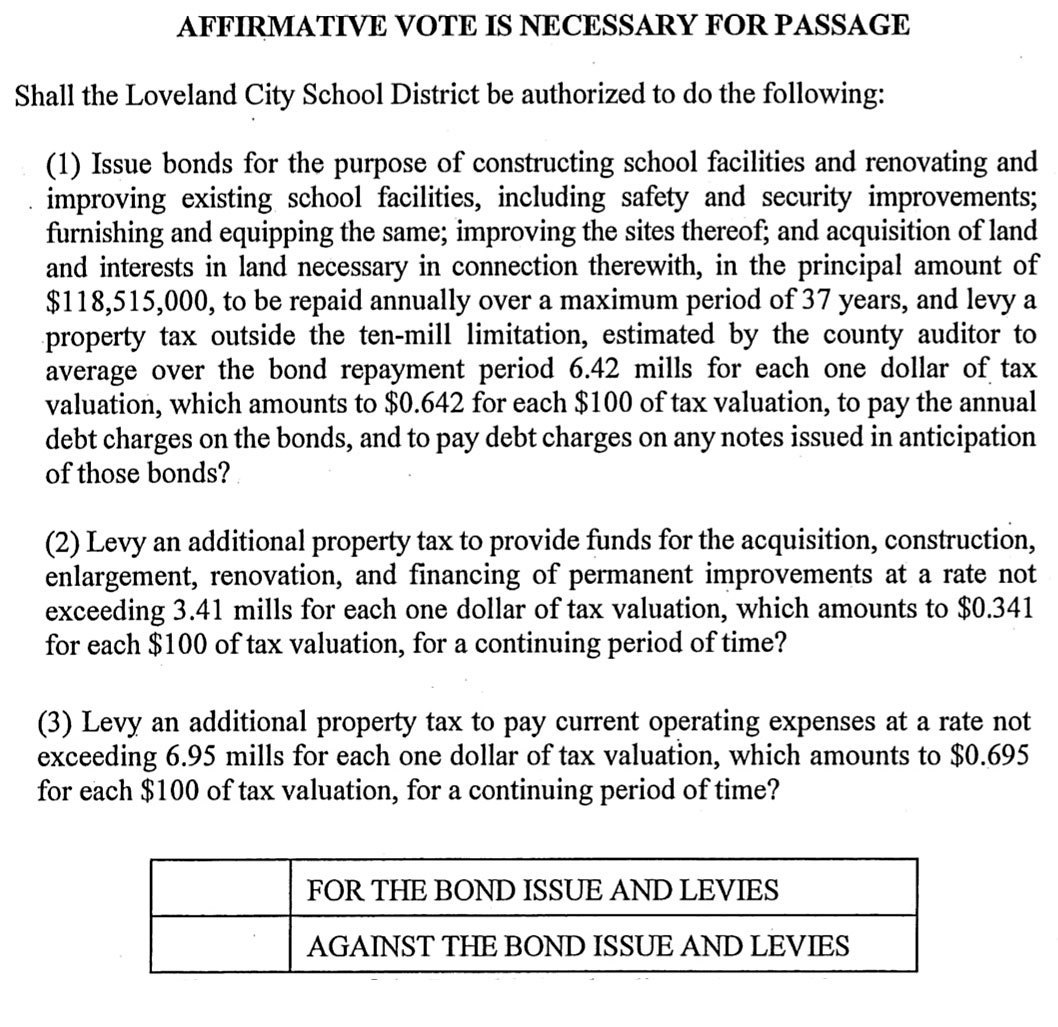
    The levy on the ballot is divided into three sections totaling 16.78 mills1;  one is for 37 years and the other two are for “continuing period of time” or PERMANENT.

    1. 6.42 mills: Issue bonds for land purchase, construction bond, and improving sites – 37-year duration (This IS permanent for many voters; I’ll be nearly 100 in 37 years!)

    2. 3.41 mills: Funds for permanent improvements – permanent.

    3. 6.95 mills: Funds to pay operating expenses – permanent  (Note:  this is a 24% increase over the last Operating Fund Levy of 5.6 mills in passed in 20142).

    Question

    What is the monthly and yearly increase over what I’m currently paying for Loveland Schools?

    • This levy would be a 42% increase in the school taxes that you are currently paying.

    • You will pay an additional $49 per month ($587.30 per year) for every $100,000 of your home’s appraised value2.  Own a $250,000 home; your taxes increase ~$1,468 per year!

    Question

    I’m a renter, will I need to pay this tax levy?

    • As a renter, you typically would not pay a real estate tax directly, though common sense would tell us that landlords will attempt to pass on their increased costs.

    • This levy will impact you as well – ask your landlord what they intend to do if the levy passes!

    Question

    Will the Board purchase the land at Grailville even if the levy issue fails?

    • The Loveland School District has already paid a $100,000.00 non-refundable deposit on the Grailville property3.  According to Art Jarvis, President – Loveland Board of Education“The board will purchase the GV property if the levy fails. This levy represents needs, not wants.  Unfortunately, the GV (Grailville) property is the only suitable land available in the school district, and it will eventually be needed to expand for our growing student population and their educational needs.” 

    • Dr. Amy Crouse – Superintendent hedges this some stating “The Board of Education has not yet voted on any purchase of land.  The LCSDBOE must take formal action concerning the purchase of the property prior to March (2020) per the option-to-purchase contract with The Grail.”

    • Although not formally approved by the Board, the plan would be to pay for the $70,000 per acre ($7,700,000 total) land purchase using funds from the existing Permanent Improvement Levy that was approved to maintain existing buildings.

    • Use these funds instead of “diverting funds to pay for temporary solutions such as trailers for classroom space.2

    • Use these funds so LSD won’t need “to continue to defer important safety and security upgrades2”.  (Currently deferring important safety and security upgrades – the community should be aghast!!)

    • Use these funds instead of “diverting funds from the classroom” so that we can make critical fixes in our schools.

    Question

    Has the Board of Education and school management held down operating expenses to reduce the impact on taxpayers?

    • Since the last Operating Expense Levy in 2014, the Loveland School District’s Operating Expendituresincreased from $43,225, 390 to $55,568,450 projected for 2019, or 5% compounded annually with a large 13% increase from 2018 to 2019.

    • The Cost per Pupil went from $8,600 in 2014 to $10,689 in 2019 which is now $968 per pupil higher than the state average.

    • This 5% annual LSD expense growth compares to a 1.66% United States average inflation rate(2015-2019E) over the same basic time period. LSD operating expenses are increasing three times (3x) inflation!

    Question

    If the Levy fails, won’t the Loveland School District be in a financial crisis?

    • Loveland School District will have funds required to operate through the end of fiscal 2021 though the district would fall into “fiscal watch” after this time according to the Ohio Department of Education definition. 

    • There are multiple opportunities to put a reasonable levy on the ballot before the end of fiscal 2021, this is not a crisis!

    Question

    There has been extensive growth in housing and rental properties within the LSD the past 10+ years, have we seen this same growth in Loveland students attending our schools?

    • Loveland District total enrolment decreased from 4,566 to 4,462 in the past 10 years (2007/8 to 2017/18)even as the community residence numbers increased.

    • As they say for investments “past performance is not indicative of future results” but no one has presented any evidence supporting future headcount growth.

    Question

    Does the Levy fund updated and new Athletic & Extracurricular Facilities that are historically funded through boosters, private donations, & corporate sponsorships?

    • The LSD plans include ~$10M in athletic upgradesincluding: New turf fields for baseball, softball, & multi-use.;  New locker rooms, restroom facility, ticket booth, and gateway entrance; and New concessions building.

    • Plans also include $22.5M5,8 for a new performing arts building with an auditorium for ~1000 and six (6) additional classrooms.

    • This $32. M equals 20% of the total $165M “ask”.


    1Official ballot language

    2LCSD Website

    3LCSD contract to purchase The Grail land

    426-August-2019 e-mail to Loveland resident

    56-October-2019 letter to Loveland resident

    6Ohio Department of Education Score Card

    7U.S. Bureau of Labor Statistics

    8LCSD breakout of planned cost for implementing “Build Tiger Nation”


    If you find this story useful and helpful in your daily life…

    Receive Headlines Each Morning

    Enter your email address:


  • Ohio Department of Education awarded $43 million focused on literacy improvements

    Ohio Department of Education awarded $43 million focused on literacy improvements

    Columbus, Ohio – The Ohio Department of Education has announced it has been awarded two competitive grants by the U.S. Department of Education — for a combined total of $43,200,000. These grants focus on improving student literacy from birth through grade 12.

    The Comprehensive Literacy State Development Grant provides funding to establish model literacy sites across Ohio in preschools and elementary, middle and high schools. The model sites will concentrate on implementing practices consistent with Ohio’s Plan to Raise Literacy Achievement. The grant also will support professional learning and coaching.

    The partnership between the model sites and the Department will allow early childhood programs, districts and families to improve student literacy and increase educational options available to students who have been traditionally underserved.

    The literacy development grant is for $42 million over five years. Activities will begin in January 2020.

    The Model Demonstration Projects for Early Identification of Students with Dyslexia Grant aims to improve the literacy of students with — or at risk for — dyslexia. Nationally, it has been estimated approximately 10 percent of students have dyslexia, a learning disability that can cause problems with reading, writing and spelling.

    This grant will support pilot programs to address the literacy needs of students in three model schools (preschool through grade 1). These schools will offer professional learning and support for teachers, coaches and principals, along with regional supports focused on instruction for children with dyslexia.

    The grant involving the early identification of students with dyslexia is for $1.2 million over four years. Activities in the three elementary schools will start in January 2020.

    “Literacy is truly the foundation of a solid education,” said Ohio Governor Mike DeWine. “By helping children learn and by meeting their unique needs, Ohio’s teachers are giving children the opportunity to ultimately pursue their dreams. These grants will help establish model programs that could be replicated across the state.”

    “Ohio’s strategic plan for education, Each Child, Our Future, developed by the State Board of Education, includes literacy as an essential component. These grants will support an aggressive agenda to improve student’s reading skills,” said State Board President Laura Kohler.

    “Ohio’s success with these grant applications reflects recognition of the great work already happening in the state,said Paolo DeMaria, state superintendent of public instruction. “Everywhere I go, there is energy focused on helping students master reading. It’s essential to each child’s success.”

    If you find this story useful and helpful in your daily life…

  • Our Top 5 Reasons to Vote Against the Loveland Levy

    Our Top 5 Reasons to Vote Against the Loveland Levy

    by Kim and Rick Donaldson

    We firmly believe that providing a quality education for our children is of utmost importance to the community, and hence deserving of adequate public financial support. However, we also believe it is incumbent on our elected representatives

    Kim and Rick Donaldson live in the Grailville neighborhood of Miami Township

    and the administrators they hire to ensure that funding is used efficiently to provide a quality education for our children. So, even though we have supported school levies in the past, we will be voting against the bond issue and tax levies on November 5th. 

    Here are our top 5 reasons:

    Reason #5

    When you are given a slick sales pitch and rushed to a decision, it’s usually a bad deal.  We were first made aware of the high cost of this levy in August, less than 3 months before the vote, by means of a slick postcard. At a mid-September community meeting, we were given a sales pitch claiming an urgent need to act now. We later learned that the board had hired a consultant to help them sell their plan. Caveat emptor!

    Reason #4

    It piles a laundry list of “wants” on top of a relatively small number of “needs” with no apparent regard for cost. The buildings most in need of repair, pre-K to grade 5, get just over half of the budget (52.4%). The remainder of the budget includes things like a $16M fine arts center at the high school, $10M turf athletic fields, an 8-lane track at the middle school … not exactly necessities in our opinion. The planning process does not appear to have seriously considered renovation as an option to address the real needs. We will not get a plan that addresses the school’s real needs within a reasonable budget unless we demand it.

    Reason #3

    Total funding growth has outpaced inflation by 21% from 2006 to 2018. The school board quoted a much lower growth rate in its 12 September presentation by focusing on 2016 through 2019, a period between levies. Now they are asking for another 26%, with a promise that they won’t come back for more for another 3 years. Unless inflation skyrockets in the interim, they’ll be on track to outpace it yet again. (Note: Total revenue includes federal and state revenue in addition to local property tax revenue, so it takes a 42% increase in school property tax to yield a 26% increase in total revenue, i.e. 16.78 mil = 42% school property tax = 26% total revenue.) This does not look like fiscal responsibility or accountability to us.

    Reason #2

    It’s bad for the community. Loveland’s school property tax is already high. According to the Ohio Department of Education data, our 2018 effective residential millage rate was higher than 85% of the districts in the state, including Indian Hill, Lakota, Mason, Milford & Sycamore. The additional 16.78 mil tax would move us above over 95% of the districts in the state, including Kings, Madeira & Wyoming. From a property value perspective, a 16.78 mil tax increase will cost an additional $48.94 per month on a $100,000 home. A prospective buyer would then have that much less to apply to a mortgage payment, which equates to having $10,251, or 10.3% less to spend. High taxes reduce home values and drive out businesses.

    Reason #1

    It’s bad for our children. More money does not necessarily mean a better education. A 2014 Cato Institute study showed Ohio SAT scores did not improve from 1972 to 2012 despite increasing inflation-adjusted per-pupil spending by 150%. Current Ohio public school comparisons show no correlation between spending and performance after correcting for the strongest factor, % disadvantaged students, which accounts for 71% of the differences among Ohio public school districts. Other studies, summarized by Professor Bruce Baker, show some positive impact of increased spending to reduce class size and/or increase teacher pay, primarily in poorer school districts where both were seriously deficient. Unfortunately, the proposed levy is focused on facilities, not teachers. Unnecessary facilities draw funding away from the classroom. To borrow a phrase from Margaret Thatcher: “… you eventually run out of other people’s money.”

    One final thought: We believe that this levy and the manner in which it has been presented are indicative of unconscionable fiscal irresponsibility on the part of the school board and administration. Consequently, no current member of this board will ever again receive our vote. Since they are running unopposed on November 5th, we will leave the school board portion of our ballots blank in the hope that a low vote count will encourage more responsible members of the community to run next time around.

    In the spirit of Dr. W. Edwards Deming, who said: “In God we trust, all others bring data”, we have posted a brief presentation of these points with supporting data and source references on Nextdoor.com.


    EDITOR’S NOTE:

    Read the official ballot language…

  • Loveland Early Childhood Center Earns Top Rating From the Ohio Department of Education

    Loveland Early Childhood Center Earns Top Rating From the Ohio Department of Education

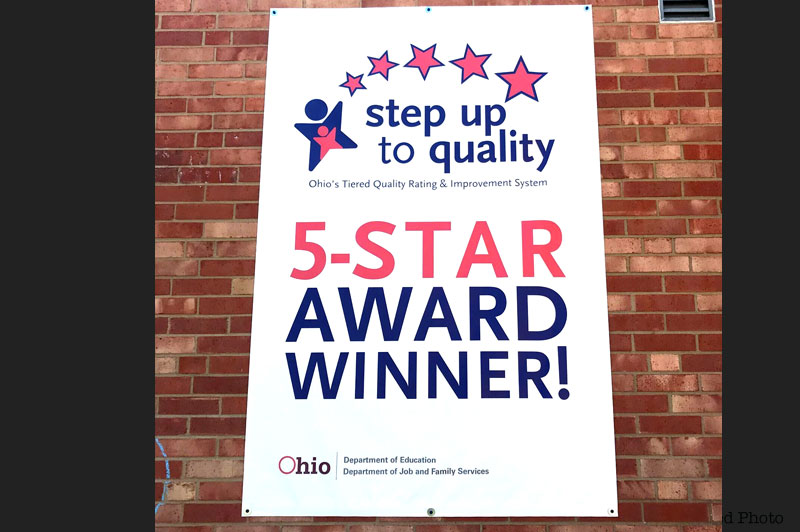
    LECC receives five-star “Step Up To Quality” rating for its preschool program

    Loveland, Ohio – The Loveland Early Childhood Center (LECC) has once again earned the five-star Step Up To Quality rating. The award is presented in recognition of meeting the quality standards and exceeding the health and safety regulations established by the Ohio Department of Education (ODE) and the Ohio Department of Job and Family Services (ODJFS).

    LECC Principal Jesse Kohls

    “It is very exciting that LECC has maintained the highest Step Up To Quality ranking possible, recognizing all the effort that goes into running a top-notch preschool program,” said LECC Principal Jesse Kohls. “I am very proud of our preschool staff members who go above and beyond to create an engaging and enriching experience for our youngest students every day.”

    All Ohio Early Childhood Education (ECE) and Preschool Special Education (PSE) programs funded by the ODE are mandated to participate in the Step Up To Quality system. In order to maintain their state funding, they must achieve a ranking of at least “3.” They must also administer and report early learning assessments.


  • Loveland Elementary School Recognized as “Rising Breakfast All-Star”

    Loveland Elementary School Recognized as “Rising Breakfast All-Star”

    Loveland, Ohio – Loveland Elementary School (LES) has been recognized as a “Rising Breakfast All-Star” for meeting noteworthy school breakfast Average Daily Participation (ADP) rates as established by the 2018 Ohio Breakfast Challenge.

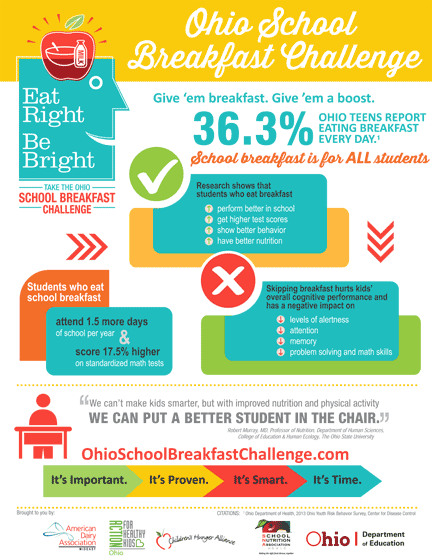
    We know from research that students who eat breakfast perform better in school than those who don’t.

    “We know from research that students who eat breakfast perform better in school than those who don’t,” said Loveland District Food Service Director Kris Tracy. “On average, they also attend more days of school per year and score almost 18 percent better on standardized math tests.”

    The breakfast program was implemented at LES in 2016, followed by the High School, Early Childhood Center and Primary School in 2017. It was also added to the Intermediate and Middle Schools at the start of the 2018-19 school year.

    The mission of the Ohio School Breakfast Challenge is to increase and sustain student participation in the School Breakfast Program, ensuring that Ohio students start each day ready to learn. The Ohio Department of Education, American Dairy Association Mideast, Children’s Hunger Alliance, Ohio Action for Healthy Kids, and Ohio School Nutrition Association are all sponsors of the Ohio School Breakfast Challenge. For more information, visit OhioSchoolBreakfastChallenge.com.


    Welcome to All About Kids We invite you to come visit one of our convenient locations, talk to our staff and teachers and learn why.


  • 2018 Community School (charter schools) Sponsor Evaluations Released

    2018 Community School (charter schools) Sponsor Evaluations Released

    Columbus, Ohio – To help ensure accountability and quality in Ohio’s community school system, the Ohio Department of Education today released the 2017-2018 sponsor evaluations.

    What’s a Sponsor? – A sponsor has the authority (ability) to establish a community school. Sponsors ensure that schools adhere to their contracts, and they make important decisions, such as whether to renew contracts with community schools. They also provide oversight and technical assistance.

    What’s a Community School? – Community schools, which are often called charter schools nationally and in other states, are public schools created in Ohio law; are independent of any school district; and are part of the state’s education program. Community schools are public schools of choice and are state and federally funded.

    “High-quality sponsors are the foundation for an effective community school system,” said Paolo DeMaria, superintendent of public instruction. “The sponsor evaluations are an important piece of Ohio’s accountability system, driving continuous improvement and helping to ensure Ohio’s families have quality school choice options.”

    The sponsor evaluation system assists the Ohio Department of Education in its oversight of sponsors and helps increase the quality of sponsor practices. The evaluation framework is made up of three equally weighted components:

    • Academic Performance;
    • Compliance with Rules and Laws; and
    • Quality Practices.

    The Academic Performance component determines how well students are performing academically at sponsors’ schools. The Compliance component rates whether sponsors are compliant with all relevant laws and rules and whether sponsors are monitoring their schools’ compliance with laws and rules. The Quality Practices component, which was created using national standards and input from sponsors, looks at sponsors’ adherence to quality practices.

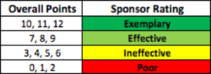
    All three components are scored on a common scale (0-4 points) to allow for simple calculations. Sponsors receive points for each component that, when added together, provide a summative rating. The point scale for 2017-2018 is as follows:

    Sponsor Rating Chart

    Ohio law includes a set of incentives for sponsors rated “exemplary,” as well as a set of consequences for sponsors rated “ineffective” and “poor.” For example, a sponsor rated “exemplary” for two consecutive years is able to take advantage of incentives, including receiving a longer term on its contract with the Department. Any sponsor that receives an “ineffective” overall rating is prohibited from sponsoring any new or additional community schools, and the sponsor is subject to a quality improvement plan. Any sponsor that receives a “poor” rating or three consecutive “ineffective” ratings is subject to revocation of its sponsorship authority. An appeals process is available to sponsors that are subject to revocation of their sponsorship authority.

    The 2017-2018 community school sponsor evaluations can be found online by clicking here.


    Welcome to All About Kids We invite you to come visit one of our convenient locations, talk to our staff and teachers and learn why.


  • Loveland High School Receives an A on State Report Card

    Loveland High School Receives an A on State Report Card

    Overall, Loveland City School District received a B

    Loveland, Ohio – On September 13, the Ohio Department of Education released its annual report cards for public school districts across the state and Loveland High School was listed as one of six high schools in the Greater Cincinnati area to receive an A, the highest grade a school can obtain.

    Dr. Amy Crouse

    “I am so proud of the work we’re doing in all of our classrooms for all of our students, although I believe we will always have room for growth and improvement,” said Dr. Amy Crouse, superintendent. “Even though we know the state report card is just one tool of accountability based on one standardized test, it is validation that we are on the right track in preparing students for tomorrow, today.”

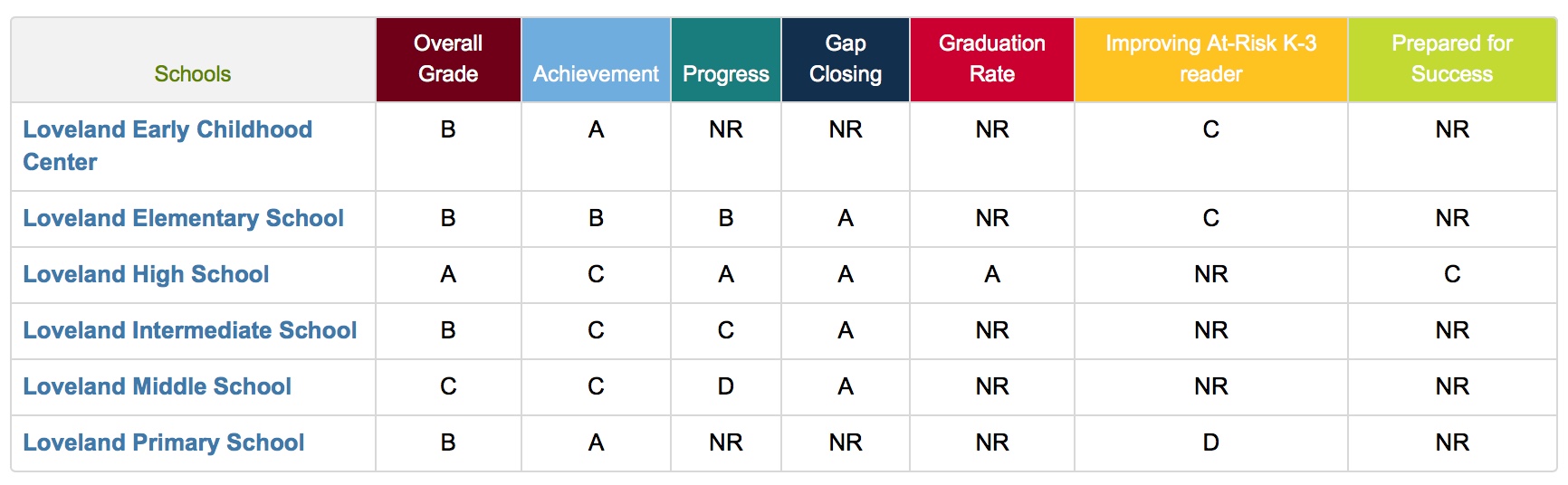
    The report card grades, A through F, are based on other sub-grades in areas such as Achievement, Progress, Graduation Rate and Gap Closing. For the first time, the state also released an overall district-level grade summing up how districts performed in this year’s report cards. Loveland City School District received a B. In Hamilton County, four school districts received an A, five received a B, and the 13 remaining districts received a grade of C or lower.

    “We know the state report card can provide us with useful information, although we have to keep in mind that its data offers just one snapshot of the very complex work we do every day in our classrooms,” said Crouse. “As a school district committed to high achievement and continuous growth, we monitor, analyze and factor in multiple data points when we consider the educational experience we strive to provide in our schools.”

    Later this month, the Loveland City School District will also release their own “Quality Profile”, which offers a look at the performance of district students and staff, using multiple measures and data points. The Quality Profile is supported by the Alliance for High Quality Education, an education consortium that works to improve educational opportunities for students and represent member districts on matters of educational policy and funding.

    “Our Quality Profile includes measures beyond the test scores that make up the state report card and seeks to show the complete picture of the total value our schools provide to our students, staff and community,” said Crouse. “While we will continue to celebrate our successes, we will never ignore the areas that present opportunities for progress. Ultimately, our goal is that every Tiger student is empowered to learn, grow and embody our core values of care, respect and responsibility.”

    Community School Closure Family Frequently Asked Questions

    State Report Card District Overview

    District Grade B


    Achievement

    The Achievement Component represents whether student performance on state tests met established thresholds and how well students performed on tests overall. A new indicator measures chronic absenteeism.
    B – Component Grade

    Progress
    The Progress component looks closely at the growth that all students are making based on their past performances.
    B – Component Grade

    Gap Closing
    The Gap Closing component shows how well schools are meeting the performance expectations for our most vulnerable students in English language arts, math, graduation and English language proficiency.
    A – Component Grade

    Graduation Rate

    The Graduation Rate component looks at the percent of students who are successfully finishing high school with a diploma in four or five years.
    A – Component Grade

    Improving At-Risk K-3 Readers

    This component looks at how successful the school is at improving at-risk K-3 readers.
    C – Component Grade

    Prepared for Success

    Whether training in a technical field or preparing for work or college, the Prepared for Success component looks at how well prepared Ohio’s students are for all future opportunities.

    LCSD 2018-19 Expectations

    Click the image below to learn more about the 2018-19 Loveland City School District expectations.


    Welcome to All About Kids We invite you to come visit one of our convenient locations, talk to our staff and teachers and learn why.


  • School safety training grants available for schools in Ohio

    School safety training grants available for schools in Ohio

    Schools will have the flexibility to use these grants for things like training for school resource officers, safety and security materials, and programs to identify and help students who may be struggling with their mental health.

    Ohio Attorney General Mike DeWine has announced that he is awarding $12 million in grants to help enhance safety and security at schools across the state.

    All of Ohio’s public schools, chartered nonpublic schools, and schools operated by county boards of developmental disabilities will receive the greater of $2,500 or $5.65 per student to spend toward school safety programs and training.

    “Schools will have the flexibility to use these grants for things like training for school resource officers, safety and security materials, and programs to identify and help students who may be struggling with their mental health,” said DeWine

    The grants are funded with appropriations made by the Ohio legislature as part of House Bill 318. The bill, which was sponsored by state representatives Sarah LaTourette (R-Chesterland) and John Patterson (D-Jefferson), appointed the Ohio Attorney General’s Office to develop the school safety training grant program in consultation with the Ohio Department of Education and the Ohio Department of Mental Health and Addiction Services.

    The law requires that participating schools and county boards work with law enforcement in their jurisdictions to determine the best use of the grant funding.

    A full list of grant awards can be found on the Ohio Attorney General’s website.

    Other Resourses

    • Active Shooter Response: An Educator’s Guide: This 25-part video series was produced by the Attorney General’s Ohio Peace Officer Training Academy (OPOTA) to aid educators in preparing for and reacting to a potentially violent school incident, such as a school shooting. The brief videos are an update to the training offered by OPOTA beginning in 2013 that provided guidance to nearly 15,000 educators on how to intervene with students who could pose a danger and how to respond in a crisis situation.
    • Emergency Management Plan Aerial Photographs: Special agents with the Attorney General’s Ohio Bureau of Criminal Investigation (BCI) are available to take free aerial photographs of school buildings for inclusion in school emergency management plans. BCI currently has six drones that are used primarily to document crime scenes and assist in missing persons cases, but BCI is offering to use its drones to take aerial photos of school campuses to help law enforcement plan for and respond to an emergency. School administrators, in coordination with local law enforcement, can request photographs by calling 855-BCI-OHIO (855-224-6446).

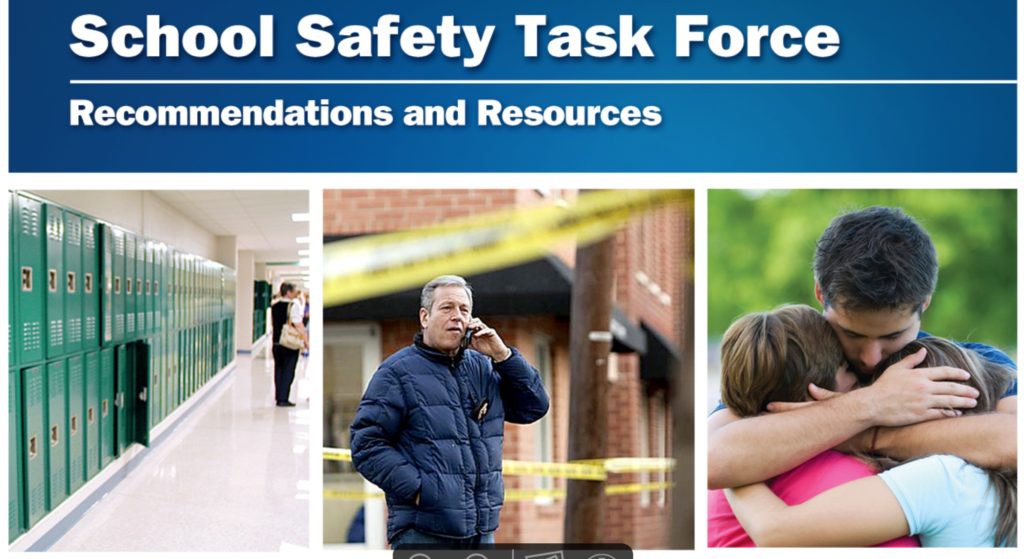
    Attorney General DeWine also worked with schools across the state to achieve greater compliance on school safety plans and convened a School Safety Task Force that issued dozens of school safety recommendations. The task force recognized that mental health awareness was essential for schools to identify and intervene with students who may be at risk.

  • Ohio Department of Education looking for local nonprofit agencies that will help them feed hungry children this summer

    Ohio Department of Education looking for local nonprofit agencies that will help them feed hungry children this summer

    Free meals are provided at schools, colleges and universities, nonprofit organizations, parks, camps, community centers, swimming pools, libraries, low-income housing complexes and more.

    With the help of numerous sponsoring agencies and stakeholders, the Summer Food Service Program works to feed thousands of children in Ohio. Since 2014, Ohio has increased participation in the program by 10 percent.

    Despite these numbers, many Ohio parents and caregivers are forced to make difficult decisions daily to provide for their families. In many cases, this leaves Ohio’s most vulnerable citizens, our children and youth, struggling with hunger daily.

    This year, the Department wants to increase participation in summer meal programs and is actively seeking local nonprofit agencies to participate as sponsors or sites by providing free meals to children.


    “The need for healthy meals doesn’t stop when school breaks for the summer,” said Paolo DeMaria, superintendent of public instruction. “The Summer Food Service Program helps provide children with nourishment to make sure summer can be a time for continued learning and fun. Instead of worrying about where their next meals will come from, our students can enjoy activities like reading, sports, playing outdoors and the growing that happens during the summer months.”

    Free meals are provided at schools, colleges and universities, nonprofit organizations, parks, camps, community centers, swimming pools, libraries, low-income housing complexes and more.

    Sponsoring organizations receive reimbursement to cover the costs of providing nutritious meals and snacks to children in eligible areas.

    Sponsoring organizations receive reimbursement to cover the costs of providing nutritious meals and snacks to children in eligible areas. Nonprofit organizations offering summer activities for children living in low-income areas also are encouraged to apply.

    Expansion of the program is particularly needed in southern Ohio counties, where families struggle with food insecurity, as well as in rural communities and areas where migrant families reside.

    The Summer Food Service Program ensures that children ages 1-18 continue to receive nutritious meals during the summer break from school, when they do not have access to school breakfast or lunch. Children with disabilities and approved individualized education programs may participate through age 21.

    A sponsoring organization must be:

    • A public or nonprofit private school;
    • A public or nonprofit private residential summer camp;
    • A unit of local, municipal, county or state government;
    • A public or nonprofit college or university; or
    • A private nonprofit organization.

    The Summer Food Service Program is funded by the U.S. Department of Agriculture and administered by the Ohio Department of Education.

    Any organization interested in becoming a sponsor or site should complete the potential sponsor survey no later than Friday, March 2.