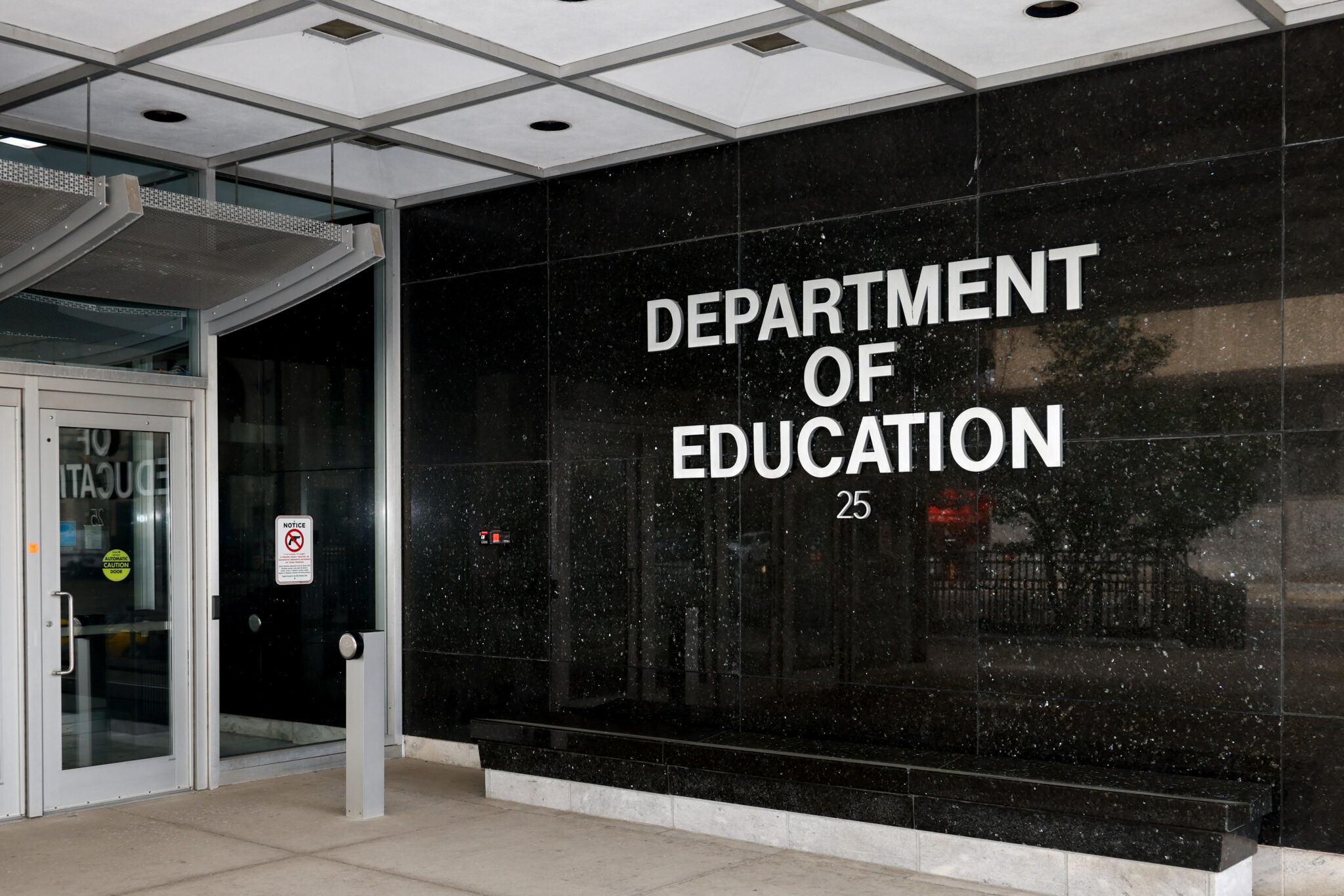
Tag: Ohio Department of Education

  • Loveland District’s annual Quality Profile

    Loveland District’s annual Quality Profile

    Loveland, Ohio – The Loveland City School District has earned an overall 5-Star Rating on the Ohio School Report Card. According to Superintendent Mike Broadwater, a 5-Star Report Card means the district “significantly exceeds” state standards. Loveland has achieved the highest rating for three years in a row.

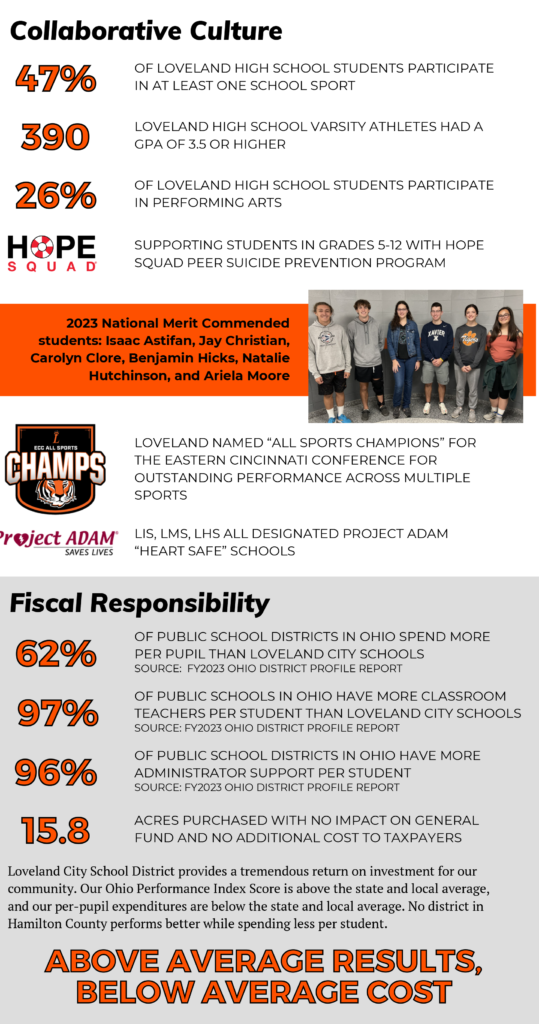
    The District’s annual Quality Profile shown below is a companion to the State Report Card. Ohio School Report Cards are required by law to provide parents, caregivers, community members, educators and policymakers information about district and school performance. The Quality Profile is intended to highlight additional measures families and community members regard as important values, but are not part of the Ohio Department of Education’s report cards.

    The Loveland District Report Card is issued by the Ohio Department of Education.


    ____________

    Loveland Earns Five Stars in Every Category on Ohio School Report Card

    Loveland City School District has earned a Five Star Overall Rating on the 2023-2024 Ohio School Report Card. Only ten public school districts in the Cincinnati region of Hamilton, Butler, Warren, and Clermont Counties earned an “Overall Rating” of Five Stars. 

    “Earning a Five-Star Ohio School Report Card is a sign that Loveland City School District delivers a great education to our students. Families should feel great knowing that they are sending their children to a fantastic school district,” Superintendent Mike Broadwater said. 

    The Ohio School Report Card has five component areas: Achievement, Progress, Gap Closing, Graduation, and Early Literacy. Districts can earn up to five stars in each category but may earn an “Overall Rating” of five stars without fives in every category. Loveland is one of only 18 districts in Ohio to earn Five Stars across the board in each component area. This accomplishment puts Loveland City School District in the top 3% of Ohio’s more than 600 public school districts. 

    “Loveland is incredibly fortunate to have all the ingredients for a top-notch school district – students and staff who work hard every day, along with families and community members who offer us tremendous support. Our entire Loveland City School District community should be proud of this accomplishment,” Broadwater said. 

    Loveland earned an Overall Rating of 5 Stars on the 2022-23 Ohio School Report Card and earned 5 Stars in every category on the 2021-22 Ohio School Report Card.

    You can view the Loveland City School District’s Ohio School Report Card results by following this link: https://reportcard.education.ohio.gov/district/overview/044271. Find more resources for understanding the Ohio School Report Card by following this link: https://education.ohio.gov/Topics/Data/Report-Card-Resources.

    ____________

  • Loveland Early Childhood Center Receives Five Stars in State quality program

    Loveland Early Childhood Center Receives Five Stars in State quality program

    Loveland, Ohio – Loveland Early Childhood Center has received a Five-Star Step Up To Quality Award from the State of Ohio.

    Step Up To Quality is a five–star quality rating and improvement system administered by the Ohio Department of Education and the Ohio Department of Job and Family Services. SUTQ recognizes and promotes learning and development programs that meet quality program standards that exceed preschool licensing and school age child care licensing health and safety regulations. “The Step Up To Quality program standards are based on national research identifying standards which lead to improved outcomes for children”, according to the Ohio Department of Education and Workforce.

    [pdf-embedder url=”https://lovelandmagazine.com/wp-content/uploads/2024/04/LECC-5-Star-Report.pdf” title=”LECC 5-Star Report”]

  • Ohio public education supporters look to 2024, lawsuit to hold private voucher system accountable

    Ohio public education supporters look to 2024, lawsuit to hold private voucher system accountable

    Getty Images

    BY:  Ohio Capital Journal

    While marijuana legislation and other bills still sit on the horizon in the second year of this term’s General Assembly, education policy can always be counted on to be a part of the discussion. 2024 should be no different.

    Ohio’s private school voucher program has been a source of strong debate among legislators and education advocates of all kinds since the 1990s, when the program began as a way to allow lower-income students to access private schools, proposed as an effort to improve education outcomes in poor-performing public school districts.

    But as public school advocates still hope to see full funding of the Fair School Funding Plan for districts across the state, they saw eye-popping increases in private school funding through vouchers that worry them almost as much as the foot-dragging that they believe has occurred when talking of public school funding.

    “You should be funding the public schools,” said Stephen Dyer, former state representative and former chair of the Ohio House Primary and Secondary Education subcommittee for the House Finance Committee. “If you want to fund the private schools, fund the private schools, but there’s no reason you can’t do both.”

    Private school voucher expansion by the numbers

    The Ohio Department of Education reported 23,272 participants in the voucher expansion for the 2023 fiscal year, up from the 20,702 reported in 2022 and even more from the year prior, when 17,155 students participated in the state-subsidized program.

    In 2021, 85% of the voucher expansion participants were below 200% of the federal poverty line, and 93% of 2022 participants were below 250% of the poverty line.

    In 2023, language on the ODE data changed to “low-income qualified” to “not low-income qualified,” removing the breakdown of federal poverty percentages. In this year’s report, 67% of participants were “low-income qualified” and 32% were “not low-income qualified.”

    With the most recent state budget, passed this summer, a GOP-led effort to expand eligibility for private school vouchers led to a ballooning of the poverty level allowed for the voucher program to 450% of the poverty line, or a household income of $135,000 or less for a family of four.

    Those receiving a scholarship can move to a private school with $6,165 in state funding for K-8 students, and $8,407 for high schoolers.

    Families with incomes above the $135,000 threshold can still be eligible for at least 10% of the maximum scholarship, even with a higher income, Senate President Matt Huffman’s office said when the budget was passed.

    Public school advocates took issue with the expansion, saying the Fair School Funding Plan, seeking to support public school districts based on their individual needs, should be the focus, considering the vast majority of students in Ohio attend traditional public schools.

    ‘A perversion of the idea behind a voucher’

    Since the most recent voucher participation numbers were released, Dyer did his own analysis of the voucher program, finding “a very different goal” compared to when it began.

    “It’s now going to wealthier, white families to subsidize the decisions they’d already made to send their kids to private schools,” Dyer told the OCJ.

    In an analysis he posted to his blog, Dyer said ODE data showed nearly nine in 10 new applications to the voucher expansion went to white students, and more new vouchers for high schoolers went to families making more than $150,000 annually than went to families making less.

    Dyer also makes an argument that has been made before by those opposing the voucher expansion: increasing private school voucher program causes “resegregation” in the public schools, with the number of white students who are leaving for private schools, vouchers in hand.

    “It’s frankly a perversion of the idea behind a voucher, which was sold as allowing poor students, students of color, students who haven’t traditionally had access to private schools, to have access,” Dyer said in an OCJ interview.

    The most recent data on Ohio’s EdChoice voucher expansion showed 66.4% of participants are white, with the Black population of voucher recipients coming in at 15%, the second highest number reported.

    In 2022, 65.9% of expansion vouchers went to white students, up from 64.1% in 2021.

    A vast majority – 9 in 10 – vouchers come from just 31 school districts, according to Dyer.

    “Those districts’ racial makeup is, on average, 21% white,” he writes in his analysis. “Yet 46% of EdChoice voucher recipients are white – more than double the percentage of white students than attend the 31 public school districts where nine in 10 voucher students would otherwise attend.”

    At the very least as the voucher program continues in Ohio, Dyer hopes a plan to audit the program is forthcoming for the billions of dollars spent to subsidize it. He pointed to an audit of the defunct Electronic Classroom of Tomorrow (ECOT), which exposed false enrollment numbers and led to court battles to claw back more than $60 million in state funding from the online charter school.

    “It’s all of our dollars, so we have a right to say what happens with all of our dollars, and we certainly have a right to audit where our dollars are going,” Dyer said.

    The lawsuit

    With a Republican supermajority in both chambers of the legislature, support of private school vouchers and “school choice” seems assured at least for the foreseeable future, so public school advocates are looking to other avenues to make change.

    Another court battle is still simmering in the Franklin County Court of Common Pleas, a lawsuit that seeks to tamp down on the voucher program in favor of the constitutional obligations the legislature has to properly fund public schools.

    The lawsuit was filed in Jan. 2022, accusing the state of Ohio of improperly and unequally funding private schools, specifically targeting the growth of the voucher program as a drain on public school resources.

    “The legislature has only moved to further expand private school vouchers in Ohio,” the leading group in the lawsuit, Vouchers Hurt Ohio, wrote in a recent statement on the program. “We do not stand a chance of changing their minds or direction so we are forced to sue to get a fair hearing in a court of law where the Ohio Constitution is respected and means something.”

    Amidst the nearly two years the case has been ongoing, time extensions have been granted and Ohio Senate President Matt Huffman has asked to be excused from a deposition due to “legislative privilege,” also arguing the testimony sought from Huffman “is neither legally relevant nor necessary.”

    Franklin County Judge Jaiza Page has not ruled on Huffman’s subpoena, but allowed subpoenas for 42 “non-party private schools” in Ohio as part of the case, selected, according to the lawsuit filers “as a representative sample based on their location, demographics, percent of EdChoice students enrolled and total EdChoice funds received.”

    Parties standing against the public school advocates in the case said the passage of the state budget, including an increase in funding for the Fair School Funding Plan along with the voucher expansion should allow for the dismissal of their complaints on funding of public schools.

    “And while plaintiffs presumably still take issue with the new, amendment program, that does not change the fact that their current complaint challenges legislation that ‘is no longer the operative legislation governing EdChoice,” attorneys arguing for dismissal stated.

    A deadline for documents and evidence in the case was Nov. 30, and the court has requested “expert reports” from both sides by Feb. 23 of next year, with a trial date set for Nov. 4, 2024.


    Susan Tebben
    SUSAN TEBBEN

    Susan Tebben is an award-winning journalist with a decade of experience covering Ohio news, including courts and crime, Appalachian social issues, government, education, diversity and culture. She has worked for The Newark Advocate, The Glasgow (KY) Daily Times, The Athens Messenger, and WOUB Public Media. She has also had work featured on National Public Radio.

    MORE FROM AUTHOR

  • Judge rules overhaul of Ohio K-12 education can begin

    Judge rules overhaul of Ohio K-12 education can begin

    The Ohio Department of Education becomes the Ohio Department of Education and Workforce, which creates a cabinet-level director position and puts the department under the governor’s office.

    BY:  Ohio Capital Journal

    Control over Ohio K-12 education can officially start to transfer to Gov. Mike DeWine’s administration after a month-long battle in court.

    Retired Franklin County Common Pleas Court Judge Richard Frye denied a preliminary injunction request to stop the transfer of power of K-12 education from the state school board to the governor’s office on Friday, the last day the temporary restraining order was in effect.

    “I am thrilled that the restraining order has been dissolved and we can focus on the important work of moving forward to help our kids be better prepared for life after high school, whether choosing additional training, beginning a career, or heading to college,” DeWine said in a statement Friday.

    Under the state’s two-year budget, the Ohio Department of Education becomes the Ohio Department of Education and Workforce, which creates a cabinet-level director position and puts the department under the governor’s office.

    Jessica Voltolini will be the interim director of the Department of Education and Workforce starting Monday, DeWine said.

    “She will lead the department as we resume our search for the director and deputy director positions,” he said.

    Voltolini most recently served as the Ohio Department of Education’s chief of staff and she was one of two candidates former interim superintendent of public instruction Dr. Stephanie Siddens recommended to fill her role when she left the department earlier this year. The state board of education picked Chris Woolard as the interim state superintendent.

    The new law also reduces the State Board of Education’s power to teacher disciplinary and licensure cases and territory disputes. The state board of education no longer has various administrative powers or control over curriculum standards.

    Seven members of the Ohio State Board of Education originally filed a lawsuit against Ohio Gov. Mike DeWine on Sept. 19 in an attempt to block these changes from taking place. Judge Karen Held Phipps issued the temporary restraining order Sept. 21, which was eventually extended until Oct. 20.

    “The temporary order we won to stop Gov. DeWine’s education takeover from going into effect was dissolved and an interim order was issued,” Democracy Forward, the plaintiff’s legal counsel, said Friday afternoon in a statement. “We await a final decision on our request to block the law while the case proceeds, and we are confident that democracy and the Ohio Constitution will ultimately prevail.”

    Lawsuit

    On Oct. 1, the lawsuit was amended and State Board of Education members Christina Collins and Michelle Newman, former Toledo Public School Board President Stephanie Eichenberg and the Toledo Public School Board were named the plaintiffs in the case.

    Collins, Newman and Eichenberg all have children attending Ohio public schools. The plaintiffs were represented by Democracy Forward and Ulmer & Berne LLP.

    Franklin County Magistrate Jennifer Hunt held an all-day preliminary injunction hearing on Oct. 2 and the judge’s temporary restraining order continued, but DeWine held a press conference later that day saying he was going to continue with the changes anyway.

    The plaintiffs asked the judge for clarification of the restraining order and the temporary restraining order was extended until Oct. 20.

    Chief Counsel and Ethics Officer for the Ohio Attorney General Bridget Coontz, who was representing the original state school board members, was disqualified from being involved in the lawsuit after she sent an Oct. 3 email with legal advice to the counsel for defendants, Julie Pfeiffer, the section chief at the Ohio Attorney General’s Office.

    Ohio State Board of Education

    Since Ohio voters passed a constitutional amendment in 1953 to create the State Board of Education, the plaintiffs argued these changes in the state budget were unconstitutional.

    Hunt, however, disagreed.

    “The Legislature has complete authority to grant, or remove, the respective powers and duties of the State Board and the Superintendent, and the State Board has no constitutional right to retain all the powers transferred under the Challenged Provisions,” she wrote in her decision.

    The Ohio State Board of Education is currently made up of 19 members — 11 elected and eight appointed by DeWine.

    State Superintendent Search

    The search firm tasked with identifying superintendent candidates paused their search because of “the recent lawsuit and other events that surround the Board’s current situation,” President of Ray & Associates Michael Collins wrote in an Oct. 9 letter obtained by the Ohio Capital Journal.

    “Plaintiffs failed to prove by clear and convincing evidence that they will suffer any of their claimed injuries if injunctive relief is denied,” Hunt wrote in her decision. “Defendants argue that an injunction will cause confusion, unrest and chaos for Ohio’s educational system.”

    Follow OCJ Reporter Megan Henry on Twitter.


    Megan Henry
    MEGAN HENRY

    Megan Henry is a reporter for the Ohio Capital Journal and has spent the past five years reporting in Ohio on various topics including education, healthcare, business and crime. She previously worked at The Columbus Dispatch, part of the USA Today Network.

    MORE FROM AUTHOR

  • Reading Recovery lawsuit trying to prevent science of reading implementation in Ohio schools

    Reading Recovery lawsuit trying to prevent science of reading implementation in Ohio schools

    BY:  Ohio Capital Journal

    A lawsuit is trying to prevent a new law from changing how Ohio students learn how to read.

    Reading Recovery Council of North America, located in Worthington, filed a lawsuit on Oct. 3 in the Franklin County Court of Common Pleas to block the science of reading from being implemented in schools across the state.

    The science of reading is based on decades of research that shows how the human brain learns to read and incorporates phonemic awareness, phonics, fluency, vocabulary, and comprehension.

    Reading Recovery Council of North America’s reading intervention programs would be banned under the new law.

    The association has seen a decline in Ohio school district memberships since the state budget was signed into law and a major portion of its operating revenue comes from annual membership fees paid by Ohio members, according to the lawsuit.

    “The unconstitutional, improper and unlawful teaching, instructional and educational policy directives of the Ohio Legislature … directly and significantly impact RRCNA’s mission and outreach,” wrote David Yeagley, an attorney with Ulmer & Berne that filed the lawsuit.

    DeWine’s press secretary Dan Tierney said the governor is disappointed this lawsuit has been filed.

    “I truly believe there’s nothing more important than the science of reading, and making sure that every single child in the state of Ohio, as they are learning to read, has the benefit of the science,” DeWine said at a March 23 event. He has visited several schools to learn about how the science of reading method has been implemented in lessons.

    State budget

    A chunk of the state’s two-year operating budget goes towards implementing the science of reading — $86 million for educator professional development, $64 million for curriculum and instructional materials, and $18 million for literacy coaches.

    DeWine, who first began advocating for the science of reading during his state of the state address back in January, signed the state budget in July. He originally put the science of reading in his proposed state budget and it remained, with some tweaks, as it went through the budget process.

    “If permitted to take effect, it will allow the General Assembly to disguise a policy-based law in a must-pass appropriations bill,” the lawsuit said.  “The literacy curriculum statute intrudes on classroom teaching and learning programs, models, methodologies and materials.”

    The lawsuit argues the General Assembly is trying to set education policy and curriculum, infringing on the Ohio State Board of Education’s authority to oversee the Ohio education system.

    Three-cueing

    The budget bans teachers from using the “three-cueing approach” in lessons unless a district or a school receives a waiver from the education department or a student has an individualized education program that specifically includes the “three-cueing approach.”

    However, the lawsuit argues the budget fails to clearly articulate “a clear standard for assessing what teaching models or methods might be categorized under the “three-cueing” approach.”

    The budget defines the “three-cueing approach” as any model of teaching students to read based on meaning, structure and syntax, and visual cues. The three-cueing method encourages children to read words by asking three questions: Does it make sense? Does it sound right? Does it look right?

    Reading recovery is “often referred to or perceived as a “three-cueing” approach, and therefore is targeted as being anti-science of reading,” according to the lawsuit. “There are no recognized or established teaching, instructional or educational approaches that strictly and exclusively fall within either the “science of reading” or the “three-cueing approach.”

    Louisiana, Arkansas and Virginia have laws that ban curriculum that includes three-cueing.

    Other education lawsuit

    This is the second education lawsuit filed against DeWine that relates back to the budget bill. Seven members of the Ohio State Board of Education filed a lawsuit against DeWine on Sept. 19 to block the transfer of power over Ohio K-12 education from the board to the governor’s office.

    On Sept. 21,Franklin County Judge Karen Held Phipps issued a temporary restraining order that currently remains in place and is set to expire on Friday.

    The lawsuit is trying to prevent the Ohio Department of Education from transitioning to the Ohio Department of Education and Workforce, which would create a cabinet-level director position and puts the department under the governor’s office. These changes would also limit the State Board of Education’s power to teacher disciplinary and licensure cases and territory disputes.

    Follow OCJ Reporter Megan Henry on Twitter.


    Megan Henry
    MEGAN HENRY

    Megan Henry is a reporter for the Ohio Capital Journal and has spent the past five years reporting in Ohio on various topics including education, healthcare, business and crime. She previously worked at The Columbus Dispatch, part of the USA Today Network.

    MORE FROM AUTHOR

  • Governor begins Ohio’s K-12 education overhaul despite judge extending temporary restraining order

    Governor begins Ohio’s K-12 education overhaul despite judge extending temporary restraining order

    BY:  Ohio Capital Journal

    Ohio Gov. Mike DeWine is moving forward with an overhaul of Ohio’s education department and state board of education despite a Franklin County judge extending a temporary restraining order to prevent that from happening.

    After an all-day preliminary injunction hearing on Monday, Franklin County Magistrate Jennifer Hunt ruled that the temporary restraining order blocking lawmakers’ attempts to overhaul Ohio’s K-12 education system remains in effect until the court makes a decision on the case, which must happen by Wednesday at noon.

    “There is certainly a potential for chaos,” DeWine said during what he called a “very unusual press conference” Monday night. “Questions such as who will send out the checks that go to our public schools across the state of Ohio, who will make the determination about eligibility for school choice. I can not let this situation fester.”

    Even though the temporary restraining order is still in effect, the education department changes are still going forward because Tuesday marks 90 days since DeWine signed the state’s operating budget into law which included these changes, DeWine said.

    As of Tuesday, he said, the Ohio Department of Education ceases to exist and is now the Ohio Department of Education and Workforce, as set forth in the budget DeWine signed into law in July. Interim Superintendent Chris Woolard is in charge of the department.

    But it’s more than just a name change. This creates a cabinet-level director position, puts the department under the governor’s office, and limits the State Board of Education’s power to teacher disciplinary and licensure cases and territory disputes.

    “We believe, based upon what our lawyers tell us, that the new department can in fact function,” DeWine said.

    He said they will follow the court order and not name the new cabinet-level director, even though “we were actively in the process of finding” candidates before the temporary restraining order was put in place.

    “We will not take an active part in any way as governor in the creation of the Department of Education and Workforce,” DeWine said. “The new department has money going into that department by reason of the budget that was passed by the General Assembly.”

    Lawsuit

    Seven members of the Ohio State Board of Education filed a lawsuit against DeWine on Sept. 19 in an effort to block the education department changes in the state budget bill. The lawsuit was filed in the Franklin County Court of Common Pleas.

    The original plaintiffs were Christina Collins, Teresa Fedor, Kathleen Hofmann, Tom Jackson, Meryl Johnson, Antoinette Miranda, and Michelle Newman. Franklin County Judge Karen Held Phipps issued the temporary restraining order Sept. 21.

    The lawsuit complaint was amended on Sunday and now Collins, Newman, Stephanie Eichenberg and the Toledo Public School Board are the plaintiffs in the case. Eichenberg is a former Toledo Public School Board president. They are being represented by Democracy Forward and Ulmer & Berne LLP.

    “The Court already ruled that the DeWine Administration’s takeover of the State Board of Education in Ohio must be halted until it has an opportunity to issue a decision,” Skye Perryman, President and CEO of Democracy Forward, said in Monday night in a statement. “If the Governor is suggesting the state will not comply with the Court’s order, then he would be in contempt of the Court.”

    Collins, Eichenberg and Toledo Public School Board President Shenna Barnes testified as plaintiffs, and ODE’s Chief of Staff Jessica Voltolini testified for the defense on Monday.

    Collins said during Monday’s hearing that she filed the lawsuit as a concerned parent, not as a state board of education member.

    “The public and transparent nature that I have enjoyed for my entire career and my entire time being a parent is gone,” she said. “There is no public debate. There is nothing that I as a parent can follow to understand why things are being done and how those things will my effect my children.”

    She is the mother of six children, with four currently attending public schools. She said she has reached out to her state board of education representative over the years about questions and concerns over implementing the state’s dyslexia policy, standardize testing and the Third Grade Reading Guarantee.

    Collins, who was elected to the state board of education in 2021, said she started looking into how to file a lawsuit on July 5, a day after DeWine signed the budget into law.

    “I felt like this looked like it was similar to the agenda of our human resources committee on a local education board,” Stephanie Eichenberg said during Monday’s hearing when she was asked what she thought of the new responsibilities of the state board of education.

    Barnes said her working relationship with the state school board “is very vital” and explained how she has worked with state board of education members to put in legislative changes in place at the local level.

    “We need someone who can give us real-time information, that gives us factual information but also responds to us when we ask questions,” Barnes said.

    Ohio voters passed a constitutional amendment in 1953 that created a State Board of Education with the power to appoint a Superintendent of Public Instruction. The Ohio State Board of Education is currently made up of 19 members — 11 elected, and eight appointed by Gov. DeWine.

    Senate Bill 1

    These changes to the Ohio Department of Education and State Board of Education started out as Senate Bill 1, which Sen. Bill Reineke, R-Tiffin, introduced in January.

    The Ohio Senate voted along party lines to pass SB 1 in March — which sent it to the Ohio House, but it stayed in committee. The Senate added SB 1 to the state budget in June, which DeWine signed into law in July.

    The seven board members who originally filed the lawsuit previously wrote a letter to DeWine the day he received the budget and asked him to veto the “power grab” of changing the state board’s roles.

    Follow OCJ Reporter Megan Henry on Twitter.


    Megan Henry
    MEGAN HENRY

    Megan Henry is a reporter for the Ohio Capital Journal and has spent the past five years reporting in Ohio on various topics including education, healthcare, business and crime. She previously worked at The Columbus Dispatch, part of the USA Today Network.

    MORE FROM AUTHOR

  • Ohio Senate passes education department overhaul

    Ohio Senate passes education department overhaul

    BY: SUSAN TEBBEN – Ohio Capital Journal

    The Ohio Senate passed a bill to overhaul the administration of the state’s education system in a Wednesday vote along party lines.

    The 26-7 party-line vote on Senate Bill 1 came with fierce urgency from GOP supporters that the chances must be completed to improve the way in which education is led in the state.

     State Sen. Andrew Brenner, R-Powell. Official photo.

    Senate Education Committee chair Sen. Andrew Brenner, R-Delaware, complimented the State Board of Education members for being hardworking people with good intentions for the state education system.

    “Yet the structure they find themselves in is sluggish and incapable of getting through the bureaucracies,” Brenner said on the Senate floor.

    Democratic opposition questioned the motives, but also the speed at which the measure was pushed through the chamber, claiming the true intent of the bill hasn’t yet been teased out.

    Senate Education Committee ranking member Sen. Catherine Ingram, D-Cincinnati, said spotlighting districts at the bottom of state report cards or test scores only points to a greater problem not addressed by SB 1.

    “When you continue to point to the lowest achieving districts, unfortunately you are continuing to point to those children who have been left behind all along,” Ingram said.

    After multiple hearings in the last General Assembly and in the current one that included hours of testimony against the bill, Ingram said she fears the desires of the public, and elected school boards in each district, will be overlooked if the bill becomes law.

    “We continue to talk about how we listen to the people,” Ingram said. “I don’t buy it.”

    If SB 1 moves on to be passed by the GOP-majority House, it will change the Ohio Department of Education to the Department of Education and Workforce, and create a new leadership position not under the purview of the Ohio State Board of Education, but under the governor’s cabinet.

    Two deputy directors, one for primary and secondary education and another for workforce, would also be created under the bill.

    If passed, the transfer of duties to the new leadership would happen six months after the bill’s passage.

    The bill would reduce the Ohio State Board of Education’s powers to include hiring a new superintendent of public instruction and dealing with district-level territorial and licensure issues.

    In the Senate Education Committee, several amendments were made, for the most part by Republican legislators.

    Amendments added to the bill before it’s full Senate passage changed the implementation date of the proposed law, taking it from June 30, 2023, to 90 days after full General Assembly passage.

    The committee also adopted an amendment that would allow the superintendent of public instruction to serve as an advisor to the heads of the new department, which was originally a requirement in the bill.

    A Democratic amendment adopted requires the Senate Education Committee to hold at least one in-person meeting before approving a director or deputy director for DEW.

    Scott DiMauro, of the Ohio Education Association, agreed that the bill’s true aim is unclear at this point.

    “I’m still not seeing exactly how restructuring the department get to what are ultimately policy decisions and support decisions,” DiMauro said. “It raises questions about what the impact of this will be.”

    DiMauro said he hopes the House consideration will include changes to ensure a voice for educators and the public.

    “I hope that whatever happens with this whole issue of any kind of restructuring … wherever Senate Bill 1 ends up, that lawmakers are not losing sight of a larger purpose,” he said.

    The bill came back to the Senate hastily after the lame-duck effort last year was rejected at the last minute. Senate President Matt Huffman pledged after the effort went down to bring it back as quickly as possible.

    When asked what he sees as the direct impact of SB 1, Huffman said it would “allow greater opportunity for reforms” and the “ability to act on specific problems.”

    “When I have district meetings, and folks ask me questions and I can’t get the current answer,” Huffman said. “I know that I’m going to be able to get a better answer now.”

    SB 1 now moves to the House for committee consideration.

  • Public school funding set for court battle in 2023

    Public school funding set for court battle in 2023

    BY: SUSAN TEBBEN – Ohio Capital Journal

    While the trial of former Ohio House speaker Larry Householder will hold the attention of many this year, the battle over public school funding will also be subject to court drama.

    Public school districts, some individual students in public schools, and the Ohio Coalition for Equity and Adequacy of School Funding, spent the last year fighting to keep a lawsuit on the books in Franklin County Common Pleas Court. That lawsuit aims a direct hit at Ohio’s EdChoice private school voucher program, which plaintiffs say takes away needed funding from the public schools attended by a vast majority of Ohio students.

    The private school voucher system goes against the Ohio Constitution’s demand for a “thorough and efficient system of common schools throughout the state,” the schools and their advocates say.

    Late in 2022, Franklin County Common Pleas Judge Jaiza Page denied attempts by the Ohio Department of Education, the state Board of Education, and a group of “Catholic school family intervenors” and other individuals, hoping to quash the lawsuit.

    “Plaintiffs have adequately pleaded that the difference in funding levels has resulted in students in the public-school districts being denied adequate facilities and learning supports,” Page wrote in denying the private school advocates’ request to end the case.

    The ODE and the state board argued the public school group didn’t have standing to sue, but Page rejected that argument as well, saying the problem in the case is “unique to students within the districts and is not experienced by the general public,” and could be rectified by the state.

    EdChoice, first implemented in 2005, has been a point of contention for the state legislature and public/private school advocates across the state for decades, since the first time the Ohio Supreme Court deemed the state’s education funding system unconstitutional.

    That case, DeRolph v. State of Ohio, was ruled on multiple times by the state’s highest court, but the rulings were the same: the state’s public school funding system doesn’t meet the requirements of the state constitution.

    While both the public school advocates who filed the suit and private school supporters who discredit the case use DeRolph to argue their sides, Page found the private school supporters’ interpretation that a court does not have the authority to establish per pupil funding without merit.

    “This ignores the fact that the DeRolph court held that the level of funding was unconstitutional and was a violation of the ‘thorough and efficient system’ clause,” Page wrote.

    In all the decisions, the General Assembly was ordered to come up with a new system of education funding. Ohioans have yet to see a plan come to full fruition.

    Another former House speaker, Bob Cupp, worked with fellow legislator John Patterson to put together an education plan that would later be called the Fair School Funding Plan. But the plan requires a six-year phase-in, something legislative leadership wasn’t willing to do when the budget came up in the last General Assembly.

    “For the 2023 school year, only 33% of the Fair School Funding Plan will be funded,” Page wrote in her most recent decision in the case.

    Public school students in the districts represented in the case are funded at $340, $1,700 and $2,800 per pupil, based on their grade level, in core funding from the Ohio Department of Education.

    Currently, the vouchers allow students who choose to attend private schools instead of their public school district to receive $5,500 for kindergarten through eighth grades and $7,500 for high schoolers.

    The program has seen expansions over the years, and with the passage of House Bill 110 in 2021, private school vouchers were directly funded through the state, rather than filtered through adjacent public school districts.

    A new expansion was proposed last month, though it didn’t make it through the end of the General Assembly, and will have to be reintroduced. That could be possible in the new year with a bolstered GOP supermajority full of “school choice” advocates.

    With a new budget cycle upcoming, public school advocates are hopeful more funding for the plan may be ahead, though Senate President Matt Huffman has said one priority on the topic of education for this General Assembly will be an overhaul of the entire education system in the state.

    That overhaul could include a restructuring of the Ohio Department of Education and a changing of roles for the state Board of Education, which could add a layer of fog to the state’s educational future and delay funding changes as the potentially brand new department finds its footing.

    The 134th General Assembly saw the legislation in the waning hours of their term, but the legislation ultimately fell short as amendments and the 2,000-page volume of the bill tripped up its success.

    Meanwhile, the department and the other state education leaders named in the lawsuit have until Jan. 20 to file responses in the case.

  • Education sees some funding boosts, some missed opportunities in 2022

    Education sees some funding boosts, some missed opportunities in 2022

    BY: SUSAN TEBBEN – Ohio Capital Journal

    Next year is sure to be a busy one when it comes to education in Ohio, with potential state agency overhauls and funding changes still on the agenda for the state legislature.

    The end of 2022 was capped by an 11th-hour push and ultimately failure for an attempted overhaul of the Ohio Department of Education and the state Board of Education. Senate Bill 178 was never passed in an Ohio House committee, so it was folded into another bill with controversial provisions, House Bill 151.

    House Bill 151 included bans for trans youth in participating in sports based on their gender identity, and after SB 178 was included, the bill came in at more than 2,000 pages. But despite delaying the vote until after 2 a.m. on the last day of the legislative session, the bill and its many provisions failed to garner enough votes in the House.

    LGBTQ advocates hailed the failure of House Bill 151, which still would have required the use of birth certificates to prove a student’s gender, despite the elimination of a provision that would have required a genital exam.

    “I can not begin to express my gratitude to the hundreds of community members and advocates who stood up for the rights of all transgender youth to participate in all parts of life as whole people, including sports, just like everyone else,” said Alana Jochum, executive director of Equality Ohio, after the bill failed to pass.

    Dr. Rhea Debussy, director of external affairs for Equitas Health and former facilitator for the NCAA’s Division III LGBTQ OneTeam Program, said the thrill of seeing the legislation voted down was tempered by concern that the bill even existed.

    “It’s very alarming that a group of legislators thought bullying gender expansive and intersex youth was an urgent need for the final hours of Ohio’s 134th General Assembly,” Debussy said in a statement.

    Senate Bill 178

    Education officials not only celebrated the failure of HB 151’s anti-trans legislation, but the downfall of the rapid-fire education overhaul they overwhelmingly said needed more time and more vetting.

    “OEA believes it is worth taking a hard look at how Ohio’s schools are governed and supported at the state level,” said OEA President Scott DiMauro in a statement. “However, collaboration is key.”

    Senate President Matt Huffman said he was “disappointed that our school reform bill and our attempt to do something about girls’ sports … I’m disappointed that those things failed.”

    But Huffman maintained the stance he took after the Senate passed HB 151 on to the House for a vote earlier this month, that if the education overhaul part of the bill didn’t pass during the 134th GA, it would move on to the 135th.

    “I’m glad we took the vote because we kind of have on the record who’s where, and there probably is a lot more due diligence that needs to be done on that issue,” Huffman said.

    Some ups, more downs

    While some funding changes were implemented — such as $56 million in state funding for Disadvantaged Pupil Impact Aid, increases in Elementary and Secondary School Emergency Relief funds and federal monies for school security and safety — public schools are still looking for full funding of the Fair School Funding Plan (formerly called the Cupp-Patterson plan, after Speaker Bob Cupp and former state Rep. John Patterson, the legislators who created it). The plan was previously funded for the two years of the current General Assembly, but needs another four-year commitment of funds to be fully phased in.

    That plan, according to the OEA, “represents the first constitutional school funding system in the state in decades.”

    The effort for better public school funding is flanked by a lawsuit moving forward in Franklin County Common Pleas Court that seeks to nullify the EdChoice private school voucher system in the state. A coalition of school districts and individuals joined together to file the lawsuit, and Franklin County Judge Jaiza Page recently ruled against the Ohio Attorney General’s Office, who argued the lawsuit should not be allowed to continue.

    “This means we will put vouchers on trial in a court of law,” the coalition behind the lawsuit, Vouchers Hurt Ohio, wrote in an email newsletter, though the timeline for the court case could go on for some time.

    Private school vouchers are on the minds of congressional Ohioans as well, with U.S. Sen. Sherrod Brown pushing for more investment in federal Head Start programs and more funding for public schools.

    “We have a state government, one of whose major aims seems to be to privatize public schools,” Brown said in a press call. “They have moved more and more money out of public education into religious schools and other private schools … and really undermined what state government should be doing and that is funding public education for the great majority of students in our state.”

    Teachers unions and public officials alike wanted to see efforts to stem the state’s teacher shortage, a rise in the teacher wages that have stagnated over the last 25 years and changes to the third-grade reading guarantee, both of which saw action in the legislature, but did not come to fruition.

    As the state’s Board of Education awaits the fate of the department and the board itself, they still have a decision to make: the search for a superintendent of public instruction.

    The board spent months on issues such as a resolution condemning racism in education, then a resolution repealing that racism measure, and finally a resolution urging the federal government not to include gender identity in anti-discrimination language that would impact education policy.

    But in their December meeting, they decided to punt on the issue of hiring a search firm to select candidates to fill the open position that heads the department.

    The board voted to wait until SB 178 was passed or rejected by the legislature, for fear that candidates for the position might change their minds once they found out how the roles of superintendent would change under the new bill.

  • Ohio education overhaul falls short

    Ohio education overhaul falls short

    BY: SUSAN TEBBEN – Ohio Capital Journal

    The Ohio House did not agree to Senate amendments to a bill banning trans athletes from participating in youth sports based on their gender identity, leaving behind more than a thousand pages of state education overhauls loaded in at the last minute.

    House Bill 151, with language from Senate Bill 178 attached to it was voted down in the House by a 46-41 vote after 2 a.m. on Thursday morning following an entire day of hemming and hawing.

    The education overhaul is not completely done yet. Even if lawmakers decline to move forward in the current General Assembly, Senate President Matt Huffman previously pledged to bring the bill back in the new year, with a General Assembly that will have an even larger GOP supermajority.

    The education overhaul part of the bill, which entered the House as a standalone this week after passing the Senate last week, would have restructured the Ohio Department of Education into the Department of Education and Workforce, and reduced the state Board of Education roles down to superintendent searches, teacher conduct and licensure issues.

    “The system is not working, it doesn’t prioritize our students,” said bill sponsor state Rep. Don Jones, R-Freeport.

    The department, and most of the roles currently under the state board of ed and state superintendent’s purview would have been put under the governor’s office umbrella, according to the bill.

    The State Board of Education put off hiring a search firm for the next superintendent due to concerns about budgetary changes SB 178 might bring and fears the legislative uncertainty might “pollute” the marketplace of candidates.

    The bill also received pushback from public school education advocates and some homeschooling groups. The Ohio Education Association and the Ohio Federation of Teachers both spoke against the bill in committee hearings, not only decrying claims that the ODE was unresponsive and inaccessible, but also criticizing the pace at which the bill came through the General Assembly.

    SB 178 sponsor state Sen. Bill Reineke, R-Tiffin, said attempts to redo the state agencies have been years in the making and urgency is needed to help improve student success.

    “I’m not looking at growing an organization; I’m looking at making it more efficient and more structurally purposeful,” Reineke said on Tuesday as he defended his bill in House Primary and Secondary Education Committee.

    It was up to that committee to pass the standalone bill over to the House for a full vote, something that didn’t happen in a Tuesday night committee that went until about 9 p.m., or a Wednesday morning meeting that recessed before the House’s session began, and didn’t return even after multiple recesses in that body.

    When committee chair state Rep. Gayle Manning, R-North Ridgeville, was asked the status of the bill or the committee at about 9 p.m. Wednesday night, she said she was waiting to see what the GOP caucus was thinking on the matter.

    Amidst the day-long discussion, the Senate decided to take matters into its own hands, inserting SB 178 into HB 151, originally meant to be a teacher mentorship bill that was made to include a ban on athletes competing on teams based on their gender identity.

    The Senate also tried to slide in language from a bill that would have banned COVID-19 vaccine mandates for K-12 students.

    After the additions, HB 151 passed on a party-line 23-7 vote in that chamber, moving it back to the House.

    The controversial part of HB 151 was added in another late-night move in June, when HB 151 was up for passage in the House before moving on to the Senate. The trans athletes part of the bill no longer includes a requirement for genital inspections of children suspected of being transgender, something Senate President Matt Huffman previously said he wouldn’t support.

    Verification of a student’s gender will be done using a birth certificate in the new version of the bill.

    The bill’s sponsor, state Rep. Don Jones, R-Freeport, wouldn’t speak on the trans athletes part of the bill when he introduced the bill in the Senate, but on the House floor he stood in support of it.

    “This bill only applies to K-12 education, so our daughters in grades kindergarten through 12 will not have to compete with biological males in primary and secondary schools,” Jones said.

    The bill would impact very few Ohio students and policies are already in place to keep equality in youth sports, causing LGBTQ advocates, education leaders and the Ohio High School Athletic Association to stand against the bill as unnecessary.

    The original language of the bill would make changes to the Ohio Teacher Residency Program and teacher mentorship.

    Democrats pushed hard for the House not to support the bill as amended, saying stakeholders needed to be involved and more time was needed to find out the impact of it.

    State Rep. Phil Robinson, D-Solon, continued an argument made by critics of the bill that the volume of the bill didn’t get the proper review by legislators or individuals in Ohio education.

    “Passing something at 1 o’clock or 2 o’clock in the morning that no one’s read and no one’s seen … is not the way to change education in the state of Ohio,” Robinson said.

    State Rep. Jeff Crossman, D-Parma, said the bill was “moving deck chairs on a sinking ship” by addressing issues that don’t solve the true problems in Ohio education.

    State Rep. Juanita Brent, D-Cleveland, said the bill would impact economic success in Ohio by making conferences question coming to the state and businesses wonder whether or not to bring employees to the state. She also said passage of the bill in the middle of the night would send a message to current Ohio voters as well.

    “We’re telling Ohioans who elected us that they can’t be seen in this process,” Brent said.