Tag: Ohio Department of Education

  • Treasurer Hawley talks about State funding reductions for the Loveland District

    Treasurer Hawley talks about State funding reductions for the Loveland District

    Loveland, Ohio – The first week of May, Ohio Governor Mike DeWine announced budget cuts to balance the State budget.

    Loveland City School District Treasurer Kevin Hawley

    Due to the economic impact of COVID-19, Governor DeWine said that $775 million in reductions to Ohio’s General Revenue Fund are needed for the remainder of the Fiscal Year 2020 which ends on June 30.

    DeWine said that Ohio is mandated to balance its budget each year, and in addition to identifying areas of savings, the following budget reductions will be made for the next two months:

      • Medicaid – $210 million
      • K12 Foundation Payment Reduction – $300 million
      • Other Education Budget Line Items – $55 million
      • Higher Education – $110 million
      • All Other Agencies – $100 million

    Loveland Magazine reached out to the Loveland City School District Treasurer Kevin Hawley asking him to comment on the impact of the State cutting revenue to the District.

    Thank you for reaching out. I can confirm pieces of this information. For your convenience, I have attached the list from The Ohio Department of Education (ODE) outlining the data for all districts in the state of Ohio. (K-12_Education (2)-1) The amount of the state revenue reduction is $1,010,855. The percentage you are referencing is how much the reduction in revenue is to our ODE calculated overall operating expenditures as stated on the form attached. The percentage decrease of our state revenue for this year is just below 8% and is a decrease of 2% from our overall operating revenue.

    The current state funding cuts are for this fiscal year (July 2019 – June 2020) and will be deducted in the next couple months on our last three state payments. School districts receive their annual state revenue in 24 payments, twice a month. We have been instructed that these payments will be taken out equally from our second May payment and both of our payments in June to finish out the fiscal year. At this point in time there is not clarification from the state of Ohio as to whether there will be further revenue cuts for next year. The state’s budget is primarily funded through sales and income tax and those numbers are announced monthly around the 10th of every month. I have not seen the April numbers at this point in time but my guess is that this current reduction is due to those numbers being much lower than projected pre-COVID. The May and June reports on sales and income tax revenue will be very revealing for how the state’s budget may be impacted next year and ultimately how that impacts K-12 education.

    The Governor has stated that there is federal funding that may benefit local school districts. At the present time, there is approximately $300k in additional money through the state from the CARES Act. Ultimately, this will help with the reductions in state funding but does not close the gap.

    We were anticipating news of potential revenue cuts from the state but were unsure of the size or which fiscal year it would impact. We are always evaluating ways to make our district more efficient and find ways to save and we will continue to do that work. Having just received the specific amount of the revenue cuts Wednesday morning (May 6) we were not factoring this decrease into the budget for next year’s planning and the Board of Education has not had the opportunity to discuss any potential cuts due to this. As we work through the overall financial impact and implications of this budget reduction, recently failed levy and other factors due to COVID-19 the Board will discuss if any future budget cuts are necessary.



  • Should Loveland school taxes increase while residents Lose their livelihoods?

    Should Loveland school taxes increase while residents Lose their livelihoods?

    by Kim and Rick Donaldson

    While many in Loveland are losing their jobs and their businesses, our school board persists in asking us to raise our taxes. As it stands today, they may very well get their way simply by virtue of low voter turnout. So, if you

    Kim and Rick Donaldson live on Paxton Road in Miami Township

    haven’t already done so, apply for an absentee ballot now. The primary election originally scheduled for March 17th is now by mail only. Completed ballots must be postmarked no later than midnight, April 27th or dropped off at your county board of elections by 7:00 PM April 28th. Since you will first need to apply to have a ballot mailed to you, there is no time to lose.

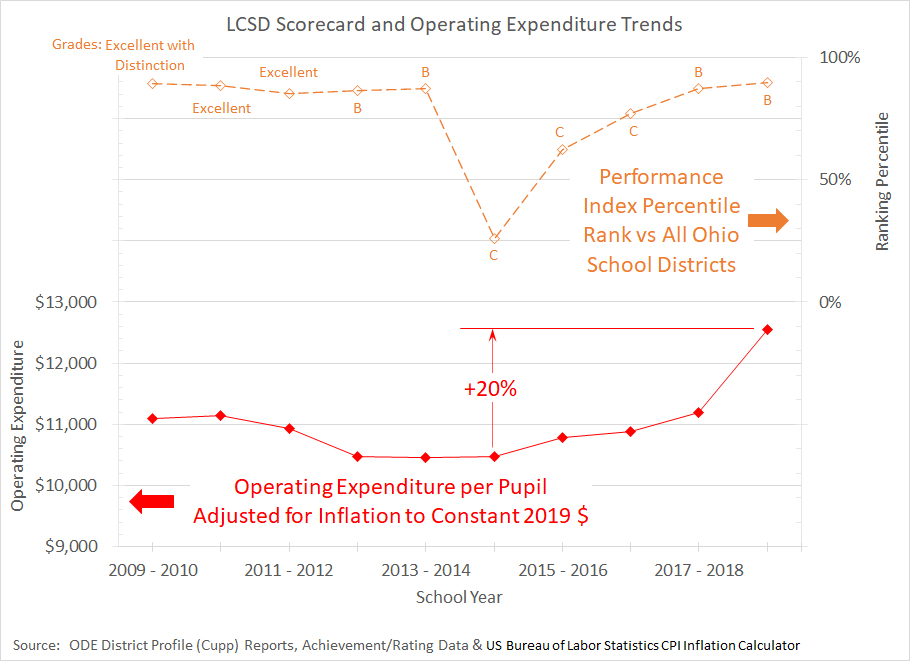
    Now back to the original question: should our school taxes be increased? We are told that additional funding is needed to “protect our progress”. This would imply that past increases have improved district performance. However, according to Ohio Department of Education data, Loveland’s overall performance index score ranked in the top 15% of Ohio schools from 2010 through 2014, with correspondingly high overall grades. In 2015, Loveland’s performance dropped precipitously, nearly to the bottom 25%. Various explanations have been floated for this drop: Common Core implementation, testing changes, students opting out of testing, etc. Available data do not definitively show what the explanation is, but it does show what it isn’t: spending. Referring to the first chart, note that Loveland’s 2019 overall performance is virtually identical to its 2010 to 2014 performance, but expenditure per pupil is as much as 20% higher after adjusting for inflation.  Also note that Loveland’s performance had already recovered to pre-2015 levels by 2018, before the big ramp-up in expenditure.

    Graph provided by Kim and Rick Donaldson

    Since increased funding doesn’t seem to be improving our district’s rating, it is difficult to see exactly what progress we are protecting. Moreover, if we are to invest more of our hard-earned and increasingly scarce money in the schools, we expect to reap some benefit as a community. So far, our children don’t seem to have reaped the benefit of a better education and our property owners haven’t reaped the benefit of the appreciation that should result from a better-rated school system. However, there is one segment of the community who has reaped the benefit: teachers.

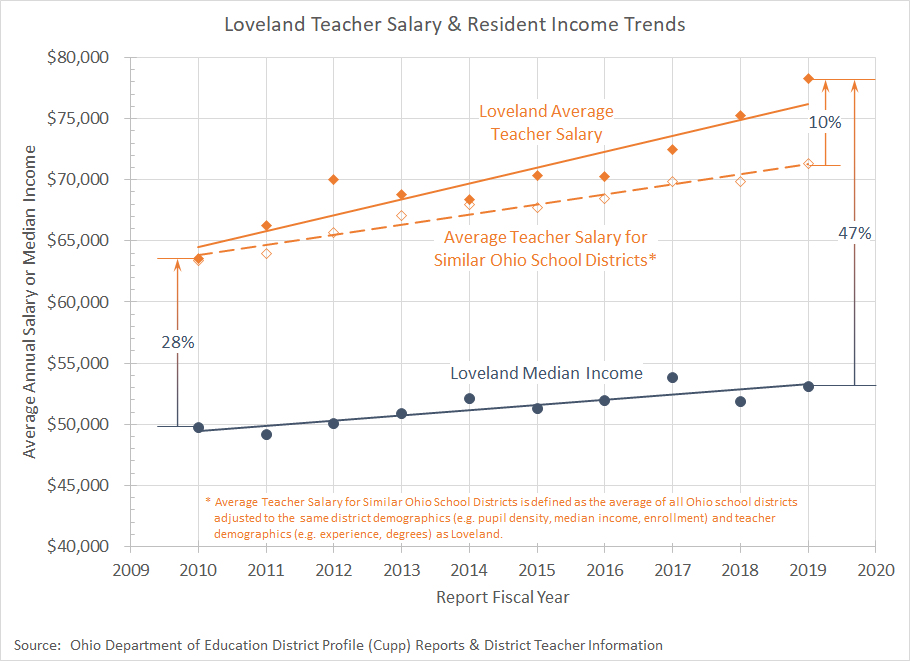
    According to Ohio Department of Education data, presented in the second chart, Loveland’s average teacher salary was $63,566 in 2010, which was about average for an Ohio school district with similar demographics among both the community and the teachers. In 2019, Loveland’s average teacher salary had increased to $78,248, 10% above the comparable Ohio district average. Loveland’s average teacher salary has also risen faster than median income. In 2010, the average teacher salary was 28% above median income. By 2019 it had risen to 47% above median income. While some might argue that paying teachers more improves educational quality, Loveland’s teacher salary and performance trends do not support that claim. Statistical analysis of statewide trends also shows no practical benefit for paying teachers above-market salaries.

    Graph provided by Kim and Rick Donaldson

    We do not question the quality, dedication or professionalism of Loveland teachers. Nor do we fault them for negotiating the most favorable compensation package they can. It is the responsibility of the board of education and administration to negotiate effectively on behalf of the Loveland community at large to deliver a high-quality education at a cost we can afford. Sadly, they do not seem to be doing an adequate job of cost control at a time when residents cannot afford to pay more.

    While no one knows how severe the current economic downturn will be or how long it will last, we do know the proposed levy will cost property owners an additional $20 per month for each $100,000 of appraised value, forever. Under the circumstances, it would be appropriate for the Loveland School Board to withdraw the levy, and we wholeheartedly agree with those who have already called on them to do so. However, the board’s past behavior indicates they are unlikely to heed those calls. The only way we can stop this levy and impose fiscally responsibility is to get an absentee ballot and vote no.

    References:

    1. Elections and Voting in Ohio, Ohio Secretary of State website:  https://www.sos.state.oh.us/elections/voters
    2. Ohio Department of Education District Profile (Cupp) Reports:  http://education.ohio.gov/Topics/Finance-and-Funding/School-Payment-Reports/District-Profile-Reports
    3. Ohio Department of Education District Achievement/Rating Data:  https://reportcard.education.ohio.gov/download
    4. US Bureau of Labor Statistics CPI Inflation Calculator:
      https://www.bls.gov/data/inflation_calculator.htm
    5. Ohio Department of Education District Teacher Information:  https://reportcard.education.ohio.gov/download
  • Upcoming Loveland City Schools Levy and Ohio School Funding

    Upcoming Loveland City Schools Levy and Ohio School Funding

    by Dr. Gregg Tracy

    The current system and laws in regard to funding schools in Ohio are flawed. The funding system overemphasizes real estate taxes and creates inequality in educational funding across the state. The system has been declared unconstitutional multiple times by the Ohio Supreme Court, most recently in 2002. However, due to inaction by the administrative and legislative branches, the funding system remains law. So school systems, like Loveland, that do not have large commercial and industrial bases, must rely heavily on local, individual real estate taxes in order to operate. Voters are faced with the choice of voting for higher taxes or not providing our public schools with the funds necessary to operate effectively. Our schools simply cannot be effective in preparing current and future students without the essential funds to operate.

    Dr. Gregg Tracy is a Loveland resident and property owner, a Loveland High School Graduate, a retired professor of leadership, and former school administrator.

    Even as assessed property values increase, no new monies are generated for schools. Thus operating funds are fixed while operating costs increase. New levies are regularly and periodically necessary. It is a reality in Ohio. Excellent schools depend on good administration, teaching, and community participation, but schools just cannot perform effectively without periodic tax levies.

    Loveland’s consistent excellence will continue to benefit students and the community.

    It is easy to say, “I do not want to pay more taxes.” It is equally as easy to come up with justifications for voting “no.” Historically, voting against operating levies has not been a strategy that has facilitated any positive change. It is a weak substitute for dialogue and cooperative participation in a meaningful process aimed at changing and improving schools. Without necessary funds, schools cannot operate effectively, let alone have opportunities to change and improve. With needed funds, Loveland’s consistent excellence will continue to benefit students and the community.  Loveland’s board and administration, have established a number of ways to learn, cooperate and participate in the school improvement process.  Administration is accessible, public meetings have been held and will continue, printed materials have been sent regularly, and  online communications are available. The leadership team has been very clear about the district’s needs and financial status.

    They are simply asking for operating funds to continue the quality education that Loveland has been providing over time.

    As our school board asks for additional operating funds in March, they are not asking for money for building or adding programs. They are simply asking for operating funds to continue the quality education that Loveland has been providing over time. The board has committed to keeping expense growth to less than 3% through fiscal year 2024. As a concerned citizen, I encourage you to make an informed decision in March based on an understanding of the need based on Ohio’s funding system and the recognition of the importance of your vote for our community. Public schools are one of our community’s vital organizations. As you make your decision in March, I hope you have gone directly to the source and not relied on hearsay and negative campaigns. I hope that you have directly accessed information sources made available by the district’s leadership team. I also hope that you consider our students and the short term and long term effects of your vote. Summarily, I hope you cast a concerned and informed vote on March 17.


  • Loveland School Budget Cuts – Responsible Management?

    Loveland School Budget Cuts – Responsible Management?

    Kim and Rick Donaldson live on Paxton Road in Miami Township

    by Kim and Rick Donaldson

    At its February 18th business meeting, the Loveland City School District Board of Education reviewed the administration’s updated five-year financial forecast, which includes annual operating expenditure cuts averaging $2.5 million and fee increases averaging $0.2 million.* The updated forecast still requires passage of a 6.95 mill operating levy, which will raise annual revenue by $6.3 million, to maintain an adequate cash balance through fiscal year 2024. Indeed, the included budget cuts were made for the express purpose of limiting the levy to only 6.95 mills. So, after cutting $2.5 million from expenditures, why do we need an additional $6.5 million (taxes plus fees) in revenue? Let’s look at the numbers.

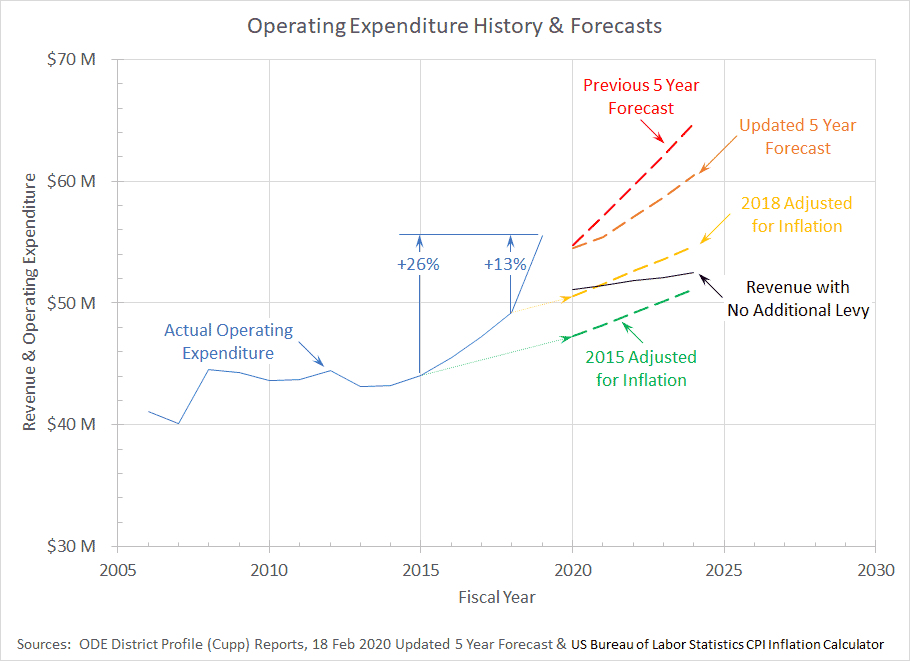
    This graphic is the Donaldson’s original presentation of the data sourced from the Ohio Department of Education and the US Bureau of Labor Statistics as noted on the chart and in the list of references.

    As shown in the included chart, both five-year forecasts start from a very high baseline expenditure level established in 2019 when operating expenditures increased 13% from the previous year.** That increase was the culmination of an accelerated spending trend that started in 2015, bringing the total four-year increase to 26%. By comparison, the cumulative inflation rate was only 7.7% during the same period.*** This rapid expenditure increase quickly overtook the 23% annual revenue increase in the years following the 2014 levy.

    Since median income tends to be tied, albeit loosely, to inflation, expenditure increases that exceed the inflation rate make our schools increasingly less affordable to taxpayers.

    Furthermore, it is important to recognize that the spending cuts and fee increases included in the updated forecast are all relative to the previous forecast, which anticipated increasing expenditures by 4% annually. Since the Federal Reserve Board targets a 2% annual inflation rate, the plan was to increase spending by twice the rate of inflation. The updated forecast anticipates annual increases of 3%, which is still 50% above the target inflation rate. Since median income tends to be tied, albeit loosely, to inflation, expenditure increases that exceed the inflation rate make our schools increasingly less affordable to taxpayers.

    As a more affordable alternative, we advocate limiting operating expenditures to 2015 levels on a per student basis, adjusted for inflation.  As shown on the chart, this approach would result in spending much lower than the updated five-year forecast and, more importantly, lower than current projected revenue. It would thus obviate the need for any additional operating levy. It is worth noting that this would be consistent with, and a continuation of, expenditure trends from 2006 through 2015.

    If a 2015 baseline seems too aggressive, the same approach using a 2018 baseline could be considered. Although it would require an additional levy, the levy vote could be postponed to November 2021 and would only need to be around 1 mill to maintain the same cash balance as in the updated forecast.

    These particular cuts, chosen by the administration, raise some serious questions.

    So, what would we cut? After all, in the same February 18th presentation we were told that we will have to eliminate teaching and staff positions even if we approve the levy in March. We have also been warned that failure to pass the levy in March will result in additional cuts, including staff, teachers and high school transportation. These particular cuts, chosen by the administration, raise some serious questions. If we could afford current staffing levels in 2018, why can we not afford them in 2021 with nearly 13% higher expenditures in the updated forecast?****  Even if we choose to defeat the levy and limit expenditures to inflation-adjusted 2018 levels, why could we not continue to support essentially the same staff and transportation that we did in 2018? Where is the additional money going, and why has the administration chosen to cut staff and transportation?

    Before we head to the polls in March, we need to have satisfactory answers to these questions that are quantitative, complete and transparent. We need to know whether the proposed budget and associated cuts are indicative of fiscally responsible management for the benefit of our children, or emotional manipulation designed to get the levy passed.  Ultimately, it comes down to a question of trust.

    References:

    *5 Year Forecast Update from 18 February 2020 Board Meeting:  https://go.boarddocs.com/oh/love/Board.nsf/files/BLY4FG0B571B/$file/5%20Year%20Forecast%20Presentation.pdf

    **Ohio Department of Education District Profile (Cupp) Reports:  http://education.ohio.gov/Topics/Finance-and-Funding/School-Payment-Reports/District-Profile-Reports

    ***US Bureau of Labor Statistics CPI Inflation Calculator:
    https://www.bls.gov/data/inflation_calculator.htm 

    ****Ohio Department of Education District Teacher Information:  https://reportcard.education.ohio.gov/download

  • Our youngest Loveland Tigers know these three words well

    Our youngest Loveland Tigers know these three words well

    by Kathryn Lorenz

    Our youngest Loveland Tigers know these three words well. Here in Loveland schools, we care for each other. We respect each other. And we take responsibility for our words and actions. 

    The Loveland Board of Education strives to do our best to live up to the expectations our teachers and staff have for our students. We care about each and every member of our school community and demonstrate that with leadership and fiscal responsibility. That care means we regularly need to place tax levies on the ballot in order to ensure the operation of programs that our students need and deserve. 

    The way taxes work in Ohio means that a school board respects the right of our district citizens to vote on these levies. We need to show the necessity for new operating funds and do so with the publishing of budgets, expenditures, and five-year forecasts. We publish the evidence of the success of our students as well.

    The last operating levy passed in 2014 was designed to move the district from a “stay put” mode of operation to a time of forward progress and was strongly supported by our community. Our teachers and students delivered significant achievements as a result of that change in direction and now we need to protect that investment and optimize that effort.

    Acting responsibly means telling the truth and sometimes means that you cannot respond in kind when false, harmful accusations are made.

    Acting responsibly means telling the truth and sometimes means that you cannot respond in kind when false, harmful accusations are made. But responsible public servants also stand up for what is true. There are many false statements being made about the March 2020 levy, about the Board of Education, and about the people who work with us and for us. The Loveland school district and this Board of Education are committed to optimizing resources, to extending the adequacy of 2020 levy funds as long as possible, and to continuing progress for Loveland students. 

    Please take the time to review the information on our website, lovelandschools.org under the levy tab. Take the time to talk to our board and our administrators. Attend a board meeting or an information session.  Get the right information right now. 

    We know our community cares about our schools. We respect the right of our citizens to vote on March 17. Each of us has a great responsibility for the future of Loveland schools. 

    Kathryn Lorenz is the President of the Loveland Board of Education and lives in Miami Township

  • Board moves to place 6.95 mills on the March 2020 ballot

    Board moves to place 6.95 mills on the March 2020 ballot

    Loveland, Ohio – The Loveland Board of Education met on Tuesday, December 17 and unanimously passed a resolution to place an operating levy of 6.95 mills on the March 2020 ballot. The deadline to file the resolution with the Hamilton County Board of Elections is today, December 18.

    Neither Board Superintendent Amy Crouse or Treasurer/CFO Kevin Hawley wanted to speak to Loveland Magazine after the meeting, so details of the implications of the levy are sketchy. Neither Crouse or Hawley would discuss the budget cuts they are proposing or the amount the levy would provide the District. However, Crouse did say last week in a press release, “Approximately $2.7 million dollars of budget cuts will be made in conjunction with the levy. They will include a combination of reductions in the instructional cycle budget (textbooks, etc.), staff, and contracted services, among others.”

    Last week’s press release also said:

    The 6.95 millage levy translates into approximately $20/month ($243 annually) per $100,000 of appraised home value as determined by the county auditor.

    Below is a LOVELAND MAGAZINE TV video of the 14-minute meeting.

    In the interview below Dale Friemoth, a member of the

    Loveland Voice on Facebook: “Voter Oversight, Involvement, Concern for Education.”

    District Ad Hoc Advisory committee that was appointed to discuss how the District should move forward after the defeat of a combined operating and bond issue that was on the November ballot discusses the Board’s vote. He talked about the new levy and also about a new community organization that has formed, Loveland Voice. Friemoth said they will meet soon to discuss their actions going forward. One thing he stressed is that he feels that the Board must take purchasing the Grailville land off the table at their next meeting if they want voter support for the new levy.

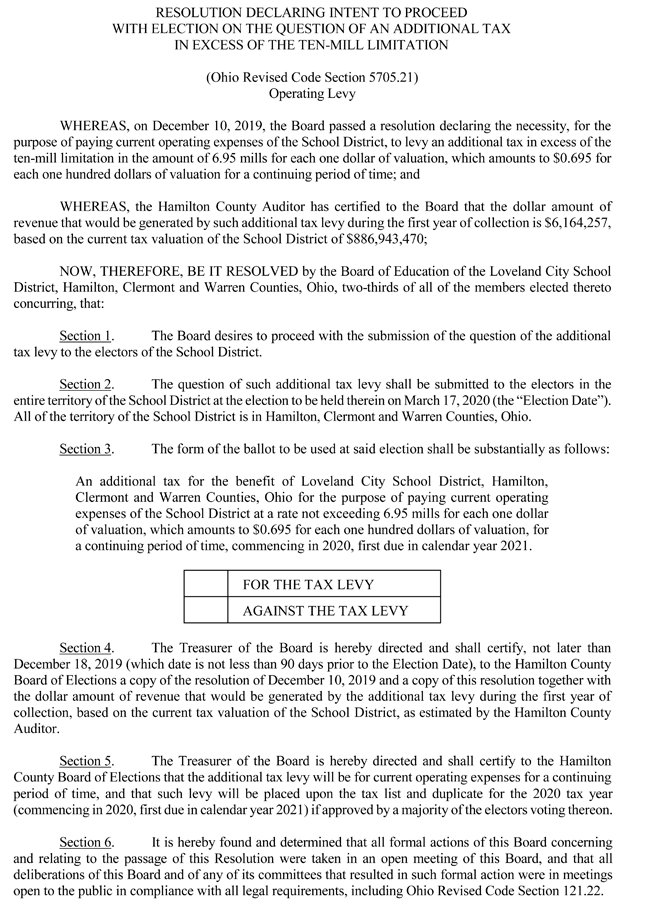
    Below is the Resolution that was to be delivered to the Hamilton County Board of Elections today.


  • Ohio Department of Education and Governor’s Office of Workforce Transformation announce Innovative Workforce Incentive Program

    Ohio Department of Education and Governor’s Office of Workforce Transformation announce Innovative Workforce Incentive Program

    Columbus, Ohio – The Governor’s Office of Workforce Transformation and the Ohio Department of Education today

    $34 Million Available Over Two Years

    announced the list of industry-recognized credentials eligible for $34 million under the new Innovative Workforce Incentive Program. Ohio Governor Mike DeWine and the Ohio General Assembly developed the program to create more opportunities for students to earn in-demand, industry-recognized credentials.

    The program includes $9 million in the state’s two-year budget for grants to assist school districts, community schools, joint vocational schools, and STEM schools in establishing credential programs to prepare students for careers in priority industry sectors. Schools can begin applying for a share of the funding via the state’s Comprehensive Continuous Improvement Plan grant application process on December 19, 2019.

    School districts are also eligible to receive a share of $25 million over the current state budget to encourage the start of additional credential programs. Under this program, schools can receive $1,250 for each qualifying credential earned by students.

    “When Ohio students graduate high school, they should be college or career ready,” said Governor DeWine. “This program helps schools expand credentialing opportunities and ensures potential employers that students have the skills they need to succeed in high-wage, in-demand fields.”

    Lieutenant Governor Jon Husted

    “We must prepare Ohio’s workforce to earn the skills they need to succeed in an increasingly tech-infused economy, and we need to seize the opportunity to do so before they graduate from high school. Today’s announcement reinforces the administration’s commitment to providing more opportunities for Ohioans to earn in-demand, industry-recognized credentials, offering a pathway to better paying and higher quality career options,” said Lieutenant Governor Jon Husted who serves as Director of the Governor’s Office of Workforce Transformation.

    Paolo DeMaria, state superintendent of public instruction

    “Today’s students are tomorrow’s workforce,” said Paolo DeMaria, state superintendent of public instruction. “We are committed to supporting students in acquiring relevant, marketable skills that empower them to achieve success in Ohio’s emerging and priority industries. Innovative Workforce Incentive Program Funds will make it possible for schools to develop the programs students need to earn in-demand credentials.”

    The Innovative Workforce Incentive Program aligns with Ohio’s five-year strategic plan for education, Each Child, Our Future. The plan states that each child will see the relevance of his or her learning, be exposed to practical, real-world work settings, and begin defining his or her future during high school.

    Industry-recognized credentials are an innovative approach to ensuring that high school inspires students to identify paths to future success. Such credentials also offer students many ways to demonstrate the knowledge and skills needed for high school graduation and beyond. Credentials also benefit employers by validating the knowledge and skills of potential employees.

    More information about the Innovative Workforce Incentive Program, including the qualifying industry-recognized credentials is available here.

    Find more information on high school industry-recognized credentials here.

  • School Board meets Tuesday for March levy vote

    School Board meets Tuesday for March levy vote

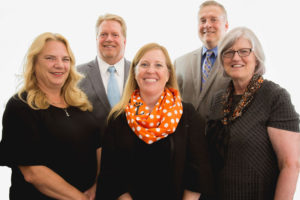
    Board members, Michele Pettit, Ned Portune, Eileen Washburn, President Art Jarvis, and Vice President Kathryn Lorenz

    Loveland, Ohio – The Loveland City School District has called a special meeting for Tuesday, December 17. This meeting will be held to consider a “resolution to proceed” in order to place a March operating levy on the ballot.

    The Board will also go into executive session to discuss employment matters.

    The 6 PM meeting is in the Loveland Intermediate and Middle School’s Media Center at 757 S. Lebanon Road.


    Treasurer Resolutions
    Approve a resolution declaring intent to proceed with election on the question of an additional tax in excess of the 10 mill limitation and certifying the same to the board of elections per ORC 5705.21.


    The Board of Education met on Tuesday, December 10, and passed a resolution of necessity to place an operating levy of 6.95 mills on the March 2020 ballot. The decision was five weeks after a failed combined operating and permanent improvement/bond issue on November 5.

    According to a press release issued by the Distric, the 6.95 millage levy translates into approximately $20/month ($243 annually) per $100,000 of appraised home value as determined by the county auditor. The board is to have the millage amount certified by the county auditor and intends to pass a resolution to proceed on December 17. The deadline to submit ballot language to the county boards of elections is December 18.


  • Three Loveland Schools Recognized with Achievement Awards by Ohio Superintendent and State Board of Education

    Three Loveland Schools Recognized with Achievement Awards by Ohio Superintendent and State Board of Education

    State Board of Education and Ohio Superintendent of Public Instruction Paolo DeMaria (Image ODE)

    Columbus, Ohio – The State Board of Education and Ohio Superintendent of Public Instruction Paolo DeMaria announced this week the recognition of schools across the state for achieving high performance, outstanding progress and momentum for students – and among them are Loveland High School (LHS), Loveland Elementary School (LES) and the Loveland Early Childhood Center (LECC).

    Loveland High School earned the “Momentum Award” for the third consecutive year in recognition of exceeding expectations in student growth. In order to be recognized, schools must earn straight A’s on all value-added measures on the report card and must have at least two value-added subgroups of students, which include gifted, lowest 20% in achievement, and students with disabilities. Value-added measures use student achievement over time in English Language Arts and Math to measure the gain in learning from year to year.

    Loveland Elementary School earned the “Overall A Award” for receiving an “A” as a school on the report card. The overall letter grade is calculated by using results in the six components that make up the state report card: Achievement, Progress, Gap Closing, Improving At-Risk K-3 Readers, Graduation Rate and Prepared for Success.

    Loveland Early Childhood Center earned the “All A Award” for receiving A grades on the applicable Ohio School Report Card measures. Only 50 schools and four school districts across the state were recognized for this achievement in 2019.

    “I’m incredibly proud of our educational leaders and staff across the district who embrace the mindset of continuous improvement,” said Loveland City School District Superintendent Dr. Amy Crouse. “They have done a remarkable job putting goals into action for the benefit of student achievement and academic momentum at Loveland Schools.”

    State Board of Education President Laura Kohler issued a statement in a press release issued by the Ohio Department of Education:

    “The students, teachers, administrators and staff honored today are shining examples to peers and colleagues around Ohio. We are so proud of these award recipients and the effort they put into learning, leading and growing every day. We are both encouraged and challenged by the example of excellence they are setting.”


  • [Breaking] School Board votes to put 6.95 mills on March ballot

    [Breaking] School Board votes to put 6.95 mills on March ballot

    Loveland, Ohio – A Press Release issued by the Loveland City School District tonight reads:

    Loveland Board of Education Passes Resolution of Necessity for Operating Levy in March 2020

    The Loveland City School District Board of Education met on Tuesday, December 10, and passed a resolution of necessity to place an operating levy of 6.95 mills on the March 2020 ballot. The decision comes five weeks after a failed combined operating and permanent improvement/bond issue on November 5.

    “We have sought the feedback of our community through an ad hoc advisory committee to determine the feasibility of a March ballot issue,” said Board President Art Jarvis. “We are tremendously grateful for the commitment shown by these individuals to step up, assist us and provide the community input needed for this decision. After collaboration and conversations with concerned community members, parents, staff and administration about the implications of both a March and a November 2020 operating levy, we, as a board, feel that it is in the best interest of the district to give the community the opportunity to vote in March.”

    Approximately $2.7 million dollars of budget cuts will be made in conjunction with the levy. According to Superintendent Dr. Amy Crouse, they will include a combination of reductions in the instructional cycle budget (textbooks, etc.), staff, and contracted services, among others.

    “When implementing cuts in our budget, our priority is to protect our students and the growth, achievement and academic momentum gained over the past several years,” said Dr. Crouse.

    If the March levy fails, additional cuts will need to be made in order for the district to go back on the ballot in November 2020.

    Operating levies fund the school district’s day-to-day expenses, including the salary and benefits of staff, which at Loveland make up approximately 83 percent of operating expenditures. Loveland Schools receive about 32 percent of its budget revenue from the state, an amount that remains relatively flat from year to year. The majority of the budget, nearly 60 percent, must be generated locally – mainly through property taxes. This locally-generated source of funding is also flat due to Ohio House Bill 920, which prevents schools from collecting additional revenue as home values increase over time.

    In addition to voting for a March levy, the board discussed the intention to look into options for increasing transparency and community involvement, for example through a model of community advisory groups, one of which would focus specifically on school funding issues and advocacy at the state level.

    “We will continue to work with our community on creative solutions for increasing income and reducing expenditures,” said Dr. Crouse. “Our school facility needs as presented earlier this year still remain and will eventually need to be addressed, but the board will not be placing any levy on the ballot for facilities in November.”

    The 6.95 millage levy translates into approximately $20/month ($243 annually) per $100,000 of appraised home value as determined by the county auditor. The board will have the millage amount certified by the county auditor and intends to pass a resolution to proceed on December 17. The deadline to submit ballot language to the county boards of elections is December 18.