Tag: Ohio news

  • 227 Ohio-based Organizations Denied Opportunity to Voice Opposition of Minority Rule Bill

    227 Ohio-based Organizations Denied Opportunity to Voice Opposition of Minority Rule Bill

    GettyImages
    Columbus, Ohio –  In a narrow 7-6 vote, the Ohio House Constitutional Resolutions Committee passed a resolution allowing HJR 1 — a bill that seeks to increase the ballot threshold for amending the constitution from a simple majority to 60% — to a floor vote.
    Following the resolution’s passage, a denial of 111 years of direct democracy right, Catherine Turcer, executive director of Common Cause Ohio, made the following statement representing a coalition of 227 organizations in opposition to a 60 percent threshold and an August special election for special interests.
    “Since 1912, Ohioans from across the political spectrum have utilized the right to amend our Constitution via the petition process. Direct democracy gives voters the ability to make a real impact and has helped engage Ohioans in the political process. There is no justifiable reason, after over 100 years, to make this already challenging process even harder.
    “Today, a sham committee shut down public testimony in opposition. This is not what democracy should look like. Extreme lawmakers turned away over 100 Ohioans who took time from their day to show up and testify in opposition. Committee Chair Phil Plummer clearly did not want to hear from voters. He and an ultra-slim margin of his anti-voter colleagues had already made up their minds, and they bullied this bad idea out of committee.
    “We have a growing coalition of 227 organizations representing hundreds of thousands of voters who will not compromise the sacred principle of one person, one vote. In Ohio and this country, a simple majority means 50 plus one equals democracy. We will not allow this undemocratic, unfair, unnecessary, and unpopular attack on voting rights and freedom to stand.”
    Additionally, the Ohio Senate passed Senate Joint Resolution 2 this afternoon, which also changes the threshold for passage of amendments to the Ohio Constitution to 60 percent. Similar to HJR 1, this measure makes the citizen initiative process more difficult by requiring 5% of the gubernatorial vote in all 88 counties. These proposals also remove the “cure period” for collecting additional signatures if a campaign falls short.
  • Ohio citizen-led abortion rights amendment takes next step after petition language certified

    Ohio citizen-led abortion rights amendment takes next step after petition language certified

    Getty Image

    BY: OHIO CAPITAL JOURNAL STAFF 

    The Ohio Attorney General’s Office has certified petition summary language for a proposed amendment to protect abortion rights in the state constitution, which organizers hope to place on the November ballot.

    The Ohio Ballot Board will now determine whether or not the initiative only involves changing only one amendment, as required. If approved by the Ballot Board, it gets sent back to the Attorney General, who turns it in to the Ohio Secretary of State’s Office, at which point full signature-gathering can begin.

    Advocates must collect signatures from 44 out of 88 counties equal to at least 5% of the total vote cast for the office of governor in that county at the last gubernatorial election. Overall, the petition must gather at least 10% of the total vote cast statewide for the office of governor at the last gubernatorial election. This math means that the group needs at least 442,958 valid signatures.

    The drive to protect access to abortion care in Ohio is being spearheaded by Ohioans for Reproductive Freedom and Ohio Physicians for Reproductive Rights.

    Right now, Ohio’s six-week abortion ban is unenforceable due to a Hamilton County judge blocking it indefinitely as the lawsuit against it continues. The bill does not have an exception for rape or incest.

    However, once it gets out of court, it will likely head to the Ohio Supreme Court. An OCJ/WEWS investigation revealed how those justices already told Right to Life groups that abortion isn’t a Constitutional right.

    If the proposed amendment gets to the ballot and is approved by voters, this amendment wouldn’t change existing laws automatically, but it would be the law that applies in all of the pending litigation.

    If passed by voters, Article 1 of the Ohio Constitution would be amended to allow “the right to reproductive freedom,” in a change similar to one approved by Michigan voters last year.

    The groups supporting the ballot initiative are racing to bring the issue before voters before any changes can be made to the threshold needed to place a measure on the ballot. A GOP effort to raise the bar from 50% plus one to 60% plus one has been ongoing, though it’s unclear how long that might take.

    Michigan’s amendment passed with 56.6% of the vote.

    Percentage abortion was protected in other states last year:

    • Kentucky — 52.3%
    • Montana — 52.5%
    • Michigan — 56.6%
    • Kansas — 59%
    • California — 66%
    • Vermont — 76.7%

    Reporting from OCJ’s Susan Tebben and WEWS’ Morgan Trau contributed to this article.

  • Loveland City School District will be closed tomorrow, Friday February 4th

    Loveland City School District will be closed tomorrow, Friday February 4th

    Loveland, Ohio – The Loveland City School District will be closed tomorrow, Friday, February 4th.

  • No-Cost PCR Testing Sites in Hamilton County

    No-Cost PCR Testing Sites in Hamilton County

    From The Health Collaborative

    For information on vaccines and provider locations, visit healthcollab.org/vaccine-info.

    UPDATE:  The Test and Protect contract between Hamilton County and The Health Collaborative expires at the end of this year when CARES Act funding ends, but the testandprotectcincy.com website will continue to be updated with no-cost testing locations in our region. Hamilton County Commissioners allocated an additional $1.2 million in American Rescue Plan dollars to continue to fill gaps in testing in 2022. New locations will be announced soon.

    CDC New Testing Guidelines 12/27/2021


    No-Cost PCR Testing Sites

    Results from PCR testing are typically expected between 48 – 72 hours.

    Provider

    Address

    Appointment Info

    Notes

    CVS

    10+ stores in Hamilton County, 30 + stores in region

    Schedule online or call 1 (800) 679-9691

    PCR Drive-Thru Testing. Type of test varies by location, see website for details. Patients with insurance testing for travel and work requirements could be required to pay a copay. Please check with your provider.

    2805 Gilbert Ave, Cincinnati, OH 45206

    Call (513) 815-4475 to schedule

    Limited appointment availability. Pre-screening required

    302 W 4th Street Parking, Covington, KY 41011

    Pre-registration encouraged. Walk-ins availalbe.

    PCR (same day) Drive-Thru Testing. Open 7 days/week

    2028 Florence Mall, Florence, KY 41042

    Pre-registration encouraged. Walk-ins availalbe.

    PCR (next day) Drive-Thru Testing. Open 7 days/week

    2332 Royal Drive, Fort Mitchell, KY 41017

    Pre-registration encouraged. Walk-ins availalbe.

    PCR (next day) Drive-Thru Testing

    1401 Steffen Ave, Cincinnati, OH 45215

    Call (513) 588-3623 to schedule

    PCR Drive-Thru Testing

    3 stores in region

    Schedule online

    PCR Drive-Thru Testing. See website for details

    2 stores in region

    Schedule online

    PCR Drive-Thru Testing. See website for details

    20+ stores in Hamilton County, 40 stores + in region

    Schedule online or call 1 (800) 925-4733

    PCR Drive-Thru Testing. See website for details

    1019 Linn Street Cincinnati, OH 45203

    Call (513) 233-7100 to schedule

    Rapid test screening. PCR available by doctor’s order

    1740 Langdon Farm Road, Cincinnati, OH 45237

    Call (513) 631-7100 to schedule

    Rapid test screening. PCR available by doctor’s order

    5275 Winneste Avenue Cincinnati, OH 45232

    Call (513) 242-1033 to schedule

    Rapid test screening. PCR available by doctor’s order

    No-Cost COVID-19 Home Test Kits

    Test kits are available at the following locations (while supplies last). See websites for details:

     To find out the different types of COVID-19 tests by visit the U.S. Food & Drug Administration or the Ohio Department of Health.


    Testing locations throughout Ohio: Ohio Department of Health.

  • HEALTH CARE POLITICS & GOV Proposed Ohio abortion bills would impose new mandates, spread misinformation

    HEALTH CARE POLITICS & GOV Proposed Ohio abortion bills would impose new mandates, spread misinformation

    BY: and Ohio Capital Journal

    Returning from summer break, the Ohio legislature could review two GOP-led pieces of legislation that would place health mandates on patients considering abortions.

    One of the bills, recently introduced by state Rep. Jennifer Gross, would require physicians to dictate the results of a mandated ultrasound and also provide information about a link between breast cancer that has been disproven by multiple medical organizations.

    State Rep. Jennifer Gross, R-West Chester 

    Gross, usually known for and outspoken in her disapproval of health care mandates, introduced the bill this week.

    Patients already have to meet with a physician 24 hours before an abortion, but under this bill, along with hearing about the medical risks of the procedure and the probably gestational age, a patient would be told “the possible increased risk of breast cancer that is associated with women who have undergone an abortion,” along with the “short-term and long-term risk of psychological or emotional harm” from choosing to have an abortion.

    Multiple organizations, including the American Cancer Society, the American College of Gynecologists and the Susan G. Komen Breast Cancer Foundation have denied the link, citing research studies on the relationship between breast cancer and abortion.

    The American Cancer Society said these research studies “have not found a cause-and-effect relationship between abortion and breast cancer.”

    The Gross bill has not been assigned to a committee for consideration, but it has several sponsors, all Republican.

    Meanwhile, a separate bill seeking to notify abortion patients of possible risks was introduced during the legislature’s summer break, and has been assigned to the House Health Committee.

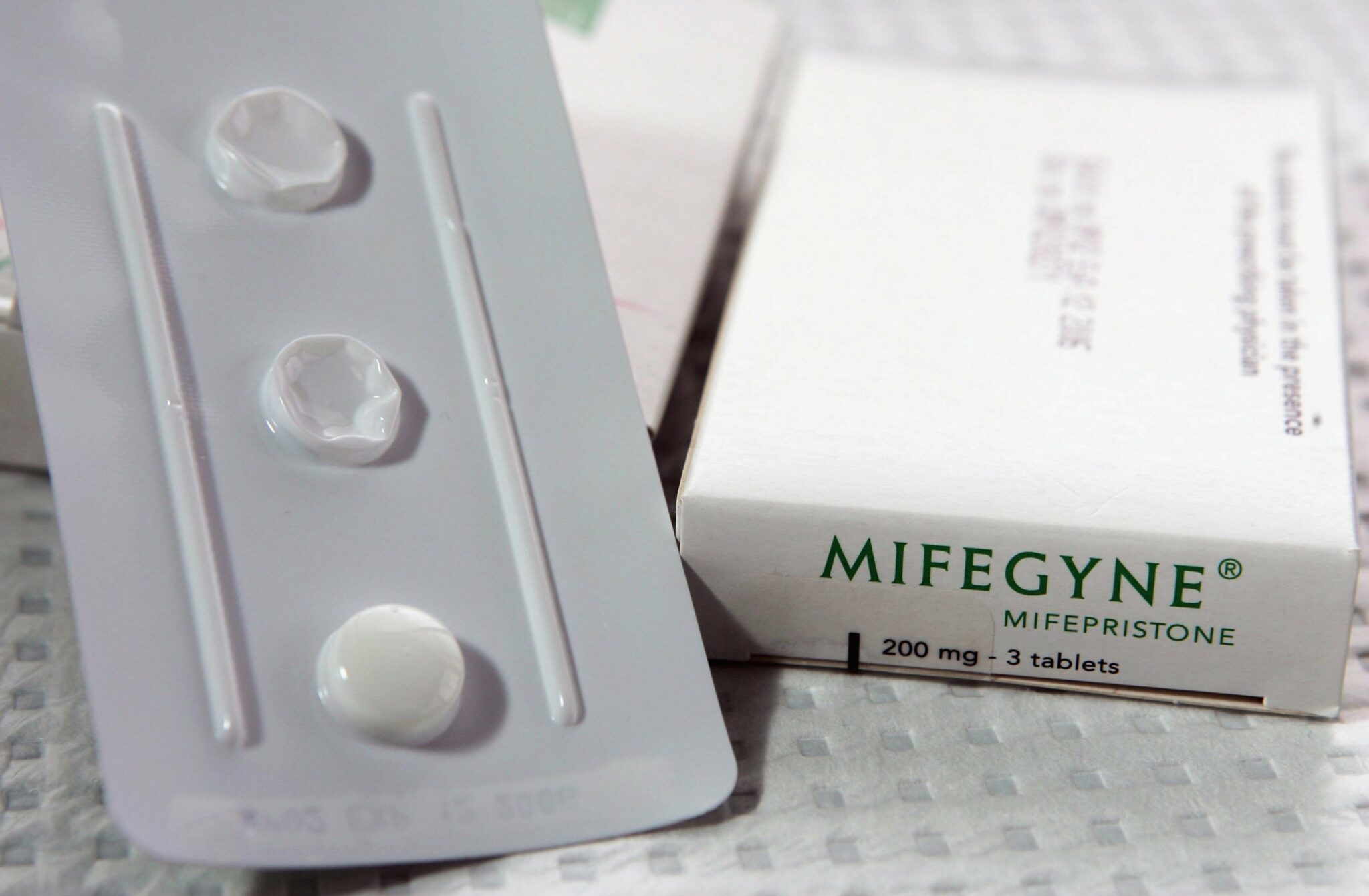
    House Bill 378  was introduced in July by state Reps. Kyle Koehler, R-Springfield, and Sarah Fowler Arthur, R-Ashtabula, and specifically targets medication abortion, which is done through a two-pill regimen, rather than surgery.

    The bill would require medical professionals to explain a controversial and medically unproven method of “reversing” the abortion by not taking the second of the two-pill regimen and giving additional progesterone to counteract the first pill.

    The American College of Obstetricians and Gynecologists said claims about the “reversal” method “are not based in science and do not meet clinical standards.”

    The bill is a reintroduction of a similar one that passed the Senate in 2019, but didn’t make it through the House.

    Abortion is legal in the state of Ohio up to 20 weeks gestation.


    Susan Tebben is an award-winning journalist with a decade of experience covering Ohio news, including courts and crime, Appalachian social issues, government, education, diversity and culture. She has worked for The Newark Advocate, The Glasgow Daily Times, The Athens Messenger, and WOUB Public Media. She has also had work featured on National Public Radio.

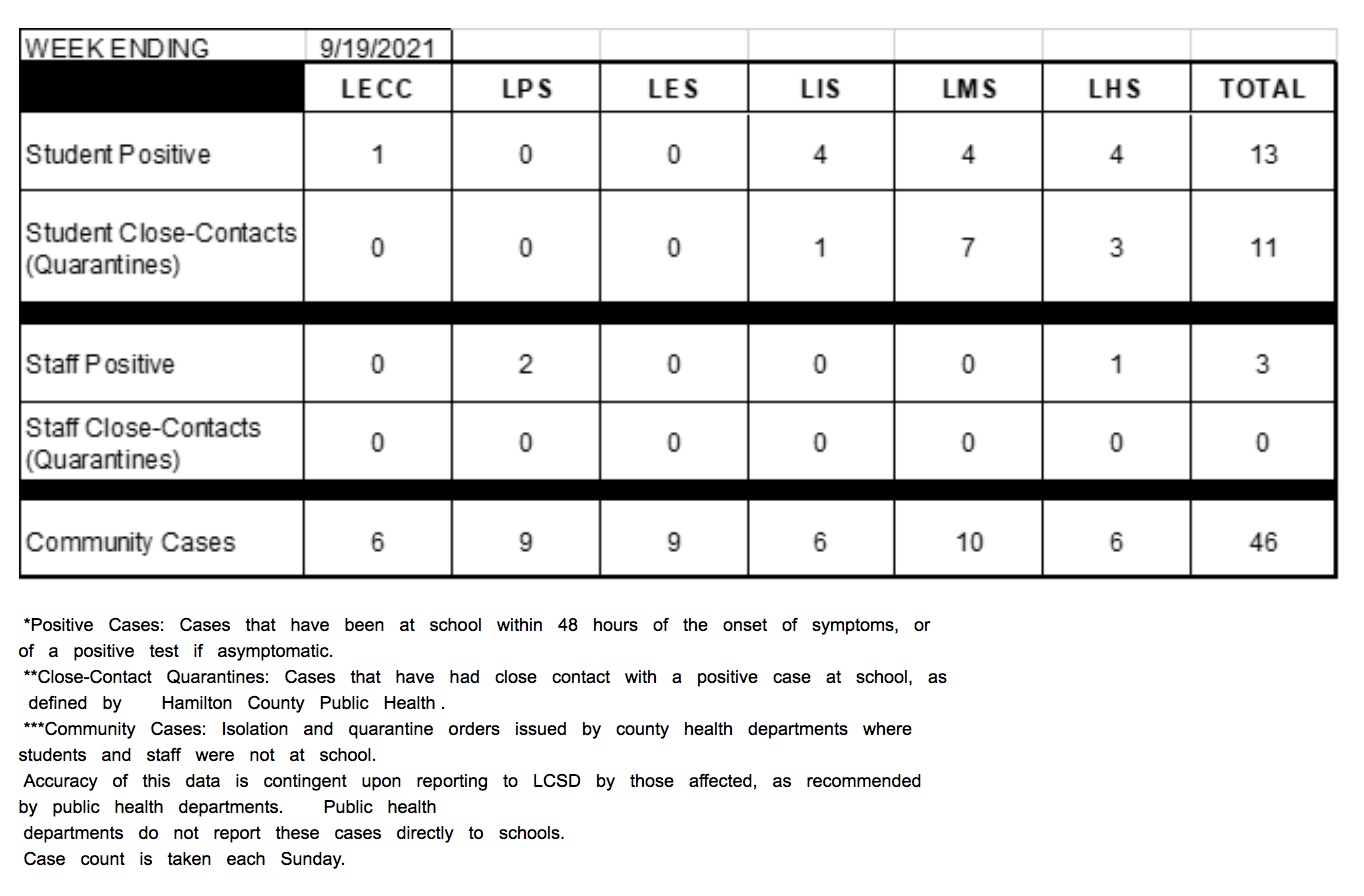
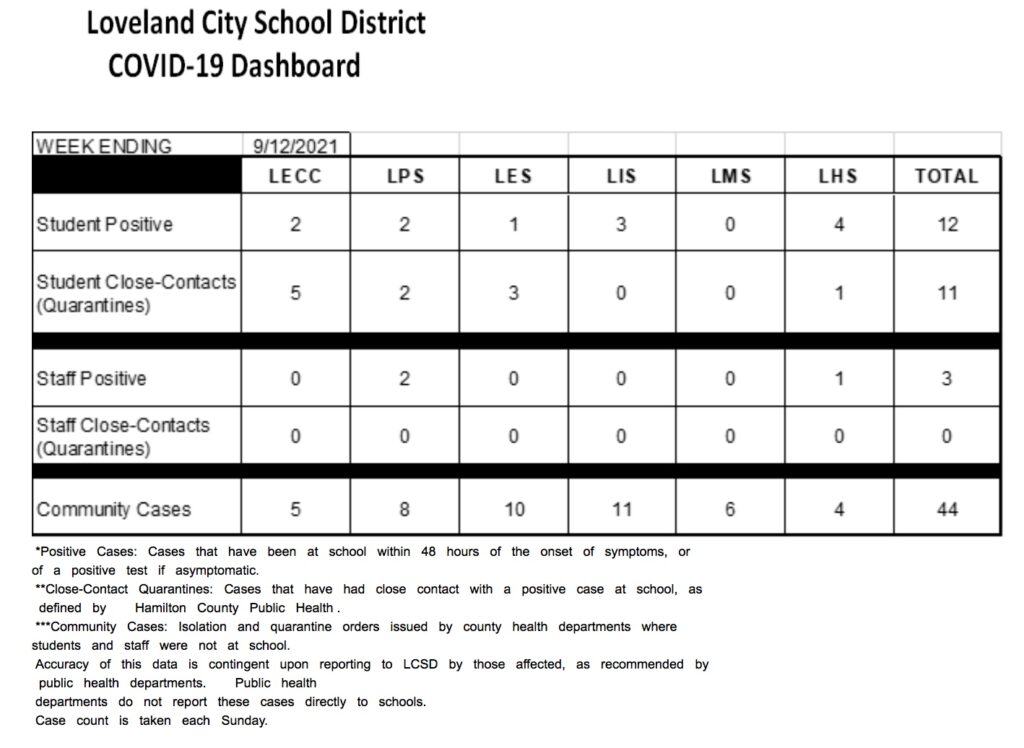
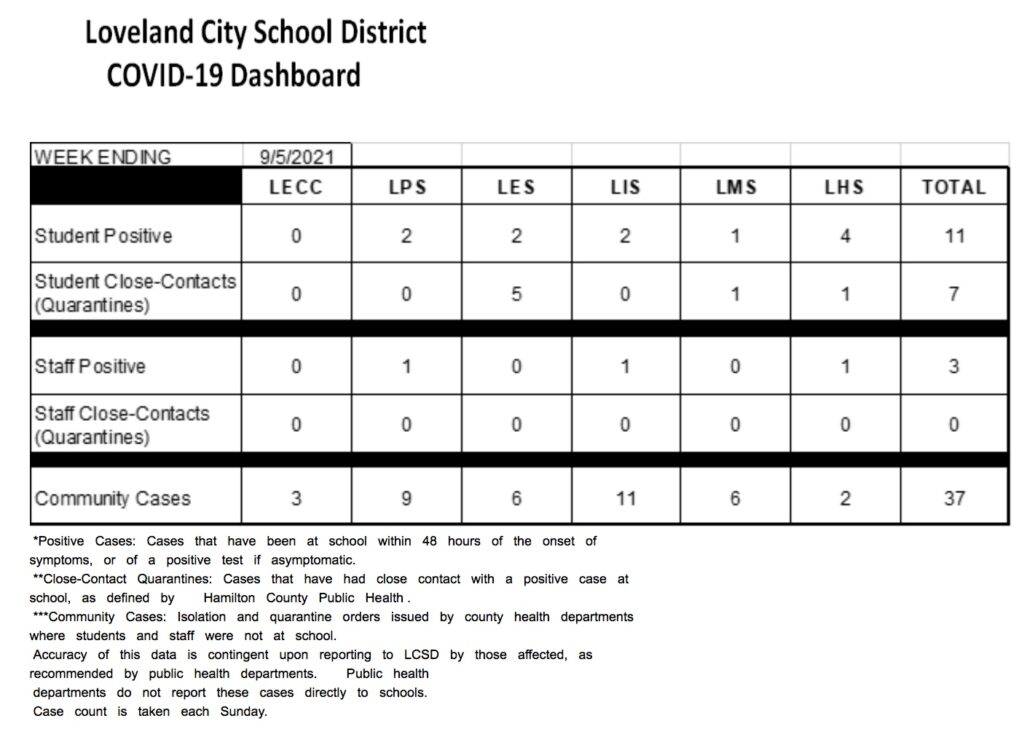
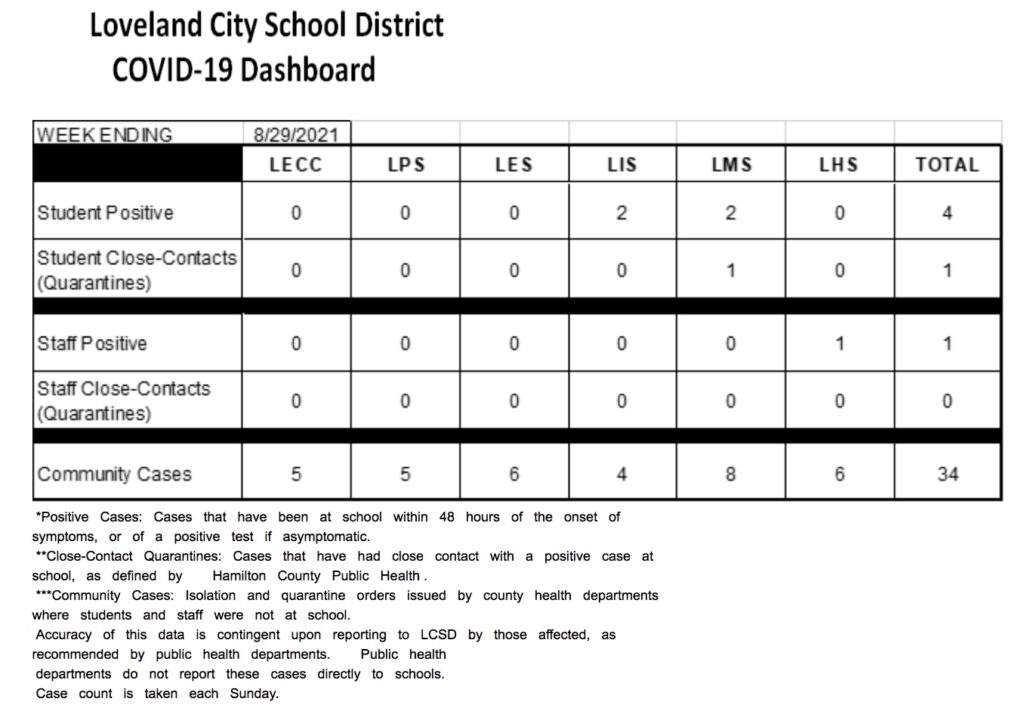
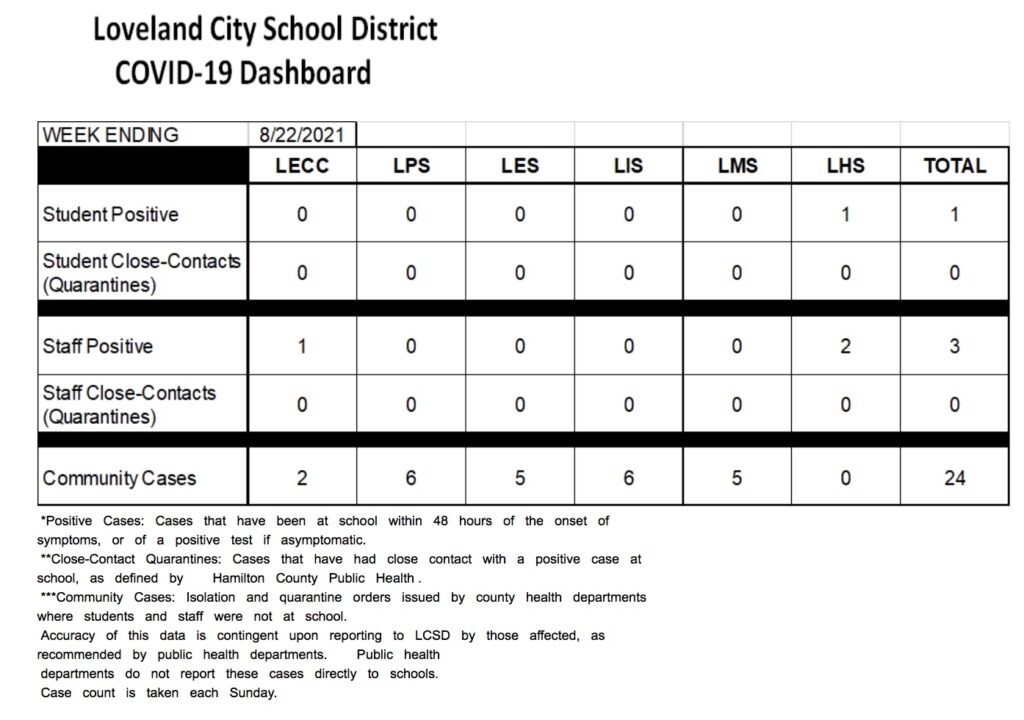
  • Loveland School COVID 19 Dashboard for 9/19/2021

    Loveland School COVID 19 Dashboard for 9/19/2021

    EDITOR’S NOTE:

    THIS STORY HAS NOW BEEN UPDATED TO SHOW THE DASHBOARD FOR SEPTEMBER 19. THE ORIGINAL VERSION HAD THE 9/12 DATA REPEATED TWICE.

    Loveland, Ohio – At the beginning of each week, the Loveland City School District releases their latest Covid 19 Dashboard. Here are the last five.

  • I felt the tears welling behind my eyes and willed them not to escape

    I felt the tears welling behind my eyes and willed them not to escape

    There is value in having no child feel rejected and invisible in their own school. If I can help it, none of them will.


    A story by a Loveland resident presented by Loveland Magazine in collaboration with the Loveland Diversity Advisory Board

    A sharp pain startled me. Something had pelted my head. Whatever it was ricocheted to the floor with a hollow plink. I rubbed the back of my skull and looked around trying to determine what had hit me. As I did, I took another sharp blow, this time to the cheek, followed again by a distinct plinking sound. The next shot hit my shoulder. Then my neck. Finally one of the projectiles flew past my face and I was able to identify what was being hurled toward me. 

    It was a penny. 

    I looked in the direction from which the projectiles originated and saw a lunch table of my fifth grade peers laughing, trying to look inconspicuous in the conspicuous way guilty ten year-olds have a tendency to do.

    “Did she pick them up?” one whispered.

    “Shhhhh! She’s looking over here,” the other said, waving his hand in the universal sign to keep it down.

    More giggles.

    x

    I sheepishly rubbed my cheek, which by now was smarting and red. I looked down at the floor where several pennies lay in a telltale scatter at my feet. 

    Another sharp pain.

    “Pick up the pennies, Jew,” someone from the table jeered, just loud enough for me to hear.

    I felt the tears welling behind my eyes and willed them not to escape. No one would see me cry. Despite my best intentions, a tear leaked out, betraying me as it rolled down my injured cheek. Its saltiness stung against the broken skin.  

    x

    The perpetrators weren’t the school’s “bad” kids. They weren’t the “troublemakers.” They weren’t the kids who wadded up the stiff brown paper towels, wet them, and threw them up on the bathroom ceiling where they’d stick and harden like cement. 

    These were the kids who raised their hands to read aloud from the social studies textbook when the teacher asked for volunteers.They attended PSR at the church down the street from my house where a giant tree sprouted pink blossoms each spring before dropping her petals in a sudden heap. These were the kids who, if I’d told a teacher, would elicit the response of ‘Well now that doesn’t sound like them. I’m sure they meant nothing by it. Have you tried ignoring it?’

    x

    The lone tear fell onto the lunch table, a solitary puddle on the faux wood facade. Pennies? What does that even mean? I pondered this question silently, focusing intently on the fallen tear to prevent more from spilling out. I felt ashamed and embarrassed. I never mentioned it again. 

    This was the first time it happened, but it wouldn’t be the last.  

    At ten years old, I didn’t understand the deeply anti-Semitic implications of these kids’ actions. As an adult, I know they picked up on these stereotypes somewhere. I feel confident that the hateful message was learned outside of school, however subtly transmitted. Maybe slips of the tongue by their parents. Maybe from the innuendos presented in the news channel their family watched. Maybe from friends whose families held biases. But what about what they learned–or didn’t learn–while they were in school? What was the message there?

    There was nary a mention of Jewish people in my elementary school. Despite a small population of Jewish students, the curriculum had settled into a comfortable rhythm they saw no need to update. I remember clearly how each year my teachers were startled when they learned that I didn’t have a Christmas tree. 

    “What do you mean?” my second grade teacher asked incredulously. “Everyone has a Christmas tree,”  And so it went. 

    x

    I accepted my lot early. I dutifully completed my “Letter to Santa” assignments each December prior to “Christmas Break” where I’d take home the ornament I had to make for my non-existent tree. In the spring, I mustered up fake gusto to color oil pastel Easter egg cut-outs. I completed the multiplication worksheets asking how much tinsel Jane needs to trim her Christmas tree and conducted the science experiments on decorating Easter eggs with various substances, bright red beet juice staining my hands for days. 

     The message coming from the school was clear: one specific religion was the universal norm. Obviously, I was different. That made me a target. 

    I share this with you to illustrate that representation matters. While some may disagree, they are likely the ones who have never been in a situation where they were the “other.”

    Representation doesn’t mean anyone has to alter their own convictions or feel put on the defensive. It doesn’t mean one side is right and the other is wrong, that there’s a hidden agenda, or that any one lifestyle is being attacked. 

    What it does do is allow students to learn that the world is full of people whose beliefs, values, and opinions differ from their own. It means the students who aren’t part of the status quo feel a sense of belonging. At its best, it fosters mutual understanding and civility. Representation neither promotes one lifestyle, race, or religion, nor detracts from another. All representation does is to allow students to see that there are different ways of being and that there is validity in who we ALL are. 

    x

    While I cannot change my school experience, we owe it to our own kids the opportunity to explore diversity through equal and prominent representation. If you’re a minority, there is value in seeing someone like yourself; if you’re in the majority, there is value in seeing that there’s an actual living, feeling human being behind the label. Most importantly, there is value in having no child feel rejected and invisible in their own school. If I can help it, none of them will.



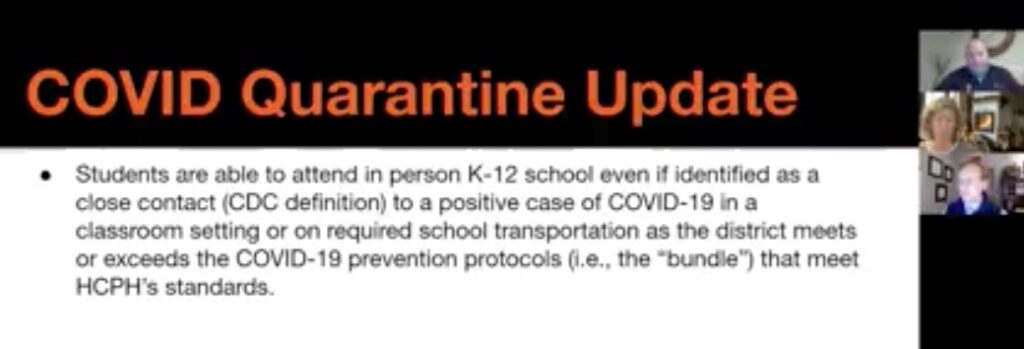
  • [Video] Loveland Middle School COVID 19 protocol explained

    [Video] Loveland Middle School COVID 19 protocol explained

    Loveland, Ohio – David Knapp, the Principal of the Loveland Middle school explains in this video the COVID 19 protocol in his building.

    Watch the video… (Look for the COVID Quarantine Update)

    The video was published by the Loveland MINT PTSA.

  • Education budget debate begins as Jan. budget shows declines in higher ed, K-12

    Education budget debate begins as Jan. budget shows declines in higher ed, K-12

    Getty Images.

    By Susan Tebben and Ohio Capital Journal

    Subcommittees on K-12 and higher education are beginning their discussions on the new operating budget this week, and they have plenty of budgetary information to look at, including declines shown in the January budget report.

    The Ohio House Finance subcommittee on higher education will take their first look at the pieces of the state operating budget that touch on higher education this week

    As they look to the future of funding colleges and universities in the state, the Office of Budget and Management gave a look at last month’s disbursements, and year-to-date funding disbursements that were below estimates.

    According to the most recent OBM monthly budget data report, January disbursements for higher education was 3.9% below estimates, a total of $7.2 million less than the month before.

    The state budget agency said declines came from below-estimate spending in the Ohio College Opportunity Grant, Choose Ohio First Scholarship and National Guard Scholarship programs. These programs had “lower-than expected requests for reimbursement from higher education institutions,” according to the OBM.

    In his executive budget proposal, Gov. Mike DeWine wants to raise the Ohio College Opportunity Grant award total by $500, and build award 2,000 more scholarships the Choose Ohio First program.

    On the year, higher education institutions received 1.2% less than the year before, and compared to January 2020, they received 11.5% less in disbursements last month.

    The executive budget proposal increases the state’s share of instruction, the main source of direct state aid colleges and universities receive, by 1.8% over the biennium “to maintain quality and provide support services.”

    The House Finance subcommittee on primary and secondary education has the operating budget as the only measure on the agenda for its meeting, scheduled for Thursday morning.

    They will look at the governor’s proposals to disburse more than $13 billion through fiscal years 2022 and 2023, including $1.1 billion in student wellness services.

    DeWine’s budget proposal adds $125 million in foundation funding that were taken away during pandemic budget cuts.

    In January, the OBM reported disbursements of $7.2 million to the Ohio Department of Education, nearly 1% below estimates for the month.

    The declines were credited to lower spending on EdChoice private school voucher program expansion, early childhood education and pupil transportation.

    The OBM report said early childhood education has been shifted away from the general revenue fund, and the EdChoice and transportation drops were due to offset payments and overspending on transportation in December.

    “The below-estimated spending was partially offset by the above-estimated disbursements for the Foundation Funding line item as the College Credit Plus payment to colleges for the summer and fall 2020 terms was above estimate,” the report stated.

    The primary and secondary education subcommittee also has a bill overhauling the funding formula for the state’s public school system on their desk to be considered during this General Assembly.

    An overhaul of that formula would change the sources and methods of disbursement to schools, releasing some of the burden on property taxes, and creating a payment system that goes more directly through the state.

    State aid to the schools through the foundation funding totaled $715.1 million in January, $8 million above estimates, according to the OBM. But disbursements were 6.2% less than January of last year, accounting for a $50 million loss.

  • Read Loveland’s Snow Emergency guide

    Read Loveland’s Snow Emergency guide

    Loveland’s salt storage as of 2 PM on Sunday. The storage dome is located on East Loveland Avenue as you leave the City

    Loveland, Ohio – There has been no snow emergency declared in Loveland, however, in case one is or you hear that one has been declared, below are the Loveland code sections that implement and guide City officials.

    Note, that this may be different than the Snow Emergency declarations issued by the counties, townships, or other government agencies. This only applies to the City of Loveland.

    City Manager Dave Kennedy said today at 2 PM that he has spoken with Scott Wisby, Loveland’s Director of Public Works, and he “does not feel that parked vehicles are deterring or will deter his ability for snow removal”.


    351.16  SNOW EMERGENCY; SPECIAL PARKING RESTRICTIONS.

       (a)   When snow, sleet, freezing rain, or other weather conditions cause or appear likely to cause, in the judgment of the City Manager, slippery or hazardous conditions which might lead to serious congestion or hazard, the City Manager may declare a snow emergency.  The City Manager shall also declare the termination of such snow emergency as soon as conditions permit.

       (b)   “Snow emergency routes” are through streets, or portions of through streets, designated by official signs on one or both sides thereof, installed by order of the City Manager.  The City Manager is authorized and directed to designate such streets as snow emergency routes which, for the safety or convenience of the public and the accommodation of traffic, should be kept open and clear in times of snow emergency.

       (c)   During the period of any snow emergency, no vehicle may be parked on any snow emergency route, provided special signs are erected designating such snow emergency route.

       (d)   A vehicle parked on any snow emergency route at the time a snow emergency is declared shall be removed by the owner within three hours if such emergency is declared between 8:00 a.m. and 8:00 p.m., or prior to 9:00 a.m. of the following morning if the emergency is declared within the hours of 8:00 p.m. and 8:00 a.m.  Nothing in this section shall permit any vehicle to park in violation of any other parking restriction previously established by ordinance  or by erection of signs by order of the City Manager.

       (e)   Any vehicle parked on any snow emergency route during a declared snow emergency and after the times or periods designated for removal of such vehicle by (d) above, and any vehicle stalled or otherwise unable to move or operate on a snow emergency route during the time of a snow emergency, may be ordered by the City Manager or the Chief of Police to be towed from such snow emergency route.  Such vehicle shall be impounded and held by the order of the Police Department until the owner shall pay the reasonable expense of towing the vehicle.

       (f)   Whoever violates this section is guilty of a minor misdemeanor.

    (Ord. 1978-23.  Passed 4-25-78.)