Ohio University will close the Pride Center, the Women’s Center and the Multicultural Center in response to a new higher education law banning diversity efforts that takes effect this summer, the university president announced Tuesday.
OU will sunset the Division of Diversity and Inclusion — which includes those three centers — “over the next several weeks,” Ohio University President Lori Stewart Gonzalez said in a statement.
GET THE MORNING HEADLINES.
There is no definitive date for when the division or the centers will close, but the centers will not be open beyond when the law takes effect on June 23, according to university spokesperson Dan Pittman.
“Work managed by the division that remains within the law will be moved to other areas of the university,” the university said.
State Sen. Jerry Cirino, R-Kirtland, introduced Senate Bill 1 at the end of January, it quickly passed both chambers and Gov. Mike DeWine signed it into law on March 28. Youngstown State University faculty are trying to get a referendum on the November ballot to block S.B. 1. The law affects Ohio’s public universities and community colleges.
The new law will also prohibit faculty strikes, regulate classroom discussion of “controversial” topics, create post-tenure reviews, put diversity scholarships at risk, create a retrenchment provision that blocks unions from negotiating on tenure, shorten university board of trustees terms from nine years down to six years, and require students take an American history course, among other things.
“We must continue to ensure every person we invite to be a part of our university community finds their place here and develops connections,” Gonzalez said in her letter to the university. “Without forgetting that essential commitment, we must also follow the law.”
All employee positions within the Division of Diversity and Inclusion will be eliminated. The three centers have eight full-time staffers, according to their websites. The centers also have student workers.
“Employees will continue in their current roles for the next several weeks and will be given the opportunity to interview for any open university position for which they apply and meet minimum qualifications,” Gonzalez said.
Employees who don’t continue to work at OU will receive full separation benefits, according to the university.
Support for the university’s Templeton, Urban, Appalachian, and Margaret Boyd Scholars programs will move under the Honors Tutorial College.
Ohio University’s Heritage College of Osteopathic Medicine’s Office of Inclusion will also close because of the new law.
The university said it will be reaching out to students, faculty and staff for their input on inclusion and belonging moving forward.
“I want to be clear that the task ahead for all of us is not to look for ways to recreate the same approaches under a different name,” Gonzalez said. “Rather, the charge is to invent something new that meets the moment and delivers results for our students.”
This comes as Ohio’s public universities are in the midst of figuring out how the controversial law affects them. The University of Toledo recently announced they are suspending nine undergraduate programs in response to S.B. 1.
Megan Henry is a reporter for the Ohio Capital Journal and has spent the past five years reporting in Ohio on various topics including education, healthcare, business and crime. She previously worked at The Columbus Dispatch, part of the USA Today Network.
Ohio Capital Journal is part of States Newsroom, the nation’s largest state-focused nonprofit news organization.
Honorees at the We Rally & We Rise Women’s Conference pose for a group photo in Lancaster, Ohio, on March 21, 2025. Kim Barlag, third from right in a purple suit, helped organize the independent event after Ohio University canceled its longtime Women’s History Month celebration following new federal guidance on anti-discrimination policies.(Megan Cardenas/OH Creative Studios for We Rally We Rise)
Amanda Becker
Read Amanda Becker’s Loveland connection in her Bio below.
Lancaster, Ohio – Kim Barlag knew she couldn’t let women be canceled.
For nearly two decades, Ohio University’s Lancaster campus hosted an annual conference to “promote and advance gender equity by recognizing the past, present, and future achievements of women from diverse ages and backgrounds.” Known as Celebrate Women, it featured awards honoring women in leadership, panels on business and civic engagement and service opportunities. The plan for this year was to collect food and school supplies for university students facing financial hardship.
Celebrate Women became a much-anticipated Women’s History Month tradition in this central Ohio city of 40,000, just 30 miles southeast of Columbus, the state capital. But then, on the eve of its 19th year, politics intervened.
On March 6, two weeks and a day before the event, Ohio University announced that the conference had been “placed on hold … in light of recent guidance from the Department of Education’s Office for Civil Rights,” which threatened to withhold federal funding to institutions that do not conform to the Trump administration’s notion of anti-discrimination. The university’s decision followed the cancellation of a reunion for Black alumni, another regular occurrence in previous years.
When she heard the news about the women’s conference, Barlag, herself an alumnus and the president of the Chamber of Commerce in nearby Pickering, cycled through a series of emotions: disappointment, sadness, anger, resolve.
“I guess I should have seen it coming after that happened, but I was still surprised,” she told The 19th. “I was pretty devastated. I shed a few tears. Then I thought: Action makes people feel better. How can we save this event? We needed to act fast.”
She called and emailed other women leaders in the area — including some who, like her, had been scheduled to participate in Celebrate Women panels — to gauge their interest in reviving the conference as a non-university event. Their response, Barlag said, was “gung ho.” The plans for the new event came together quicker than Pam Kaylor, a communications professor who organized Celebrate Women for the university, was able to notify participants of the previous one’s cancellation.
The independent event had a new name, We Rally & We Rise Women’s Conference, and it brought together some 300 women at the Crossroads Event Center in Lancaster last week. Many Celebrate Women sponsors shifted their support and some new sponsors signed on, angry about the cancellation — Barlag took to calling it “mad money.” Organizers handed out branded tote bags and notebooks. The event raised money for local nonprofit organizations. Speakers shared strategies to conquer anxiety and impostor syndrome. The boxed lunches were made by a nonprofit caterer that employs survivors of sex trafficking. The writing on the back of attendees’ name tags captured the vibe: “Welcome All BABS!!! BAD ASS BITCHES. Yes, you read that correctly.”
As Barlag opened the conference, the audience’s enthusiastic response “set me off my game there for a minute” because “it was so powerful and inspiring,” she later said.
“The energy was great — people were grateful to have a conference to attend, to be together, a show of force in support,” she added.
A woman listens during the We Rally & We Rise Women’s Conference in Lancaster, Ohio, on March 21, 2025. Hundreds gathered at the independently organized event after the university-backed celebration was canceled. (Megan Cardenas/OH Creative Studios for We Rally We Rise)
Lancaster may be close to the state’s capital, but it’s the county seat in an agricultural region of pig and cattle farms. Lancaster itself is known for its glassware — the hometown company, Anchor Hocking, is named for the Hocking River, which snakes through the city. Once one of the world’s largest manufacturers of glassware, Anchor Hocking went through a merger, then a bankruptcy. Like in so many small cities and towns, Lancaster’s historic downtown became a symbol of economic decline in the post-industrial Rust Belt. In recent years, though, Lancaster’s population began to tick up again.
Fairfield County is a Republican stronghold in presidential elections. President Lyndon Johnson, in 1968, is the only Democrat who has won there since 1944. Republican President Donald Trump’s America-first economic message resonated with voters who have watched Lancaster struggle, then rebound. In 2024, close to 62 percent of the county’s voters cast ballots for Trump and Vice President JD Vance, who was then one of the U.S. senators for Ohio. The state, a one-time presidential bellwether that has in recent cycles grown more conservative, backed Trump over Democratic Vice President Kamala Harris by 55-to-44 percent.
In this slice of Trump Country, personal interpretations of the reasons for the cancellation of Celebrate Women are a sort of political Rorschach test. Some left-leaning voters believe it was the inevitable result of Trump’s assault on diversity, equity and inclusion, or DEI, a broad concept that his administration has deployed to challenge and threaten institutions deemed too liberal. Some conservative-leaning voters believe the cancellation to be an overly cautious move by the university — and potentially a way to make the new administration look bad.
One thing on which women on both sides agree is that they should not be silenced.
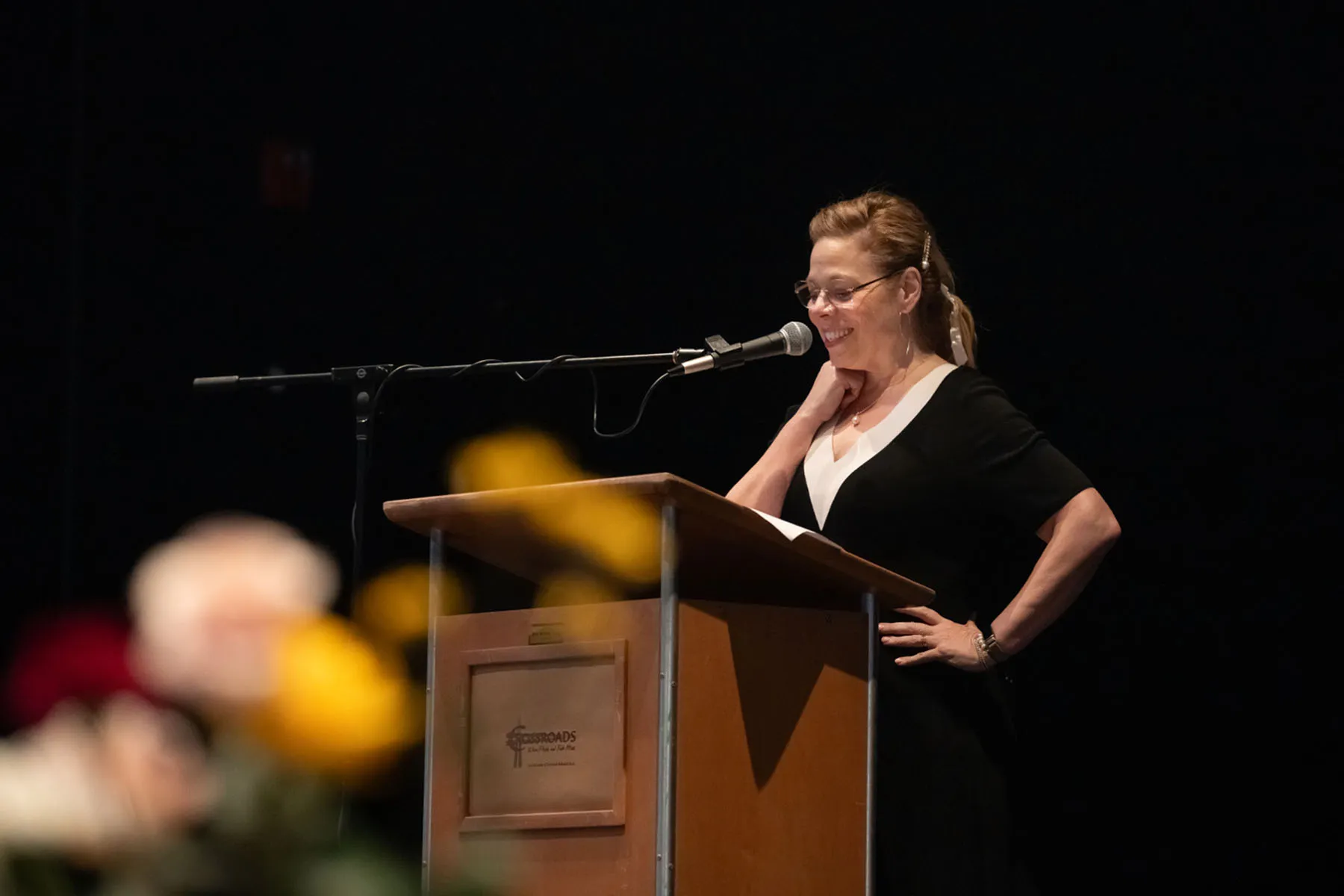
“There is dissent about how we came to this place,” Fairfield County Auditor Carri Brown, an elected Republican, acknowledged during her opening remarks. But “when we’re told we cannot celebrate women, we’ll respond by saying, ‘Yes we can’ … and we’ll rally and we’ll rise!”
When she described diversity as “not a bad word” but a “blessing,” the crowd applauded and some rose to their feet. “I have a very strong faith in America,” Brown said.
Fairfield County Auditor Carri Brown delivers opening remarks during the We Rally & We Rise Women’s Conference.
(Megan Cardenas/OH Creative Studios for We Rally We Rise)
Ohio University’s decision to cancel the Celebrate Women event is the latest skirmish between conservative politicians and the elite institutions of higher education that they have long charged with being hostile to their political viewpoints, with so-called DEI efforts at colleges and universities now front and center to their case.
A February 14 “dear colleague” letter from the civil rights office of Trump’s Department of Education to colleges and universities alleged an “embrace of pervasive and repugnant race-based preferences and other forms of racial discrimination” at the expense of White students. It noted that federal law “prohibits covered entities from using race in decisions pertaining to admissions, hiring, promotion, compensation, financial aid, scholarships, prizes, administrative support, discipline, housing, graduation ceremonies, and all other aspects of student, academic, and campus life.” Noncompliance would risk the federal funding that nearly all colleges and universities receive.
Though the letter made no direct mention of gender, it put university administrators on alert as they sought to identify any programming that could jeopardize their funding. When the Department of Education, which Trump now seeks to dismantle, launched investigations against more than 50 education institutions, it included two in Ohio: the University of Cincinnati and the Ohio State University.
Judith Cosgray, a librarian and leader of an arts nonprofit who has attended Celebrate Women on and off for the past 15 years, described its cancellation as a balloon deflating when its attendees most needed a lift.
“I understand that they’re afraid of losing their funding, I understand that, but sometimes you’ve got to stand up, too,” Cosgray said in between conference sessions.
In addition to the various executive orders and directives that Trump has made about DEI, the Ohio legislature, where Republicans hold a veto-proof majority in part due to unconstitutionalgerrymandering, recently approved a higher education bill that bans DEI training, scholarships and offices, and contains admonitions about teaching “controversial” topics. It is expected to be sent to GOP Gov. Mike DeWine for his signature as early as this week.
A spokesperson for DeWine did not respond to a request to comment on whether he will sign the anti-DEI legislation or if, by his estimation, events like Celebrate Women would fall under its purview. The office of GOP state House Speaker Matt Huffman likewise did not respond to the same question by publication time.
Ohio governor Mike DeWine speaks to the press on the first day of the Republican National Convention on July 15, 2024 in Milwaukee, Wisconsin.
(Andrew Harnik/Getty Images)
Celebrate Women isn’t the only recent example of how the assault on DEI across public life has led to a seeming prohibition on celebrating the accomplishments of women, with many actions taken during March, the month specifically earmarked to remember such events.
Information about the first woman to pass Marine infantry training was among some 26,000 photos and online posts marked for deletion as part of a DEI purge at the Defense Department, the Associated Press reported. A page about Golden Girls actor Bea Arthur, one of the first to serve in the Marine Corps Women’s Reserve, also disappeared. There are reports that Arlington National Cemetery scrubbed its website of references related to notable women veterans.
It isn’t limited to women. A Defense Department webpage that described the military service of Black civil rights icon and baseball player Jackie Robinson disappeared — and then reappeared. Information about the Tuskegee Airmen, the first Black military pilots who served in World War II, when the U.S. military was still segregated, has also vanished. Outcry over the removal of webpages about the Navajo Code Talkers who served during the same war led to their restoration. “History is not DEI,” Pentagon spokesperson Sean Parnell said as the department scrambled to respond.
Tabitha Stover, a financial adviser who describes herself as liberal, attended Celebrate Women for the first time last year. Despite spending most of her life in Lancaster, she didn’t know anyone at the event, but found the group kind and inviting. She was disappointed to hear this year’s conference would not move forward, then heartened when We Rally & We Rise took its place. She has vacillated about who was to blame, but described it as an event that brings people together instead of driving them apart.
Stover shared a table with a group of colleagues from the area branch of a national nonprofit organization focused on youth mentorship. Several of them are friends of hers on Facebook; she knows the women have what she called “very different” politics from one another.
“And yet we’re all here sitting at the same table,” Stover said.
Hundreds of Ohio State University students, faculty and community members protested the ongoing Israel-Hamas war in Gaza on May 1, 2024. (Photo by Megan Henry, Ohio Capital Journal.)
Ohio State University, Case Western Reserve University, Oberlin College, Ohio University, Miami University and Denison University have all had campus protests the past couple of weeks.
Ohio colleges and universities have been the site of recent protests over the Israel-Hamas war in Gaza.
Ohio State University, Case Western Reserve University, Oberlin College, Ohio University, Miami University and Denison University have all had campus protests the past couple of weeks as the semester winds downs.
Protesters are calling for universities to divest their finances from companies and institutions with connections to Israel, transparency over their financial investments and an immediate ceasefire in Palestine.
However, Ohio law stands in the way of some of their demands. Ohio Revised Code Section 9.76 prohibits state agencies like universities from contracting with companies that are boycotting or disinvesting from Israel.
Protests at colleges and universities have ramped up across the nation after more than a hundred protesters at Columbia University were arrested after setting up an encampment on April 18. The University of Southern California canceled its commencement ceremony over safety concerns due to recent protests.
President Joe Biden said he respects the rights of people to express their opinions during the campus protests, but said it must be done without violence or destruction.
“Violent protest is not protected,” he said in a speech Thursday morning. “Peaceful protest is. It’s against the law when violence occurs. Destroying property is not a peaceful protest. It’s against the law. Vandalism, trespassing, breaking windows, shutting down campus, forcing the cancellation of classes and graduation. None of this is a peaceful protest. … To dissent is essential to democracy. But dissent must never lead to disorder, or to denying the rights of others so students can finish a semester and their college education.”
Ohio State University
Hundreds of Ohio State students and faculty as well as community members peacefully protested Wednesday night on the South Oval.
A chorus of chants rang out throughout the protest:
“From the river, to the sea, Palestine will be free.”
“From the river, to the sea, Palestine will live forever.”
“Ohio wants divestment now.”
“Divestment is our demand. No more bloodshed on our hands.”
“Disclose. Divest. We will not stop, we will not rest.”
There were no encampments erected on the South Oval. Ohio State University Police were present as well as Ohio State Highway Patrol cars. An electronic sign near the South Oval read “no overnight events permitted … to include encampments.”
Protesters voluntarily dispersed after a few hours and no arrests were made — a stark contrast to last week when 41 people were arrested at various campus protests. Nineteen of those arrested were Ohio State students, one was an Ohio State staff member and the rest were not affiliated with the university.
“Encampments are not allowed on campus regardless of the reason for them,” Ohio State University President Ted Carter wrote in a campus-wide letter after last week’s protests. “They create the need for around-the-clock safety and security resources, which takes these resources away from the rest of our community.”
“As a public university, demonstrations, protests and disagreement regularly occur on our campus — so much so that we have trained staff and public safety professionals on-site for student demonstrations for safety and to support everyone’s right to engage in these activities,” Carter went on to write in his letter. “Sadly, in recent days, I have watched significant safety issues be created by encampments on other campuses across our nation. These situations have caused in-person learning and commencement ceremonies to be canceled. Ohio State’s campus will not be overtaken in this manner.”
Ohio House Speaker Jason Stephens, R-Kitts Hill, said he supports Carter’s actions.
“There’s always a challenge whenever you have protests and whatnot,” Stephens said when asked about last week’s arrests at Ohio State. “But, again, I think it’s important for the safety of everyone at a campus that the rules be followed.”
Case Western Reserve University
There have been no arrests so far at any protests at Case Western Reserve University in Cleveland, but about 20 protesters were detained and released from police custody Monday morning, a university spokesperson said.
The private university originally put a 8 p.m. curfew in place, but has allowed students to camp on the university’s Kelvin Smith Library Oval Monday, Tuesday and Wednesday nights, a university spokesperson said.
“Oberlin supports the right of our students to gather and demonstrate peacefully,” the university said in a statement. “Oberlin expects all who participate to conduct themselves in ways that are respectful of others, that do not disrupt the day-to-day activities of the school and that uphold our shared values: respect for each other and our community.”
About 100-125 people attended a protest at Ohio University Wednesday night where people chanted up and down the escalators at Baker Center. No one was arrested.
Megan Henry is a reporter for the Ohio Capital Journal and has spent the past five years reporting in Ohio on various topics including education, healthcare, business and crime. She previously worked at The Columbus Dispatch, part of the USA Today Network.
Ohio Capital Journal is part of States Newsroom, the nation’s largest state-focused nonprofit news organization.
Twelve race-based scholarships totaling $46,000 weren’t given out at Ohio University’s E.W. Scripps School of Journalism’s awards banquet this week, said Journalism School Director Eddith Dashiell.
And that’s only a fraction of the 130 gift agreements that represent $450,000 worth of scholarship money under review by the university after comments Ohio Attorney General Dave Yost made about race-based scholarships after the U.S. Supreme Court ruled against race-conscious admissions.
“I’m disappointed that the university chose this route,” Dashiell said to the Ohio Capital Journal. “It would have been a clear, very easy way to demonstrate their true commitment to diversity and by cowardly cowering to one person’s opinion about how to interpret the U.S. Supreme Court’s decision has resulted in at least 12 of our students not getting scholarships they need.”
Ohio University’s scholarship review is ongoing, university spokesperson Dan Pittman said in an email.
“It would be premature for us to speculate on any potential outcomes, including the scope of impacted scholarships and/or gift agreements,” Pittman said.
Dashiell said it’s misleading for a university to say the scholarships are still under review at the tail end of spring semester.
“To me, when the university says their official position is the scholarships are still under review, that is code for they haven’t been given out,” she said. “Scholarship season is over. … The decision has already been made.”
The Capital Journal reported in March that at least seven Ohio public universities — including OU — are reviewing scholarships. The other universities include Cleveland State University, Kent State University, the University of Akron, the University of Toledo, Youngstown State University and Ohio State University. Bowling Green State University is also reviewing race-based scholarships.
Cleveland State University said the scholarships in questions remain under review and Bowling Green said it “continues to evaluate next steps.” The rest of the universities did not respond by the Capital Journal’s deadline.
Dave Yost’s remarks
Ohio Attorney General Dave Yost. (Photo by Morgan Trau, WEWS.)
The day after the Supreme Court decision, Yost sent a letter to Ohio colleges and universities saying his office won’t legally protect someone at a college or university who uses race as a factor.
Race-based scholarships came up on a January call Yost had with universities — even though scholarships were not mentioned in the Supreme Court decision.
“What was said in response to a question was after the recent Supreme Court decision, scholarships will need to be looked at to ensure compliance with the law,” Yost’s spokesperson Bethany McCorkle said in a Febuary email. “… Race-based scholarships discriminate on the basis of race in awarding benefits. Therefore, it would follow that such programs are unconstitutional.”
Not long after that phone call, university faculty and staff across the state got wind that diversity scholarships were under review.
“A public institution of higher education is … supposed to follow the law,” Dashiell said. “(OU is) following one man’s opinion of what the law is.”
12 missing scholarships
Dashiell compared this year’s list of journalism scholarships to last year’s list and noticed 12 scholarships were missing.
“They aren’t there,” she said. “That’s more than under review. They made a decision. They deleted them.”
OU’s journalism school is made up of 84% white students, Dashiell said.
“The diversity scholarships weren’t created to keep white students from getting any money,” she said. “They were designed to help encourage African American students to come to a little bitty town called Athens, Ohio. … To say that these 12 scholarships somehow according to the Ohio Attorney General’s Office, somehow that these scholarships discriminate against whites, is so blatantly racist, I don’t even know how to explain that.”
“On behalf of the E. W. Scripps School of Journalism: To our donors, please accept our deepest apology for our inability to share your generosity with our students for next academic year,” she said.
Some of the donors whose scholarships weren’t awarded include Pulitzer Prize winning journalist and columnist Clarence Page and former Washington Post ombudsman Andrew Alexander.
Dashiell is worried how else the Supreme Court decision is going to be interpreted.
“If it’s diversity scholarships this year, what are they going to pause next year?” she asked. How are they going to stretch the U.S. Supreme Court decision again?”
Megan Henry is a reporter for the Ohio Capital Journal and has spent the past five years reporting in Ohio on various topics including education, healthcare, business and crime. She previously worked at The Columbus Dispatch, part of the USA Today Network.
Ohio Capital Journal is part of States Newsroom, the nation’s largest state-focused nonprofit news organization.
College students walk on campus. (Klaus Vedfelt/Getty Images)
The University of Akron, the University of Toledo, Cleveland State University, Kent State University, Ohio University, Ohio State University and Youngstown State University all said they are in the process of reviewing their scholarships.
At least seven Ohio public universities are reviewing scholarships in the wake of comments Ohio Attorney General Dave Yost made about race-based scholarships after the U.S. Supreme Court ruled against race-conscious admissions.
Cleveland State University, Kent State University, the University of Akron, the University of Toledo and Youngstown State University all said they are in the process of reviewing their scholarships. This is in addition to Ohio University and Ohio State University, as previously reported by the Capital Journal.
“The University of Toledo has paused the distribution of scholarships that consider race as a part of their award criteria following the U.S. Supreme Court ruling on the use of affirmative action in higher education admissions,” university spokesperson Tyrel Linkhorn said in email.
This affects 6% of Toledo’s nearly 1,200 donor-supported scholarships, which is worth $500,000, he said in an email.
“The University and The University of Toledo Foundation are actively working with donors to explore potential revisions to scholarship agreements so we can continue to support our donors’ goals in a way that fully complies with the Supreme Court decision,” Linkhorn said in an email.
Kent State and Youngstown State mentioned the Supreme Court case and “guidance from the state of Ohio” as reasons for their review. Cleveland State just mentioned the Supreme Court case and Akron didn’t give a specific reason.
The Capital Journal previously reported that Ohio University is “temporarily pausing” awarding race-based diversity scholarships and that Ohio State University is in the “process of updating scholarship criteria to ensure compliance with the law,” according to the university’s website.
Ohio University has 130 gift agreements that are currently under review that represent $450,000 in potential scholarship awards, university spokesperson Dan Pittman said in an email.
“The review is to ensure language in the gift agreements remains lawful,” Pittman said. “If deemed necessary, the University will work with donors to make revisions to language in the agreements.”
Ohio State University expects to give away approximately $448 million dollars in financial aid this fiscal year, university spokesperson Ben Johnson said in an email.
Bowling Green State University, Miami University, Northeast Ohio Medical Center, Shawnee State University, the University of Cincinnati and Wright State University did not answer questions about the status of their race-based scholarships.
A university spokesperson for Central State University, Ohio’s only public historically Black university, said in email they don’t have race based scholarships.
Supreme Court decision
The U.S. Supreme Court. (Al Drago/Getty Images)
Last summer, the U.S. Supreme Court ruled Harvard and the University of North Carolina violated the equal protections clause of the 14th Amendment by using race as a factor in applications.
The next day, Yost sent a letter to Ohio colleges and universities saying “employees must immediately cease considering race when making admissions decisions,” according to the letter. It also said his office won’t legally protect someone at a college or university who uses race as a factor.
The topic of race-based scholarships came up on a Jan. 26 call with universities, said Yost’s spokesperson Bethany McCorkle.
“What was said in response to a question was after the recent Supreme Court decision, scholarships will need to be looked at to ensure compliance with the law,” McCorkle said in an email. “Although the Court did not expressly prohibit race-based scholarships, it indicated that ‘eliminating racial discrimination means eliminating all of it.’ Race-based scholarships discriminate on the basis of race in awarding benefits. Therefore, it would follow that such programs are unconstitutional.”
The Harvard Supreme Court decision is being “weaponized to intimidate and create fear,” said Sara Kilpatrick, executive director of the Ohio Conference of the American Association of University Professors.
“We obviously disagree with the Harvard decision, and we also disagree with how the Attorney General is trying to extrapolate it to apply to virtually anything that touches race,” she said. “We hope that institutions are not being pushed into a direction that ultimately will harm students.”
If race-based scholarships are removed from universities, Kilpatrick said it could prevent Ohio students from earning degrees.
“This is a dangerous slippery slope, and they should be cautious about how far they’re trying to push this,” she said. “This will undoubtedly dry up desperately needed revenue streams for institutions.”
Megan Henry is a reporter for the Ohio Capital Journal and has spent the past five years reporting in Ohio on various topics including education, healthcare, business and crime. She previously worked at The Columbus Dispatch, part of the USA Today Network.
This story is about suicide. If you or someone you know needs support now, call or text 988 or chat 988lifeline.org.
The state of Ohio is embarking on a decade-long study to better understand the root causes of mental illness, substance use disorders, and suicide.
The Ohio Department of Mental Health and Addiction Services is providing a $20 million grant to fund the State of Ohio Action for the Resiliency (SOAR) study, Ohio Gov. Mike DeWine announced during a press conference Friday.
“Currently, there’s a lot that we don’t know and the SOAR study is a huge step forward in advancing our understanding of mental health and substance use disorders,” said Ohio State University President Ted Carter. “This study will provide key data that will shape the future of mental health across Ohio and beyond.”
“There’s nobody that is not affected by this,” Carter said. “There’s somebody that you know in your family, your community, your neighborhood that is affected by this.”
The study will go for at least a decade with the hope it will continue for decades to come and will look at generations of families from all across Ohio who are affected by mental illness and substance abuse disorders, DeWine said. Funding for the SOAR study comes from the state’s two-year operating budget.
“We know mental illness and substance use disorders are preventable, treatable, and people can and do recover,” said Ohio Department of Mental Health and Addiction Services Director LeeAnne Cornyn.
The SOAR study has two main projects — the SOAR Wellness Discovery Survey and the SOAR Brain Health Study.
The wellness study will study as many as 15,000 people across Ohio’s 88 counties to learn how skills may help overcoming adversity. The brain health study will look at 3,600 Ohioan in families to help look at the biological, psychological, and social factors that help people handle adversity.
“There’s still an awful lot to know about mental health,” DeWine said. “And candidly, the research in this field has not been as robust as it has been in other areas. … It will give us a complete picture of each participant to uncover why, for example, two people in similar circumstances or with similar health have very, very different outcomes.”
Ohio State University will lead the study and is partnering with hospitals and universities around the state: Bowling Green State University, Central State University, Kent State University, Nationwide Children’s Hospital, Northeast Ohio Medical University, Case Western Reserve University, University Hospital in Cleveland, Ohio University, the University of Cincinnati, Cincinnati Children’s Hospital, University of Toledo and Wright State University.
The SOAR study will be led by Dr. Luan Phan, chair of the Department of Psychiatry and Behavioral Health at the Ohio State University College of Medicine.
“Our approach … is to identify the factors that can be modified to reduce risk and build resilience in the face of stress, trauma and adversity,” Phan said. “It’s important to identify what we don’t know — the root causes, the risks, the preventive factors of mental illness, to explain what, I feel, are fairly simple, but fundamental questions: who gets ill? Why did they get ill? How do they get ill? And when do they get ill?”
Researchers hope this study will do for mental health what the Framingham Heart Study has done for heart disease.
The Framingham Heart Study was initiated by the United State Public Health Service in 1948 to investigate the risk factors for cardiovascular disease. It has enrolled more than 15,000 study participants.
“Ohio represents a microcosm of our country,” Phan said. “What we learn here can be disseminated and scaled broadly. Other states will not only copy and adopt what we have done, they will be compelled to do so.”
Suicide and opioid overdose deaths
Nineteen Ohioans die prematurely every day from unintentional overdose and suicide, Phan said.
Opioid overdose deaths increased by more than 300% since 2010 in Ohio, said Dr. John Warner, CEO of Ohio State University Wexner Medical Center.
Megan Henry is a reporter for the Ohio Capital Journal and has spent the past five years reporting in Ohio on various topics including education, healthcare, business and crime. She previously worked at The Columbus Dispatch, part of the USA Today Network.
Loveland, Ohio – These photos were taken on December 17 by Loveland Magazine photographer Alex Eicher during the Christmas in Loveland pagent that was presented by the Little Miami River Chamber Alliance.
The story of the ballot fight includes a scandal in Ohio University’s Student Senate, a primary election delayed by Ohio’s messy redistricting clash, a Democrat’s resignation after winning an uncontested race, and some of the finer points of election law.
The result is Jay Edwards, a three-term Republican incumbent, currently running unopposed in one of the more competitive districts in the November General Election.
Ohio law allows the two major political parties to replace candidates who withdraw after primaries. The Democratic Party chose Tanya Conrath — a southeast Ohio native, attorney and nonprofit leader — to fill a hole left by the victor who dropped out.
Republicans on the Athens County Board of Elections, however, objected, leaving the matter tied 2-2. Ohio Secretary of State Frank LaRose, a Republican responsible for casting the deciding vote, voted against letting Conrath on the ballot.
He said because Rhyan Goodman, the Democratic candidate who won an uncontested primary, resigned before officials formally counted the vote and certified his victory, then the law doesn’t guarantee the Democrats the right to replace a candidate.
“They’re trying to cheat their way into not giving [incumbent GOP Rep. Jay Edwards] an opponent and not giving voters a choice,” Conrath said in an interview.
Tanya Conrath. Courtesy photo.
The issue traces back to February when Goodman, as a 19-year-old Ohio University student, filed to run in Ohio’s 94th House District using his dorm as his filing address. In a matter of weeks, however, Goodman met his first brush with political scandal — not via state politics but with the Ohio University Student Senate.
Goodman faced impeachment for allegations that he lodged false accusations in an anonymous letter against the student treasurer and encouraged other student senators to accuse her of intimidation, according to student publication The New Political. He resigned just before his trial was set to start.
In the fallout of some “mistakes that might have been made,” Goodman drifted away from the Ohio House race, according to Athens County Democratic Party Chairman Sean Parsons. In the runup to the primary, Goodman had no campaign website, no social media, and did not respond to phone calls from a reporter.
He won 100% of the 1,174 votes cast in the Aug. 2 primary. Regardless, six days after he won the election but before county officials formally certified the vote, Goodman withdrew his name from contention for the November election. He did not respond to calls or emails.
Rep. Allison Russo, the ranking House Democrat, defended the lack of failsafe candidates in the race. She said candidate recruitment is difficult in districts that weren’t finalized at the time, some of which were later found to be unconstitutional gerrymanders. What Democrat would step into that uncertainty knowing Republicans control the game?
She said the party developed “some concerns” about Goodman in the spring, but there was little to be done without a certain election date or district lines to go off. Conrath, Russo said, followed the rules and the Republicans are just afraid of the competition.
“Not surprisingly, Secretary LaRose once again put partisan interests over running fair elections and couldn’t even cite any case law to support his decision,” she said.
Deadlines
Ohio law allows a “party candidate” who withdraws after a primary but before a general election to be replaced by whomever party officials see fit. This must be done by 4 p.m. on the 86th day before a general election — Aug. 15.
Primary elections are typically held in May. However, the Ohio Supreme Court repeatedly found Republicans’ proposed decennial redistricting maps to be unconstitutional partisan gerrymanders. The court’s majority demanded fairer maps. Republicans refused. The standoff ended with a second primary election in August after a federal court ordered the election to proceed with a map the state Supreme Court found unconstitutional.
Although the election date changed, some of the relevant administrative deadlines did not. Conrath, who had been contacted by the party and urged to run, had until Aug. 15 to file. The board of elections didn’t certify Goodman’s victory until Aug. 17.
However, Republicans on the Athens County Board of Elections argued that because Goodman wasn’t certified at the time of Conrath’s filing, the party therefore has no eligible candidate to replace. Larose agreed.
“As such, Rhyan Goodman was not the official nominee and party candidate at the time of his withdrawal,” he said in casting his tie-breaking vote. “The Athens County Democratic Party … could not replace him prior to the official certification of the Aug. 2, 2022 primary results.”
Conrath’s lawsuit in the Supreme Court disputes the idea that the lack of certification means Conrath can’t be chosen as a replacement. In court documents, she cites a similar case from 1992 in which a Republican candidate running for county recorder withdrew from the ballot after some primary votes were cast and his name was already printed on the ballot. The secretary of state at the time ordered against certifying the candidacy.
The Ohio Supreme Court reversed, finding boards of election have a “clear duty” to count ballots cast for a candidate even despite an “untimely withdrawal” from consideration. The court also held that candidacies “retain vitality” for some purposes even after withdrawing.
LaRose, through a spokesman, did not respond to inquiries. The Supreme Court ordered him to respond in court to Conrath’s lawsuit by Wednesday.
Edwards, reached via text message, didn’t respond when asked if he thought the court should let Conrath run.
Parsons tentatively acknowledged that the Democrats should have fielded another candidate for the race. However, he said the chronic uncertainty given redistricting and the mishmash of deadlines weakened the process. And Republicans’ reasoning, he said, doesn’t pass the smell test.
“They’re not operating in good faith on this issue; It’s an attempt to keep somebody off the ballot,” he said. “It’s always better to have choice. That’s the way representative democracies work.”
Conrath
Conrath describes herself as a fifth generation Appalachian. She was born and raised in southeast Ohio and married a fellow native. After graduating Ohio University as an undergrad and Ohio State University for law school, she worked in a law practice in Athens.
She owns a home appraisals business, works as associate director of the Ohio University Innovation Center, and works at an adult career center as well. She has served on nonprofit boards including My Sister’s Place and Planned Parenthood of Southeast Ohio.
She said she was invited to run after Goodman’s resignation in August and made the decision and filing in a “whirlwind.” She had previously toyed around with the idea of running, but the U.S. Supreme Court’s decision to overturn its landmark ruling establishing women’s constitutional right to abortion access cemented her decision.
“The Dobbs decision and watching Ohio put in a six-week abortion ban was the straw that broke the camel’s back,” she said.
Besides the court’s findings of partisan gerrymandering, the vast majority of statehouse elections are unlikely to produce competitive general elections. Edwards’ district, however, is comparatively tight. Dave’s Redistricting App estimates it gives Republicans a 52%-45% edge. While President Donald Trump won the district in a landslide, Gov. Mike DeWine won it by a narrow 1.5%, according to analysis from the Ohio Manufacturers’ Association.
Conrath expressed confidence she’d prevail in court. She said voters, not partisan officials, should pick their representatives.
“This is a political play, and I think everyone knows it,” she said. “And I hope the Supreme Court sees this for what it is.”
Sam Cao, 17, at left, seen with Sam Lawrence, 19, at right. The two teenaged Sams are running as Democrats for seats in the Ohio House. Source: Sam Lawrence.
Sam Cao worked out a plan with his principal and superintendent. They had to figure out how Cao could potentially balance constituent work in the Ohio House of Representatives with classwork at Mason High School.
At Miami University, Sam Lawrence mulled a similar plan for his upcoming sophomore year. Ohio University’s Rhyan Goodman is likely doing the same for his junior year.
The three Democrats would be quite young for elected office. Cao is 17 but turns 18 before Election Day, which allows him to run; Lawrence is 19; Goodman was 19 when he announced his run in February.
If elected, they could shape state policy on everything from Ohio’s $74 billion biennial budget, civil and criminal justice, women’s rights, gun policy and countless others. All three are running in districts where Republicans have recently won with commanding margins, leaving them with uphill paths to office.
They can serve in wars and vote. They can’t lawfully buy a drink. And they don’t think their age should preclude them from public office.
“The one thing I’d like to point out is it’s not no experience; it’s different experience,” Lawrence said.
“I would like to ask every one of our legislators if they were attending school while all these terrible school shootings are happening. They were not in school when we had these high-powered assault weapons that could mow down tens of children at a time. Those people don’t have those life experiences.”
Some current incumbents started their terms just a few years older. Sen. Niraj Antani, R-Miamisburg, started in the House in 2018 at 23 years old. Rep. Jena Powell, R-Arcanum, first won in 2018 at 24. Rep. Thomas Hall, R-Madison Twp., won office in 2020 at 25. Rep. Bride Rose Sweeney, D-Cleveland, won in 2018 at 26.
Several (older) Democrats asked about the youthful insurgents rebuffed concerns of a lack of life or work experience from the candidates. They also rejected the trend as any signs of a party unable to attract more established candidates. Instead, they characterized it as a reflection of members of a new generation who are aghast at increasingly extreme legislation coming from the Statehouse and inspired enough to seek to affect change on their own.
“They’re going to be limited based on their life experiences, but at the same time, there is something romantic about it,” said Dennis Willard, a Democratic political consultant.
“In a sane world, this might seem insane. But were not living in a sane world with the Ohio Legislature. I know who I’d vote for.”
There’s some historical precedent too. U.S. Sen. Sherrod Brown, the dean of Ohio’s struggling Democratic Party, won his first state House race at 21 in 1974. In 2000, 18-year-old Derrick Seaver won a seat as a Democrat (he switched parties a few years later).
In an interview, Seaver, now 40 and the director of the San Jose Chamber of Commerce, expressed ambivalence about teenagers running for office. Youth has its perks — young people can be listeners and learners who bring new perspectives to older and pastier general assemblies. Plus, the media attention they attract can make the difference in tough races.
However, they’re less situated to understand the nuances or interconnectedness of public policy, he said. Plus, if they lose an election, they don’t have a college degree or developed work experience to fall back on.
“I will say that since that time, and I don’t want this to come across as discouraging, but certainly I feel that maybe I should have waited until I was older,” he said.
Sam Cao
Ohio’s new 56th House District contains swaths of Warren County including the cities of Lebanon and Mason. More than 62% of its voters are Republican, according to Dave’s Redistricting App.
Cao grew frustrated when COVID-19 grew so prevalent in the county that his high school closed its doors when it ran out of healthy substitute teachers. He tried to contact Zeltwanger, to no avail. Then he tried to contact the Democrat running for the seat, only to learn no such person exists. He credits his AP Government teacher with encouraging him to take a shot for himself.
To prepare, he’s looking to history. For one, there are his role models — Brown, the U.S. Senator; Robert Kennedy, the liberal icon and former U.S. Attorney General; and William Proxmire, another U.S. Senator who famously replaced the demagogic Sen. Joe McCarthy and declared his predecessor a “disgrace to Wisconsin, to the Senate, and to America.”
Cao has also been seeking guidance from the last four Democrats who tried and failed to win the seat.
“You know what you’re entering, kid?” he said, relaying their advice.
“We call this the arena for a reason. You’re a minnow. And sharks come in. These legislators at the Statehouse, they’re not playing with you. They could eat you up.”
His path to the general election ballot is no guarantee — he’s facing Joy Bennett, a freelance writer, in the looming Aug. 2 primary.
In an interview, he boiled his policy goals down to three items. For one, he wants to vote against abortion restrictions and gun rights expansions, which are likely to come in the GOP-dominated legislature. For two, he wants to improve the state’s infrastructure — one example being a lack of roads leading to his own high school, the largest in the state, causing regular traffic jams. Third, he wants to support legislation introduced by Sen. Tina Maharath (another young and Asian-American Democratic lawmaker) to develop curriculum teaching Asian-American history in school classrooms.
“Look beyond our age,” Cao said. “I know our age is like, the wow factor or the pizazz factor about who we are as candidates, but I want you to look at the policies. I want you to look at what values we stand for.”
Sam Lawrence, at left, and Sam Cao at right. Source: Sam Lawrence.
Sam Lawrence
In Hamilton County, Lawrence is running against Rep. Sara Carruthers, a two-term incumbent Republican. It’s a similarly tough district for Democrats — more than 60% of its voters are registered Republicans, according to Dave’s Redistricting App.
His goals in office include protecting abortion access for women, legalizing and taxing marijuana for recreational use, bringing intrastate train access to Ohio, and expanding clean energy generation like wind and solar in Ohio.
He said a House full of only 19-year-olds would likely destroy the state. But having a few of them around has its value — who better to represent the interests of young Ohioans? Who better to understand the realities of seeking student loans in an inflationary economy? Or evaluating recently passed legislation that allows teachers to carry arms in Ohio, which he called “incredibly unpopular” among young people.
He considers former presidential candidate and current U.S. Secretary of Transportation Pete Buttigieg a role model. He has knocked on doors for House Minority Leader Allison Russo, D-Columbus, and volunteered for Congressman Tim Ryan’s U.S. Senate Campaign as well.
“Something everyone should know about us: We are taking this extremely seriously,” he said. “There is a reason that this Democratic process is in place. There is a reason that, by law, you are allowed to run at my age. There is a reason that people have won at my age. I think we should test that theory.”
Rhyan Goodman
Of the three teenagers, Goodman has the best shot at winning as far as the raw demographics go. His Athens County district splits 52-45 for Republicans.
He’ll face Rep. Jay Edwards, R-Nelsonville, a successful fundraiser and former member of House leadership seeking his fourth term in office. Edwards has won in a landslide every election since 2016.
Goodman doesn’t have any campaign website that could be located. He did not respond to calls or text messages seeking an interview.
His nascent political career has already met scandal. In April, he resigned from Ohio University’s student senate before facing an impeachment trial. According to The New Political, a student publication, Goodman was accused of coordinating an effort to remove former Treasurer Simar Kalkat from her position. He allegedly encouraged student senators to accuse Kalkat of intimidation.
Luciano Acosta, of FC Cincinnati, grabs his leg after being challenged by a Red Bull defender
Cincinnati, Ohio – FC Cincinnati and the visiting New York Red Bulls played to a 1-1 draw Saturday night in front of 24,476 fans at TQL Stadium, the largest home crowd of the season.
FCC move to 7-7-5 (26 points) with the club’s third straight draw. The Red Bulls hold on to first place in the Eastern Conference with a 9-5-6 mark (33 points).
FC Cincinnati scored first in the 20th minute with the team-high ninth goal of the season from Brandon Vazquez.
The forward got in behind the Red Bulls defense and ran on to a through ball from Luciano Acosta. Vazquez’s initial shot on target was saved by New York goalkeeper Carlos Coronel, but Vazquez followed up on the rebound and tapped in the contest’s opening goal.
FC Cincinnati and the visiting New York Red Bulls played to a 1-1 draw Saturday night in front of 24,476 fans at TQL Stadium, the largest home crowd of the season.
FCC move to 7-7-5 (26 points) with the club’s third straight draw. The Red Bulls hold on to first place in the Eastern Conference with a 9-5-6 mark (33 points).
FC Cincinnati scored first in the 20th minute with the team-high ninth goal of the season from Brandon Vazquez.
The forward got in behind the Red Bulls defense and ran on to a through ball from Luciano Acosta. Vazquez’s initial shot on target was saved by New York goalkeeper Carlos Coronel, but Vazquez followed up on the rebound and tapped in the contest’s opening goal.
Luciano Acosta of FC Cincinnati claps as he walks off the field after receiving a red card during their game agains the New York Red Bulls at TQL Stadium, in Cincinnati, Ohio, on Saturday, July 9, 2022. [Alex Eicher | Loveland Magazine]FCC midfielder, Álvaro Barreal, takes a shot on New York Red Bulls’ goal at TQL Stadium, in Cincinnati, Ohio, on Saturday, July 9, 2022. [Alex Eicher | Loveland Magazine]FCC forward, Brandon Vázquez, dribble the ball after fouling Red Bulls defender, Dylan Nealis, at TQL Stadium, in Cincinnati, Ohio, on Saturday, July 9, 2022. [Alex Eicher | Loveland Magazine]New York Red Bull, Cristian Cásseres Jr, heads the ball away from FC Cincinnati forward, Brenner, at TQL Stadium, in Cincinnati, Ohio, on Saturday, July 9, 2022. [Alex Eicher | Loveland Magazine]Brandon Vázquez, of FC Cincinnati, takes a shot on goal where he later scores off a deflection at TQL Stadium, in Cincinnati, Ohio, on Saturday, July 9, 2022. [Alex Eicher | Loveland Magazine]Luciano Acosta, of FC Cincinnati, grabs his leg after being challenged by Red Bull defender John Tolkin at TQL Stadium, in Cincinnati, Ohio, on Saturday, July 9, 2022. [Alex Eicher | Loveland Magazine]FC Cincinnati defender, Raymon Gaddis, clears the ball away from the New York Red Bulls at TQL Stadium, in Cincinnati, Ohio, on Saturday, July 9, 2022. [Alex Eicher | Loveland Magazine]Luciano Acosta, of FC Cincinnati, takes a shot on the Red Bulls’ goal at TQL Stadium, in Cincinnati, Ohio, on Saturday, July 9, 2022. [Alex Eicher | Loveland Magazine]New York Red Bull defender, Cristian Cásseres Jr, reaches for the ball at TQL Stadium, in Cincinnati, Ohio, on Saturday, July 9, 2022. [Alex Eicher | Loveland Magazine]Luciano Acosta of FC Cincinnati works around New York Red Bull defender, Aaron Long, at TQL Stadium, in Cincinnati, Ohio, on Saturday, July 9, 2022. [Alex Eicher | Loveland Magazine]
























![[Photos by Alex Eicher] FC Cincinnati take third straight draw in 1-1 result with New York Red Bulls](https://lovelandmagazine.com/wp-content/uploads/2022/07/alex-eicher-fc-cincinnati.jpg)