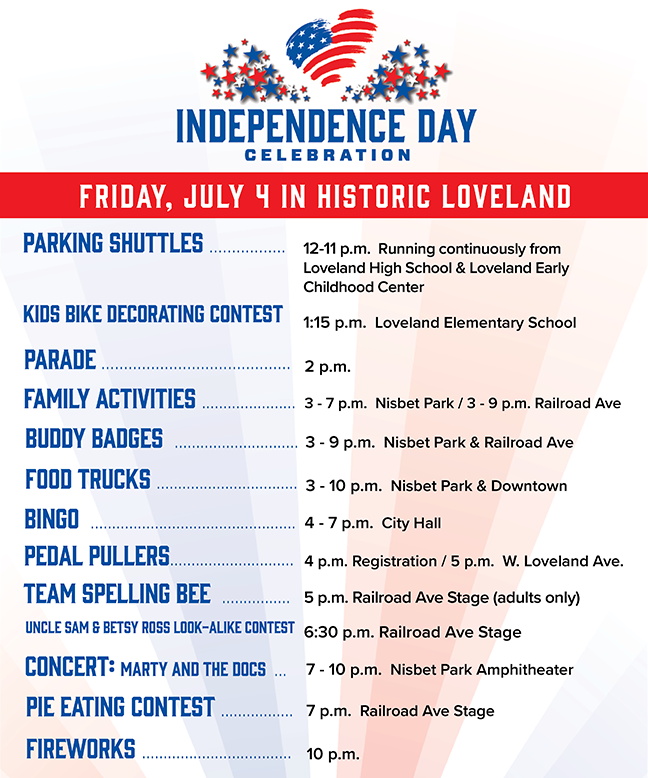
Loveland, Ohio – The Grand Marshal of the parade is DVD Brew. The parade will leave from the Loveland Elementary School (600 Loveland-Madeira Road) at 2 PM, turn onto West Loveland Avenue, travel through the West Loveland Historic, crossing over the Col. Thomas Paxton bridge and ending at the intersection of State Route 48/Second Street and East Loveland Avenue in the Downtown Historic District.
FREE parking shuttles will run continuously
Shuttle pick-up locations will be at Loveland High School (1 Tiger Trail) and the Loveland Early Childhood Center (6740 Loveland-Miamiville Road).
Drop-off locations will be at Riverside Drive (near Veterans’ Memorial) and Third Street (near fire station).
Eventgoers will need to walk to the festivities from the drop-off locations.
Buddy Badges Are Back – There will be roaming sales and a tent on Railroad Avenue. Prize Redemption will be at the gazebo in Nisbet Park. All sales benefit The Kiwanis Club of Greater Loveland.
Food Trucks: Loveland Dairy Whip, Fabulous Funnel Cakes, Donut NV, Schmidt’s Sausage Truck, El Vaquero, Mama Bear Mac, Cousins Maine Lobster, and Chili Hut near Nisbet Park. Jay’s Fish Taco at Narrow Path & Bagel Deli at Cappy’s.
Buckeye Pedal Pullers: New this year for children ages 4-11. Experience a pedal pull (similar to a tractor pull). There is an opportunity to advance to regional and national competitions. Registration will be day of the event from 4 until 5 PM and the event begins at 5 PM. Participants will receive a ribbon with trophy’s for winners. For more information, visit http://www.buckeyepedalpullers.net/
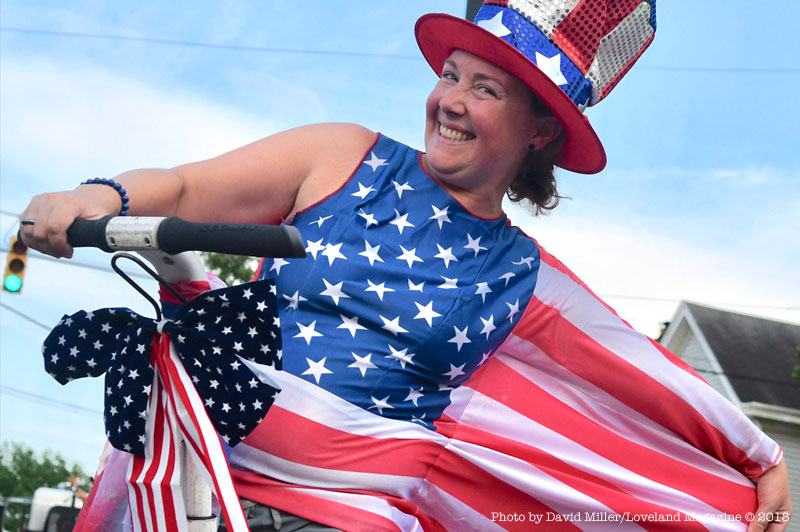
6:30 PM Uncle Sam and Betsy Ross Look-Alike Contest
7PM Pie Eating Contest
7:30 PM Kids Dance Party
8 PM Arm Wrestling Championship Round
Heads Or Tails: Meet at the stage on Railroad Avenue at 4 PM. When the announcer starts the game, select Heads by putting your hands on your head OR select Tails by putting your hands on your bottom. When everyone is set, the announcer will flip a coin. If it lands on heads, everyone that guessed heads moves on. If you guessed wrong, you’re out. The game continues until one winner remains to collect their $20 gift card prize. There will be a total of 5 rounds, starting at 4 PM and then every 10 minutes after, ending at 5 PM.
Children’s Dance Party: A 30-minute children’s dance party at 7:30 PM.
Pie Eating Contest: Sign up at the city booth or on Railroad Avenue the day of the contest, or register here prior to the event.
Arm Wrestling Championship Round: At 8 PM.
Betsy Ross and Uncle Sam Look-Alike Contest: At the Railroad Ave stage at 6:30 PM. The contest is open to everyone of all ages. Sign up at the link below or up to an hour before the contest starts. All participants will be asked to be at the stage on Railroad Ave. by 6:15 PM. Register at this link
Adult Team Spelling Bee: Teams of up to 3 adults (18+ years and older); $15 entry fee per team (Payment is due the day of event at the City booth located on Railroad Avenue); One mulligan (second chance) available for $5—must be purchased at registration. Contact Julie @ jrobinson@lovelandoh.gov with any questions. There is a maximum limit of 20 teams, waitlist available. Register at this link
As programs recognizing LGBTQ+ people are cut, an Ohio archive is doing what queer Americans always have: preserving their own history.
Cincinnati, Ohio – The Ohio Lesbian Archives in Cincinnati’s Over-the-Rhine neighborhood started with a friendship.
Phebe Beiser said that when she and co-founder Victoria “Vic” Ramstetter met in the 1970s, they bonded over being “hidden, secret, teenage lesbians,” growing up in what was then a conservative city and region where there were few gay role models. For a time in their 20s, they shared group houses in Clifton, where they now joke that they “survived the lesbian commune together.” They were young and idealistic. They wanted to “turn being an activist lesbian into something fun and interesting, and maybe help change the world.” Beiser, now in her mid 70s, told The 19th that they had a mantra: “We never wanted to be invisible again.”
When the Crazy Ladies Bookstore, named for the women who history brushed off as “crazy,” opened in Northside in 1979, it became the center of gravity in the Cincinnati lesbian community of which Beiser and Ramstetter were a part. Women bought homes in the neighborhood, gathering at the feminist bookstore for coffee, tea and conversation about being women, and about being gay. In 1989, the Archives opened on an upper floor.

It seemed that the visibility of the Crazy Ladies Bookstore and the Ohio Lesbian Archives — and of the women who made them happen — would be cemented in history in 2023, when the Ohio History Connection, the state’s nonprofit historical society, “embarked on a three-year project to diversify Ohio’s historical markers to include ten new stories of LGBTQ+ Ohioans” via its Gay Ohio History Initiative, or GOHI. At the time, there were roughly 1,800 historical markers in Ohio’s program, but only two commemorated places, events or people from the state’s queer history. A third, recognizing Summit Station, a lesbian bar in Columbus that operated from 1970 to 2008, was dedicated during Pride Month that year. The Archives and bookstore were selected for joint recognition.
That long-overdue acknowledgement has been derailed by the Trump administration’s sweeping war on DEI, which extends beyond diversity, equity and inclusion programs to seemingly include anything that acknowledges the country’s diversity of experience. But the archives — and the volunteers who sustain it — are undeterred, carrying on as the queer community has throughout history, documenting their existence.
“We never wanted to be invisible again.”
Phebe Beiser

The Ohio Lesbian Archives first began in 1989 in a small room on the third floor above the Crazy Ladies Bookstore in Cincinnati, Ohio. (Cincinnati & Hamilton County Public Library)
The Marking Diverse Ohio program was financed by a $250,000 grant from the Institute of Museum and Library Services, an independent agency created by a Republican-led Congress in 1996 that is the main source of federal funding for libraries and museums. Beiser and Branstetter were interviewed for an oral history. Ohio History Connection researchers visited the Archives to peruse the collection. A location was secured in a city park near where the since-shuttered Crazy Ladies Bookstore once was. By early this year, preparations to forever commemorate the Archives and bookstore with a plaque were all but complete. Its installation was expected in June, Pride Month.
Then, in late March, President Donald Trump issued an executive order regarding “The Continuing Reduction of the Federal Bureaucracy,” singling out seven agencies for elimination — including the Institute of Museum and Library Services, or IMLS. Nearly all of its employees were put on leave and their emails were disconnected. Days later, his administration’s Department of Government Efficiency, or DOGE, canceled $25 million worth of already-awarded IMLS grants, including the $250,000 for Ohio History Connection’s Marking Diverse Ohio program. The federal agency’s seemingly final Instagram post stated: “The era of using your taxpayer dollars to fund DEI grants is OVER.” The last photo listed erecting “LGBTQIA+ historical markers across Ohio” among the alleged government excesses that would be cut.

Svetlana Harlan, a former project coordinator for Marking Diverse Ohio, recalled that when she looked at the list, and saw the program with other projects she admired, “it almost seemed like a positive thing, I was like, ‘Oh yeah, these are nice initiatives!’”
“And it turns out that [DOGE] was just taking over the account. So then I was like, ‘Oh, they’re cutting those. Oh, our name is on the list,’” she said.
DOGE’s cancellation of the $250,000 IMLS grant to Ohio History Connection threw into question the future of the markers that were supposed to ensure that Ohio’s public displays of its history include LGBTQ+ people. Along with the Ohio Lesbian Archives and the Crazy Ladies Bookstore, there were markers in the works for an LGBTQ+ district in Akron; the first professor of gay and lesbian studies at Kent State University; 19th-century sculptor Edmonia “Wildfire” Lewis; LGBTQ+ journalism in Ohio; Toledo’s first LGBTQ+ member of city council; a Columbus hospice care center for HIV and AIDs patients; an open lesbian pastor in Athens; the screen-printing company Nightsweats and T-Cells in Lakewood; and the Rubi Girls, a Dayton-area drag group that has raised more than $3 million for HIV/AIDs and LGBTQ+ causes since the 1980s.
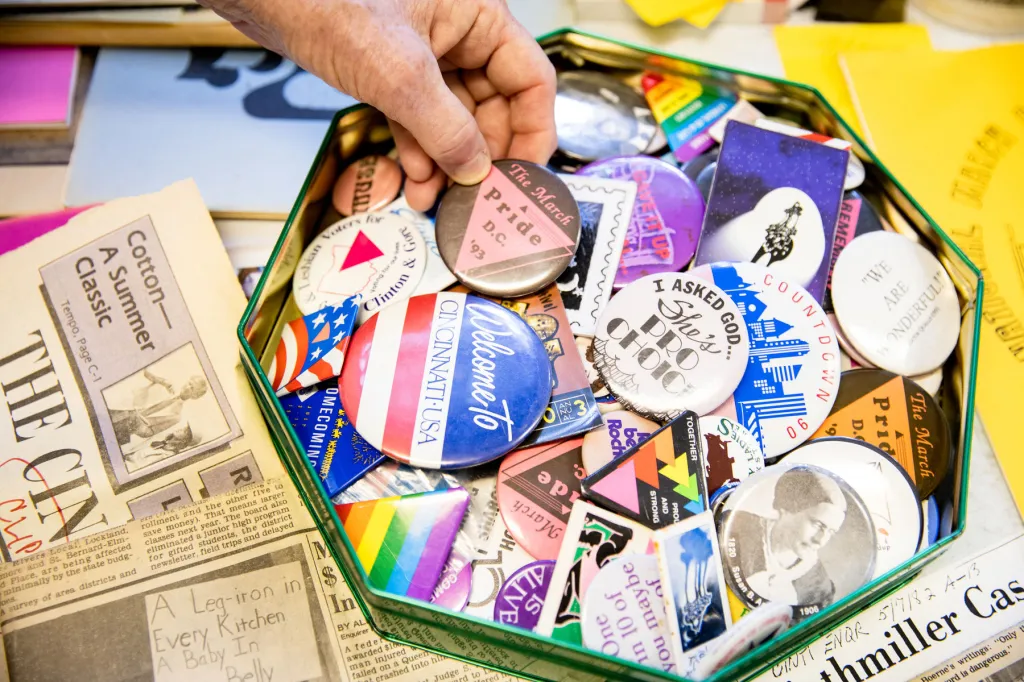
Ephemera collected at the Ohio Lesbian Archives include buttons from past Pride marches, political campaigns and other symbols of lesbian life.
(Courtesy Ohio Lesbian Archives)
Preservation on hold
Marking Diverse Ohio and other programs recognizing specific communities weren’t the only programs impacted in the state when DOGE cut IMLS grants and the federal agency essentially shuttered. And, given that more than $250 million is granted annually to libraries and museums nationally, the economic chaos at the country’s museums, libraries and historical institutions wasn’t confined to Ohio.
In Ohio, other entities that received recent IMLS funding include the Frank Lloyd Wright-designed Westcott House in Springfield, for post-pandemic, on-site programming; the Cincinnati Zoo for a big cat breeding program; Dayton Metro Library programs that helped low-income Ohioans secure Internet access; and Cincinnati’s Contemporary Arts Center, which lost $175,000 slated for programming aimed at the 3,000 or more teens it serves each year.
Institutions in Pennsylvania warned the economic upheaval could scuttle the digitization of The Rosenbach museum’s collection of rare books and manuscripts; the Woodmere Art Museum was mid renovation on a building to house its collection and expected to be reimbursed. In Wisconsin, small-town libraries said without the $3 million from the IMLS they’d received the year before they would have to reduce staff and therefore services. The American Library Association, or ALA, and the American Federation of State, County and Municipal Employees, or AFSCME, the labor union representing government workers, sued the Trump administration. ALA President Cindy Hohl said at the time that, “Libraries play an important role in our democracy, from preserving history to … offering access to a variety of perspectives.” AFSCME President Lee Saunders added: “Libraries and museums contain our collective history and knowledge.”
Earlier this month, a federal judge ruled that the Trump administration could continue dismantling the Institute of Museum and Library Services as the case continues.

For now, Ohioans who want LGBTQ+ history represented among the 1,800 markers in the state will not get the federal funding that was granted and must search for alternative resources in their communities. A couple of the markers look poised to move forward with outside funding from community foundations and other organizations. Others, like the Ohio Lesbian Archives and the Crazy Ladies Bookstore, are still waiting. The remaining cost to install the marker would likely be $3,000-$5,000.
When The 19th reached out to Ohio History Connection to ask if any alternative funding sources were being explored to install the Archives’ marker, spokesperson Neil Thompson said that he was “not able to provide any additional information for an Ohio Historical Marker application that is not in the public domain” and that it is only considered in the public domain once “the markers are finalized, cast and ready to be installed and dedicated.”
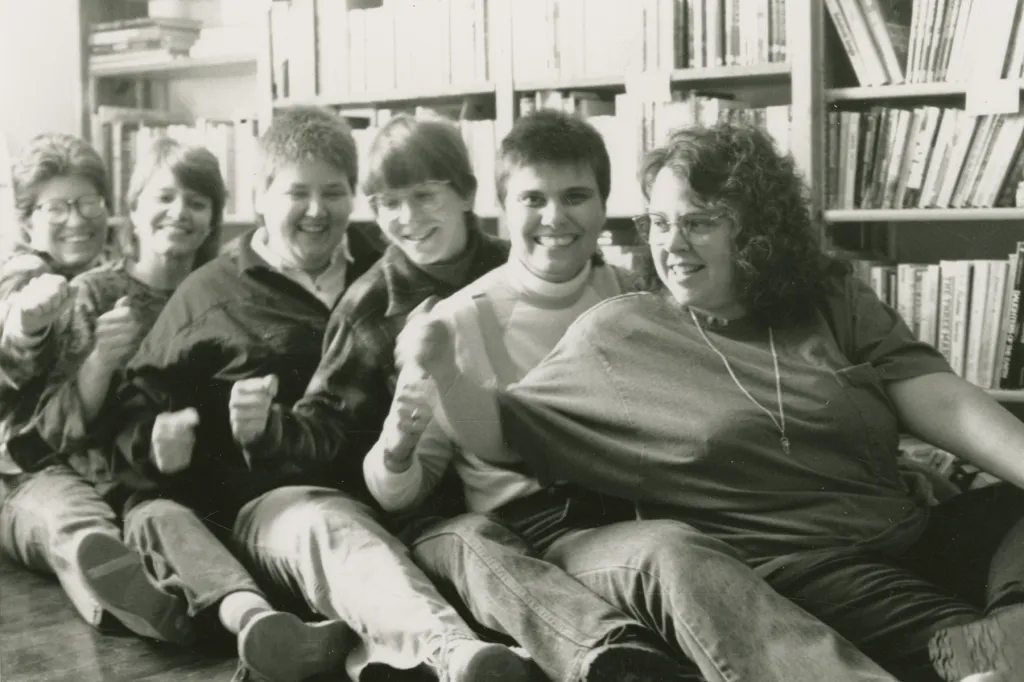
Phebe Beiser (far left), who co-founded the Ohio Lesbian Archives with her longtime friend Victoria ‘Vic’ Ramstetter, with Janice Uhlman, Elizabeth Van Dyke, Cathy McEneny, Morgan Kronenberger, and Ruth Rowan (left to right) at the Ohio Lesbian Archives in 1989. (Cincinnati & Hamilton County Public Library)
‘A reflection of themselves’
The Ohio Lesbian Archives has always been a DIY endeavor, powered by a group of passionate volunteers.
When the Crazy Ladies Bookstore’s founder, Carolyn Dellenbach, moved out of the area, she handed it over to its patrons to be run as a feminist collective. A lesbian newsletter called Dinah operated out of the upper floor — they referred to the National Organization for Women’s Task Force on Sexuality and Lesbianism, established in 1973, as FOSAL, or fossil, and Dinah was a play on dinosaur. Beiser laughed explaining the name: It was the 1970s; maybe there were drugs involved. For a time she wrote for Dinah and loved interviewing famous arrivals from the “women’s music circuit” when they came to town.
At some point, the women working shifts at the bookstore, writing for Dinah and organizing talks and other events related to feminist and lesbian issues, realized that the community they had built, and the ephemera they were collecting and creating, were an important part of history — theirs, lesbians,’ Ohioans,’ and women’s.
“We held on to them because we knew they could not be replaced,” Beiser said of the collection. “It’s proof of our existence … so we held on to these things to never be invisible again.”
We held on to them because we knew they could not be replaced. It’s proof of our existence.”
Phebe Beiser

Books on lesbian history line the shelves of the Ohio Lesbian Archives. (Courtesy Ohio Lesbian Archives)
In a 1991 issue of Dinah, letters to the editor included one from “Ma” who updated the “wimmin” in the community — they often spelled variations of their gender in ways that did not include “man” — that she was homesteading outside the city with her partner and building a log cabin. Another was from a woman who said she was “shocked” to find out that her being fired for being a lesbian was not a violation of civil rights laws and she was disappointed that the LGBTQ+ community did not come out to support her recent picket, writing: “I hope that in my lifetime I will see the gay and lesbian community get off their asses and together start fighting for their rights.”
Across from the metal filing cabinet at the Archives that houses the Dinah issues, a modern-looking poster from before the Supreme Court decided Bostock v. Clayton County in 2020, which extended employment protections to LGBTQ+ Americans, reminded Ohioans that it was still legal for them to be fired for their sexual orientation or gender identity. Today, Trump’s Equal Employment Opportunity Commission is aiming to curtail those hard-won workplace protections established by Bostock.
Lüdi Rich, a 27-year-old librarian, was working a recent Sunday afternoon at the Archives’ twice-weekly open hours, organizing books and research materials while the space was open to members of the community to drop in.
When Rich moved to Cincinnati nearly two years ago, she didn’t know anyone in the area, so she looked online for queer spaces so she could start building her community. When she attended a panel on local queer history, one of the speakers was Beiser, a longtime librarian herself in the country’s second-largest public library system.
Beiser mentioned at the panel that the Ohio Lesbian Archives would be having an open house that night at its new location next to Over-the-Rhine’s Washington Square Park, where Beiser was among those who met to march in Cincinnati’s first Pride Parade in April 1973. Rich asked Beiser how she could volunteer.
A couple months later, Rich showed up for her first shift, “And I’ve been here working ever since,” she said.
Nancy Yerian, the 34-year-old president of the Archives’ board, said that when she graduated from college in Massachusetts, she didn’t know if she could return to Cincinnati, where she grew up — until she discovered the Archives. “I thought that to live the kind of life I wanted to lead, I had to get out of what I thought was a very conservative place,” said Yerian, who has been volunteering at the Archives in some capacity since shortly after she finished school.
“Finding the Archives and the people I’ve met through the organization and the community we’re creating, as well as the history we’re preserving — it gave me a lot of hope that I could create a life for myself here,” she added.
It really is just us, preserving our history.”
Lüdi Rich
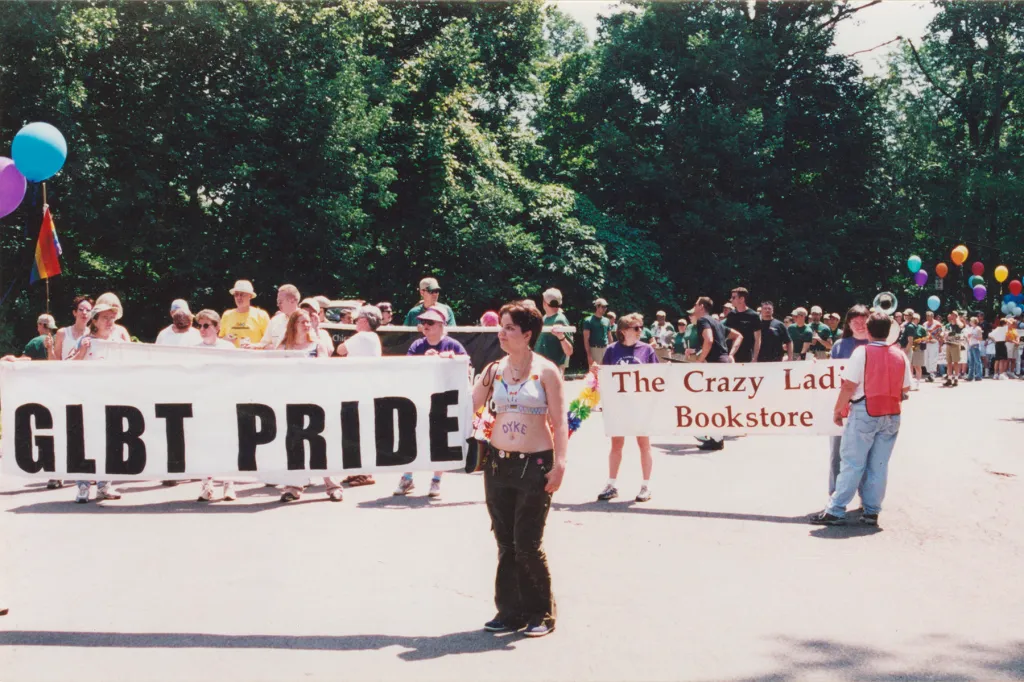
The Crazy Ladies Bookstore marched in a Cincinnati, Ohio Pride parade. (Cincinnati & Hamilton County Public Library)
The Archives’ volunteers have helped digitize old photos, some of which are now in a collection at the Cincinnati Public Library. They organize the books, arranged by first names instead of last, since so many women, especially in those early years, published works after taking on their husbands’ surnames. There are filing folders of Dinah newsletters. A cabinet holds multiple VHS and DVD copies of the early aughts television drama “The L Word.” A collection of buttons includes those from past Pride marches; supporting Hillary Clinton’s presidential campaigns; and one with “REMEMBER” and an inverted pink triangle, the Nazi symbol that Adolf Hitler used to identify gay and trans people. There is also one with the logo of the Crazy Ladies Bookstore, the silhouette of a woman reading while reclined in a chair, a cat by her side.
“Many people who are coming to the archives are looking for a reflection of themselves and in many ways that’s why Vic and Phebe started it. It shows models of ways to be in the world and a feeling of not being alone and not being the first queer person or lesbian,” Yerian said.
The Ohio Lesbian Archives, marker or not, is and will keep doing what it always has: making sure that lesbian Americans are visible in the country’s historical record.
“It really is just us, preserving our history,” Rich said.
Feeling overwhelmed by the news? The 19th is considering new ways to keep you informed. But we need your input! Fill out this quick survey to share your thoughts.
Good government leaders in Ohio and around the country are worried about state lawmakers attempting to ‘bake in’ 2026 election results long before voters head to the polls. Between new rounds of redistricting and even more restrictive voting legislation, Republican state lawmakers seem poised to engineer an easier path for their party’s candidates, they say.
“I think Ohio has become something of a test subject state for seeing just how far a super majority can chip away at access to the ballot and our rights to direct democracy,” Kelley Dufour from Common Cause Ohio said.
GET THE MORNING HEADLINES.
With Republicans notching several wins in 2024, the “sensationalized” version of voter restriction rhetoric has taken something of a back seat, Dufour said.
“But forces are still working behind the scenes, right? At an administrative death by 1,000 cuts,” she said. “It’s a quieter process, but it’s significantly harmful to voters.”
One example is a sharp uptick in provisional voting.
In 2024, Dufour explained, 34,000 had to vote provisionally — roughly 40% more than in the last presidential election.
Meanwhile, Ohio lawmakers are considering new measures that would require proof of citizenship to register and open the door to challenging a voters’ citizenship status on Election Day itself.
Proof of citizenship would require voters gathering birth certificates, divorce records, name-change records, or other paperwork.
This has already presented difficulties, for instance, for some trying to obtain a National I.D. card for air travel.
How it plays out on the map
But the “cherry on top,” Dufour said, is redistricting. Ohio could see a major shakeup to its congressional map ahead of next year’s midterms because lawmakers here are legally required to draft a new map.
Right now, Ohio has 15 districts with five represented by Democrats and 10 represented by Republicans, or 33% to 66%.
Midterm elections typically serve as a kind of referendum on a new presidential administration. Historically it has not been kind to the president’s party. That’s particularly concerning in the U.S. House, where Republicans are clinging to a thin 220-2012 majority.
Redistricting in GOP-controlled states like Ohio and Texas could turn that vulnerability into an advantage.
Common Cause Texas Executive Director Anthony Gutierrez explained, in his state, the governor has already announced a special session in July.
The governor hasn’t shared what will be on the agenda, but at a recent press conference the state’s lieutenant governor was enthusiastic about the idea.
“He was asked about redistricting, and he said that he does think that if there’s any opportunity for Republicans in Texas to pick up some seats, that he does think that they should do it,” Gutierrez said, “So, nothing confirmed, but senior Republicans who probably have some insight into what’s going on, have been giving indications that they do think this is going to happen.”
In Ohio, lawmakers have to come up with a new map because the last one was approved along party lines.
The General Assembly has until the end of September to come up with a map but has shown little inclination to do so thus far. If lawmakers don’t act, that would put the task back in the hands of the seven-member Ohio Redistricting Commission.
“Currently, we have five Democrats and 10 Republicans that Ohio sends to D.C.,” Dufour said. “The map-making process could eliminate a few Democratic-leaning districts.”
What that might look like in Ohio
Ohio Republican U.S. Sen. Bernie Moreno is eager to see it happen. Moreno told Punchbowl News he thinks the GOP will pick up two additional seats and that Republicans controlling 12 of 15 districts — 80% of the delegation — “reflects the state.”
Moreno reasoned there’s “a recognition” that big cities like Cincinnati, Columbus, and Cleveland will be represented by Democrats.
Moreno won his statewide race with just 50.09% of the vote, a far cry from the 80% share he thinks Republicans should control in the U.S. House. In addition to losing the three Cs, Moreno lost counties anchored by Toledo, Akron, Dayton, and Athens.
Sitting in the crosshairs of Ohio’s redistricting effort are Ohio Democratic U.S. Reps. Marcy Kaptur and Emilia Sykes. Kaptur’s Toledo-area district and Sykes’ Akron-based seat are the two most closely divided districts in the state.
Both lawmakers have drawn familiar challengers. Republican former State Rep. Derek Merrin has joined a crowded primary field for a rematch against Kaptur. State Rep. Josh Williams, R-Sylvania Twp., has thrown his hat in the ring, too.
In Sykes’ district, her 2024 opponent, Republican former state Rep. Kevin Coughlin, is running to face her again, as well.
In both contests, even minor tweaks to the map could have a significant impact on the outcome. Sykes only beat Coughlin by about two points. Kaptur’s margin was even tighter. She beat Merrin by just 2,382 votes — less than a percentage point.
Follow Ohio Capital Journal Reporter Nick Evans on X or on Bluesky.
Nick Evans
Nick Evans has spent the past seven years reporting for NPR member stations in Florida and Ohio. He got his start in Tallahassee, covering issues like redistricting, same sex marriage and medical marijuana. Since arriving in Columbus in 2018, he has covered everything from city council to football. His work on Ohio politics and local policing have been featured numerous times on NPR.
Ohio Capital Journal is part of States Newsroom, the nation’s largest state-focused nonprofit news organization.
Loveland, Ohio – This charity raffle will benefit the LIFE Food Pantry that serves hundreds of local families every week.
You can also help LIFE by donating funds, contributing food, volunteering, and hosting a food drive. If you operate a business, please consider becoming a partner.
The video below will provide you with an idea of the process involved and the cuts of meat that come from a 1/4 Hind. There will be some slight fluctuations depending on the size and weight of the cow that is processed but on average yields over 100 lbs. of beef valued at over $1,500 in today’s market.
Ohio lawmakers will likely go on summer break without making any changes to the state’s marijuana law, a Republican state representative said Tuesday.
For the second week in a row, Ohio Senate Bill 56 was up for a possible vote out of the Ohio House Judiciary Committee, but both times the vote did not take place.
Once the bill is voted out of committee, it can be brought to the House floor for a vote. The Senate passed the bill in February.
GET THE MORNING HEADLINES.
Last week, the bill was removed from the committee agenda and this week the committee meeting — which only had S.B. 56 on the agenda — was canceled.
“We are going to push pause,” state Rep. Brian Stewart, R-Ashville, said when asked about the marijuana bill. “We’re going to take the summer and come back and potentially take another crack at it.”
Ohio House Speaker Matt Huffman, R-Lima, said the Senate raised more than a dozen issues related to S.B. 56 last week.
“I just told my caucus, ‘We’re not going to just say, OK, because we’re so anxious to pass the marijuana bill, which I’d like to get it done, but we’re not going to give up House priorities to do that,’” he said last week.
The lawmakers are currently working on the state’s two-year operating budget, which Ohio Gov. Mike DeWine must sign before July 1. The lawmakers will go on summer break after the budget is finished.
S.B. 56 would reduce the THC levels in adult-use marijuana extracts from a maximum of 90% down to a maximum of 70%, limit the number of active dispensaries to 400 and prohibit smoking in most public places.
It would keep Ohio’s home grow the same at a limit of six plants per person and 12 plants per residence. State Sen. Steve Huffman, R-Tipp City, introduced the bill in January and the bill originally would have limited Ohio’s home grow from 12 plants down to six.
“The people of Ohio spoke very clearly on this issue,” said Ohio House Minority Leader Dani Isaacsohn, D-Cincinnati. “They knew what they were voting on, and they voted to pass adult-use cannabis recreationally here in the state of Ohio.”
Intoxicating hemp products
The House has made significant changes to S.B. 56, most notably adding regulations to intoxicating hemp products.
As the bill currently stands, only a licensed marijuana dispensary would be able to sell intoxicating hemp products that have been tested and complied with packaging, labeling and advertising requirements.
The Ohio Department of Commerce would regulate intoxicating hemp products and drinkable cannabinoid products. Grocery stores, carryout stores, bars, and restaurants would continue to be able to sell drinkable cannabinoid products.
Isaacsohn agrees there should be regulations around intoxicating hemp products, but wants it to happen through a “clean bill.”
“It is so tied up in trying to overturn the will of the voters,” he said. “If we had a clean bill to fairly regulate intoxicating hemp, we could have voted on it months ago, years ago. … There are so many common sense things that we agree on, and when the majority brings forward a clean bill, we would be happy to vote for it.”
Flowers of hemp plants that contain less that 0.3 percent tetrahydrocannabinol (THC) the primary psychoactive substance in marijuana. (Photo by Graham Stokes for Ohio Capital Journal. Republish photo only with original article.)
The 2018 Farm Bill says hemp can be grown legally if it contains less than 0.3% THC.
State Rep. D.J. Swearingen, R-Huron, was planning on introducing amendments to the bill’s hemp provisions during Tuesday’s committee meeting, but that didn’t happen since the meeting was canceled.
The American Republic Policy worked with Swearingen on the amendments which would have allowed licensed hemp companies in Ohio to continue to operate their retail stores and create a unified regulatory framework for hemp and marijuana products, said Dakota Sawyer of American Republic Policy.
“The same regulations that would apply to marijuana under the Ohio administration code would apply to hemp products as well,” he said. “We are ensuring that we do not have state-sanctioned monopolies in the state of Ohio, that federally legal hemp products can be accessed through independent businesses, and that they would not be forced to go into dispensaries.”
Sawyer said forcing hemp products into only dispensaries would eliminate market competition.
“We want to ensure that there are options out for people, to ensure that they are able to purchase what they love, what they would want … and to ensure that we do not have state-sanctioned monopolies,” he said.
State Rep. Jennifer Gross, R-West Chester, said 3,000 hemp businesses would close if S.B. 56 passes as it currently stands — with hemp products only being sold in dispensaries.
“We need to reward the good actors,” she said. “We need to ID check our hemp products when it is consumable. We also need to allow these businesses to stay open.”
Wesley Bryant, company owner of 420 Craft Beverages in Cleveland, said he already does many of the things that are outlined in the proposed amendment.
“Every square inch of my facility is fully covered by cameras,” he said. “We have a full track and traceability of everything that comes into my facility. We even go so far as to double check IDs. And my doors stay locked throughout the day. You have to be buzzed in order to enter the facility.”
DeWine and various lawmakers have expressed safety concerns for children when it comes to hemp products, but Sawyer said the average age of an Ohio hemp customer is 40 years old.
“It’s not geared towards children,” Sawyer said. “What some legislators have done is created this mystical boogeyman that says that all these hemp people are doing all these crazy things that are attracting minors. And essentially we’re saying, let’s punish the bad actors that are doing that, but let’s not punish the good guys for that.”
But Adrienne Robbin, deputy executive director of Ohio Cannabis Coalition (OHCANN), said Ohio children are being put at risk by intoxicating hemp products.
“It’s a sad day for all Ohioans that we’re going to continue to see these illicit products be sold in our state over the summer,” she said. “These products are being marketed to (children) specifically,” she said. “I think the hemp industry is really good at pulling a few good actors out and highlighting them, but the reality is, the majority of these products are illicit.”
Sawyer said he would prefer to see the legislation as two separate bills — one with marijuana regulations and a separate one with hemp regulations.
“Marijuana and hemp are totally separate in terms of the industry and products,” he said.
Megan Henry is a reporter for the Ohio Capital Journal and has spent the past five years reporting in Ohio on various topics including education, healthcare, business and crime. She previously worked at The Columbus Dispatch, part of the USA Today Network.
Ohio Capital Journal is part of States Newsroom, the nation’s largest state-focused nonprofit news organization.
Loveland, Ohio – On Monday afternoon I got a chance to sit down with Ohio Secretary of State candidate Bryan Hambley, the only declared Democratic candidate for the state-wide office. Two Republicans have also declared their intention to run, current Ohio Treasurer Robert Sprague from Findlay and Marcell Strbich who lives in Montgomery County.
Hambley is a cancer doctor who cares for leukemia patients at U.C. His wife Jana, is a trauma surgeon, and together they have two children ages 5 and 7 that attend Loveland schools.
I sat down with Hambley at a private meet the candidate night where we talked about what he could do as the Ohio Secretary of State to correct Ohio’s gerrymandered democracy, how the current Secretary of State has been responsible for deliberately confusing ballot language, how he would improve assistance to the caregivers that help disabled Ohioans cast their ballot, and improving civility among Ohio politicians.
Loveland, Ohio – The Loveland-Symmes Fire Department received delivery of the new MiniAmbulance last week. The unit, which was co-purchased in partnership with the City of Mason, is now ready to be placed into service. This compact vehicle will serve as a safety asset, improving emergency response during city events, along the bike trail, at river access points, and at high school sporting events.
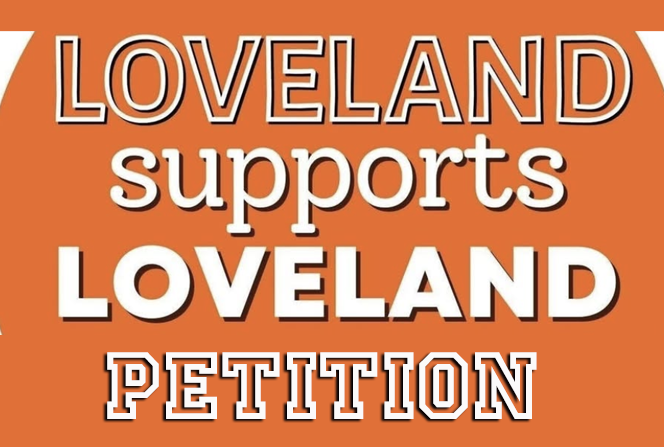
Loveland, Ohio– As Ohio legislators are in the final moments drafting the budget that will go to Governor Mike DeWine’s desk, Loveland City School District resident Rebecca Moates started this petition to send a message to Ohio Statehouse leaders. She says in the introduction, “As residents of Ohio and strong supporters of public education, We are writing to urge you to adopt the following recommendations in the final version of Amended Substitute House Bill 96. These requests reflect the concerns of educational leaders from across the state.”
Moates is encouraging District residents to join her by signing the petition.
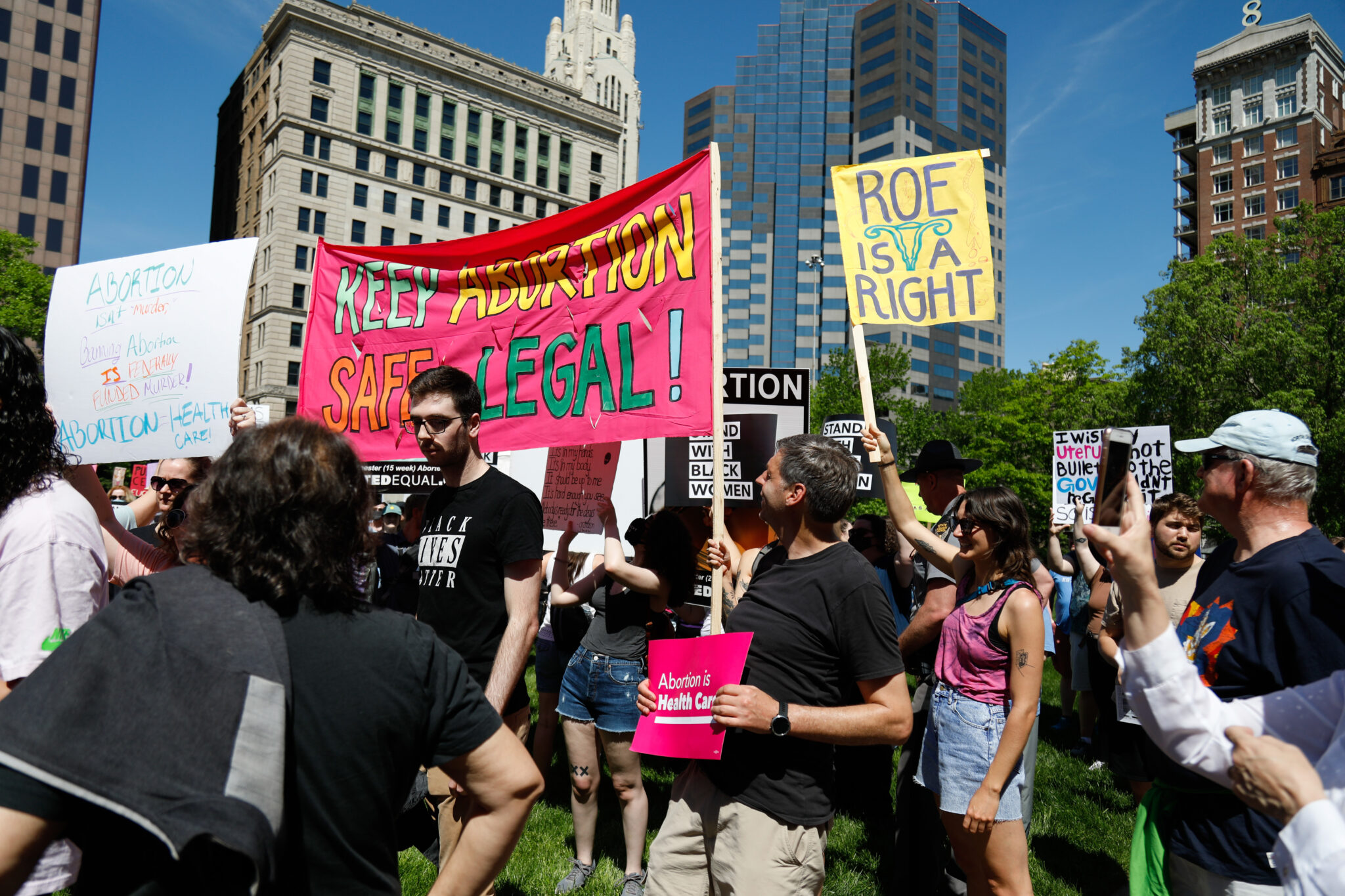
Pro-abortion rights advocates are taking a proposed total abortion ban in Ohio to heart. Noting the celebration of Juneteenth and Black emancipation, they say the use of the 14th Amendment to try to exert state control over individual freedom and bodily autonomy is vile.
The new bill a pair of freshman Republican House lawmakers are planning to introduce would ban abortion and criminalize it, along with in-vitro fertilization and certain types of contraception. The measure’s filing was first reported by WEWS.
The bill is meant as a direct challenge to the state reproductive rights amendment passed by 57% of Ohio voters in 2023.
Bill supporters say the current constitutional amendment that enshrined reproductive rights into the Ohio Constitution “should be treated as null and void” because, they claim, it violates the equal protection clause of the 14th Amendment “by denying pre-born persons the right to life.”
The 14th Amendment of the U.S. Constitution protects citizenship and due process, along with equal protection under the law.
“In appealing to the 14th Amendment, the Ohio Prenatal Equal Protection Act appeals to a higher law; the U.S. Constitution,” the anti-abortion group End Abortion Ohio, who is leading the charge on the bill, said in a statement.
Austin Biegel, a member of End Abortion Ohio, argued that yes, the bill would go against the majority public opinion of Ohioans, but he justified it by arguing that slavery was once also supported and legal in the U.S.
Lexi Dotson-Dufault, executive director of the resource and referral service Abortion Fund Ohio, called the use of the 14th Amendment as part of an abortion ban bill “vile.”
“A bill that bans abortion while citing the 14th Amendment misuses a civil rights protection to justify state control over our marginalized community members, especially Black people,” Dotson-Dufault said.
A report from the National Partnership for Women & Families in May of last year found that state abortion bans “exacerbate the existing Black maternal mortality crisis,” and “threaten” 7 million Black women nationwide.
The study found that mothers who can’t access abortion care see negative impacts to their “economic security and development of their existing children.”
‘Canary in the coal mine’
Dotson-Dufault and Ohio Women’s Alliance Deputy Director Jordyn Close believe Republican legislators are emboldened to attempt anti-abortion measures in part because of a Missouri Supreme Court ruling that reinstated a “de facto abortion ban” in May, lifting an injunction that had blocked abortion restrictions.
Lexi Dotson-Dufault, executive director of Abortion Fund Ohio. Photo courtesy of Lexi Doston-Dufault.
The decision came months after that state also approved an amendment to its constitution that protected reproductive rights.
The pro-abortion rights advocates see no legal standing for the new abortion ban bill, but they also see abortion rights as “the canary in the coal mine when it comes to … rights being stripped away from people.”
“I don’t think that this bill has any legs to stand on, but I do think that it’s very important to highlight just how gross it is that they would even try it,” Close said. “Because if it’s not this bill, it will be another one introduced in the next session … it just continues because they do not respect Ohioans.”
Ohio’s constitutional amendment, passed in 2023, protects abortion and other types of reproductive health like fertility treatments and miscarriage care, but more than 30 other regulations still sit on the books in Ohio law.
Those statutes would have to be undone one by one, even though state courts have blocked some of the laws, as well as a six-week abortion ban that was on the books before Roe v. Wade was overturned by the U.S. Supreme Court.
But Republicans in the state legislature are also trying to double-down on such regulations.
State Reps. Mike Odioso and Josh Williams have already filed House Bill 347, a bill which targets informed consent, requiring that 24 hours before an abortion doctors provide not only “medically accurate information that a reasonable patient would consider material to the decision of whether to undergo the elective abortion” —which abortion providers have said they are already required to do — but also “alternatives to abortion, including adoption and parenting.”
H.B. 347 also puts into law medically controversial and unproven language that “it may be possible to reverse the effects of the abortion-inducing drug” if a medication abortion is taking place.
This isn’t the first time Ohio lawmakers have attempted to include this language in state law.
The bill also requires a physician to notify the pregnant person, except in the case of rape or incest, “that the unborn child’s father has a child support obligation, even if the father has offered to pay for the elective abortion.”
According to a recent midyear analysis from the Guttmacher Institute, 13 states have total abortion bans on the books, with another 28 that have bans between six weeks of gestation and “viability.”
Ohio’s constitutional amendment places abortion legality at viability, as determined by an individual’s physician.
The institute’s report also said the first half of 2025 has given rise to anti-abortion state lawmakers who “have continued to push the envelope toward pregnancy criminalization, restrictions on bodily autonomy and laws that recognize fetal and embryonic personhood,” while also reducing funding for resources like sex education.
Jordyn Close, deputy director of Ohio Women’s Alliance. (Photo by Graham Stokes for Ohio Capital Journal. Republish photo only with original article.)
The state-level action comes as the Trump administration spent its first few months in office revoking Biden-era executive orders on abortion, including patient privacy protections, and rolling back guidance on access to emergency abortion care under the federal Emergency Medical Treatment and Labor Act.
President Donald Trump also pardoned nearly two dozen people convicted under a federal law that bans threats, physical obstruction or force at the entrances to reproductive health clinics.
The language of that federal law for which Trump issued pardons also bars interference, injury or intimidation for any exercise of First Amendment religious freedom, including at places of worship.
Efforts to slash federal funding have also touched reproductive health, with cuts to Title X, which funds “family planning” grants and other reproductive health services for low-income individuals, including many services in Ohio.
Pro-abortion rights groups have already started their fight against the total abortion ban bill with a demonstration on Wednesday that interrupted an anti-abortion gathering in the Statehouse.
They want to spend more time not only raising their voices in the halls of the legislature, but also educating the voters going into 2026 elections.
“Even though we had a moment of victory in 2023, the fight is far from over,” Close said. “We have to look toward the next electoral (cycle) to protect our courts, because inevitably when we have these showdowns in the state legislature, the courts is where everything ends up.”
A spokesperson for Oho House Speaker Matt Huffman said Huffman’s focus remains on the state operating budget until its July 1 deadline, and had no other information on the bill’s introduction or timeline.
A request for comment from Senate President Rob McColley on whether he would consider such a bill went unanswered on Wednesday.
Back in November 2024, just before he began his tenure as Senate president, McColley told the Capital Journal “the inaction on the issue kind of speaks for itself,” referring to any effort to undermine the constitutional amendment. He also said since the issue had passed the year before, “there really hasn’t been a lot of discussion about it.”
“I think, by and large, people realize Ohioans spoke, and that’s the way it is right now,” McColley said then.
The Ohio Democratic Party said they were staunchly against the abortion ban measure, questioning the priorities of state Republicans, and saying the party with the Statehouse supermajority is attempting to “drag our state into the past.”
“Ohio women would die under this cruel, disastrous legislation,” said Ohio Democratic Party Chair Kathleen Clyde.
Susan Tebben
Susan Tebben is an award-winning journalist with a decade of experience covering Ohio news, including courts and crime, Appalachian social issues, government, education, diversity and culture. She has worked for The Newark Advocate, The Glasgow (KY) Daily Times, The Athens Messenger, and WOUB Public Media. She has also had work featured on National Public Radio.
Ohio Capital Journal is part of States Newsroom, the nation’s largest state-focused nonprofit news organization.