


.















_______________________
 _______________________





 _______________________



News and Events from the Loveland, Ohio Area
Without fear or favor
Since 2004


_______________________


_______________________
![[WATCH] Major General Dr. Joseph Warren statue unveiled in Lebanon](https://lovelandmagazine.com/wp-content/uploads/2025/06/general-warren-statue.jpg)
Lebanon, Ohio – “June 17, 2025 was a day to remember in Lebanon, Ohio. On the 250th anniversary of the Battle of Bunker Hill, the community gathered on the lawn of the Harmon Museum to honor one of America’s earliest patriots — Major General Dr. Joseph Warren, the namesake of Warren County. The highlight of the afternoon was the unveiling of a stunning bronze statue of Warren, crafted by sculptor John Hebenstreit.” – Blue Horse Theatre
This story comes via the Warren County Post… Read their full story…
Video by Blue Horse Theatre

Members of Colemine Records meet with Miami University students. Miami students in Intro to Music Business and Record Labels and Music Publishing Operations classes learn the ins and outs of the music industry while working directly with label executives.
Loveland, Ohio – What does it take to launch a successful album? A lot of talent, even more luck, and the right team of in-the-know marketers, like the students in Miami’s music business courses.
Across two classes – Intro to Music Business and Record Labels and Music Publishing Operations – students in Willie Caldwell’s lectures learn the ins and outs of the music industry while working directly with label executives.
The collaboration began when Caldwell, an adjunct instructor in Arts Management and Arts Entrepreneurship, was researching the regional music scene to learn more about the local music venues and record labels. Terry Cole’s name stood out in his search.
 Cole is the founder of Colemine Records, which is housed above the label’s shop, Plaid Room Records in Historic Downtown Loveland, Ohio. As the story goes, he cooked up the idea for Colemine Records in 2007 and drew the logo on the back of a Subway napkin right here in Oxford – while he was a graduate student at Miami.
 Together, Colemine executives and Caldwell workshopped a collaboration. Cole visited one of Caldwell’s classes to guest lecture on the industry, which Caldwell said was very well received by his student, but they had sights on a bigger partnership.
“They were interested in better understanding Gen Z’s new music discovery habits,” Caldwell said. “So what if we target the Miami student population? How do they discover new music? Where’s it coming from? What are their listening habits?”
Caldwell and his class generated a survey that was sent out campus-wide before students left for spring break. They received over 300 responses in just two weeks’ time and ended up with a solid pool of data for further research.

With that baseline, the class could use the data to inform their next stage in the Colemine Records collaboration. The students were charged with creating an artist release campaign that would engage Gen Z listeners for the launch of artist Kendra Morris’ upcoming album.
The students had the opportunity to interview Morris to learn more about her and her artistic style, and then they combined that information with the survey results to build out their projects.
“It’s just a really cool opportunity where we were able to connect with the largest independent label out of Southwest Ohio and get access to a signed artist that is underneath them,” Caldwell said. “(Students) got to put their creativity to work and actually come up with some campaign ideas for her release.”
The entire collaboration culminated in a visit from the Colemine Records executive team, which led a panel for music industry questions. As part of their final exam for the class, the student groups set their campaign pitches to Colemine Records.
Morris and Colemine Records executives latched on to student-generated ideas circling around social media livestream and broadcasting features that would help promote Morris’ upcoming release.
“We absolutely loved this collaboration and continue to explore possibilities for future engagements between the Arts Management and Arts Entrepreneurship program and Colemine Records,” Caldwell said.
For Ian Dilenschneider, this collaboration was one of his last hurdles to graduate with a degree in Music Technology – one he’s glad he got to be involved with.
“As a graduating senior hoping to go into the music industry – especially the indie scene – it was immensely helpful to have this opportunity,” Dilenschneider said. “The chance to talk to the label felt like I was taking my first steps as a professional artist.”

Working with Colemine Records executives on this project pushed the course beyond the norm of textbook work, according to senior music technology major Isa Riddle. She said she was truly inspired by the executives when they spoke to her class.
“I couldn’t be more grateful for the opportunity,” Riddle said. “As someone who wants to pursue a career in the music industry, all of the work we’ve done has helped me build confidence in myself to start enacting some of my plans!”
With the success of the project, the Arts Management and Arts Entrepreneurship program plans to continue working with Colemine Records in the fall and will be introducing a new course, Live Music and Touring, alongside Intro to Music Business and Record Labels and Music Publishing Operations.

Juneteenth flag. (Getty images)
Ohio Democratic lawmakers want to eradicate slavery from the Ohio Constitution.
State Reps. Dontavius Jarrells, D-Columbus, and Veronica Sims, D-Akron, are working on a joint resolution that would remove slavery from the state’s foundational document.
“This isn’t political,” Jarrells said Wednesday during an Ohio Legislative Black Caucus press conference. “This isn’t personal. This is a moral overdue journey to change our constitution once and for all. Other states have already done it. We simply want Ohio to live up to this promise of freedom.”
GET THE MORNING HEADLINES.
The 13th Amendment to the U.S. Constitution abolished slavery and involuntary servitude, except as punishment for being convicted of a crime. The Ohio Constitution currently says “There shall be no slavery in this state; nor involuntary servitude, unless for the punishment of crime.”
Seven states have removed the slavery loophole from their constitution — Alabama, Oregon, Tennessee, Vermont, Utah, Colorado, and Nebraska, according to the Abolish Slavery National Network.
“I submit that slavery and or involuntary servitude in any shape, form or fashion, should be disembodied from the sacred pages of the founding document of our great state,” Sims said. “It is time to remove any exception under any circumstances, slavery is a vile, despicable imposition upon another human being.”
This is not the first time there have been legislative attempts in Ohio to remove slavery from the state’s constitution. Jarrells had a bipartisan joint resolution that was unable to get out of committee during the last General Assembly. A Senate Joint Resolution was also unsuccessful back in 2020.
If the House and Senate pass the new joint resolution, it would go to the statewide ballot for the voters to decide.
Wednesday’s press conference was hosted by members of the Ohio Legislative Black Caucus in honor of Juneteenth, a federal holiday Thursday remembering the end of slavery in the United States on June 19, 1865 — two years after the Emancipation Proclamation.
“Juneteenth signifies the end of slavery, and it’s a time to celebrate,” said State Rep. Terrence Upchurch, D-Cleveland. “Although we are proud of the progress we have made, that does not negate the fact that there are still several challenges Black Ohioans face across the state. People are still struggling with finding housing, healthy foods, good paying jobs, satisfactory education, fair treatment in the justice system, and so much more.”
Jarrells introduced House Bill 306 last month, also known as the Enact the Hate Crime Act.
“It empowers victims with real civil remedies and gives law enforcement clear, enforceable tools to hold perpetrators accountable,” he said. “This bill says that every single person in this state deserves to live without fear, and if you are targeted for who you are, this state will stand with you.”
State Rep. Darnell T. Brewer, D-Cleveland, talked about recent gun legislation he is working on.
“Gun violence is devastating our communities,” he said. “We can no longer afford to be silent or inactive.”
Black youth are 11 times more likely to die from firearm homicide than their white peers, according to Brady: United Against Gun Violence.
Brewer said he plans on introducing a resolution to encourage responsible gun ownership by promoting safe storage practices to prevent children from accessing guns and a resolution on safe firearm storage education.
“Gun violence is not just an emergency,” he said. “It’s a daily reality.”Infant mortality, when a child dies before their first birthday, is higher for Black babies compared to white babies. The national infant mortality rate is 5.5 per 1,000 live births for babies and 10.9 for Black babies, according to the Centers for Disease Control and Prevention. The infant mortality rate for Ohio Black babies in 2022 was 13.4 per 1,000 live births.
“Why do we stop caring about babies after they’re born?” State Rep. Derrick Hall, D-Akron, asked.
State Rep. Ismail Mohamed, D-Columbus, talked about House Bill 281, a bill that would withhold Medicaid funding from hospitals that do not cooperate with the United States Immigration and Customs Enforcement. State Rep. Josh Williams, R-Sylvania Twp., introduced the bill last month.
“What this bill does is essentially force medical providers to choose between honoring your oath as medical providers or complying with the state’s political agenda,” Mohamed said. “It will discourage immigrant communities from seeking life saving treatment care out of fear.”
Mohamed also talked about House Bill 1, a piece of legislation that would place restrictions on foreign ownership of land. State Reps. Angie King, R-Celina, and Roy Klopfenstein, R-Haviland, introduced the bill earlier this year.
“It is arbitrary,” Mohamed said. “It is discriminatory in its face, and will negatively impact economic development in the state of Ohio.”
Follow Capital Journal Reporter Megan Henry on Bluesky.

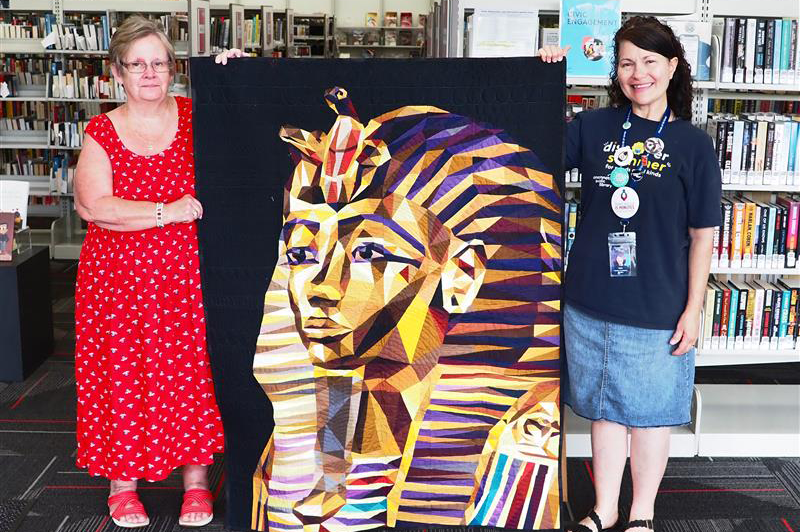
Terri Sinoway on the left photo by Cincinnati & Hamilton County Public Library
Loveland, Ohio – Terri Sinoway is the winner of the 25th Annual Loveland Quilt Show. Her winning quilt, “Tut, the Boy King,” uses 90 different fabrics and took about a month to complete.

Clermont County, Ohio – Clermont County athletes had a great time at this year’s Special Olympics Ohio Games held in the Jess Owens Memorial Stadium at Ohio State University..


Cincinnati, Ohio – Ohio Governor Mike DeWine and Kentucky Governor Andy Beshear unveiled Tuesday the design of the new companion bridge to be built as part of the 8-mile Brent Spence Bridge Corridor Project in Cincinnati and Northern Kentucky.
The press release said, “Today’s announcement marks a major milestone in one of the nation’s most significant transportation investments that will improve safety and strengthen economic development opportunities.”
“As we went through the designs, we wanted this bridge to be cost effective, functional, and safe, but we also wanted it to look good,” DeWine said. “This bridge will become an iconic part of the Cincinnati skyline and create a landmark gateway that honors our states’ excellence in engineering, transforms the daily commute, and keeps commerce moving.”
“The new companion bridge will be a game-changer for commuting families and it’ll revolutionize a crucial economic corridor,” Beshear said. “This is a project that has been dreamed of for years and that many said would never happen. But we are getting it done by working together — and we’re doing it without tolls.”
Northbound drivers crossing the Ohio River from Kentucky into Ohio will use the top level of the new bi-level companion bridge, which showcases an unobstructed view of the Cincinnati skyline and the bridge’s unique design.
According to the release by The Brent Spence Bridge Corridor Project, “The design team, managed by the Ohio Department of Transportation (ODOT) and Kentucky Transportation Cabinet (KYTC), evaluated multiple concepts against key visual and aesthetic criteria, including how well they fit the surroundings, their visual connection to the existing bridge and their potential to become a recognizable regional landmark. The design also underwent extensive technical review and wind testing. Ultimately, cost, constructability, and schedule were the deciding factors in the selection of the bridge type. Compared to the other options considered, this design is lower in cost and easier to build.”
“This is more than just a bridge — it’s a long-overdue investment in the future of our region,” said ODOT Director Pamela Boratyn. “For decades, communities have waited for a safer, more efficient crossing that not only eases traffic and improves safety but also strengthens one of our most critical freight corridors. This new bridge will unlock economic opportunities, support regional growth, and better connect people and commerce for generations to come.”
“This companion bridge reflects the values of the communities it connects — practical, forward-looking and built to last,” said KYTC Secretary Jim Gray. “With the bridge design selected, our expert teams continue to work hard behind the scenes on activities to help us march toward construction.”
The Brent Spence Bridge Corridor Project spans eight miles of I-71/I-75 in Kentucky and I-75 in Ohio. Beyond the new companion bridge, the project includes improvements to the existing Brent Spence Bridge to carry local traffic, redesigned ramp configurations throughout the corridor, new pedestrian and bike paths connecting communities to transit and employment centers, and “aesthetic improvements designed to create walkable, urban environments.”
With the design selection complete and acknowledgement from the Federal Highway Administration (FHWA) concurring with the bridge type, the design-build team will continue to advance the project toward final engineering and construction phases.
The existing Brent Spence Bridge, which has served the region since 1963, currently carries traffic volumes exceeding its original design capacity. It will be reconfigured to three lanes on each deck with emergency shoulders on each side to improve safety and carry local traffic between Covington and Cincinnati. The new companion bridge will carry traffic on I-71 and I-75.






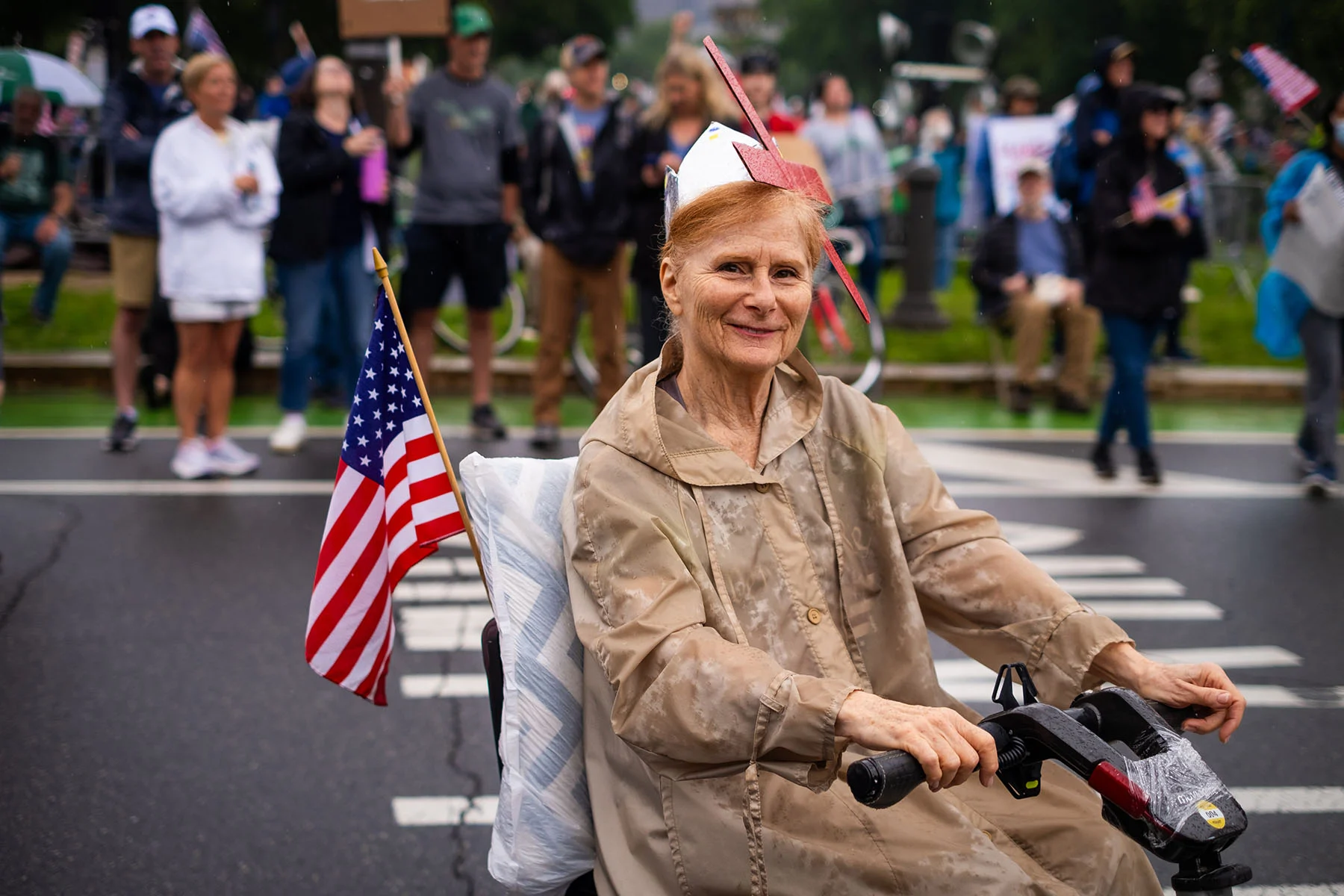
A woman joins the No Kings protests near the Philadelphia Museum of Art on June 14, 2025. (Tara Pixley for The 19th)

Read Amanda Becker’s Loveland, Ohio connection in her Bio below.
This story was originally reported by Amanda Becker of The 19th. Meet Amanda and read more of her reporting on gender, politics and policy.
_____________
SPRINGFIELD, OHIO — The 2017 Women’s March was Barbara Hartwick’s first-ever political protest. She drove from the exurban community where she lived at the time to downtown Cincinnati, a left-leaning city of 300,000 people that anchors the otherwise conservative region. Still, Hartwick said, she felt too nervous to carry a sign or join in most of the crowd’s chants.
Eight years later, having watched President Donald Trump’s political ascent, Hartwick, 63, has gone from a “hesitant” to an enthusiastic protester. When she joined the several hundred people outside Springfield’s city hall on Saturday — among them many retirees who, like her, took to the streets to oppose Trump’s agenda — she held up a sign that read: “Let the wild rumpus start!” She was inspired by the crown-wearing young boy in Maurice Sendak’s children’s book, “Where the Wild Things Are.” It was, she said, a nod to the “No Kings” nationwide rallies.
Hartwick, a retired teacher, said she had “misconceptions” back in 2017 about what protests were like; she had never been politically active beyond voting. The march revealed to her “the camaraderie, the community of people there.” The crowd was “generally peaceful and positive” as they protested and it helped Hartwick realize that other women like her were also frustrated and disappointed with the direction of the country. She discovered that community spirit again Saturday in Springfield, the conservative-leaning city that Vice President JD Vance put on the map during the presidential campaign, when he made false accusations against the Haitian migrants legally living there to make the case for today’s militaristic immigration crackdown.

Protests, Hartwick said, “give people hope.”
Women led prominent protests during Trump’s first term against his presidency writ large, his treatment of women, his now-fulfilled pledge to appoint Supreme Court justices that would overturn the federal right to abortion, his family separations policy at the U.S. border and more. But while Black women have voted against the president in every election, White women voted for Trump in 2016, backed him again at the ballot box in 2020 and then a third time in 2024, according to exit polls. Democratic former Vice President Kamala Harris actually lost support from women overall last year as compared to 2020 across all age groups except one: those over 65.
Headed into Saturday’s protests, the only age group across all genders and races with a lower opinion of Trump than 65+ voters was voters under the age of 30, according to a weekly tracking poll conducted by YouGov for the Economist magazine.
Rural America is older than urban America, so in Saturday’s small-town and suburban protests, the graying nature of the coalition in the streets protesting Trump was visible enough that it caught the attention of local news outlets. The St. Louis Post-Dispatch posted a video of “senior citizens and others” at a protest in the moneyed suburb of Clayton, Missouri. West Virginia Public Radio reported that at a demonstration in Charleston, the state capital, “all ages were represented, but a large contingent of older West Virginians braved the sun and humidity to attend.” Trump had a higher margin of victory in the largely rural state than nearly any other.
Longtime climate activist Bill McKibben, who founded the Third Act organization several years ago to build a community of Americans 60 and older to fight climate change and protect democracy, wrote a recent Los Angeles Times op-ed with Akaya Windwood, an adviser for the group, under the title: “Why older Americans are Trump’s biggest nightmare.”
A research team led by American University’s Dana R. Fisher surveyed the host organizers of Saturday’s events and found that “consistent with the Resistance to the Trump administration during its first term, the majority of hosts and participants were female, predominantly White, and highly educated.” What has changed since the president’s first term, Fisher told The 19th, is that “the people in the streets are older than they were back in the first administration.”
Fisher’s team’s preliminary findings showed that the median age on Saturday for participants in Philadelphia was 36 years old while the median age for protest event hosts nationwide was 67. Their field research in the first months of Trump’s second term shows that participants and organizers protesting the president are more likely to be women, more likely to be older and more likely to be White than participants and organizers of other recent protest movements.
The 2017 Women’s March, held the day after Trump’s first inauguration, was, at the time, the largest single-day protest in U.S. history — between 3.2 million and 5.2 million people, or 1 to 2 percent of the country’s population, participated in more than 400 demonstrations nationwide. Saturday’s “No Kings” protests aimed for the lofty goal of about 12 million people, or about 3.5 percent of the country’s population, a number that reflects the level of participation that political scientists say is necessary to overcome a dictator or authoritarian leader.
Organizers sought to do that by dispersing protests across more than 2,000 locations, many in places where public demonstrations are rare. Cities like Philadelphia and Chicago reported some of the largest crowds, but there were also well-attended events in small towns and mid-sized cities in politically conservative states like Ohio, Missouri, Tennessee and West Virginia.
Jeremy Pressman, co-director of the Crowd Counting Consortium, a joint project of Harvard Kennedy School and the University of Connecticut, said it would be weeks before they can fully tally nationwide attendance. But, he told The 19th by email, it “looks very likely it was one of the largest days of protest in U.S. history.”
It didn’t surprise Hartwick that older Americans, and especially older women, are souring on the president, whose administration has fired tens of thousands of federal workers and shuttered federal programs under the banner of anti-diversity equity and inclusion efforts. Plus, Republicans in Congress are debating legislation that would finance tax breaks for the wealthy by making deep cuts to the Medicaid health insurance program for lower-income Americans and nutrition programs on which many seniors rely.
An aphorism in U.S. politics is that Americans become more conservative as they age; many older women who spoke to The 19th on Saturday noted that it isn’t a conservative approach, in the “small-c” sense of the word, to dismantle government programs and institutions and to upend democratic norms.
“We don’t want to go back. It took a movement to get the right to vote. It took a movement to get Civil Rights. I’ve never in my lifetime lived when rights are taken away — until now,” Hartwick said, lamenting that to younger Americans, Trump’s policies and intensely divided politics likely seem normal.
Also at the Springfield protest was Joan Justice, 84, holding a sign that said: “If there’s money for a parade? Then there’s money for Medicaid!” “I have friends who are in nursing homes and I know the money is running out and it really scares me,” Justice, also a retired educator, told The 19th of the program that covers long-term residential care for lower-income seniors because Medicare, the health insurance program for elderly Americans at all income levels, does not.
Another “No Kings” protest in nearby Middletown, Ohio, a deeply conservative town of about 50,000 where Vance was raised by his grandparents, drew more than 400 and skewed older than Springfield. Among the people gathered at a busy intersection near a large supermarket, hardware store and a panoply of national restaurant chains was a 64-year-old woman who asked to be identified by her first name only, Rebecca, because, she said, she knows Trump opponents who have faced harassment. She was attending her first protest and said, “I want to start getting more active, I want to start writing my congressmen. My parents were Republicans and they would be appalled.”
Standing nearby was Nannette, 74, who requested her surname be withheld for the same reason. She said that “Middletown is a small town, but I’m doing everything I can think of,” attending the April protests against cuts to the federal government that preceded those held on Saturday. “I was a lifelong Republican, and I tried to hold on, but January 6th was the end,” she said. When she sends mail, she puts her stamps with the American flag upside down as a subtle signal of distress.
Hartwick said she sees a recent version of her past self in these older women who are overcoming fears about public demonstrations to protest the president, so she is “finding little opportunities to let people know it’s okay to not like what’s going on right now.”
Just last week, Hartwick said, she was buying posterboard at her local Kroger supermarket when a woman in her late 60s or early 70s asked if she was making signs for a garage sale. “I said ‘no’ and she said ‘oh, what is it for?’ I said: ‘A protest.’ And she whispered: ‘The No Kings protest?’ I said ‘yes.’ And then she said: ‘Good luck.’”
“People might be looking for someone else who feels the way they do because they don’t see it in their own community,” Hartwick said.


Suspect in shooting of Minnesota state lawmakers targeted 2 others that night, prosecutors say
Investigators say Vance Boelter appeared to spend months preparing for the shootings — the latest in a string of political attacks across the U.S. His list of potential targets contained dozens of names, including officials in at least three other states.
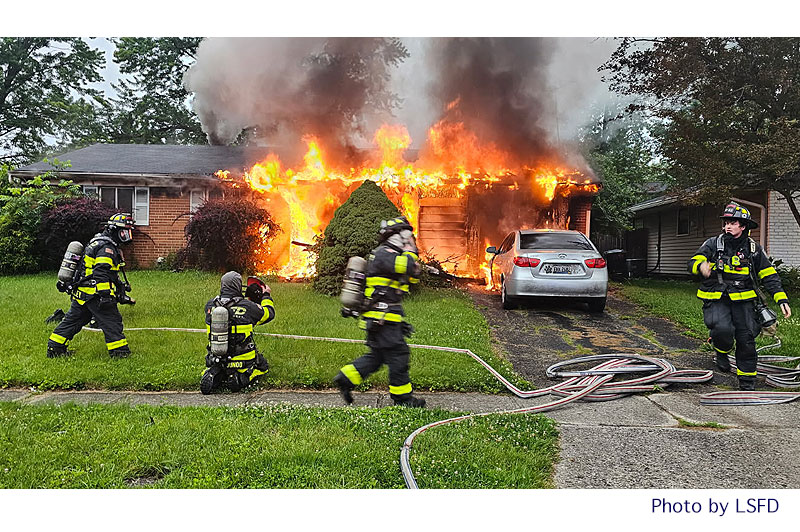
Loveland, Ohio – A senior couple and their pet were saved Saturday morning when their home ignited in fire, filling it with toxic smoke. They were alerted and were able to escape due to a working smoke alarm.
At 6:45 AM on Saturday, June 14, a 1st alarm was transmitted for a dwelling fire on Marbea Drive in the City of Loveland, Ohio. The Loveland-Symmes Fire Department (LSFD) responded with regional automatic mutual aid partners from Deerfield Township, Miami Township-Clermont, and the cities of Montgomery, Sharonville, and Blue Ash.
Smoke alarms woke the couple and when they opened their bedroom door they faced heavy smoke. First responders arrived at 6:48 AM and faced intense fire conditions. The occupants were found in the rear yard as they had escaped safely.
A passerby stayed with the couple, and paramedic crews checked them out as they were shaken but physically uninjured.
Firefighters were able to save some of the couple’s personal paperwork, prescriptions, and other important items, according to the Department.
Investigators are working on determining the cause. LSFD, in coordination with the family and the Red Cross, made sure the couple had a place to stay and were taken care of.
Message from LSFD Deputy Chief Billy Goldfeder
ONCE AGAIN WE ARE REMINDED: WORKING SMOKE ALARMS SAVE LIVES!
Roughly three out of five fire deaths happen in homes with either no smoke alarms or no working smoke alarms. More than one-third (38 percent) of home fire deaths result from fires in which no smoke alarms are present. The risk of dying in a home fire is cut in more than half in homes with working smoke alarms!
LIFE SAVING TIPS FOR HOMEOWNERS, RENTERS, SLEEP-OVERS & FOR DORMITORIES
Working smoke and carbon monoxide (CO) alarms save lives by quickly giving you and your loved ones an early warning signal that something is wrong. Fire spreads fast, and carbon monoxide is a silent killer. Working alarms are the most critical component of your escape plan.
If you are unable to purchase a smoke alarm, the Loveland-Symmes FD will provide one and install it for you at no cost. This service is also available from other area fire departments in each community.
The Loveland-Symmes Fire Department in conjunction with the American Red Cross will come out and test your smoke detectors, inspect their location, and or replace defective batteries and detectors. We will also install a new detector on each door of your home if needed. Please submit your information to the Fire Prevention Request Form and the best time to come out to your home. Please email web-fireprevention@lsfd.org to get more information and schedule a time to check/change your smoke detectors.