Loveland, Ohio– Resident, Dick Dyson went to the Council meeting on May 23 and asked why Councilwoman Pam Gross was the City Council Representative for the Planning and Zoning Commission and was the Vice President of Community Improvement Corporation.
Loveland, Ohio – On Tuesday, May 23, Tom Morris went to the Loveland Council meeting and asked Council to slow down the demolition of City Hall. He told council members that he moved to Loveland because it was a small town that cared more about its history and its people than its desire for growth and revenue.
Morris said that Loveland Station was a blight and the project was handled terribly from selling the land to changing the laws to appease a single developer.
He also said that the community was now stuck with a cheap looking building and traffic problems.
Morris asks Council to slow the demolition of City Hall and have hearings on the project to see if the community actually wants the project to move forward. He said, “There is a suspicious lack of information about the project”
Morris said, “Instead of talking down to people, perhaps you should be explaining to us like the voting adults we are, why this is a project the City needs.”
Power Ryde in Miami Township recently raised $2100 for NEST which supports and educates Loveland children under the poverty level.
The next Power Ryde fundraiser is for the Loveland fire survivors on Saturday, June 24 at 10:30 AM. For a $20 minimum donation, you can attend a 45-minute spinning class on the RealRyder tilting bikes. Casey Hilmer, Founder and Co-owner of Power Ryde, will teach the class.
Megen Hilmer said, “It’s important for people to sign up for the class ahead of time if they want to spin. If the 10:30 AM class fills, we will add an additional class(es). People don’t have to spin, but can just come to the Open House to support the fire victims. ALL proceeds from the fundraiser will be given to the victims.”
You won’t pay until the fundraiser on June 24 (either cash or check made out to the Loveland Fire Victims). There is a donation jar on Power Ryde’s reception desk so people can still contribute even if they can’t attend the fundraiser. People can get sponsors as well.
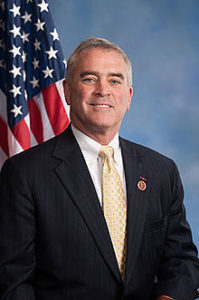
Congressman Brad Wenstrup (OH-02) released the following statement following the shooting in Alexandria this morning:
“You never expect a baseball field in America to feel like being back in a combat zone in Iraq, but this morning it did. Capitol police and emergency responders reacted swiftly and courageously – we are grateful for their presence. I urge the nation to keep Rep. Scalise and all injured in their prayers today.”
Read more: A report from CNN about Wenstrup helping his fellow congressman http://cnn.it/2s0JlBD
Mayor Mark Fitzgerald announced at the beginning of the May 23 Council meeting that he has instituted a “zero tolerance policy” towards whispering or passing documents during meetings. The Mayor in recent months has used his gavel indiscriminately and in a random manner to quiet the audience attending meetings. He routinely warns them against applauding what their fellow citizen’s say during the open forum portion of meetings. Lately, he has warned citizens he will use the police force to remove anyone who disrupts the meetings
Less than five minutes later, when Councilwoman, Pam Gross walked to the same podium the public uses, he allows, and joins, in applauding Gross’ presentation. Then, seconds later, when resident, Mike Meldon followed Gross to the same podium, and the audience applauded Meldon’s comments about how important the environment was to the community, the Mayor said he was issuing his final warning about applause and he will be asking the police to remove anyone who, “Disrespects that request.”
The Mayor was speaking on behalf of all of Council. None objected to the policy. There are two other people sitting at the council table who also remained silent, Dave Kennedy, the City Manager and Joe Braun, the City lawyer. These are the two professionals Council hires to keep them out of trouble. Professionals, who have been hired based on their knowledge and expertise of the law and how a municipality operates within the laws of Loveland’s Charter, the Ohio Constitution, the Ohio Revised Code, and the Constitution of the United States.
[quote_box_left]No matter, Fitzgerald needs counsel now, and there are nine people who have a sworn duty to deliver it to him, because, sitting on your hands is equivalent to sitting on the Constitution.[/quote_box_left]In addition, the Loveland Police Chief is almost always in the room, another professional the City has hired to protect citizen’s rights.
Nine people who are sworn to protect our citizens have sat silent and not objected while the Mayor, at random whim, takes away the public’s right to free speech, and threatens to use the “color” of the police department for enforcement.
See below just recent examples of how Fitzgerald shows favor to certain subjects and individuals and bullies other silent.
If in his randomness, Fitzgerald continues, or heaven forbid has someone removed from the room or arrested, he will have hoed himself and taxpayers a deep, deep furrow because of his discrimination. He will certainly lose in court, and it will be taxpayers paying the bills.
Fitzgerald’s discriminatory, gavel is causing turmoil in our community and doing harm to the Community’s reputation.
Perhaps there are three “majority” members of Council who are afraid that if they cross the Mayor they will be treated to the same wrath and scolding, but that is not an adequate excuse. Perhaps the other three “minority” members of Council are sitting on their hands, thinking ahead to election time, letting the Mayor dig his deeper furrow.
No matter, Fitzgerald needs counsel now, and there are nine people who have a sworn duty to deliver it to him, because, sitting on your hands is equivalent to sitting on the Constitution.
In this LOVELAND MAGAZINE TV video, you will see clips of the Mayor indiscriminately enforcing his rule against applause within about ten minutes of issuing his warning. He allows applause when fellow council member Pam Gross takes the podium, and himself is seen applauding, but gives the audience a final warning when the next speaker, a resident, speaks about the importance of Loveland’s environment.
In this LOVELAND MAGAZINE TV video, you will see other clips of the Mayor indiscriminately enforcing his rules. In one clip from several meetings ago you will see Fitzgerald telling resident Tom Calarco to turn around and speak to Council and not the public. Calarco had only turned his head, looking to see if there were any police officers in the room, whom he had just complimented. In the next clip, you will see Fitzgerald allowing Councilwoman Gross to rearrange the microphone on the podium so she could stand behind the podium, and address the audience with her back to the rest of Council.
It will take action by each of us this weekend to lower the risk to our children
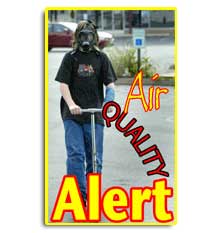
Loveland, Ohio– The Southwest Ohio Air Quality Agency has issued an Air Quality Advisory for Saturday, Sunday, and Mondayfor Loveland. and the surrounding counties of Butler, Clermont, Hamilton and Warren in Ohio, and Boone, Campbell and Kenton counties in Kentucky.
The Agency expects to see levels of ozone in the “unhealthy for sensitive groups” range on the Air Quality Index (AQI).
Health Message: Active children and adults, and people with lung disease, such as asthma, should reduce prolonged or heavy exertion outdoors.
On Air Quality Advisory days, everyone can help reduce ozone formation by taking the following actions:
Bike, or walk instead of drive.
Refuel your vehicle after 8 p.m.; do not top off when refueling and tighten the gas cap.
DON’T RIDE YOUR MOTORCYCLE
Do not idle your vehicle; exhaust contributes considerably to ozone formation.
Combine trips or eliminating unnecessary vehicle trips.
Avoid use of gasoline-powered lawn equipment on Air Quality Advisory days.
Avoid use of oil-based paints and stains on Air Quality Advisory days.
Never burn leaves or other yard trimmings.
Suspend use of fire pits, campfires and grills on Air Quality Advisory days.
Conserve electricity by turning out lights and unplugging unused appliances and electronics.
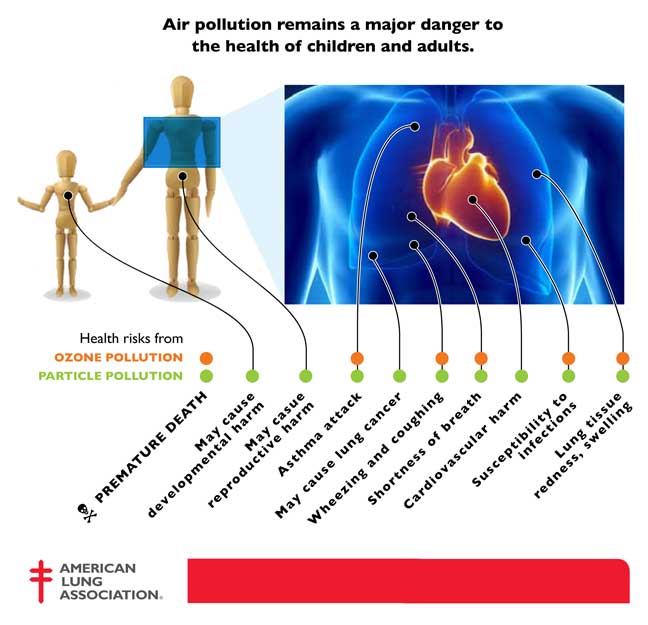
Children face special risks from air pollution because their lungs are growing and because they are so active
Just like the arms and legs, the largest portion of a child’s lungs will grow long after he or she is born. Eighty percent of their tiny air sacs develop after birth. Those sacs, called the alveoli, are where the life-sustaining transfer of oxygen to the blood takes place. The lungs and their alveoli aren’t fully grown until children become adults.1 In addition, the body’s defenses that help adults fight off infections are still developing in young bodies.2 Children have more respiratory infections than adults, which also seems to increase their susceptibility to air pollution.3
Furthermore, children don’t behave like adults, and their behavior also affects their vulnerability. They are outside for longer periods and are usually more active when outdoors. Consequently, they inhale more polluted outdoor air than adults typically do.
Air Pollution Increases Risk of Underdeveloped Lungs
A Southern California Children’s Health study looked at the long-term effects of particle pollution on teenagers. Tracking 1,759 children who were between ages 10 and 18 from 1993 to 2001, researchers found that those who grew up in more polluted areas face the increased risk of having underdeveloped lungs, which may never recover to their full capacity. The average drop in lung function was 20 percent below what was expected for the child’s age, similar to the impact of growing up in a home with parents who smoked.5
Community health studies are pointing to less obvious, but serious effects from year-round exposure to ozone, especially for children. Scientists followed 500 Yale University students and determined that living just four years in a region with high levels of ozone and related co-pollutants was associated with diminished lung function and frequent reports of respiratory symptoms. 6 A much larger study of 3,300 school children in Southern California found reduced lung function in girls with asthma and boys who spent more time outdoors in areas with high levels of ozone.
For 17 years, the American Lung Association has analyzed data from official air quality monitors to compile the State of the Air report. The more you learn about the air you breathe, the more you can protect your health and take steps to make our air cleaner and healthier.
Drive less. Combine trips, walk, bike, carpool or vanpool, and use buses, subways or other alternatives to driving. Vehicle emissions are a major source of air pollution. Support community plans that provide ways to get around that don’t require a car, such as more sidewalks, bike trails and transit systems.
Use less electricity.Turn out the lights and use energy-efficient appliances. Generating electricity is one of the biggest sources of pollution, particularly in the eastern United States.
Don’t burn wood or trash. Burning firewood and trash is among the largest sources of particle pollution in many parts of the country. If you must use a fireplace or stove for heat, convert your woodstove to natural gas, which has far fewer polluting emissions. Compost and recycle as much as possible and dispose of other waste properly; don’t burn it. Support efforts in your community to ban outdoor burning of construction and yard wastes. Avoid the use of outdoor hydronic heaters, also called outdoor wood boilers, which are frequently much more polluting than woodstoves.
Make sure your local school system requires clean school buses, which includes replacing or retrofitting old school buses with filters and other equipment to reduce emissions. Make sure your local schools don’t idle their buses, a step that can immediately reduce emissions.
Clermont County residents who have an interest in assisting with the direction of local addiction and mental health services in the county are invited to contact the Clermont County Mental Health and Recovery Board (CCMHRB) about volunteer positions on its Board of Directors.
There are currently two vacancies on CCMHRB’s Board of Directors. As of July 1, there will be an additional four vacancies, as four current board members will have served their full terms and will be leaving the Board.
The Board of County Commissioners is responsible for appointing eight members of the board. Three of the vacant positions will be appointed by the County Commissioners, from applications gathered and reviewed by the CCMHRB. Applicants must be a resident of the county and have an interest in mental health and/or alcohol/drug issues.
Three positions will be appointed by the Ohio Department of Mental Health and Addiction Services (OMHAS), which is responsible for appointing six board members. Priorities for these OMHAS appointments will be to a person who has received services for mental health issues or alcohol and/or drug use, a family member of someone who has or had a mental health or addiction issue, or someone who is working or has worked in the mental health or addiction field, or who has been involved in advocating for mental health and/or alcohol/drug services.
The selected individuals will be part of a 14-member board representing a variety of interests, including professionals from the mental health and alcohol/drug fields, family members, individuals in recovery, and community representatives. The board meets monthly on the second Monday of the month at 7 p.m.; members also are involved periodically in committee meetings. Terms for Board members are four years, and a member can serve two terms.
CCMHRB is the local board of alcohol, drug addiction, and mental health services. It is the county agency responsible for planning, monitoring, evaluating, and funding all mental health and addiction services in the county provided through public dollars.
If you are interested in serving on the Board, please send a letter of interest and a resume to CCMHRB at 2337 Clermont Center Drive, Batavia, OH 45103 or by email to cknoblauch@ccmhrb.org. For more information, call the CCMHRB office at 513.732.5400.
Loveland, Ohio– On May 9th Jay Stewart the President of the Community Improvement Corporation (CIC) presented the final recommendations to City Council with options on how to repurpose the City Building. Part of the recommendation was for Council to hold “public hearings” on the recommendations before proceeding with the project. Mayor Mark Fitzgerald asked for a motion to hold a hearing at the next meeting.
Both Weisgerber and Phelps wanted more than a “public hearing” style of opportunity for the public to weigh-in on the proposal. They want a more give and take opportunity for the public, where there would be dialogue, instead of monologue; a more informal format. Weisgerber said he wanted, “General sessions, informational sessions, or charrettes with the public to get input.”
Phelps said that this was the first-time the CIC has addressed City Council to discuss the repurposing of City Hall. He had the same questions as Weisgerber, and, “More.” He wanted to find out more about the process and how the CIC arrived at their recommendations, and why the three- story option was eliminated. Both Phelps and Weisgerber said that he would not be in favor of holding a public hearing at this point.
Fitzgerald thought Council should follow the recommendation of the CIC.
The motion by Vice-Mayor Angie Settell was voted down with a 3-3 tie vote. Fitzgerald, Settell, and Pam Gross voted, “Yes.” Ted Phelps, Rob Weisgerber, and Kathy Bailey voted, “No.” Stephen Zamagias was absent.
Weisgerber then moved to have no less than three open sessions with the public in Council Chambers, during after-work hours that all of Council can attend, to talk about design options and receive public input. The motion was seconded by. Bailey. The motion received loud applause from the audience.
Phelps said the meetings proposed by Weisgerber would allow, “Stakeholders, neighboring property owners, and downtown residents to weigh-in on the project.”
Fitzgerald then said he did not understand why Weisgerber did not want to begin with the formal type of public hearing at the next council meeting that was the recommendation of the CIC. He then abruptly shut off debate on the motion and called for a vote.
The motion also failed, with a 3-3 tie, reversing their votes on the earlier Settell motion.
During the open forum part of the meeting, Diane Powers asked Council to have three or four, “across the table discussions” to build trust and dialogue with the residents and stakeholders. She urged Council to “take some time off” before they position themselves, and take a vote.
Fitzgerald said he found it, odd that Powers would want to delay the recommendation of the CIC, because, “It would not preclude other meetings.”
Steven Smith also took a turn at the podium urging more community input on the project and explained in a detailed handout, how it could be accomplished.
These two LOVELAND MAGAZINE VIDEOs are of the Council votes.


![[VIDEO] Dick Dyson wants answers about Pam Gross sitting in too many seats](https://lovelandmagazine.com/wp-content/uploads/2017/06/maxresdefault-23-100x65.jpg)

![[VIDEO] Tom Morris says there is a suspicious lack of information about City Hall project”](https://lovelandmagazine.com/wp-content/uploads/2017/06/maxresdefault-22-100x65.jpg)




 Congressman Brad Wenstrup (OH-02) released the following statement following the shooting in Alexandria this morning:
![[EDITORIAL] Council and City staff must curb Mayor Fitzgerald’s reign of error](https://lovelandmagazine.com/wp-content/uploads/2017/06/qtq80-7MqV1B-100x65.jpeg)







![[Video] Loveland’s 2017 Memorial Day Parade](https://lovelandmagazine.com/wp-content/uploads/2017/06/maxresdefault-11-100x65.jpg)

 For more information go to: