(Reprinted with permission from a social media post of Jamie Smith)
by Jamie Smith
There will be a planning and zoning meeting at Loveland City Hall Wednesday, May 4th at 7 PM, with a demonstration beforehand at 6 PM to rally against the petition Drees is submitting for an (SPD) proposal.
Jamie’s family is often on the Grailville Farm. “My dogs have their absolute biggest smiles here, as do my kids and I.”
The granting of an SPD would allow them to build over 200 homes on the land that was annexed originally for “low-density housing.” This neighborhood of about 206 homes would sit on the south side of the old Grailville property, between Saint Columban Church and the north side of Grailville (their current offices).
The building of yet another non-distinct neighborhood in Loveland would destroy several historically rich and architecturally beautiful buildings that hold much significance in the hearts of many Loveland residents. Even a stranger passing by, with no knowledge of the importance of the work that was done there, is struck at the beauty of the place.
The women (and men) who started the mission here at Grailville were so dedicated to the righteousness of its cause that many of its early devotees are buried on-site, in the loveliest little cemetery on the north side of O’Bannonville Road.
Some of the reasons I feel very strongly against the actions aimed at adding yet another subdivision to our previously rolling river valley and forested areas are as follows:
1. It is my favorite place in Loveland, exactly as it is, in its natural state. My dogs have their absolute biggest smiles here, as do my kids and I.
2. I and my children have gained much peace and happiness from our exposure to the blessings of the land, water, and sky at Grailville. We have shared this joy with others. This land has kept us healthy physically and mentally. I can feel instant decompression upon starting my explorations there.
3. The place has a beautiful historical significance. You can explore the beginnings of the good that has been done on this land starting with this LINK. The historical films created, however, don’t even begin to touch on the good work that was done up until current times.
4. Not only have many historic buildings of Loveland been destroyed that are tragically gone FOREVER, but the greenspace in Loveland is rapidly disappearing, to the point that Grailville is the “last of the Mohicans.” Losing the large stretch of greenspace that connects fields to the “wilderness” on the north side would have a hugely detrimental impact on local wildlife, as well as on the human beings that regularly seek solace in the fields and woods of its paths.
5. TRAFFIC IN DOWNTOWN LOVELAND
“I and my children have gained much peace and happiness from our exposure to the blessings of the land, water, and sky at Grailville.”
6. GREED over NATURE
7. Absolutely zero benefits to Loveland residents, only more destruction, construction, and overcrowding of our streets….adding to issues of congestion instead of working on solutions.
8. Once this land is developed, the sanctity and purity of the place will be lost forever. We are Loveland, and beginning to look like Liberty Township, a “run-on sentence of subdivisions.” We are a town rich in farming and RR history. Let’s not erase YET ANOTHER part of our heritage. There is enough history at Grailville to erect a small museum to the humanitarian work and personal development that was achieved there and carried throughout other communities in the hearts of members of the Grail.
9. The land is certified organic, which is no small feat.
10. About 10 million reasons this ties into the bigger picture of the environmental crisis: urban sprawl (in turn, increasing urban blight), loss of greenspaces for migratory species, the immediate destruction of the habitat for countless plant and animal species, loss of biodiversity, etc., etc., etc.
11. The thought of losing this place and the PEACE IT HAS BROUGHT MY FAMILY, and having to deal with the congestion of another subdivision literally breaks my heart….and I am not alone.
Come show your solidarity. Let’s not let an out-of-state developer take what’s left of who we are! These historic places, YES EVEN OPEN PLACES, FARMS….this is what Loveland was, and part of it always should be! We need to retain a connection to what draws people to love this land.
A look at how overcrowding and poor design contributed to two of the worst national outbreaks
This article was provided by Eye on Ohio, the nonprofit, nonpartisan Ohio Center for Journalism. Please join their free mailing list as this helps us provide more public service reporting.
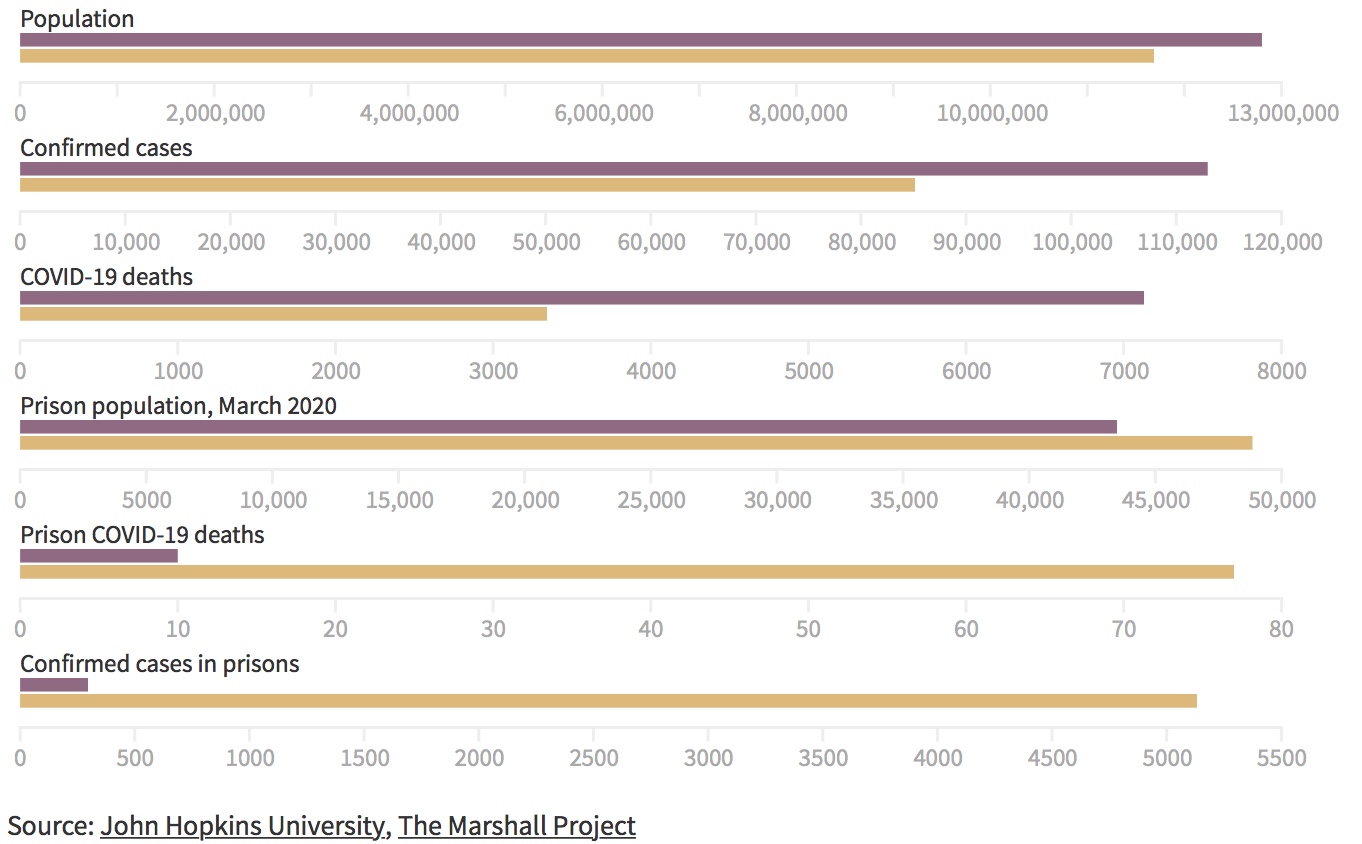
For the first two months after the COVID-19 pandemic hit the U.S., Ohio’s response set an example. Thanks to an early shutdown order, the state’s per-capita deaths from the virus as of late April were less than half of those in neighboring Pennsylvania, a state with similar demographics.
But inside the two states’ prison systems, it was a different story.
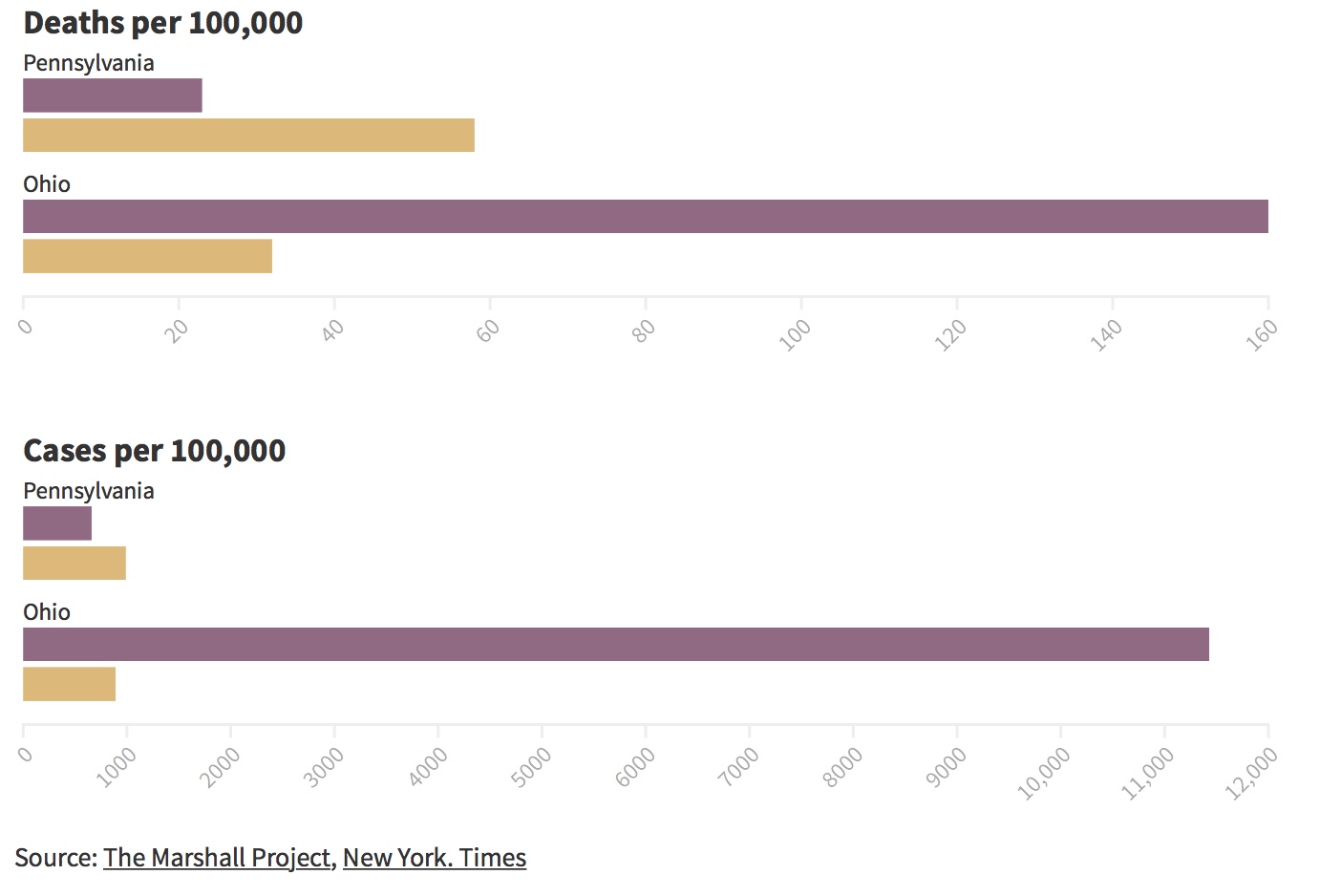
By late April , the death rate from COVID-19 in Ohio prisons was 22 per 100,000, a rate more than 4 ½ times the overall Ohio rate and nearly twice the national rate.
As of August 14, there have been 77 inmate deaths known to be caused by COVID-19, and another 10 suspected— a rate of 160 deaths per 100,000 people. Ohio’s prisons have incubated two of the four largest COVID outbreaks in the nation.
In Pennsylvania’s prison system, which houses about 44,000 inmates at 25 facilities, the death rate was comparatively low— 10 incarcerated people have died as of mid August, for a death rate of 23 per 100,000 people, despite the virus showing up in each state just a few days apart. In fact, a Pennsylvania inmate is less than half as likely to die of COVID-19 as a free Pennsylvanian.
Why have Ohio’s prisons failed so thoroughly to control the spread of COVID-19 when Pennsylvania fared far better?
No state has had a model approach for controlling the virus in prisons. All have made missteps that put inmates’ and staff members’ lives at risk, according to prisoners and prisoner advocates. Prison outbreaks have also spread into the communities outside their walls. But, whether through foresight or luck, factors in some states have kept the virus from running rampant as it has in Ohio prisons. As the country faces new waves of cases, corrections departments may be able to learn from what helped or harmed some states during the first stage of the pandemic.
While advocates for incarcerated people in Pennsylvania caution against holding that state’s experience as a model for how to respond to the pandemic, they agree that the answer may lie both in how crowded the prisons are, and how inmates are housed.
Crowded prisons spread disease
Controlling an outbreak of infectious disease in a prison is never easy. As with other communal living facilities such as nursing homes, once a respiratory illness enters, close quarters gives a virus ample opportunity to spread.
Overcrowding only makes the situation worse.
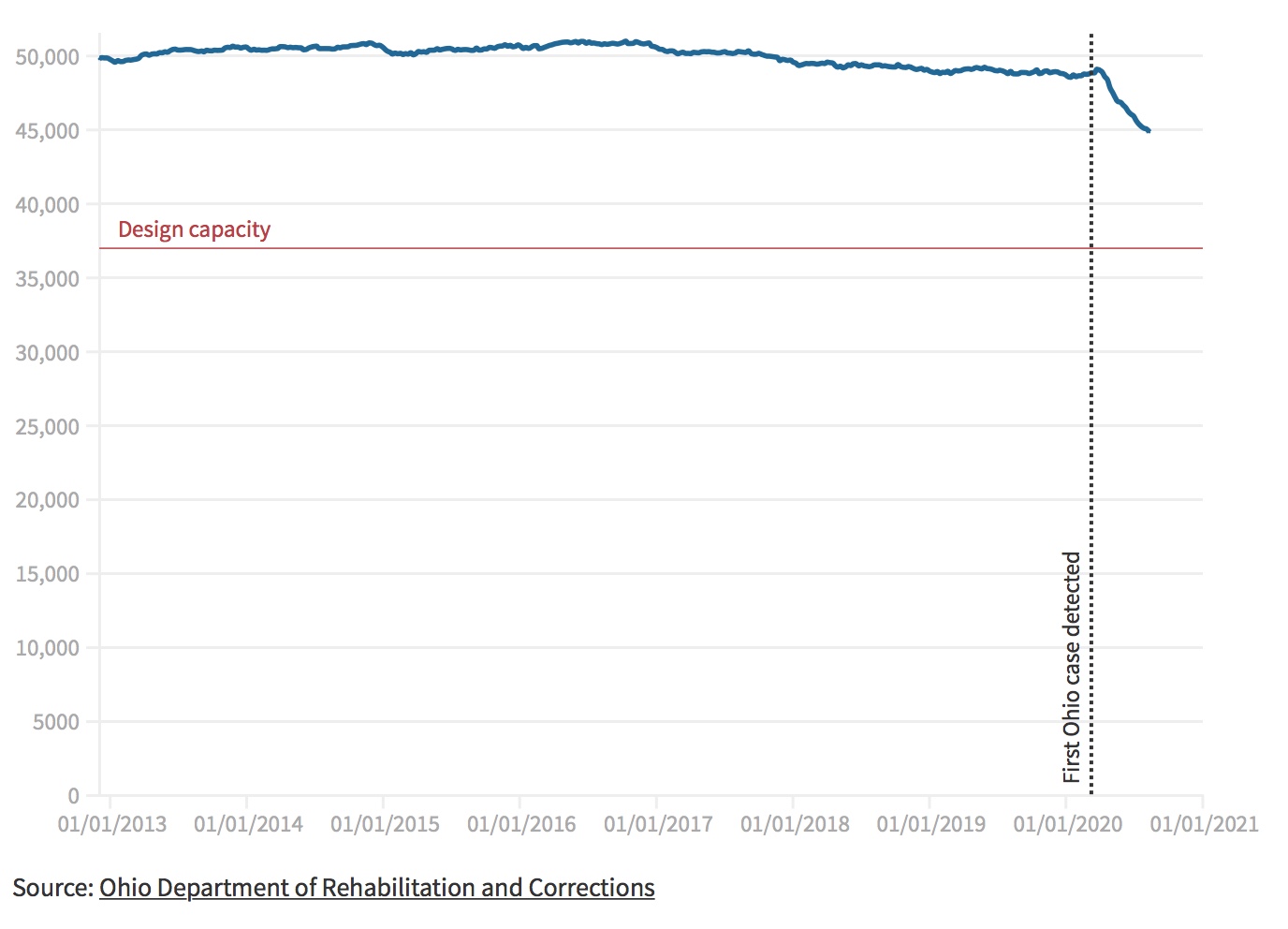
In Ohio, where the prisons were 32% above capacity in February, the virus spread rapidly.
In Pennsylvania’s prisons, at 95% of capacity in February, there were outbreaks in several prisons, but far fewer deaths.
That state’s biggest outbreak to date—183 infections and five deaths among inmates— happened at its oldest prison facility, the 131-year-old State Correctional Institution (SCI) Huntingdon in central Pennsylvania.
“SCI Huntingdon dates from the late 1800’s and has cells with open bars, and four-story housing units with open air shafts to all of the cells,” said Claire Shubik-Richards, executive director of the Pennsylvania Prison Society, a non-profit inmate advocacy organization. “So when the virus came in it spread like wildfire.”
In other, newer Pennsylvania prisons with significant outbreaks, such as SCI Phoenix, the virus proved easier to control. Only 49 inmates at Phoenix, which opened about 2 years ago, have tested positive, and four have died, despite being located in hotspot Montgomery county, just north of Philadelphia.
“The thing about that facility was that the outbreak went up and then went down pretty quickly because it’s a facility where isolating people is pretty easy,” Shubik-Richards said, because it has more single and double-occupancy cells than open dorm units.
In Ohio’s more crowded prison system, the virus was first detected in a staff member in the 66-year-old Marion Correctional Institution on March 29. Less than a month later, nearly 4,000 inmates across the state had tested positive for the virus; 10 were dead, as was one staff member.
Now, the death count is approaching 80. Ohio’s prison system is home to two of the four largest COVID-19 outbreaks in the nation, with 2,440 cases at Marion Correctional Institution in rural central Ohio, and 1,792 at Pickaway Correctional Institution outside Columbus.
Pickaway, built in the 1920s as a mental hospital and converted to a prison in 1984, was designed to hold 1,328 people. As the pandemic began in Mid-March, it held 2,047– 54 percent over capacity.
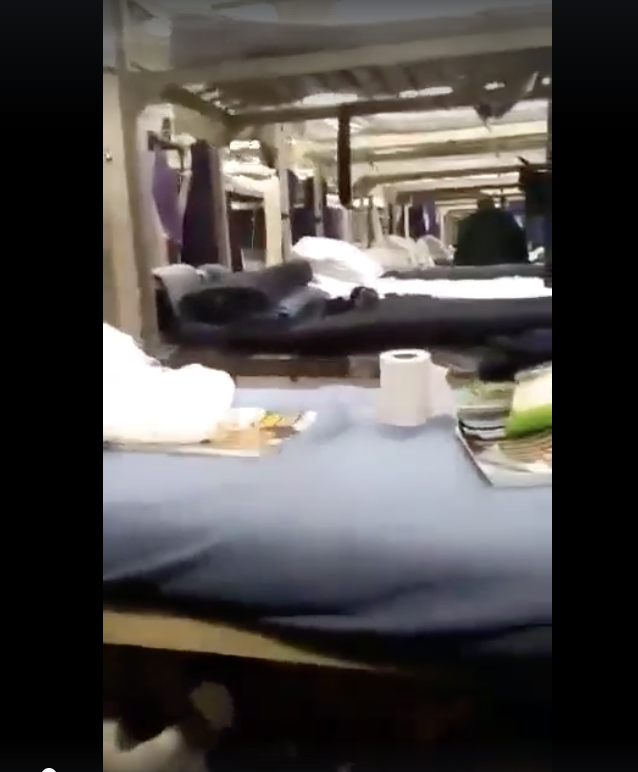
In one cell phone video that purportedly shows the inside of Pickaway, seemingly endless racks of double-bunked beds are visible, with no barriers and little space between.
“Everybody’s stacked on top of each other, man,” says the person wielding the camera. “Ain’t no social distancing in here….They’re playing with our lives, man.”
Picture of Ohio dorms
Virus runs amok in dorms
Pickaway was designed to have 87% of its beds in open double-bunk dorms, described in a 2015 state prison renovation plan as “barrack-style” (sic), where beds were typically three feet apart. When prisons are overcrowded, staff often squeeze even more beds into the dorms than they were designed to hold, said Meghan Novisky, a Cleveland State University professor who studies how prisons impact health.
In the 2015 master plan, state officials acknowledged that the prison’s dorm-style housing was a problem, not because of disease, but because it elevated prisoners’ stress, setting the stage for unrest.
“A critical need is to improve the dormitory living conditions and reduce the very high levels of crowding,” the report said. “The [Strategic Capital Master Plan] recommends the phased conversion of all dormitory living units to a cubicle-type configuration where inmates will have a higher degree of personal space and privacy.”
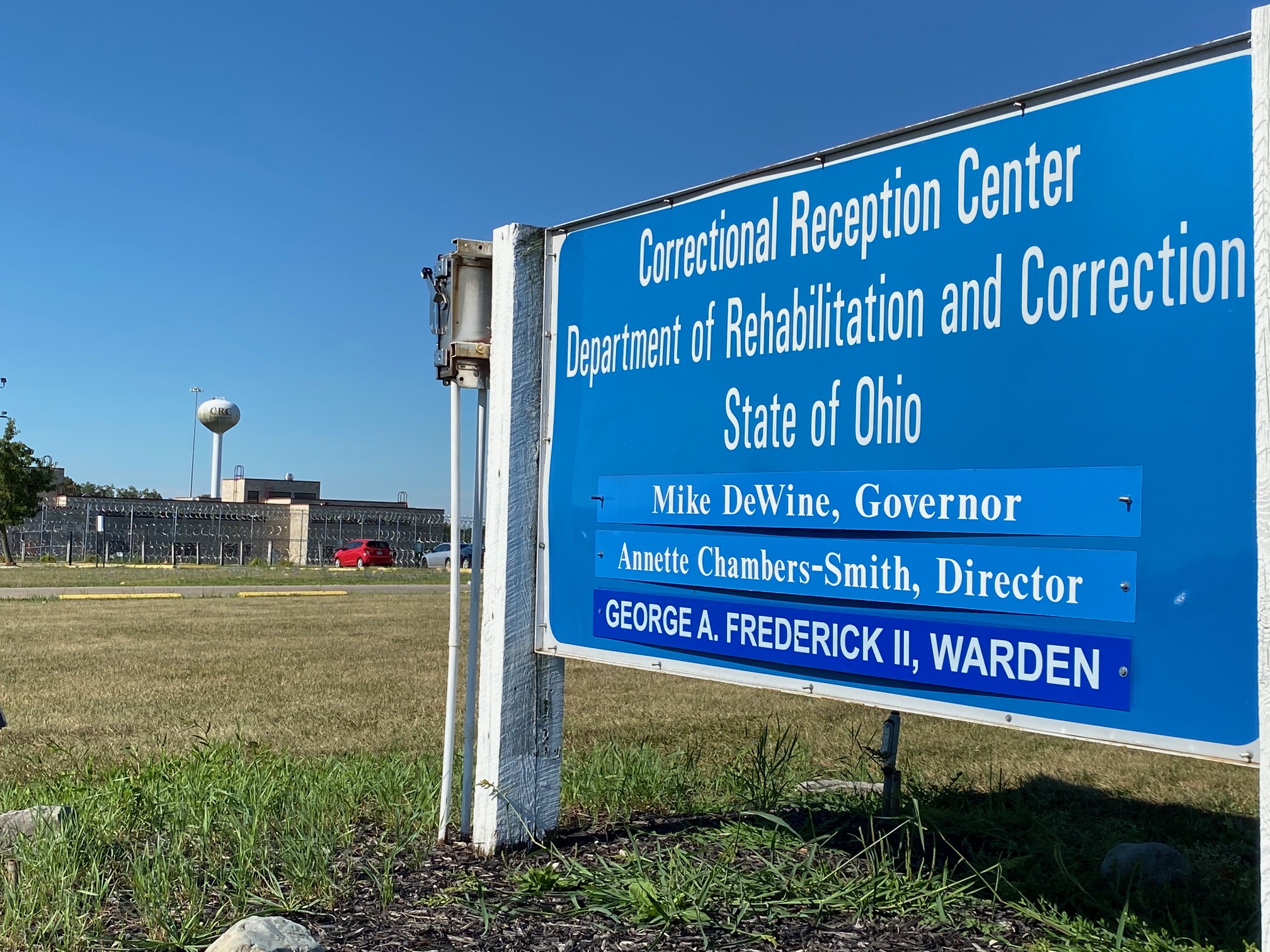
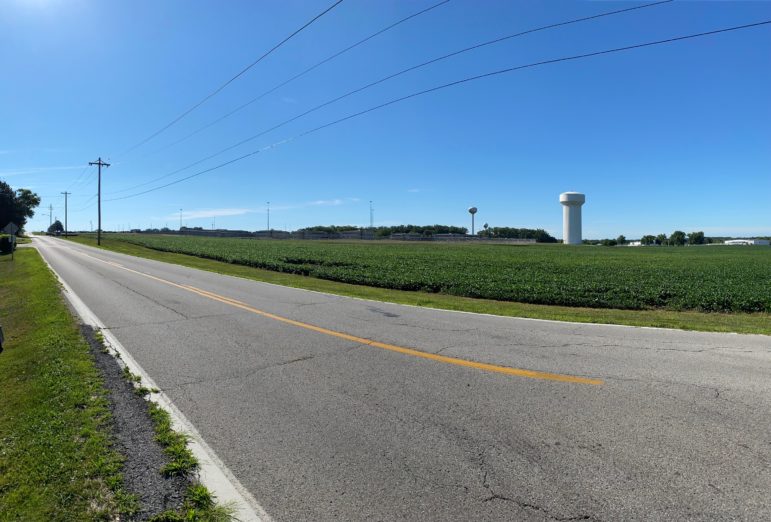
Outside Pickaway Correctional Institution. (Photo Credit Eye on Ohio)
Ohio Department of Rehabilitation and Correction (DRC) spokesperson JoEllen Smith said that some of the plan’s recommendations for Pickaway have been implemented. The Orient Correctional Institution, a prison adjoining Pickaway that hasn’t been used since 2001, was demolished, as was Pickaway’s dilapidated E block of dorms. But construction of a new unit with over a thousand beds is on hold due to the pandemic.
Around March 29, leadership at Marion – designed to hold 73% of its inmates in dorms – declared that prisoners in dorms would sleep arranged head-to-foot. That way their faces would be more than three feet apart, according to an email between the prison’s medical services director and the Marion County public health department, obtained by the Documenting COVID-19project at The Brown Institute for Media Innovation.
According to daily statistics released from Ohio DRC, on April 21, more than 28,000 of the state’s 48,396 inmates were either “isolated” or “quarantined.” But in overcrowded prisons where most inmates lived in dorms, both happened in groups, according to numerous inmates.
Daily coronavirus reports from DRC noted that “isolation” meant keeping infected inmates away from those who weren’t sick, while “quarantine” meant “limiting the movements” of someone who may have been exposed to the virus. Guidance issued by the DRC early in the pandemic said it was preferable to quarantine inmates in the infirmary, but if not enough cells were available, they could be “quarantined” in “an area large enough to hold beds and equipment for a minimum of 50 patients.”
Marion was designed to hold 450 inmates in cells. On April 16, 2,417 inmates there were listed as “in quarantine.”
The close quarters of dorm-style housing is a problem in other Ohio prisons, too, inmates reported.
Javalen Wolfe, an inmate incarcerated in dormitory-style housing at Belmont Correctional Institution in southeastern Ohio, said that every time a flu or a cold enters the prison, there’s no stopping it.
“This is how it works because we live so close together. If one person gets sick, everybody gets sick,” he said. “We are literally two feet, maybe two and a half feet between the next person, and there’s no divider, no wall.”
At least nine Belmont inmates had died of COVID-19 as of Aug. 10. Belmont was designed to have 1,855 beds, over 90% of which would be in dorms. As of March 17, near the beginning of the outbreak in Ohio, 2,719 inmates were crammed into the prison— 146% of the population it was meant to hold.
Of the 77 confirmed COVID-19 deaths in Ohio prisons as of mid-July, 67 of them were in prisons that were designed to hold at least half their inmates in dorms. Of the deaths in prisons made up mostly of cells, 10 were in Franklin Medical Center, a small prison dedicated to caring for the system’s most seriously ill inmates.
The worst Pennsylvania outbreaks were at two prisons where inmates were housed almost exclusively in cells – Huntingdon and Phoenix. But the system overall houses just 19% of its inmates in dorms. Roughly 60% of Ohio’s inmates live in dorms, according to Department of Rehabilitation and Corrections Director Annette Chambers-Smith. Each dorm can hold anywhere from 40 to 300 inmates.
And even Pennsylvania’s worst prison outbreaks paled in comparison to Ohio’s. At Huntingdon, the prison with the most deaths, 359 coronavirus cases were confirmed, out of 1,835 inmates. Phoenix housed 2,825 inmates as of late July, 89 of whom tested positive for COVID-19 at some point.
Since mass testing wasn’t conducted at any of the Pennsylvania prisons, the death toll is probably a more faithful indicator of the spread of the disease. The inmate death rate at Huntingdon was 272 COVID-19 deaths per 100,000 people. At Pickaway, it was 1,709, and at Franklin Medical Center, it was over 2,000.
In an interview with Eye on Ohio, DRC Director Annette Chambers-Smith acknowledged that the open bays make it difficult to control the virus. She said they have attempted to mitigate dorm crowding by spreading inmates out in other areas that aren’t normally used for housing, such as gymnasiums and classrooms.
”They literally installed lavatories and facilities in a building so that it could be used overnight to house people,” she said.
And administrators are experimenting with makeshift barriers between dormitory beds at most of its prisons to reduce transmission.
Reducing overcrowding– release of prisoners
Pennsylvania started the pandemic in a relatively good position in terms of space after years of modest, gradual population reduction. They freed up more space after the pandemic hit by giving 3,500 people sentence reprieves and shutting down the county court system.
Several other states have taken steps to free up space in their prisons since the pandemic began, with 15 reducing their prison populations 10% or more between March and June, according to data from The Marshall Project.
Connecticut has taken the most drastic measures, cutting its inmate population by more than 22%, from 12,364 on March 8, the day the virus was first detected in a Connecticut prison, to 9,604 on August 12. Six inmates have died so far in the Connecticut system, which houses only 12,000 inmates thanks to a decade-long pre-pandemic decarceration effort that reduced the population from about 20,000 in 2008.
Compared to the state’s prison population in March, its per-capita death rate has been less than half that of Ohio’s prisons.
That’s despite the fact that, according to prisoner advocate groups in Connecticut, the state made many of the same missteps as Ohio in their attempts to quarantine and isolate inmates.
Melvin Medina, public policy and advocacy director for the ACLU of Connecticut, said that the CDC has recommended isolating people with laboratory-confirmed COVID-19 together and quarantining close contacts together as a group due to limited space in prisons, but did not indicate how large these groups can or should be.
“Our DOC took that to say that in dorm-style settings if there was one sick person in a dorm of 100 people, that meant that whole block was quarantined together,” he said. “They locked sick and healthy people in together and let the virus run its course. In hindsight, I’m deeply thankful that our death count was really low. We could have had a disaster, and we got very lucky.”
Advocates like Novisky say releasing inmates is the best way to protect them from COVID-19, since any group housing makes it hard to control the spread of disease. Even in places where prison populations have dropped by double-digit percentages, advocates say it’s not enough.
“They need to release those that are medically vulnerable,” based on the CDC’s criteria, not just those who are close to the end of their sentences or incarcerated for non-violent offenses, said Nyssa Taylor, criminal justice policy counsel for the American Civil Liberties Union of Pennsylvania. The state is home to about 4,000 older adults serving life sentences, she said, one of the highest such populations in the country.
“I don’t think we should be politicizing who to release,” she said. “I think it’s really important to look at how to save lives, not just ‘release all the non-violent.”’
Meanwhile, Ohio’s prison population fell by about 5.2% between March and June. By August 11, it had fallen 9%.
“I think part of the problem that they’re running into is we really haven’t taken advantage of options to reduce our population size,” said Novisky.
On April 15, Ohio Gov. Mike DeWine announced he was invoking an overcrowding statute to release some prisoners early. Inmates who were within 90 days of their planned release date could be eligible for early release, but only if they met a list of criteria. That excluded people convicted of most types of violent crime, who had served more than one sentence, who had previously been denied judicial release, or who had committed a serious infraction while in prison.
“It basically eliminated everyone,” Novisky said.
Chambers-Smith said the department has taken multiple steps to reduce the population, including reviewing cases of elderly inmates or those with health conditions that make them especially vulnerable to COVID-19. The list of crimes that disqualify inmates for early release under Ohio’s emergency overcrowding law, she noted, is set by the Ohio legislature. The law would have to be amended to loosen those criteria.
“There are more serious crimes where you wouldn’t want to think about people getting out before they’re ready,” she said. “There’s a balancing act here between keeping the public safe and keeping the people in prisons safe.”
Of the 77 Ohio inmates who have died of COVID-19, 34 — more than half— were in prison for sex offenses. Another 18 had been convicted of murder. The average sentences for rape or murder are more than 20 years. Many of the men killed by the coronavirus had grown old in prison.
But most Ohio inmates are serving time for lesser crimes. Only about 12% of Ohio’s inmates were convicted of murder, and 16% were sex offenders. Meanwhile, 15% of Ohio’s inmates were in prison for drug offenses, with 10% serving time for burglary.
But almost a third of Ohio’s inmates released in 2014 ended up back in prison within three years, according to the most recent recidivism study published by the state. All of those prisoners would have been disqualified by DeWine’s exemptions. And with the prisons packed full of repeat offenders, even low-level ones, it would have been difficult to keep older, more vulnerable inmates serving long sentences for more serious crimes isolated.
A spokesperson clarified that it was a joint decision of the governor’s office and the DRC to disqualify repeat offenders, not a stipulation of the emergency overcrowding law.
The day of his announcement, DeWine said he had found 105 people who were eligible for early release, though he noted that more would be considered as they came within 90 days of the end of their sentence.
Since then, the number of inmates has declined slightly, but more due to court shutdowns meaning fewer people sentenced than the slow trickle of early releases. As of August 11, Ohio’s prison population was still nearly 8,000 people over capacity.
Putting the community at risk
Ohio’s prison pandemics also put those outside of prison walls at risk.
As prisons were cut off from visitors, it may have created the false impression that diseases that spread in prisons would stay in prisons. But the Marion outbreak demonstrated otherwise. County health officials and residents voiced concerns in emails that both staff and inmates who finished their sentences were capable of spreading the virus across multiple counties.
In one email obtained by the Documenting COVID-19 project, Traci Kinsler, the Marion County health commissioner, noted that the Marion prison was not isolating inmates before releasing them. Marion released at least one inmate who was known to be infected with COVID-19. He moved to Ashland County.
Chambers-Smith said the department initially offered staff members the option of staying at the facility where they worked to avoid infecting their families. When that offer had few takers, they contracted with hotels to give prison workers a place to sleep, or at least shower before they went home.
Inmates are tested before their release dates, she said, and those who were selected for early release have their release dates pushed back if they test positive until they are considered recovered— officially defined by the department as 14 days past the onset of symptoms, and 72 hours symptom-free. If they reach their regularly scheduled release date, the department has no authority to keep them incarcerated, but will release COVID-positive people with a quarantine order. She said the department collaborates with health departments and religious organizations to give them a place to liveand supplies so they can self-isolate.
Kinsler told Eye on Ohio that the Marion prison outbreak flooded the Marion Public Health Department with cases all at once, and at first officials in various departments struggled with contact tracing. They were able to contact most of the infected people who were released, though, and alerted the county health departments where they settled.
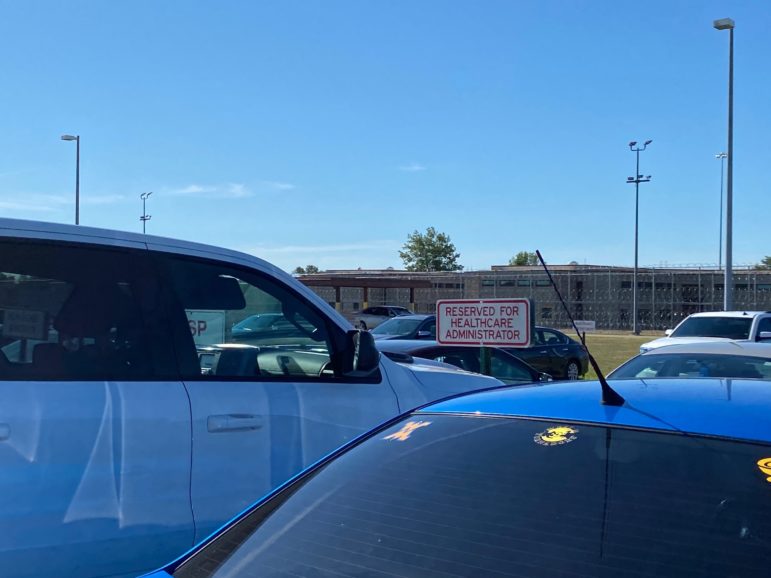
Parking Spot for the Healthcare Administrator at Pickaway Correctional Institution. (Photo Credit Eye on Ohio)
Ultimately, most of the 2,532 people known to be connected to the outbreak at Marion Correctional were either inmates or staff. But the virus made its way to an additional 58 people outside the prison, including family members, health care workers and food workers.
And there could be other cases where health workers simply forgot to label the infection as related to the Marion prison outbreak in the database.
Chambers-Smith said the danger works both ways.
”If there’s COVID out in the community, there’s COVID in the prisons,” she said.
This story is sponsored by the Northeast Ohio Solutions Journalism Collaborative, composed of 16-plus Greater Cleveland news outlets including Eye on Ohio, which covers the whole state.
Columbus, Ohio – The ACLU of Ohio (ACLU) sent a letter on August 4 to over 450 criminal legal stakeholders in Ohio with urgent recommendations to mitigate the ongoing risks associated with COVID-19 for incarcerated populations, specifically people in Ohio’s county jails. The ACLU said, “The ripple effect of the deadly virus is, and will continue to be, ongoing, but decreasing local jail populations will save lives and lessen community-spread.”
The ACLU urges stakeholders to immediately eliminate or decrease money bonds that hold pretrial individuals in jail, and also to release certain categories of people through a collaborative systems approach.
Specifically, release should be prioritized for:
People held on certain offenses
People who would be sentenced to probation
People who have six months or less remaining on their sentence
Medically-vulnerable people
“The crisis is far from over. This past week Ohio set a one-day record for new cases and public health experts predict a second wave of the pandemic later this year. We must act now to mitigate widespread infection and death in our county jails. The decarceration strategies we offer will enhance public safety, reduce harm, and potentially save countless lives,” said Sabrina Harris, Policy Strategist for the ACLU of Ohio.
Ohio Chief Justice Maureen O’Connor
In March, Supreme Court of Ohio Chief Justice O’Connor recommended that judges reduce money bonds to decrease jail populations – and at least four counties implemented this practice during the first wave of the pandemic. The ACLU noted that approximately two-thirds of people in Ohio’s jails are legally innocent and held pretrial, which can be as many as 12,000 people on any given day.
“We commend the stakeholders that took action to reduce jail populations during phase one of the pandemic, but it is imperative that every actor in our criminal legal system – from courts to county jails – remain vigilant and alert to the devastation that COVID-19 holds over incarcerated populations. People in Ohio jails remain at a heightened risk of potentially fatal outcomes due to overcrowding, the lack of social distancing, and subpar conditions,” added Jocelyn Rosnick, Policy Director for the ACLU of Ohio.
Ohio saw the second highest number of COVID-19 deaths in state prisons, and while there is not comprehensive data for jail deaths, the ACLU of Ohio reminds Ohio stakeholders that they have the ability to make and influence policy changes to save lives in the future, and rewrite the narrative.
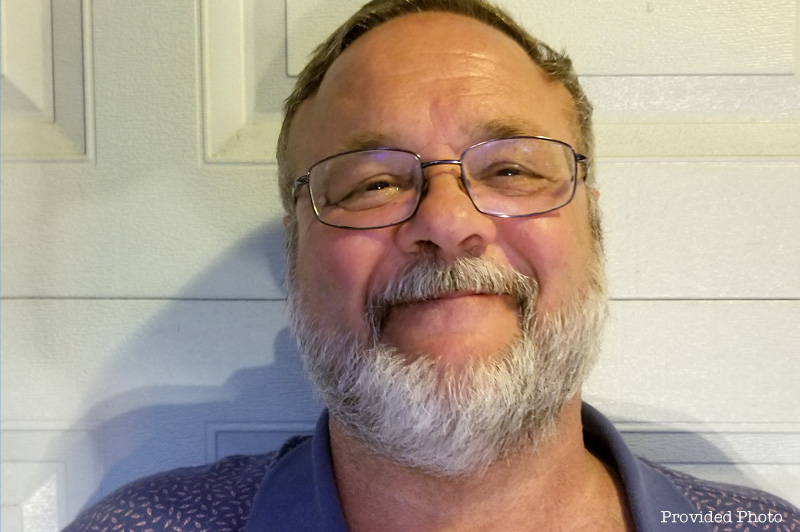
My name is Mark Leguillon and I live on McKinney Road. I’m a longtime resident of the community and a graduate of the Loveland School District. I believe most people in our community think that quality education is important.
However, I think the proposed millage of 16.78 for any levy is ABSURD!
If passed, this levy will put thousands of those residents on a fixed income in financial risk. This would also include many others who live paycheck to paycheck.
Renters should also be concerned, if this levy passes it is almost a certainty that their landlords will pass the cost on to them.
The average additional tax burden to the folks that made Loveland a great place to live is about 42% – this is in an additional amount to an existing tax burden. An actual example – a homeowner currently pays $2,099 in school tax alone. This proposed levy would add an additional $878. That is $2,977 which does not include county and other local taxes (And Symmes Township is already talking about the need to place 3 levies on the ballot next year. I don’t know if the City of Loveland has any levies planned.
What other product or service can you name that has increased by 42%?
I’m happy and proud that Loveland has achieved the “Excellence in Education” award and we should thank all the staff and students for achieving that award.
I have a few questions that I hope the superintendent or the school board will respond to in writing and release the answers to all media outlets within 7 days. To stay transparent. These questions are?
Is there a secret super-duper excellence award that this levy would insure it can obtain? (in other words, how would this levy drastically improve the education of the student?)
How does spending $10-$12 Million dollars on astroturf of engineered athletic fields improve the education of the student? Is there a direct correlation between these types of fields and much higher grade point averages?
Do I understand that the Board has spent $100,000 of our taxpayer money that is not refundable and has committed to about $7.8 Million Dollars for the rest of the Grailville property without the levy passing?
(I see this as the extortion part of your plan….)
I am just waiting for that official to stand up and say “WE WILL LOSE THE $100,000 IF WE DON’T MOVE FORWARD WITH THE PLAN.
DOES THIS REMIND ANYONE OF THE STREETCAR IN CINCINNATI??
So you really know how I feel!
I’m angry and I see these actions as careless and Irresponsible.
Now I’m going to give you one hypothetical:
If the taxpayers could demand a 42% reduction to the entire school district budget how do you think that would be received by the school district? Especially if it was only for 37 years (that is what you’re asking from the taxpayers in reverse).
I understand that the last levy passed was a 5.6 levy in 2014.
If the buildings are in such bad shape and there is an overcrowding problem. I believe these and other problems rest clearly on your leadership or lack of.
Since the past problems were not addressed – what circumstances would create a want so large as to do financial harm to our neighbors
In ending I would like to talk about process and reality.
I understand that we hired consultants. My opinion of consultants is they exist for 2 reasons.
They tell you about existing problems you should already know about,
AND THE BIG ONE
THEY TELL YOU WHAT YOU WANT TO HEAR WHETHER YOU CAN AFFORD IT OR NOT!
DID THEIR REPORT INCLUDE THE PART ABOUT THIS LEVY BANKRUPTING MANY OF OUR NEIGHBORS?
Mark Leguillon spoke at the beginning of the meeting about the combined operating and bond levy of 16.78-mil that will be before voters on the November 5 ballot.
If you find this story useful and helpful in your daily life…