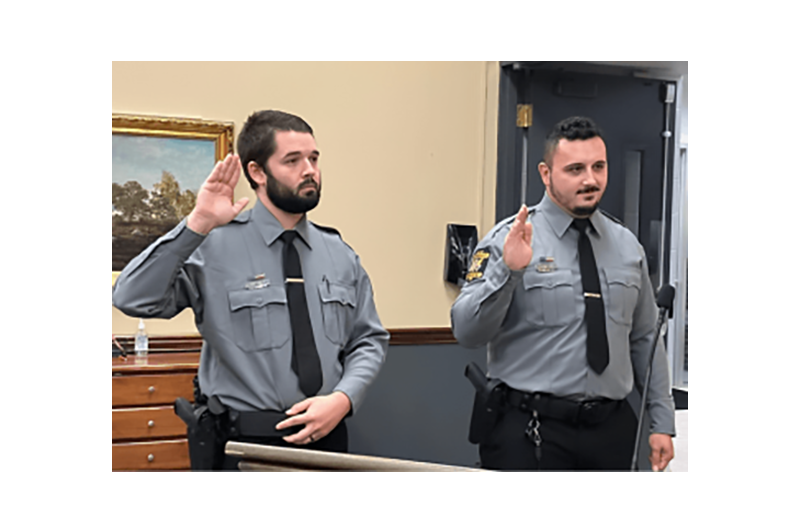
Loveland, Ohio – “We are excited to have these officers on board. They are two great additions to our police department,” Chief Michael Gabrielson said.
Benjamin Marcum and Brandon Wilson were introduced at the City Council meeting on Oct. 8, 2024.
Marcum began his law enforcement career in 2019 as an officer with Clay Township in Montgomery County. Most recently, he served as a ranger with Five Rivers Metro Parks in Dayton, Ohio. Marcum grew up in Troy, Ohio, and holds a Bachelor of Science in Criminal Justice from the University of Cincinnati.
Likewise, Wilson comes to LPD by way of Colerain Township and the Village of Woodlawn Police Departments. Wilson is a Cincinnati native and graduated from Lockland High School. He brings experience in patrol and criminal investigations to LPD.
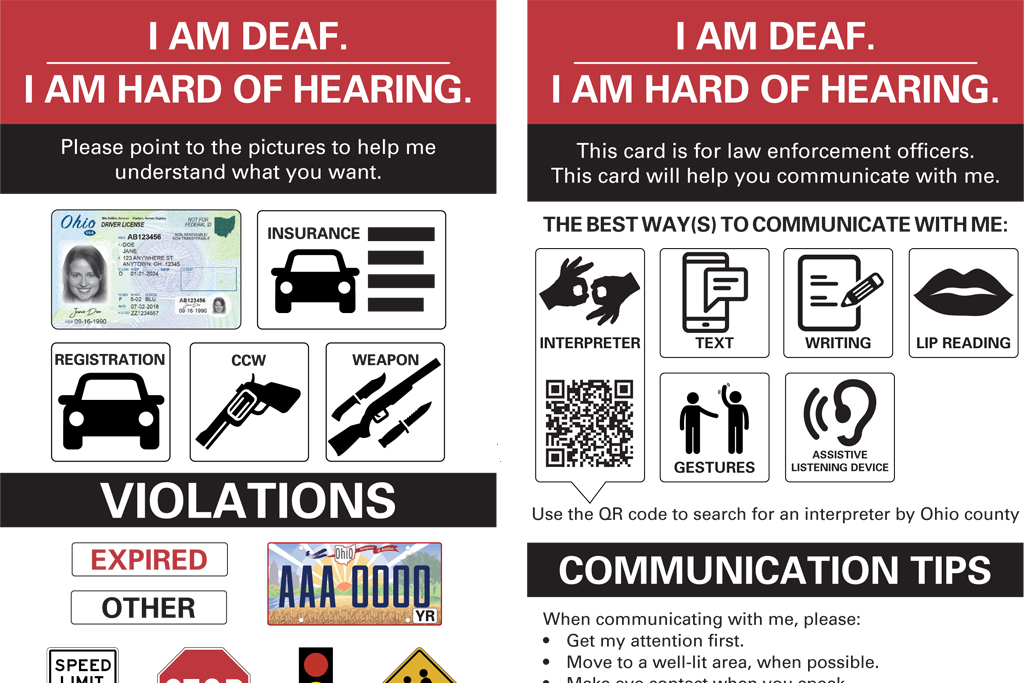
A communication card is available to help individuals who are deaf or hard of hearing and police officers communicate with each other.
Ohio Governor Mike DeWine announced that the Ohio Department of Public Safety’s Traffic Safety Office (OTSO), Opportunities for Ohioans with Disabilities (OOD), and statewide law enforcement partners developed the new communication card to help individuals who are deaf or hard of hearing safely exchange information with law enforcement.
The card can be downloaded onto a phone or printed and stored inside a vehicle, wallet, or purse. Deaf and hard-of-hearing individuals can point to various pictures on the card more easily communicate with law enforcement.
“Removing barriers for Ohioans with disabilities is crucial for helping them live self-determined, independent lives,” said Governor DeWine. “This new communication tool will improve safety for the deaf and hard-of-hearing community as well as law enforcement officers across the state.”
The communication card also displays icons of common violations and provides tips for law enforcement to help officers effectively communicate with those who are hard of hearing or deaf.
“Approximately 303,000 Ohioans are deaf or hard of hearing,” said Kevin Miller, OOD Director. “We appreciate our partners from the Community Centers for the Deaf, Deaf World Against Violence Everywhere, and the Coalition for Deaf Access and Equity for collaborating on this practical solution to help bridge communication gaps and improve understanding.”
The Buckeye State Sheriffs’ Association, Ohio Association of Chiefs of Police, and Ohio State Highway Patrol also participated in the development of the card.
“We believe that communication between law enforcement and all citizens is important,” said Tom Stickrath, Director of the Ohio Department of Public Safety. “OTSO will also print and distribute copies of the card to Ohio law enforcement agencies across the state so that they can have a copy to carry with them.”
In 2019, Governor DeWine signed Executive Order 2019-03D, which established Ohio as a Disability Inclusion State and Model Employer of Individuals with Disabilities.
First responders, including paramedics, EMTs, firefighters, and police officers, are at special risk for suicide due to their exposure to trauma as well as other factors that are matter-of-course for this work.
Join Steven M. Click, Director of the Ohio Office of First Responder Wellness in the Ohio Department of Public Safety, to learn why it can be difficult to engage first responders in suicide prevention efforts, tips to bypass barriers, and upcoming opportunities to support first responder suicide prevention activities in your community.
American Sign Language interpretation will be available for the live and recorded presentation.
Learning objectives: After participating in this webinar, attendees will be able to
Explain why first responders are uniquely vulnerable to suicide,
Recognize protective factors that reduce the likelihood of first responders dying by suicide,
Identify strategies for engaging first responders in effective suicide prevention activities.
Registration is free for OSPF members and $25 for non-members. Continuing education will be provided for prevention, addiction counseling, social work, marriage and family counseling, and psychologists.
Loveland, Ohio – “Many things are still in flux. We are on daily morning briefings with the Health Department and Homeland Security officials. Many of the questions you have asked are being ironed out at this time,” said Loveland/Symmes Fire Chief Otto Huber.
Loveland Magazine asked both Huber and Loveland Police Chief Sean Rahe several questions yesterday as local delivery of a COVID 19 vaccine approaches. Chief Huber responded on behalf of both department chiefs.
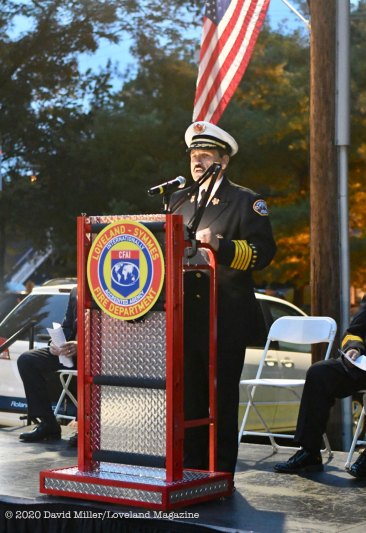
Loveland/Symmes Fire Chief Otto Huber speaking at Loveland’s 9/11 ceremony in September.
First responders will be in Phase 1 of Ohio’s vaccine distribution plan along with high-risk healthcare workers, and seniors living in congregate settings (i.e. nursing homes).
Ohio Capital Journal reported on Tuesday that Federal regulators could allow two COVID-19 vaccines for emergency use as early as December, but getting the vaccines from out-of-state manufacturers to 11.7 million Ohioans poses a web of logistical challenges.
The Ohio Department of Health has identified 10 sites across the state that will receive the pre-positioned vaccine after a COVID-19 vaccine is given emergency-use authorization. Once the Centers for Disease Control and Prevention’s Advisory Committee on Immunization Practices issues its recommendation on how to use the vaccine, these sites will begin administering the vaccine immediately to those who choose to receive it and are identified as able to receive it in the first stage.
The ten pre-positioned sites were selected based on geography, population, and access to ultra-cold storage capacity. The University of Cincinnati Hospital Medical Center in Clifton is the Cincinnati area site.
The Chiefs were asked if they have established any policy about their employees receiving the vaccine when it becomes available and if officers and firefighters will be required to be vaccinated. The chiefs were also asked whether they will be vaccinated. Huber said, “We will be providing the opportunity for our staff to receive vaccines as they are offered.”
Huber also said, “At this point, we will be leaning on our Medical Director Dr. Policastro for guidance. We hope to have a plan finalized with the Health Department very soon. Keeping our staff safe so that we can safely provide service to our residents is our highest priority.”
Loveland Magazine also asked if there was anything that can be shared about plans for distribution in the City of Loveland or Symmes Township when a vaccine is available to the general public and whether local Kroger stores are the designated point of distribution for area residents when the vaccine is universally available. “Loveland and Symmes are both points of distribution however we do not know yet if they will choose to open those PODS,” said Huber.
Under the draft issued by the Statehouse that was released on October 28, Ohio would implement a 4-phase approach to distributing the COVID-19 vaccine once it’s available.
A summary of the phases are as follows:
Phase 1 – High-risk healthcare workers, first responders, seniors living in congregate settings (i.e. nursing homes)
Phase 2 – Public health workers, teachers and school employees, homeless individuals, prison workers and inmates, persons with mental health in group homes or institutions, and individuals with a medical condition putting them at greater risk of mortality due to COVID-19
Phase 3 – Students, young adults, children, and individuals in high risk occupations
An organization representing more than 23,000 police officers, including school resource officers, says allowing teachers to bring guns to school under only a concealed carry permit could do more harm than good.
The Fraternal Order of Police of Ohio said this in a brief to the Ohio Supreme Court, which is considering a case that would keep schools from allowing a firearms authorization policy. The police organization said they were not taking a stand on whether teachers should be armed, but rather the training involved.
Susan Tebben is an award-winning journalist with a decade of experience covering Ohio news, including courts and crime, Appalachian social issues, government, education, diversity and culture. She has worked for The Newark Advocate, The Glasgow Daily Times, The Athens Messenger, and WOUB Public Media. She has also had work featured on National Public Radio.
“An interpretation holding that a school resource officer or security guard needs extensive training to carry a gun in school, but the art teacher does not, is neither just nor reasonable,” the group said in a brief to the court.
While 17 other school districts argued that the “plain language” in the Ohio Revised Code allowed them the right to bring guns to school when authorized, the FOP read the “plain language” as advising schools to the contrary.
“A teacher who carries a weapon into a classroom while teaching is, quite
literally, both ‘armed’ and ‘on duty,’” the organization stated. “There is no reason to depart from this plain language because it yields a ‘just and reasonable’ result, as the Revised Code demands.”
Agreeing with the language, a group of 284 current or former Ohio teachers or school staff members said the law was “unambiguous” in its explanation of the training requirements needed to bring guns to schools. The teachers and staff don’t say school districts should be banned from creating weapons policies.
“But the General Assembly has required that, should they elect to arm teachers, school districts must ensure that they have adequate training, which the legislature has determined was satisfactory completion of an approved basic peace officer training program,” the brief by the teachers and staff stated.
The FOP even went so far as to say the Madison Board of Education’s interpretation “would get people killed.”
In arguing against the firearms policy, the police officer’s group brought up gun-retention skills, accuracy in a gunfight and situational awareness that they say would decrease if teachers were given the responsibility of defending themselves and others in a school shooting.
The brief to the court also said a lack of training would make armed teachers a liability, causing law enforcement to have more difficulty stopping an active shooter, and “may get themselves shot in the process.”
“If nothing else, police officers train on the ‘mental preparedness’ necessary to take a life,” the brief stated. “But in the context of a school setting, undertrained teachers will be mentally unprepared to kill one of their own students.”
Several others submitted document in support of a decisions that keeps gun policies out of the board’s hands, including the Ohio Education Association and the Ohio Federation of Teachers. A group of “experts in school safety and firearms training,” including Dayton Police Department Chief Richard Biehl, a former leader of the Columbus Division of Police Training Bureau and a former Madison Local School District teacher who became a police officer after the 2016 school shooting there, joined in the support of the parents against the firearms policies.
The cities of Columbus and Cincinnati also filed briefs showing their interest in the case, and support of the present law on training of armed personnel in schools.
If an Ohio Senator has his way, the law will change regarding armed personnel in school. The bill passed the Senate Government Oversight & Reform Committee, and is awaiting a full floor vote before moving on to the Ohio House.
Columbus, Ohio – Today Governor John R. Kasich ordered that all flags be flown at half-staff upon all public buildings and grounds throughout the State of Ohio in honor of the lives and service of Westerville Police Officers Eric Joering and Anthony Morelli effective immediately through their interments.
Kasich’s order reads: “In honor of the lives and service of Westerville Police Officers Eric Joering and Anthony Morelli, I hereby proclaim, by the authority vested in me as Governor of the State of Ohio by the Ohio Constitution and the laws of the United States of America, that the flags of the United States of America and the State of Ohio shall be flown at half-staff upon all public buildings and grounds throughout the state of Ohio effective immediately through their interments.”
“We can continue as a nation to sweep problems under the rug on which we stand – or we can take a knee.”
by Steve Link,
HAVE TO SAY THIS: If I thought the NFL protests were a slap in the face to “our soldiers, our police officers, and our veterans” as some have claimed, I’d be right there with those who object.
On Tuesday, October 9 the Press Secretary for our administrative branch of government said, “We support the national anthem, the flag, and the men and women who fought to defend it.”
Well, I was proud to serve in the military. Never in harm’s way, but served on active duty for two years. I was a Drill Sergeant. Most of my …trainees went to Vietnam. They did not fight for a flag.
Our nation’s flag is supposed to denote and identify our great country. IT IS A SYMBOL, NOT AN IDOL. It symbolizes this nation of people and the systems within which we live – including the good and the bad. Certainly, no one salutes the flag to honor what’s wrong in America, but the bad is part of American life just as it is globally.
I can understand some of the confusion surrounding for whom the flag flies. Many Americans believe that the United States is the “greatest nation on earth.” That’s just not so and is, frankly, fake news. The one way in which we ARE far above all other nations is in military strength. So one might confuse the symbolism of our flag as being militaristic. But our flag is certainly not designed to represent any special segment of our citizenry. Most Americans do not serve in the military or law enforcement. Rather, the American flag it is a symbol of equality for all – among other ideals – for which we try to stand as a people. (And “equality for all” is also fake news.)
So, I do not see the NFL players disrespecting any individuals. No, they are trying the best they can to turn our collective attention to problems in our country that are morally abhorrent. I am pleased that some of them have been passionate enough to take risks and draw upon a large audience to make a statement that needs hearing (and seeing).
We can continue as a nation to sweep problems under the rug on which we stand – or we can take a knee.