Hamilton County, Ohio – On May 4, Treasurer Robert Goering announced he is extending the real estate tax due date to July 17. The deadline for taxes due for the second half of 2019 was June 22.
Goering said that the tax bills will be mailed approximately June 22.
The decision was made taking into account multiple factors according to the Goering, including that the Hamilton County Administration Building remains closed to the public and his office is not available to taxpayers. The office is closed to the general public until further notice.
Dear Loveland Magazine Readers, I’m William Gibbs-Heard, a graduating senior at Loveland High School, and instead of having a graduation party, I decided, because of…
The current system and laws in regard to funding schools in Ohio are flawed. The funding system overemphasizes real estate taxes and creates inequality in educational funding across the state. The system has been declared unconstitutional multiple times by the Ohio Supreme Court, most recently in 2002.However, due to inaction by the administrative and legislative branches, the funding system remains law. So school systems, like Loveland, that do not have large commercial and industrial bases, must rely heavily on local, individual real estate taxes in order to operate.Voters are faced with the choice of voting for higher taxes or not providing our public schools with the funds necessary to operate effectively. Our schools simply cannot be effective in preparing current and future students without the essential funds to operate.
Dr. Gregg Tracy is a Loveland resident and property owner, a Loveland High School Graduate, a retired professor of leadership, and former school administrator.
Even as assessed property values increase, no new monies are generated for schools. Thus operating funds are fixed while operating costs increase.New levies are regularly and periodically necessary. It is a reality in Ohio.Excellent schools depend on good administration, teaching, and community participation, but schools just cannot perform effectively without periodic tax levies.
Loveland’s consistent excellence will continue to benefit students and the community.
It is easy to say, “I do not want to pay more taxes.” It is equally as easy to come up with justifications for voting “no.” Historically, voting against operating levies has not been a strategy that has facilitated any positive change. It is a weak substitute for dialogue and cooperative participation in a meaningful process aimed at changing and improving schools. Without necessary funds, schools cannot operate effectively, let alone have opportunities to change and improve. With needed funds, Loveland’s consistent excellence will continue to benefit students and the community. Loveland’s board and administration, have established a number of ways to learn, cooperate and participate in the school improvement process.Administration is accessible, public meetings have been held and will continue, printed materials have been sent regularly, and online communications are available.The leadership team has been very clear about the district’s needs and financial status.
They are simply asking for operating funds to continue the quality education that Loveland has been providing over time.
As our school board asks for additional operating funds in March, they are not asking for money for building or adding programs. They are simply asking for operating funds to continue the quality education that Loveland has been providing over time. The board has committed to keeping expense growth to less than 3% through fiscal year 2024. As a concerned citizen, I encourage you to make an informed decision in March based on an understanding of the need based on Ohio’s funding system and the recognition of the importance of your vote for our community. Public schools are one of our community’s vital organizations.As you make your decision in March, I hope you have gone directly to the source and not relied on hearsay and negative campaigns. I hope that you have directly accessed information sources made available by the district’s leadership team. I also hope that you consider our students and the short term and long term effects of your vote.Summarily, I hope you cast a concerned and informed vote on March 17.
Kim and Rick Donaldson live on Paxton Road in Miami Township
by Kim and Rick Donaldson
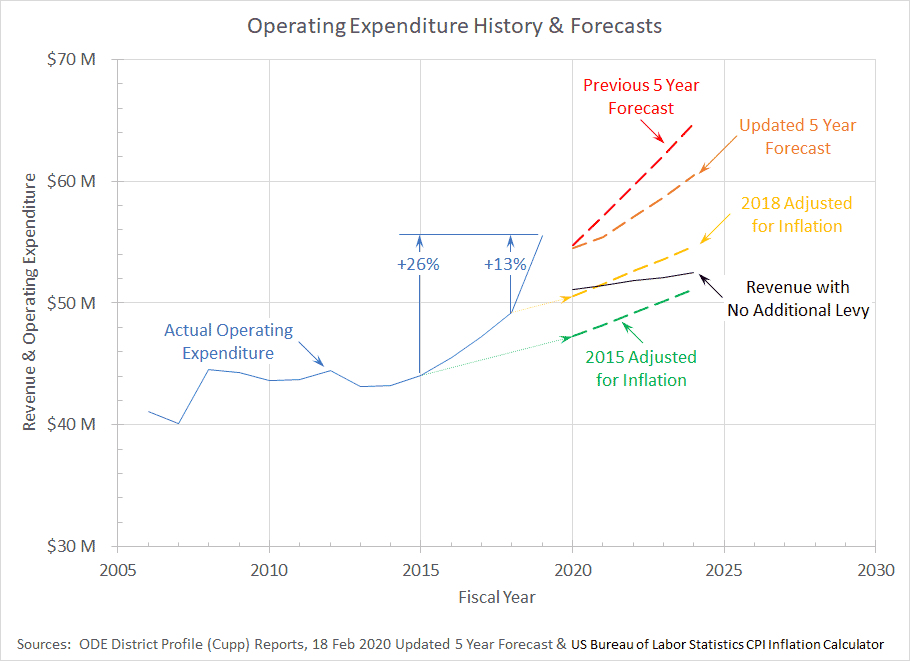
At its February 18th business meeting, the Loveland City School District Board of Education reviewed the administration’s updated five-year financial forecast, which includes annual operating expenditure cuts averaging $2.5 million and fee increases averaging $0.2 million.* The updated forecast still requires passage of a 6.95 mill operating levy, which will raise annual revenue by $6.3 million, to maintain an adequate cash balance through fiscal year 2024. Indeed, the included budget cuts were made for the express purpose of limiting the levy to only 6.95 mills. So, after cutting $2.5 million from expenditures, why do we need an additional $6.5 million (taxes plus fees) in revenue? Let’s look at the numbers.
This graphic is the Donaldson’s original presentation of the data sourced from the Ohio Department of Education and the US Bureau of Labor Statistics as noted on the chart and in the list of references.
As shown in the included chart, both five-year forecasts start from a very high baseline expenditure level established in 2019 when operating expenditures increased 13% from the previous year.**That increase was the culmination of an accelerated spending trend that started in 2015, bringing the total four-year increase to 26%.By comparison, the cumulative inflation rate was only 7.7% during the same period.***This rapid expenditure increase quickly overtook the 23% annual revenue increase in the years following the 2014 levy.
Since median income tends to be tied, albeit loosely, to inflation, expenditure increases that exceed the inflation rate make our schools increasingly less affordable to taxpayers.
Furthermore, it is important to recognize that the spending cuts and fee increases included in the updated forecast are all relative to the previous forecast, which anticipated increasing expenditures by 4% annually.Since the Federal Reserve Board targets a 2% annual inflation rate, the plan was to increase spending by twice the rate of inflation.The updated forecast anticipates annual increases of 3%, which is still 50% above the target inflation rate.Since median income tends to be tied, albeit loosely, to inflation, expenditure increases that exceed the inflation rate make our schools increasingly less affordable to taxpayers.
As a more affordable alternative, we advocate limiting operating expenditures to 2015 levels on a per student basis, adjusted for inflation.As shown on the chart, this approach would result in spending much lower than the updated five-year forecast and, more importantly, lower than current projected revenue.It would thus obviate the need for any additional operating levy.It is worth noting that this would be consistent with, and a continuation of, expenditure trends from 2006 through 2015.
If a 2015 baseline seems too aggressive, the same approach using a 2018 baseline could be considered.Although it would require an additional levy, the levy vote could be postponed to November 2021 and would only need to be around 1 mill to maintain the same cash balance as in the updated forecast.
These particular cuts, chosen by the administration, raise some serious questions.
So, what would we cut?After all, in the same February 18th presentation we were told that we will have to eliminate teaching and staff positions even if we approve the levy in March.We have also been warned that failure to pass the levy in March will result in additional cuts, including staff, teachers and high school transportation.These particular cuts, chosen by the administration, raise some serious questions.If we could afford current staffing levels in 2018, why can we not afford them in 2021 with nearly 13% higher expenditures in the updated forecast?****Even if we choose to defeat the levy and limit expenditures to inflation-adjusted 2018 levels, why could we not continue to support essentially the same staff and transportation that we did in 2018?Where is the additional money going, and why has the administration chosen to cut staff and transportation?
Before we head to the polls in March, we need to have satisfactory answers to these questions that are quantitative, complete and transparent. We need to know whether the proposed budget and associated cuts are indicative of fiscally responsible management for the benefit of our children, or emotional manipulation designed to get the levy passed.Ultimately, it comes down to a question of trust.
Our youngest Loveland Tigers know these three words well. Here in Loveland schools, we care for each other.We respect each other. And we take responsibility for our words and actions.
The Loveland Board of Education strives to do our best to live up to the expectations our teachers and staff have for our students. We care about each and every member of our school community and demonstrate that with leadership and fiscal responsibility. That care means we regularly need to place tax levies on the ballot in order to ensure the operation of programs that our students need and deserve.
The way taxes work in Ohio means that a school board respects the right of our district citizens to vote on these levies. We need to show the necessity for new operating funds and do so with the publishing of budgets, expenditures, and five-year forecasts. We publish the evidence of the success of our students as well.
The last operating levy passed in 2014 was designed to move the district from a “stay put” mode of operation to a time of forward progress and was strongly supported by our community. Our teachers and students delivered significant achievements as a result of that change in direction and now we need to protect that investment and optimize that effort.
Acting responsibly means telling the truth and sometimes means that you cannot respond in kind when false, harmful accusations are made.
Acting responsibly means telling the truth and sometimes means that you cannot respond in kind when false, harmful accusations are made.But responsible public servants also stand up for what is true. There are many false statements being made about the March 2020 levy, about the Board of Education, and about the people who work with us and for us. The Loveland school district and this Board of Education are committed to optimizing resources, to extending the adequacy of 2020 levy funds as long as possible, and to continuing progress for Loveland students.
Please take the time to review the information on our website, lovelandschools.org under the levy tab.Take the time to talk to our board and our administrators.Attend a board meeting or an information session.Get the right information right now.
We know our community cares about our schools. We respect the right of our citizens to vote on March 17. Each of us has a great responsibility for the future of Loveland schools.
Kathryn Lorenz is the President of the Loveland Board of Education and lives in Miami Township
Loveland, Ohio – The Loveland Board of Education met on Tuesday, December 17 and unanimously passed a resolution to place an operating levy of 6.95 mills on the March 2020 ballot. The deadline to file the resolution with the Hamilton County Board of Elections is today, December 18.
Neither Board Superintendent Amy Crouse or Treasurer/CFO Kevin Hawley wanted to speak to Loveland Magazine after the meeting, so details of the implications of the levy are sketchy. Neither Crouse or Hawley would discuss the budget cuts they are proposing or the amount the levy would provide the District. However, Crouse did say last week in a press release, “Approximately $2.7 million dollars of budget cuts will be made in conjunction with the levy. They will include a combination of reductions in the instructional cycle budget (textbooks, etc.), staff, and contracted services, among others.”
Last week’s press release also said:
The 6.95 millage levy translates into approximately $20/month ($243 annually) per $100,000 of appraised home value as determined by the county auditor.
District Ad Hoc Advisory committee that was appointed to discuss how the District should move forward after the defeat of a combined operating and bond issue that was on the November ballot discusses the Board’s vote. He talked about the new levy and also about a new community organization that has formed, Loveland Voice. Friemoth said they will meet soon to discuss their actions going forward. One thing he stressed is that he feels that the Board must take purchasing the Grailville land off the table at their next meeting if they want voter support for the new levy.
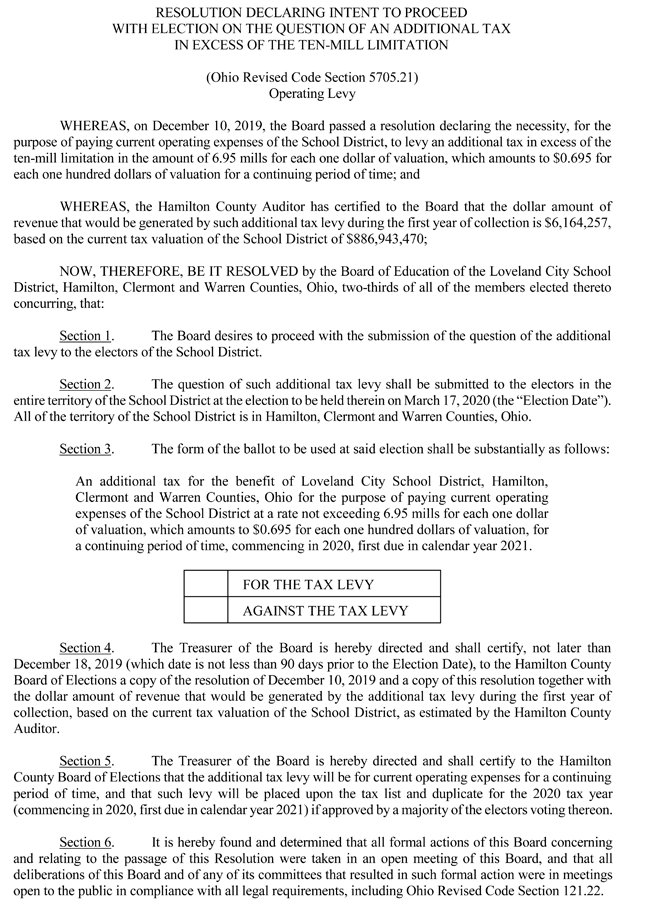
Below is the Resolution that was to be delivered to the Hamilton County Board of Elections today.
Board members, Michele Pettit, Ned Portune, Eileen Washburn, President Art Jarvis, and Vice President Kathryn Lorenz
Loveland, Ohio – The Loveland City School District has called a special meeting for Tuesday, December 17. This meeting will be held to consider a “resolution to proceed” in order to place a March operating levy on the ballot.
The Board will also go into executive session to discuss employment matters.
The 6 PM meeting is in the Loveland Intermediate and Middle School’s Media Center at 757 S. Lebanon Road.
Treasurer Resolutions
Approve a resolution declaring intent to proceed with election on the question of an additional tax in excess of the 10 mill limitation and certifying the same to the board of elections per ORC 5705.21.
The Board of Education met on Tuesday, December 10, and passed a resolution of necessity to place an operating levy of 6.95 mills on the March 2020 ballot. The decision was five weeks after a failed combined operating and permanent improvement/bond issue on November 5.
According to a press release issued by the Distric, the 6.95 millage levy translates into approximately $20/month ($243 annually) per $100,000 of appraised home value as determined by the county auditor. The board is to have the millage amount certified by the county auditor and intends to pass a resolution to proceed on December 17. The deadline to submit ballot language to the county boards of elections is December 18.
Loveland, Ohio – A Press Release issued by the Loveland City School District tonight reads:
Loveland Board of Education Passes Resolution of Necessity for Operating Levy in March 2020
The Loveland City School District Board of Education met on Tuesday, December 10, and passed a resolution of necessity to place an operating levy of 6.95 mills on the March 2020 ballot. The decision comes five weeks after a failed combined operating and permanent improvement/bond issue on November 5.
“We have sought the feedback of our community through an ad hoc advisory committee to determine the feasibility of a March ballot issue,” said Board President Art Jarvis. “We are tremendously grateful for the commitment shown by these individuals to step up, assist us and provide the community input needed for this decision. After collaboration and conversations with concerned community members, parents, staff and administration about the implications of both a March and a November 2020 operating levy, we, as a board, feel that it is in the best interest of the district to give the community the opportunity to vote in March.”
Approximately $2.7 million dollars of budget cuts will be made in conjunction with the levy. According to Superintendent Dr. Amy Crouse, they will include a combination of reductions in the instructional cycle budget (textbooks, etc.), staff, and contracted services, among others.
“When implementing cuts in our budget, our priority is to protect our students and the growth, achievement and academic momentum gained over the past several years,” said Dr. Crouse.
If the March levy fails, additional cuts will need to be made in order for the district to go back on the ballot in November 2020.
Operating levies fund the school district’s day-to-day expenses, including the salary and benefits of staff, which at Loveland make up approximately 83 percent of operating expenditures. Loveland Schools receive about 32 percent of its budget revenue from the state, an amount that remains relatively flat from year to year. The majority of the budget, nearly 60 percent, must be generated locally – mainly through property taxes. This locally-generated source of funding is also flat due to Ohio House Bill 920, which prevents schools from collecting additional revenue as home values increase over time.
In addition to voting for a March levy, the board discussed the intention to look into options for increasing transparency and community involvement, for example through a model of community advisory groups, one of which would focus specifically on school funding issues and advocacy at the state level.
“We will continue to work with our community on creative solutions for increasing income and reducing expenditures,” said Dr. Crouse. “Our school facility needs as presented earlier this year still remain and will eventually need to be addressed, but the board will not be placing any levy on the ballot for facilities in November.”
The 6.95 millage levy translates into approximately $20/month ($243 annually) per $100,000 of appraised home value as determined by the county auditor. The board will have the millage amount certified by the county auditor and intends to pass a resolution to proceed on December 17. The deadline to submit ballot language to the county boards of elections is December 18.
Loveland, Ohio – Below is the agenda for Tuesday’s Loveland Board of Education’s Work Session scheduled for 6 PM at the LMS/LIS Media Center.
The Administration has said that if the recommendation is to put an operating levy on the ballot in March, the board will need to pass an initial resolution of necessity on December 10, have it certified by the county auditor, and pass a second resolution to proceed on December 17. The content of the ballot issue must be submitted to the board of elections no later than December 18.
1. Opening Items
1.1 Adoption of Board Agenda
2. Discussion Topics
2.1 First Reading Policy 5460 – Graduation Requirements
2.2 Open Checkbook Update
2.3 Discuss the potential of a March levy which may include the passage of the first of two resolutions for the March ballot
3. Superintendent Resolutions
3.1 Approve course adoptions for 2020-2021
4. Treasurer Resolutions
4.1 Approve disposal of inventory
5. Assistant Superintendent of Human Resources
5.1 Resignations and employment of certified, classified, homebound, substitute and supplemental positions for the 2019-2020 school year
5.2 Motion to approve travel for our athletic teams, performance groups or individuals will be staying overnight at an event.
Loveland, Ohio– On December 3 the Loveland Board of Education met with their ad hoc advisory committee to discuss how the District should move forward after the defeat of a combined operating and bond issue that was on the November ballot. This is Part 1 of the meeting where the fate of the option to purchase 110 acres at Grailville was discussed.
Grail U.S. Executive Director Terrie Pucket was at this meeting to discuss their stance on the contract they have signed with the District.
The Administration also brought in their consultant to discuss land and building options.
To view the slides used for the discussion go HERE.
Loveland, Ohio – The Loveland Board of Education is expected to discuss the purchase of the Grailville property at a “Special Meeting” on December 3.
No formal agenda for the meeting has been published yet, but besides discussing Grailville, the Board is expected to continue discussions with their Ad Hoc, Short Term Advisory Committee* that has been established to help the Board of Education to determine whether a March ballot issue is feasible or not. The committee met for the first time with the Board on November 26.
The determination of millage for a ballot issue in March 2020 must be approved in a formal resolution of necessity by the Board of Education on 12/10/19. Seven days later (12/17) the Board must approve a resolution to proceed. The resolutions must be given to the Board of Elections by 12/18/19.
The video of the December discussion is being up-loaded so stay tuned if you are interested in hearing the back and forth between the Board and residents. No consensus on how to move forward was reached. You can watch Part 1 and 2 right now by visiting LOVELAND MAGAZINE TV. The videos are being uploaded in 25-minute increments so you can easily pause and can return to take up where you left off.
This ad hoc advisory committee has been established for the purpose of helping the Board of Education to determine whether a March ballot issue is feasible or not. The committee will work with the Board while the meeting is in session which will allow for interaction between committee members and board members.
On 11/26, the committee will be invited to join the meeting after the board has concluded regular business outlined on the agenda. On 12/3, the full board meeting time will likely be given to the work of the committee.
Should the work result in a determination that a March ballot language is feasible, we must meet election timelines. The determination of millage for a ballot issue in March 2020 must be approved in a formal resolution of necessity by the Board of Education on 12/10/19. Seven days later (12/17) the Board must approve a resolution to proceed. The resolutions must be given to the Board of Elections by 12/18/19.
Should the work result in a determination that March is not feasible, the Board and community will focus on a November 2020 operating levy.
Following the 12/3/19 meeting, this committee will be dissolved having served its intended objective. However, should the format be successful we will develop a system to continue the work and identify a way to give more people an opportunity to participate if they wish.
Up-Coming Meetings
Tuesday, December 3, 6 PM (special meeting) (LMS/LIS Media Center)
Tuesday, December 10, 6 PM (work session) (LMS/LIS Media Center) (LMS/LIS Media Center)












![[Breaking] School Board votes to put 6.95 mills on March ballot](https://lovelandmagazine.com/wp-content/uploads/2019/01/loveland-board-of-education.jpg)

![[Video] Grailville? YES or NO](https://lovelandmagazine.com/wp-content/uploads/2019/12/maxresdefault-1.jpg)
 Loveland, Ohio – On December 3 the Loveland Board of Education met with their ad hoc advisory committee to discuss how the District should move forward after the defeat of a combined operating and bond issue that was on the November ballot. This is Part 1 of the meeting where the fate of the option to purchase 110 acres at Grailville was discussed.