Tag: redistricting

  • Ohio and national government watchdogs warn GOP trying to engineer a more favorable midterm map

    Ohio and national government watchdogs warn GOP trying to engineer a more favorable midterm map

    By:  Ohio Capital Journal

    Good government leaders in Ohio and around the country are worried about state lawmakers attempting to ‘bake in’ 2026 election results long before voters head to the polls. Between new rounds of redistricting and even more restrictive voting legislation, Republican state lawmakers seem poised to engineer an easier path for their party’s candidates, they say.

    “I think Ohio has become something of a test subject state for seeing just how far a super majority can chip away at access to the ballot and our rights to direct democracy,” Kelley Dufour from Common Cause Ohio said.

    GET THE MORNING HEADLINES.


    With Republicans notching several wins in 2024, the “sensationalized” version of voter restriction rhetoric has taken something of a back seat, Dufour said.

    “But forces are still working behind the scenes, right? At an administrative death by 1,000 cuts,” she said. “It’s a quieter process, but it’s significantly harmful to voters.”

    One example is a sharp uptick in provisional voting.

    In 2024, Dufour explained, 34,000 had to vote provisionally — roughly 40% more than in the last presidential election.

    Meanwhile, Ohio lawmakers are considering new measures that would require proof of citizenship to register and open the door to challenging a voters’ citizenship status on Election Day itself.

    Proof of citizenship would require voters gathering birth certificates, divorce records, name-change records, or other paperwork.

    This has already presented difficulties, for instance, for some trying to obtain a National I.D. card for air travel.

    How it plays out on the map

    But the “cherry on top,” Dufour said, is redistricting. Ohio could see a major shakeup to its congressional map ahead of next year’s midterms because lawmakers here are legally required to draft a new map.

    Right now, Ohio has 15 districts with five represented by Democrats and 10 represented by Republicans, or 33% to 66%.

    Midterm elections typically serve as a kind of referendum on a new presidential administration. Historically it has not been kind to the president’s party. That’s particularly concerning in the U.S. House, where Republicans are clinging to a thin 220-2012 majority.

    Redistricting in GOP-controlled states like Ohio and Texas could turn that vulnerability into an advantage.

    Common Cause Texas Executive Director Anthony Gutierrez explained, in his state, the governor has already announced a special session in July.

    The governor hasn’t shared what will be on the agenda, but at a recent press conference the state’s lieutenant governor was enthusiastic about the idea.

    “He was asked about redistricting, and he said that he does think that if there’s any opportunity for Republicans in Texas to pick up some seats, that he does think that they should do it,” Gutierrez said, “So, nothing confirmed, but senior Republicans who probably have some insight into what’s going on, have been giving indications that they do think this is going to happen.”

    In Ohio, lawmakers have to come up with a new map because the last one was approved along party lines.

    The General Assembly has until the end of September to come up with a map but has shown little inclination to do so thus far. If lawmakers don’t act, that would put the task back in the hands of the seven-member Ohio Redistricting Commission.

    “Currently, we have five Democrats and 10 Republicans that Ohio sends to D.C.,” Dufour said. “The map-making process could eliminate a few Democratic-leaning districts.”

    What that might look like in Ohio

    Ohio Republican U.S. Sen. Bernie Moreno is eager to see it happen. Moreno told Punchbowl News he thinks the GOP will pick up two additional seats and that Republicans controlling 12 of 15 districts — 80% of the delegation — “reflects the state.”

    Moreno reasoned there’s “a recognition” that big cities like Cincinnati, Columbus, and Cleveland will be represented by Democrats.

    Moreno won his statewide race with just 50.09% of the vote, a far cry from the 80% share he thinks Republicans should control in the U.S. House. In addition to losing the three Cs, Moreno lost counties anchored by Toledo, Akron, Dayton, and Athens.

    Sitting in the crosshairs of Ohio’s redistricting effort are Ohio Democratic U.S. Reps. Marcy Kaptur and Emilia Sykes. Kaptur’s Toledo-area district and Sykes’ Akron-based seat are the two most closely divided districts in the state.

    Both lawmakers have drawn familiar challengers. Republican former State Rep. Derek Merrin has joined a crowded primary field for a rematch against Kaptur. State Rep. Josh Williams, R-Sylvania Twp., has thrown his hat in the ring, too.

    In Sykes’ district, her 2024 opponent, Republican former state Rep. Kevin Coughlin, is running to face her again, as well.

    In both contests, even minor tweaks to the map could have a significant impact on the outcome. Sykes only beat Coughlin by about two points. Kaptur’s margin was even tighter. She beat Merrin by just 2,382 votes — less than a percentage point.

    Follow Ohio Capital Journal Reporter Nick Evans on X or on Bluesky.


    Nick Evans
    Nick Evans

    Nick Evans has spent the past seven years reporting for NPR member stations in Florida and Ohio. He got his start in Tallahassee, covering issues like redistricting, same sex marriage and medical marijuana. Since arriving in Columbus in 2018, he has covered everything from city council to football. His work on Ohio politics and local policing have been featured numerous times on NPR.

    Ohio Capital Journal is part of States Newsroom, the nation’s largest state-focused nonprofit news organization.

    MORE FROM AUTHOR

  • Voices across Ohio: The battle over Issue One and fair districts

    Voices across Ohio: The battle over Issue One and fair districts

    October 31, 2024 – Farah Siddiqi, Public News Service (OH)


    In Ohio, the debate over Issue One has stirred strong emotions among residents and community leaders.

    For many, the proposal to establish a citizens’ redistricting commission transcends politics. It represents a push for fair representation.

    Marian Stewart, a retired pastor from Greene County, is a vocal supporter of the measure and frames the issue as a moral imperative.

    “Rigging the maps is not fair; it’s cheating,” Stewart asserted. “Disenfranchising voters and limiting accountability does not value or respect all of our voices. It’s just wrong. That’s why I joined with faith leaders across Ohio in voting yes on Issue One.”

    Stewart’s words echoed the concerns of many Ohioans who believe gerrymandered districts limit the political voice of everyday citizens. Proponents argued Issue One will ensure a fairer process by empowering a bipartisan citizens’ commission to draw electoral maps.

    Critics of the measure, including some conservative groups, countered it could introduce new forms of political bias into redistricting. The opposing group had the language of the ballot issue changed to include the word “gerrymander.”

    For advocates of Ohio’s labor community, the proposal is about ensuring working people’s interests are not drowned out by political manipulation.

    Ted Linscott, president of the Southeast Ohio Central Labor Council, described how unfair districts can sideline Ohio’s working-class voices.

    “Working people need fair voting districts so their voices can be heard,” Linscott contended. “Workers don’t need extreme right or left. We need fairness.”

    The League of Women Voters of Ohio has been advocating for anti-gerrymandering reforms since 1981, underscoring the need for a responsive government.

    Jen Miller, the group’s executive director, views Issue One as an important step toward accountability, noting the first initiative had support from the Ohio Republican Party but was opposed by Democrats, who held power at the time.

    “The first thing that mappers did was look at the addresses of their favorite candidates and incumbents and draw lines around them, rather than drawing districts that keep communities together and make sure that Ohioans have meaningful elections,” Miller pointed out.

    Ohio’s Issue One has drawn support from a diverse coalition, including labor unions, faith leaders and civic organizations, all advocating for a more representative government. As voters head to the polls, they are faced with a question beyond party lines: Should Ohio’s electoral districts be shaped by politicians or by the people they serve?

  • How the Ohio Supreme Court races intersect with Issue 1 and redistricting

    How the Ohio Supreme Court races intersect with Issue 1 and redistricting

    Retired Ohio Supreme Court Chief Justice Maureen O’Connor speaks to supporters at the Citizens Not Politicians rally, July 1, 2024, at the Statehouse in Columbus, Ohio. (Photo by Graham Stokes for Ohio Capital Journal. Republish only with original story.)

    Even though Ohioans will be voting on Issue 1, which would remove politicians from the redistricting if approved, it’s possible redistricting will go before the state’s high court again.

    By:  Ohio Capital Journal

    The justices elected to the Ohio Supreme Court in 2024 will be the ones deciding on any challenges to new maps if Ohio voters pass the proposed Issue 1 anti-gerrymandering amendment this November.

    Even though Ohioans will be voting on Issue 1, which would remove politicians from redistricting if approved, it’s possible redistricting will go before the state’s high court again.

    “Maps, no matter who draws them, are certainly subject to challenge, and they’re subject to challenge for violating the provisions of the Ohio Constitution,”said University of Cincinnati Political Science Professor David Niven. “So we’re not done no matter what happens with Issue One. … There are still unhappy political actors who will go to the courts in some cases, questioning the process.”

    Redistricting and past Supreme Court rulings

    Redistricting is currently done through the Ohio Redistricting Commission — which includes the governor, the secretary of state, the state auditor and four legislative leaders (two from each party). In 2015, 71% of Ohioans voted in favor of a constitutional amendment to create a bipartisan redistricting commission to draw legislative districts in 2021.

    Six different Statehouse district maps and two congressional maps have gone through the current redistricting process. The Ohio Supreme Court ruled five of the Statehouse maps unconstitutionally gerrymandered and both congressional maps were rejected as unconstitutional.

    A federal court ordered Ohio voters to use the last of the gerrymandered Statehouse maps in 2022 since the commission ran out of time to come up with a constitutionally approved map. State lawmakers are currently occupying those districts.

    Republican former Ohio Supreme Court Chief Justice Maureen O’Connor, who served on the state’s high court from 2003 to 2022, talked about this in an ad for Issue 1.

    “Seven times career politicians have so blatantly gerrymandered our voting district maps that the Ohio Supreme Court ruled the maps unconstitutional. Seven times,” she said in the ad. “Issue One bans politicians from drawing voting maps. It will restore power to where it belongs, with citizens not politicians.”

    Citizens Not Politicians, a nonpartisan coalition, is behind the proposed constitutional amendment. Issue 1 would create a 15-member Ohio Citizens Redistricting Commission made up of Republicans, Democratic and independent citizens. It would prohibit current or former politicians, political party officials, lobbyists and large political donors from being on the commission.

    Ohio Supreme Court races

    Republicans currently have a 4-3 majority on the Ohio Supreme Court. Depending on the outcome of the election, the Democrats could flip the court or the Republicans could tighten their grip.

    “The makeup of the court makes a tremendous difference,” Executive Director of Common Cause Ohio Catherine Turcer said. “Are these folks that are going to serve on the court going to look at new voting districts with an eye to what’s in the Ohio Constitution and to what is actually good for Ohio voters, or are they going to be swayed by partisan interests?”

    Ohio Republican lawmakers added party labels to the previously nonpartisan Ohio Supreme Court races starting in 2022.

    Incumbent Democratic Justice Michael P. Donnelly is being challenged by Republican Hamilton County Court of Common Pleas Judge Megan Shanahan.

    Incumbent Democratic Justice Melody Stewart is being challenged by incumbent Republican Justice Joseph Deters, who decided not to run for his current seat and instead chose to go up against Stewart.

    Democratic candidate Lisa Forbes, of the Eighth District Court of Appeals, and Republican candidate Dan Hawkins, of the Franklin County Court of Common Pleas, are fighting for Deters’ open seat.

    Deters recently talked briefly about redistricting on a right-wing Cleveland radio show.

    “I think it’s kind of humorous to watch when the other side can’t win, they want to change the rules whether it’s hacking the U.S. Supreme Court because they don’t have the justices they like, or getting rid of the Electoral College because they don’t have a clear advantage in the Electoral College like they do, and it’s just a flat popular vote. And now redistricting,” he said on Strictly Speaking with Bob Frantz.

    Follow OCJ Reporter Megan Henry on X.


    Megan Henry
    Megan Henry

    Megan Henry is a reporter for the Ohio Capital Journal and has spent the past five years reporting in Ohio on various topics including education, healthcare, business and crime. She previously worked at The Columbus Dispatch, part of the USA Today Network.

    Ohio Capital Journal is part of States Newsroom, the nation’s largest state-focused nonprofit news organization.

    MORE FROM AUTHOR


  • Ohio redistricting reform group submits more than 731,000 signatures, sets sights on November

    Ohio redistricting reform group submits more than 731,000 signatures, sets sights on November

    BY:  Ohio Capital Journal

    Reporting more than 731,000 signatures submitted to the Ohio Secretary of State’s Office, Citizens Not Politicians said it cleared a massive hurdle in their plan to reform the state’s redistricting process by replacing politicians with a citizen commission.

    The group hoping to get a citizen-led redistricting commission inserted as an amendment to the Ohio Constitution was required to collect 413,487 signatures by July 3 in order to qualify for the Nov. 5 general election. That number accounts for 10% of the total votes cast in the last gubernatorial election, a threshold state law requires for ballot initiatives.

    Ohio also requires petitions to receive at least 5% of the vote in at least 44 counties. Citizens Not Politicians said it did this in 57 counties, while also collecting signatures in all 88 counties in the state.

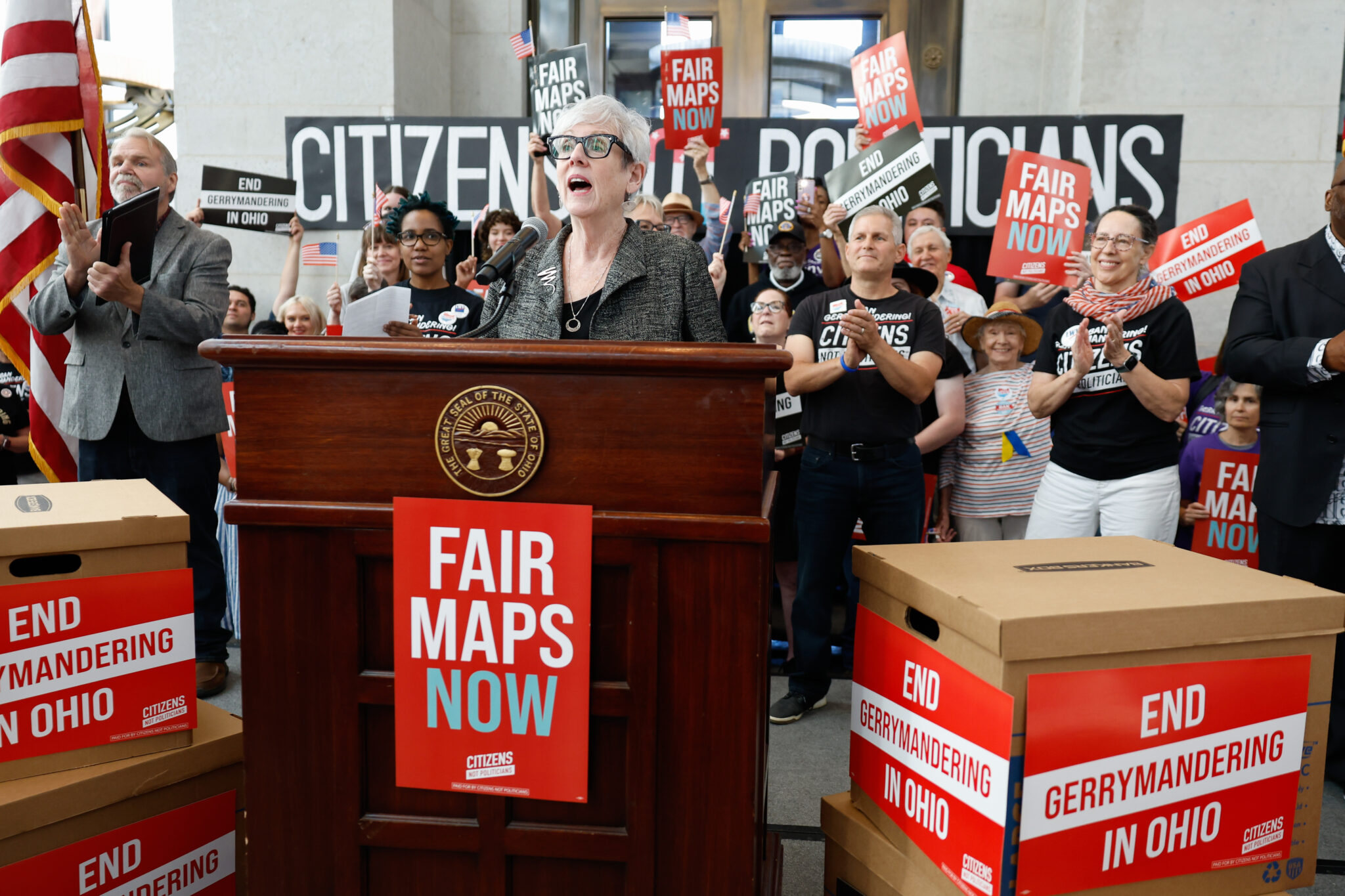
    During a rally celebrating the submission of the signatures on Monday, retired Republican Ohio Supreme Court Chief Justice Maureen O’Connor told a crowd of hundreds in the Statehouse atrium that the initiative received the third highest signature total the state has seen in more than a century. She said it was “one of the most widely supported citizen-initiated constitutional amendments in Ohio’s history.”

    “Ladies and gentlemen, let me let you in on a little secret,” she told supporters who attended the rally. “This amendment will pass. We will prevail.”

    The signatures will now be verified by the Secretary of State’s Office, to filter out possible duplicate or invalid voter signatures, before a final count will be released.

    O’Connor joined in on the redistricting reform process after being chief justice of a supreme court that rejected six different maps adopted by the Ohio Redistricting Commission, a commission made up of elected officials.

    The current seven-member Ohio Redistricting Commission includes the Ohio House Speaker and Ohio Senate President, along with the governor, secretary of state, auditor of state, and two minority party legislative leaders. If approved by the voters, the amendment would replace the politician commission with the Ohio Citizens Redistricting Commission, which would have 15 members, five matching the political party of the governor at the time, five from the party of the gubernatorial candidate who received the second-most votes in the most recent election, and five unaffiliated members.

    The most recent map adopted by the current redistricting commission was cleared by the state’s highest court after O’Connor left due to age limits, and the head chair was taken up by Republican Chief Justice Sharon Kennedy.

    Ohio’s congressional map passed by the commission was also ruled unconstitutional, but challengers to the map chose to step back from legal fights to focus on redistricting reform.

    The rally and the reason for it brought out all sorts, from education and nurses association members to bricklayers and religious leaders.

    Maria Montanez is a part of the Ohio Organizing Collaborative’s Building Freedom Ohio, which works with residents who have been a part of the criminal justice system.

    Montanez said she is a convicted felon, but one who served her time while also obtaining a Bachelor’s degree in business administration.

    “When I got out of prison, I wasn’t given a fair chance,” Montanez said. “Even though I came out with an accolade and prepared myself to be a productive citizen within the community, I’m still looked at as a felon.”

    She wants to see changes to collateral sanctions in Ohio, and thinks making changes to voting rules and making voting districts representative can help make that happen.

    “There’s plenty of people that look like me, feel like me and are living the same civil debt that I am living today,” she said.

    For Cleveland-area school nurse David Spanos, changing the way redistricting is done could help bring more funding to public schools, and lift fair partisan representation into reality, rather than map manipulations meant to help incumbents hold on to power.

    “I don’t think Ohio would be a Republican state if it weren’t for gerrymandering,” Spanos said.

    Cincinnati resident and salon owner Desirae Futel works hard to help her customers learn where and when to vote, and what their voice means when it comes to change in politics.

    “Gerrymandering has long silenced communities like mine, but today, we stand to change that,” she told the crowd.

    With the signatures now submitted, the campaign to get voters to the ballot in support of the measure begins. That strategy includes battling against those who oppose the new redistricting plan, according to O’Connor.

    “They’re going to scheme and spread disinformation, and try and muddy the waters and confuse the voters,” she said.

    But if the motivation encapsulated in the Statehouse atrium spreads to the rest of Ohio voters, Montanez said the votes will go their way.

    “It’s in the numbers that we move this, it’s in the capacity, it’s not just one person,” she said.


    Susan Tebben
    SUSAN TEBBEN

    Susan Tebben is an award-winning journalist with a decade of experience covering Ohio news, including courts and crime, Appalachian social issues, government, education, diversity and culture. She has worked for The Newark Advocate, The Glasgow (KY) Daily Times, The Athens Messenger, and WOUB Public Media. She has also had work featured on National Public Radio.

    Ohio Capital Journal is part of States Newsroom, the nation’s largest state-focused nonprofit news organization.

    MORE FROM AUTHOR

  • As deadline for reform measure nears, advocates look to future of Ohio redistricting

    As deadline for reform measure nears, advocates look to future of Ohio redistricting

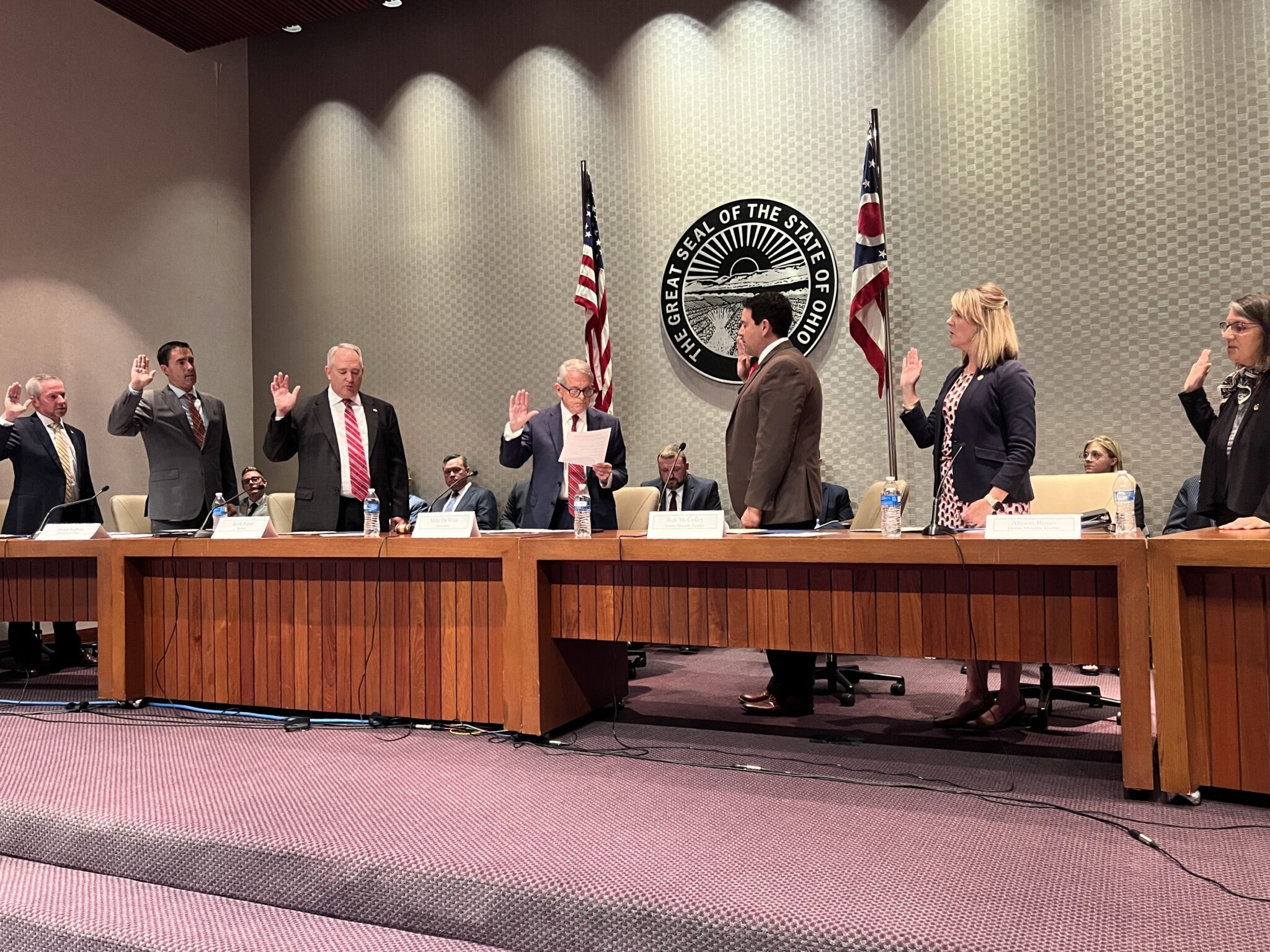
    The members of the Ohio Redistricting Commission are sworn in by Gov. Mike DeWine on Wednesday. Left to right: State Rep. Jeff LaRe, Secretary of State Frank LaRose, Auditor of State Keith Faber, DeWine, Senate Majority Floor Leader Rob McColley, House Minority Leader Allison Russo and Senate Minority Leader Nickie Antonio. (Photo by Susan Tebben, OCJ.)

    BY:  Ohio Capital Journal

    Signature collection continues for an anti-gerrymandering ballot measure in Ohio that would replace politicians on the redistricting commission with citizens. As the July deadline approaches, supporters are pointing to a new study showing how uncompetitive Statehouse races are.

    The Brennan Center for Justice at NYU’s law school analyzed Ohio’s current maps alongside the results of the most recent primary election.

    Authors of the study said the data “reveals one of the tangible ways Ohio’s gerrymandered maps undermine electoral competition, and how the districts leave millions of Ohio voters without a significant voice in the Ohio House elections slated for this November.”

    “An overwhelming majority of Ohioans will cast ballots this November in legislative districts that were drawn to lock in general election outcomes, and few districts featured meaningful primary contests,” the Brennan Center report stated. “These are the predictable consequences of living in a gerrymandered state.”

    One of the authors of the report, released Tuesday, is Yurij Rudensky, who spoke in support of the new ballot initiative proposed to hit voters in November. If it gets on the ballot and is passed by voters, the reforms would replace the current Ohio Redistricting Commission made up of elected officials with a citizen-run, judge-vetted commission to draw the next Statehouse and U.S. Congressional maps.

    Rudensky spoke in a March panel, alongside former Ohio Supreme Court Chief Justice Maureen O’Connor and others, about the difference between the reforms passed in 2015 and 2018 and the proposed amendment that voters may see on their general election ballots.

    At the March panel discussion, Rudensky hesitated to call the last two measures reforms because he argued no changes were made and the previous amendments merely demonstrated that “political insiders have no business being in the process.”

    Since those amendments passed — reforms made through legislative negotiation before hitting the voters — the Ohio Redistricting Commission has been built on a Republican majority, with Gov. Mike DeWine, Senate President Matt Huffman, former House Speaker Bob Cupp, Secretary of State Frank LaRose and Auditor of State Keith Faber all standing on the commission during some or all of the proceedings over the two years it took for the group to pass six Statehouse maps and two congressional maps. State Rep. Jeff LaRe, R-Violet Twp., replaced Cupp and state Sen. Rob McColley, R-Napoleon, came in for Huffman toward the end of the two-year span.

    The Statehouse maps were declared unconstitutionally gerrymandered five times by a bipartisan majority on the Ohio Supreme Court, but voters were forced by federal judges to use them for the 2022 Election.

    Statehouse maps passed by the redistricting commission this past September, and set to be used for this year’s election, were the only to receive bipartisan agreement (with Senate Minority Leader Nickie Antonio and House Minority Leader Allison Russo’s votes), while the state’s Congressional map is still considered unconstitutional under an Ohio Supreme Court ruling.

    In analyzing the current Ohio Statehouse maps, Rudensky and co-author Gina Feliz concluded that about 77% of the state’s population live in “districts where elections for state representatives are not in serious dispute.”

    “That is, these districts are either uncontested, or they give one party a disproportionate advantage in the general election so that the district is uncompetitive, even if it’s formally contested,” the researchers wrote.

    The report defines “uncompetitive” as districts where the partisan draw favors one party by 55% or more.

     Source: Brennan Center analysis of Ohio Secretary of State’s Office Unofficial 2024 Primary Election Results. 

    Nearly half of the districts in the Ohio House didn’t have a primary contest in March to drive a November general election race, the Brennan Center research found, citing data from the Ohio Secretary of State.

    “In all, there are 15 districts (out of 99 total) that will give voters no choice between Democratic and Republican candidates for state representative,” according to the study.

    The report also recognized the low turnout in the state during the primary season, with an average of 18.8% of registered voters casting ballots in districts with competitive primaries.

    Because of that, Rudensky and Feliz counted fewer than 450,000 voters who “all but decided who would serve as state representatives on behalf of more than 2.3 million registered voters and 3.5 million constituents.”

    The report pointed to the proposed ballot initiative led by Citizens Not Politicians as a redistricting reform that could “center community needs and voter preferences rather than the interests of incumbents.”

    Looking to a future that may have an independent redistricting commission, the voting rights group Common Cause put out its own report, a summary of a 2023 conference where members reflected on states who already have such a system in place, and those like Ohio that could see the change come in November.

    “Unsurprisingly, all those who attended the conference believed in the possibilities of fair and representative maps and that independent redistricting commissions were the best strategy to achieve this goal,” Common Cause stated in the new report.

    The “Roadmap for Fair Maps in 2030,” a summary of the 2023 National Citizen Redistricting Commissioners Conference, talked about the need to make redistricting a transparent process that is “responsive to community needs.” At the conference, the report said a “model commission” was organized for Ohio and neighbor state Indiana “to demonstrate how an alternative process based on community input and transparency can work.”

    In a previous report, released shortly after the Ohio Redistricting Commission adopted the current Statehouse district maps, Common Cause gave the state a failing grade, calling the current map-drawing process and the results that came from it “unmitigated disasters.”

    Ideally in redistricting, Common Cause members said the process should “ensure that commissions reflect the diversity of the jurisdiction” and engage community-based organizations and leaders to build resident trust and hold commissions accountable.

    What should not be included in the process, according to the report, are legislature-appointed commissioners or any legislative role in the mapping process.

    “Commission decisions on maps should be final, except for judicial review, with no approval from elected officials required,” the report stated.

    The Citizens Not Politicians initiative was supported in the report as part of strategies to “increase fair representation in 2030,” the next time the process is set to start, though maps in Ohio would need to be redrawn in 2025 if the ballot measure passes in November.

    Opposition to the initiative has been led by Huffman, who helped formulate the previous redistricting reforms. In an Ohio Chamber of Commerce event following the March primaries, he laid out his arguments against the initiative, saying litigation would pile up with the proposed system, and that “when allowed to work,” the current system did its job.

    In order for the measure to appear on Ohio ballots in the general election, supporters must collect 413,487 valid state voter signatures by July 3.


    Susan Tebben
    SUSAN TEBBEN

    Susan Tebben is an award-winning journalist with a decade of experience covering Ohio news, including courts and crime, Appalachian social issues, government, education, diversity and culture. She has worked for The Newark Advocate, The Glasgow (KY) Daily Times, The Athens Messenger, and WOUB Public Media. She has also had work featured on National Public Radio.

    Ohio Capital Journal is part of States Newsroom, the nation’s largest state-focused nonprofit news organization.

    MORE FROM AUTHOR

  • Ohio Redistricting Commission co-chair defends Dem teamwork, despite process issues, criticism

    Ohio Redistricting Commission co-chair defends Dem teamwork, despite process issues, criticism

    BY:  – Ohio Capital Journal

    Redistricting concluded on Tuesday with the adoption of new Statehouse maps that had unanimous approval from all members of the Ohio Redistricting Commission.

    The vote represents the first bipartisan agreement on maps, though the bipartisan agreement was lopsided, with only two Democrats on the current seven-member commission.

    The maps give the GOP 61 of 99 seats in the Ohio House, and all but 10 of the 33 seats in the Senate. The maps show three Republican toss-ups and one Democratic toss-up in the Senate, and eight Dem-leaning toss-ups in the House, with the GOP seeing three toss-ups.

    Both of the Dem members, Senate Minority Leader Nickie Antonio and House Minority Leader Allison Russo maintained during the meeting and after receiving criticism for their “yes” votes on the maps that the votes represented support for a future without a commission led by elected officials, and toward more redistricting reforms.

    “I believe at the core of all this, the way we draw our district lines have to change,” Antonio, who was also a co-chair on the commission, told the OCJ on Thursday. “Because I do not believe even folks who are following the rules of a quorum should be doing it the way we’re doing it.”

    Antonio’s compatriot, House Minority Leader Allison Russo prefaced her “yes” vote on Tuesday night by saying she was voting not because she supported the maps, but more because she wanted to take the process out of the hands of the current commission.

    “Every step of this process has been nothing but political,” she said in a statement. “Every negotiating tactic has come with a political angle. Every district we’ve discussed has been viewed as a political pawn.”

    Antonio said there was unity within the two Democrats on the commission, and in her mind, she and Russo had to agree before Antonio would go forward with a “yes” vote.

    “I really believed that the only way I would consider a vote in the affirmative is if we were on the same page,” Antonio said.

    The Senate minority leader defended her decision to vote for the maps, because moving forward without the attempt at negotiations with the majority GOP party would have ended with a much worse set of Statehouse maps.

    “What we were presented … was a map that would have devastated us even more, and put us in a further minority than we are right now,” she said.

    Faced with the idea of an even worse set of districts in a broken redistricting system, Antonio said she and Russo set their sights on stemming the bleed.

    Negotiation for the two-person Dems versus the five-person GOP was admittedly unbalanced, but Antonio also said there was “an openness to sit down and talk” from the members on the other side of the aisle.

    “There was give and take,” Antonio said. “I do believe we were listened to.”

    What came from the negotiations was a change in lines in Cuyahoga County, something Antonio in particular pushed for, but also three Senate districts – 16, 6, and 24 – that she says are more competitive, and three more – 27, 18, and 3 – that she foresees as opportunities for Democrats in the future.

    “Right off the bat, I’m telling you, this advances our representation and our competitiveness,” she said.

    The Senate minority leader said she looks forward to returning to Ohio as a state where there is “a legislative body that swings with the pendulum of issues and population,” but with the system in place on Tuesday, she felt she had to play with the cards in her hand.

    “I had to deal with today, and today my job was to do the best that I could for the people of Ohio,” Antonio said.

    Map criticism

    The maps passed on Tuesday night received criticism similar to that of the previous maps, which did not have the support of the Democratic members of the commission.

    The Brennan Center for Justice at New York University’s law school, which has been a party in lawsuits challenging the previous maps, claim the maps once again violate the state constitution and “deny Ohioans fair representation.”

    “This set of maps and its predecessors say one thing: the politicians on the Ohio Redistricting Commission from both parties can’t be trusted, not to follow the state constitution or honor basic fairness in elections,” said Yurij Rudensky, who is senior counsel for the Brennan Center’s Democracy Program, in a statement following the map adoption.

    Members of the Ohio NAACP, the Ohio Organizing Collaborative and the Ohio Unity Coalition called out the maps for what they see as a lack of inclusion for communities of color, which leads to separated communities and voting districts that split common interests.

    “By ignoring the racial impact of these new maps on these citizens, the commission has done a grave disservice by not assuring that districts are drawn that do not disenfranchise some voters at the expense of others,” said Petee Talley, executive director of the Ohio Unity Coalition, in a statement.

    As yet, a plan for litigation hasn’t been confirmed by any advocacy group, though Freda Levenson, legal director for the ACLU of Ohio said the group is “considering all existing options to obtain fair maps for Ohioans, and litigation is not off the table.”

    Rudensky cited former Ohio Supreme Court Chief Justice Maureen O’Connor in saying “the solution requires removing the power to draw these maps from the people who benefit most from them.”

    “Litigation can only do so much if the politicians responsible for maps refuse to follow the law,” Rudensky said.

    Advocacy groups may end up suing over the maps, but for now they are still more focused on the effort to get more redistricting reform on the ballot.

    “We are working together on an amendment to ban politicians from map drawing so that Ohio voters get the impartial districts they fundamentally deserve, and lawmakers will be responsive to the people rather than mega-donors and lobbyists,” said Catherine Turcer, executive director of Common Cause Ohio.

    How long will the maps last?

    The potential ballot initiative could bring change by 2024, including an independent redistricting commission to redraw maps, but it will have to jump through a few hoops before it gets to voters.

    Ohio Attorney General Dave Yost has considered and rejected the proposed ballot initiative twice now, but a third version has been submitted to Yost, and is awaiting a decision.

    The maps that were passed most recently could be impacted if a ballot initiative were passed by voters, but there was confusion even among commission co-chairs as to whether the maps would last for the rest of the decade, even with bipartisan agreement.

    “There are people who believe that if both Democrats vote for the map it will be an eight year map, there are also people that believe that you can’t have any longer than a 2-year map no matter who votes for it, because that chance to have a longer map passed in the first sitting,” Commission co-chair and Auditor of State Keith Faber said on Tuesday morning.

    The chance of litigation also could throw the map’s future into uncertainty, but the Ohio Constitution’s current language, as much as it could regulate redistricting, matches the 8-year opinion.

    “My reading of Article XI sections 8 and 9 suggest that the maps passed will indeed be in operation until 2030,” Collin Marozzi, deputy policy director for the ACLU of Ohio, told the Capital Journal. “It is clear that the current Article XI did not contemplate the scale and scope of failure of the commission to follow the process as approved by Ohio voters, so admittedly it is a little gray.”


    Susan Tebben
    SUSAN TEBBEN

    Susan Tebben is an award-winning journalist with a decade of experience covering Ohio news, including courts and crime, Appalachian social issues, government, education, diversity and culture. She has worked for The Newark Advocate, The Glasgow (KY) Daily Times, The Athens Messenger, and WOUB Public Media. She has also had work featured on National Public Radio.

    MORE FROM AUTHOR

  • Ohio’s congressional redistricting case moves back to state supreme court

    Ohio’s congressional redistricting case moves back to state supreme court

    BY:  Ohio Capital Journal

    In an expected move, the U.S. Supreme Court on Friday sent back an Ohio congressional redistricting appeal for reconsideration by the state’s highest court.

    Following its decision in Moore v. Harper, in which a majority of the court rejected the concept of the independent state legislature theory, the court entered a short order regarding the Ohio case, directing the state supreme court to reconsider the case “in light of Moore v. Harper.”

    The Moore v. Harper decision essentially rejected all of the arguments attorneys for Huffman and GOP leadership made for legislative authority over district maps.

    Using a very old and often rejected legal theory, arguments were made in the North Carolina case that a state legislature holds power over the administration of elections, therefore rise above the scrutiny of the judicial system when setting voting districts.

    SCOTUS Chief Justice John Roberts said the Elections Clause of the U.S. Constitution “does not insulate state legislatures” from judicial review.

    But the Ohio case, listed under the lead parties Senate President Matt Huffman and district map challenger Meryl Neiman, is headed back to a state supreme court with a new chief justice, one who led the dissent in each of the court’s rejections of congressional (and, for that matter, statehouse) redistricting maps, leading to the appeal sent to the U.S. Supreme Court.

    Chief Justice Sharon Kennedy would have upheld the very first map presented to the court nearly two years ago, and every map thereafter.

    Freda Levenson, legal director for the ACLU of Ohio said Friday that if Moore v. Harper is applied correctly by the Ohio Supreme Court, the court would uphold its previous decision, rejecting the current congressional maps.

    “What SCOTUS said in Moore was that legislatures must follow their state constitutions — consistent with what the Ohio Supreme Court already decided,” Levenson said.

    Before the court made either decision regarding redistricting, Huffman told reporters it “may simply be that we have the same congressional districts for the 2024 race as the one we have now.”

    Regarding the SCOTUS decision, Huffman released a statement on Friday praising the court’s move, and saying the appeal “clearly recognized serious constitutional concerns with the narrow majority opinions rendered under the former Chief Justice.

    “We are reviewing the U.S. Supreme Court’s message to determine the path forward,” Huffman said in a statement.

    The Ohio Redistricting Commission would need to be reconvened by Gov. Mike DeWine, but a spokesperson for the governor suggested that won’t happen until after the state budget is finalized.

    Also of note is DeWine’s son, Pat DeWine, who is a sitting justice on the supreme court. Pat DeWine has recused himself from previous cases in which the court considered contempt proceedings on ORC members (including DeWine) for missing redistricting deadlines, but has not recused himself from general redistricting lawsuits coming before the state supreme court.


    Susan Tebben
    SUSAN TEBBEN

    Susan Tebben is an award-winning journalist with a decade of experience covering Ohio news, including courts and crime, Appalachian social issues, government, education, diversity and culture. She has worked for The Newark Advocate, The Glasgow (KY) Daily Times, The Athens Messenger, and WOUB Public Media. She has also had work featured on National Public Radio.

    MORE FROM AUTHOR

  • Ohio redistricting slated for later this summer, maps in September, Senate president predicts

    Ohio redistricting slated for later this summer, maps in September, Senate president predicts

    Redistricting ahead with budget cycle’s end, Alabama decision could have impacts

    BY:  Ohio Capital Journal

    Once the Ohio two-year budget cycle is finished by June 30, Ohio Senate President Matt Huffman expects work to begin again on redistricting for Statehouse maps, with September as a likely date for them, he told reporters recently.

    Both Ohio’s U.S. Congressional district maps and Statehouse maps were declared unconstitutional gerrymanders multiple times by a bipartisan majority of the former Ohio Supreme Court, but voters were nevertheless forced to vote under them in 2022 after Republicans on the Ohio Redistricting Commission ran out the clock and appealed to a federal court.

    With swing vote former Ohio Supreme Court Republican Chief Justice Maureen O’Connor forced to retired due to age, Republicans added partisan labels to the 2022 Ohio Supreme Court races and won a majority of justices. Gov. Mike DeWine then appointed a family friend to an open seats after Justice Sharon Kennedy was elected chief justice.

    The new right-wing 4-3 majority on the court is not expected by analysts to have a swing vote on the issue of gerrymandering going forward. O’Connor has called for further anti-gerrymandering reform by Ohio voters, which had passed such reform in 2015 and 2018 with more than 70% of the vote. That system left politicians in charge of the process, however. O’Connor has since called for an independent commission.

    Ohio Republicans have also brought a case to the U.S. Supreme Court over the congressional district maps, seeking the court to declare under a theory called “independent state legislature doctrine” that the Ohio General Assembly has total control over the maps and the Ohio Supreme Court does not have jurisdiction.

    Because the high court has yet to decide whether or not it will review the case, Huffman told reporters last week that the congressional maps could stay the same for the 2024 election.

    “(The congressional map’s) a little bit more uncertain, it may simply be that we have the same congressional districts for the 2024 race as the one we have now,” Huffman said.

    As for the Statehouse maps, it’s up to the governor to call the Ohio Redistricting Commission back into session, Huffman said. The commission is made up of a majority of Republican leaders, including the governor, Auditor of State Keith Faber and Secretary of State Frank LaRose, as well as a Republican and Democrat from each chamber of the state legislature.

    Huffman – who was on the commission until he and then-House Speaker Bob Cupp removed themselves, saying they were needed for other legislative duties – sees a mid-September date as a likely end date for the Statehouse district discussion.

    “The plan in my head…is that we would start in earnest after June 30, have hearings and all of the other negotiations and things that are to be done and to try to have a map by mid-September,” Huffman said.

    He said he doesn’t know “how much all the districts will change” in the General Assembly maps, but action will be needed on them.

    One change that could come into play for the Statehouse maps has to do with a recent U.S. Supreme Court decision in an Alabama redistricting case.

    In the case, the court upheld a lower court decision that the state had likely violated the Voting Rights Act with a congressional map that had one majority Black district.

    Amid redistricting deliberations in Ohio, a staffer who helped draw some of the earliest maps in the process said he was directed to ignore racial data in drawing state districts.

    A lawsuit was filed by two Youngstown residents accusing redistricting officials of racial discrimination. The lawsuit did not see further action as maps were redrawn several times, and a federal court ordered the commission to redraw maps after they were used for the 2022 election.

    Though the Alabama decision was considered a general win for the Voting Rights Act, it’s not clear how much change it will make in Ohio.

    “It may prompt the legislature or the commission to approach the redraw differently, but I don’t see anything in the lawsuit that necessitates that change,” said Yurij Rudensky, senior counsel for the Democracy Program at the Brennan Center for Justice.

    The Alabama decision upheld existing Voting Rights Act language that bars states from ignoring demographics.

    “If it is such that the conditions on the ground could lock out voters of color from being able to participate in the process … there has to be an eye to how voters of different races are being grouped together,” Rudensky said.

    Rudensky is also counsel in a lawsuit between the Ohio Organizing Collaborative and the ORC challenging district maps in the state.

    A spokesperson for Ohio House Speaker Jason Stephens did not respond to requests for comment on the status of the redistricting process.

    Asked whether Gov. Mike DeWine had a plan when it came to redistricting post-budget cycle, a spokesperson said “it is accurate we are focused on the biennial budget due June 30th, as is the General Assembly.”


    Susan Tebben
    SUSAN TEBBEN

    Susan Tebben is an award-winning journalist with a decade of experience covering Ohio news, including courts and crime, Appalachian social issues, government, education, diversity and culture. She has worked for The Newark Advocate, The Glasgow (KY) Daily Times, The Athens Messenger, and WOUB Public Media. She has also had work featured on National Public Radio.

    MORE FROM AUTHOR

  • In GOP flip, August special election will return

    In GOP flip, August special election will return

    Voters casting ballots. | Mario Tama/Getty Images

    Bill, along with SJR 2 constitutional amendment bill, directly impact abortion rights ballot initiative

    BY:  – Ohio Capital Journal

    Less than half a year after proclaiming August elections to be too expensive for the turnout they attract, the Senate Republican majority expanded the use of a special election this year, complete with $20 million in funding.

    “This is legislative whiplash, and we do it really well here in Columbus,” said state Sen. Kent Smith, D-Euclid.

    In a mostly party-line vote, Senate Bill 92 was passed Wednesday by the body. The only Republican to vote against SB 92 was state Sen. Nathan Manning, R-North Ridgeville.

    The vote came immediately after the state senate also passed an increase in the threshold for passing a constitutional amendment from 50% to 60% along party lines.

    The threshold bill, SJR 2, is a companion bill to HJR 1, which has been making its way through the Ohio House, but has yet to come up for a floor vote. The House resolution passed its committee after three hours of testimony on Wednesday, most of which spoke in opposition to the bill.

    Both bills could lead to a ballot measure where voters would approve or deny a constitutional amendment to raise that threshold.

    With the approval of SB 92, August special elections will now be held “for consideration of a General Assembly proposed constitutional amendment,” to fill a congressional vacancy or hold a special primary for congressional party candidates.

    The bill also appropriates $20 million to conduct “a one-time August special election on August 8, 2023,” a funding influx made while the bill was in committee.

    That August election would be to send a constitutional voter threshold to the ballot for voters to approve an legislature-initiated amendment to raise the threshold from 50% to 60%.

    Republicans pushed back on comparisons between previous August elections, including last year’s that saw an abysmal 8% turnout, with the argument that this time around, voters will care.

    “With this being a bonafide, statewide question, and with it being an important question … I would say the turnout is going to be markedly higher in this August election,” McColley told his colleagues on the Senate floor.

    The legislative measures seem to be direct hits at a potential constitutional amendment that would codify abortion rights if it makes it to the ballot box and is approved by voters in November. Abortion rights advocates are currently collecting the needed signatures. State law currently requires more than 400,000 in 44 of the 88 states.

    One of the pro-abortion rights groups helping with the ballot measure, Pro-Choice Ohio, called the passage of SB 92 “both expected and incredibly disappointing” in a post on Twitter.

    Last year, after redistricting confusion rocked the legislature, Republicans all-but eliminated the August election in a move that they said would save the state money and get rid of an unneeded annual election date that historically had low voter turnout.

    In August of last year, the special primary election included statehouse races because the redistricting maps were rejected by the Ohio Supreme Court before they could be included in the May election. A U.S. District Court then intervened in the legal snarl that swept up the redistricting process, and allowed the state to use a map previously deemed unconstitutional by the Ohio Supreme Court as the map for the August primary.

    That map is still in effect currently.

    Speaking in opposition for SB 92, state Sen. William DeMora, D-Columbus, quoted Ohio Secretary of State Frank LaRose who spoke in support of reducing August special election usage last year, when he said they “aren’t good for taxpayers, election officials, voters or the civic health of our state.”

    “(SB 92) is so bad that (LaRose) Secretary LaRose couldn’t even find the time to come and testify about it in committee,” DeMora said.

    State Sen. Theresa Gavarone, R-Bowling Green, said claims that the August special elections were eliminated last year was an exaggerated claim.

    “We’re not reinventing the wheel on this legislation,” Gavarone said, pointing out that certain occasions allowed for an August special election.

    SB 92 now moves to the House for consideration.

    _____________________

    Susan Tebben is an award-winning journalist with a decade of experience covering Ohio news, including courts and crime, Appalachian social issues, government, education, diversity and culture. She has worked for The Newark Advocate, The Glasgow (KY) Daily Times, The Athens Messenger, and WOUB Public Media. She has also had work featured on National Public Radio.

    MORE FROM AUTHOR

  • Ohio Right to Life makes spurious, anti-trans argument in favor of supermajority amendment

    Ohio Right to Life makes spurious, anti-trans argument in favor of supermajority amendment

    [vc_row][vc_column][vc_column_text]

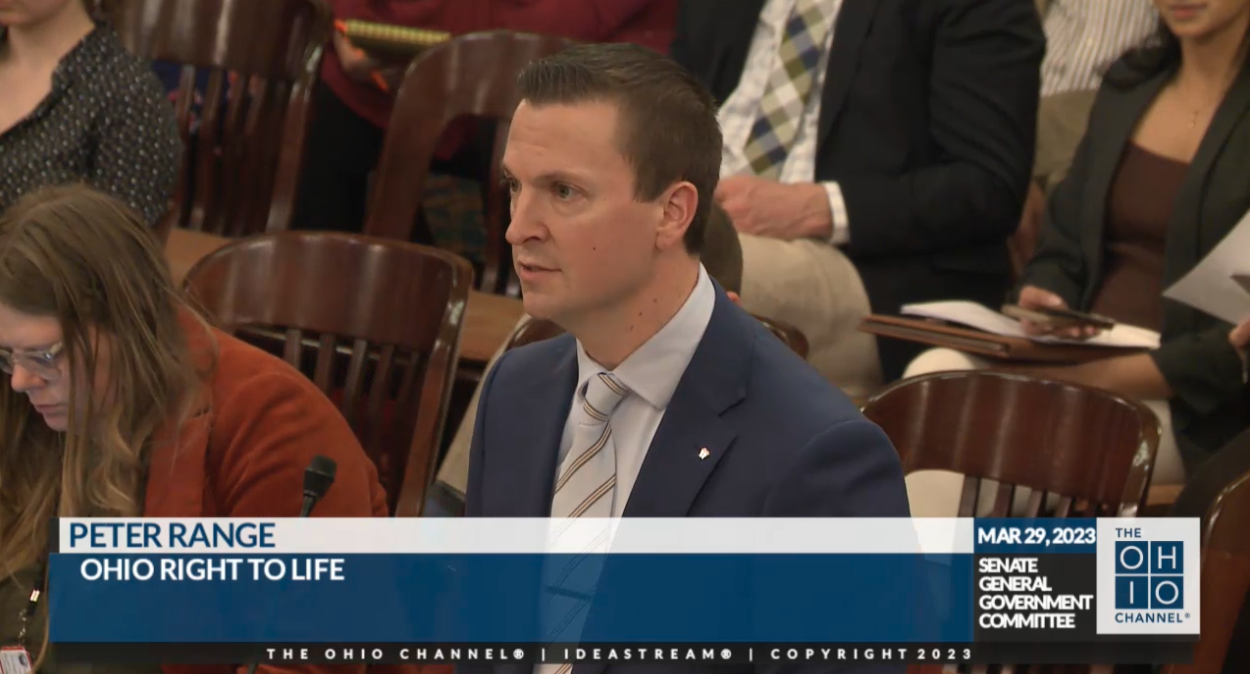
    Ohio Right to Life CEO Peter Range speaking before the Senate General Government committee in favor of SJR 2. (Screen grab from the Ohio Channel)

    [/vc_column_text][vc_column_text]

    Right to Life officials claim a reproductive rights amendment would allow youth to receive gender affirming care without parental notification

    BY:  Ohio Capital Journal

    Late last year, Rep. Brian Stewart, R-Ashville, and Secretary of State Frank LaRose introduced their plan requiring supermajority for constitutional amendments. It didn’t take long for opponents to check the calendar and argue the resolution was advancing — and advancing now — to block an abortion rights amendment on the horizon.

    Despite Stewart and LaRose’s contentions to the contrary, Republican leaders have given up the charade that the two ballot measures are unconnected. On Wednesday in a Senate committee hearing for SJR 2, outside conservative organizations doubled down. A 60% threshold for future constitutional amendments is necessary, they argued, to head off the reproductive rights amendment before November.

    But they went a step further, too.

    Speakers from Ohio Right to Life argued — without evidence — that the reproductive rights amendment would open the door to minors receiving gender affirming care without parental notification.

    It’s a specious argument that presages an exceptionally bitter march to November, marked by disinformation and fear-mongering, with critics of the argument noting that nothing in the proposed amendment mentions or supersedes Ohio’s parental consent laws.

    A “healthy tension”

    Unlike the last year’s attempt to establish a supermajority threshold, numerous proponents showed up to speak in favor of the idea.

    Some, like University of Toledo professor Lee Strang, stuck to the policy,

    “Ohio adopted this initiative mechanism for a variety of reasons,” he explained. “The most common reason was the belief that the state legislature was not sufficiently responsive to average Ohioans and was instead subject to control of large nationwide trusts.”

    Of course, that might sound familiar. Ohio’s last redistricting became a debacle in which Republican leaders repeatedly defied the state supreme court. It’s been less than a month since a jury convicted former House speaker Larry Householder in a multimillion-dollar bribery scheme funded by two major utilities.

    Strang contends the amendment process needs to maintain a “healthy tension” between two ideals: stability and flexibility. The higher threshold would insulate the constitution from provisions that belong in statutes, he said.

    Other speakers, however, wandered farther afield.

    Right to Life

    Ohio Right to Life CEO Peter Range argued passing SJR 2 is about “building a culture of life.” His testimony made no bones about wanting the higher threshold to undermine the reproductive rights amendment. But he also injected one of the latest rallying cries of the culture war.

    “This amendment that’s coming up in November will wipe away parental rights to be engaged in their teenagers decision to get an abortion or not, in their teenagers decision to get sex change operation or not.”

    He wasn’t the only right to life official to make a “parental rights” argument tied to trans youth. Kate Batra insisted, “I’m not being hyperbolic at all, when I say lives are stake.”

    “If this extreme amendment is passed, parents will have their rights obliterated,” Batra argued. “So moms and dads won’t be notified, let alone be able to consent, to their underage daughters undergoing abortion procedures. This also opens the door for adolescents to pursue controversial sex change operations, puberty blockers, sterilization procedures and the like—all without the parents’ knowledge or consent.”

    The amendment itself, however, makes no mention of gender affirming care. It’s first section reads, in full:

    “Every individual has a right to make and carry out one’s own reproductive decisions, including but not limited to decisions on contraception; fertility treatment; continuing ones own pregnancy; miscarriage care; and abortion.”

    It goes on to prohibit state interference except that abortion “may be prohibited after fetal viability.” The amendment carries an exception for the life or health of the mother.

    After the committee hearing, Sen. Rob McColley, R-Napoleon, who is one of the resolution’s sponsors, offered a tepid response to the parental rights argument.

    “There’s been an argument proffered by some that says they’re concerned with the language that says ‘but not limited to,’” he explained. “I’m not 100% well versed on that argument, so I can’t really opine on it.”

    “Demonstrably and totally false”

    Organizers leading the push for the reproductive rights amendment didn’t seem surprised by the line of argument.

    Television ads from the dark money organization Protect Women Ohio make the same spurious allegations about parental rights. The ad’s script actually leads with trans fear-mongering.

    “Your daughter is young, vulnerable, online,” the narrartor says. “You fear the worst: pushed to change her sex or to get an abortion.”

    Executive director of Ohio Physicians for Reproductive Rights, Dr. Lauren Beene, pushed back forcefully on the ad’s claims.

    “The ad is demonstrably and totally false. There is absolutely nothing in the amendment that mentions or supersedes Ohio’s parental consent laws,” she said.

    In a recent NBC4 factcheck, a Capital University law school professor rated Protect Women Ohio’s claims as four out of four Pinocchios.

    “Their intentionally deceptive ad is the beginning of a multi-million-dollar disinformation campaign,” she added, “designed to raise unsubstantiated fears and distract from the fact that the amendment will ensure Ohioans have access to comprehensive reproductive health care, including abortion, and preserve the sanctity of the doctor-patient relationship.”

    Equality Ohio executive director Alana Jochum criticized the ad as well for making “false claims” and “ignoring the facts.”

    “Not only does the proposed amendment have nothing to do with gender affirming healthcare, those arguing that it does are implying that life-saving healthcare is something nefarious,” she said. “The ballot initiative being referenced specifically protects the right to abortion, another form of lifesaving medical care that Ohioans deserve to have access to.”

    “False claims about what the proposed abortion amendment would do attempt to mislead voters by spreading lies that have been debunked by legal experts,” she added. “They are once again dragging precious children, their families, and their health care providers into a conversation that has nothing to do with them — especially when we should actually be talking about protecting democracy.”

    Cincinnati attorney David Langdon registered Protect Women Ohio as an Ohio non-profit a little over a month ago. Langdon helped draft the 2004 Ohio constitutional amendment defining marriage as between one man and one woman. He has also represented the Center for Christian Virtue — another organization pushing for the supermajority threshold.

    Follow OCJ Reporter Nick Evans on Twitter.[/vc_column_text][vc_separator border_width=”10″][vc_column_text]

    Nick Evans has spent the past seven years reporting for NPR member stations in Florida and Ohio. He got his start in Tallahassee, covering issues like redistricting, same sex marriage and medical marijuana. Since arriving in Columbus in 2018, he has covered everything from city council to football. His work on Ohio politics and local policing have been featured numerous times on NPR.

    MORE FROM AUTHOR[/vc_column_text][/vc_column][/vc_row]