Tag: remote work

  • In Ohio, 32.7% of parents work in remote-friendly jobs

    In Ohio, 32.7% of parents work in remote-friendly jobs

    The COVID-19 pandemic has resulted in a major shift towards remote work. While working from home has its benefits for certain individuals, including no commute time, a better work-life balance, and increased productivity, it can be hard for parents—especially mothers—to work from home while juggling family responsibilities. Additionally, not all occupations are conducive to remote work. A recent study by University of Chicago researchers shows that 37 percent of jobs in the U.S. are able to be performed entirely at home, but this varies substantially across cities. When considering working parents, Census Bureau data combined with data from the aforementioned study show that about 34 percent hold remote-friendly jobs.

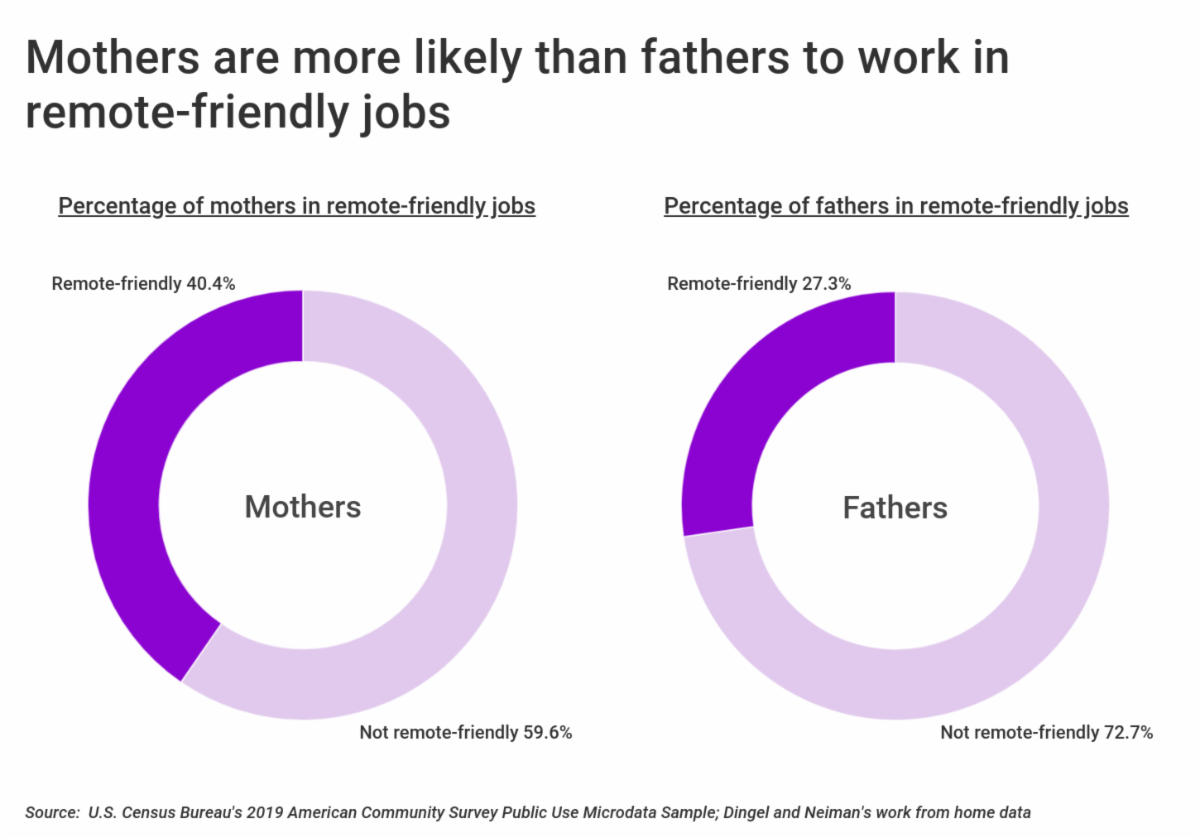
    According to occupational data from the U.S. Census Bureau, working mothers are more likely than working fathers to work in remote-friendly jobs. Over 40 percent of working mothers work in remote-friendly jobs compared to just 27 percent of working fathers. However, several studies show that working from home is harder for moms than it is for dads. As schools and day care centers closed during the pandemic, the gender gap in household chores and child care has widened. Research indicates that women working from home are more likely to take on a disproportionate share of housework and child care, while men are more likely to report an increase in productivity.
    Due to differences in local economies, there is significant variation in the share of jobs that can be performed at home across cities and states. For instance, places that rely heavily on agriculture, manufacturing, retail, and hospitality tend to have fewer jobs that can be performed at home, while areas with more business and professional jobs tend to have a large share of jobs that can be done remotely. At the state level, the Northeast tends to have more working parents in remote-friendly jobs with New Jersey and New Hampshire boasting the highest shares at 40.1 and 38.6 percent, respectively. At the opposite end of the spectrum, North Dakota and Nevada have the lowest shares of working parents in remote-friendly jobs, at 27.4 and 25.9 percent, respectively.
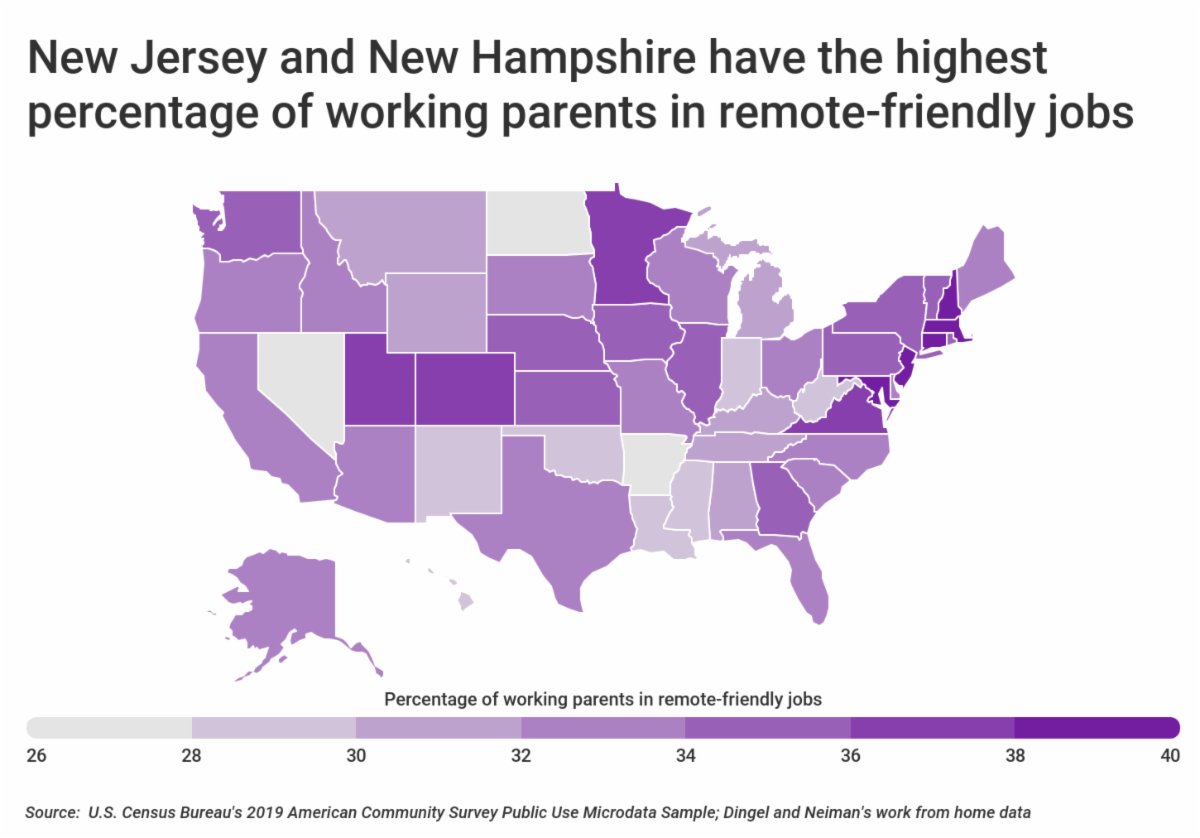
    To find the states with the most parents working from home, researchers at RetailMeNot analyzed the latest data from the U.S. Census Bureau as well as data from a University of Chicago study on remote-friendly occupations. The researchers ranked states according to the percentage of working parents in remote-friendly jobs. Researchers also calculated the percentage of working fathers and mothers in remote-friendly jobs and the percentage of fathers and mothers who work (either full-time or part-time).

    The analysis found that in Ohio, 32.7% of working parents have remote-friendly jobs. Here is a summary of the data for Ohio:

    • Percentage of working parents in remote-friendly jobs: 32.7%
    • Percentage of working fathers in remote-friendly jobs: 26.3%
    • Percentage of working mothers in remote-friendly jobs: 39.3%
    • Percentage of fathers who work: 91.5%
    • Percentage of mothers who work: 74.2%

    For reference, here are the statistics for the entire United States:

    • Percentage of working parents in remote-friendly jobs: 33.6%
    • Percentage of working fathers in remote-friendly jobs: 27.3%
    • Percentage of working mothers in remote-friendly jobs: 40.4%
    • Percentage of fathers who work: 92.1%
    • Percentage of mothers who work: 72.4%

    For more information, a detailed methodology, and complete results, you can find the original report on RetailMeNot’s website: https://www.retailmenot.com/blog/cities-with-most-parents-working-from-home.html

  • Ohio Has the 20th Fewest Remote-Friendly Jobs

    Ohio Has the 20th Fewest Remote-Friendly Jobs

    by Krista Doyle Outdoorsy Author

    Krista Doyle

    In a nationwide effort to slow the spread of COVID-19, millions of Americans have transitioned to remote work. An impending vaccine may leave many wondering whether the influx of remote work will recede with the virus. Some companies have already committed to remote working conditions beyond 2020—even permanently—but there are several jobs that simply cannot be carried out from home. Those who work in maintenance, food preparation, construction, and much of the healthcare industry are often (or always) required to physically be somewhere other than home.

    Still, approximately one-third of all jobs can be conducted remotely. Analyzing two surveys conducted by the Occupational Information Network, researchers at the University of Chicago formulated a work-from-home measure for each of 22 major occupational groups. Using that measure and recent employment data from the U.S. Bureau of Labor Statistics (BLS), researchers at Outdoorsy calculated the percentage of each U.S. metropolitan area’s workforce that can conduct work exclusively from home. Applying educational attainment, wage, and minority population data to the analysis, researchers identified some key takeaways.

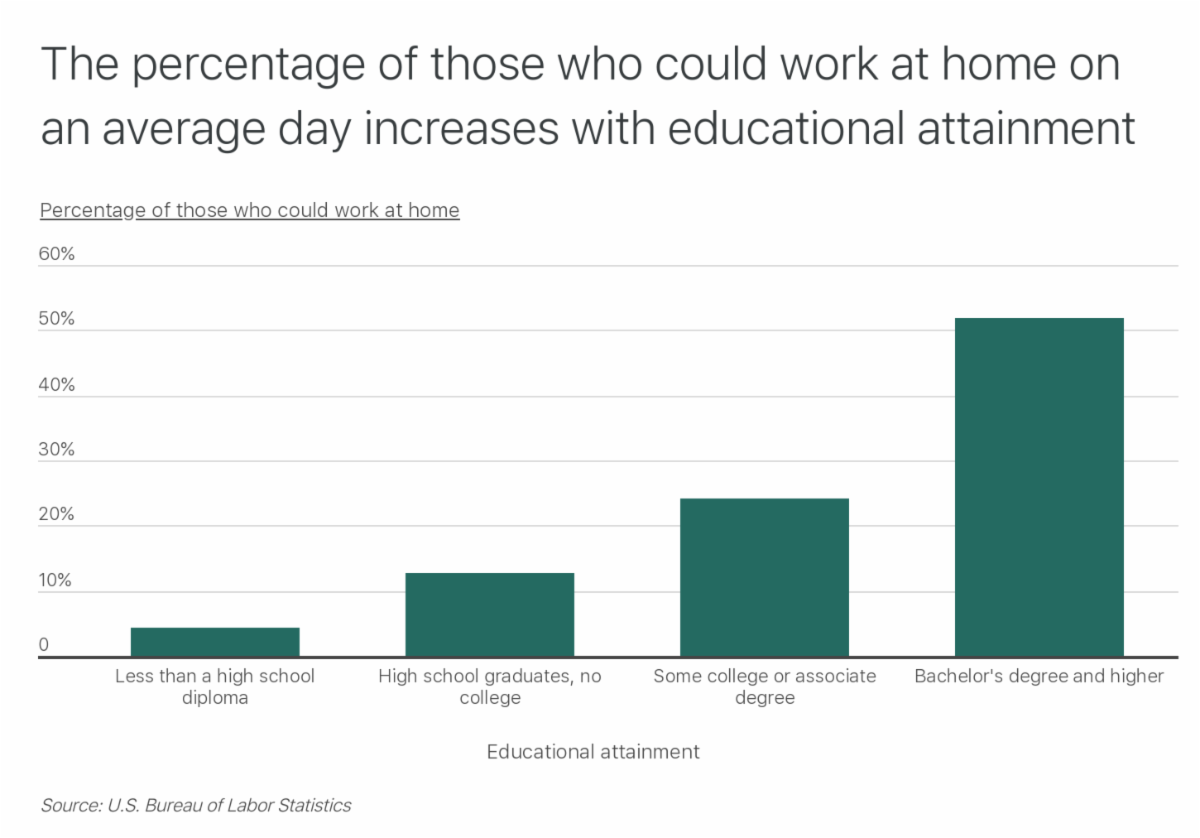
    As it turns out, educational attainment is a strong predictor of the ability to work remote. Citing responses provided in the annual American Time Use Survey (ATUS), the BLS discovered that the percentage of workers who could do at least some work from home on an average day increases significantly based on educational attainment. While less than 5 percent of workers who did not finish high school report being capable of doing some work from home, more than 50 percent of those with a bachelor’s degree or higher could.

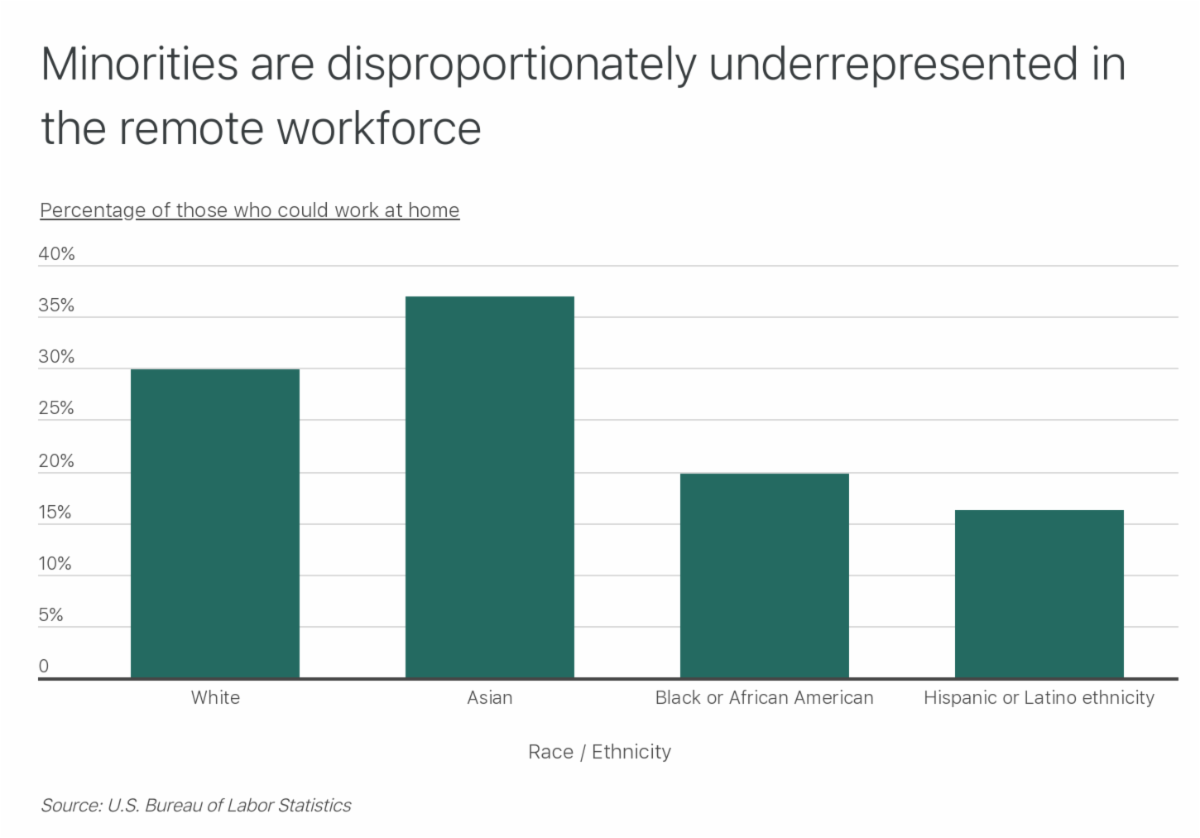
    Educational attainment is not the only predictive measure of remote work. The ATUS found that certain minorities were disproportionately underrepresented in the potential remote workforce. Overall, only 16.2 percent of Hispanic or Latino workers and 19.7 percent of Black or African American workers report being able to do some of their work from home compared to 29.9 percent and 37 percent of White and Asian workers, respectively. In addition to occupation, living arrangements—including access to computers and broadband internet—may impact the ability of many minorities to work remotely. Pew research found that prior to the pandemic, only 57 percent of Hispanics and 58 percent of Blacks had access to a computer at home compared to 82 percent of Whites.

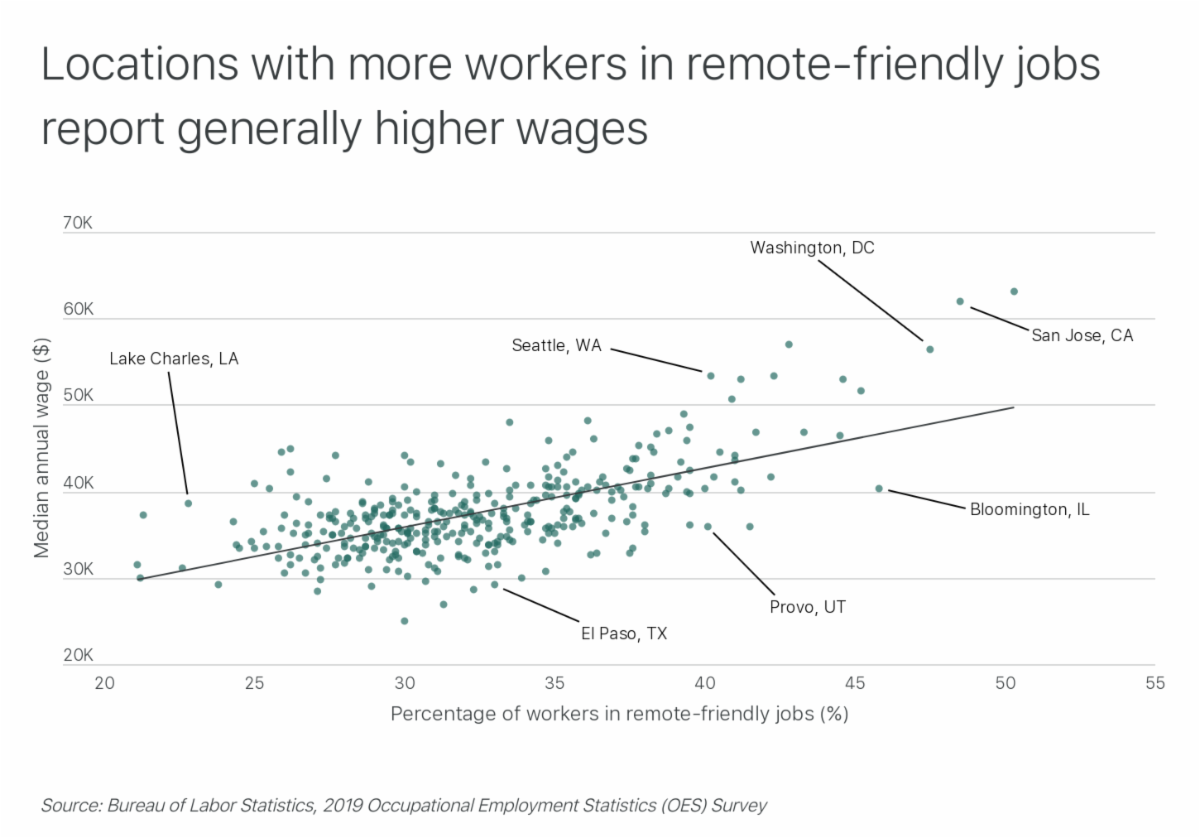
    The ability to work from home has not only kept millions of Americans employed this year, remote work is also financially rewarding. While remote jobs make up 35.5 percent of all U.S. employment, they account for 45.8 percent of all U.S. wages. As a result, locations throughout the country with higher percentages of workers in remote-friendly occupations report generally higher median annual wages.

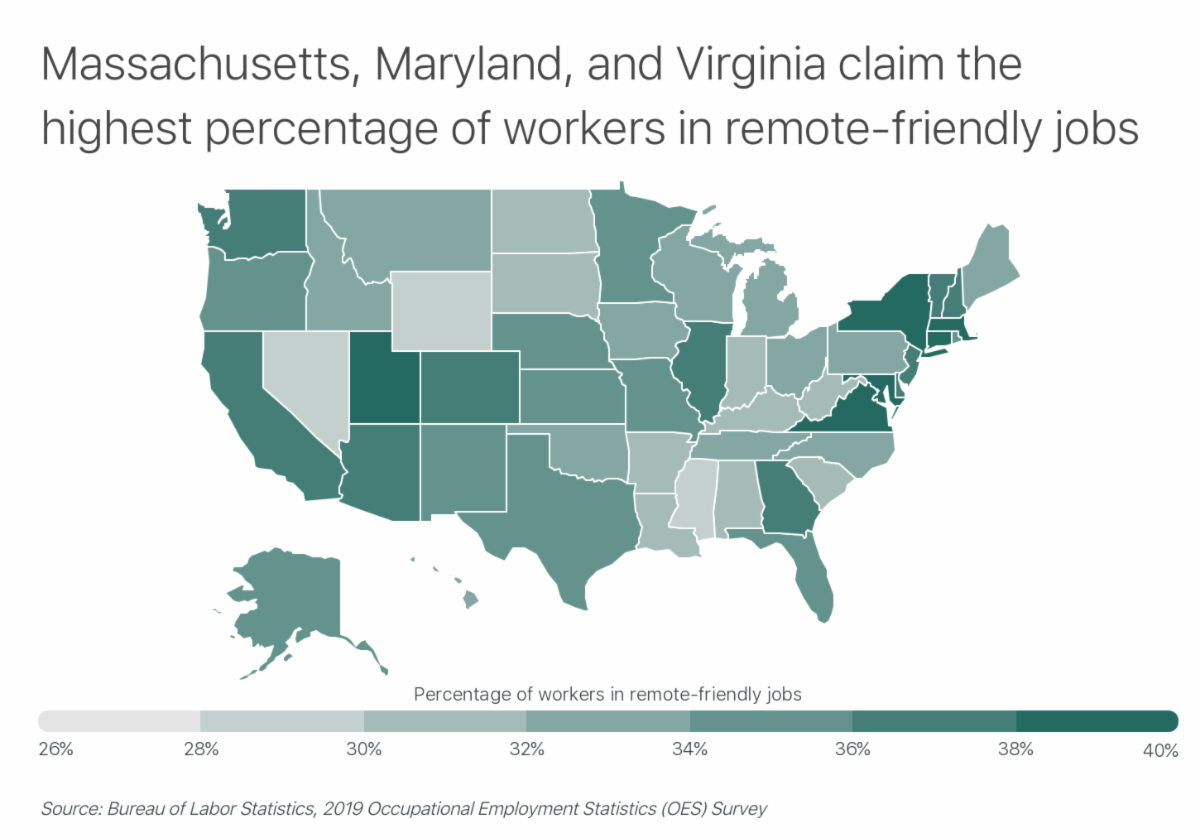
    The prevalence of remote work varies significantly at the state level. Massachusetts, Maryland, and Virginia top the list of states with the highest percentage of workers in remote-friendly jobs, reporting 40.2 percent, 39.6 percent, and 38.9 percent, respectively. Utah, Colorado, Washington, and California also show high percentages, all ranking in the top 10. The lowest percentage of workers in remote-friendly jobs—just 29.7 percent—is in Mississippi.

    To find the states with the most remote-friendly jobs, researchers at Outdoorsy analyzed the most recent employment data from the BLS’s 2019 Occupational Employment (OES) Survey. A work-from-home measure that rates an occupation’s viability for remote work created by the Booth School of Business at the University of Chicago was used to calculate the percentage of workers in remote-friendly jobs in each metro. Researchers ranked states accordingly. The report also includes the total number of workers in remote-friendly jobs, the median annual wage, the population with a bachelor’s degree or higher, and the minority population share of each location.

    The analysis found that in Ohio, 33.7% of all wage and salary workers have a remote-friendly job, defined for the purposes of this analysis as being a job that can be performed entirely remotely. Out of all U.S. states, Ohio has the 20th lowest percentage of workers in remote-friendly jobs. Here is a summary of the data for Ohio:

    • Percentage of workers in remote-friendly jobs: 33.7%
    • Total workers in remote-friendly jobs: 1,833,629
    • Median annual wage: $38,560
    • Population with a bachelor’s degree or higher: 29.3%
    • Minority population share: 20.8%

    For reference, here are the statistics for the entire United States:

    • Percentage of workers in remote-friendly jobs: 35.5%
    • Total workers in remote-friendly jobs: 52,108,014
    • Median annual wage: $39,810
    • Population with a bachelor’s degree or higher: 33.1%
    • Minority population share: 38.9%

    For more information, a detailed methodology, and complete results, you can find the original report on Outdoorsy’s website: https://www.outdoorsy.com/blog/top-remote-friendly-cities

    Read the profiles of the Large metros with the highest percentage of workers in remote-friendly jobs

  • Ricky Mulvey and David English – 4/21/2020 A quarantine episode…

    Ricky Mulvey and David English – 4/21/2020 A quarantine episode…

    Ricky Mulvey is a stand-up comedian, radio producer, and a mid-range threat in any pick-up basketball game. Mulvey loves talking about saving money on tickets, business news, and how e-commerce changed inflation as we know it. He graduated with a finance degree from THE Ohio State University in 2018.

     

    David English is a Kentucky Wildcat, soccer fanatic, and a credentialed financial professional. He loves spending time with his wife, Amy, and tweeting at people who will probably not interact with him back.


    Loveland Magazine’s favorite Podcasters are back with a special Quarantine Episode.

    Our favorite ones on the Internet of Radio because Ricky Mulvey worked at Loveland Magazine for five years and David English – well, just because we like him. David has been to the Loveland Magazine TV studio for an interview with Cassie Mattia, and we like David… well… because he sometimes gives our friend Ricky a hard time!

    Business news, but better

    Business news is boring. Let’s make it interesting, fun, and understandable. Ricky Mulvey and David English cut through the headlines and talk about how business news affects you.

    Listen to “A Quarantine Episode”

    Updates on remote work, CARES Act, recent unemployment claims, local business struggles, and MORE!

    “Full of Cents” co-hosts Ricky Mulvey and David English interviewed by Cassie Mattia…