In a short meeting, the Ohio Ballot Board signed off on a proposed constitutional amendment abolishing property taxes in the state. The only question before the board was whether the proposal contains one or multiple amendments.
Supporters contend lawmakers have been unwilling or unable to make significant enough changes as property taxes climb. But critics warn eliminating that revenue stream could cripple important services like schools and first responders.
Campaign reaction
GET THE MORNING HEADLINES.
The day after the ballot board meeting, Beth Blackmarr described her mood as ‘busy.’
“Busy, busy, busy,” she said, “I mean, here we go — we’ve got to hit the ground running.”
Blackmarr is part of the organization Citizens for Property Tax Reform which is leading the repeal campaign. With the ballot board’s decision, the group is now able to start gathering signatures to appear on the ballot.
To go before voters, they’ll need 10% of the electoral turnout from the last governor’s race (just shy of 415,000). Additionally, in 44 of Ohio’s counties, they’ll need signatures from at least 5% of the governor’s race turnout. In practice, campaigns turn in hundreds of thousands more signatures than necessary to make up for any rejections.
Blackmarr said they want to start collecting “as soon as humanly possible,” and work could begin as early as next week. Asked whether they’d work with paid circulators, she just laughed.
“Many of us are youthful at heart, but senior citizens that are just really working out of our pockets,” she said. “There’s no big money backing this at all. It’s all volunteer.”
The merits
Blackmarr argued Ohio’s current property tax system is broken. She points to other states like New Jersey and Texas that have far more generous initiatives to keep seniors, vets and the disabled in their homes.
“You can’t have senior citizens who have paid for their homes — fully paid for — having to move out because they can’t afford property tax,” she insisted.
Blackmarr contends those kinds of protections are low-hanging fruit. Lawmakers have had continual warnings and “ample opportunity” to act. Instead, she argued, they’ve dithered with changes at the margins.
“I suspect it’s because they built a wobbly tower of property tax law over these decades,” she said, “and they’re afraid to pull one of the blocks out, because they’re afraid the whole thing’s gonna come tumbling down.”
That ‘tumbling down’ is exactly the concern many critics voice about the plan. The most recent annual report from the Ohio Department of Taxation puts 2023 property tax collections at about $18.5 billion. That’s an enormous amount of funding to just disappear. It’s roughly double the amount reported for state income taxes, and a billion more than Ohio’s sales and use tax.
Spread evenly, it would cost every single Ohioan more than $1,500 to make up that gap in funding.
Blackmarr argued repeal will just force lawmakers “to come up with an alternative.” But that’s a big ask — particularly for Republicans allergic to tax increases.
Still she’s right about dramatic increases in property taxes. The same Department of Taxation report shows assessed values climbing almost 40% in five years while tax collections have risen more than 21%.
Legislature’s role
In a statement following the ballot board decision, House minority leader Allison Russo said the proposal “clearly demonstrates frustration by Ohioans on this issue” and blamed lawmakers for failing to act.
“However, this particular initiative concerns me because while it eliminates the property tax, it doesn’t explain how we’ll replace the funds that support police, fire departments, public education, and other critical services,” she said.
Russo argued Democrats have signed on to bipartisan legislation providing direct relief but Republican leaders haven’t prioritized those bills.
Blackmarr acknowledged that as their campaign gains steam, pressure will grow on lawmakers to pass legislation or propose their own ballot measure to undercut their efforts.
“At the end of the day it goes to the voters,” she said. “They have to make the decision for themselves.”
And if lawmakers’ intervention means voters have to choose between competing visions, that’s just fine with Blackmarr.
“Wouldn’t that be nice, you know?” she said.
Follow Ohio Capital Journal Reporter Nick Evans on X or on Bluesky.
Nick Evans
Nick Evans has spent the past seven years reporting for NPR member stations in Florida and Ohio. He got his start in Tallahassee, covering issues like redistricting, same sex marriage and medical marijuana. Since arriving in Columbus in 2018, he has covered everything from city council to football. His work on Ohio politics and local policing have been featured numerous times on NPR.
Ohio Capital Journal is part of States Newsroom, the nation’s largest state-focused nonprofit news organization.
Loveland, Ohio – The Southwest Ohio Air Quality Agency expects to see levels of ozone in the “unhealthy for sensitive groups” range on the Air Quality Index (AQI).
Saturday, Aug 5
Unhealthy for Sensitive Groups
Ozone
This level of Ozone can be harmful to children, seniors, adults who are active outdoors (such as manual laborers), and people with heart disease, lung disease (such as asthma, emphysema, and bronchitis), or diabetes.
On Air Quality Alert days, everyone can help reduce ozone formation by taking the following actions:
Take the bus, carpool, bike, or walk instead of drive.
Refuel your vehicle after 8 p.m.; do not top off when refueling and tighten the gas cap.
Do not idle your vehicle; exhaust contributes considerably to ozone formation.
Combine trips or eliminating unnecessary vehicle trips.
Keep your vehicle maintained with properly inflated tires and timely oil changes.
Avoid use of gasoline-powered lawn equipment on Air Quality Alert days.
Avoid use of oil-based paints and stains on Air Quality Alert days.
Never burn leaves or other yard trimmings.
Suspend use of fire pits, campfires and charcoal grills on Air Quality Alert days.
Conserve electricity by turning out lights and unplugging unused appliances and electronics.
Loveland, Ohio – The Southwest Ohio Air Quality Agency expects to see levels of ozone in the “unhealthy for sensitive groups” range on the Air Quality Index (AQI).
Friday, Aug 4:
108 AQI
Unhealthy for Sensitive Groups
Ozone
This level of Ozone can be harmful to children, seniors, adults who are active outdoors (such as manual laborers), and people with heart disease, lung disease (such as asthma, emphysema, and bronchitis), or diabetes.
On Air Quality Alert days, everyone can help reduce ozone formation by taking the following actions:
Take the bus, carpool, bike, or walk instead of drive.
Refuel your vehicle after 8 p.m.; do not top off when refueling and tighten the gas cap.
Do not idle your vehicle; exhaust contributes considerably to ozone formation.
Combine trips or eliminating unnecessary vehicle trips.
Keep your vehicle maintained with properly inflated tires and timely oil changes.
Avoid use of gasoline-powered lawn equipment on Air Quality Alert days.
Avoid use of oil-based paints and stains on Air Quality Alert days.
Never burn leaves or other yard trimmings.
Suspend use of fire pits, campfires and charcoal grills on Air Quality Alert days.
Conserve electricity by turning out lights and unplugging unused appliances and electronics.
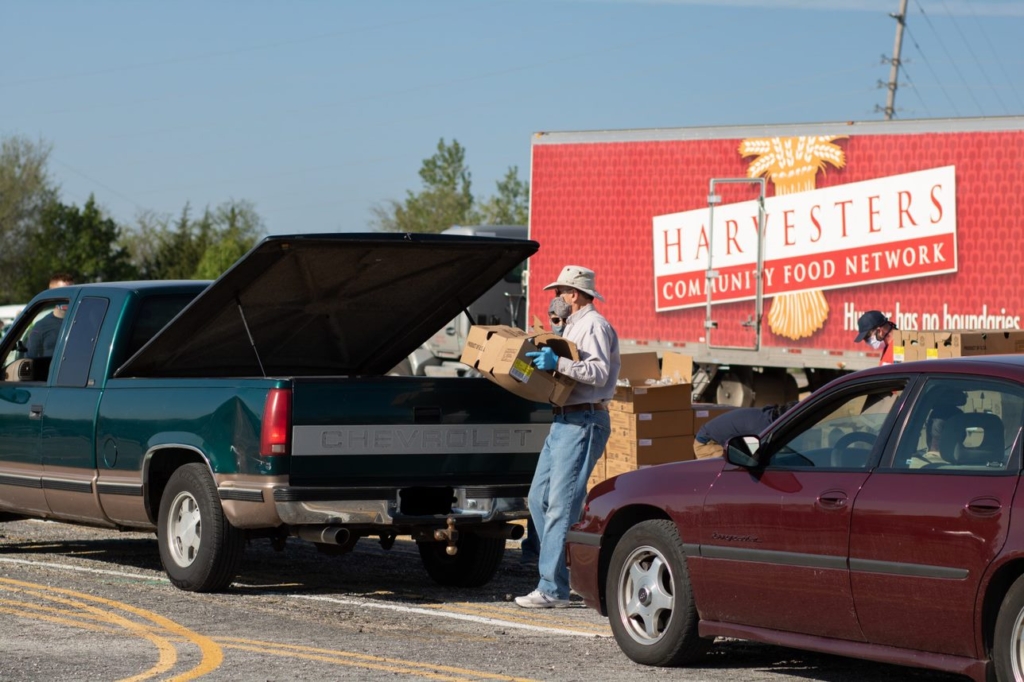
Throughout the pandemic, families have turned to food banks for help. Harvesters, a private food bank, saw the amount of food distributed increase from 54 million pounds in 2019 to 65 million in 2020. In this picture, food is distributed at a drive-in in Kansas City, Kansas. (Harvesters — The Community Food Network).
After Congress ended pandemic food assistance in February, 70,000 older Ohioans have seen food benefits slashed to $23 a month, in some cases down from $280.
That has many making excruciating choices between food, medicine and utilities like electricity and gas, Lisa Hamler-Fugitt, executive director of the Ohio Association of Foodbanks, said Wednesday.
And while it’s dire for anybody to live in hunger, that’s especially true the older you are, she said, because insufficient nutrition exacerbates conditions such as diabetes and depression and can take away seniors’ ability to live on their own. The end of COVID-era enhancements to benefits under the Supplemental Nutrition Assistance Program — or SNAP — has added to the already increasing number of older Ohioans seeking help at Ohio’s groaning food pantries, Hamler-Fugitt said.
“They’re the canaries in the hunger coal mine,” she said, explaining that because most older Ohioans live on fixed incomes, they can’t earn their way out of food insecurity. “When they join the food line, they’re not leaving until they go into the nursing home or they pass away.”
To help low-income people deal with the economic shocks from the coronavirus epidemic, Congress and the Trump administration in 2020 enhanced benefits under SNAP, the program formerly known as food stamps, and it eased eligibility to include households with somewhat higher incomes. And by literally putting food on the table, it had a big effect on poverty, the Center on Budget and Policy Priorities reported.
“The temporary benefits pushed back against hunger and hardship during COVID,” the report said. “A study estimated that (enhanced allotments) kept 4.2 million people above the poverty line in the last quarter of 2021, reducing poverty by 10 percent — and child poverty by 14 percent — in states with (enhanced allotments) at the time. The estimated reduction in poverty rates due to (enhanced allotments) was highest for Black and Latino people.”
But last December, Congress and the Biden administration decided to end the enhancements effective in February.
“This change was made as part of a bipartisan compromise that created a permanent Summer Electronic Benefit Transfer (EBT) program to provide grocery benefits to replace school meals for some 30 million children in low-income families when schools are closed in the summer — a time when families with school-aged children are at higher risk for food insecurity,” the Center on Budget and Policy Priorities reported.
Hamler-Fugitt said that in Ohio, the group over 60 was particularly hard hit in part because it’s an aging state. It has the 18th-highest percentage of residents over 65, for example.
In some cases, seniors don’t have support systems and some are even supporting others, such as grandchildren and great-grandchildren. And the older one becomes, the more health complaints accumulate, often making it impossible to perform many of the jobs that are available.
Hamler-Fugitt said her agency has been hearing about the real-life consequences of cutting back food benefits to older Ohioans.
“You just can’t even believe these horror stories,” she said. “We’re interviewing them now about what their coping strategies are and it’s really, really scary. Before they had about $2 a meal — that was a best-case scenario. Now it’s 75 cents a day. That’s 25 cents a meal.”
She explained that the permanent fix to the problem is at the federal level, where providing the U.S. Department of Agriculture with more resources could make the enhanced benefits permanent.
But over the short term, advocates for the poor are asking the Ohio General Assembly to pony up $21 million for each of the next two years to ensure that every eligible Ohio household has at least a $50 monthly SNAP benefit.
“The economic consequences of this for an aging state like Ohio are just huge,” Hamler Fugitt said.
_____________________________
MARTY SCHLADEN
Marty Schladen has been a reporter for decades, working in Indiana, Texas and other places before returning to his native Ohio to work at The Columbus Dispatch in 2017. He’s won state and national journalism awards for investigations into utility regulation, public corruption, the environment, prescription drug spending and other matters.
In addition to overseas wars and continuing supply-chain disruptions, diseases and climate-driven storms are making it hard to feed the hungriest Ohioans, Ohio’s top food bank official said Friday.
And that’s even as continuing inflation is creating ever more of them, she said.
“We’re just not seeing a return to normal at all,” said Lisa Hamler-Fugitt, executive director of the Ohio Association of Foodbanks.
Throughout the pandemic, Ohio’s food banks have seen record demand. Now, with costs of essentials like food and utilities continuing to increase, things are only getting worse.
“We thought we were at the high-water mark for demand,” Hamler-Fugitt said. “We’re way past that.”
She said that in the quarter ending Sept. 30, Ohio’s overstretched food banks saw 50% more children than they had in the same quarter of an unusually busy 2021. They also saw 31% more seniors, she said.
“Once people start getting these high heating costs, this will continue,” she said. “Seniors are just outliving their resources.”
In addition, Putin’s war in Ukraine continues to keep grain and other agricultural products off the market and while gas prices are coming down, prices for the fuel mostly used to transport food — diesel — remain high. All those factors increase food prices at the same time that food banks are having to buy more because USDA food donations have been cut substantially.
To help with those purchases, Gov. Mike DeWine in October announced that food banks would get $15 million in unexpended federal coronavirus funds — money that Hamler-Fugitt said is going to buy protein-rich food like beef, ham, poultry, eggs and dairy products. Last week, the legislature announced another $25 million for the food banks, which Hamler-Fugitt said would be evenly split between proteins and plant-based foods.
But as the food suppliers of last result scramble to meet demand, mother nature seems to be conspiring against them.
“Most of our vegetable production this time of year shifts to the South and the West Coast,” Hamler-Fugitt said.
In addition, the coronavirus isn’t the only disease increasing food costs. An avian flu outbreak has impacted more than 44 million birds, trebled egg prices and also inflated the cost of Thanksgiving and Christmas turkeys.
All of which adds to the burden shouldered by foodbanks. Hamler-Fugitt acknowledged that she’s been appealing for help since the start of the pandemic and said she understands that covid fatigue set in long ago. But she said the number of hungry Ohioans is still growing.
“We’re just bracing and hoping that something else doesn’t happen,” she said.
The Mission:To improve the quality of life for older adults by providing a broad range of home and community based services, enabling them to remain as active and independent as possible.
Clermont Senior Services is a private, 501(c)3 non-profit organization dedicated to serving older adults. We are your source for information on services for seniors, age 60 and over, who live in Clermont County, Ohio.
For over forty years, Clermont Senior Services has been providing and coordinating in-home and community based services, enabling older adults to live independently for as long as possible. We also serve as an information and referral source for seniors, as well as their families and caregivers.
‘Service With Heart’ is the benchmark of our service provided by professionally trained, caring, compassionate staff.
Here are the highlights of Ohio’s draft COVID-19 immunization plan. You can read the complete draft: ODH Draft COVID-19 Plan
The final plan must be submitted to the CDC by November 1st.
Under the draft, Ohio would implement a 4-phase approach to distributing the COVID-19 vaccine once its available.
A summary of the phases are as follows:
Phase 1 – High-risk healthcare workers, first responders, seniors living in congregate settings (i.e. nursing homes)
Phase 2 – Public health workers, teachers and school employees, homeless individuals, prison workers and inmates, persons with mental health in group homes or institutions, and individuals with a medical condition putting them at greater risk of mortality due to COVID-19
Phase 3 – Students, young adults, children, and individuals in high risk occupations
This article provided to Loveland Magazine was edited by David Miller and is by by Eye on Ohio, the nonprofit, nonpartisan Ohio Center for Journalism. Please join their free mailing list as this helps us provide more public service reporting.
In early March, just as Ohioans were learning about the first cases of novel coronavirus in the state, Anna Bondar’s grandfather fell at his Cleveland home.
Luckily, the 92-year old, who lives with dementia, wasn’t injured badly.
The tight-knit family started to discuss the possibility of a nursing home, though they had serious reservations.
Their tough choice was made even more difficult by mounting fears about the coronavirus. In nearly four months, COVID-19 has infected more than 31,191 people statewide and has proven particularly deadly for residents of long-term care facilities in Ohio.
Seventy percent of the reported deaths in Ohio due to COVID-19 complications have been in long-term care facilities, which is among the highest in the country.
Nationally the portion of COVID-19-related deaths in long-term care facilities has hovered just over 40%, though the amount of testing done in nursing homes varies significantly by state.
Every day, families like Bondar’s are making what can feel like an impossible choice – whether to send a loved one to a nursing home where they will receive around-the-clock specialized care but face a greater risk of contracting COVID-19, or to care for that person at home where risk of transmission is lower but providing care can be more challenging.
Even before the pandemic, sorting through the myriad of quality ratings and measures was daunting enough. Then, COVID-19 deaths started to soar.
Now, families and seniors agonize over what could be life or death choice using confusing numbers on infection “hotspots” and without the ability to visit nursing homes to observe how the staff cares for residents – which is the number one recommendation of most advocates.
Dr. Amy Acton, director of the Department of Health
State officials, including Dr. Amy Acton, the former director of the Department of Health, have emphasized that “congregate” settings like nursing homes are at highest risk of infection. Staff, who often travel between facilities, need to be in close contact with residents to provide care. And residents, who are primarily older and have multiple medical conditions, are more susceptible to COVID-19-related complications.
“All of this makes it high risk. At the same time, it’s really necessary for many patients to be there,” said Dr. Steven Schwartz, a geriatric physician at the Cleveland Clinic who travels to nursing homes as part of the Clinic’s Center for Connected Care.
Ohio National Guardmembers will begin testing all staff members and any residents who likely were exposed to COVID-19 in the state’s nursing homes, Gov. Mike DeWine announced May 27. What are being called Congregate Care Unified Response Teams will focus on facilities where confirmed or assumed positive cases are reported in hopes of reducing the number of COVID-19 cases and deaths in Ohio’s nursing homes, which as of May 27 was 5,324 resident cases and more than 1,442 deaths.
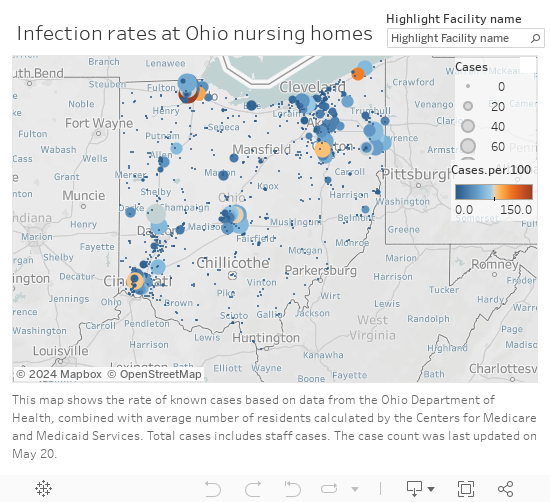
Infection rates in Ohio Nursing Homes
Making an educated decision
Last month, state officials began to release the numbers of reported infections and deaths in long-term care facilities, which include nursing homes, rehabilitation centers, and assisted living centers.
But it’s unclear how much the numbers – which are reported weekly and are also tracked cumulatively – matter for families currently trying to choose a facility.
The state, on its coronavirus website, says the infection and death numbers shouldn’t replace a thoughtful conversation with a nursing facility about infection control practices and that “residents and family members should understand that the presence of COVID-19 at a facility is [in] no way an indicator of a facility that isn’t following proper procedures.”
Yet many in the health care industry say infection information should be considered, along with other factors, when deciding which site to choose.
“If you see a nursing home with a large outbreak, that’s something to worry about. If you see a nursing home with a small outbreak, I’m not sure it means anything but bad luck.”
“If you see a nursing home with a large outbreak, that’s something to worry about. If you see a nursing home with a small outbreak, I’m not sure it means anything but bad luck,” said Dr. James Campbell, department chair of geriatric medicine at MetroHealth.
The infection information provided by the state can be useful, for instance, if a family is choosing between two similar facilities, said Nate Cyrill, a Long Term Care Ombudsman for Cuyahoga, Geauga, Lake, Lorain and Medina counties.
Since information on the virus changes rapidly, most families still rely on the quality measures that were available before COVID-19, including existing state and federal online guides Cyril said.
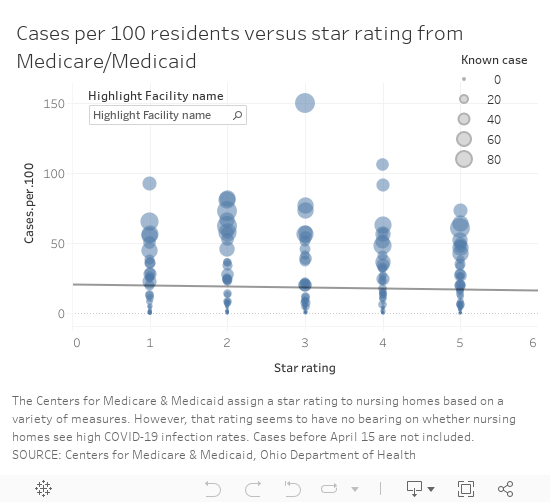
One of the commonly-used ranking systems, maintained by the Centers for Medicare and Medicaid Services, assigns ratings – from 1 to 5 “stars” – to facilities based on performance on quality measures, staffing and inspections.
The number of “stars” Ohio’s nursing homes received, however, does not appear to have a correlation to the number of infections reported to the state, based on a comparison of the publicly available information. The analysis did not include assisted living facilities.
Cases vs. Star rating
“You want to look for a nursing home that’s four of five stars preferably but even that doesn’t tell you the whole story,” Steven Schwartz said.
There are numerous 1-star rated facilities that have reported few infections, like Whetstone Gardens and Care Center in Columbus, which has reported 9 cases or 8 per 100 residents.
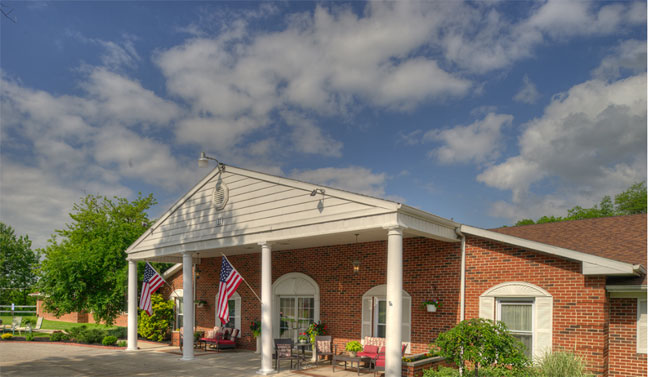
Salem North Healthcare Center
Salem North Healthcare Center in northern Columbiana County had 51 patients test positive for the virus as of May 20, as well as five staff, according to the state. It is rated a 5-star facility, the highest rating from CMS.
It’s one of four 5-star facilities with an infection rate over 50 casesper 100 residents, based on Medicare’s calculation of each facility’s average number of residents. (The rate does not include infections among staff because the number of staff in each facility was not available.)
Since April, the focus on high numbers of reported infections, often referred to as clusters, in long-term care facilities has intensified. In some cases, those numbers are a reflection of the level of testing, said Fred Stratmann, general counsel and chief compliance officer for CommuniCare Health Services. It doesn’t mean all of the residents with a positive test had symptoms of COVID-19. The state infection numbers also don’t show the residents who have recovered from the virus, he said.
CommuniCare, which operates close to 90 health care facilities in seven states has been proactive about testing, Stratmann said. When COVID-19 cases started to appear at the North Salem facility, the company enlisted the state’s “strike team” to proactively test all of the residents. It has since re-tested all of the residents who were initially negative and purchased 3,000 testing kits to supplement what the state could provide.
“We wanted to be certain of the extent of COVID in this center in order to be able to properly treat it and to fight back against it,” Stratmann said. The facility does that by isolating any COVID-19-postive patients in a separate unit with its own dedicated staff and by admitting new residents to an observation unit for 14 days to make sure they have no symptoms of infection, he said.
Restrictions on visits make choices harder
The most effective way to scout out a facility typically is to visit it, preferably unannounced, said Dr. James Campbell, department chair of geriatric medicine at MetroHealth. However, because visitors aren’t permitted in nursing homes right now, the next best thing is to ask detailed questions about care, any COVID-19 cases and infection control measures, he said.
Campbell also suggested turning to hospital staff, who work with nursing homes regularly, for advice. Social workers can place five people in a week, while most individuals face that decision, at most, only a few times in their lives, he said.
Cyrill said his agency can also provide information that can’t be found online for families trying to choose between facilities.
Cyrill said his agency can also provide information that can’t be found online for families trying to choose between facilities.
The agency, along with other similar independent agencies across the state, investigates complaints in long-term care, skilled nursing, group homes and rehabilitation facilities and can share what are called “verified complaints” that aren’t otherwise available publicly.
Most of the complaints investigated in relation to COVID-19, Cyrill said, have been related to visitation or the ability of families to get information on a loved one’s condition.
It’s been harder, though, for Cyrill and his colleagues to investigate complaints with COVID-19 restrictions in place.
It’s been harder, though, for Cyrill and his colleagues to investigate complaints with COVID-19 restrictions in place.
Under normal circumstances, an ombudsperson would go to the facility and talk to patients and could do so without announcing the visit in advance. Since visits are restricted for infection control reasons, they have to work through staff to speak to residents or to ask questions, which isn’t optimal. And they aren’t able to make direct observations.
“It makes our job much more challenging,” Cyrill said.
At the North Salem facility, which has had about a dozen new residents admitted or transfered from other facilities, the staff has given “virtual tours” over the phone to family members or prospective residents who were in the hospital, Stratmann said. The company also invested in technology that won’t replace face-to-face visits but enables more family contact and the ability and for staff to help keep residents’ spirits up by making videos of activities, like dancing and singing, to keep them connected with the local community.
In addition, Stratmann said they walk families through the infection control procedures and share techniques they have implemented to improve health outcomes for patients with COVID-19 including, when appropriate:
Treating residents with anticoagulant medications to reduce the risk of blood clots and strokes, which has been a factor in some COVID-19-related fatalities.
Practicing “proning” or positioning residents, while awake, flat on their belly and chest to reduce the buildup of fluid in lung tissue and reduce the risk of Acute Respiratory Distress Syndrome, which has been associated with many COVID-19 fatalities.
The idea of putting their beloved grandfather in a nursing home was gut-wrenching
Choosing home
For Bondar’s family, the idea of putting their beloved grandfather in a nursing home was gut-wrenching, especially as visitation was curtailed to limit the virus’ spread. He speaks Russian, his native language, and would not have been able to communicate well with the staff caring for him.
“It felt like admitting him [to a facility] would be like saying goodbye,” Bondar said. “Like leaving him to die.”
Bondar’s family ultimately decided to care for her grandfather at home, in his Mayfield Heights senior highrise, where they could limit his exposure to the virus.
Before his fall, an aide visited for about eight hours a week. After the Ohio’s “stay at home” order was put in place March 23, Bondar and her mother were able to work from home and pitch in with care.
The advice of the Clinic’s Steven Schwartz led them to a hospice program, which helped the family find additional aides, including one who speaks Russian, as well as a hospital bed for safer sleeping and a wheelchair.
The home care route isn’t the easiest but Bondar said the family feels like they have more contact and control over the quality of care.
The home care route isn’t the easiest but Bondar said the family feels like they have more contact and control over the quality of care.
“We’ll do this as long as we can manage it,” Bondar said.
Anecdotally, it is a choice more families are making: the decision to use home care or even pull family members out of nursing homes out of fear or because they miss them and can’t visit, Steven Schwartz said.
“Sometimes it’s appropriate. But sometimes, even given everything, it may be safer to have your family member there to get stronger and get the necessary care,” said Steven Schwartz. “I would really try to balance the benefit of going to a nursing home versus the risk.”
Patients with dementia or Alzehimer’s may be unsafe going back home.
Patients with dementia or Alzehimer’s may be unsafe going back home, he said, and families may need to decide if a nursing home really is the safer place.
One of the first orders Ohio put in place to prevent the spread of COVID-19 was to halt in-person visitation in more than 900 nursing and long-term care facilities. The state is not yet ready to lift those restrictions and resume visits in those settings, Gov. Mike DeWine said, but on June 8 will start allowing outdoor visits at assisted living facilities care centers for individuals with disabilities.
“We are not to nursing homes yet and I know that causes anguish for a lot of people who are watching this but we’re trying to do this so that we don’t increase the COVID inside the nursing homes or the assisted living or the immediate care facilities,” DeWine said during a May 28 briefing.
Decisions made harder
Figuring out what kind of care might be best for a patient has become more challenging, too.
Previously, nurses and social workers would visit clients in their homes to assess how they functioned – whether they could independently bathe, cook and grocery shop, said Theresa Foster, a nurse and licensed social worker at Western Reserve Area Office on Aging.
They relied on conversations with clients and family and also observations of the environment in the home and possible risks, said Foster, who runs the agency’s resource center.
Those assessments were used to determine whether a person could safely remain at home with community support or whether they needed facility-level care and what resources, whether subsidized or private, existed to pay for the services.
Now, those assessments are done by phone and can be done successfully, but it is more difficult, Foster said.
At UH’s hospitals, medical staff use a scoring system to determine the best place for a patient being discharged, said Dr. Sean Cannone, UH’s medical director for population health.
Patients are assessed on their ability to perform daily tasks and on their cognitive abilities.
“We’re trying as much as we can to get patients home if at all possible,” he said. The goal is to provide patients with resources so they can receive care in whichever setting they prefer.
The goal is to provide patients with resources so they can receive care in whichever setting they prefer.
“We want to respond to what people really want for their own care,” Cannone said.
The shift started before COVID-19 cases surfaced but has accelerated as more families worry about potential exposure to the virus in congregate living situations.
As technology has advanced, the capabilities of what can be done in a patient’s home has also increased. In March, UH introduced a new patient management system, Massimo SafetyNet, for remote monitoring.
When patients are released from the emergency room or from a COVID-19 floor, providers now put a bluetooth sensor on their wrist — it looks like an Apple Watch — that streams data about a patient’s vitals to a central monitoring center, said Jonathan Sague, UH’s vice president of clinical operations. That way, providers can make sure a patient is safe at home.
Douglas Beach is the chief executive officer at Western Reserve Area Office on Aging
Douglas Beach, chief executive officer at Western Reserve Area Office on Aging, has had firsthand experience weighing care decisions amid COVID-19 worries. His mother is rehabilitating in a nursing home after a six-week hospital stay related to a heart condition.
Not being able to visit her in the hospital or the facility has been hard, Beach said. He and his brother, who is a doctor, had to make all of the arrangements by phone, including figuring the best way to transport her that would have the lowest risk of exposure to the virus.
“Home and community-based services is what I do,” Beach said. Part of his mission is to advocate for the setting that allows for any person, whether they are older adults or live with a disability, to be as independent as possible .
But for his mother, a nursing facility was the right choice because she needed 24-hour care that her family could not provide at home.
Beach said nursing homes have had to deal with an unprecedented set of circumstances: a new virus, initial unknowns about transmission and populations at extremely high risk for complications.
Nursing homes will continue to play a vital role and will remain the best option for people who need more care than can be safely provided at home, Beach said.
For the more than 9,500 clients his agency serves in Cuyahoga, Geauga, Lake, Lorain and Medina counties, delivering care at home, with health aides, nurses and community and family supports, has proven a low risk. As of mid-May only 35 clients had tested positive for the virus, he said. That is roughly 0.3% of clients, though not all clients are tested.
Managing COVID-19
Cuyahoga County nursing homes have been paired with one of the area’s three largest hospital systems during the pandemic, Campbell said. The hospitals help the facilities both prepare for and respond to COVID-19 cases.
“The goal is when you have one patient in a nursing home with COVID is to make sure you don’t end up with 30 patients with COVID,” Campbell said.
UH developed what is being called a playbook for local nursing homes. The playbook gives facilities a plan for how to respond if there’s a COVID-19 outbreak on-site, said Sague, who works as a firefighter and medic on the weekends.
“It can be pretty startling and pretty alarming if they’re not ready for it,” Sague said.
The playbook gives guidelines on screening, triaging, determining exposure, testing and isolating those who test positive, as well as how to get personal protective equipment, increase staffing and to eventually reopen safely, Sague said.
Once a case is identified at a facility, what is known as an intercept team is dispatched — either virtually or in person — to help a nursing home handle it, he said.
Patrick Schwartz, director of strategic communications for LeadingAge Ohio, a long-term care trade association, said access to testing and safety equipment has been a consistent problem for Ohio’s nursing homes.
But in the past month or so, the state has made “a definite shift” and started prioritizing testing at nursing homes, which is helping, he said.
Patrick Schwartz said he hoped the expanded testing would enable facilities to test their entire population— of residents and staff — so they can better limit the spread of the virus.
Throughout Ohio, populations that have received mass testing — health care workers, first responders, those incarcerated and those in nursing homes — have had higher numbers of positive cases. Many people with COVID-19 are asymptomatic, so it is unknown if they have the virus until they are tested.
“Since this pandemic first reared its head, it was clear to long-term care providers that the front lines would be in long-term care,” Patrick Schwartz said. The populations at those congregate living facilities, many of whom are older and have multiple medical conditions, are among the most vulnerable for complications from COVID-19, he said.
In Cuyahoga County, and elsewhere, local health departments have deployed limited testing resources to nursing homes quickly in hopes of limiting spread in and between facilities and given guidance to homes about how to isolate patients and trace exposures between facilities to limit the spread of infection.
Cuyahoga County Health Commissioner Terry Allan said nursing homes try to guard against outbreaks but have varying degrees of resources. The assistance from the National Guard will allow more residents and staff at facilities in Northeast Ohio to be tested, he said.
Support for this project was provided by the Center for Community Solutions.
Questions to ask:
How can family members stay in touch with residents while visiting is restricted?
Does staff facilitate video visits? Is window visiting allowed?
How often will the facility provide updates on a resident’s condition?
How much COVID-19 testing is being done? Is the facility proactively testing patients or only those with symptoms?
Are private rooms available?
Do staffing ratios allow for residents to be taken outside?
Are residents currently restricted to rooms?
Are separate units and staffs used for COVID-19-positive patients and COVID-19-negative patients?
How does the facility work to limit COVID-19 complications?
Award Diplomas and honor the accomplishments of LHS graduates
Loveland, Ohio – Loveland High School (LHS) has announced a “Structured and Controlled In-Person Graduation Ceremony” for the Class of 2020. The commencement ceremony will be held on the day originally scheduled. It will be held at Loveland High School.
“The Class of 2020 deserves to have the most memorable ceremony possible given the current circumstances,” said LHS Principal Peggy Johnson. “While this is not the traditional ceremony that we had envisioned for our seniors when we started out this school year, we feel it is the most personal of all options given us by the Ohio Department of Education.”
EVENTS
May 13 – Drive Through Cap and Gown Distribution
Graduates will be given an appointment time and remain in their cars for the entire process. All LHS staff members will be wearing face masks and will adhere to health and safety guidelines. Any items or materials distributed to graduates will be sanitized and quarantined for at least 72 hours prior to distribution. Graduates will receive their rental gown, cap, and tassel. Graduates earning cords will receive them.
May 13 – Virtual Senior Awards Ceremony
The LHS staff will “host” the ceremony as if speaking to a packed house in the auditorium.
The goal is to honor the accomplishments the graduates have achieved. “Unfortunately, we are not able to hold our traditional Senior Awards Ceremony honoring students for a variety of accomplishments to include our Valedictorian, Salutatorian, Top 10 of the class, scholarship winners, military accolades, academic medals and pins, and much more.” This ceremony is also typically the night many “Local” scholarships are announced.
This year, the Class of 2020 will be celebrated virtually. The LHS staff will “host” the ceremony as if speaking to the usually packed house in the LHS auditorium during this annual event. The event will be video recorded and shared. “Our hope is that we can release it later in the day on May 13 so you can view it that evening.” As in the past, scholarship winners are not announced until the evening of the ceremony so most of what will be announced is a surprise.
May 23 – “Single Family In-Person” graduation ceremony
Graduation will be held on May 23, the originally scheduled date.
Families will be called into the Ron DeWitt auditorium at the High School one-by-one (no more than 10 people total including the school administrators). Graduates are permitted to bring 4 guests. The student walks across the stage, receives a diploma and their 4 guests remain in the general seating area.
Graduation speeches by school officials, student speakers, and musical performances will be recorded prior to the ceremony.
The entire graduation ceremony will be video recorded and shared.
Graduates and their families will exit the auditorium through a side door that will lead them to the cafeteria where they will return their rental graduation gown. The student and guests return back to their vehicle.
Any items or materials distributed to graduates will be sanitized and quarantined for at least 72 hours prior to distribution.
“Everyone in our community should have a safe and healthy place to live, especially in times of crisis.”
As our community adjusts to the new normal amidst the COVID-19 outbreak, People Working Cooperatively understands that the vulnerable populations we serve daily are scared and anxious about the new health and financial hardships they are facing. At this unprecedented time of crisis, their work of providing critical and emergency home repairs is needed more than ever to ensure the safety and health of our low-income neighbors including families with young children, seniors, people with disabilities, and other at-risk populations. According to the Centers for Disease Control (CDC), community preparedness for COVID-19 should include older adults and people with disabilities and the organizations that support them, to ensure their needs are met.
The need for PWC’s emergency services will continue to grow as conditions expand and worsen. Those living on the margins will face unemployment, elderly are being asked to self-quarantine and children will remain home for weeks as schools remain closed across the region. Due to these new circumstances, they are constantly being exposed to unhealthy and unsanitary living conditions such as no heat or water, no working toilet, dangerous electrical issues, leaking roofs and the inability to get in or out of their home safely. These emergency issues need to be addressed immediately to not only keep our neighbors healthy and safe, but also to prevent additional stress on our already overwhelmed healthcare providers and hospitals.
PWC is monitoring the spread of COVID-19, taking precautions to protect our high-risk neighbors and preparing for increased demand and new ways of delivering their services. At this time they have postponed volunteer projects and suspended other non-emergency services, and are focusing on level 1 emergency repairs, or emergencies which pose an immediate threat to the client’s well-being including:
Broken water lines where water is pouring, not dripping, out of the line
Client’s only accessible commode is blocked or otherwise unusable
No water
Gas fumes present
No heat
First-floor doors or windows cannot be closed and/or secured
Existing air conditioning is not working and a resident’s health issues could be complicated during a heat emergency
An electrical condition that poses a fire threat
Accessibility modification to allow a client to return home





 MARTY SCHLADEN




 Those assessments were used to determine whether a person could safely remain at home with community support or whether they needed facility-level care and what resources, whether subsidized or private, existed to pay for the services.