Just over half of us have made New Year’s resolutions. The most common ones revolve around physical and mental wellbeing. Topics like exercise, fitness, and losing weight weigh heavy on our minds. Just as important are issues such as socializing, de-stressing, finding life’s balance, inner peace and others that fall under the mantle of mental health.
Living in or visiting Loveland, Ohio can mean you are in the perfect place to help you live up to the promises you’ve made to yourself on January 1st.
If you’ve made a personal health related resolution or goal for 2025, there is a simple and free way to accomplish what you’ve set out to do. I’m talking about nature.
Research shows that spending even short amounts of time in nature can have positive effects on both mental and physical health. The American Psychological Association purports that spending time in nature can improve mood, and attention while at the same time lowering stress levels. They even claim reduced risk of psychiatric disorders and increased empathy and cooperation. Studies show that exposure to green spaces like parks and trails can increase cognitive development and promote self-control.
Hiking, walking, kayaking, canoeing, and jogging are great ways to get some exercise while spending time outdoors. Don’t forget about taking in deep breaths of fresh air which promotes better sleep.
So how much time do we need to spend in nature to start seeing benefits? One study found that two hours of nature exposure per week led to significant upticks in both mental and physical health. The best part is that the breakdown of those two hours didn’t matter. In other words, the benefits are the same whether the two hours were spent in one block of time or several shorter blocks of time.
Southwest Ohio residents have easy access to many free, fine parks and trails. Check out city, county, and state parks (https://ohiodnr.gov) as well as The Loveland Bike Trail (The Loveland Bike Trail Map Home – The Loveland Bike Trail Map). This trail is paved and offers users over 70 miles of safe exercise. It also connects the Ohio to Erie Trail which connects the Ohio River to Lake Erie. Lake Isabella is a Hamilton County park right on the outskirts of Loveland. Lake Isabella is a quiet 74-acre park on the bank of the State and National Scenic Little Miami River.
As you can see, opportunities to reach your health and fitness goals for 2025 are plentiful. So, get out into nature for a better you.
Some tips for enjoying all the benefits that nature can offer this winter:
• Be sure to check the weather forecast.
• Dress appropriately. Light thin layers that can be removed as you warm up are best.
• When temperatures dip, keep sensitive skin like fingers and ears covered.
• Wear good shoes or boots to keep your feet supported and dry.
• Beware of snow and ice. Slow down. Invest in walking cleats that slip on over shoes or boots (think Yaktrax).
• If there is snow and the sun is out, wear polarized sunglasses to help you see while preventing snow blindness.
• Drink plenty of liquids. It’s easy to get dehydrated in the winter so be sure to drink enough.
• Prevent chapped lips and hands by using lip balm and lotions that contain sunblock.
• When possible, go with a friend, not only for safety reasons, but also for accountability.
• Be sure your cell phone is fully charged. Cold air causes batteries to drain more quickly.
Best Buddies International, a groundbreaking nonprofit founded in 1989 by Anthony K. Shriver to establish a global volunteer movement that creates opportunities for one-to-one friendships, integrated employment, leadership development, and inclusive living for people with intellectual and developmental disabilities (IDD), has announced that the Best Buddies Friendship Walk will take place April 22, 2023, at Marcum Park in Hamilton for the second time in Southwest Ohio.
Since 2009 more than 250,000 participants have walked in over 60 cities and raised more than $24 million for Best Buddies.
The Friendship Walk is coming together out of a need for funding in Southwest Ohio. Program numbers have grown significantly, creating a need for more support.
“Our Friendship Walks are one of Best Buddies’ most celebrated events, bringing communities together where they can experience our mission in action and engage with our program participants,” said Anthony K. Shriver, Founder, Chairman & CEO of Best Buddies International. “I am beyond grateful that the important work of this organization will continue, thanks to our participants, volunteers, partners, and the entire community. I am confident that we will continue empowering people with special abilities, connecting advocates, and mobilizing our supporters to create a more inclusive world.”
Best Buddies in Ohio anticipates more than 100 participants lacing up their shoes to walk for inclusion, all working to surpass the 2023 fundraising goal of $35,000. Registration begins at 10:30 AM, and the Walk commences at 11:15 AM at Marcum Park, 116 Dayton Street in Hamilton.
Following the Walk, please join Best Buddies for a day of fun, family, wellness, and friendship.
Proceeds from the Friendship Walk are fundamental in supporting state programs that provide one-to-one friendships, integrated employment, leadership development, and inclusive living. These programs can be found in all 50 states and will create promising opportunities for more than 350,000 people this year.
Walk for inclusion. Walk for friendship. Walk for a better Southwest Ohio!
ABOUT BEST BUDDIES INTERNATIONAL:
Best Buddies® is a nonprofit 501(c)(3) organization dedicated to establishing a global volunteer movement that creates opportunities for one-to-one friendships, integrated employment, leadership development and inclusive living for people with intellectual and developmental disabilities.
Founded in 1989 by Anthony K. Shriver, Best Buddies is a vibrant organization that has grown from one original chapter to nearly 2,900 middle school, high school, and college chapters worldwide.
Today, Best Buddies’ nine formal programs — Middle Schools, High Schools, Colleges, Citizens, e-Buddies®, Jobs, Ambassadors, Promoters, and Inclusive Living— engage participants in each of the 50 states and in 56 countries, positively impacting the lives of nearly 700,000 people with and without disabilities around the world.
In many cases, due to their involvement with Best Buddies, people with intellectual and developmental disabilities secure rewarding jobs, live on their own, become inspirational leaders, and make lifelong friendships.
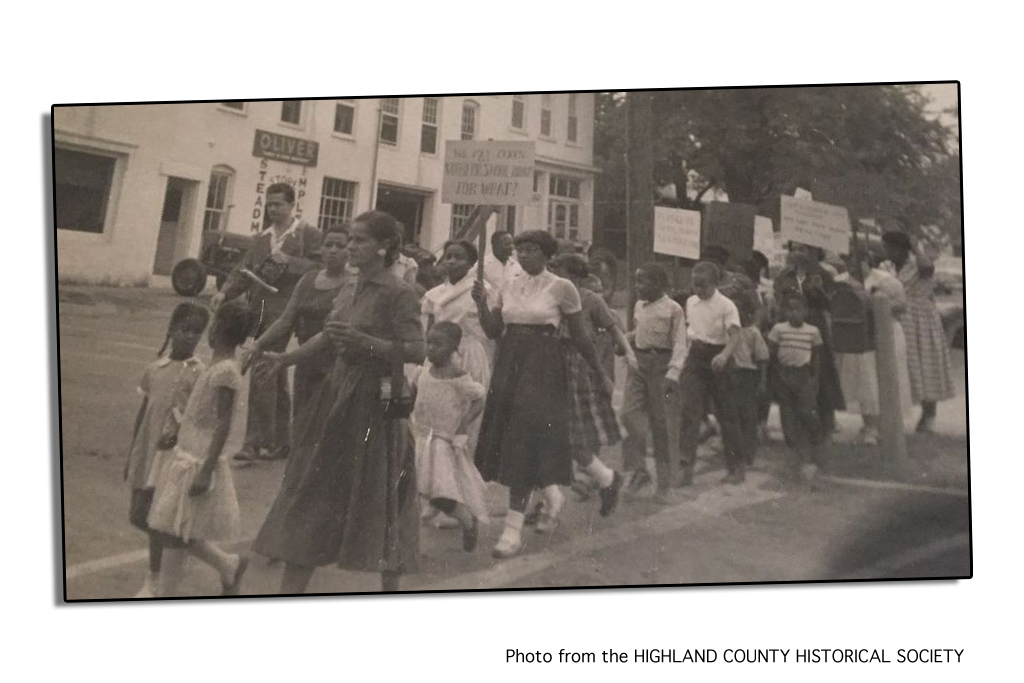
For over two years, 55 Black mothers and children in Hillsboro, Ohio, marched daily to a whites-only school to demand admission. The Lincoln School Story highlights a facet of the Black struggle for freedom that is too often under-recognized. Remembering the efforts of the marchers to integrate public schools in southwest Ohio provides important context for understanding the Black experience in the United States. The stories shared by the Lincoln School marchers help us imagine a future free of racial inequality.
This project provides an opportunity to connect and build understanding. Here are a few of the things documentary viewers said they want to share with their friends:
“History lives through us. We first learn to experience history in our bodies then later in our hearts.”
“Ohio played an important role in the civil rights movement.”
“The fearless and persistent mothers who fought for a better life for their children. AMAZING!”
“There are good people in dark places! Keep believing.”
“Perseverance and love can change the world.”
Ohio Humanities is proud to support important projects like The Lincoln School Story so that we can learn from the powerful dedication and bravery of those who fight for change. We plan to expand this project by funding an extended documentary that will explore the story in more depth and producing complementary educational materials and a children’s book.
If you value projects like The Lincoln School Story, please make a gift to Ohio Humanities so that more Ohioans can learn about the people, moments, and movements that have made our state what it is. And help us reach more people by sharing this link with your friends and family. Encourage them to sign up to receive our newsletter, magazine, updates on events and activities, and more ways to get involved with Ohio Humanities. Sincerely,
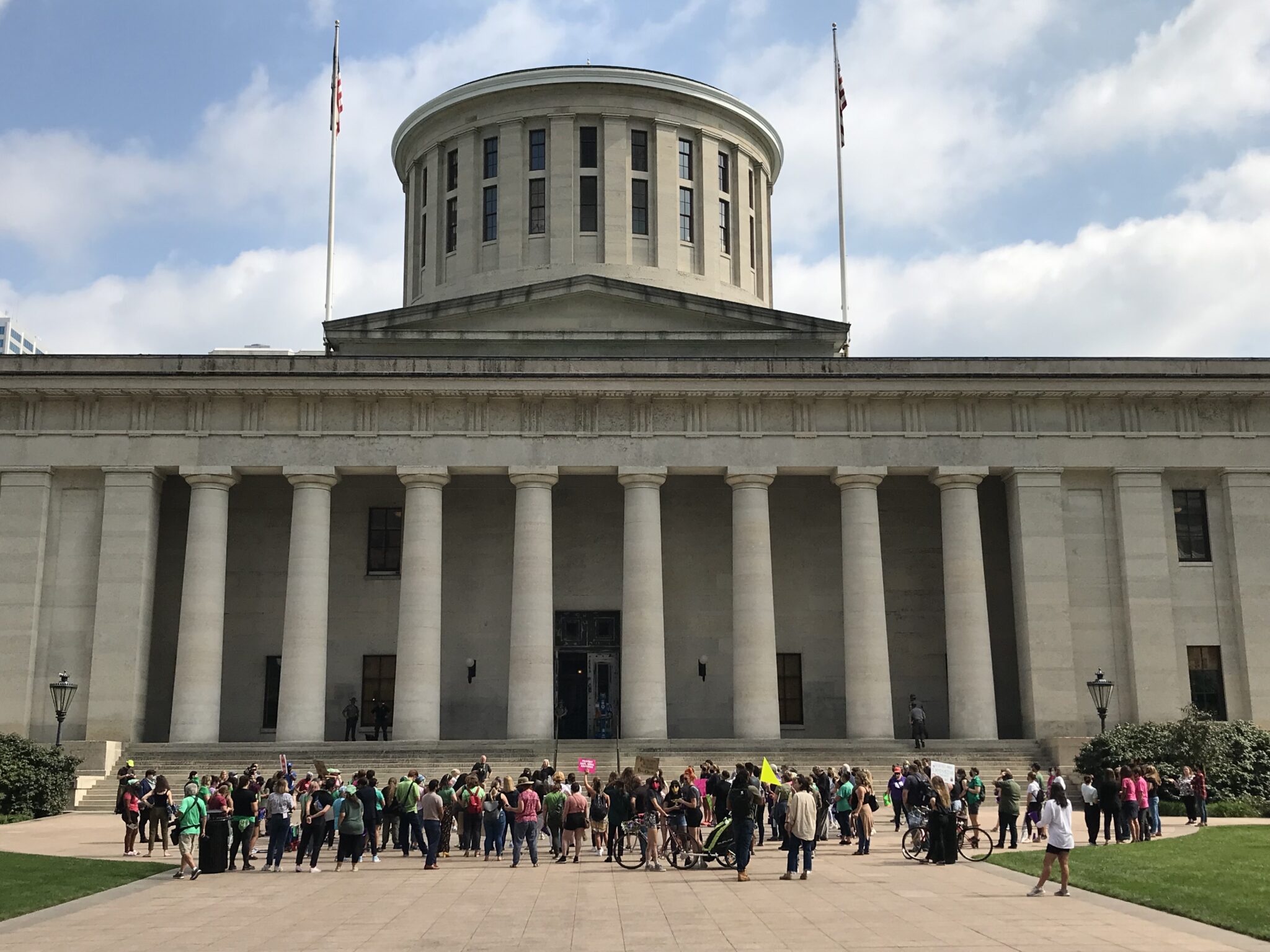
Protesters of a bill to promote a total abortion ban with the overturning of Roe v. Wade demonstrate outside the Ohio Statehouse in September. Photo by Susan Tebben
A lawsuit has been filed against the newest state abortion restriction and its regulation of doctors’ ability to practice medicine.
The ACLU, Planned Parenthood Southwest Ohio Region and Women’s Med Dayton are asking a Hamilton County Common Pleas Court to keep the state from enforcing a law to create “onerous and unwarranted” restrictions to health care in Southwest Ohio in particular.
The Ohio General Assembly passed Senate Bill 157 in December, and the law is set to be effective March 23, if the court doesn’t fulfill the lawsuit’s request.
If the law goes into effect, doctors who work with state public universities or medical centers will not be allowed to also be affiliated with abortion clinics in the state.
Abortion clinics that conduct surgical abortions are considered “ambulatory surgical facilities,” also the name of other outpatient facilities where procedures can be done.
Clinics who conduct abortions are required to have a “written transfer agreement” with a local hospital to which a patient can be transferred should medical care “beyond the care that can be provided at the ambulatory surgical facility” is needed.
Those hospitals need to be within 30 miles of the facility.
To obtain a variance to the written transfer agreements, doctors are required to have hospital admitting privileges within those 30 miles. But these variance agreements could be made more complicated by this new law, originally pushed by bill sponsors as a way for the Ohio Department of Health to track so-called “failed abortions,” which the state already defines as abortion procedures in which the child is alive when removed from the pregnant person’s body.
So-called “failed abortions” are rare, and state data shows none of the abortions conducted after 19 weeks – still not considered a gestation period when a baby would survive outside of the womb – were on viable pregnancies.
In the new lawsuit, doctors argue not only would the law create constitutional conflicts by singling out abortion providers, but it would also keep physicians from being able to “operate their businesses and pursue their professions,” including caring for their patients.
“Because of SB 157, many patients seeking procedural abortions will be significantly delayed in accessing this vital, time-sensitive and constitutionally-protected health care until later in pregnancy, when the procedure not only carries greater health risks, but is also more expensive,” the lawsuit states.
The Ohio Department of Health already requires abortion clinics to have at least four backup physicians to obtain the medical variance agreement, something that’s been in place since 2015.
That, alone, is a problem when there aren’t enough doctors to allow for four backup doctors.
“The hostile climate in Southwest Ohio makes it extremely difficult to find even one backup doctor to support a variance,” the lawsuit states. “There has been a national campaign to harass and shame the Dayton doctors who provide backup services to patients of WMD.”
If variances are lost, licenses to practice as an ambulatory surgical facility are lost. That would mean a lose of health care services in Southwest Ohio, meaning the patients would be the ones suffering.
“If plaintiffs’ ASF licenses are revoked, people needing procedural abortions would be forced to travel hundreds of miles round-trip to the next closest procedural abortion providers, and, due to a statutory waiting period, make that trip twice, or stay overnight, in order to access procedural abortion,” the clinics wrote in the lawsuit.
The fact that the lawsuit has been assigned to Judge Alison Hatheway could mean good things for abortion clinics. Hatheway has been the judge on two other lawsuits fighting against state abortion restrictions, and in both cases Hatheway has ruled in favor of temporary stops to state legislation clinics said hampered their right to provide care.
Most recently, Hatheway stopped a fetal tissue disposal law for a second time, saying clinics are “substantially likely to succeed” in their suit against an Ohio law that would require clinics to pay for burial or cremation of fetal tissue resulting from an abortion.
Ohio Gov. Mike DeWine signed a new abortion law on Wednesday that looks likely to close Southwest Ohio abortion clinics.
DeWine signed Senate Bill 157 without further comment, along with several other bills that passed through the legislature in their last work week before the holidays.
The bill was condemned by abortion providers, who said not only that portions of the bill that direct doctors on the amount of care they should give babies born as a result of a “failed abortion” are already part of medical oaths and Ohio law, but that the bill would impact wanted pregnancies in which complications become a factor.
“At this moment, we’re at a crisis point for abortion access in Ohio and across the country,” said Kersha Deibel, CEO of Planned Parenthood Southwest Ohio. “…Stripping abortion care from Southwest Ohio will cause havoc that disproportionately impacts our communities.”
The Southwest Ohio region of Planned Parenthood also opposes the legislation because of changes to hospital transfer variance agreements between abortion providers and physicians, prohibiting for doctors who are funded by Ohio’s public medical schools from participating.
“There is no medical justification for disallowing qualified, experienced physicians from agreeing to provide backup coverage for abortion providers under a variance,” said Dr. Adarsh Krishen, chief medical officer for Planned Parenthood of Greater Ohio. “In fact, if the state was genuinely concerned for patient safety, such physicians would be ideal. Instead, this provision is only meant to make it more challenging for abortion providers to remain licensed and operational.”
The religious policy lobby Center for Christian Virtue praised the law and the potential shut down of Women’s Med Center in Dayton and Planned Parenthood of Southwest Ohio’s clinic, saying the state “has made a bold statement about where our values lie.”
DeWine did not comment on the bill with his announcement that the bill had been signed.
The bill is one of a few pieces of abortion legislation brought by the legislature this year. Another measure would make abortion illegal with the rollback of the U.S. Supreme Court decision in Roe v. Wade.
The newest abortion bill to pass the Ohio House could spell the closure of Southwest Ohio clinics and the criminalization of doctors.
Despite multiple Democrat attempts to amend the bill and remove the language that would affect doctors’ ability to transfer patients from abortion facilities, Senate Bill 157 passed Wednesday afternoon along party lines, 59-33.
State Rep. Allison Russo, D-Upper Arlington, attempted to bring in the same amendment she tried to include in committee hearings on the bill, to remove the bill’s provision prohibiting physicians who are affiliated with and funded by public medical schools and institutions from having transfer agreement variances with abortion clinics.
This would effectively close clinics in Southwest Ohio, Russo emphasized in Wednesday’s House session.
“As a reminder to my colleagues, these consulting physicians that are required in order to get a variance from these transfer agreements, do not actually perform abortion services,” Russo said. “They are only consulted by the facility in the very rare case when there is an emergency and the need to transfer a patient to the hospital.”
After the bill was passed, Planned Parenthood’s Southwest Ohio region confirmed this would in fact be true, and is something they plan to fight against.
“Stripping abortion care from Southwest Ohio will cause havoc that disproportionately impacts our communities,” said Kersha Deibel, CEO of Planned Parenthood Southwest Ohio. “This isn’t the end, and we will continue to fight — abortion is still legal in Ohio.”
The organization said the closure of Planned Parenthood and Women’s Med of Dayton through this bill “would make Cincinnati the biggest metropolitan (area) in Ohio without an abortion provider.”
The bill was originally slated by sponsors to prevent doctors from allowing a fetus born alive after an attempted abortion to die without medical intervention, and to create another reporting system for “failed abortion” cases.
The chairman of the House committee that passed SB 157, state Rep. Susan Manchester, R-Waynesfield, stood in support of the bill on the House floor on Wednesday.
“This is an important piece of legislation that provides a system to protect infants that are born alive after an abortion by enforcing the administration of prevailing standards of care that apply to every child,” Manchester said.
Testimony made throughout the Senate and House committee process by abortion and pro-choice advocates focused on current law that already prohibits doctors from failing to provide care in a life-saving situation, and reporting requirements already in place by the Ohio Department of Health.
Opponents of the bill also said “failed abortions” are a rare occurrence, as shown by state data.
The bill became more controversial once the amendment on physician variance agreements was added, after which abortion advocates called the bill “dangerous,” even saying the bill would impact complicated pregnancies in hospitals, not just abortions in surgical facilities.
Another amendment tabled by the GOP majority attempted to remove the criminal charges physicians face for not following documentation procedure created in the bill. State Rep. Beth Liston, D-Dublin, presented the amendment just as she did in the previous House committee.
In the bill, doctors could face felony charges for failing to provide care to infants after an attempted abortion (something that is already a part of Ohio law), and for failing to file the proper paperwork on “failed abortions” as prescribed in the bill.
Liston said the bill impacts “futile” medical situations in which resuscitation of the baby isn’t scientifically possible and keeping the parent from holding the child only adds to the trauma of the situation.
“The only situations this bill impacts are those emergency circumstances where the woman’s life is at risk or there is a serious complication with the fetus,” Liston said. “These are desired pregnancies and devastating situations to all involved.”
State Rep. Kristen Boggs, D-Columbus, tried to add an amendment for workplace protection for pregnant Ohioans, and state Rep. Stephanie Howse, D-Cleveland, also tried to amend the bill to make workplace accommodations for pregnancies. Also attempted as an amendment was the inclusion of paid family leave, which has been a measure state Rep. Janine Boyd, D-Cleveland Heights, has championed for multiple general assemblies.
All amendments were tabled along party lines.
The bill is headed to conference committee because of a technical change added during hearings in the House Families, Aging & Human Services Committee, and could head to Gov. Mike DeWine’s desk in the next week.
DeWine has consistently approved of anti-abortion legislation, so it seems unlikely he will veto the bill.
Abortion is legal up to 22 weeks gestation in Ohio.
Ohio River Foundation begins area’s largest habitat restoration
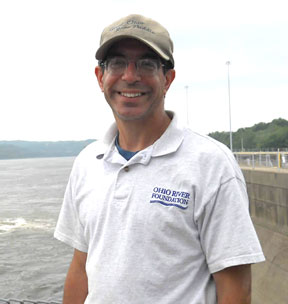
Loveland, Ohio – The Ohio River Foundation (ORF) is embarking on the largest habitat restoration project ever undertaken in Southwest Ohio. The project, made possible by a $50,000 grant from Coors Seltzer and its Change the Course partnership, will restore six miles of riverbank along three Ohio River tributaries: The Little Miami River, Great Miami River, and O’Bannon Creek.
ORF will plant 10,000 to 15,000 native trees and shrubs along those riverbanks. Phase one of the project begins this month and involves harvesting live stakes – taking cuttings from native trees that grow in riparian areas during their winter dormancy. Those “live stakes” will then be planted on riverbanks once the weather warms up in March.
“The Ohio River is a source of drinking water for more than 5 million people. But because of pollution from urban runoff, agriculture, sedimentation, and industrial pollution, many sections of the Ohio River do not meet water quality standards,” said Rich Cogen, Ohio River Foundation’s executive director.
Recreation is an important part of the economic sustainability of Loveland along the National and State Scenic and Wild Little Miami River.
The Little Miami is the source of drinking water for Loveland, Milford, and Indian Hill. O’Bannon Creek empties into the Little Miami in Historic Downtown and Loveland folks know this creek because they so often cross over it when heading north along the Loveland Bike Trail from Nisbet Park.
Plants along riverbanks improve water quality by keeping pollutants out of the water and by helping control erosion, thus reducing sedimentation. As they mature, these riparian plants also provide habitat for streamside birds and mammals and create shade that helps fish and other aquatic species thrive.
Rich Cogen, Ohio River Foundation’s executive director
“Restoring the habitats along these tributaries will go a long way toward improving their health, and it will reduce the amount of pollution that makes its way into the Ohio River,” Cogen said.
Assisting ORF with this project are Great Parks of Hamilton County, Hamilton County Soil and Water Conservation District, Miami Township, Miami Conservancy District, Anderson Township, City of Loveland, Cincinnati Parks, Colerain Township, and Rivers Unlimited.
Volunteers are needed for both phases of the project. Live stake harvesting will take place on:
Sunday, Feb. 28 (10 a.m.-1 p.m.) at Nisbet Park, 126 Karl Brown Way, Loveland, Ohio, 45140
Thursday, March 4 (10 a.m.-1 p.m.) at Miami Township West Community Park, 4063 E. Miami River Road, Cleves, Ohio, 45002
Sunday, March 7 (10 a.m.-1 p.m.) at Heritage Park, 11405 E. Miami River Road, Cincinnati, Ohio, 45252 Volunteers, who will be helping cut stakes, should dress for the weather, wear waterproof shoes, bring a mask and follow all COVID-19 recommendations. All tools, including boats needed to access some sites, will be provided. Advance registration is required; for more details, or to sign up, visit www.ohioriverfdn.org. Additional volunteer opportunities to help with spring stake planting will be announced at a later date. For more information, visit www.ohioriverfdn.org.
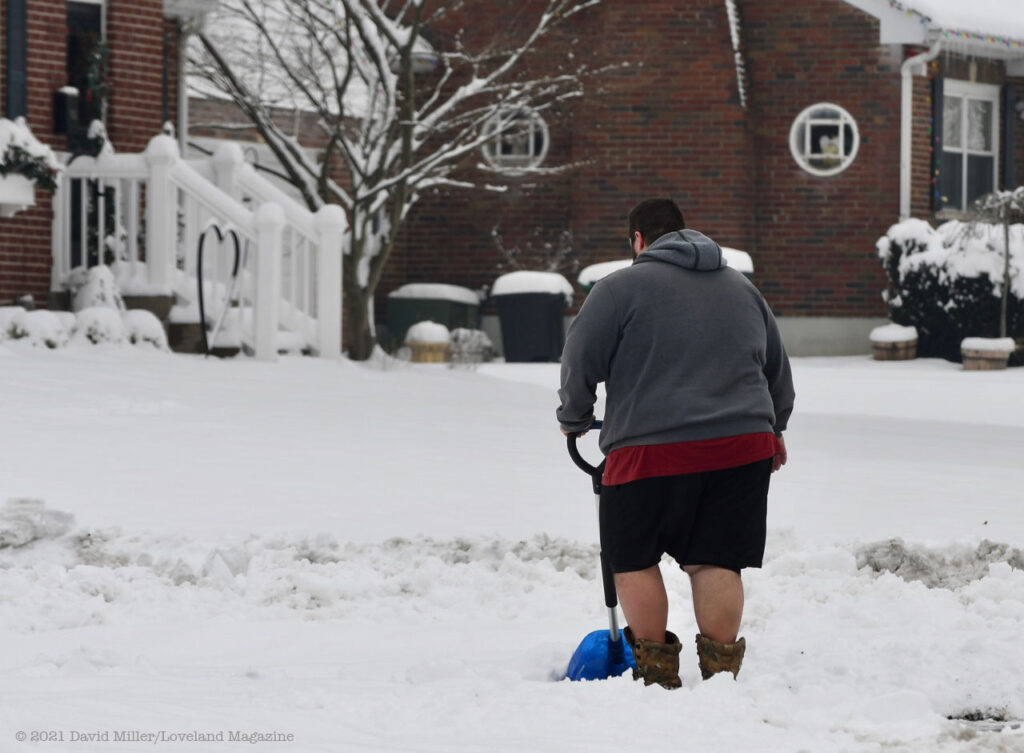
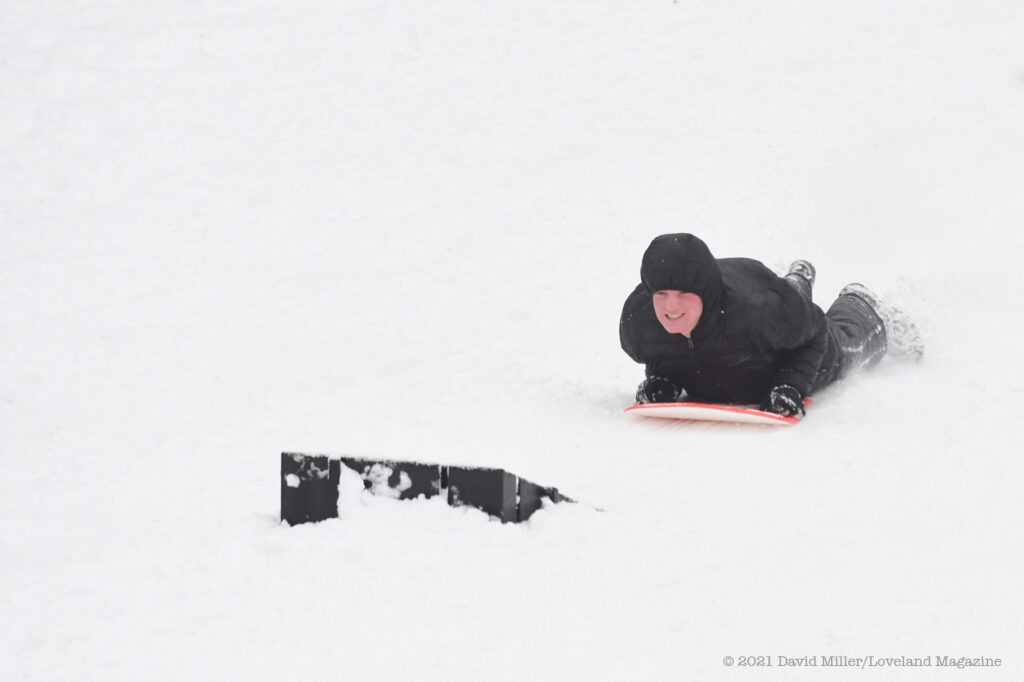
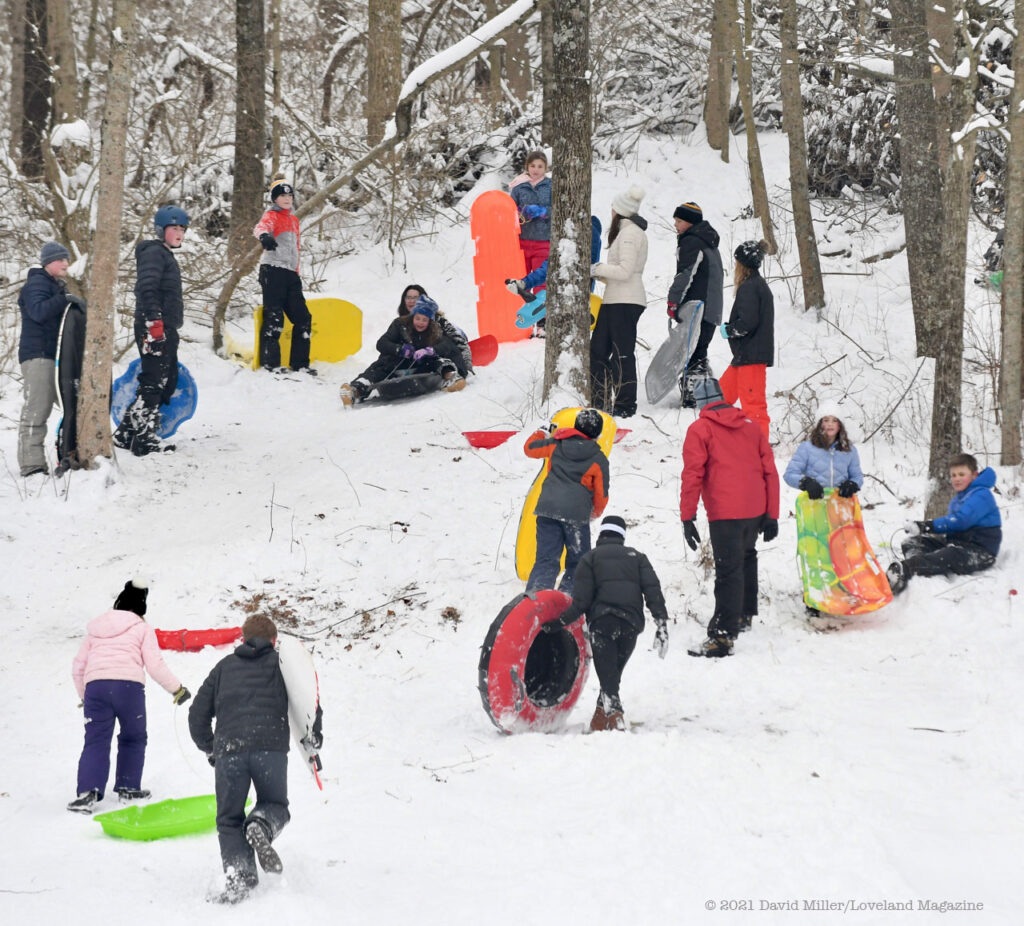
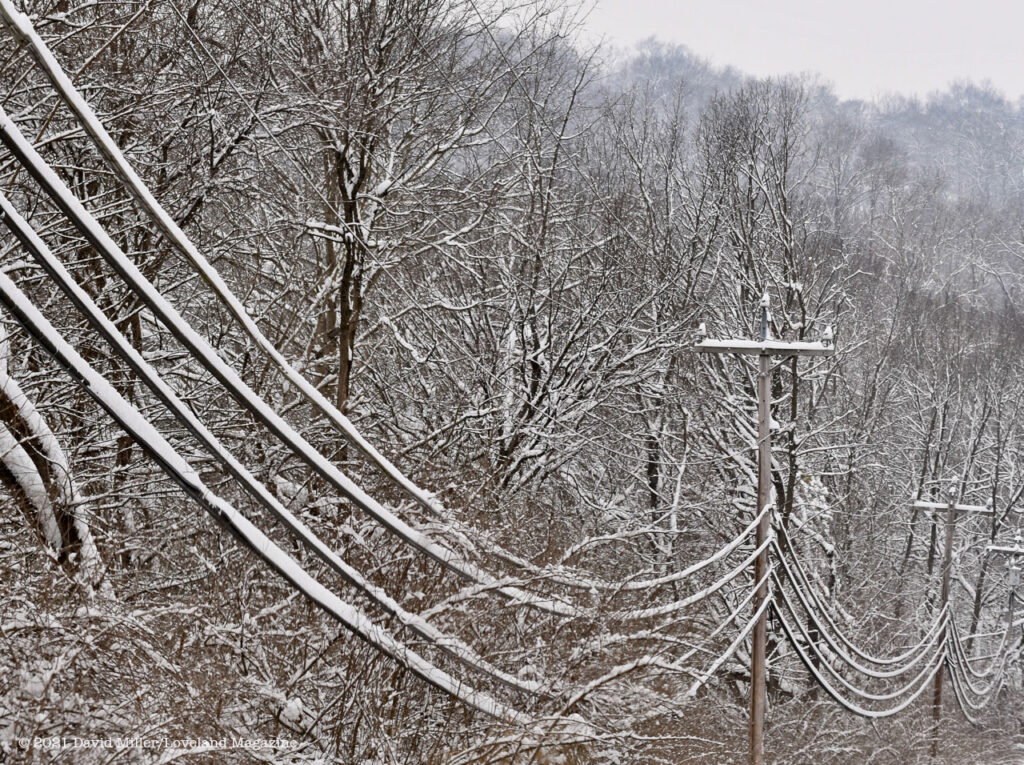
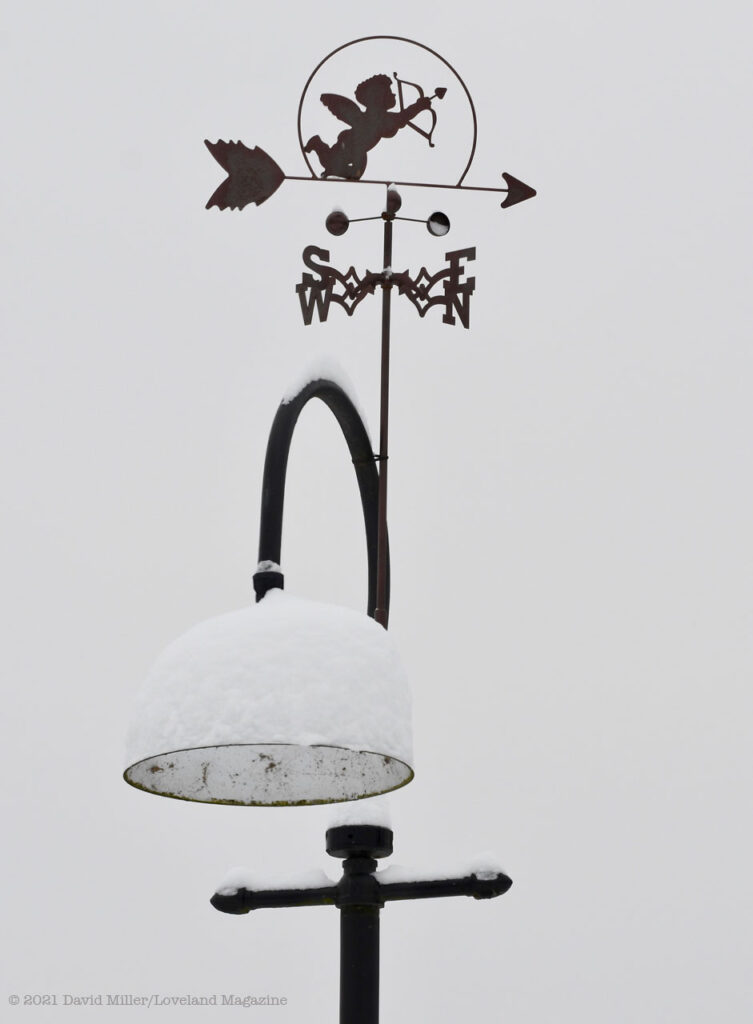
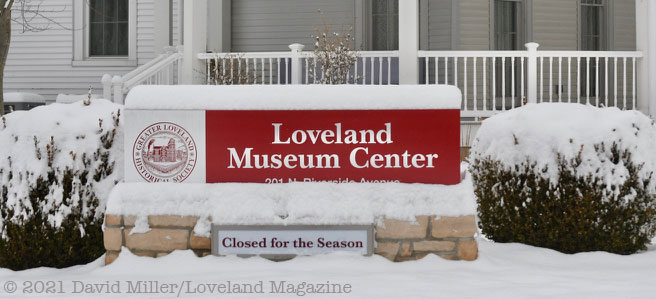
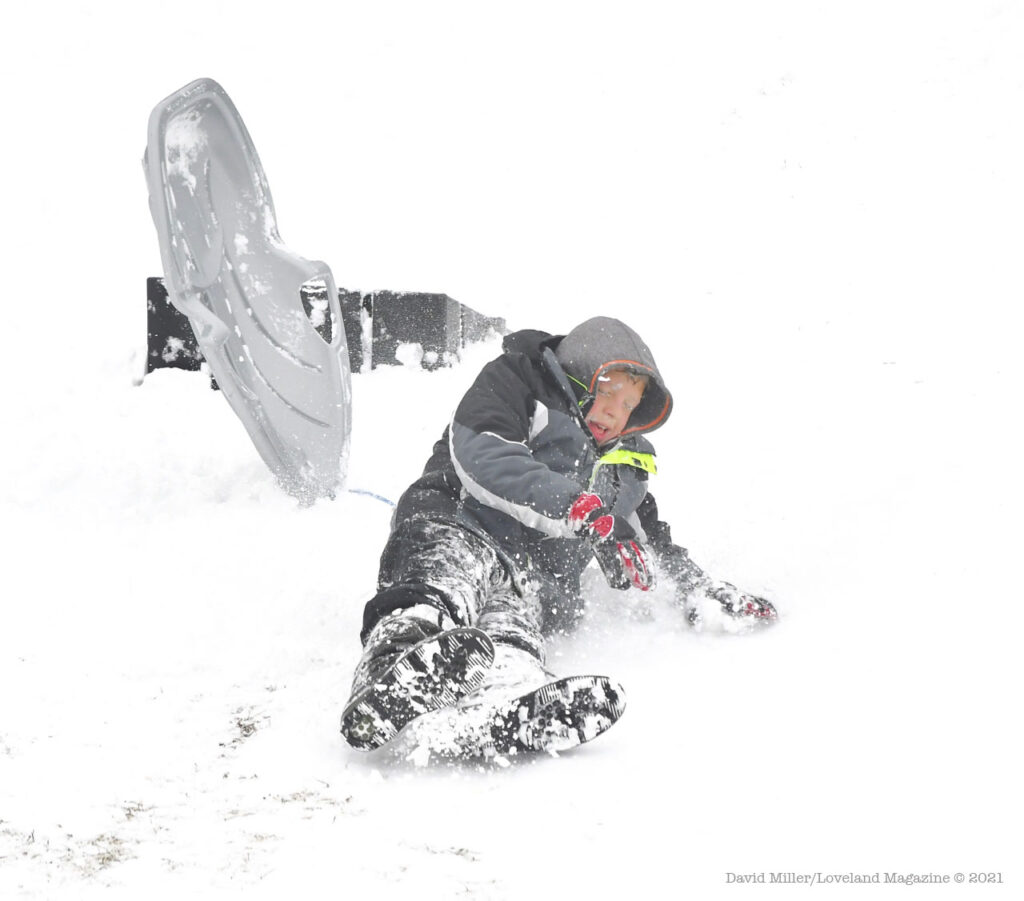
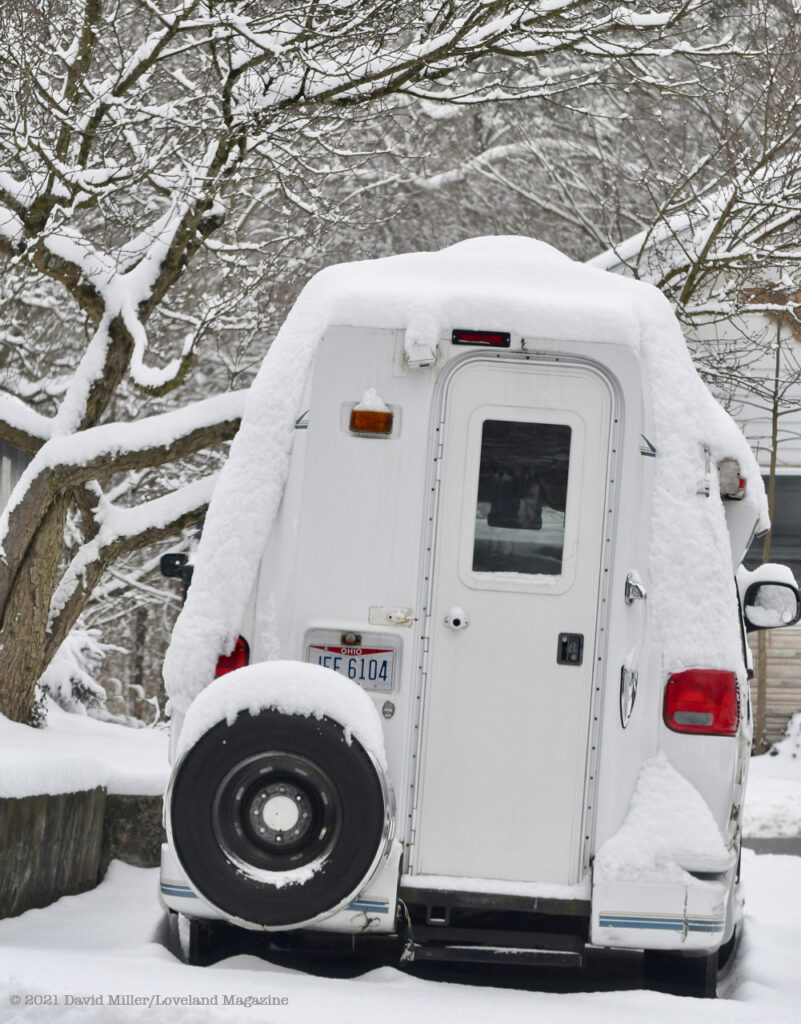
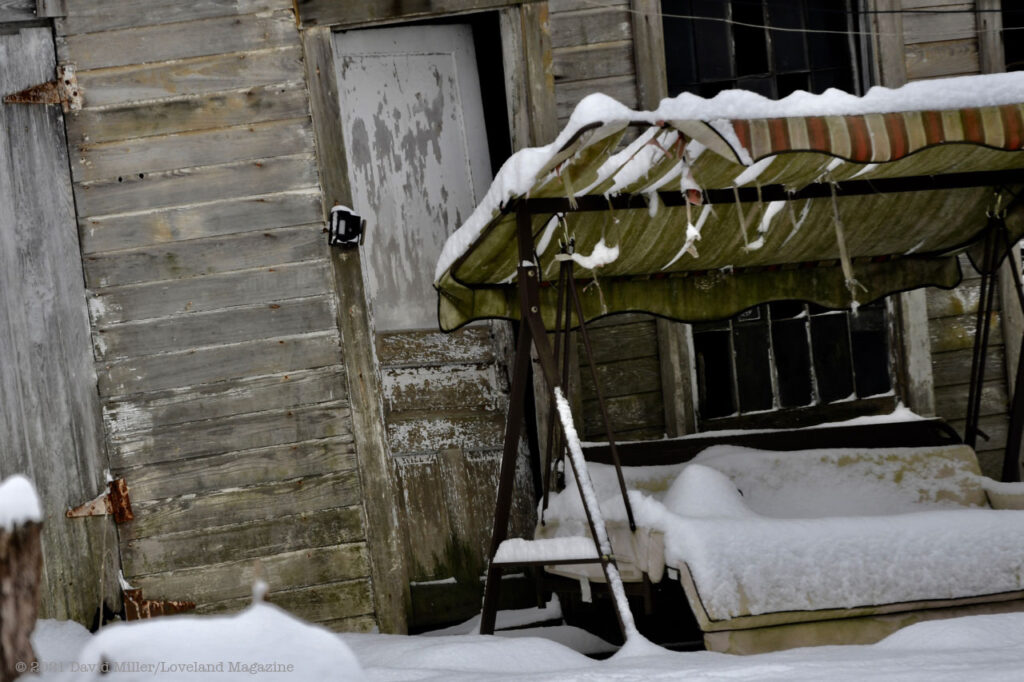
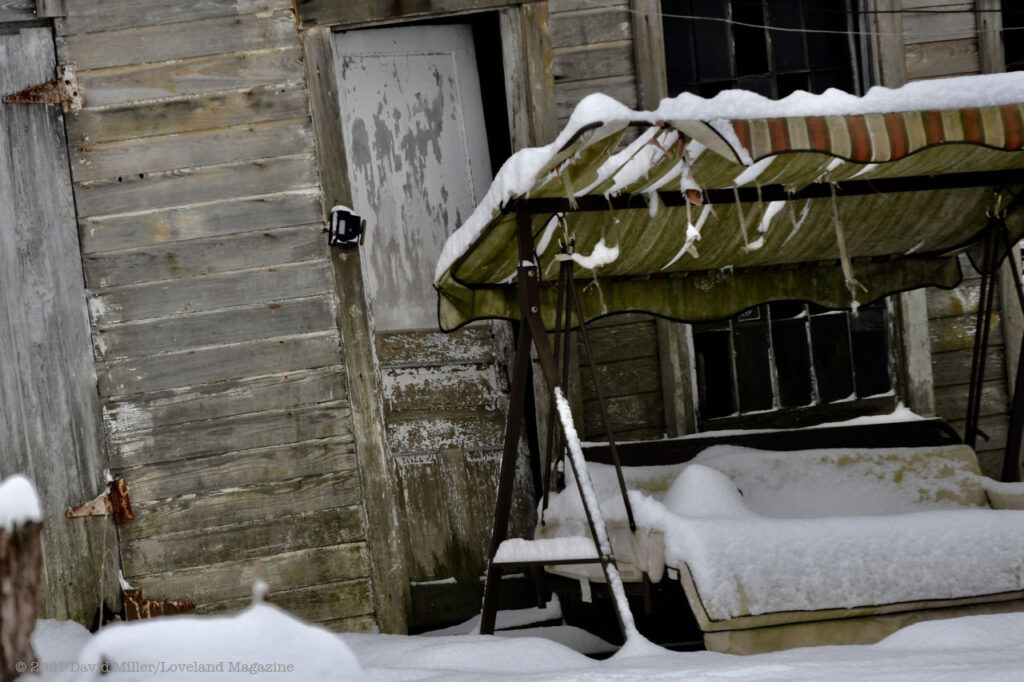
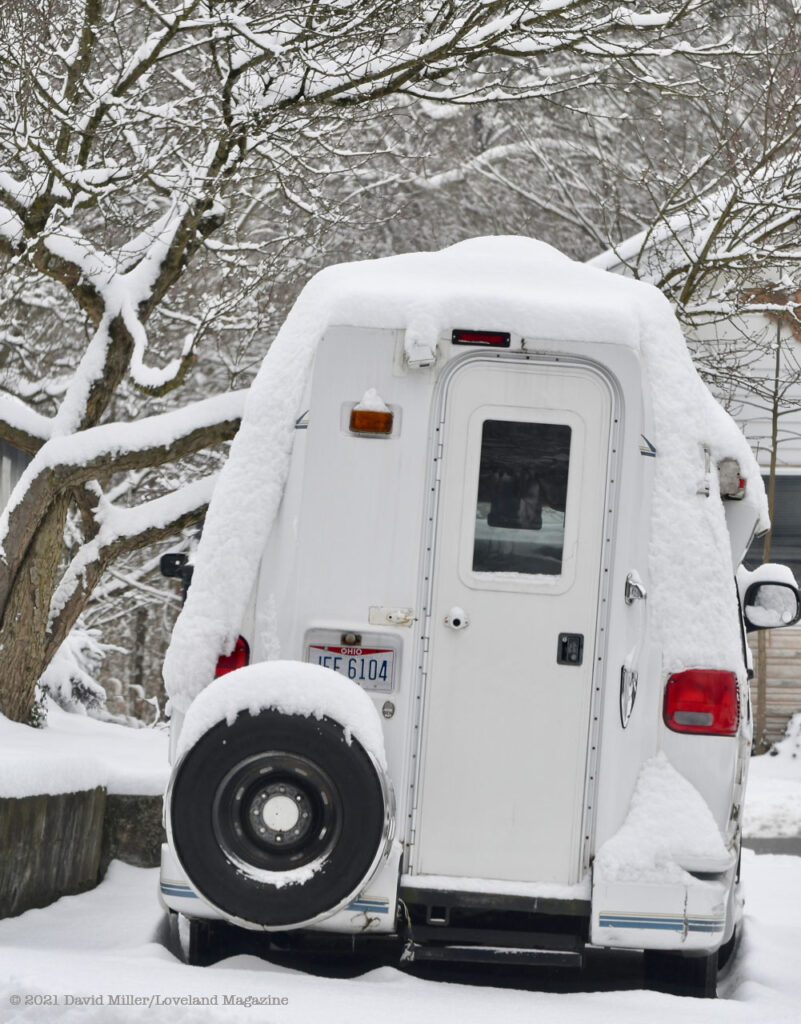
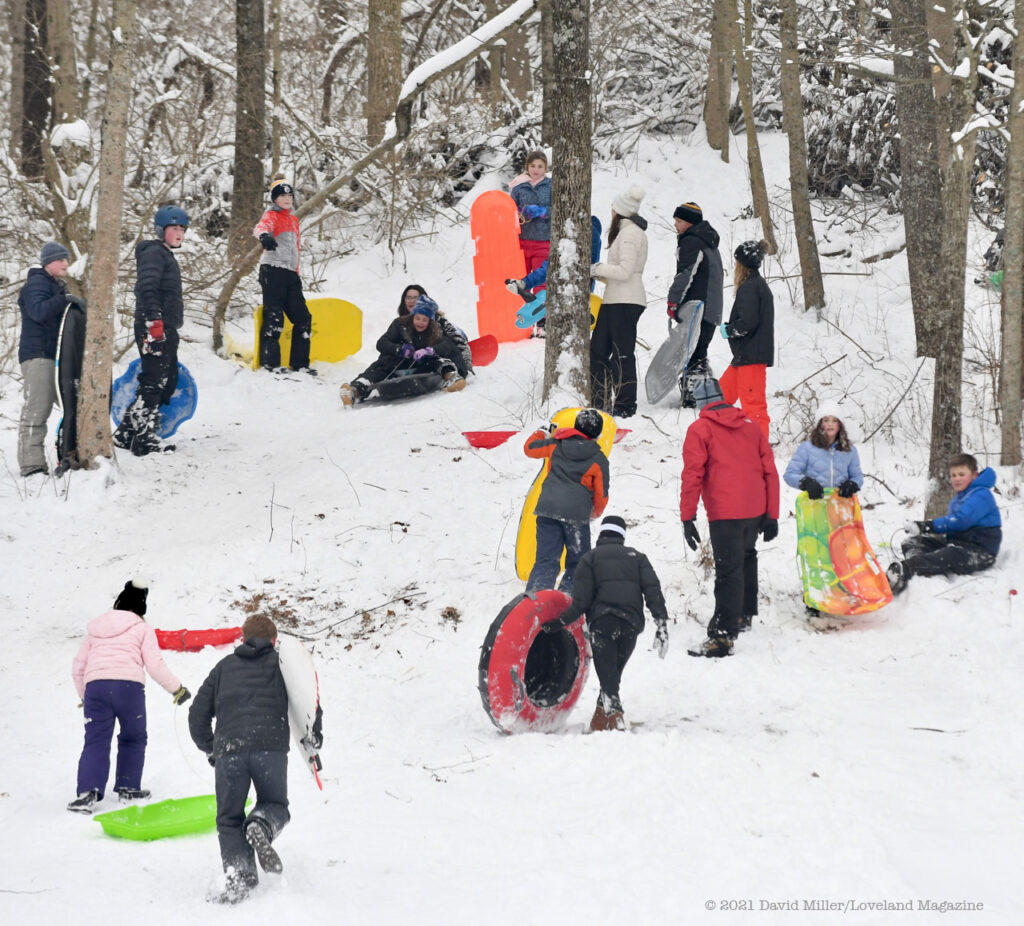
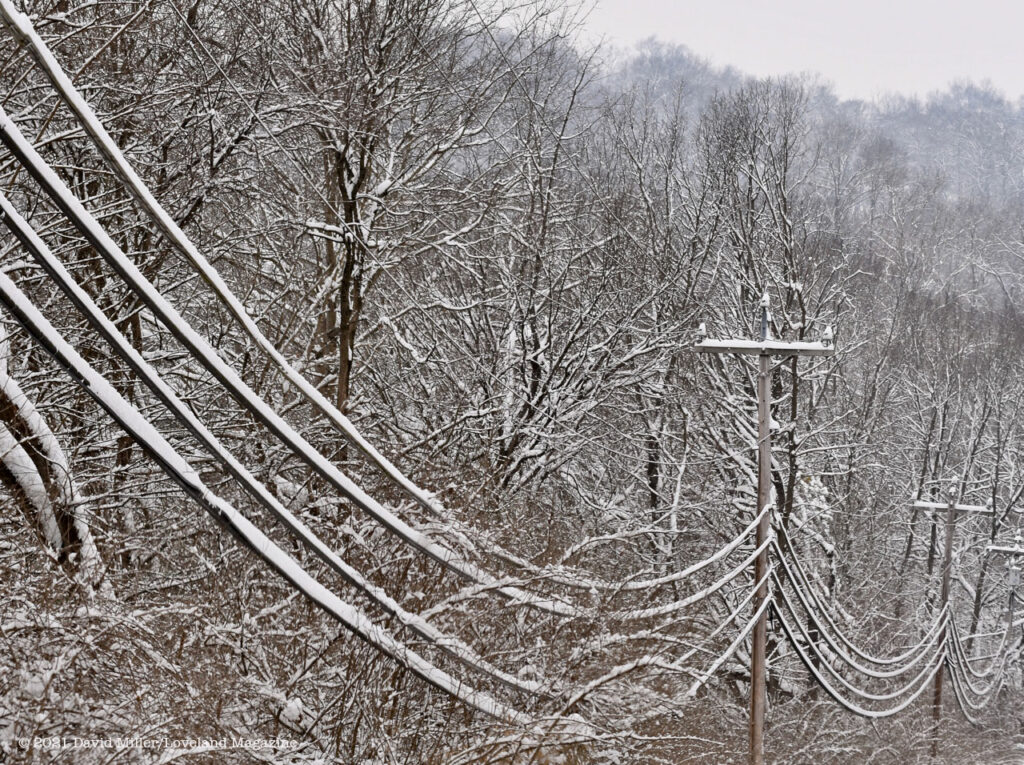
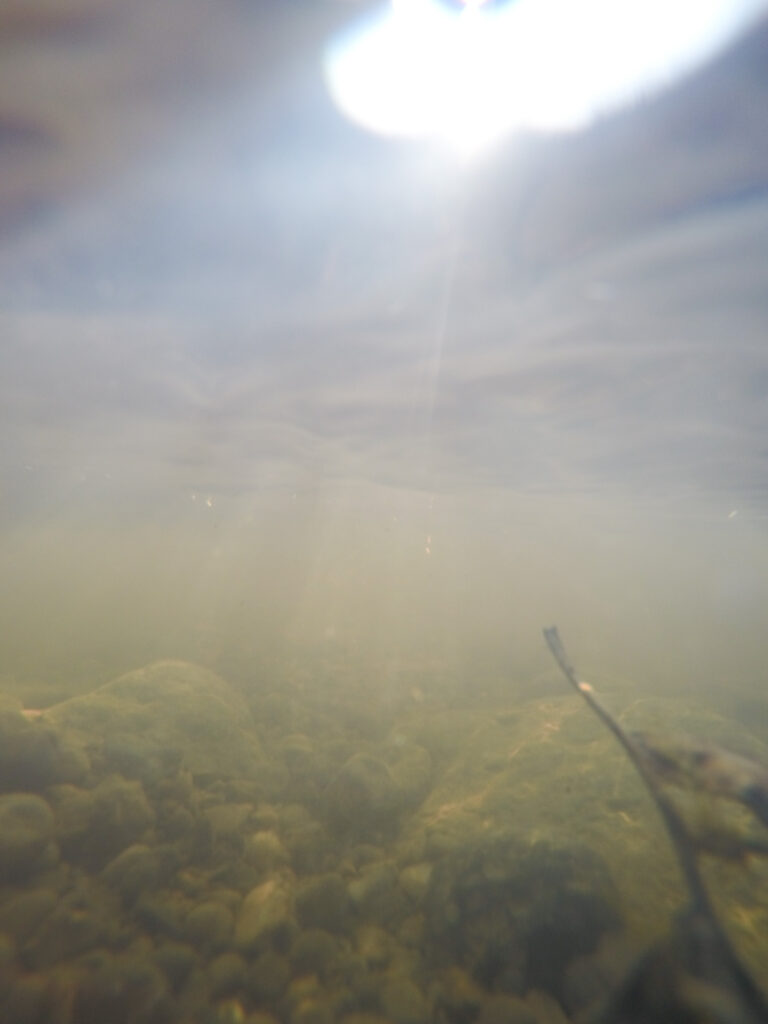
Loveland, Ohio – These photos were taken mid-morning on February 9 after the Loveland Area was blanketed with a perfect, sled-riding, up to 9 inches of school canceling snow.
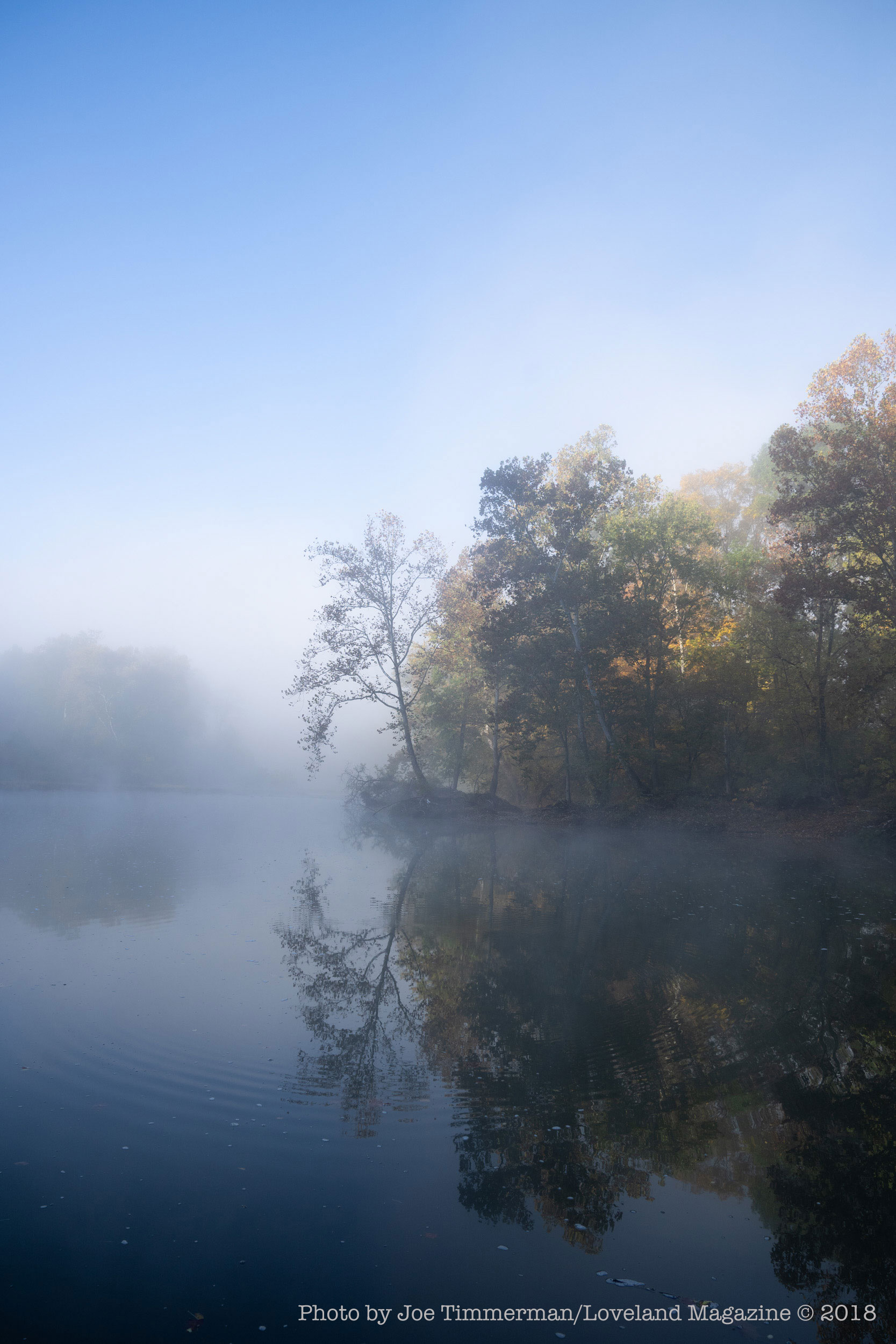
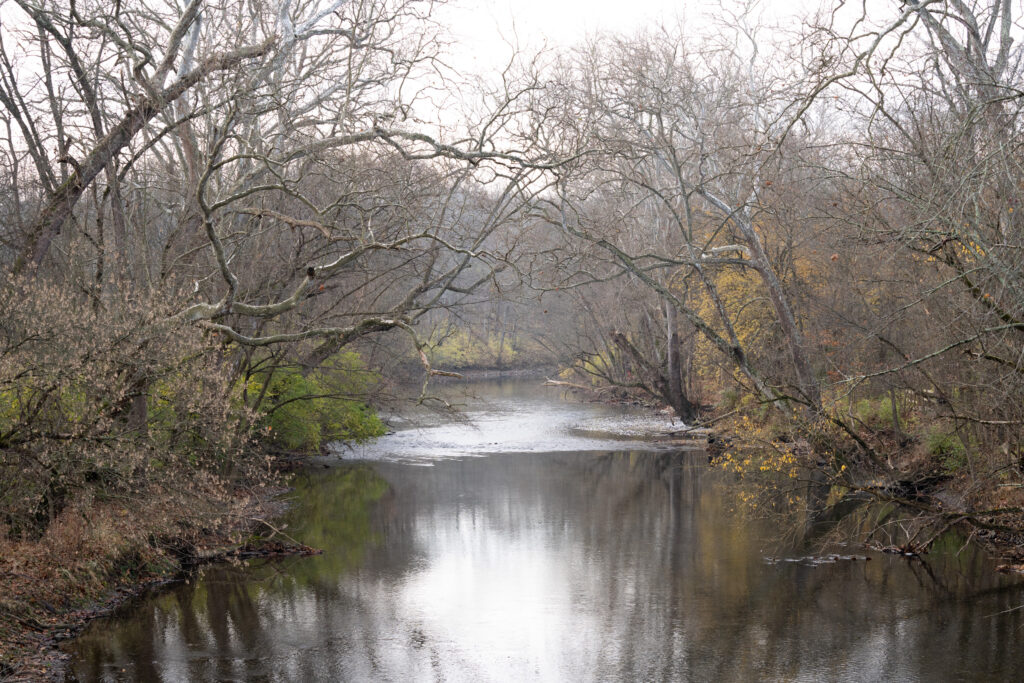
Few leaves are still falling off trees and down the ever-running water of the National Wild and Scenic Little Miami River, where they float through five counties and 111 miles of southwest Ohio, into the Ohio River and toward the Mississippi before eventually finding their way into the Gulf of Mexico. Today, these 111 miles of Little Miami River are the cleanest that they have been in the last 40 years, and as the world may seem largely disconnected due to the coronavirus pandemic, a connection between people over time is helping to create the river’s lasting sustainability.
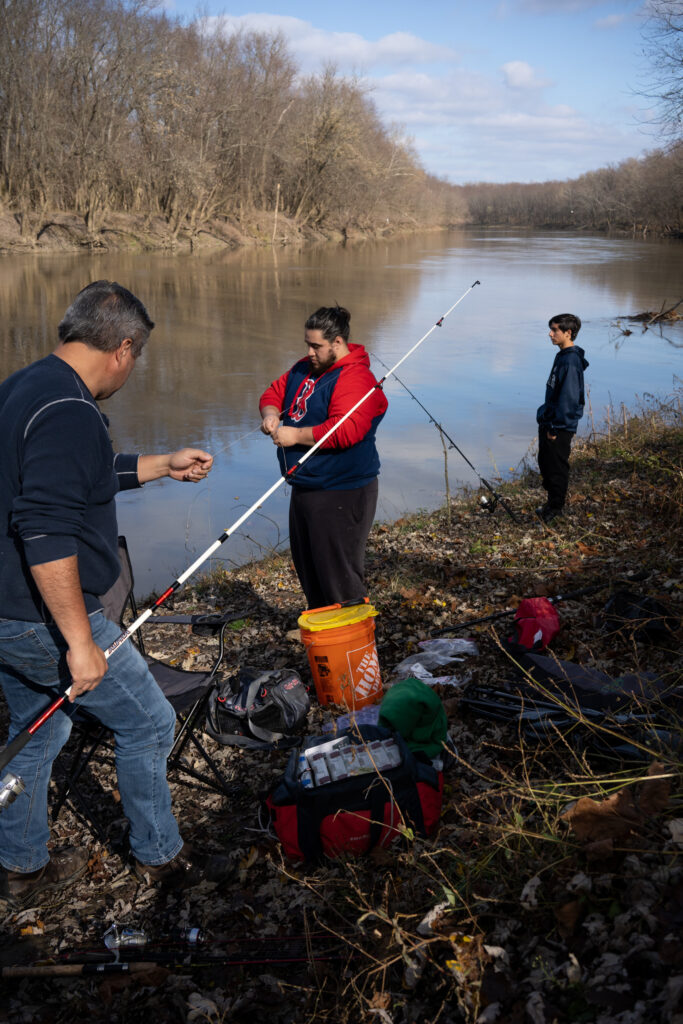
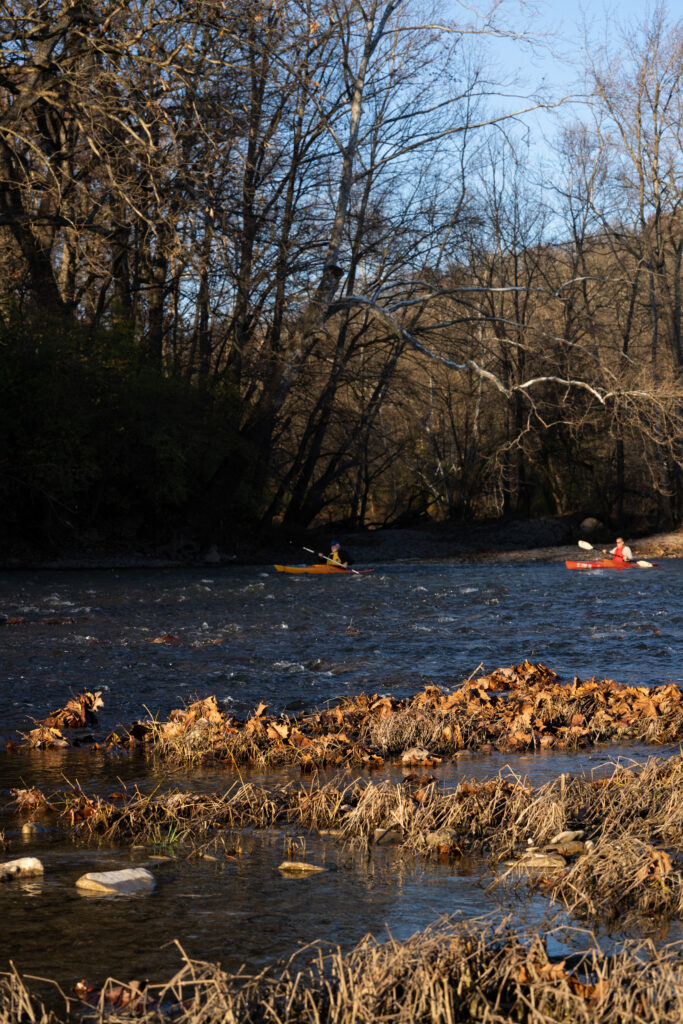
Since the end of the last Ice Age before this land was known as America, humans have lived along the Little Miami River and enjoyed the resources it provides — drinking the water alongside its banks while hunting for fish within, using the clay to build pottery or structures, and floating on the surface in kayaks or canoes like the leaves still do today. In that time, the river has seen many seasons of change, from shifts in human culture alongside its banks through community development to biological diversities in its rich, natural environment, according to the Little Miami Ecology and History report.
When the Little Miami was designated as Ohio’s first State Scenic River and included in the National Wild and Scenic River System in 1973, according to the Ohio Department of Natural Resources, locals had already been active in its conservation and return to sustainability for more than half a decade. The Little Miami Conservancy (LMC), a non-profit organization fueled by passion for the protection of the river, led the effort in Washington to recognize the importance of protecting the Little Miami River as not only a local hidden gem, but as a national treasure.
The lower section of the river runs right through the heart of Loveland, Ohio, where LMC and its current executive director, Eric Partee, is based. Partee’s passion roots from the original director of the conservancy, Glenn Thompson, who in 1967 embodied the idea that their effort isn’t about one single person, but rather about everyone coming together to save the river.
“Someday, a corridor of green will stretch from one end of the river to the other. Individuals and families will enjoy peace and quiet and restoration of spirit that comes with clean water, birds, and trees,” a quote from Glenn Thompson that Partee believes the conservancy has lived up to.
Since its origin, the conservancy has worked with agencies like the Ohio Environmental Protection Agency (OEPA), who records the condition of the Little Miami River every 10 years by sampling fish life. In the 1980s, only 4% of the Little Miami River was in full attainment of water quality health, but in recent years, the chart has flipped, and as of 2007, the river is at 96% attainment of health, according to OEPA research.
“As early as the turn of the century, this river was very well polluted. (There were) a lot of deformed fish, it was not anything close to exceptional,” Partee said in an interview. “It took a lot of discussion, a little bit of arm twisting, and some local funding to fund improvements to the sewage treatment plants to ratchet down on phosphorus, which was the main culprit … when we got the treatment plants to ratchet down on that, biology basically turned around on a dime —from terrible to exceptional.”
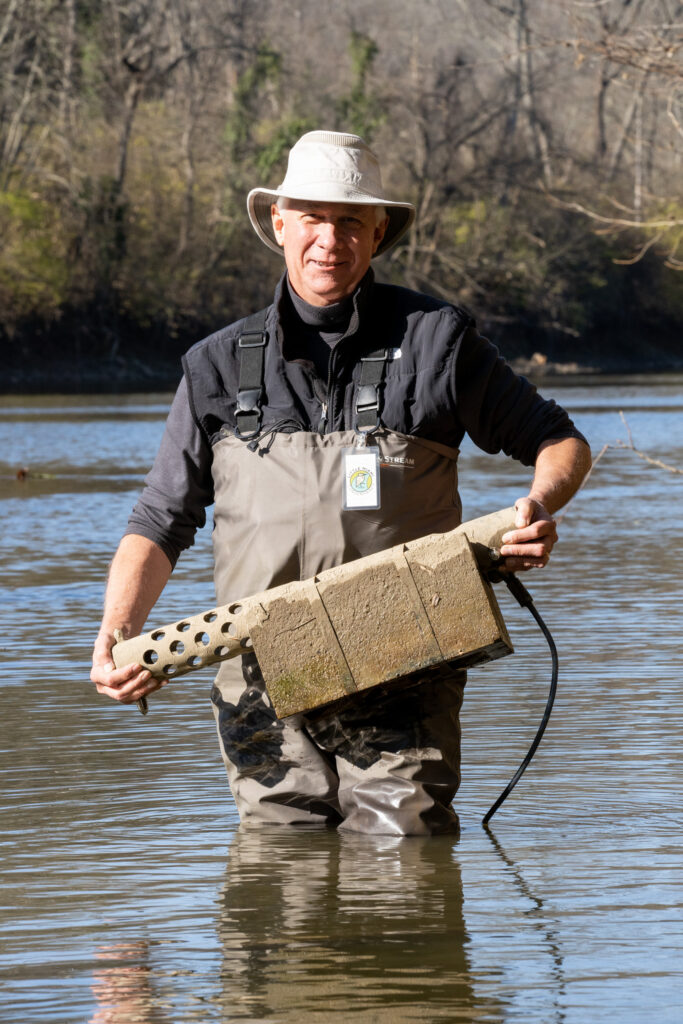
To make sure the river stays healthy, LMC introduced a set of equipment called YSI Water Quality Sondes, which monitor dissolved oxygen in nine locations throughout the length of the entire Little Miami, according to Partee. Each system monitors oxygen every 15 minutes, allowing for constant awareness of river health to prevent a reversion of quality. The conservancy also takes prides in their work on forest restoration through buying riverfront properties, planting trees, removing invasive species, and working collectively to clean up trash in the effort to grow closer to the initial goal of a corridor of green along the riverbank.
A short walk from the doors of the conservancy is the Loveland Canoe and Kayak Livery, owned by Mark and Robyn Bersani, which is just one of the many businesses along the Little Miami River that rely on its health as their main resource for income. The Bersanis work closely with the conservancy each year by offering and volunteering for cleanups as well as generous donations. This year, along with two other liveries including Rivers Edge and Scenic River, their combined donation to the Little Miami Conservancy’s effort was $56,000, according to Bersani.
“We’re involved from a grassroots portion, to actually helping with cleanups, to keeping an eye on the river, as well as donating and continuing to fund the good work that they do,” Bersani said in an interview. “It comes down to the people that live along the river, people that visit the river, the people in the community, if the river is going to stay clean. This river is very natural, it looks like it did 300 years ago … it is vital that the citizens all realize they have a role in this.”
Up the road at Loveland High School, Amy Aspenwall, an AP environmental science teacher teaches teenagers the importance of environmental awareness through hands-on experiences in places like the Little Miami River.
Perhaps half of the students attending Loveland High School cross over the Little Miami State and National Scenic Little Miami on their way to school each morning.
In an interview over Zoom, Aspenwall talked about the importance of students getting out into nature to actually see how humans fit in the environment, because “if you don’t see it, it’s really not your problem,” Aspenwall said. From understanding food waste to the water drinking system to sewer treatment facilities, her goal is to allow students the opportunity to realize a sense of civic responsibility.
“It’s important for students to start to think of themselves as a bigger picture rather than just someone following teacher instructions,” Aspenwall said. “I want them to start thinking on their own and realize how powerful they are as a consumer.”
Michelle Waller, an environmental specialist in the Division of Surface Water at OEPA, discussed the difficulties the river has faced through poor nutrients entering the river due to excess phosphorus from treatment plants and still faces through agricultural runoff from farms, in an interview over Zoom.
Waller said that placing phosphorus limits on the main stem’s water treatment plants in recent years proved to show major improvements in river nutrients after the OEPA performed sampling, but other negative sources are out of their reach. “We do not have authority over agriculture the way we do with what we call point sources, the treatment plants,” Waller said. “We try to work with local Soil and Water Conservation Districts, they try to get the word out about good farming practices … but there is no real regulatory authority which is a really big problem.”
The majority of land along the Little Miami River is agricultural, unlike other major rivers in Ohio that have industry running alongside their waters. And just like the branches of community that have come together to help preserve the river, many tributary streams and creeks branch out from the Little Miami, though those tributaries can be overlooked.
As most organizations, including the OEPA and LMC, focus their efforts on upholding the exceptional quality of the main stem of the Little Miami River, there is still work to be done in the tributaries. Partee talked about how there just isn’t enough time for LMC to visit every tributary and talk to every landowner. However, near Beaver Creek in Greene County, there is an organization called the Beaver Creek Wetlands Association, which has adopted that very issue. “I think that’s probably the best future for the watershed, to have local citizens dealing with multiple tributaries and try to restore or protect it,” said Partee.
Between the shared relationships of the Little Miami Conservancy, OEPA, local government officials, developers, landowners, non-profits, teachers, and local business owners, a community has come together and worked toward the common effort to make a positive, sustainable change in the health of the river.
The timelessness of the Little Miami River will carry on as long as its water continues to run. And as it always has been, it’s still up to the people alongside the riverbank to make sure that the water runs clean for generations to come. As the late author Nelson Henderson said, and Eric Partee paraphrased when we talked together, “The true meaning of life is to plant trees, under whose shade you do not expect to sit.”
Loveland, Ohio – The 2020 Ohio High School Athletic Association Football postseason is finally here! On October 1st, OHSAA announced the regional brackets for the football playoffs, which currently includes 648 schools.
During a normal OHSAA Football season, 224 schools typically qualify for the playoffs, with eight schools from each of 28 regions earning a bid through the OHSAA’s Harbin computer ratings system. This season the Harbin system will not be used. Due to the COVID-19 pandemic, the playoffs will begin in Week 7 (Oct. 9-10) and all teams could potentially opt-in.
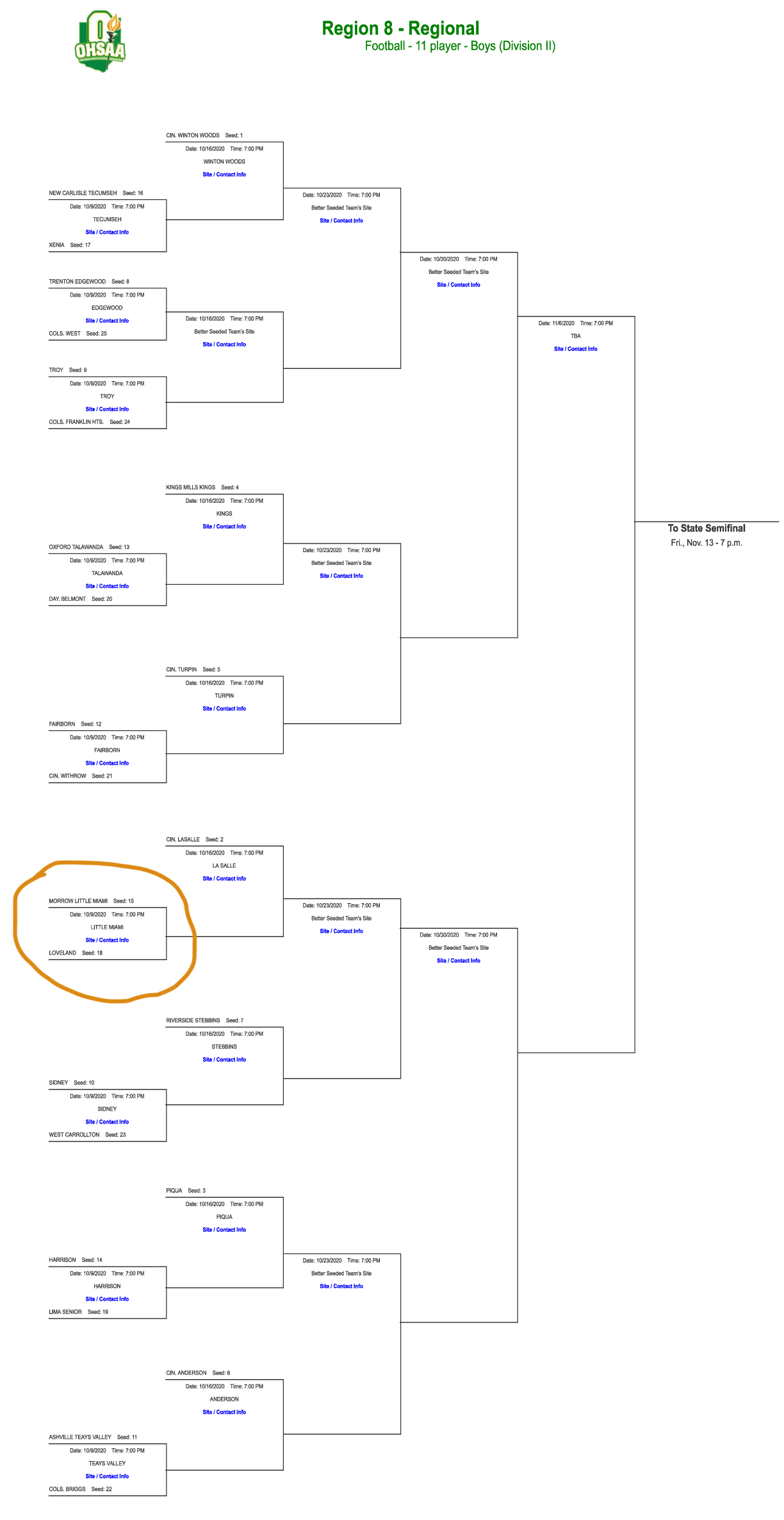
The Loveland Tigers will travel to Little Miami High School this Friday, October 9. Game time is 7 PM. Little Miami has a 15 seed and Loveland is seeded 18.
The Panthers beat the Tigers in Tiger Stadium on September 18th, 55-20.
The Tigers lost at Kings last Friday night 63-32 and play the last game of their announced schedule on Friday, October 16th at Milford. All teams have the option of playing more games if or when they are eliminated from the State Tournament. The Milford game scenario would change depending on tournament first-round game results.
Below is the Region 8 Bracket for Div II. (Right-Click the Bracket and open in a new tab or window for a larger view)
(Continue reading about the State Tournament below the Bracket…)
The head coaches in each region voted to determine the seeding in their region. OHSAA placed teams in particular brackets according to their seeds. In most regions, the higher seeds will have a first-round bye.
All playoff tickets will be sold online through www.OHSAA.org/tickets and will be available starting Tuesday, October 6.
Divisions, I, II, III, and VII will play on Friday nights. Divisions IV, V, and VI will play on Saturday nights. All games will kick-off at 7 p.m.
For each game through at least the regional semifinals, the higher seeded team will have the first opportunity to host the game. If the higher-seeded team cannot host, the other team will host the game. The OHSAA will determine sites for the regional finals, state semifinals, and state championships. If a team is unable to play a playoff game on the assigned day according to the bracket, its opponent will advance on the bracket.
Schools eliminated from the playoffs or that chose not to enter have the option to schedule additional regular-season contests through Saturday, November 14 (maximum of 10 regular season contests permitted).
All sports in Ohio – at all levels – are under the direction of the latest Ohio Department of Health order, which was signed on August 19th by Governor DeWine. The order and additional guidance from the ODH and OHSAA are posted at:https://www.ohsaa.org/Home/OHSAA-COVID-19-Correspondence
STATE CHAMPIONSHIP GAMES
The Division I State Championship Game will be played Friday, November 13th. The specific dates and times for the state championship games in Divisions II through VII will be announced at a later date but will be played within the November 19th-22nd date range. Sites will be announced at a later date, as well, but it is unlikely that all seven games will be played at the same venue according to the OHSAA. There will be no state championship games that happen simultaneously, as each game will have its own time slot
Spectrum News 1 will be the official television partner of the OHSAA and will select several playoff games each weekend to televise live. Only Spectrum can provide live television coverage of the OHSAA Football Playoff Games. All other television broadcasts can start at 10 P.M. on the same day as the game. Live video streaming will be permitted for games not selected by Spectrum News 1 at rates set by the OHSAA.
For more of your Loveland Sports 411 With Me, Cassie Mattia, stay tuned!



 by Julie Watson



































































































 by Cassie Mattia
 The head coaches in each region voted to determine the seeding in their region. OHSAA placed teams in particular brackets according to their seeds. In most regions, the higher seeds will have a first-round bye.