Tag: sports 411 Loveland City School District

  • Current local COVID 19 data: How does Hamilton County avoid Level 4 Alert

    Current local COVID 19 data: How does Hamilton County avoid Level 4 Alert

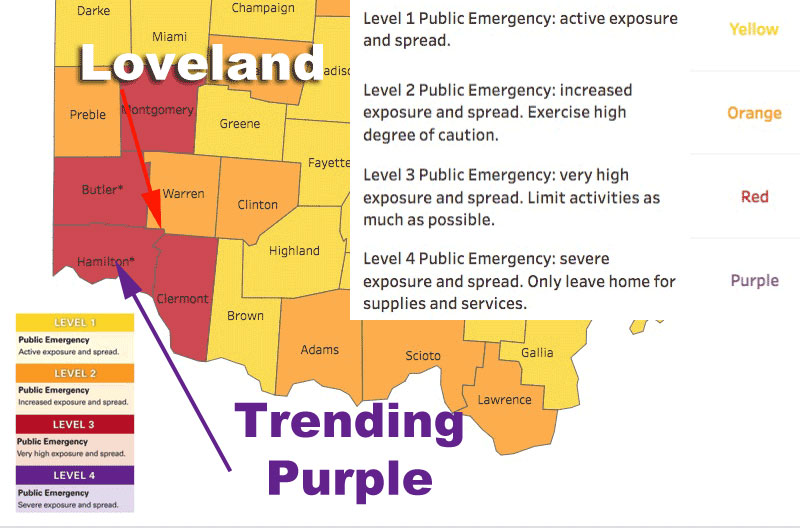
    Loveland, Ohio – Mike Samet the Public Information Officer for Hamilton County Public Health told Loveland Magazine on Friday, “As a ‘red’ county, most of our “indicators” are trending upward, hence the potential designation as ‘purple.”

    The message to county residents is a simple one said Samet in response to the question of how does Hamilton County avert escalating to Level 4. “The one we’ve been talking about since February. Until we have a vaccine and/or treatment for COVID-19, the only way to slow down transmission is: physical distance (6 ft. plus); wear a mask when out; stay home if you are ill; wash hands often and thoroughly; cover coughs/sneezes.”

    Samet added, “Wearing a mask is not a political statement. The mask shows care and respect for others in that we’re trying to reduce their risk of infection, as well as ours. It’s summer, it’s hot, no one likes wearing a mask, but it’s what we have to do to protect each other.”

    Samet said that from an enforcement perspective, as a county agency, the Health Department is not able to issue citations. “Nobody wants to be the mask police. This is education over enforcement, he said.  Samet added that he wants people to understand why masks are important now, not punish them for non-compliance. “In any event, our enforcement system is complaint-driven. People may register complaints with us at www.hcph.org. We follow-up on each complaint received,” said Samet. Read how to file a complaint in Clermont County below.

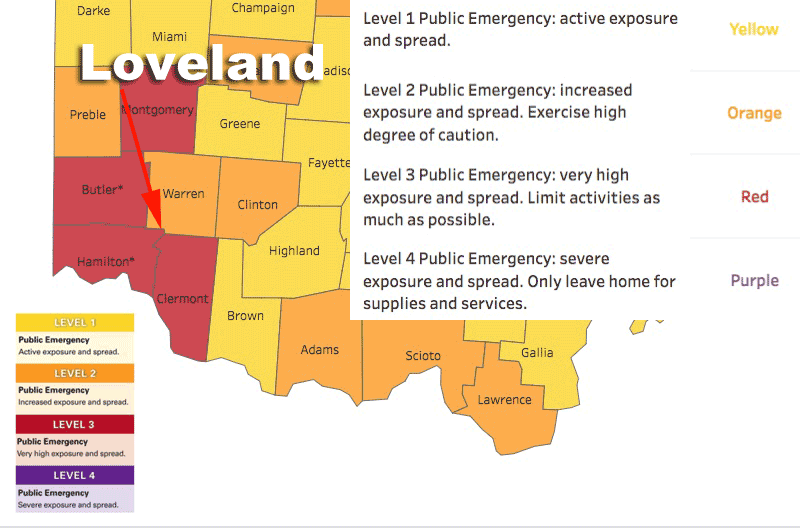
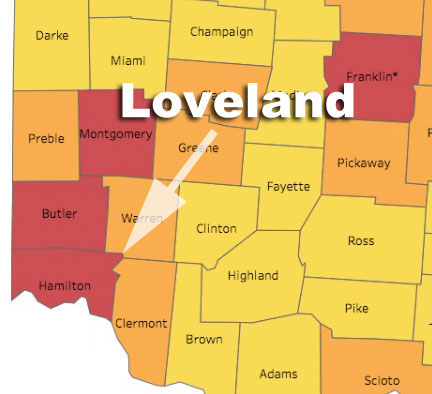
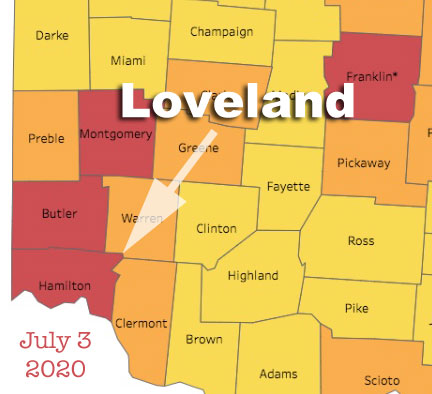
    Both Hamilton and Clermont counties are currently under the State RED Alert for COVID 19 spread. Clermont County was elevated from ORANGE to RED last Thursday. Warren County remains in the ORANGE Alert designation.

    What does it mean if Hamilton County goes to the highest Alert level?

    Hamilton County is on the State Watch list to possibly be elevated from the current RED Level Alert to the highest, PURPLE Level Alert. That destination would mean that the county is experiencing “Severe exposure and spread.” The order from the state would be, “Only leave home for supplies and services and Stay at home/necessary travel only.”

    Why was Hamilton County put under a RED Alert?

    As of July 7, Hamilton County during the 3 weeks prior had COVID 19 cases increase along with several other healthcare indicators.

    Between June 24 and June 30, Hamilton County had 1,124 cases, the largest number of COVID 19 cases in any week since the beginning of the pandemic.

    From June 16 until June 30, the average new cases per day doubled from 82 to 161. Due to clinical and reporting lags, these numbers may continue to grow for this reporting period.

    The community continued to experience early signs that more people are seeking medical care for COVID 19 symptoms.

    From June 16 to June 30, visits for COVID 19 to the emergency department doubled from an average of 11 per day to 22. More people are also visiting their doctors and being diagnosed with COVID 19.

    Between June 16 and July 2, the average outpatient visits more than tripled from 52 to 172 visits per day.

    In recent weeks, more than 86% of the cases are not in congregate settings, signaling significant transmission in the broader community.

    Hamilton County also hit a new threshold for the overall utilization rate for regional intensive care unit beds, which exceeded 80% during 5 of those past 7 days.
    Why was Clermont County put under a RED Alert?

    As of July 7, Clermont County during the 3 weeks prior had COVID 19 cases increase along with several other healthcare indicators.

    From June 16 until June 30, the average new cases per day doubled from 4 to 9. Due to clinical and reporting lags, these numbers may continue to grow for this reporting period.

    The community continued to experience early signs that more people are seeking medical care for COVID 19 symptoms.

    More people are also visiting their doctors and being diagnosed with COVID 19.

    Between June 16 and July 2, the average outpatient visits nearly tripled from 9 to 25 visits per day.

    In recent weeks, more than 94% of the cases are not in congregate settings, signaling significant transmission in the broader community.

    Clermont County also hit a new threshold for the overall utilization rate for regional intensive care unit beds, which exceeded 80% during 5 of those past 7 days.

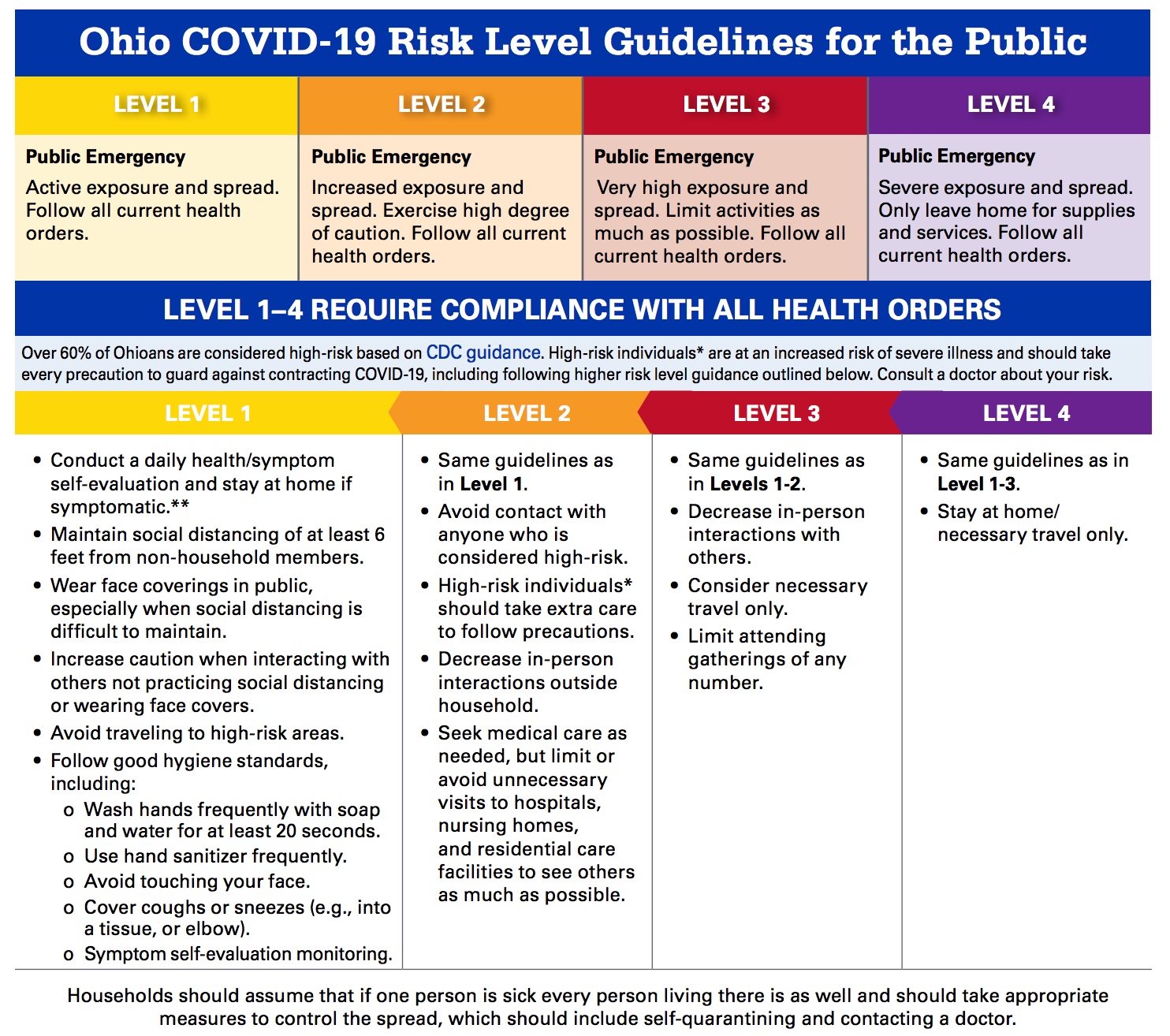
    LEVEL 1   0–1 Indicators Triggered

    Active exposure and spread. Follow all current health orders.

    LEVEL 2   2–3 Indicators Triggered

    Increased exposure and spread. Exercise high degree of caution. Follow all current health orders.

    LEVEL 3   4–5 Indicators Triggered

    Very high exposure and spread. Limit activities as much as possible. Follow all current health orders.

    LEVEL 4   6–7 Indicators Triggered

    Severe exposure and spread. Only leave home for supplies and services. Follow all current health orders.

    Summary of Alert Indicators


    As of today, Monday, July 13:

    The number of hospitalizations in Ohio is 8,842. Total Deaths in Ohio is 3,058.

    There are 462 hospitalizations and 131 deaths in Hamilton County. There have been 3,657 cases and 1,154 recoveries.

    There have been 497 confirmed and probable cases of COVID 19 in Clermont County and 7 confirmed and probable death. There are currently 60 hospitalizations. 341 people are being reported as recovered.

    In Warren County there have been 945 positive and probable cases and 25 positive and probable deaths. Warren County is reporting 120 new positive cases, 5 new hospitalizations, and 3 new deaths in the last 14 days.


    Clermont County Public Health has issued these 5 Protocols for All Businesses and these Frequently Asked Questions and Answers

    1. Require face coverings for employers and recommend them for clients/customers at all times.

    2. Conduct daily health assessments by employers and employees (self-evaluation) to determine if “fit-for-duty”.

    3. Maintain good hygiene at all times -hand washing, sanitizing, and social distancing.

    4. Clean and sanitize workplaces throughout the workday and at the close of business or between shifts.

    5. Limit capacity to meet social distancing guidelines.

    •Establish maximum capacity at 50% of the fire code.
    • And, use appointment setting where possible to limit congestion.

    Q. Will I have to wear a mask or face covering while I am at work?
    A. Yes. Face coverings are required for employees except if any of the following apply:

    1. Facial coverings in the work setting are prohibited by law or regulation;

    2. Facial coverings are in violation of documented industry standards;

    3. Facial coverings are not advisable for health reasons;

    4. Facial coverings are in violation of the business’ documented safety policies;

    5. Facial coverings are not required when the employee works alone in an assigned work area; or There is a functional (practical) reason for an employee not to wear a facial covering in the workplace.

    Q. Will I have to wear a mask or face covering if I am a customer at a business?
    A. Yes. Under the level 3 Public Health Emergency issued on July 10, customers must wear masks while inside businesses or other buildings.

    Q. Will I need to take my temperature before coming to work?
    A. Yes. Employees must take their temperature and watch for other symptoms such as coughing or difficulty breathing. Sick employees should stay at home.

    Q. What safety precautions should my employer be taking?
    A. All businesses should follow these protocols

    1. Require face coverings for employers and customers.

    2. Conduct daily health assessments by employers and employees (self-evaluation) to determine if “fit-for-duty”.

    3. Maintain good hygiene at all times -hand washing, sanitizing, and social distancing.

    4. Clean and sanitize workplaces throughout the workday and at the close of business or between shifts.

    5. Limit capacity to meet social distancing guidelines.

    •Establish maximum capacity at 50% of the fire code.
    • And, use appointment setting where possible to limit congestion.

    Q. What should I do if my co-workers aren’t wearing facial coverings at work?
    A. If an employee of a business is not wearing a facial covering, ask the employer/business for written justification on why the employee isn’t wearing a face covering.

    Q. What should I do if my employer is not following proper safety precautions?
    A. If an employer is not following the above safety protocols, you can file an online complaint here.

    To File a complaint about a business you think is in violation of the Stay Safe Ohio Order, click here.

    To check the status of a complaint click here. (Choose “Code Case” in the search drop-down box).

    Full Ohio Department of Health Stay Safe Ohio Order 

    More information from the Ohio Department of Health on the Responsible RestartOhio page

  • Ohio’s K-12 public schools got cuts. Private, charter schools got cash

    Ohio’s K-12 public schools got cuts. Private, charter schools got cash

    The amount of the state revenue reduction for the Loveland City School District was $1,010,855

    An up-date on 7/12/2020:

    Loveland Treasurer Kevin Hawley reports to the Board in the agenda for their June 23 business meeting:

    Loveland City Schools received approximately $350,000 from the CARES Act. These funds were provided to the state of Ohio and they determined the breakdown for each district. Ohio determined the allocation based on Title I federal funding rates. Title I is a federal grant primarily provided to “schools with high numbers or high percentages of children from low-income families to help ensure that all children meet challenging state academic standards.” This was the way the state determined equity in payments. As a reminder, the state decreased our overall state funding by $1,010,855. These funds are provided specifically for any increased expenses due to COVID-19. Therefore, this will help with any additional expenses incurred due to the pandemic and with the resumption of school in the fall of 2020.

    By Susan Tebben| Tyler Buchanan at the Ohio Capital Journal


    Local Private Schools Receiving Paycheck Protection Program Funds

    Cincinnati Country Day School 2-5m

    Cincinnati Hills Christian Academy 2-5m

    St. Xavier High School 2-5m

    Elder High School 1-2m

    Mount Notre Dame 1-2m

    McNicholas High School 350k-1m

    La Salle High School 350k-1m

    Roger Bacon High School 350k-1m

    Seton High School 350k 1m

    Lebanon Christian School 150k-350k

    Liberty Bible Academy (Mason) 150k-350k

    Ohio educators were at home celebrating “Teacher Appreciation Week” in May when they learned cuts would be made at every public school district in the state.

    These cuts came just as hundreds of private and charter schools in Ohio were approved to receive millions of dollars from the federal government to keep their workers on payroll. Some of these already receive public school funding as part of the EdChoice private school voucher program.

    The federal funding was offered through the Paycheck Protection Program (PPP). It is a program administered by the Small Business Administration which gives low-interest loans to businesses and nonprofits. The loans are forgiven if used primarily to help with payroll costs.

    After the federal government released a list of PPP recipients on Monday, the Ohio Capital Journal reviewed data on the nearly 23,000 recipients in this state to track funding that went to schools.  

    The list does not give an exact dollar figure received by each place, but rather provides a range: $150,000 to $350,000; $350,000 to $1 million; $1-2 million; $2-5 million; and $5-10 million.

    In total, the Capital Journal identified 220 schools in Ohio that received PPP funding. The possible range of the combined funding is between $95 million and $232 million.

    This money went to a variety of schools. Many are religious institutions, such as Chaminade Julienne Catholic High School in Dayton, which received between $1-2 million. The list includes many charter schools, such as the chain of Horizon Science Academy locations in more than a half-dozen cities which took in millions of dollars.

    There are private gifted schools, college preparatory schools and those which operate as nonprofits independent of the traditional public school system. Some are specialized schools for certain areas of study, such as the Global Ambassadors Language Academy in Cleveland, which allows children to learn in language immersion programs for Spanish and Mandarin. The academy took in between $150,000 and $350,000.

    Together, the 220 schools were able to retain many thousands of jobs thanks to the PPP funding. 

    There were additional loans given to Montessori schools, day care centers, pre-schools, after-school programs, summer camps and other entities which serve children. These were not included in the Capital Journal review. 

    PPP money has been limited to businesses and nonprofit entities, thus making public school districts ineligible for funding.

    The Ohio Capital Journal previously reported about a similar disparity within higher education. Dozens of private colleges and universities took in tens of millions of dollars in forgivable PPP loans, while some of Ohio’s public institutions have suffered from severe budget shortfalls in 2020. 

    Public schools hope for future funding

    Public schools are still searching for funding relief after $300 million was cut by Gov. Mike DeWine’s administration in early May as the coronavirus pandemic began to impact state revenues. The amount of the state revenue reduction for the Loveland City School District was $1,010,855.

    Columbus City Schools Superintendent and CEO Talisa L. Dixon told a legislative committee discussing the future of K-12 education as the cuts took place that uncertainty is the greatest factor facing Ohio schools.

    “Uncertainty for the educational programs our families may need and want during this crisis, uncertainty of what our revenues may be as the state discusses further reductions, uncertainty of what our expenses may be in order to bring students back safely,” Dixon said.

    The state education system has seen declining growth not just related to coronavirus cuts, but year over year, according to historic data. On top of decreasing budgets, public schools have had to absorb the expenses of sending some students in low-ranked public schools to private schools through the EdChoice program.

    The Cleveland Heights-University Heights City School District, for example, saw more than one-third of its state aid deducted for EdChoice scholarships in fiscal year 2019, according to a report done by the district.

    According to the PPP awards, a number of Cleveland private schools received funding — examples include the Lutheran High School Association as well as the St. Joseph Academy, each taking in forgivable loans of between $1-2 million.

    Hamilton County’s Indian Hill Exempted Village School District had around one-fourth of its state aid diverted to EdChoice private school vouchers, and Sycamore Community City School District lost about one-fifth.

    In 2020 PPP awards, nearby schools received loans such as Cincinnati Hills Christian Academy (between $2-$5 million) and St. Ursula Academy (between $1-$2 million).

    The leader of a teacher’s union representing 20,000 Ohio educators is taking issue with PPP funding and public school monies going toward private schools. In a recent conference call regarding falling budgets and the need for federal aid, Ohio Federation of Teachers Executive Director Melissa Cropper said the diversion of government funding to private schools has only added to the struggles that impact most students in the state.

    “Ninety percent of our students are educated in public schools, so when we have this money diverted to private schools, we’re impacting 90% of the students that the money is being taken away from,” Cropper said. “So this just continues to create disparities within our education system.”

    Education advocates see other potential solutions to public schools’ budget woes — namely, funding from the federal CARES Act, a COVID-19 relief bill signed into law back in March. A separate HEROES Act includes more funding for public education, including $3.2 billion earmarked for Ohio schools, but the bill has languished in the U.S. Senate after passing in the U.S. House of Representatives. 

    The Ohio Capital Journal is a hard-hitting, independent, nonprofit news organization dedicated to connecting Ohioans to their state government and its impact on their lives. The Capital Journal combines Ohio state government coverage with relentless investigative journalism, deep dives into the consequences of policy, political insight and principled commentary.

  • Clermont County elevated to RED COVID 19 Alert

    Clermont County elevated to RED COVID 19 Alert

    The Public Health Advisory Alert System is a color-coded system designed to supplement existing statewide orders through a data-driven framework to assess the degree of the virus’ spread and to engage and empower individuals, businesses, communities, local governments, and others in their response and actions.

    The system consists of four levels that provide Ohioans with guidance as to the severity of the problem in the counties in which they live.  The levels are determined by seven data indicators that identify the risk level for each county and a corresponding color code to represent that risk level.

    Loveland, Ohio – Governor DeWine announced today that new public health data has led the Ohio Department of Health to designate that Clermont County is now among 12 counties as being in a Red Alert Level 3 Public Emergency as defined by the Ohio Public Health Advisory System.

    Clermont County had been in Level 2 until the announcement today.

    Hamilton County remains RED Alert Level 3 however it is on Ohio’s “Watch List” as they are approaching Purple Alert Level 4.

    Mandates for people to begin wearing masks in public in Clermont County will begin at 6 PM on Friday, July 10.

    Governor DeWine announced the creation of the Ohio Public Health Advisory System last week to provide local health departments, community leaders, and the public with data and information on the severity of the COVID-19 spread in the counties in which they live. The system consists of four levels with specific risk-level guidelines. Each level is calculated with data gathered on seven public health indicators.

    Read the Health Order

    Director’s Order for Facial Coverings in Butler, Cuyahoga, Franklin, Hamilton, Huron, Montgomery, and Trumbull Counties in Level 3 Public Health Advisory

    Those in counties designated as Red Alert Level 3 or Purple Alert Level 4 are required to wear a face covering:

      • In any indoor location that is not a residence;
      • When outdoors and unable to consistently maintain a distance of six feet or more from individuals who are not members of their household; or
      • While waiting for, riding, driving, or operating public transportation, a taxi, a private car service, or a ride-sharing vehicle.

    The order does not apply to children under the age of 10 or any other minor who cannot safely wear a face covering. The order also reflects the mask guidance in place for employees and businesses which does not require a person to wear a mask if their physician advises against it, if wearing a mask is prohibited by federal regulation, if communicating with the hearing impaired, when alone in an office or personal workspace, and other similar measures.

    Schools that offer Kindergarten through Grade 12 instruction should follow the guidelines set forth last week by the Ohio Department of Education and the Ohio Department of Health.

    The Ohio Department of Health will update county rankings every Thursday. Any county that increases to Red Alert Level 3 will automatically be included in the face-covering mandate. Any county that decreases from Red Alert Level 3 to Orange Alert Level 2 will automatically be released from the face-covering requirement.

  • [POLL] Do you feel safe sending your child back to school in light of the “Red” Alert?

    [POLL] Do you feel safe sending your child back to school in light of the “Red” Alert?

    “The Public Health Advisory Alert System is a color-coded system designed to supplement existing statewide orders through a data-driven framework to assess the degree of the virus’ spread and to engage and empower individuals, businesses, communities, local governments, and others in their response and actions.”

    Loveland, Ohio – Today beginning at 6 PM all of Hamilton County which includes parts of the Loveland School District is under an order of the Ohio Department of Health that mandates the wearing of face coverings in public.

    Loveland High School, the Intermediate and Middle School Campus, and the Primary and Elementary Campus are all within the RED alert area. There are approximately 4,000 students that attend these schools.

    The Early Childhood Center is in Clermont County which is in the Orange Alert area.

    Loveland Schools are currently scheduled to resume classes on August 26, 48 days from now.

    Loveland is in three counties. The Little Miami River is the East/West dividing line between Hamilton County and Clermont County, A smaller part of Loveland is in Warren county. Hamilton County is in the RED in Ohio’s Public Health Emergency Alert system. Clermont and Warren are both currently ORANGE.

    Also, Governor Dewine tweeted on July 7, “As the #COVID19 pandemic has progressed more younger Ohioans are being diagnosed with #COVID19. We are seeing young people who are getting very sick. There is also the concern that they are passing it on to those who are at risk.” He released this graphic to emphasize that point.


    [poll id=”5″]


    Read the Health Order

    Director’s Order for Facial Coverings in Butler, Cuyahoga, Franklin, Hamilton, Huron, Montgomery, and Trumbull Counties in Level 3 Public Health Advisory

  • Take our Poll: Should Loveland Area Governments Require Face Mask?

    Take our Poll: Should Loveland Area Governments Require Face Mask?

    Today Cincinnati City Council passed a resolution requiring the public to wear face masks.

    Already, the Springfield City Commission requires a face mask. Dayton became the first major city in Ohio to require masks by law. Similarly, Yellow Springs passed a resolution and Bexley passed a local ordinance requiring masks.

    [poll id=”4″]

  • DeWine lays out K-12 reopening plans

    DeWine lays out K-12 reopening plans

    Columbus, Ohio – Ohio Gov. Mike DeWine laid out reopening guidelines for state K-12 schools on Thursday, including a mask requirement for teachers, but no such mandate for students.

    DeWine said it is “the state’s strong recommendation” that children from the third grade on wear face masks, but maintained that local control for school districts will be in place as reopenings begin. 

    “A great deal of flexibility is allowed, as it should be,” DeWine said in his Thursday COVID-19 press conference.

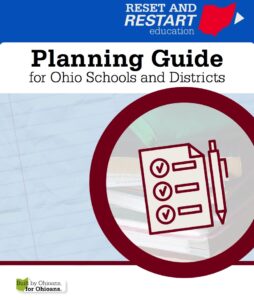
    Ohio Department of Education’s 36-page planning guide

    The governor announced that the Ohio Department of Education published a 36-page planning guide that includes recommendations on everything testing to field trips and recess precautions.

    The guidance is specifically noted as “not mandatory” in the documents and emphasized the need for schools and districts to develop and implement their own protocols, while using the information provided by local and state health departments.

    “Planning teams should include school leaders, local health department officials, local school board members, educators, education support professionals, school health professionals, parents, students, community partners and local business leaders,” the planning documents stated.

    In developing coronavirus related-protocols, DeWine said before anyone enters a school facility, parents and school officials should “vigilantly assess” symptoms, and take the temperatures of everyone coming into the schools. In the guidance, outside individuals such as delivery personnel, student teachers and faculty of student teachers are all treated the same as official school personnel. 

    The Loveland District is currently working on models for reopening school in the fall, “which can be adjusted based on the pending guidance from state and local health agencies.”

    The planning guide said flare-ups are considered “expected” by state officials, and warns that school buildings may need to close in the event of said flare-up.

    Schools were told to work with local health departments to develop a testing strategy, thoroughly clean and sanitize schools, and teach and practice social distancing and hand-washing.

    Social distancing in places like school buses will be more difficult, and DeWine said as much distance as is possible will benefit students and staff.

    “(Specific measurements of distance is) all relative and it’s somewhat arbitrary,” DeWine said. “But the more distance you can have the better.”

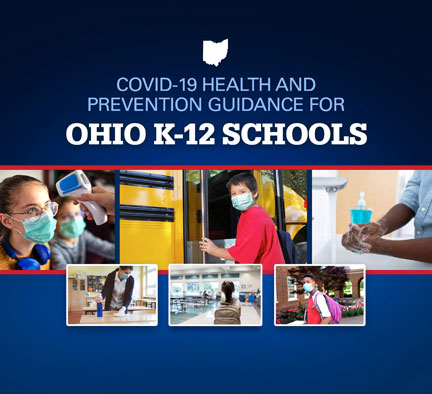
    COVID 19 Health and Prevention Guidance for Ohio K-12 Schools

    Face coverings are required by staff unless it is unsafe or if doing so “could interfere with the learning process,” DeWine said on Thursday.

    Ohio Federation of Teachers Executive Director Melissa Cropper appreciated the moves by the governor, but said the OFT worries about the financial demands of the new protocols.

    “We are concerned that local governments and school districts will have to make decisions about the governor’s recommendations at a time when they are anticipating budget crunches and beginning to make spending cuts,” Cropper said in a statement.

    DeWine said it “is not right for me or (other departments) to micromanage” school buildings or districts.

    The governor did say he plans to meet with House Speaker Larry Householder, Senate President Larry Obhof, and minority leaders to discuss extra funding, along with the use of CARES Act funding.

    Cropper said schools would benefit from HEROES Act funding as well, a bank of about $2 billion in monies for K-12 education, but the act is still awaiting U.S. Senate consideration after passing the House.

    The guidance comes as the state faces continual growth in coronavirus cases, and data showing that cases are passed through the individuals within the area. DeWine noted that 80% of confirmed cases in Montgomery County have been linked to community spread.

  • [VIDEO] LHS grad Hakim Oliver keynotes BLM March in Mason

    [VIDEO] LHS grad Hakim Oliver keynotes BLM March in Mason

    Mason, Ohio – Hakim Oliver graduated from Loveland High School in 1999. He then graduated from Bowling Green State University and is now an intervention specialist working with Seniors at Mason High School.

    Hakim Oliver is married to Alison Oliver

    On June 20 two Mason Alumni put on the BLM Mason March starting at Pine Hill Lakes Park in Mason going to the municipal building that drew thousands. The protest march with petition signing and speakers was to, “…stand in solidarity with our Black community members in their struggle for justice.” Their goals were to raise funds to support social justice, racial equality, protesters, and other facets of the Black Lives Matter movement.

    After the protest march, Oliver approached leaders at Mason City Hall with the idea of holding community conversations in Mason Community Exposure – Bridging Stories. They accepted and embraced the idea. Oliver said, “This is a collaboration with the City of Mason and I’m looking forward to building relationships.”

    Mason has announced the community conversations by saying:

    Sponsored by the City of Mason and in partnership with Mr. Hakim Oliver this program is intended to facilitate positive intergroup interaction and discussion recognizing individuals are different from others and how we together create a community.

    This four part series includes a panel discussion, public input, engagement and interaction helping increase participants perspective by listening and mentally walking in someone else’s shoes. The program aligns with Mason’s mission for building a culture of wellness in the community by helping elevate morale, respect differences, and give a voice to the community.

    Community Exposure – Bridging Stories! participants meet each Wednesday July 15 through August 5 from 7:00 p.m. to 8:15 p.m. at the Mason Municipal Center located at 6000 Mason Montgomery Road.

    Space is limited. Register Here!


    Oliver has since approached Loveland City Hall for their support of similar community forums.

    This video is Oliver’s keynote address:

    Here is a video of the BLM Mason protest posted on YouTube by K Jackson.


    BLM Mason Demands for Change

    Today we stand in solidarity with our Black community members in their struggle for justice. On May 25th, 2020 George Floyd was yet another victim of police brutality against the Black community in America. His death following those of Ahmaud Arbery, Breonna Taylor, Nina Pop, and Tony McDade sparked a nationwide demand for racial equality. However, our community has largely stayed silent on such issues despite the international outrage that followed. Times like these are when a community must show its character, and for that reason we have organized a peaceful demonstration to achieve the following:

    Goals for protest:

    Raise funds to support social justice, racial equality, protestors, and other facets of the Black Lives Matter Movement

    Sign petitions to further racial equality and protest safety in America

    Demands:

    1. Demand the establishment of two anonymous tip lines, one for the public to utilize, and another for police officers to release statements of other police officer’s misuse of power to both the police department and a third party group.
    2. Demand the redistribution of Mason Police Department funding towards Police Officer Body Worn Cameras and cultural competency training to make Mason PD a progressive role model
    3. Demand that the City of Mason hold an open meeting designated for People of Color to voice their concerns about safety and racism in our community.


  • Loveland District Planning Commission meets tonight

    Loveland District Planning Commission meets tonight

    No Agenda for this meeting is publicly available

    Loveland, Ohio – The full Planning Commission of the Loveland City School District will meet tonight via ZOOM/Youtube. The meeting starts at 6:30 PM.

    The July 1 Meeting will be livestreamed remotely via Zoom at the following link: https://youtu.be/9EWbcQixBng

    As there has been technical difficulties with livestreaming of meetings in the past, here is a backup link should any issues arise:
    (This link will ONLY be used in case the connection to the meeting is lost via the link provided above.)

    Here is the Constitution for the Planning Commission.

    You can email the officers at: planningcommission@lovelandschools.org.

    Loveland City School District Planning Commission
    The Board of Education has implemented a community-based Planning Commission to be a research and advisory resource for the school district. The Commission will assist the Board by researching and/or evaluating assigned issues and topics, and reporting its findings and recommendations to the Board for consideration. The purpose of the Commission is also to assist the Loveland community in becoming better informed about a variety of issues related to the schools. The Planning Commission has four Sub-Committees:
    Communication/Community Engagement Subcommittee
    Tasked with researching additional, innovative, and alternative ways to increase communication and engagement between the school district and the community. Members include:
    Kelley Deer
    Tara Hamilton
    Jeff Hawk
    Lisa Moorhead
    Lynn Oury
    Michael Shiverski
    Facilities Subcommittee
    Tasked with understanding the facilities assessments and current master plan, researching ways to revisit the master plan, and recommending a timeline. Members include:
    Daniel Colletto
    Brad Combs
    Leah Jewell
    Kevin Kimnach
    Alvin Kressler

    Warren Winning

    Finance Subcommittee
    Tasked with investigating opportunities for Loveland City Schools to increase income that does not raise local property taxes and researching effective practices in reducing expenditures. Members include:

    Donel Autin
    Brad Goldie
    Matthew Hammer
    Jill Jones
    Craig Lewis
    Nathan Libby
    Lynn Mangan
    Kirk McCracken

    School Improvement/Student Experience Subcommittee
    Tasked with understanding the current school improvement process and providing input to goals, benchmarks, and comparison districts for the implementation of the Portrait of a Tiger while optimizing our current resources. Members include:

    Susan Craig
    Lisa Saletta
    Alexander Topala
    Lindsey Willmann
    Natasha Young

  • Local Facebook Group Fundraises for “Pay-to-Play” LHS Student-Athletes!

    Local Facebook Group Fundraises for “Pay-to-Play” LHS Student-Athletes!

    by Cassie Mattia

    Loveland, Ohio – Loveland has always been known as a community that gives back, and ALWAYS takes care of the youth. Over the past few months many have been fighting for the Loveland School levy because, without the appropriate funds, Tiger student-athletes have to “pay-to-play.”

    Recently two Loveland School levies failed, leaving both Tiger student-athletes and their parents at a stand-still. Now those Tigers wanting to participate in a sport will have to pay $310. This did not sit well with Loveland Tiger advocate, Tori Morrison, so with the approval of the Loveland Athletic Booster Board she created a Facebook group that would help those athletes that could not afford to pay the sports fees.

    “With the recent failure of two school levies, we knew that Pay to Play fees would be increasing this year,” Morrison explained, “In anticipation of that, the Athletic Boosters decided that we needed some way to help the athletes to continue to play. We feel that no tiger should be left out. Fees were previously $105 for all sports except football and lacrosse which were $155. Now all sports will be paying $310 per sport.”
    Morrison attended Loveland Schools from 2nd through 6th grade before she moved with her family to New Richmond where she eventually met her husband and moved back to Loveland when her oldest child entered into 3rd grade.

    “We have had three children graduate from Loveland schools – Ashlei (03), Chelsei (10), and Ben (20). My kids have been involved in soccer, baseball, softball, basketball, football, lacrosse, yearbook, drama, and choir,” Morrison said, “Over the years I have been a team mom for various sports and most recently organized and planned the Homecoming Parade for the last six years. When my son graduated I decided I was ready to become involved in a different way and decided to run for the Loveland Athletic Booster Board.”

    Morrison says that the newly created Facebook Group “Loveland Athletic Boosters” is focusing on raising money for the student-athletes that may not be able to afford the pay-to-play fees.

    “We want to share information and we encourage everyone to spread the word,” Morrison said, “The more people that join the group the more Tigers we can help! We want everyone to get a chance to play regardless of their financial situation. It’s going to be really tough for some families to pay the now $310 pay to play fee. Some athletes won’t be able to play at all and others will be forced to pick one sport where they used to be able to play two or three.” Many, many families have more than one child that will want to participate in a sport.

    Thus far Morrison told us that the entire Loveland Athletic Boosters (LAB) Board is behind the fundraising efforts including, President Jeff Williams, Vice President Rich Myklebust, Treasurer Stephanie Bashardoust, and Secretary Stacey Lund. Soon LAB will be offering Business Memberships which would be a first for the Board.

    I asked Morrison if the new Facebook Group would be holding any fundraising events and she said they are ALWAYS searching for new ideas and ways to raise money. The LAB’s do in fact have some awesome events planned that they hope will bring in a lot of funds for Tiger Student-Athletes.

    Learn more about the annual Golf Outing on July 27 at O’Bannon Creek  Golf Club.

    “Our annual Golf Outing is July 27 at O’Bannon Creek  Golf Club.

    The Membership drive kicks off on July 1 and fall student-athletes will be selling discount cards that will be good at local restaurants and businesses,” Morrison said, “We will also be having like we do every year in January our Tiger Ball. One hundred percent of the money from these events will go towards helping our student-athletes with fees, gear, and anything else they need.” 

    Here at Loveland Magazine we encourage everyone to join the Loveland Athletic Boosters Facebook Group and support the Tiger student-athletes!

    The group added Venmo so that it makes it easier to donate.

    You may also comment on the FB page to adopt a Tiger. To learn more about how you can get involved with helping Loveland’s Student-Athletes compete in sports visit the Loveland Athletic Booster Facebook Page or check their website at www.lovelandathleticboosters.com.


  • Wenstrup now accepting applications for U.S. Service Academies for Class of 2025

    Wenstrup now accepting applications for U.S. Service Academies for Class of 2025

    From the office of Ohio Congressman Brad Wenstrup:

    As a Member of Congress, I have the privilege of nominating exceptional young people for admission to the U.S. Military Academy at West Point, the Naval Academy, the Air Force Academy and the Merchant Marine Academy, known collectively as the U.S. Service Academies.  My office also works with students interested in the Coast Guard Academy. The U.S. Service Academies offer opportunities for motivated young men and women to serve their country while receiving an excellent education and developing valuable leadership skills.  In place of tuition, the Academies require military service after graduation.

    If you’re interested in attending a U.S. Service Academy, check out the resources below. If you have any questions, please contact Annie Cummins in my Cincinnati District Office: (513) 474-7777.

    Pathway to an Academy Nomination

    Admission to the U.S. Service Academies is highly competitive and selective, as is the process of securing a nomination. Here are some things to consider on your pathway to a nomination and, ultimately, admission to an Academy:

    Academic Achievement:

    The U.S. Military Academies are looking for candidates who have a strong record of academic achievement. Your high school GPA and class rank are important indicators of your academic record, as are the kinds of courses you take. Consider taking more challenging courses (like AP/Honors classes, math and science classes, etc.) whenever possible.

    Leadership and Service:

    Candidates for the Academies must demonstrate outstanding leadership both in and outside of the classroom. Participating in extracurricular activities like athletics, clubs, and community service organizations can help you develop and hone your leadership skills.

    Summer Programs:

    The U.S. Military Academy, the U.S. Air Force Academy, and the U.S. Naval Academy each offer a variety of summer programs for prospective applicants. Participating in one or more of these programs is a great way to become acquainted with life at the Academies. Click on the links below to learn more about these opportunities.

    U.S. Military Academy at West Point
    The Summer Leaders Experience
    Sports Camps
    STEM Programs

    U.S. Air Force Academy
    Summer Seminar
    Sports Camps 

    U.S. Naval Academy
    Summer Seminar
    Summer STEM Program
    Sports Camps

    Academy Day

    Interested in joining a service academy?

    Stay tuned for upcoming Academy Day dates.

    Applying for an Academy Nomination

    To be considered for a nomination to one of the United States Service Academies for the graduating class of 2025, your application must be received by the Cincinnati District Office by 5:00 p.m. on September 25th, 2020.  Your completed file must contain the following:

    1.         Completed Application Form

    2.         High School Transcript – Transcript must include all course work, GPA, and class rank.

    3.         Standardized Test Scores – Please provide official scores from the ACT or SAT, or both, as reflected on a school transcript or in official documentation from ACT or SAT.

    4.         High School Recommendation – Please provide a letter of recommendation written by your Guidance Counselor or High School Principal.

    5.         Letters of Recommendation – Please provide 2 additional letters of recommendation.

    6.         Community & School Activity List – Please list all school, athletic, and community activities and other significant accomplishments/awards.

    7.         Essay – Please provide an essay (300 words or less) outlining why you want to attend a United States Service Academy and then serve in the military as a commissioned officer.

    8.         Interview – All applicants will be required to attend an interview session conducted by our Academy Panel.  Dates, times, and locations will be determined at a later date.

    9.         Photograph – Please provide a current 5×7 photograph.

    10.       Deadline – Send the above information by September 25, 2020.

    The nomination materials referenced above are SEPARATE AND DISTINCT from the application materials you must submit directly to the Academies.

    Please make sure to also begin your pre-candidate file with each Academy to which you plan to make application.

    Click here to access my office’s 2020 Academy Nomination Application form.