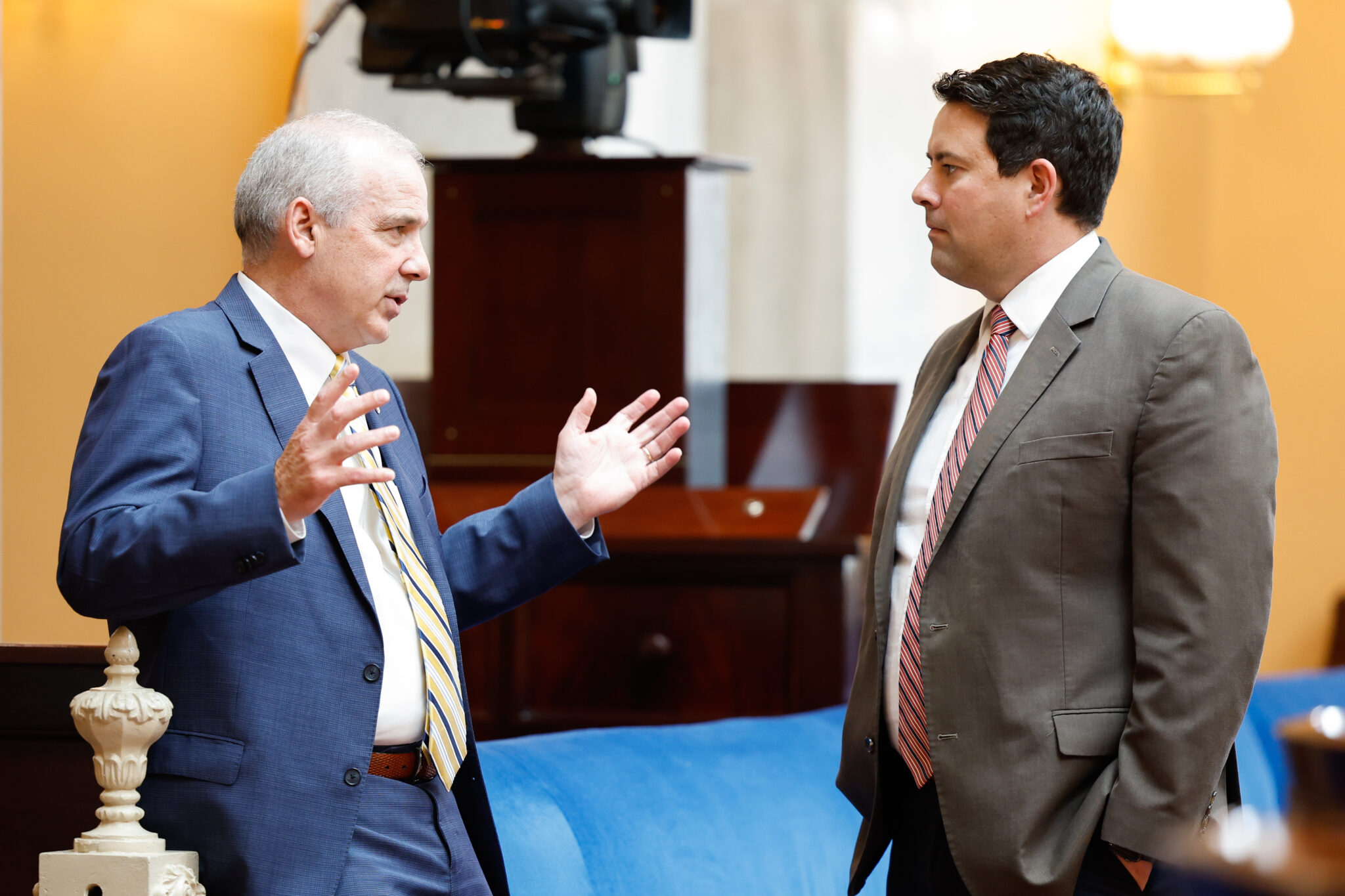
COLUMBUS, Ohio — MAY 31: Senate President Matt Huffman, R-Lima (left), talks to Senate Majority Floor Leader Rob McColley, R-Napoleon, after the Ohio Senate session, May 31, 2023, at the Statehouse in Columbus, Ohio. (Photo by Graham Stokes for Ohio Capital Journal. Republish photo only with original story.)
by DAVID DEWITT – Ohio Capital Journal
By far the most burdensome part of collecting signatures for citizens to amend the Ohio Constitution is the current requirement that they be gathered in 44 out of our state’s 88 counties.
Organizers typically try to gather double the number of signatures they need to get a proposal on the ballot, because so many things can go wrong and they need that much of a buffer to ensure they have enough valid and accepted signatures to get a proposal through. It’s a slog, requiring a tremendous amount of time, money, resources, volunteers, and dedicated effort for Ohio citizen groups to fulfill. And that’s fair.
But Ohio Republicans moving the goal posts from 44 counties to 88 counties, as they propose to do with State Issue 1 on the ballot Aug. 8, would effectively destroy the ability of grassroots Ohio citizen groups to succeed in getting proposed amendments on the ballot ever again. The only groups that would have even a remote shot of success would be the most wealthy and powerful special interest groups imaginable.
Ohio’s unconstitutionally gerrymandered, extremist Republican supermajority in the Ohio Statehouse is the first legislature in Ohio history to try to roll back the constitutional power of Ohio voters, proposing with State Issue 1 to destroy majority voter authority and raise the threshold for passing amendments to 60%.
Ohio voters have had a majority say over the Ohio Constitution since 1851, and the power to bring citizen ballot initiatives since 1912. Now Ohio Republicans want to eliminate the last possible avenue of accountability for voters against our corrupt, out-of-control legislature.
Republican leaders have admitted in private and in public that their effort is really aimed to stop an abortion rights amendment slated for the November ballot, and to stop voters from any effort toward further anti-gerrymandering reform.
After months of denying that the attempt to roll back majority voter authority and enshrine 41% minority rule over our constitution was tied to abortion, Ohio’s two-faced Secretary of State Frank LaRose was recorded telling Seneca County Republicans this is “100% about keeping a radical pro-abortion amendment out of our constitution.”
LaRose has used his position as our state’s chief elections official to write the most manipulative ballot language possible for the proposal, once again violating the Ohio Constitution as he did when he ignored a bipartisan Ohio Supreme Court, the voters, and the rule of law, to force through unconstitutionally gerrymandered maps.
Ballot language is constitutionally mandated to be both neutral and accurate. State Issue 1 as written for the ballot by LaRose fails in both regards. In trying to defend the language, which is now the subject of a lawsuit, the state openly admits that it is inaccurate, but claims that’s not a “material defect.”
The misleading ballot language LaRose and Ohio Republicans are forcing Ohio voters to consider 1.) Fails to state clearly the current process and standards, and how exactly they would change by comparison under the amendment, 2.) Uses weighted language about “elevating” the standards instead of neutral language about raising the threshold for passage from 50% to 60%, and 3.) Inaccurately describes the signature requirement as needing at least 5% of eligible voters in each county, instead of the truthful and accurate 5% of the ballots cast in each county during the most recent election for governor.
Meanwhile, Ohio Senate President Matt Huffman, also guilty of assaulting the voters, Ohio Constitution, and rule of law with gerrymandering, is now using the state budget process to extort Statehouse lobbyists into supporting this attack on voters.
Huffman has most recently proposed underfunding the August election by only allocating $15 million for it in the state budget, instead of $20 million as was spent on the August 2022 election. This will stretch county boards of election resources thin and hamper their ability to conduct this election, especially in Oho’s most populous counties, which are the most likely to strongly oppose the amendment.
Frank LaRose and Matt Huffman are using their elected positions of public trust to deploy every dirty trick in the book against Ohio voters to try to get us to strip ourselves of power and kneel down in subservience to their wanton extremism and corruption.
But the real kicker is that they plan on spending $6 million in TV ads — with financial backing of an extremist out-of-state billionaire — to try to convince Ohio voters this is about protecting our constitution from out-of-state special interests, when what the amendment would actually do is hand over all keys of power to the most wealthy and extreme special interests.
This brings us back to the change from 44 counties to 88 for signature gathering and the amendment’s elimination of a “cure period” after signatures have been turned in where organizers can correct things like wrong addresses listed on petitions.
“Requiring potentially hundreds of thousands of more signatures is bad enough,” the ACLU of Ohio’s Gary Daniels told House lawmakers in testimony against the proposal. “Eliminating the cure period in a state where many often move residences and are unnecessarily purged from voting rolls is even worse. The switch from 44 to 88 counties guarantees that the only campaigns that will qualify for the ballot are the most extremely rich ones.”
As we’ve seen in scandal after scandal — whether it’s payday lenders, corrupt charter schools, FirstEnergy bribing lawmakers and regulators for a billion-dollar bailout, or an Illinois billionaire trying to rewrite more than 100 years of Ohio Constitutional voter powers — our gerrymandered Statehouse is captured by corrupt, big money special interests.
By enshrining 41% minority rule, eliminating the signature gathering grace period, and mandating the near-impossible task of gathering thousands of signatures from every single Ohio county, State Issue 1 would guarantee that the only people who have influence on Ohio government are the most wealthy special interests and the corrupt Ohio politicians who keep selling out Ohioans, our state, and our future for pennies on the dollar.
DAVID DEWITT
OCJ Editor-in-Chief and Columnist David DeWitt has been covering government, politics, and policy in Ohio since 2007, including education, health care, crime and courts, poverty, state and local government, business, labor, energy, environment, and social issues. He has worked for the National Journal, The New York Observer, The Athens NEWS, and Plunderbund.com. He holds a bachelor’s degree from Ohio University’s E.W. Scripps School of Journalism and is a board member of the E.W. Scripps Society of Alumni and Friends. He can be found on Twitter @DC_DeWitt
MORE FROM AUTHOR




 YES 40.00% – 184
 YES 36.49% – 131
 YES 43.83% – 206
 YES 36.32% – 138
 YES 39.23% – 142
 YES 48.55% – 217