Tag: U.S. Supreme Court

  • Yost Seeks Freeze on EPA emissions rule

    Yost Seeks Freeze on EPA emissions rule

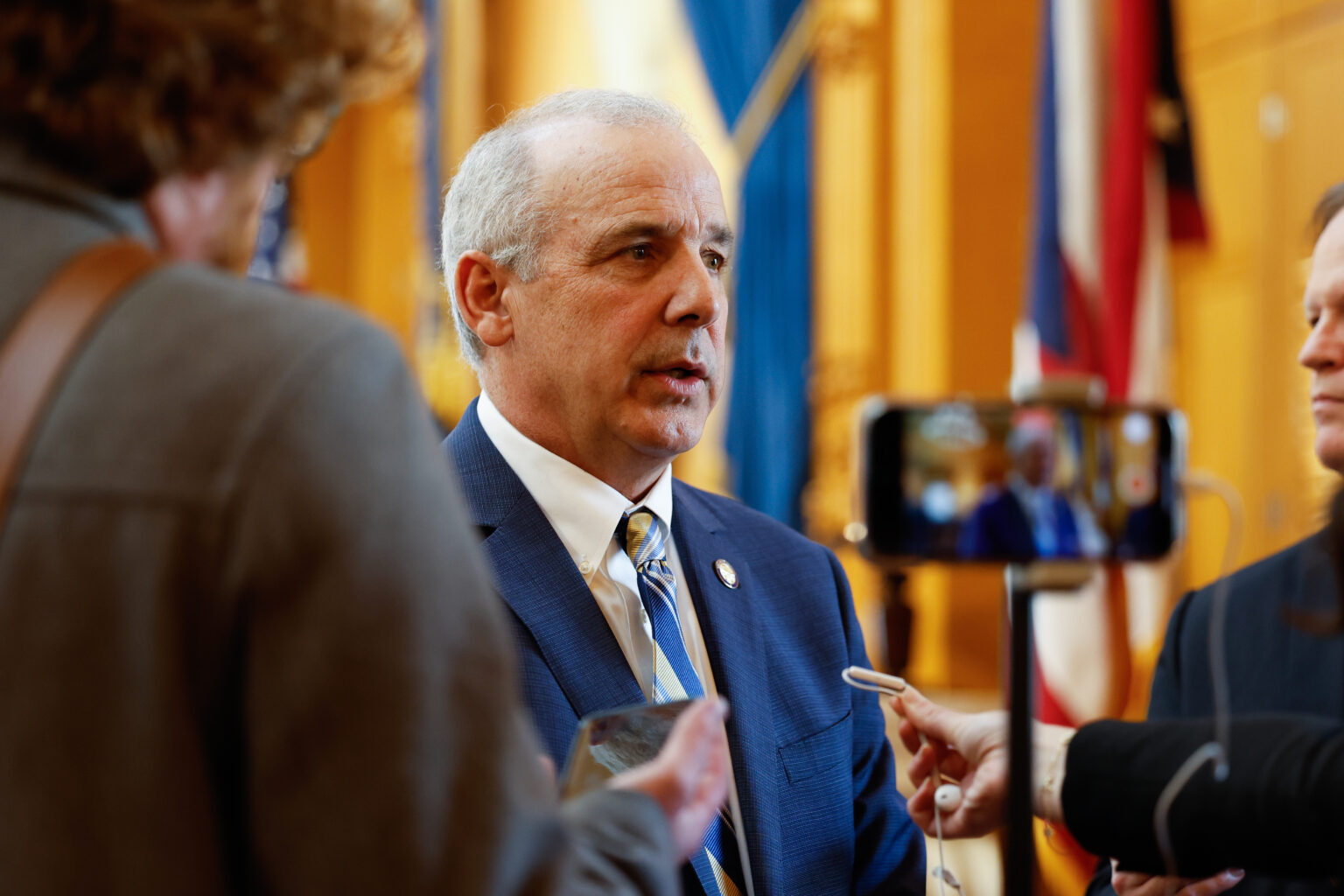
    Columbus, Ohio – Ohio Attorney General Dave Yost has asked the U.S. Supreme Court to pause a federal rule that forces states and power plants to comply with “unrealistic” and “unlawful” regulations targeting air pollution.

    In a filing with the court, Yost and the attorney general of Kansas oppose a recent Environmental Protection Agency rule that gives coal-fired power plants an ultimatum: Capture and store 90% of carbon emissions or shut down within eight years.

    “The EPA has resorted to ‘take it or leave it’ tactics to force its climate agenda on states and their power industries,” Yost said. “Protecting the air we breathe shouldn’t cost us our rights.”

    The attorneys general assert that the EPA lacks authority under the Clean Air Act to impose such regulations, noting a court ruling in a separate case that blocked the agency from forcing power plants to shift from fossil-fuel power to other types of energy.

    The EPA is taking an indirect approach to achieve the same unlawful outcome, the filing says, by giving states and power plants “impossible choices” that inevitably favor the agency’s climate agenda and strip states of their rights.

    Under the rule, the filing says, the EPA presents power plants with the no-win option to either risk billions of dollars on unproven emissions technology to meet unachievable benchmarks or shut down.

    Likewise, states can choose to immediately expend significant resources to comply with a rule that is likely to prove illegal or stand by as the federal government infringes on their sovereignty, the attorney generals write.

    In July, the U.S. Court of Appeals for the D.C. Circuit allowed the EPA’s rule to take effect as legal challenges continue. Yost and Kansas Attorney General Kris Kobach seek a stay from the U.S. Supreme Court to put a hold on the rule while the case proceeds.

  • U.S. Supreme Court rejects attempt to limit access to abortion pill

    U.S. Supreme Court rejects attempt to limit access to abortion pill

    BY:  Ohio Capital Journal

    WASHINGTON — The U.S. Supreme Court ruled in a much-anticipated decision Thursday that mifepristone, one of two pharmaceuticals used in medication abortion, can remain available under current prescribing guidelines.

    The high court unanimously rejected attempts by anti-abortion groups to roll back access to what was in place more than eight years ago, writing that they lacked standing to bring the case.

    Those limits would have made it more difficult for patients to get a prescription for mifepristone, which the Food and Drug Administration has approved for up to 10 weeks gestation and is used in about 63% of U.S. abortions.

    Erin Morrow Hawley, senior counsel at Alliance Defending Freedom, who argued the case in front of the court on behalf of the legal organization, doesn’t believe this is the end of efforts to challenge access to mifepristone.

    She said on a call shortly after the ruling was released the three states that intervened in a lower court — Idaho, Kansas and Missouri — could still advance their arguments against mifepristone and potentially hold standing, the legal right to bring a case.

    “I would expect the litigation to continue with those three states,” Hawley said.

    Kavanaugh writes opinion

    Justice Brett Kavanaugh wrote the opinion in the united ruling from the Supreme Court, with Justice Clarence Thomas writing a concurring opinion.

    “Plaintiffs are pro-life, oppose elective abortion, and have sincere legal, moral, ideological, and policy objections to mifepristone being prescribed and used by others,” Kavanaugh wrote.

    The four anti-abortion medical organizations and four anti-abortion doctors who originally brought the lawsuit against mifepristone have protections in place to guard against being forced to participate in abortions against their moral objections, he noted.

    “Not only as a matter of law but also as a matter of fact, the federal conscience laws have protected pro-life doctors ever since FDA approved mifepristone in 2000,” Kavanaugh wrote. “The plaintiffs have not identified any instances where a doctor was required, notwithstanding conscience objections, to perform an abortion or to provide other abortion-related treatment that violated the doctor’s conscience.”

    “Nor is there any evidence in the record here of hospitals overriding or failing to accommodate doctors’ conscience objections,” he added.

    Alliance Defending Freedom has not “identified any instances where a doctor was required, notwithstanding conscience objections, to perform an abortion or to provide other abortion-related treatment that violated the doctor’s conscience since mifepristone’s 2000 approval,” the opinion said.

    Kavanaugh might have also included hints on how the court will rule later this session on a separate abortion access case that addresses the Emergency Medical Treatment & Labor Act, known as EMTALA.

    “EMTALA does not require doctors to perform abortions or provide abortion-related medical treatment over their conscience objections because EMTALA does not impose obligations on individual doctors,” Kavanaugh wrote.

    Thomas agrees but questions who can sue

    Thomas wrote a concurring opinion in the case, saying that he agreed with the court’s unanimous decision, which he did join, but brought up concerns with how a certain type of standing is used by the Court.

    “Applying these precedents, the Court explains that the doctors cannot establish third-party standing to sue for violations of their patients’ rights without showing an injury of their own,” Thomas wrote.

    “But, there is a far simpler reason to reject this theory: Our third-party standing doctrine is mistaken,” Thomas added. “As I have previously explained, a plaintiff cannot establish an Article III case or controversy by asserting another person’s rights.”

    Reaction pours in

    Politicians, anti-abortion groups and reproductive rights organizations all reacted to the ruling within hours of its release, often pointing to November’s elections as a potential next step.

    President Joe Biden released a written statement saying the “decision does not change the fact that the fight for reproductive freedom continues.”

    “It does not change the fact that the Supreme Court overturned Roe v. Wade two years ago, and women lost a fundamental freedom,” Biden added. “It does not change the fact that the right for a woman to get the treatment she needs is imperiled if not impossible in many states.”

    Former President Donald Trump, the Republican Party’s presumptive nominee, was in meetings most of Thursday with U.S. House Republicans and then separately with Republican U.S. Senators.

    Neither Trump nor his campaign released a statement by early Thursday afternoon addressing the Supreme Court’s ruling.

    Louisiana Republican Sen. Bill Cassidy, ranking member on the Health, Education, Labor and Pensions Committee, wrote in a statement that the justice didn’t actually address the merits of the case.

    “The Court did not weigh in on the merits of the case, but the fact remains this is a high risk drug that ends the life of an unborn child,” Cassidy wrote. “I urge FDA to follow the law and reinstate important safeguards.”

    President of the American College of Obstetricians and Gynecologists Stella Dantas related a statement saying the ruling “provides us with long-awaited relief.”

    “We now know that patients and clinicians across the country will continue to have access to mifepristone for medication abortion and miscarriage management,” Dantas wrote. “Decades of clinical research have proven mifepristone to be safe and effective, and its strong track record of millions of patient uses confirms that data.”

    Hawley from Alliance Defending Freedom wrote in a written statement the organization was “disappointed that the Supreme Court did not reach the merits of the FDA’s lawless removal of commonsense safety standards for abortion drugs.”

    “While we’re disappointed with the court’s decision, we will continue to advocate for women and work to restore commonsense safeguards for abortion drugs—like an initial office visit to screen for ectopic pregnancies,” Hawley wrote. “And we are grateful that three states stand ready to hold the FDA accountable for jeopardizing the health and safety of women and girls across this country.”

    Nancy Northup, president and CEO of the Center for Reproductive Rights, wrote in a statement she had “both relief and anger about this decision.”

    “Thank goodness the Supreme Court unanimously rejected this unwarranted attempt to curtail access to medication abortion, but the fact remains that this meritless case should never have gotten this far,” Northup wrote.

    “The FDA’s rulings on medication abortion have been based on irrefutable science,” Northup wrote. “Unfortunately, the attacks on abortion pills will not stop here — the anti-abortion movement sees how critical abortion pills are in this post-Roe world, and they are hell bent on cutting off access.”

    Scientific evidence argued

    The Supreme Court heard oral arguments in the case in March, during which Solicitor General Elizabeth Prelogar argued the FDA’s guidelines for prescribing mifepristone were based on reputable scientific evidence and years of real-world use.

    “Only an exceptionally small number of women suffer the kinds of serious complications that could trigger any need for emergency treatment,” Prelogar said. “It’s speculative that any of those women would seek care from the two specific doctors who asserted conscience injuries. And even if that happened, federal conscience protections would guard against the injury the doctors face.”

    Hawley of ADF told the court that conscience protections in federal law didn’t do enough to protect anti-abortion doctors from having to possibly treat patients experiencing complications from medication abortion.

    “These are emergency situations,” Hawley said. “Respondent doctors don’t necessarily know until they scrub into that operating room whether this may or may not be abortion drug harm — it could be a miscarriage, it could be an ectopic pregnancy, or it could be an elective abortion.”

    The case reached the Supreme Court within two years of ADF originally filing the lawsuit in the District Court for the Northern District of Texas, where ADF wrote the FDA “exceeded its regulatory authority” when it originally approved mifepristone in 2000.

    ADF filed the case on behalf of Alliance for Hippocratic Medicine, the American Association of Pro-Life Obstetricians and Gynecologists, American College of Pediatricians and Christian Medical & Dental Associations, as well as four doctors from California, Indiana, Michigan and Texas.

    Kacsmaryk ruling started journey to high court

    Judge Matthew Joseph Kacsmaryk essentially agreed with the anti-abortion groups, in a ruling in April 2023, where he wrote he did “not second-guess FDA’s decision-making lightly.”

    “But here, FDA acquiesced on its legitimate safety concerns — in violation of its statutory duty — based on plainly unsound reasoning and studies that did not support its conclusions,” Kacsmaryk wrote.

    The U.S. Supreme Court issued a stay at the request of the Justice Department, which put the district court’s ruling on hold until the appeal process could work itself out.

    The Justice Department also appealed the district court’s ruling to the 5th Circuit Court of Appeals in Louisiana, where a three-judge panel heard the case in May 2023.

    The panel — composed of Jennifer Walker Elrod, who was appointed by former President George W. Bush, as well as James C. Ho and Cory T. Wilson, who were both appointed by former President Donald Trump — issued its ruling in August 2023.

    The appeals court disagreed with the district court’s ruling that mifepristone’s original approval should be overturned, though it said that the FDA erred in making changes to prescribing guidelines in 2016 and 2021.

    “It failed to consider the cumulative effect of removing several important safeguards at the same time. It failed to consider whether those ‘major’ and ‘interrelated’ changes might alter the risk profile, such that the agency should continue to mandate reporting of non-fatal adverse events,” the appeals judges wrote. “And it failed to gather evidence that affirmatively showed that mifepristone could be used safely without being prescribed and dispensed in person.”

    That ruling didn’t take effect under the Supreme Court’s earlier stay.

    The Department of Justice wrote to the high court weeks later in September, urging the justices to take up an appeal of the 5th Circuit’s decision.

    “The loss of access to mifepristone would be damaging for women and healthcare providers around the Nation,” the DOJ wrote in the 42-page document. “For many patients, mifepristone is the best method to lawfully terminate their early pregnancies. They may choose mifepristone over surgical abortion because of medical necessity, a desire for privacy, or past trauma.”

    Briefs filed with court

    Dozens of abortion rights organizations and lawmakers filed so-called amicus curiae or friend of the court briefs to the Supreme Court calling on the justices to keep access to mifepristone in line with the FDA guidelines.

    A group of more than 16 medical organizations, including the American College of Obstetricians and Gynecologists and the American Medical Association, wrote that “restricting access to mifepristone will not only jeopardize health, but worsen racial and economic inequities and deprive women of the choices that are at the very core of individual autonomy and wellbeing.”

    Anti-abortion groups and lawmakers opposed to mifepristone wrote numerous briefs as well.

    Attorneys general from Alabama, Alaska, Arkansas, Florida, Georgia, Indiana, Iowa, Kentucky, Louisiana, Mississippi, Montana, Nebraska, North Dakota, Ohio, Oklahoma, South Carolina, South Dakota, Tennessee, Texas, Utah, West Virginia and Wyoming sent in a 28-page brief.

    They wrote that the availability of mifepristone undermined states’ rights, since some of their states had sought to restrict abortion below the 10 weeks approved for mifepristone use or had sought to bar access to medication abortion.

    “The FDA’s actions undermine these laws, undercut States’ efforts to enforce them, and thus erode the federalism the Constitution deems vital,” the attorneys general wrote. “Given these harms to federalism, this Court should view the FDA’s actions with skepticism.”

    During oral arguments in March, several Supreme Court justices brought up conscience protections that insulate health care workers from having to assist with or perform procedures they have a religious objection to, like abortion.

    Associate Justice Ketanji Brown Jackson said she was “worried that there is a significant mismatch in this case between the claimed injury and the remedy that’s being sought.”

    “The obvious, common-sense remedy would be to provide them with an exemption that they don’t have to participate in this procedure,” Jackson said.

    Associate Justice Neil Gorsuch said the case seemed “like a prime example of turning what could be a small lawsuit into a nationwide legislative assembly on an FDA rule, or any other federal government action.”


    Jennifer Shutt
    JENNIFER SHUTT

    Jennifer covers the nation’s capital as a senior reporter for States Newsroom. Her coverage areas include congressional policy, politics and legal challenges with a focus on health care, unemployment, housing and aid to families.

    Ohio Capital Journal is part of States Newsroom, the nation’s largest state-focused nonprofit news organization.

    MORE FROM AUTHOR

  • Ohio doctors fear effects of emergency abortion care case set to go before U.S. Supreme Court

    Ohio doctors fear effects of emergency abortion care case set to go before U.S. Supreme Court

    Because of Idaho’s abortion ban and a court decision that does not protect emergency room physicians from prosecution under that law, some Idaho physicians are advising their pregnant patients, or those trying to become pregnant, to purchase memberships with companies like Life Flight Network or Air St. Luke’s in the Boise area to avoid potentially significant costs if they need air transport in an emergency. (Courtesy of Life Flight)

    BY:  Ohio Capital Journal

    A federal law that allows emergency departments to treat patients without regard to their ability to pay will be under U.S. Supreme Court scrutiny this week, and Ohio doctors are concerned about the case’s local impact on emergency abortion care.

    The nation’s highest court will hear oral arguments in Idaho v. United States, an appeal in which the state is questioning elements of a 1986 law called the Emergency Medical Treatment and Labor Act (EMTALA). The law compels emergency rooms to treat all patients who are experiencing emergency medical conditions and stabilize or transfer those patients, whether or not insurance or financial payment has been confirmed.

    “It is the only guarantee of universal health care in the United States, and it only applies to emergency departments,” Dr. Laurel Barr, a practicing emergency physician in central Ohio, said at a press conference discussing EMTALA and the Supreme Court case.

    The U.S. Department of Justice sued after Idaho passed their own abortion ban that only provides exceptions for the life of the pregnant individual. The DOJ argued the EMTALA preempts any such law.

    After the 2022 decision by the court in Dobbs — which overturned the nationwide right to abortion care and returned the decision to the states — the U.S. Department Health and Human Services sent out a memo with guidelines telling medical professionals that EMTALA still preempted state laws, including in the use of medically necessary abortions.

    “If a pregnant patient is experiencing an emergency medical condition and abortion is the stabilizing treatment necessary to resolve that condition, the physician must provide that treatment to stabilize that patient,” said Ohio health care attorney Jennifer Nelson Carney.

    At issue in the Idaho case is whether or not abortions can be considered a stabilizing treatment, but Carney said depending on how the Supreme Court rules, the case could have ripple effects far beyond reproductive health.

    “(Plaintiffs) think that what they’re asking for is to have the court rule that abortion is not a possible treatment to stabilize, but the likelihood is that, if the court were to go that way, that it would be a much broader implication that would result in people not being treated at all,” Carney said.

    She called it the “classic legal analysis of slippery slope,” and potentially criminalizing conduct covered under EMTALA “places health care providers in a very grim situation of risking criminal liability if they follow just their expertise, training and ethical obligations.”

    “If the opinion says that states can decide what health care services are subject to EMTALA and what aren’t, that is just a brand new health care framework that we haven’t seen in 40 years,” Carney said.

    Ohio is already too familiar with conflicting regulations for physicians, which can cause hesitation when it comes to providing needed care. Though voters approved a constitutional amendment establishing the right to reproductive care such as abortion and miscarriage treatment with 57% of the vote last November, laws still remain on the books in the state that require a 24-hour waiting period before an abortion can take place and for doctors to have hospital privileges within a certain distance from a health clinic that provides abortions services.

    “The big problem right now for us is that Issue 1 has passed … and yet we have seen nothing done with the laws in Ohio,” said Dr. Amy Burkett, an OB/GYN who also served on the board of directors for Ohio Physicians for Reproductive Rights, a leader in the campaign to pass Issue 1.

    To that end, abortion clinics have joined with the ACLU of Ohio in lawsuits to undo regulations that conflict with the recently minted constitutional rights. Most recently, the groups filed a lawsuit in the Franklin County Court of Common Pleas to eliminate “several Ohio laws that together force abortion patients to wait a minimum of 24 hours after receiving unnecessary state-mandated information in person before they can access their desired abortion care,” the clinics said in announcing the suit.

    A separate lawsuit that has been active in one form or another since the fall of Roe v. Wade asks a Hamilton County court to permanently strike down a six-week abortion ban still enacted in the state, though the various court cases targeting it have largely prohibited its enforcement.

    With those lawsuits still working their way through the courts, Dr. Marcelo Azevedo, also a member of OPRR as part of its executive committee, said the EMTALA decision from the Supreme Court could have the same effect that the undoing of Roe v. Wade had on Ohio medicine.

    “I would prepare ourselves for having that same level of confusion that we had after the decision in Dobbs,” Azevedo said.

    That confusion could filter directly from hospital administration decisions to the patients. Barr said before EMTALA, a trend of “patient dumping” was present in hospitals. The term refers to private hospitals who transferred patients to public hospitals after finding out they couldn’t pay or didn’t have the needed insurance.

    Without EMTALA, the situation could return to those days, even when it comes to conditions that don’t involve pregnancy. For those who are stable but need a refill of their insulin prescription, for example, “hospitals will have no financial incentive to treat you when you’re sick, so then they won’t let me provide that prescription unless you swipe a credit card,” according to Barr.

    “It will become an issue where if you can pay, you’ll get your care,” Barr said. “If you can’t, you’ll die.”

    The U.S. Supreme Court is set to hear oral arguments in the Idaho case on Wednesday, April 24.


    Susan Tebben
    SUSAN TEBBEN

    Susan Tebben is an award-winning journalist with a decade of experience covering Ohio news, including courts and crime, Appalachian social issues, government, education, diversity and culture. She has worked for The Newark Advocate, The Glasgow (KY) Daily Times, The Athens Messenger, and WOUB Public Media. She has also had work featured on National Public Radio.

    Ohio Capital Journal is part of States Newsroom, the nation’s largest state-focused nonprofit news organization.

    MORE FROM AUTHOR

  • Ohio’s congressional redistricting case moves back to state supreme court

    Ohio’s congressional redistricting case moves back to state supreme court

    BY:  Ohio Capital Journal

    In an expected move, the U.S. Supreme Court on Friday sent back an Ohio congressional redistricting appeal for reconsideration by the state’s highest court.

    Following its decision in Moore v. Harper, in which a majority of the court rejected the concept of the independent state legislature theory, the court entered a short order regarding the Ohio case, directing the state supreme court to reconsider the case “in light of Moore v. Harper.”

    The Moore v. Harper decision essentially rejected all of the arguments attorneys for Huffman and GOP leadership made for legislative authority over district maps.

    Using a very old and often rejected legal theory, arguments were made in the North Carolina case that a state legislature holds power over the administration of elections, therefore rise above the scrutiny of the judicial system when setting voting districts.

    SCOTUS Chief Justice John Roberts said the Elections Clause of the U.S. Constitution “does not insulate state legislatures” from judicial review.

    But the Ohio case, listed under the lead parties Senate President Matt Huffman and district map challenger Meryl Neiman, is headed back to a state supreme court with a new chief justice, one who led the dissent in each of the court’s rejections of congressional (and, for that matter, statehouse) redistricting maps, leading to the appeal sent to the U.S. Supreme Court.

    Chief Justice Sharon Kennedy would have upheld the very first map presented to the court nearly two years ago, and every map thereafter.

    Freda Levenson, legal director for the ACLU of Ohio said Friday that if Moore v. Harper is applied correctly by the Ohio Supreme Court, the court would uphold its previous decision, rejecting the current congressional maps.

    “What SCOTUS said in Moore was that legislatures must follow their state constitutions — consistent with what the Ohio Supreme Court already decided,” Levenson said.

    Before the court made either decision regarding redistricting, Huffman told reporters it “may simply be that we have the same congressional districts for the 2024 race as the one we have now.”

    Regarding the SCOTUS decision, Huffman released a statement on Friday praising the court’s move, and saying the appeal “clearly recognized serious constitutional concerns with the narrow majority opinions rendered under the former Chief Justice.

    “We are reviewing the U.S. Supreme Court’s message to determine the path forward,” Huffman said in a statement.

    The Ohio Redistricting Commission would need to be reconvened by Gov. Mike DeWine, but a spokesperson for the governor suggested that won’t happen until after the state budget is finalized.

    Also of note is DeWine’s son, Pat DeWine, who is a sitting justice on the supreme court. Pat DeWine has recused himself from previous cases in which the court considered contempt proceedings on ORC members (including DeWine) for missing redistricting deadlines, but has not recused himself from general redistricting lawsuits coming before the state supreme court.


    Susan Tebben
    SUSAN TEBBEN

    Susan Tebben is an award-winning journalist with a decade of experience covering Ohio news, including courts and crime, Appalachian social issues, government, education, diversity and culture. She has worked for The Newark Advocate, The Glasgow (KY) Daily Times, The Athens Messenger, and WOUB Public Media. She has also had work featured on National Public Radio.

    MORE FROM AUTHOR

  • U.S. Supreme Court justices take lavish gifts — then raise the bar for bribery prosecutions

    U.S. Supreme Court justices take lavish gifts — then raise the bar for bribery prosecutions

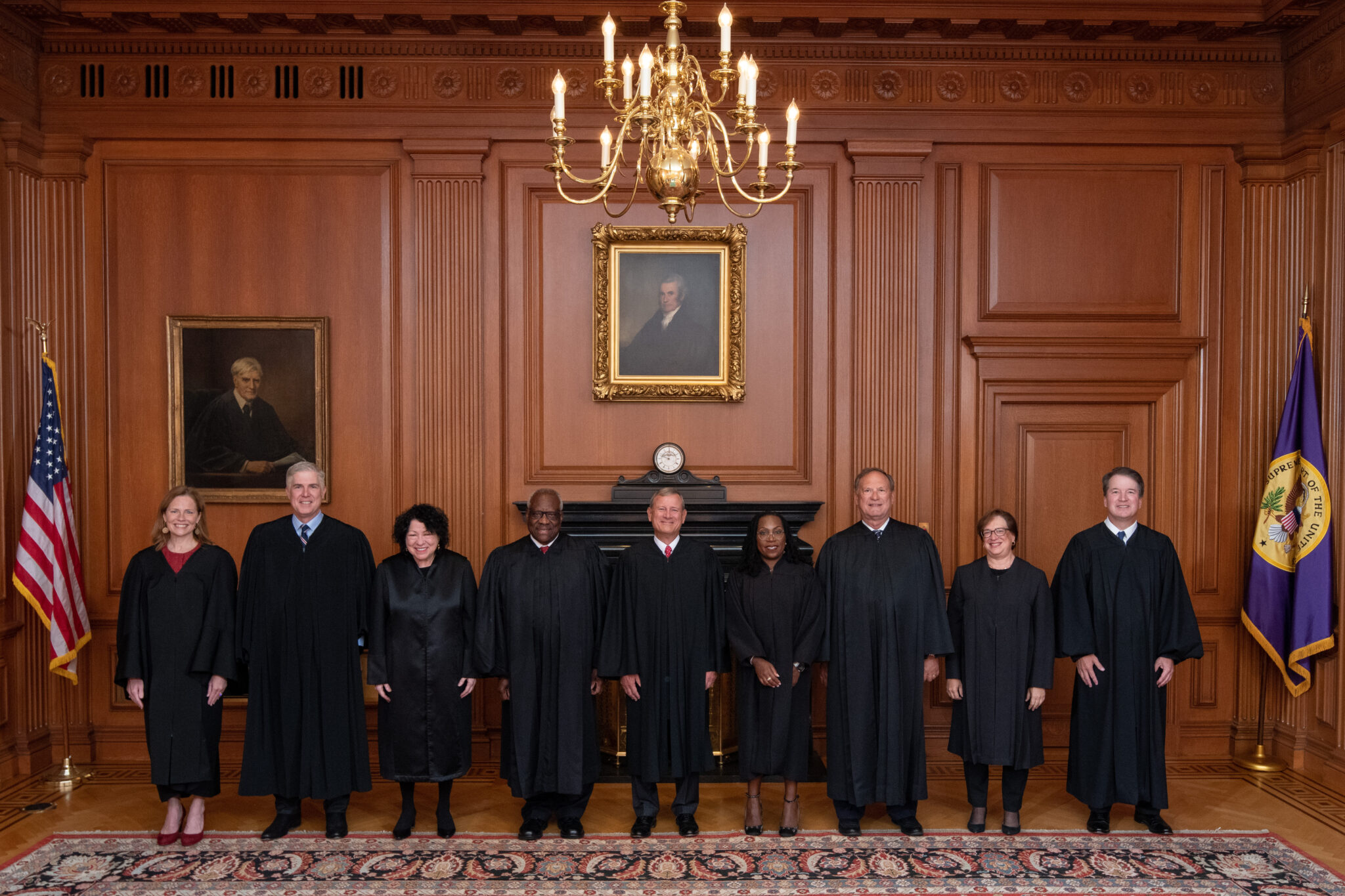
    Members of the U.S. Supreme Court in the Justices’ Conference Room. From left to right: Associate Justices Amy Coney Barrett, Neil M. Gorsuch, Sonia Sotomayor, and Clarence Thomas, Chief Justice John G. Roberts, Jr., and Associate Justices Ketanji Brown Jackson, Samuel A. Alito, Jr., Elena Kagan, and Brett M. Kavanaugh. (Photo from the Collection of the Supreme Court of the United States.)

     Ohio Capital Journal

    Justice Clarence Thomas might be the most egregious when it comes to taking gifts and not disclosing them, but he’s not alone. His colleagues on the U.S. Supreme Court also haven’t been shy about taking fancy freebies from rich people — many of whom have an interest in the actions of the court.

    The justices seem not to think it’s fair to have to entertain themselves on their $268,000 salaries that are in addition to whatever other income they get from book deals, investments and other sources. So it might not be a coincidence that in 2016, those same justices unanimously voted to make it a lot harder to prosecute public officials — including themselves — for accepting bribes.

    “Family trips”

    No matter how much fun they are to hang out with, average people aren’t likely to be offered a $500,000 Indonesian vacation on a private jet and a superyacht. Nor is a billionaire likely to buy your mother’s house, pour tens of thousands into it, and let her live there rent-free.

    But when ProPublica exposed those regal freebies — and the fact that Thomas failed to disclose those and others for decades — the justice in a statement characterized them as just the kinds of things good buddies do when they want to hang out. And he implied that his status as a Supreme Court justice had nothing to do with it.

    Describing Texas billionaire and conservative activist Harlan Crow and his wife as among Thomas and his wife’s “dearest friends,” Thomas wrote, “As friends do, we have joined them on a number of family trips during the more than quarter century we have known them.” He added that he had no conflict because it was “personal hospitality from close personal friends, who did not have business before the court.”

    Thomas made the claim even though Crow has spent at least $14.7 million on conservative causes over the years — including to move the judiciary to the right. That figure doesn’t include any 501(c)(4) dark money contributions by Crow that Thomas helped to facilitate with his affirmative vote in the 2010 split decision, Citizens United v FEC.

    Crow didn’t make Thomas’s acquaintance until he was on the Supreme Court and it seems unlikely that their friendship would be so dear if Thomas’s powers were limited to working a cash register — the most common job in the United States — as opposed to having a potentially dispositive say over the meaning of the U.S. Constitution. And in his statement, Thomas didn’t mention that as part of many of the freebies he’s taken from Crow, the justice was in close proximity with other conservative activists who also have had business before and a strong interest in the makeup of the federal courts.

    Across the ideological spectrum

    Thomas has been far from alone on the court in enjoying the largesse of the uber-wealthy.

    Late liberal Justice Ruth Bader Ginsberg in 2018 took a trip to Israel compliments of billionaire Morris Kahn, who had business before the court just a year earlier.

    Late Justice Antonin Scalia took at least 258 subsidized trips while he was on the court and he was on one when he suddenly died in 2016.

    Scalia’s more-liberal colleague, retired Justice Stephen Breyer, took at least 225 subsidized trips between 2004 and 2016. They include a 2013 trip to the exclusive island of Nantucket compliments of private-equity billionaire David Rubenstein, Gabe Roth, executive director of the group Fix the Court, reported.

    Those were some of the 1,309 trips Supreme Court justices took compliments of others between 2004 and 2019, according to a list compiled by the watchdog group Open Secrets. That’s nine trips per justice, per year, and it’s unlikely they stayed at the Holiday Inn on most of them.

    And those are just the ones that justices have disclosed. It’s unclear how many — like decades of Thomas’ travels — have been unreported, or whether the justices will suffer any consequences for not reporting them.

    Disturbing examples of such non-disclosure continue to flow in — thanks to investigative reporters, not the justices themselves.

    On Tuesday, Politico reported that Justice Neil Gorsuch had been trying for some time in 2017 to unload a 40-acre property he co-owned in Colorado. Nine days after he was confirmed to the Supreme Court, the property was purchased by the CEO of a law firm that has had numerous cases before the court — and whose clients Gorsuch has sided with much more often than not.

    Gorsuch disclosed that he made between $250,000 and $500,000 off of the sale, but he left blank the box that would have informed the public of the identity of the person who paid the money, and who had a lot of lucrative business that Gorsuch would preside over, Politico reported.

    Despite all the ethical lapses, at least some justices from across the ideological spectrum are indignant at the notion that their conduct should be scrutinized. When Sen. Chuck Grassley, R-Iowa, in 2006 proposed an inspector general to keep an eye on the justices, liberal icon Ginsberg likened it to “Stalinism, saying that such oversight ‘is a really scary idea’ that ‘sounds to me very much like [how] the Soviet Union was,’” Roth of Fix the Court wrote.

    Watering down bribery prosecutions

    In the midst of such hostility to oversight, the court in 2016 took up McDonnell v United States. Perhaps not surprisingly, it sided in its decision with a powerful public official who had taken expensive gifts from a wealthy friend who was pushing a special interest.

    Former Virginia Gov. Bob McDonnell and his wife had been convicted in 2014 on charges of bribery. But the McDonnells appealed their convictions, arguing that federal prosecutors failed to show that McDonnell undertook an “official act” in return for the presents they received.

    The couple got about $175,000 worth of stuff from Jonnie Williams, including rides in a private plane, a Rolex, $20,000 worth of designer clothing, a $50,000 loan and $15,000 for their daughter’s wedding. Williams, the CEO of Star Scientific, was trying to market a nutritional supplement made from a compound found in tobacco, and he wasn’t having much luck interesting the scientific community in conducting research.

    To help, the governor directed Williams’ proposals for research at the Medical College of Virginia and the University of Virginia School of Medicine to his director of health and human services. When that didn’t bear fruit, McDonnell hosted a lunch at the governor’s mansion and brought in university officials. Even so, the actual scientists were skeptical of Williams’ claims and didn’t embrace his supplement.

    As a general matter, governors have great sway over state budgets and public universities partly depend on state funding. Governors also often appoint public universities’ governing boards — in the case of the University of Virginia, the Board of Visitors. So, when McDonnell pushed Williams’ supplement on his health director and on university officials, it probably wasn’t easy for them to say no.

    But in writing for the Supreme Court in the case, Chief Justice John Roberts said McDonnell’s attempts to help Williams didn’t amount to an “official act.”

    “An ‘official act’ is defined as ‘any decision or action on any question, matter, cause, suit, proceeding or controversy, which may at any time be pending, or which may by law be brought before any public official, in such official’s official capacity, or in such official’s place of trust or profit,’” Roberts wrote.

    Somehow, he and the other eight justices couldn’t see it as an abuse of the governor’s place of trust or profit when he brought subordinates and quasi-subordinates to his official residence to hear a new-age medical pitch from a guy who had given the governor $175,000 in fancy presents. Perhaps the gifts the justices themselves were taking had influenced them in ways they didn’t see.

    Out of touch

    In an interview last week, Roth of Fix the Court said the Supreme Court decision in McDonnell made it a lot harder to prosecute public officials in federal court for taking bribes.

    “I think (the decision) appears to be a simultaneously textualist and tone-deaf decision,” he said. “The opinion is focusing on what the parameters of what the law are as written by Congress, but it’s never that easy. It’s never just, ‘Oh, hey, I’m going to do a bribe.’”

    Perhaps making it seem extra tone-deaf lately has been Roberts’ continued inaction as Thomas’s failure to report millions in gifts and payments to his wife from conservative groups is serially revealed.

    In concluding his opinion in McDonnell, the chief justice seemed to express his own hostility to oversight, slamming federal prosecutors for their “boundless interpretation” of bribery laws.

    The claim seems hard to square with exploding dark money expenditures by undisclosed special-interests as federal corruption prosecutions have gone down in recent decades. But Roberts implied that the feds are out of control when it comes to charging public officials with taking bribes.

    “There is no doubt that this case is distasteful; it may be worse than that,” Roberts wrote. “But our concern is not with tawdry tales of Ferraris, Rolexes, and ball gowns. It is instead with the broader legal implications of the Government’s boundless interpretation of the federal bribery statute. A more limited interpretation of the term ‘official act’ leaves ample room for prosecuting corruption, while comporting with the text of the statute and the precedent of this Court.”

    Recent revelations about the lavish freebies Thomas and his colleagues have been accepting cast the decision in a new light. Roth said that when the McDonnell decision was handed down seven years ago, the public wasn’t as sensitized to the fact that many on the court are taking ritzy presents from oligarchs, granting them extended facetime and then pretending it doesn’t influence their decisions.

    “I was screaming about this in 2016,” he said. “Now folks are getting wise to the fact that the lavishness is not restricted to state officials in Virginia, but it has in fact infected the highest court. It is an incredibly elite, incredibly out-of-touch institution.”

    Take me out to the ballgame

    Roberts illustrated such a lack of self-awareness in his opinion.

    He used an example of a social interaction that overzealous bribery prosecutions might dampen that is wildly different from Thomas’ trip to Indonesia, Ginsberg’s to the Holy Land and Scalia’s many, many luxurious hunting vacations that came compliments of billionaires. What’s wrong, Roberts asked, with constituents wanting to take an official to a good, old-fashioned ballgame?

    “The basic compact underlying representative government assumes that public officials will hear from their constituents and act appropriately on their concerns — whether it is the union official worried about a plant closing or the homeowners who wonder why it took five days to restore power to their neighborhood after a storm,” the chief justice wrote. “The Government’s position could cast a pall of potential prosecution over these relationships if the union had given a campaign contribution in the past or the homeowners invited the official to join them on their annual outing to the ballgame.”

    When wealthy patrons shower justices with gifts — the like of which average Americans will never see — it’s only logical to think they expect something in return, Roth said.

    “The justices say they only care about what they see or read that exists within the four corners of the page,” he said. “But clearly if someone is taking the time to get to know someone once he’s already on the court you can’t help but expect there to be some sort of quid pro quo or ulterior motives there.”

    He added that it’s up to Congress to fix the problem.

    “We need laws to change, not justices who don’t care that much about ethics to begin with,” Roth said.

    ____________________

    MARTY SCHLADEN

    Marty Schladen has been a reporter for decades, working in Indiana, Texas and other places before returning to his native Ohio to work at The Columbus Dispatch in 2017. He’s won state and national journalism awards for investigations into utility regulation, public corruption, the environment, prescription drug spending and other matters.

    MORE FROM AUTHOR

  • Despite reports of harm, DeWine refuses comment on abortion ban law

    Despite reports of harm, DeWine refuses comment on abortion ban law

    BY: MARTY SCHLADEN – Ohio Capital Journal

    With Gov. Mike DeWine’s blessing, Ohio is in court, fighting to reimpose strict abortion regulations under a law he signed in 2019. But he’s refusing to publicly comment on the numerous stories of suffering it caused during the 11 weeks it was enforced.

    The law DeWine signed, Senate Bill 23, bans abortion after fetal cardiac activity can be detected. That’s about five or six weeks into a pregnancy — a point so early that many women and girls don’t yet know they’re pregnant.

    The law makes no exceptions for rape and incest. It includes some protections for the life and health of the mother, but doctors — who can be charged with felonies under the law — say they’re too vague to be workable.

    SB 23 was unenforceable until June 24 because it violated the 1973 U.S.  Supreme Court decision in Roe v Wade. But then the U.S. Supreme Court conservative majority handed down its decision in Dobbs v Jackson Women’s Health, overturning Roe and its protections of the right to an abortion.

    Almost immediately, SB 23 went into effect and just a week later, the Indianapolis Star reported that the law had forced a 10-year-old rape victim from Columbus to travel there for an abortion. The incident made for international news, but DeWine refused to comment on it, other than to say child rape is “gut wrenching.”

    After that, more horror stories came in the form of sworn affidavits filed by doctors and other workers in Ohio abortion clinics. 

    They included two more minors who had been impregnated by rapists and cancer patients who couldn’t get abortions needed for treatment because their doctors were afraid of being charged with crimes and losing their medical licenses. 

    Other women were diagnosed with fetal abnormalities so severe that their pregnancies couldn’t be successful. Under SB 23 they had to leave Ohio for abortions if they didn’t want to carry those fetuses for months.

    On Sept. 14, enforcement of SB 23 was paused when a Cincinnati judge granted a temporary restraining order against it and then later issued a preliminary injunction. The case is expected to make its way to the Ohio Supreme Court, on which DeWine’s son, Pat, sits as a justice.

    In the face of news of medical and emotional problems caused by SB 23, Gov. DeWine has been steadfastly silent. 

    “Our office has no new comments on the issue or the ongoing litigation at this time,” Press Secretary Dan Tierney said in an email Monday. He said something similar 10 days earlier.

    Also, some of the governor’s recent conduct might be seen partly as an attempt to avoid questions about the impact the abortion law he signed is having on some women and girls. 

    He has refused to debate his Democratic challenger in the Nov. 8 election, Nan Whaley. Also in recent weeks, DeWine has made few appearances in central Ohio, where he’d be likely to face the Capitol press corps.

    At the same time, he may be quietly signaling his support for even more sweeping abortion measures.

    After the Dobbs decision, state Rep. Jean Schmidt, R-Cincinnati, introduced a bill that would ban abortions at any point in a pregnancy with only narrow exceptions to protect the life and health of the mother. She said she had the governor’s support.

    DeWine apparently hasn’t spoken publicly about the measure, House Bill 598. But a spokesman didn’t dispute Schmidt’s claims.

    Follow Marty Schladen on Twitter.

  • What if anti-abortion activists really wanted to reduce abortion rates?

    What if anti-abortion activists really wanted to reduce abortion rates?

    Birth control pills. Getty Images.

    Countries with more restrictions on abortion do not have lower rates of abortion

    A Guest Column by Rob Moore

    The U.S. Supreme Court’s landmark decision to strike down the right to family privacy around abortion care has cleared the way for Ohio’s six-week ban on legal abortion.

    Since about 1 in 3 women do not realize they are pregnant until six weeks or later, this bill effectively bans legal abortion care for a large number of pregnant women. 

    Ohio lawmakers are not stopping there, either. Boldly saying that pregnancies resulting from rape and incest should be required by the government to be carried to term, legislative leaders are pushing to ban legal abortion care in its entirety.

    This approach may come off as extreme in the face of its tepid support among the general public. According to the Pew Research Center, more Ohioans think abortion should be legal in all or most cases than those who think that it should be illegal in all or most cases. One in four women will have an abortion in their lifetime and most do not believe the extreme ontological claims about moral standing pushed by legislative leaders.

    A tragedy of legislative leaders’ efforts on abortion is how ineffective they will be at achieving their own goals. A 2017 cross-country analysis of abortion restrictions found that countries with more restrictions on the practice of abortion do not have lower rates of abortion. Believe it or not, interference with the private medical decisions of citizens is not only frowned upon in liberal democracies and beyond, it is also extremely difficult to do.

    Perplexing is legislative leaders’ ignorance of the decline of abortion over the past few decades. According to both the Guttmacher Institute and the CDC, the number of abortions in the United States have declined from a peak of about a million and a half in 1990 to less than a million in 2020.

    So what can legislative leaders do if they want to actually reduce abortion? There is one tool that has led to the reduction of abortion over the past decades that legislators could use that also do not infringe on personal medical decisions. That is improvement of access to contraceptives.

    Washington University of St. Louis researchers found that providing access to no-cost contraceptives cuts abortion rates by 62% to 78% among those who receive the contraceptives. Researchers at the Guttmacher Institute have found reductions in abortions are driven particularly by increase of use of long-acting reversible contraceptives such as intrauterine devices (IUDs), which have high success rates in reducing pregnancies and give women the ability to control when they want to become pregnant.

    A high-profile Colorado program providing long-acting reversal contraceptives to low-income women reduced teen births and abortions by 50% according to the Colorado Department of Public Health & Environment. In my graduate studies I worked with a team to conduct a cost-benefit analysis on a national version of this program, finding such a program would have benefits that would far outweigh its costs.

    Abortion is not going away. Even families that plan well find themselves in tragic situations where a fetus is unviable or the mother will die. Police state intervention is unlikely to be tolerated by families or effective in reducing abortion rates. But anti-abortion activists can reduce abortions if they want to: by increasing access to contraceptives that give families control over their reproductive health.

  • DeWine: No comment on abortion ban that forced a child to Indiana

    DeWine: No comment on abortion ban that forced a child to Indiana

    BY: MARTY SCHLADEN – Ohio Capital Journal

    t appears that a 10-year-old rape victim had to leave Ohio for an abortion. But Ohio Gov. Mike DeWine isn’t commenting on the fact that a law he signed making that necessary if she didn’t want to become a mother.

    Shortly after the U.S. Supreme Court overturned Roe v Wade and cleared the way for the law to take effect, the child was on her way to Indiana for an abortion because she couldn’t get one in Ohio, an Indianapolis OB-GYN told the Indianapolis Star. The doctor, Caitlin Bernard, told the paper that an Ohio child-abuse doctor had called, saying the child was six weeks and three days pregnant and needed help.

    That was three days after the six-week limit the DeWine-signed law places on abortion in Ohio. It makes no exceptions for women and children who are victims of rape and incest.

    The story has made national news. But DeWine seemed unprepared Wednesday to discuss whether legislation he championed is forcing children out of state if they don’t want to have their rapists’ babies.

    “Yeah, first of all, I have no more information than you do or anybody does. Reading in the in the paper, it came came as you know, from a story out of out of Indiana from from a doctor over there,” he said as part of a rambling answer to a question from the Cincinnati Enquirer, according to a transcript.

    DeWine went on to say it was “gut-wrenching” as a father and grandfather to think about a 10-year-old being raped, and that he hoped the doctors caring for her reported the assault to law enforcement. But he didn’t address the fact that a law he signed put girls like her in such an onerous situation.

    In a follow-up on Thursday, DeWine Press Secretary Dan Tierney was asked whether the governor thinks juvenile rape victims who become pregnant should be able to get abortions, or whether he believes they should be forced to carry their pregnancies to term. Tierney didn’t answer directly.

    “You have access to Governor DeWine’s recent comments on these issues, including that the only information available on the Indiana matter was from Indiana media reports,” Tierney said in an email. “I do not have further comment for you beyond yesterday’s remarks and the Governor’s numerous and extensive comments since the” Supreme Court decision overturning Roe v Wade.

    While DeWine and his spokesman underscored that media reports were all they knew about the incident involving the Ohio 10-year-old, there have been warnings that something like this was likely to happen.

    Shortly after DeWine signed the six-week ban in 2019, CBS News reported on an Ohio 11-year-old who was repeatedly raped by a 26-year-old, impregnating her. If the Ohio law was cleared by the Supreme Court, the story said, the girl could be left with few options after six weeks of pregnancy. 

    The story also describes victim-blaming the child experienced at a “pregnancy care center.” It cited a police report quoting an employee describing the 11-year-old rape victim as “rebellious” and that she “refuses to listen to her mother and runs away from home all the time.”

    At six weeks, as many as a third of women don’t know they’re pregnant, and it’s a safe bet that even fewer girls do. And while statistics on pregnancies resulting from rape are sparse, it seems likely that Ohio and other states that don’t allow abortions in cases of rape or incest are going to force more children into the most difficult of situations.

    The U.S. Centers for Disease Control and Prevention estimates that about 18 million women experience vaginal rape in their lifetimes and that almost 3 million become pregnant from it. The 2018 research from which those statistics were drawn said it was “the first in over 20 years to offer a nationally representative prevalence estimate of (rape-related pregnancy) of U.S. women…”

    That’s an apparent reference to a 1996 paper published in the American Journal of Obstetrics and Gynecology. It was based on a three-year survey of 4,008 women that sought to determine “the prevalence and incidence of rape and related physical and mental health outcomes.”

    Its findings relating to young rape victims are not reassuring.

    “Among 34 cases of rape-related pregnancy, the majority occurred among adolescents and resulted from assault by a known, often related perpetrator,” an abstract of the study said. “Only 11.7% of these victims received immediate medical attention after the assault, and 47.1% received no medical attention related to the rape.” 

    It added that almost a third of adolescent rape victims didn’t know they were pregnant for 12 weeks — more than double the point at which their abortions would now be illegal in Ohio.

    “A total 32.4% of these victims did not discover they were pregnant until they had already entered the second trimester; 32.2% opted to keep the infant whereas 50% underwent abortion and 5.9% placed the infant for adoption; an additional 11.8% had spontaneous abortion,” the paper said.

    DeWine and his spokesman were reluctant this week to say whether he thinks young rape victims should be forced to carry pregnancies to term. But his office earlier this month confirmed his support of a bill restricting abortion in Ohio even further — and also making no exceptions for rape and incest.

    For Aileen Day, communications director for Planned Parenthood Advocates of Ohio, DeWine owns the consequences of the abortion bills he signs — whether he addresses them directly or not.

    “DeWine signed the six-week ban into law and he is the reason the 10-year-old Ohioan had (to) jump through repeated obstacles to get the health care she needed,” Day said in an email. “It is truly disgusting that he’s not being held accountable for all the harm he has caused Ohio. DeWine’s team has bragged that he is the most anti-abortion governor in Ohio’s history and his history backs that up by signing 10 dangerous abortion restrictions and bans into law.” 

    Follow OCJ Reporter Marty Schladen on Twitter.

  • Biden unveils executive order on abortion access, cites case of 10-year-old Ohio rape survivor

    Biden unveils executive order on abortion access, cites case of 10-year-old Ohio rape survivor

    BY: JENNIFER SHUTT – Ohio Capital Journal

    WASHINGTON — President Joe Biden, who has repeatedly been criticized as slow to respond to a widely expected U.S. Supreme Court decision that ended the nationwide right to an abortion, signed an executive order Friday that could preserve some access to abortion in states where the procedure remains legal.

    Biden in a White House speech also brought up the case of a 10-year-old rape survivor from Ohio who was forced to travel out of state to access abortion care in Indiana, questioning if that’s actually the will of a majority of the state’s residents.

    “Does anyone believe that it’s Ohio’s majority view that that should not be able to be dealt with? Or in any other state in the nation? A 10-year-old girl should be forced to give birth to a rapist’s child?” Biden said. “I can tell you that I don’t. I can’t think of anything that’s much more extreme.”

    Ohio Republican Gov. Mike DeWine declined to comment on the state law’s impact in the case this week, saying he had read about it in the paper. He did say he found it “gut-wrenching” that a man raped a child.

    Biden, who began his speech from the White House’s Roosevelt Room more than 30 minutes late by talking about the morning’s jobs report, said the fastest way to reestablish nationwide protections for abortion is by voting in November’s midterm election.

    “Based on the reasoning of the court, there is no constitutional right to choose  —  the only way to fulfill and restore that right from women in this country is by voting,” Biden said. “We need two additional pro-choice senators and a pro-choice House to codify Roe at federal law.”

    Biden acknowledged the frustration and anger many abortion rights advocates and Democrats expressed after he gave a speech the day of the Supreme Court decision, calling on Americans to vote on the issue in November.

    He doubled down on that message during his remarks Friday, saying the Supreme Court opinion in the case, Dobbs v. Jackson Women’s Health Organization, “made clear it will not protect the rights of women.”

    “It’s my hope and strong belief that women will in fact turn out in record numbers to reclaim the rights that have taken from them by the court,” Biden said, opting not to call on men, who are needed for pregnancy to take place, to turn out at the ballot box.

    Executive order

    Biden’s executive order would direct the U.S. Health and Human Services secretary to make sure abortion medication “is as widely accessible as possible,” according to a White House fact sheet.

    The president has also “asked the Chair of the Federal Trade Commission to consider taking steps to protect consumers’ privacy” when seeking information about abortion services and will request HHS “consider additional actions” to protect “sensitive information related to reproductive health care.”

    As part of those efforts, the administration has posted websites to try to help patients protect information their cell phones may store about reproductive health care and about the type of health care records that are protected under the federal law known as the Health Insurance Portability and Accountability Act, or HIPAA.

    The White House is hoping to combat misinformation that has become more common since the Supreme Court’s ruling, with Biden directing the HHS secretary, the attorney general and chair of the Federal Trade Commission “to consider options to address deceptive or fraudulent practices, including online, and protect access to accurate information.”

    The executive order, Biden said, would direct the federal government to look into tech privacy.

    “Now when you use a search engine, or the app on your phone, companies collect your data, they sell it to other companies and even share it with law enforcement,” Biden said. “There’s an increasing concern that extremist governors and others will try to get that data off of your phone, which is out there in the ether, to find what you’re seeking, where you’re going and what you’re doing with regard to health care.”

    House to vote on abortion access

    The Democratic-controlled U.S. House is set to vote on two bills next week addressing abortion access, though it’s unlikely either will get past the U.S. Senate’s legislative filibuster.

    The first bill, the Women’s Health Protection Act of 2022, would reestablish a nationwide right to an abortion. The second bill, the Ensuring Access to Abortion Act of 2022, would block state governments from making abortion travel illegal and protect health care providers in states where the procedure remains legal.

    Congress is also slated to have a series of hearings on the impact of the Supreme Court’s decision to overturn Roe v. Wade, including next week in the U.S. Senate Judiciary Committee as well as the Senate Health, Education, Labor and Pensions panel.

    Washington state Democratic Sen. Patty Murray, chair of the HELP panel, said in a written statement Friday following Biden’s speech that while the executive order is an important step, the “fight is far from over.”

    “The reality is that the President’s executive authority is limited — so the surest way to protect every woman’s right to abortion is electing two more pro-choice Democratic senators and protecting our pro-choice majority in the House so that we can codify Roe,” Murray said.

  • 10-year-old rape victim apparently not among Ohio Gov. DeWine’s ‘most vulnerable’ needing protection

    10-year-old rape victim apparently not among Ohio Gov. DeWine’s ‘most vulnerable’ needing protection

    Ohio Capital Journal Editor-in-Chief David DeWitt

    A Guest Column by David Dewitt

    Gov. Mike DeWine spends a lot of time jawing about his concern for protecting the “most vulnerable” Ohioans whenever he signs a draconian law attacking the bodily autonomy of others.

    But as we learned according to reporting from the Indianapolis Star this week, a 10-year-old Ohio rape victim was forced to travel to Indiana for an abortion after the U.S. Supreme Court overturned national abortion rights, and within hours Ohio Attorney General Dave Yost had a federal court put Ohio’s six-week abortion ban signed by DeWine in 2019 into effect.

    From the Indy Star:

    On Monday three days after the Supreme Court issued its groundbreaking decision to overturn Roe v. Wade, Dr. Caitlin Bernard, an Indianapolis obstetrician-gynecologist, took a call from a colleague, a child abuse doctor in Ohio.

    Hours after the Supreme Court action, the Buckeye state had outlawed any abortion after six weeks. Now this doctor had a 10-year-old patient in the office who was six weeks and three days pregnant.

    Could Bernard help?

    Though Indiana lawmakers are poised to further restrict or ban abortion in mere weeks with a special session July 25, for now, the procedure still is legal there. And so, the Star reported, the girl soon was on her way to Indiana to Bernard’s care.

    Asked Wednesday about the law he signed preventing this 10-year-old rape victim from having a choice over her pregnancy in Ohio, DeWine could only stutter and stammer through a political hack non-answer:

    “Yeah, first of all, I have no more information than you do or anybody does. Reading in the in the paper, it came came as you know, from a story out of out of Indiana from from a doctor over there. This is a horrible, horrible tragedy, you know, for a 10-year-old to be assaulted, 10-year-old to be raped, you know, as a father and grandfather, it just it’s just gut-wrenching to even even even think about it. I assume that the doctor has reported this. I assume that if she was treated at an emergency room, you know, these are all mandatory reporters. So I’m assuming that this has been referred to children’s services, I assume has also been referred to local whatever the local law enforcement agency is. We have out there a obviously a rapist. We have someone who is dangerous and we have someone who should be picked up and locked up forever. And again, I don’t not knowing all the facts of the case, I’m just assuming that that process has has in fact, has in fact, been been followed. [sic]”

    Everyone knows that the rape of a 10-year-old is horrible and the rapist should be thrown in prison. That’s not the question.

    The question is for DeWine to explain why he thinks he is justified in creating law to force child rape victims to carry pregnancies from their rapists. On that subject, DeWine’s silence rang loud.

    DeWine would inflict the emotional and physical violence of forced birth-giving on child rape victims, but won’t take responsibility for his own actions.

    This is a most disgusting form of cowardice.

    Either DeWine has the courage of his convictions and explains why children must undergo this suffering he’s causing; or he’s a coward.

    From his answer, it’s apparent he’s so unconcerned — while this has made national and international news all week — he hasn’t bothered to seek out the facts of the case.

    Compare his current posture to the rhetoric DeWine deployed when he signed the law that caused this situation:

    “The essential function of government is to protect the most vulnerable among us, those who don’t have a voice,” DeWine said.

    If a 10-year-old rape victim does not rank among Ohio’s most vulnerable, I shudder to imagine DeWine’s conception of vulnerability.

    This is just the beginning. Fifty-two children under the age of 15 received abortion care in Ohio in 2020, according to the latest statistics from the Ohio Department of Health. This was one example that came within days of the Supreme Court’s ruling and the enactment of Ohio Republicans’ law.

    Over the coming years, there will be many more. We will report on each story we can, and they will all be heartbreaking to read, I’m sure, and devastating to everyday Ohioans’ lives.

    This is what happens when long-standing freedoms are ripped away from Americans by extremist politicians and politically motivated, activist courts.

    This is what happens when politicians choose to be blind to the nuances and complexity of life, and instead stake out radical, absolutist positions, and then give those positions the power of law.

    Ohio Republicans are planning to move legislation next that will ban nearly all abortions, again with no exceptions for rape or incest.

    The sponsor says she has the votes in the General Assembly as well as the “full support” of DeWine.

    State Rep. Jean Schmidt doesn’t know yet, she said, whether they will make this new, even more extreme law before or after the November General Election. She’s called forced pregnancy for rape victims “an opportunity.”

    Ohio Republicans and Mike DeWine may be fine with making our state an example of heartless cruelty before the eyes of the nation and the world.

    I think it’s sick and monstrous.

    But that’s the law they made and threaten to make worse, so they don’t get to shirk responsibility and accountability for their actions.

    Each heartbreaking story of suffering and pain falls squarely on their heads.