Tag: Vaccination

  • Health Director Urges Parents to Ensure Children Are Vaccinated Against Measles as ODH Confirms Outbreak in Ohio

    Health Director Urges Parents to Ensure Children Are Vaccinated Against Measles as ODH Confirms Outbreak in Ohio

    If people are not protected against the disease, nine out of 10 people who are exposed will become ill

    Ohio Department of Health (ODH) Director Bruce Vanderhoff, MD, MBA, announced today a measles outbreak in Ashtabula County and one confirmed case of a visitor in Knox County who exposed others to measles in Knox and nearby counties.

    Dr. Vanderhoff said ODH and Ashtabula County have identified 10 measles cases. Nine are linked to an adult male reported last week as the state’s first measles case of 2025. None of the individuals were vaccinated.

    “Given the measles activity in Texas, New Mexico, and other states around the country, we’re disappointed but not surprised we now have several cases here in Ohio and known exposure in some counties,” said Dr. Vanderhoff. “This disease can be very serious, even deadly, but it is almost entirely avoidable by being properly vaccinated. Measles is especially dangerous for young children, so I strongly urge all parents across Ohio to make sure your children are vaccinated. It is a crucial layer of protection that can save lives.”

    ODH is working with health departments in Ashtabula and Knox counties to follow up on potential exposures and to promote opportunities for vaccination. For more information, visit ashtabulacountyhealth.com and knoxhealth.com.

    The Centers for Disease Control and Prevention (CDC) defines a measles outbreak as three or more related cases. Measles can spread quickly, and each case can lead to an additional 12 to 18 cases if people aren’t protected against the disease. The CDC reported 378 cases nationwide as of March 20.

    Ohio had 90 cases of measles in 2022, when an outbreak in central Ohio totaled 85 cases. The state had one measles case in 2023 and seven in 2024.

    Measles is extremely contagious and can spread to others through coughing and sneezing. It can be brought into Ohio by individuals who travel to places where measles is spreading. If people are not protected against the disease, nine out of 10 people who are exposed will become ill.

    The measles vaccine (called MMR as it protects against measles, mumps and rubella) is safe and effective at preventing measles. Two doses of MMR is 97% effective against measles. If you are up to date on measles vaccine, the risk of getting sick is extremely low.

    The CDC recommends all children get two doses of MMR vaccine, starting with the first dose at 12 through 15 months of age, and the second dose at 4 through 6 years of age.

    In most instances, adults who were vaccinated against measles as children do not need any additional doses as adults. However, adults who did not receive the MMR vaccine as children or those who are unsure about their vaccination status are encouraged to talk to their healthcare provider for more information.

    Those born prior to 1957 are likely protected by previous infection.

    The measles virus can live for up to two hours in air where an infected person coughed or sneezed. If other people breathe the contaminated air or touch an infected surface and then touch their eyes, noses, or mouths, they can become infected. People infected with measles can spread it to others from four days before, through four days after a rash appears.

    Measles symptoms include a rash, high fever, runny nose, cough, loss of appetite and red, watery eyes. The rash usually lasts five to six days and begins at the hairline, moves to the face and upper neck, and proceeds down the body. Diarrhea and ear infections are common complications of measles. More severe complications may also occur.

    Complications from measles are more common among children younger than 5 years of age, adults older than 20 years of age, pregnant women, and people with compromised immune systems. As many as one out of every 20 children with measles gets pneumonia, the most common cause of death from measles in young children.

    Dr. Vanderhoff held a news conference on March 18 to discuss Ohio’s childhood immunization rates and to urge parents to get their children up to date on all recommended vaccines, including the MMR vaccine. You can find the video of that news conference on the ODH YouTube channel.

    More information about measles is available on the CDC website, including general information and the recommended immunization schedule. ODH also has a measles FAQ page.
  • Food and Drug Administration approves COVID boosters for upcoming season

    Food and Drug Administration approves COVID boosters for upcoming season

    BY:  Ohio Capital Journal

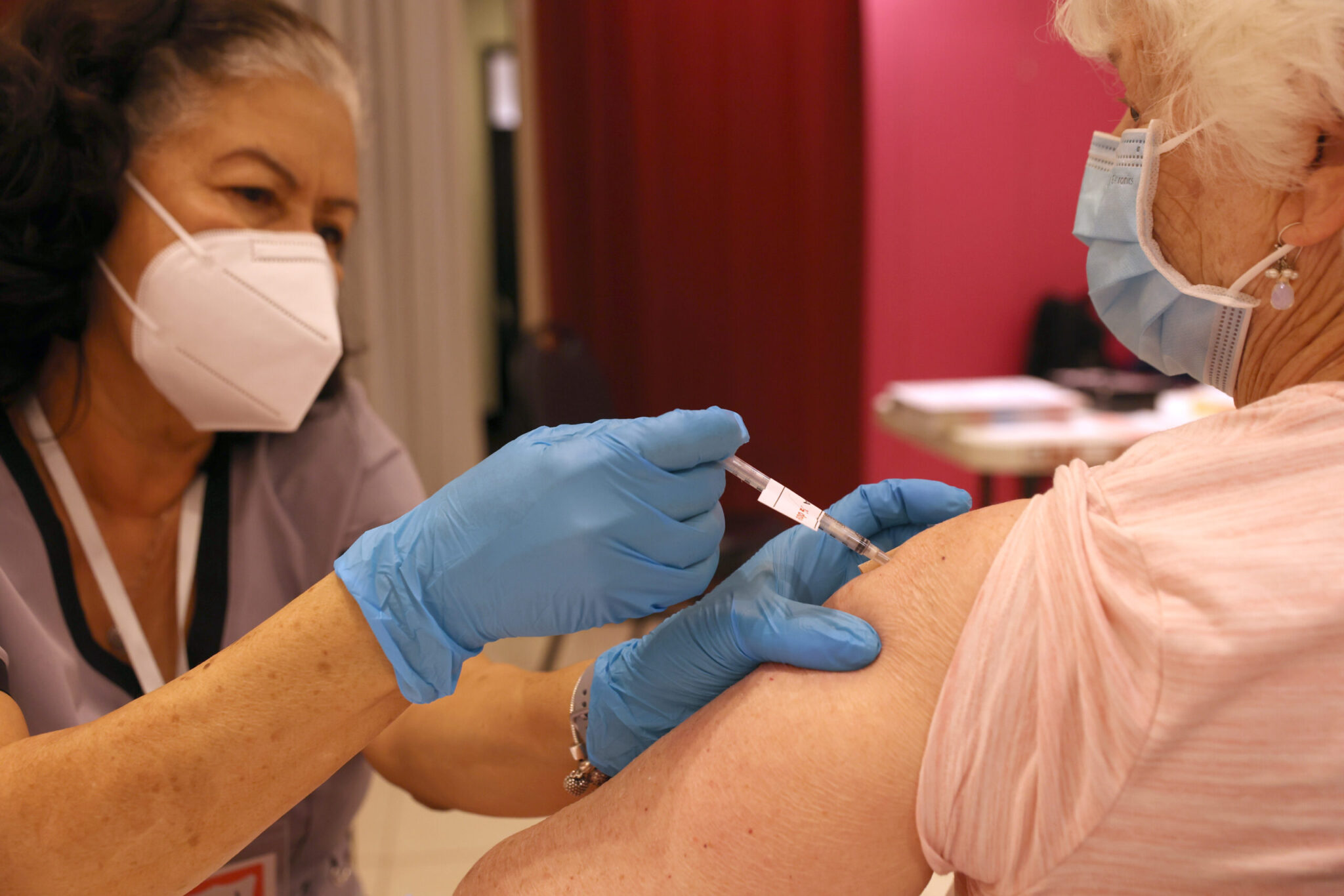
    WASHINGTON — The U.S. Food and Drug Administration on Monday approved the latest round of COVID-19 boosters, as public health officials brace for another cold and flu season.

    An advisory panel at the Centers for Disease Control and Prevention is scheduled to vote on recommendations Tuesday, the final step in the process before people will be able to get the shots.

    “Vaccination remains critical to public health and continued protection against serious consequences of COVID-19, including hospitalization and death,” said Peter Marks, director of the FDA’s Center for Biologics Evaluation and Research.

    “The public can be assured that these updated vaccines have met the agency’s rigorous scientific standards for safety, effectiveness, and manufacturing quality,” Marks added. “We very much encourage those who are eligible to consider getting vaccinated.”

    The updated COVID-19 booster shots are made by Moderna and Pfizer.

    The FDA said in a statement that people 5 and older can get one dose of the updated mRNA COVID-19 vaccine as long as it’s been at least two months since their last dose of the vaccine.

    Vaccinated children between six months and 4 years old can get one or two doses of the updated vaccine. Unvaccinated children in the same age range are eligible for three doses of the updated Pfizer-BioNTech vaccine or two doses of the updated Moderna shot.

    “The updated vaccines are expected to provide good protection against COVID-19 from the currently circulating variants,” the FDA said in a statement. “Barring the emergence of a markedly more virulent variant, the FDA anticipates that the composition of COVID-19 vaccines may need to be updated annually, as is done for the seasonal influenza vaccine.”

    Hospitalizations and deaths from COVID-19 have been trending upward in recent weeks, though officials aren’t expressing alarm at the rise in severe illness.

    The number of hospitalizations has risen by nearly 16% while deaths increased by almost 11%, according to data from the CDC.

    The percentage of Americans getting COVID-19 shots has steadily decreased since the first round of vaccinations rolled out in the last weeks of 2020.

    More than 81% of the country got at least one dose of the original vaccine, but 70% completed the primary two-dose series. Just 17% of the U.S. population decided to get the bivalent vaccine that was approved last year, according to CDC data.


    Jennifer Shutt
    JENNIFER SHUTT

    Jennifer covers the nation’s capital as a senior reporter for States Newsroom. Her coverage areas include congressional policy, politics and legal challenges with a focus on health care, unemployment, housing and aid to families.

    MORE FROM AUTHOR

  • In COVID’s third winter, biggest threat is three viruses at once

    In COVID’s third winter, biggest threat is three viruses at once

    BY: NICK EVANS – Ohio Capital Journal

    Ohio health officials are urging caution again this winter. But entering our third holiday season with COVID-19, the nature of those warnings is a bit different.

    Three at once

    As Ohio Department of Health Director Dr. Bruce Vanderhoff explained, this year the threat is multiple respiratory viruses at once.

    “Unlike the last two winters, it’s not just about COVID,” he said. “But the combination of COVID, influenza, and RSV, especially for those whose health is more vulnerable or who have not been adequately vaccinated against flu and COVID-19.”

    RSV, or respiratory syncytial virus, often feels like a common cold for adults and otherwise healthy children. But for infants, the elderly or immunocompromised people it can be dangerous. According to the CDC, RSV is the most common cause of bronchitis and pneumonia among kids 12 months old and younger.

    Unlike COVID-19 and flu, RSV has no vaccine.

    Precautions and metrics

    As ever, Vanderhoff’s chief precautionary recommendations are for people feeling ill to stay home and for everyone to wash their hands regularly. In situations where people must leave the house, officials recommend wearing an N95 mask.

    He also urged those who haven’t gotten vaccinated for the flu or COVID-19 to do so.

    “Vaccination is the safest and most dependable way to assure that you’re maximizing that cellular immunity I talked about,” Vanderhoff explained. “It gives your immune system its best opportunity to confront and beat the virus.”

    According to the CDC, the COVID-19 community level — a statistic based on number of hospital admissions and number of cases per 100k population — is low in many Ohio counties. Twelve rank as ‘high’ based on those metrics.

    Dr. Joe Gastaldo, OhioHealth medical director for infectious diseases, said people should be especially cautious in those counties.

    “In those scenarios, regardless of vaccination status, the recommendation is to wear a mask,” he said. “If you’re not feeling well wear a mask. I think specifically if you have an at-risk condition, or are immunocompromised, I would advise you as an infectious disease doctor to wear a mask indoors in public.”

    The CDC’s more familiar community transmission metric, based on cases per 100k population and percentage of positive tests, remains high throughout the state. All but nine of the Ohio’s 88 counties rank high for community transmission and none are low.

    As for RSV and the flu, Vanderhoff noted this year both started earlier and rose more rapidly than in past years. Both viruses have receded from their peak, he explained, but remain dangerous for some populations.

    Follow OCJ Reporter Nick Evans on Twitter.

  • CDC “streamlines” COVID-19 guidance 

    CDC “streamlines” COVID-19 guidance 

    A Press Release from the CDC


    Today, CDC is streamlining its COVID-19 guidance to help people better understand their risk, how to protect themselves and others, what actions to take if exposed to COVID-19, and what actions to take if they are sick or test positive for the virus. COVID-19 continues to circulate globally, however, with so many tools available to us for reducing COVID-19 severity, there is significantly less risk of severe illness, hospitalization and death compared to earlier in the pandemic.

    “We’re in a stronger place today as a nation, with more tools—like vaccination, boosters, and treatments—to protect ourselves, and our communities, from severe illness from COVID-19,” said Greta Massetti, PhD, MPH, MMWR author. “We also have a better understanding of how to protect people from being exposed to the virus, like wearing high-quality masks, testing, and improved ventilation.  This guidance acknowledges that the pandemic is not over, but also helps us move to a point where COVID-19 no longer severely disrupts our daily lives.”

    In support of this update CDC is:

    • Continuing to promote the importance of being up to date with vaccination to protect people against serious illness, hospitalization, and death. Protection provided by the current vaccine against symptomatic infection and transmission is less than that against severe disease and diminishes over time, especially against the currently circulating variants. For this reason, it is important to stay up to date, especially as new vaccines become available.
    • Updating its guidance for people who are not up to date on COVID-19 vaccines on what to do if exposed to someone with COVID-19.  This is consistent with the existing guidance for people who are up to date on COVID-19 vaccines.
    • Recommending that instead of quarantining if you were exposed to COVID-19, you wear a high-quality mask for 10 days and get tested on day 5.
    • Reiterating that regardless of vaccination status, you should isolate from others when you have COVID-19.
      • You should also isolate if you are sick and suspect that you have COVID-19 but do not yet have test results.
        • If your results are positive, follow CDC’s full isolation recommendations.
        • If your results are negative, you can end your isolation.
    • Recommending that if you test positive for COVID-19, you stay home for at least 5 days and isolate from others in your home.  You are likely most infectious during these first 5 days. Wear a high-quality mask when you must be around others at home and in public.
      • If after 5 days you are fever-free for 24 hours without the use of medication, and your symptoms are improving, or you never had symptoms, you may end isolation after day 5.
      • Regardless of when you end isolation, avoid being around people who are more likely to get very sick from COVID-19 until at least day 11.
      • You should wear a high-quality mask through day 10.
    • Recommending that if you had moderate illness (if you experienced shortness of breath or had difficulty breathing) or severe illness (you were hospitalized) due to COVID-19 or you have a weakened immune system, you need to isolate through day 10.
    • Recommending that if you had  severe illness or have a weakened immune system, consult your doctor before ending isolation. Ending isolation without a viral test may not be an option for you. If you are unsure if your symptoms are moderate or severe or if you have a weakened immune system, talk to a healthcare provider for further guidance.
    • Clarifying that after you have ended isolation, if your COVID-19 symptoms worsen, restart your isolation at day 0. Talk to a healthcare provider if you have questions about your symptoms or when to end isolation.
    • Recommending screening testing of asymptomatic people without known exposures will no longer be recommended in most community settings.
    • Emphasizing that physical distance is just one component of how to protect yourself and others.  It is important to consider the risk in a particular setting, including local COVID-19 Community Levels and the important role of ventilation, when assessing the need to maintain physical distance.

    Actions to take will continue to be informed by the COVID-19 Community Levels, launched in February. CDC will continue to focus efforts on preventing severe illness and post-COVID conditions, while ensuring everyone have the information and tools, they need to lower their risk.

    This updated guidance is intended to apply to community settings. In the coming weeks CDC will work to align stand-alone guidance documents, such as those for healthcare settings, congregate settings at higher risk of transmission, and travel, with today’s update.

  • Superintendent: Why there were no quarantined students or staff in Loveland Schools last week

    Superintendent: Why there were no quarantined students or staff in Loveland Schools last week

    by David Miller

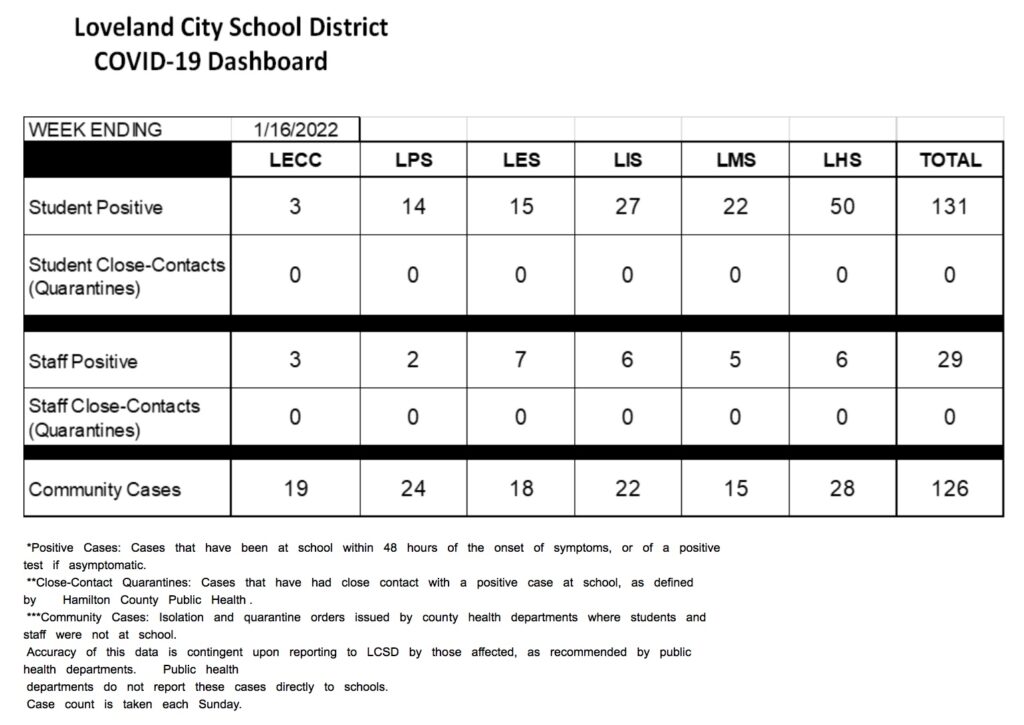
    Loveland, Ohio – After publishing the Loveland School District’s latest COVID 19 Dashboard on Tuesday, January 18, many readers wondered how there could be so many positive cases in the schools but zero students or staff who were quarantined.

    In an email yesterday I asked Superintendent Mike Broadwater: “I have a question that has come up after we published the latest COVID 19 Dashboard image yesterday. People are wondering why there were no quarantine figures on it.”

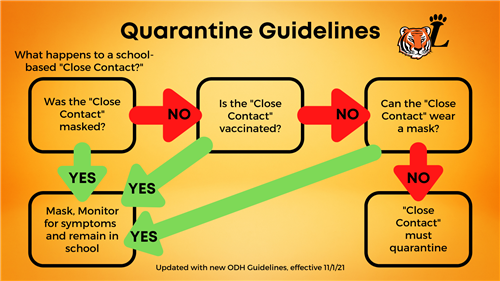
    Broadwater answered via email saying, “In regards to the Dashboard, there are no more quarantines with the new guidelines set forth by ODH (Ohio Department of Health). The only time you will see a quarantine would be if the family opts to quarantine their child rather than mask to stay. You’ll notice all zeroes with the exception of a few single quarantines since the new guidelines were released.”

    New CDC Guidelines were implemented 1/3/2022 and are reflected in subsequent reporting.

    Readers can view all of the COVID 19 Dashboard reports at this LINK.

    The current District quarantine and mask policy is found on the District website and states:

    Effective November 1, 2021

    The Ohio Department of Health (ODH) has made a few minor changes to the quarantine recommendations for K-12 schools, and these new guidelines should help us keep our students healthy and in the classroom, where they learn best. 

    These guidelines will not change our current masking policy, but will change how we handle situations where a student has been identified as a “close contact/direct contact.” 

    Mask to Stay/Test to Play

    Direct contacts, regardless of vaccination or masking status, may remain in the classroom environment if they do the following:

    • Wear a mask for 14 days after their last date of exposure.
    • Self-monitor, or parent-monitor, for symptoms of COVID-19.
    • Isolate and get tested if they start to experience symptoms associated with COVID-19 (regardless of the level of severity).
    • Consistent with guidance for others quarantining in lower-risk environments, students and staff may discontinue these quarantine procedures after seven days – if they don’t develop symptoms and test negative between days 5-7.

    Direct contacts may continue to participate in extracurricular activities if they do the following:

    • Wear a mask when able. (This includes: transportation; locker rooms; sitting/standing on the sidelines; and anytime the mask will not interfere with breathing, the activity, or create a safety hazard.)
    • Test on initial notification of exposure to COVID-19.
    • Test again on days 5-7. If they are negative at this time, they will test out of quarantine.

    You can read the full policy from the Ohio Department of Health by following this link

    We believe the guidance from ODH will keep our students safe, and in school as much as possible, which has been our goal this year.

  • COVID-19 cases leap by 900% over a month, State health department says

    COVID-19 cases leap by 900% over a month, State health department says

    A surgical mask and an N95 mask hang on display for sale at a pharmacy. Photo by Sean Gallup/Getty Images.

    BY: JAKE ZUCKERMAN and Ohio Capital Journal

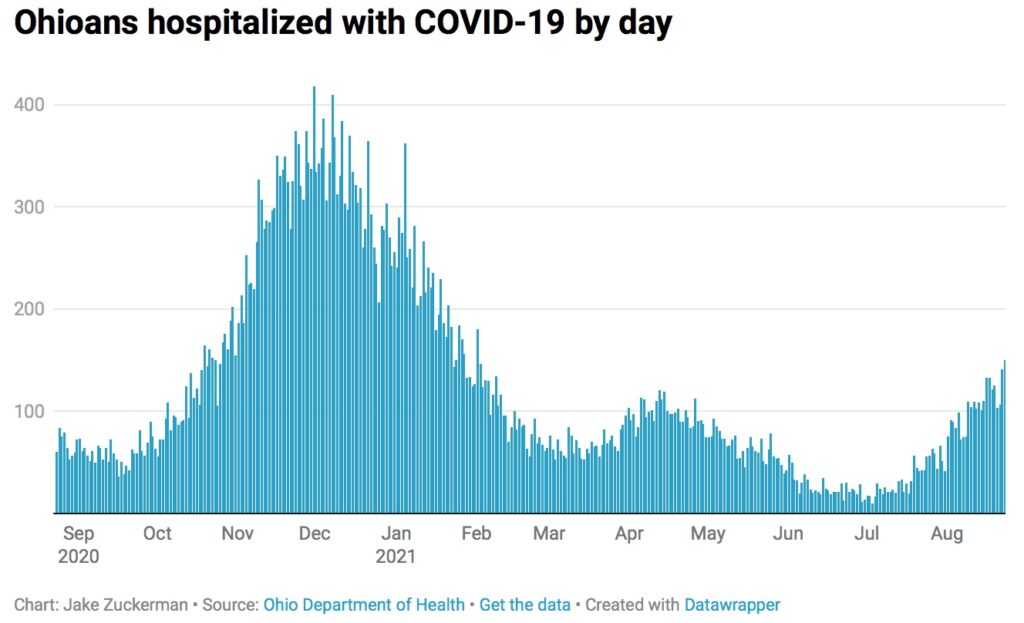
    More than 3,000 Ohioans per day are contracting COVID-19 on average, the highest the rate has been since early February.

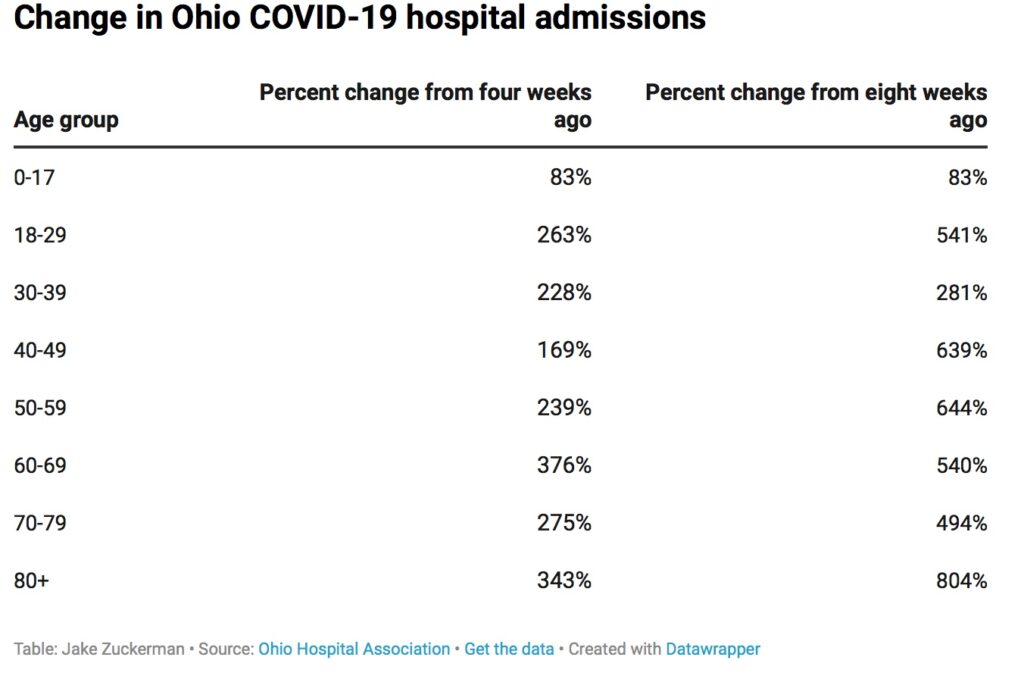
    Over the last month, hospitalizations increased by between 83% and 375% by age group, according to data from the Ohio Hospital Association.

    As children go back to school, more students are testing positive. Comparing the week of July 4 with the week of August 25, COVID-19 infections leapt by 909% among all Ohioans and 827% among school-age Ohioans, according to separate data from the Ohio Department of Health.

    While vaccination has modestly picked up pace, Ohio’s coverage sags well below the national average. About 52% of the state has received at least one vaccine dose, compared to 61% nationally, according to a New York Times data tracker. Only 12 states have a lower rate.

    The state’s hottest spots for infection are toward the southern border, where the vaccination rate sits between 30% and 40%.

    All told, more than 65,000 Ohioans have been hospitalized with COVID-19. More than 20,700 have died.

    “With many districts going back to school last week, the number of illnesses from Monday, Aug. 23 is troubling,” said ODH Director Dr. Bruce Vanderhoff in a news release. “As students statewide continue to return to their classrooms, this high figure should be yet another indicator to parents and families that the best protection from COVID-19 is for those 12 and older to choose to be vaccinated, and for those who aren’t vaccinated to wear masks.”

  • Loveland School Board: A homework Assignment

    Loveland School Board: A homework Assignment

    COMMENTARY

    David Miller is the Publisher and Editor of Loveland Magazine

    By David Miller

    Dear Loveland School Board.

    Given that COVID infections caused by the now predominant delta variant are likely to go undetected and children attending school with what appears to be a mild cold, what measures, if any, do you propose to use to prevent the spread of COVID-19 throughout the Tiger school community?

    The predominant delta variant is much more contagious than the version of COVID-19 Loveland school children faced last year.

    Here is a list of things to consider and do before your meeting on Tuesday, August 10 – eight days before classes begin for the school year. I have provided the resource materials below that you will need to complete your assignment.

    You know this but does it bear repeating? Loveland students eleven years old and younger cannot currently receive any benefit a vaccination will provide.

    Only approximately 18% of our students who are eligible for a vaccine are fully vaccinated.

    The tracking system of the Centers for Disease Control and Prevention (CDC) has now moved Clermont and Warren Counties to the highest level of warning for the transmission of COVID 19. Hamilton County remains in the “Substantial” range.

    There will be no remote learning opportunities (Remote Academy) for Loveland teachers or students as all school buildings will return to full capacity in-person classes in August. Find out how many more students will be attending each building and riding buses as classes begin.

    Find out how many students, staff, and teachers became infected and how many were quarantined last school year when there were far fewer persons in the buildings and on buses than there will be this year.

    Review the comprehensive study ($66K “Pandemic Preparedness and Planning” services) that you purchased before school began last year. Review which of the recommended COVID protocols were implemented and whether or not you are going to abandon them as school starts on August 18.

    Your current policy states that you will follow any “mandates” of a list of what you call your “Directing Entities”. Since none of these “Directing Entities” have mandated protocols and nothing in current Ohio law prevents you from adopting any recommendation you choose – review their recommendations and choose one.

    Below is a list of what your “Directing Entities” are currently recommending for K-12 schools.

    Also, below for your review, are the recommendations contained in the $66,000 report you purchased.

    With all due respect, none of you or your staff are smarter or have any greater insight as to what is the best way to start this school year than the medical and scientific community of your Directing Entities.

    And, with all due respect to the parents of the District, “parental choice” of your child wearing a mask or not – is not your decision to make. You can be the loudest voice in the classroom of social media, but just as the elected Board of this District relies on known experts to decide which textbooks teachers use or what is served in the cafeteria – providing a healthy classroom is in their job description.

    Board, please follow the latest advice from the health experts, your “Directing Entities” and from your own “consultant experts” that you hired in 2020.

    Let’s get back to school. Let’s do so in a way that fully protects our children, teachers, and our friends that work as District staff. Don’t allow any of them to be put in the potentially lethal classroom petri dish experiment of this new delta variant.


    Ohio Department of Health Releases Updated K-12 School Guidance

    Loveland Magazine –  Jul 28, 2021

    COVID-19 Guidance for Safe Schools from American Academy of Pediatrics

    Loveland Magazine –  Jul 28, 2021

    Cincinnati Children’s recommends all children wear masks at school

    Loveland Magazine –  Jul 28, 2021

    Centers for Disease Control issues new guidance for return to school

    Loveland Magazine –  Jul 28, 2021

    Ohio Department of Health Releases Updated K-12 School Guidance

    Loveland Magazine –  Jul 28, 2021

    Hamilton County Public Health responds to request for back to school…

    Loveland Magazine –  Jul 29, 2021


    School Board gives go-ahead for $66K “Pandemic Preparedness and Planning” services

    “Pandemic Preparedness and Planning” report for Loveland Early Childhood Center

    Nov 9, 2020

    “Pandemic Preparedness and Planning” report for Loveland High School

    Nov 9, 2020

    “Pandemic Preparedness and Planning” report for Loveland Middle School

    Nov 2, 2020

    “Pandemic Preparedness and Planning” reports for Loveland Intermediate School

  • Video message from Loveland Superintendent about “Parent Choice” and masking/vaccination policy

    Video message from Loveland Superintendent about “Parent Choice” and masking/vaccination policy

    Loveland, Ohio – The Loveland City School District issued this statement at 3:42 PM:


    Loveland Tiger Families,

    Please watch the following video message from Superintendent Mike Broadwater. It should answer many of your most important questions about back-to-school. Follow this link for the Ohio Department of Health Guidelines for Quarantine After Exposure in K-12 Classroom Settings.

    You may email the Loveland City Schools Board of Education through this link.

    You may email Superintendent Mike Broadwater through this link.Learn more about our Board of Education meeting schedule through this link.

  • It’s Vaccination INFO Wednesday

    It’s Vaccination INFO Wednesday

    Clermont County

    COVID-19 Vaccine Info

    Upcoming Vaccine Clinics No appointments needed Tuesdays & Thursdays 2400 Clermont Center Drive Batavia, OH 45103 9-noon; 1-3 p.m.

    Where can you get vaccinated?

    Clermont County Public Health
    2400 Clermont Center Drive
    Suite 200
    Batavia, OH 45103
    To schedule an appointment, call our office at 513-735-8400. Walk-ins will be accepted based on vaccine availability.

    *All eligible minors (12-17 yrs.) must be accompanied by a parent or guardian at vaccine clinics

    Healthsource of Ohio

    Register online at www.healthsourceofohio.org or call 513-732-5081 to leave your information for registration.

    Kroger Pharmacy

    Visit www.kroger.com/ohiocovidvaccine or call the COVID helpline at 866-211-5320

    Meijer Pharmacy

    To register, text COVID to 75049 and receive a link to register. Online registration is available at https://clinic.meijer.com/. Individuals without internet access or texting capabilities can call the pharmacy directly for assistance registering.

    Mercy Health – Clermont Hospital

    Register for an appointment online here

    3000 Hospital Drive Batavia, OH 45103 Behavioral Health Entrance (Next to main ER Entrance)

    Wal-Mart Pharmacy

    (currently only Milford and Eastgate locations)
    Register online at walmart.com

    Fitzgerald’s Pharmacy
    305 W. Main Street
    Williamsburg, OH 45176
    513-724-7081
    www.fitzgeraldrx.com


    Hamilton County

    POP-UP/WALK-IN COVID-19 VACCINE CLINICS

    COMING TO A WALK-IN CLINIC? MAKE AN ARMORVAX ACCOUNT!

    Hamilton County Public Health is using ArmorVax to document administration of the COVID-19 vaccine. Help us avoid lines by creating an ArmorVax account for you and your family*. You can create an account using the ArmorVax smartphone app (available in the Google Play and Apple App stores) or you can create an account with a web browser by visiting ArmorVax.com. Once you create an account, we’ll take care of the rest when you arrive!
    *Minors between 12-18 years of age are only eligible for the Pfizer vaccine and will need to be added under a parent or guardian account under “add family”. Parent or guardian account will need to be made first.

    Need help making an account? No problem!

    We now have customer service representatives available every Monday and Tuesday from 9:00am – 5:00pm to help you over the phone. Give us a call: 513-999-2312!

    UnitedWay of Greater Cincinnati is also available for help with accounts and transportation needs. Just dial 211 from any phone to reach the UnitedWay!

    TRANSPORTATION AND HOME BOUND RESOURCES

    For those with developmental disabilities

    Home Bound Senior Program

    The Council on Aging (COA) is working with local health departments to bring COVID 19 vaccines to home bound individuals. COA will provide lists of home bound individuals who are eligible for vaccination to local health departments on a weekly basis. Older adults who need assistance with COVID 19 vaccinations can contact Council on Aging at (513) 721-1025. COA’s call center is open Monday-Friday, 8am-5pm. (READ MORE)


    Warren County

    The WCHD is currently administering Pfizer Biotech COVID-19 vaccine Monday thru Friday 8:00 am-12:00 pm and 1:00 pm to 4:00 pm.

    Visit gettheshot.coronavirus.ohio.gov to schedule an appointment. You can also call (513) 695-shot 8:00 am-12:00 pm and 1:00 pm-4:00 pm Monday-Friday.


    COMMUNITY WALK-IN VACCINE SITES

    Butler County Health Dept.

    Butler County Fairgrounds

    1715 Fairgrove Ave.

    Wednesdays 9am-12pm

    J&J, Pfizer, Moderna

    Thursday

    Hamilton County Public Health

    Whitewater Crossing Christian Church

    5771 OH-128 Cleves, OH 45002

    Thursdays 1-4pm

    J&J, Pfizer

    Friday

    Hamilton County Public Health

    Trinity Lutheran Church

    1553 Kinney Ave., Cincinnati, OH 45231

    Fridays 11am-5pm

    J&J, Pfizer

    Sundays

    Healthcare Connection

    Urban League Of Greater Southwestern Ohio

    3459 Reading Rd

    Sundays 11am-2pm

    Moderna, Pfizer

    8/3/2021

    Equity Bus/UC Health

    Pendleton Heritage Center

    2760 Riverside Dr, Cincinnati, OH 45202, USA

    4-6pm

    J&J, Pfizer

    513 Relief – JFS on site

    8/3/2021

    Cincinnati Health Dept.

    Jacobs Center CPS New Hire Event

    5425 Winton Ridge Lane

    9am-4pm

    J&J, Pfizer

    First 100 vaccinated receive a $20 gift card

    8/4/2021

    Hamilton County Public Health

    Symmes Library Branch

    11850 Enyart Rd, Loveland, OH 45140

    11am-4pm

    J&J, Pfizer

    8/4/2021

    Cincinnati Health Dept.

    Winton Hills Presbyterian Church

    5255 winneste Ave, Cincinnati, OH 45232

    11:30am-1:30pm

    Pfizer

    8/6/2021

    Hamilton County Public Health

    Valley Interfaith

    420 W Wyoming Ave, Cincinnati, OH 45215

    10am-1pm

    J&J, Pfizer

    8/6/2021

    Cincinnati Health Dept.

    Price Hill Library

    3215 Warsaw Ave, Cincinnati, OH 45205

    12:30-3:30pm

    J&J, Pfizer

    8/6/2021

    Equity Bus/UC Health

    Father’s Day, Again @ CityLink

    CityLink Center, 800 Bank St, Cincinnati, OH 45214

    4-6pm

    J&J, Pfizer

    513 Relief – JFS on site

    8/7/2021

    Equity Bus/UC Health

    Forest Park City Cycle

    1201 W Kemper Rd, Cincinnati, OH 45240

    11am-2pm

    J&J, Pfizer

    513 Relief – JFS on site

    8/7/2021

    City of Hamilton Health Dept.

    Butler County Fairgrounds

    1715 Fairgrove Ave.

    11am-4pm

    J&J, Pfizer, Moderna

    8/7/2021

    Cincinnati Health Dept.

    Evanston Recreation Center

    3204 Woodburn Ave, Cincinnati, OH 45207

    12-3pm

    J&J, Pfizer

    8/7/2021

    NKY Health Dept.

    Randolf Park

    226 E 8th St, Covington, KY 41011

    11am-2pm

    J&J

    8/10/2021

    Hamilton County Public Health

    Mariemont Library

    3810 Pocahontas Ave, Cincinnati, OH 45227

    11am-3pm

    J&J, Pfizer

    8/11/2021

    City of Hamilton Health Dept.

    City Hall

    City of Hamilton Health Department – 345 High St

    3-7pm

    J&J, Moderna

    8/12/2021

    City of Hamilton Health Dept.

    Lindenwald United Methodist

    3501 Pleasant Ave

    4-6:30pm

    J&J, Moderna

    8/12/2021

    Equity Bus/UC Health

    College Hill Back to School Event

    Good News Church of God in Christ, 1063 W North Bend Rd, Cincinnati, OH 45224

    4-6pm

    J&J, Pfizer

    Backpacks, clothing, and JFS resourses

    8/12/2021

    Mercy Health

    St. Aloysius

    4721 Reading Road, Cincinnati, OH 45237

    4-7pm

    Pfizer; first 100 vaccinated get a $20 Kroger gift card

    8/14/2021

    Equity Bus/UC Health

    Black Lives Matter Mural Block Party

    801 Plum St, Cincinnati, OH 45202

    3-7pm

    J&J, Pfizer

    513 Relief – JFS on site

  • DeWine signs bill to temporarily ban school COVID-19 vaccine mandates

    DeWine signs bill to temporarily ban school COVID-19 vaccine mandates

    By Jake Zuckerman and Ohio Capital Journal

    His signature on the bill seems to violate his pledge to veto any legislation that would “discourage vaccination.”

    Columbus, Ohio – Ohio Gov. Mike DeWine signed legislation Wednesday that could block schools from mandating vaccination against COVID-19 for the fall.

    In the dying moments of the final legislative session before a summer recess, lawmakers tacked the vaccine provision as an amendment onto an unrelated bill regarding educational opportunities for military children. The amendment:

    • Forbids public K-12 schools and colleges from requiring any vaccine that has not yet received “full approval” from the U.S. Food and Drug Administration.
    • Forbids the schools from “discriminating” against anyone who has not been vaccinated, which includes infection control provisions like masks and social distancing.
    • Does not apply to hospitals or health care facilities operated by or affiliated with universities.

    It passed on party lines in both chambers, with Republicans in support and Democrats in opposition.

    All three vaccines available for use against COVID-19 are approved under an “emergency use authorization.” The FDA uses this streamlined regulatory process for drugs and vaccines that can be used against an ongoing emergency such as the pandemic, which has killed more than 608,000 Americans to date. The regulators issued the temporary authorization after reviewing clinical trial data on tens of thousands of recipients. The FDA, along with the Centers for Disease Control and Prevention (CDC), continues to monitor safety and efficacy profiles of all three vaccines.

    DeWine announced his approval of the bill without any public comment or fanfare. His signature on the bill seems to violate his pledge to veto any legislation that would “discourage vaccination.”

    Dan Tierney, a spokesman for the governor, played up the bill’s original aims in an email and said DeWine expects looming regulatory approval to nix the issue.

    “The primary purpose of the bill was to enhance educational opportunities for children in military families — a worthy goal,” he said. “The provision you are referring to is limited to vaccines that do not have full FDA approval. We are confident that these vaccines, proven repeatedly to be very safe and very effective, will be approved by the FDA, thus rendering this issue moot.”

    Passage comes amid an ongoing clash between DeWine and fellow Republicans in the legislature regarding public health policy. Earlier this year, lawmakers overrode DeWine’s veto on a broad weakening of state public health laws.

    Meanwhile, Republicans in the House Health Committee are considering legislation that would weaken state vaccination laws and prevent employers, nursing homes, hospitals, colleges and more from requiring vaccination of students and employees. DeWine has said he would veto the bill if it made it to his desk.

    During a hearing on that bill, lawmakers — many of whom have announced their refusal to seek vaccination against COVID-19 and aligned themselves with anti-vaccination activists — invited testimony from a discredited doctor who has claimed vaccines are a “depopulation” and “mass destruction” tool.

    DeWine’s signature furthers an emerging anti-vaccination push from Republican-controlled state legislatures. For instance, the Tennessee Department of Health halted all adolescent vaccine outreach and forced out its top vaccine official this monthunder pressure from Republican lawmakers, according to recent reporting from The Tennessean. Florida Gov. Ron DeSantis recently signed legislation to ban “vaccine passports,”which do not exist in most areas of the country but would theoretically be used by institutions to validate people’s vaccination status.

    Under the new Ohio law signed by DeWine on Wednesday, schools can still technically require immunization against COVID-19 once the federal regulators issue a full-blown authorization. However, Ohio is one of about a dozen states that allows exemptions to school immunization requirements for “reasons of conscience” — something of a catchall term.

    The new law’s sponsors, state Reps. Andrea White, R-Kettering, and Brian Lampton, R-Beavercreek, issued a lengthy statement regarding the help the bill will deliver for military children. They briefly addressed the vaccination issue.

    “By prohibiting our educational institutions from requiring vaccines that are not fully approved by the FDA, we are ensuring that safety is at the forefront of our priorities,” they said.

    The sponsors did not answer whether this means they consider the vaccines to be unsafe.

    Two Democrats on the House Health Committee issued a statement Wednesday evening criticizing the new law, saying it puts “political self-interests” ahead of good health policy.

    “With the arrival of the delta variant, this country is still in the midst of a dangerous pandemic and unvaccinated individuals are at highest risk,” said Rep. Allison Russo, D-Columbus.

    “Public schools and universities deserve to have the flexibility to either require COVID-19 vaccines or establish mitigation procedures they deem appropriate for the circumstances in their communities. Instead, this bill further undermines trust in science and a vaccine that has saved the lives of thousands of Ohioans.”

    This article was updated to reflect the legislation only applies to public schools and universities.