Tag: video

  • Current local COVID 19 data: How does Hamilton County avoid Level 4 Alert

    Current local COVID 19 data: How does Hamilton County avoid Level 4 Alert

    Loveland, Ohio – Mike Samet the Public Information Officer for Hamilton County Public Health told Loveland Magazine on Friday, “As a ‘red’ county, most of our “indicators” are trending upward, hence the potential designation as ‘purple.”

    The message to county residents is a simple one said Samet in response to the question of how does Hamilton County avert escalating to Level 4. “The one we’ve been talking about since February. Until we have a vaccine and/or treatment for COVID-19, the only way to slow down transmission is: physical distance (6 ft. plus); wear a mask when out; stay home if you are ill; wash hands often and thoroughly; cover coughs/sneezes.”

    Samet added, “Wearing a mask is not a political statement. The mask shows care and respect for others in that we’re trying to reduce their risk of infection, as well as ours. It’s summer, it’s hot, no one likes wearing a mask, but it’s what we have to do to protect each other.”

    Samet said that from an enforcement perspective, as a county agency, the Health Department is not able to issue citations. “Nobody wants to be the mask police. This is education over enforcement, he said.  Samet added that he wants people to understand why masks are important now, not punish them for non-compliance. “In any event, our enforcement system is complaint-driven. People may register complaints with us at www.hcph.org. We follow-up on each complaint received,” said Samet. Read how to file a complaint in Clermont County below.

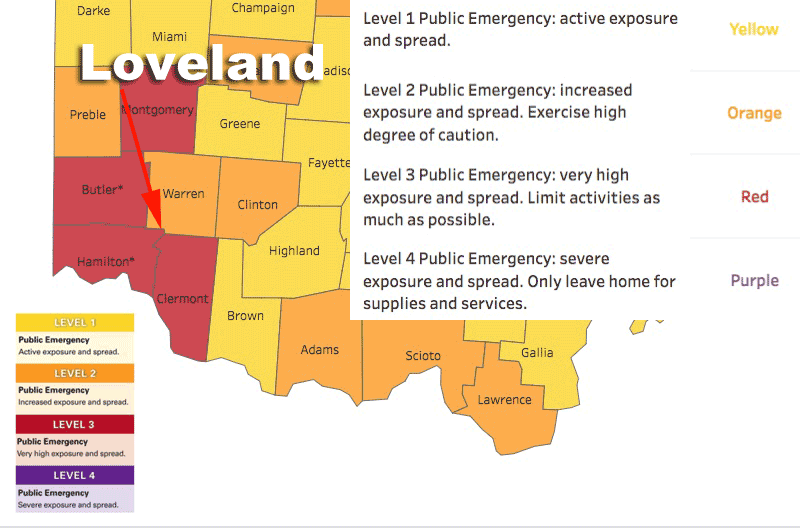
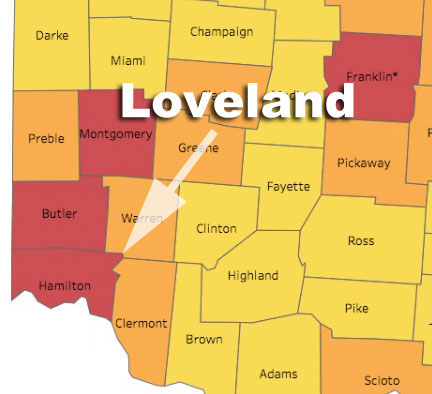
    Both Hamilton and Clermont counties are currently under the State RED Alert for COVID 19 spread. Clermont County was elevated from ORANGE to RED last Thursday. Warren County remains in the ORANGE Alert designation.

    What does it mean if Hamilton County goes to the highest Alert level?

    Hamilton County is on the State Watch list to possibly be elevated from the current RED Level Alert to the highest, PURPLE Level Alert. That destination would mean that the county is experiencing “Severe exposure and spread.” The order from the state would be, “Only leave home for supplies and services and Stay at home/necessary travel only.”

    Why was Hamilton County put under a RED Alert?

    As of July 7, Hamilton County during the 3 weeks prior had COVID 19 cases increase along with several other healthcare indicators.

    Between June 24 and June 30, Hamilton County had 1,124 cases, the largest number of COVID 19 cases in any week since the beginning of the pandemic.

    From June 16 until June 30, the average new cases per day doubled from 82 to 161. Due to clinical and reporting lags, these numbers may continue to grow for this reporting period.

    The community continued to experience early signs that more people are seeking medical care for COVID 19 symptoms.

    From June 16 to June 30, visits for COVID 19 to the emergency department doubled from an average of 11 per day to 22. More people are also visiting their doctors and being diagnosed with COVID 19.

    Between June 16 and July 2, the average outpatient visits more than tripled from 52 to 172 visits per day.

    In recent weeks, more than 86% of the cases are not in congregate settings, signaling significant transmission in the broader community.

    Hamilton County also hit a new threshold for the overall utilization rate for regional intensive care unit beds, which exceeded 80% during 5 of those past 7 days.

    Why was Clermont County put under a RED Alert?

    As of July 7, Clermont County during the 3 weeks prior had COVID 19 cases increase along with several other healthcare indicators.

    From June 16 until June 30, the average new cases per day doubled from 4 to 9. Due to clinical and reporting lags, these numbers may continue to grow for this reporting period.

    The community continued to experience early signs that more people are seeking medical care for COVID 19 symptoms.

    More people are also visiting their doctors and being diagnosed with COVID 19.

    Between June 16 and July 2, the average outpatient visits nearly tripled from 9 to 25 visits per day.

    In recent weeks, more than 94% of the cases are not in congregate settings, signaling significant transmission in the broader community.

    Clermont County also hit a new threshold for the overall utilization rate for regional intensive care unit beds, which exceeded 80% during 5 of those past 7 days.

    LEVEL 1   0–1 Indicators Triggered

    Active exposure and spread. Follow all current health orders.

    LEVEL 2   2–3 Indicators Triggered

    Increased exposure and spread. Exercise high degree of caution. Follow all current health orders.

    LEVEL 3   4–5 Indicators Triggered

    Very high exposure and spread. Limit activities as much as possible. Follow all current health orders.

    LEVEL 4   6–7 Indicators Triggered

    Severe exposure and spread. Only leave home for supplies and services. Follow all current health orders.

    Summary of Alert Indicators


    As of today, Monday, July 13:

    The number of hospitalizations in Ohio is 8,842. Total Deaths in Ohio is 3,058.

    There are 462 hospitalizations and 131 deaths in Hamilton County. There have been 3,657 cases and 1,154 recoveries.

    There have been 497 confirmed and probable cases of COVID 19 in Clermont County and 7 confirmed and probable death. There are currently 60 hospitalizations. 341 people are being reported as recovered.

    In Warren County there have been 945 positive and probable cases and 25 positive and probable deaths. Warren County is reporting 120 new positive cases, 5 new hospitalizations, and 3 new deaths in the last 14 days.


    Clermont County Public Health has issued these 5 Protocols for All Businesses and these Frequently Asked Questions and Answers

    1. Require face coverings for employers and recommend them for clients/customers at all times.

    2. Conduct daily health assessments by employers and employees (self-evaluation) to determine if “fit-for-duty”.

    3. Maintain good hygiene at all times -hand washing, sanitizing, and social distancing.

    4. Clean and sanitize workplaces throughout the workday and at the close of business or between shifts.

    5. Limit capacity to meet social distancing guidelines.

    •Establish maximum capacity at 50% of the fire code.
    • And, use appointment setting where possible to limit congestion.

    Q. Will I have to wear a mask or face covering while I am at work?
    A. Yes. Face coverings are required for employees except if any of the following apply:

    1. Facial coverings in the work setting are prohibited by law or regulation;

    2. Facial coverings are in violation of documented industry standards;

    3. Facial coverings are not advisable for health reasons;

    4. Facial coverings are in violation of the business’ documented safety policies;

    5. Facial coverings are not required when the employee works alone in an assigned work area; or There is a functional (practical) reason for an employee not to wear a facial covering in the workplace.

    Q. Will I have to wear a mask or face covering if I am a customer at a business?
    A. Yes. Under the level 3 Public Health Emergency issued on July 10, customers must wear masks while inside businesses or other buildings.

    Q. Will I need to take my temperature before coming to work?
    A. Yes. Employees must take their temperature and watch for other symptoms such as coughing or difficulty breathing. Sick employees should stay at home.

    Q. What safety precautions should my employer be taking?
    A. All businesses should follow these protocols

    1. Require face coverings for employers and customers.

    2. Conduct daily health assessments by employers and employees (self-evaluation) to determine if “fit-for-duty”.

    3. Maintain good hygiene at all times -hand washing, sanitizing, and social distancing.

    4. Clean and sanitize workplaces throughout the workday and at the close of business or between shifts.

    5. Limit capacity to meet social distancing guidelines.

    •Establish maximum capacity at 50% of the fire code.
    • And, use appointment setting where possible to limit congestion.

    Q. What should I do if my co-workers aren’t wearing facial coverings at work?
    A. If an employee of a business is not wearing a facial covering, ask the employer/business for written justification on why the employee isn’t wearing a face covering.

    Q. What should I do if my employer is not following proper safety precautions?
    A. If an employer is not following the above safety protocols, you can file an online complaint here.

    To File a complaint about a business you think is in violation of the Stay Safe Ohio Order, click here.

    To check the status of a complaint click here. (Choose “Code Case” in the search drop-down box).

    Full Ohio Department of Health Stay Safe Ohio Order 

    More information from the Ohio Department of Health on the Responsible RestartOhio page

  • Ohio’s K-12 public schools got cuts. Private, charter schools got cash

    Ohio’s K-12 public schools got cuts. Private, charter schools got cash

    The amount of the state revenue reduction for the Loveland City School District was $1,010,855

    An up-date on 7/12/2020:

    Loveland Treasurer Kevin Hawley reports to the Board in the agenda for their June 23 business meeting:

    Loveland City Schools received approximately $350,000 from the CARES Act. These funds were provided to the state of Ohio and they determined the breakdown for each district. Ohio determined the allocation based on Title I federal funding rates. Title I is a federal grant primarily provided to “schools with high numbers or high percentages of children from low-income families to help ensure that all children meet challenging state academic standards.” This was the way the state determined equity in payments. As a reminder, the state decreased our overall state funding by $1,010,855. These funds are provided specifically for any increased expenses due to COVID-19. Therefore, this will help with any additional expenses incurred due to the pandemic and with the resumption of school in the fall of 2020.

    By Susan Tebben| Tyler Buchanan at the Ohio Capital Journal


    Local Private Schools Receiving Paycheck Protection Program Funds

    Cincinnati Country Day School 2-5m

    Cincinnati Hills Christian Academy 2-5m

    St. Xavier High School 2-5m

    Elder High School 1-2m

    Mount Notre Dame 1-2m

    McNicholas High School 350k-1m

    La Salle High School 350k-1m

    Roger Bacon High School 350k-1m

    Seton High School 350k 1m

    Lebanon Christian School 150k-350k

    Liberty Bible Academy (Mason) 150k-350k

    Ohio educators were at home celebrating “Teacher Appreciation Week” in May when they learned cuts would be made at every public school district in the state.

    These cuts came just as hundreds of private and charter schools in Ohio were approved to receive millions of dollars from the federal government to keep their workers on payroll. Some of these already receive public school funding as part of the EdChoice private school voucher program.

    The federal funding was offered through the Paycheck Protection Program (PPP). It is a program administered by the Small Business Administration which gives low-interest loans to businesses and nonprofits. The loans are forgiven if used primarily to help with payroll costs.

    After the federal government released a list of PPP recipients on Monday, the Ohio Capital Journal reviewed data on the nearly 23,000 recipients in this state to track funding that went to schools.  

    The list does not give an exact dollar figure received by each place, but rather provides a range: $150,000 to $350,000; $350,000 to $1 million; $1-2 million; $2-5 million; and $5-10 million.

    In total, the Capital Journal identified 220 schools in Ohio that received PPP funding. The possible range of the combined funding is between $95 million and $232 million.

    This money went to a variety of schools. Many are religious institutions, such as Chaminade Julienne Catholic High School in Dayton, which received between $1-2 million. The list includes many charter schools, such as the chain of Horizon Science Academy locations in more than a half-dozen cities which took in millions of dollars.

    There are private gifted schools, college preparatory schools and those which operate as nonprofits independent of the traditional public school system. Some are specialized schools for certain areas of study, such as the Global Ambassadors Language Academy in Cleveland, which allows children to learn in language immersion programs for Spanish and Mandarin. The academy took in between $150,000 and $350,000.

    Together, the 220 schools were able to retain many thousands of jobs thanks to the PPP funding. 

    There were additional loans given to Montessori schools, day care centers, pre-schools, after-school programs, summer camps and other entities which serve children. These were not included in the Capital Journal review. 

    PPP money has been limited to businesses and nonprofit entities, thus making public school districts ineligible for funding.

    The Ohio Capital Journal previously reported about a similar disparity within higher education. Dozens of private colleges and universities took in tens of millions of dollars in forgivable PPP loans, while some of Ohio’s public institutions have suffered from severe budget shortfalls in 2020. 

    Public schools hope for future funding

    Public schools are still searching for funding relief after $300 million was cut by Gov. Mike DeWine’s administration in early May as the coronavirus pandemic began to impact state revenues. The amount of the state revenue reduction for the Loveland City School District was $1,010,855.

    Columbus City Schools Superintendent and CEO Talisa L. Dixon told a legislative committee discussing the future of K-12 education as the cuts took place that uncertainty is the greatest factor facing Ohio schools.

    “Uncertainty for the educational programs our families may need and want during this crisis, uncertainty of what our revenues may be as the state discusses further reductions, uncertainty of what our expenses may be in order to bring students back safely,” Dixon said.

    The state education system has seen declining growth not just related to coronavirus cuts, but year over year, according to historic data. On top of decreasing budgets, public schools have had to absorb the expenses of sending some students in low-ranked public schools to private schools through the EdChoice program.

    The Cleveland Heights-University Heights City School District, for example, saw more than one-third of its state aid deducted for EdChoice scholarships in fiscal year 2019, according to a report done by the district.

    According to the PPP awards, a number of Cleveland private schools received funding — examples include the Lutheran High School Association as well as the St. Joseph Academy, each taking in forgivable loans of between $1-2 million.

    Hamilton County’s Indian Hill Exempted Village School District had around one-fourth of its state aid diverted to EdChoice private school vouchers, and Sycamore Community City School District lost about one-fifth.

    In 2020 PPP awards, nearby schools received loans such as Cincinnati Hills Christian Academy (between $2-$5 million) and St. Ursula Academy (between $1-$2 million).

    The leader of a teacher’s union representing 20,000 Ohio educators is taking issue with PPP funding and public school monies going toward private schools. In a recent conference call regarding falling budgets and the need for federal aid, Ohio Federation of Teachers Executive Director Melissa Cropper said the diversion of government funding to private schools has only added to the struggles that impact most students in the state.

    “Ninety percent of our students are educated in public schools, so when we have this money diverted to private schools, we’re impacting 90% of the students that the money is being taken away from,” Cropper said. “So this just continues to create disparities within our education system.”

    Education advocates see other potential solutions to public schools’ budget woes — namely, funding from the federal CARES Act, a COVID-19 relief bill signed into law back in March. A separate HEROES Act includes more funding for public education, including $3.2 billion earmarked for Ohio schools, but the bill has languished in the U.S. Senate after passing in the U.S. House of Representatives. 

    The Ohio Capital Journal is a hard-hitting, independent, nonprofit news organization dedicated to connecting Ohioans to their state government and its impact on their lives. The Capital Journal combines Ohio state government coverage with relentless investigative journalism, deep dives into the consequences of policy, political insight and principled commentary.

  • [VIDEO] Bob Kessler gets intimate with 6″ shells on the 4th of July!

    [VIDEO] Bob Kessler gets intimate with 6″ shells on the 4th of July!

    Cassie Mattia is the Associate Editor of Loveland Magazine and lives in Historic Downtown.

    by Cassie Mattia

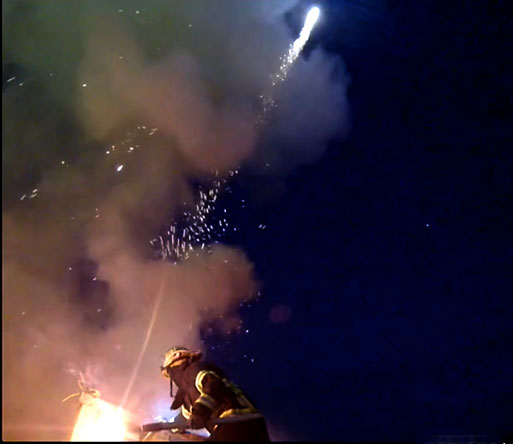
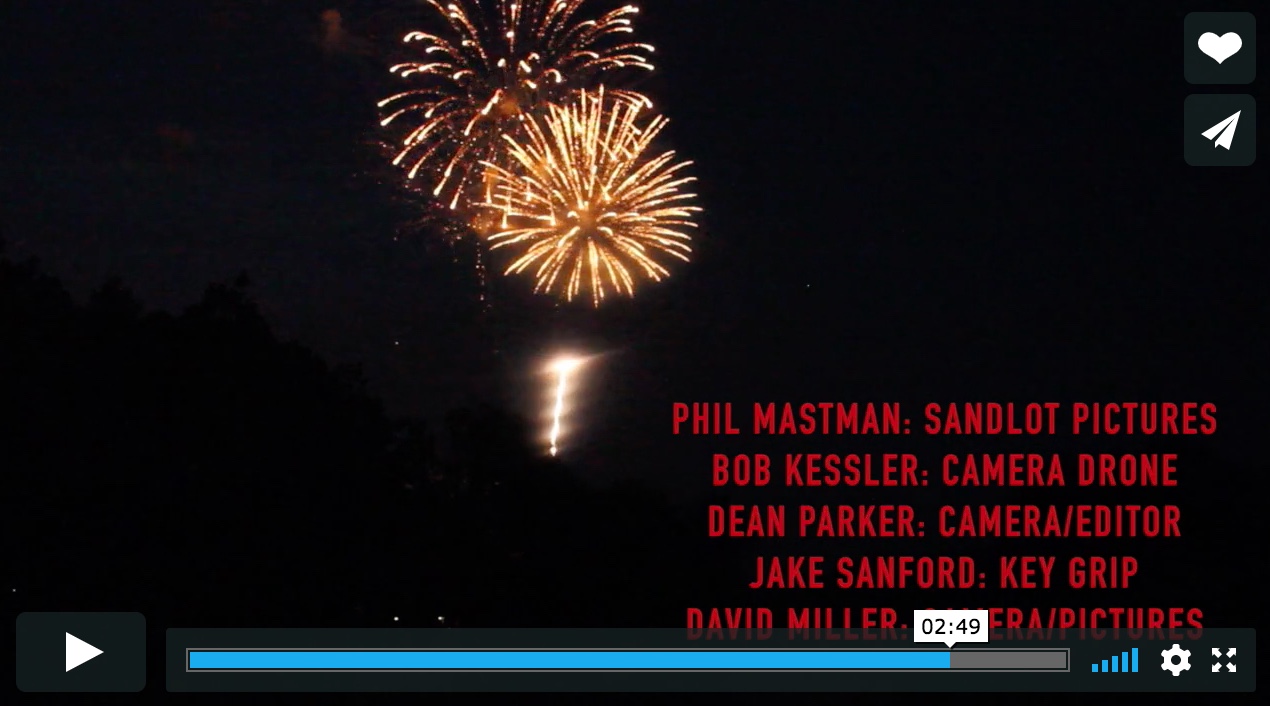
    Loveland, Ohio – Loveland videographer Bob Kessler wanted to get a unique perspective of this year’s 4th of July fireworks by getting up close and personal with the launch zone! Kessler was able to not only show the launch of the fireworks but the explosions as well in one wide-angle shot. Loveland Magazine and Kessler teamed up this year for the 4th so that he could receive credentials to be on the actual launch site. By doing this, Kessler was able to witness the firework preparations and be there when the fuses were lit.

    Loveland’s and Symmes Township’s annual Independence Day celebrations were canceled this year, however, the City and Township were able to hold two simultaneous, “park and watch” firework shows on Saturday, July 4th.

    Kessler positioned himself at Loveland’s launch site inside Philips Park which was closed to the public for the day. Symmes Park, which was also closed to the public for the day, acted as the launchpad for the Township.

    Kessler explained that previously he shot video from various street views in Downtown Loveland and on the bridge of the Little Miami River. Typically, Loveland launches its annual show from inside Kiwanis Park on Wall Street but, this year, because of COVID 19 the City was concerned about having thousands of people crowd into Historic Downtown, which is known as the best viewing spot for the fireworks. City Hall ended up deciding to move the launch to a higher location in order to take advantage of the area’s church and school parking lots. Spectators were either encouraged to watch the shows, drive-in movie style and practice social distancing, or residents who lived near the parks were asked to stay at home to enjoy the show. Those that decided to watch the fireworks from their cars went to Loveland High School, Home of the Brave Park, church parking lots, and surrounding subdivisions while of course remaining socially distant.

    Kessler told us that the launch locations were chosen to accommodate the use of larger shells, which go higher into the air and allow spectators to watch from a much wider area.

    Here is Kessler’s favorite still shot from his vantage point at the launch pad inside Phillips Park. “This is my favorite picture from the batch I shot last night. I was about 250′ from the launch site, behind the exhibitors running the show. Nikon D850, 14mm, ISO 400, f/10, 8 seconds,” said Bob Kessler.

    Kessler said he was excited about the addition of a second launch site at Symmes Park this year.

    “The second launch site promised to make for a unique experience. That’s why I settled on Phillips Park as the best location for me to photograph both stills and video images.”

    Dave Miller, Loveland Magazine’s Editor-in-Chief, covered the wide shots from the top of the stands at LHS’s stadium where he was able to view both Loveland’s and Symmes’ fireworks. He used two cameras, one acted as a live feed so LOVELAND MAGAZINE TV could have a live broadcast of the shows.

    Kessler and Miller were in constant communication in the days leading up to the show as times and locations rapidly changed with not much notice to the public. Luckily Loveland Magazine had a firework “inside man,” which allowed us to communicate quick and accurate firework updates to the public.

    A few minutes before launch time Kessler sent a message to Miller saying, “I passed the cop-test. The patrol came through and the Rozzi guy said, ‘He’s with us!”

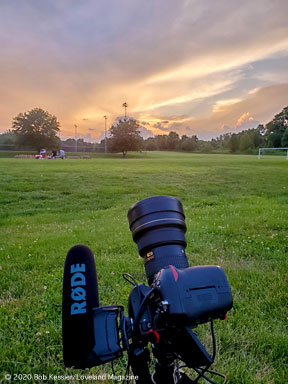
    Some of the camera equipment Bob Kessler used at the launch site of the Loveland Fireworks show.

    Loveland was the first to set off their rockets, then Symmes followed shortly after. Each firework show lasted about fifteen minutes. After the two shows finished both launch pads put on a simultaneous Grand Finale.

    “I first contacted the Loveland Symmes Fire Department about getting permission to be close, as they previously ran the show and knew me and my work with Loveland Magazine,” Kessler explained, “I then approached Rozzi’s Famous Fireworks and got the permission of the exhibitor running the show to shoot within the normally closed firing zone.”

    Kessler positioned himself in a ditch behind the show operator. Using a wide-angle lens and shooting 4K, he was able to capture a high definition video that allowed him to digitally “zoom-in” on the image without compromising quality. “I concurrently shot digital images with my still camera, the equivalent to an 8K image,” Kessler said.

    Kessler experimented with various settings on his camera as the show progressed, mostly shooting still frames at various time exposures of 4, 6, 8, 10, and 12 seconds. “All this fussing had to be done quickly, as I knew the show would only last 15-20 minutes. I managed to get about 75 images and several videos,” Kessler said, “Out of that, I ended up with 11 shots that I liked enough to post on Facebook.”

    Kessler learned from the Rozzi folks that the firework shells are able to go up to 100′ in the air for each inch of shell diameter. For example, a 4′ shell would go 400′ feet into the air while a 6′ shell would go about 600 feet into the air.

    “I always look forward to working with Bob Kessler on video projects because I learn so much,” David Miller said, “My only regret is there wasn’t enough of him to go around that night so he couldn’t be in the stadium with me to adjust my camera. If he could have been there then all I would have had to do was hit the record button. My video would have been so much better!”

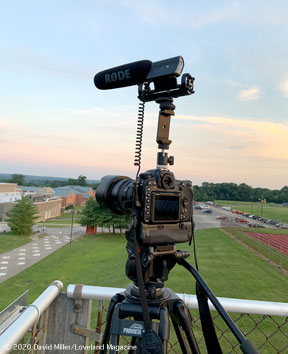
    Some of the video equipment David Miller used to shoot video and live-stream the fireworks show from the high vantage point of the stands at Tiger Stadium

    Miller also said that when Kessler offered to shoot the show he knew that he would expend countless hours readying his equipment and making adjustments. “Doing something like shooting fireworks is seat-of-pants. There are so many variables such as the rapidly setting sun. Will it be completely dark, well it will be if it’s a cloudy day. If the sun is out and going over the horizon which way will it be heading in relation to where the camera is? Fifteen minutes can make a huge difference in the ambient light that time of day,” Miller explained, “Bob sees all these variables in the days before and has the brainpower to take most of the guesswork out of the equation.”

    Miller said he really enjoyed watching the evening unfold from the highest elevation in town. “When I got to the stadium there were already about 20 teens playing frisbee football and before the show, someone new showed up with a cooler of water balloons to cool them off with.”

    At showtime, many of the teens and some adults joined Miller at the top of LHS’s bleachers to enjoy the vantage point of seeing both shows. “The pre-show of all the neighborhood fireworks displays going off from the high vantage point I had was pretty cool as well,” Miller added.

    Did you miss the 4th of July firework shows this year? Well, we have you covered! Click below to relive Bob Kessler’s 4th of July Fireworks video production!

    Kessler also produced a short clip of Loveland’s Finale which Loveland Magazine ended up using as an experiment of a “Video Cover Photo”.

    Loveland Magazine sends out a special thanks to Rozzi’s Famous Fireworks for giving us access to the launch site and showing us such wonderful hospitality!


    Check out these previous firework shows that Bob Kessler produced for Loveland Magazine TV. In this first video from 2015, Bob showed close-ups as the fuses were lit by a crew of Loveland Firefighters in full protective gear. Deputy Fire Chief Don Books talks about the show and how safe it was for the crew.

    VIDEO: Setting off your 4th of July fireworks was no job for the timid

    VIDEO: Loveland’s Firecracker Festival

  • Clermont County elevated to RED COVID 19 Alert

    Clermont County elevated to RED COVID 19 Alert

    The Public Health Advisory Alert System is a color-coded system designed to supplement existing statewide orders through a data-driven framework to assess the degree of the virus’ spread and to engage and empower individuals, businesses, communities, local governments, and others in their response and actions.

    The system consists of four levels that provide Ohioans with guidance as to the severity of the problem in the counties in which they live.  The levels are determined by seven data indicators that identify the risk level for each county and a corresponding color code to represent that risk level.

    Loveland, Ohio – Governor DeWine announced today that new public health data has led the Ohio Department of Health to designate that Clermont County is now among 12 counties as being in a Red Alert Level 3 Public Emergency as defined by the Ohio Public Health Advisory System.

    Clermont County had been in Level 2 until the announcement today.

    Hamilton County remains RED Alert Level 3 however it is on Ohio’s “Watch List” as they are approaching Purple Alert Level 4.

    Mandates for people to begin wearing masks in public in Clermont County will begin at 6 PM on Friday, July 10.

    Governor DeWine announced the creation of the Ohio Public Health Advisory System last week to provide local health departments, community leaders, and the public with data and information on the severity of the COVID-19 spread in the counties in which they live. The system consists of four levels with specific risk-level guidelines. Each level is calculated with data gathered on seven public health indicators.

    Read the Health Order

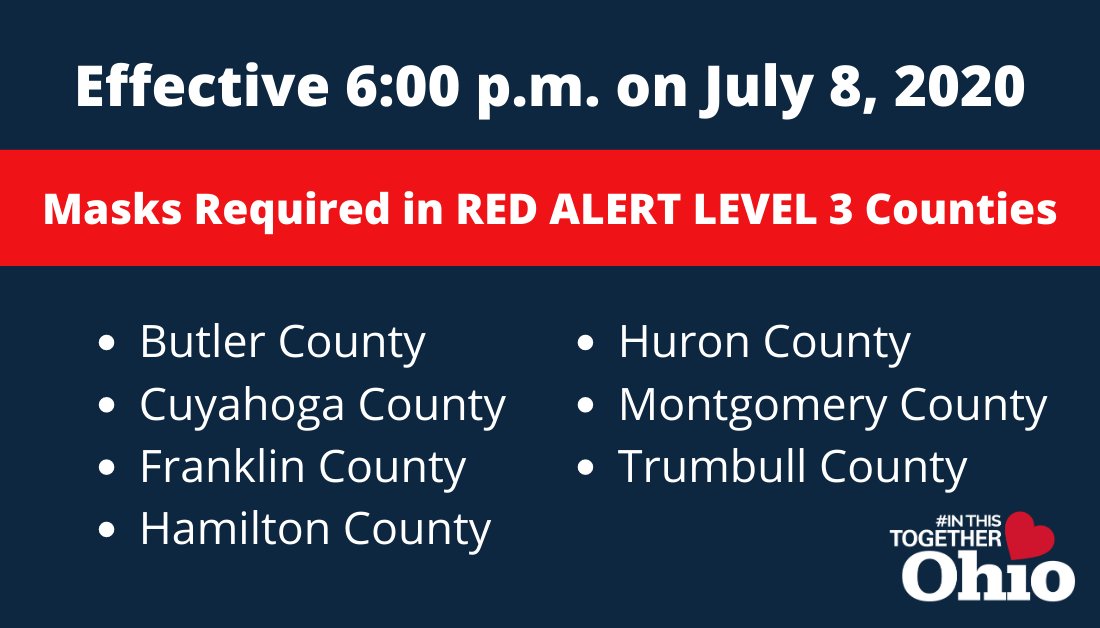
    Director’s Order for Facial Coverings in Butler, Cuyahoga, Franklin, Hamilton, Huron, Montgomery, and Trumbull Counties in Level 3 Public Health Advisory

    Those in counties designated as Red Alert Level 3 or Purple Alert Level 4 are required to wear a face covering:

      • In any indoor location that is not a residence;
      • When outdoors and unable to consistently maintain a distance of six feet or more from individuals who are not members of their household; or
      • While waiting for, riding, driving, or operating public transportation, a taxi, a private car service, or a ride-sharing vehicle.

    The order does not apply to children under the age of 10 or any other minor who cannot safely wear a face covering. The order also reflects the mask guidance in place for employees and businesses which does not require a person to wear a mask if their physician advises against it, if wearing a mask is prohibited by federal regulation, if communicating with the hearing impaired, when alone in an office or personal workspace, and other similar measures.

    Schools that offer Kindergarten through Grade 12 instruction should follow the guidelines set forth last week by the Ohio Department of Education and the Ohio Department of Health.

    The Ohio Department of Health will update county rankings every Thursday. Any county that increases to Red Alert Level 3 will automatically be included in the face-covering mandate. Any county that decreases from Red Alert Level 3 to Orange Alert Level 2 will automatically be released from the face-covering requirement.

  • Health Order for Hamilton County requiring face masks released

    Health Order for Hamilton County requiring face masks released

    Loveland, Ohio – Today beginning at 6 PM all of Hamilton County is under an order of the Ohio Department of Health that mandates the wearing of face coverings in public.

    Read the Health Order

    Director’s Order for Facial Coverings in Butler, Cuyahoga, Franklin, Hamilton, Huron, Montgomery, and Trumbull Counties in Level 3 Public Health Advisory

    Read Background

    Hamilton County, including part of Loveland under Mandatory Mask order at…

  • [POLL] Do you feel safe sending your child back to school in light of the “Red” Alert?

    [POLL] Do you feel safe sending your child back to school in light of the “Red” Alert?

    “The Public Health Advisory Alert System is a color-coded system designed to supplement existing statewide orders through a data-driven framework to assess the degree of the virus’ spread and to engage and empower individuals, businesses, communities, local governments, and others in their response and actions.”

    Loveland, Ohio – Today beginning at 6 PM all of Hamilton County which includes parts of the Loveland School District is under an order of the Ohio Department of Health that mandates the wearing of face coverings in public.

    Loveland High School, the Intermediate and Middle School Campus, and the Primary and Elementary Campus are all within the RED alert area. There are approximately 4,000 students that attend these schools.

    The Early Childhood Center is in Clermont County which is in the Orange Alert area.

    Loveland Schools are currently scheduled to resume classes on August 26, 48 days from now.

    Loveland is in three counties. The Little Miami River is the East/West dividing line between Hamilton County and Clermont County, A smaller part of Loveland is in Warren county. Hamilton County is in the RED in Ohio’s Public Health Emergency Alert system. Clermont and Warren are both currently ORANGE.

    Also, Governor Dewine tweeted on July 7, “As the #COVID19 pandemic has progressed more younger Ohioans are being diagnosed with #COVID19. We are seeing young people who are getting very sick. There is also the concern that they are passing it on to those who are at risk.” He released this graphic to emphasize that point.


    [poll id=”5″]


    Read the Health Order

    Director’s Order for Facial Coverings in Butler, Cuyahoga, Franklin, Hamilton, Huron, Montgomery, and Trumbull Counties in Level 3 Public Health Advisory

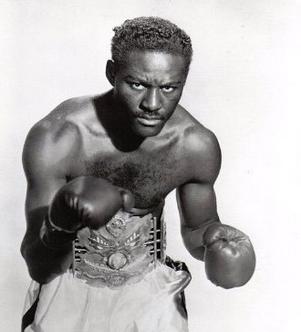
  • COOL: Episode 3 of Ricky Mulvey’s documentary podcast about Ezzard Charles, Total Fighter, is up RIGHT NOW

    COOL: Episode 3 of Ricky Mulvey’s documentary podcast about Ezzard Charles, Total Fighter, is up RIGHT NOW

    Ricky Mulvey’s Podcast: “Total Fighter” about Cincinnati’s Ezzard Charles

    This podcast shines a new light on the underrated Cincinnati Cobra; the greatest light-heavyweight of all time.

    Ricky Mulvey is a former sportswriter and talking head at Loveland Magazine

    Part 3 of Ricky Mulvey’s 5 part podcast series on Ezzard Charles, “Total Fighter” is up now.

    In the third episode, Ezzard Charles tries to move on from his tragic meeting with Sam Baroudi and the mafia tightens its grip over his boxing career. A match against Joe Louis becomes more possible after the biggest fight in Cincinnati’s history.

    The Man in Front of Me (Part 3)


    Total Fighter features interviews with Buddy LaRosa, founder of LaRosa’s Pizza, William Dettloff, author of “Ezzard Charles: A Boxing Life,” and Ezzard Charles II.

    Episode 2: “Cobra Strike” covers Ezzard’s tragic and career-defining boxing match, his experience in World War II, and his manager who was “allegedly” connected to the New York Mafia.

    Play Episode 2

    Featuring interviews with P Man Jones, Ezzard Charles II, William Dettloff, author of “Ezzard Charles: A Boxing Life,” and Buddy LaRosa, founder of LaRosa’s Pizza.

    “Total Fighter,” is a narrative, nonfiction podcast about Ezzard Charles, Cincinnati’s heavyweight champion, and hosted by Loveland native Ricky Mulvey.
    By Source, Fair use, https://en.wikipedia.org/w/index.php?curid=42512075

    This podcast shines a new light on the underrated Cincinnati Cobra; the greatest light-heavyweight of all time.

    The series will ultimately follow Charles to his match against Joe Louis, and the characters who followed him– his family and the mafia.

    The premier episode, “More Than a Gym Fighter” is a deep-dive into a very different Cincinnati. Go to a bustling Findlay Market in the 1940s, in between the pool tables and cigar smoke at the American Legion Hall in Newport, Kentucky for Charles’ first boxing match, and a Battle Royale in Lawrenceville, Georgia.

    Play Episode 1

    “Total Fighter” features interviews and stories from Buddy LaRosa, founder of LaRosa’s Pizza, William Dettloff, author of “Ezzard Charles: a Boxing Life,” Frank Wettencamp, one of Ezz’s high school classmates, and more. 

    This show explores his complex character; why the name “Ezzard Charles” became an insult by Frank Sinatra and an inspiration to the composer George Russell.

    You can first hear new episodes and updates right here on Loveland Magazine or by following Ricky Mulvey on Facebook, @rickymulvey on Instagram, and @rickssoslick on Twitter.
    You can find the show on Apple Podcasts, Spotify, or most other platforms.
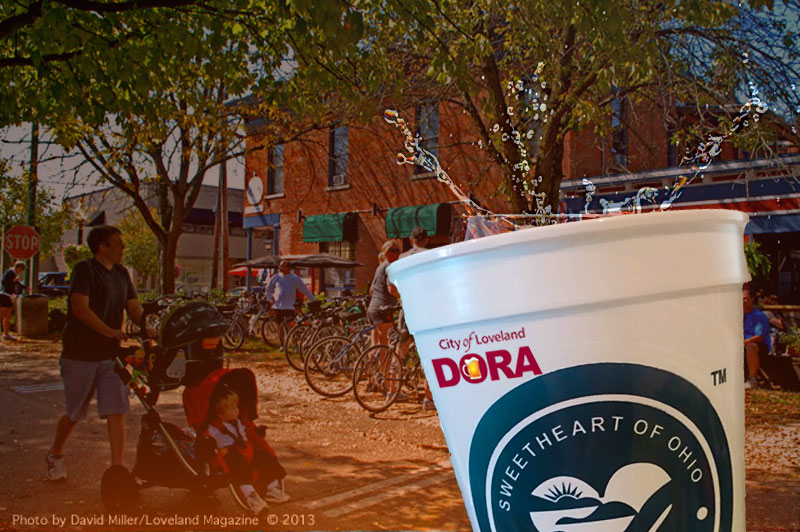
  • DORA open carry extended into September in Historic Downtown Loveland

    DORA open carry extended into September in Historic Downtown Loveland

    Loveland City Manager Dave Kennedy was given the authority to extend the DORA for 60-days.

    Loveland, Ohio – The City of Loveland’s Designated Outdoor Refreshment Area (DORA), which previously allowed for the consumption of alcohol within specific boundaries in Historic Downtown only during specified events was modified in May from being in effect only during specified events to being in effect seven days a week from noon to 11 PM.

    The modification that went into effect in May was set to expire today.

    The DORA allows for the consumption of alcohol within specific boundaries in Historic Downtown.

    As provided within the legislation previously adopted by City Council, the City Manager was given the authority to extend the DORA for an additional 60-days.

    Under that authorization, City Manager Dave Kennedy announced yesterday that he has extended the seven-day DORA until September 5.


    Q: What is a DORA?

    A: A Designated Outdoor Refreshment Area (DORA) is a specially designated area that allows patrons of an establishment serving alcohol to take an open container of alcohol out of the business and walk around the public streets. Drinks must be in special cups designated as DORA cups. These cups can be obtained at all participating alcohol establishments inside the DORA.

    Q: May a person bring their own alcohol into a DORA?

    A: No. Ohio open container law prohibits a person from having an opened container of alcohol on a permit premises that was not purchased from that permit holder even if the permit premises are within a DORA purchased elsewhere.

    Q: Do I have to use special DORA Cups?

    A: Yes. Any open alcohol which leaves an establishment must be in designated DORA cups. And, DORA cups must be empty to enter an establishment. Cups can be obtained at any participating establishment.

    Q: What types of alcoholic beverage can I have in my DORA cup?

    A: Beer, wine and liquor are allowable beverages to be consumed in designated DORA cups.

    Q: Can I walk anywhere with my DORA cup?

    A: Patrons can enjoy their beverage within the designated DORA Boundaries which are marked by signage.

    Businesses serving DORA beverages will have the below sticker decal displayed:
    DORA Sticker


    Check out these savings from All American Gutter Protection. All American Gutter Protection offers the best micro mesh gutter guards and gutters at highly competitive pricing.

  • 35% OFF in store orders at RP Diamond during July

    35% OFF in store orders at RP Diamond during July

    Huge savings for

    Christmas in July

    RP Diamond

    Storewide discounts lasting the entire month! Sale begins this Wednesday!


  • Symmes Township approves new contract for yard waste

    Symmes Township approves new contract for yard waste

    Symmes Township, Ohio – The Township has entered into an agreement with Irvine Wood Recovery, 110 Glendale Milford Road, Miamiville 45147 to collect yard waste from June 1 through October 31.

    The hours of operation will be Monday through Friday from 8 AM until 5 PM and Saturdays, weather permitting, 8 AM until Noon (call first (513) 831-0060).

    Irvine Wood Recovery will be closed: Independence Day, and Labor Day.

    The following guidelines apply:

    -Yard waste in commercial vehicles or from commercial establishments cannot be accepted.
    -No large trailers or trucks larger than pickups will be allowed.
    -No pallets, boards, nails, fence, or wire accepted.
    -No stumps, root balls, or cattails.
    -Yard waste must be free of any debris/trash.
    -No bricks, stones or soil accepted.
    -No food materials.
    -All children must stay inside vehicles.

    Please note that this service is for Symmes Township residents only. Residents will be asked to show proof of residency, ie. driver’s license.