Tag: vote

  • The Bengal Boys Present: VOTE – Who will you cheer to victory?

    The Bengal Boys Present: VOTE – Who will you cheer to victory?

    The Bengals Boys – The boy band that only knows one song. Showing their love for the Cincinnati Bengals by presenting the Cincy renowned fight song, “Bengals Growl” by George Bird, in a different genre/style every week.”

    Bengal Boys Members: 

    Dylan Bodley – Loveland HS Grad (2012)

    Alex Dolezal – Loveland HS Grad (2012)

    Parker Phillips – Loveland HS Grad (2012)

    Colin Cooper – CHCA Grad (2010) 

    PUBLISHER’S NOTE of THANKS:

    Thank you to John Ames the Loveland School Business Manager for the hours you spent on the details of room logistics and the sound system. Thank you, Pastor Bill Hounshell, for perhaps the hardest job of the evening – sorting through the many audience submitted questions and fairly and impartially asking them to the candidates. Thank you, Judge Greenberg, for adding your dignity to the forum and for keeping things running so smoothly. Thank you Loveland Voters for attending and your community engagement. Thank you, Chamber – CeeCee Collins and Meredith Taylor – for the important roles you played in making the evening a success and allowing us to partner with you again this year. David Miller, Publisher

    If you find this story useful and helpful in your daily life…


  • The City of Loveland educates through the mail!

    The City of Loveland educates through the mail!

    Loveland Magazine writer Cassie Mattia lives in Historic Downtown

    Loveland, Ohio As election day quickly approaches the City of Loveland wants to be sure that all Loveland voters are not only aware but educated on the issues they will be voting on come November 5th!

    If you are a Loveland resident and you haven’t yet seen a packet from the City of Loveland addressing the proposed changes to the City’s Charter, well Loveland Magazine has it all right here! Below is a short description of what you will see in the packet of proposed changes to the City Charter, how the changes came about, and why these changes are being proposed.

    The 411 from City Hall:

    “On the November 5 ballot, you will be asked to consider amendments to the Loveland City Charter. The Charter is our City’s constitution. It defines how the City of Loveland is organized and how it functions and can only be changed by a vote of Loveland citizens. Loveland’s first Charter was approved by the voters in 1961, and throughout the years, revisions have been made, with the last round of revisions being approved by the voters in 2003. In 2018, Loveland City Council determined that our Charter needed to be reviewed, as most communities review their charters at least every ten years. City Council appointed a Charter Review Commission on February 27, 2018, and the members met twice a month for over a year to review each section of the charter. Additional background on the proposed amendments is available on the City’s website within the Commission’s meeting minutes. The Commission accepted public comments at every meeting and held a formal public hearing on May 22, 2019, to receive public input before submitting the proposed Charter Amendments to City Council for consideration. On July 9, 2019, the Charter Amendments were presented to City Council and a second public hearing was held to receive public comments. Following the public hearing, City Council adopted Ordinance 2019-61, which approved the submission of the proposed Charter Amendments to electors on the November 5 general election ballot. The proposed Charter Amendments are presented in a format that allows you to easily see the current charter language in the left column and the proposed changes within the right column. Many sections were not subject to changes. These proposed changes are being mailed to all registered voters in the City as required by Article XVIII Section 9 of the Ohio Constitution. All Loveland citizens are encouraged to vote in the November 5, 2019, general election which will include these proposed changes to our Charter.”


    Councilman Ted Phelps chaired the Charter Review Commission and we asked him to tell our readers the major changes that people should pay attention to when they review the proposal:

    First, the Charter was last amended in 2003.  One of the major things appearing in this year’s changes, is a requirement that at least once every 10 years, the City appoint a Charter Review Commission to review and recommend changes to Council (12.09).  This way, we will hopefully avoid long periods of time passing, like the 16 years since the last revision, which tends to give rise to a back-log of changes and the inefficiencies which accompany not doing so sooner.  Similarly, another change now being proposed is to require at least every 10 years, the City review its Master Plan (2.10).  This too will avoid City planning becoming stale or obsolete and will help Loveland to assess and reassess its direction in a more timely and productive manner.

    Another substantive change on the ballot this year seeks to address what happens when there is a vacancy in the office of Mayor.  This situation arose just a few years back and the City was without a Mayor for multiple months until the general election.  Under the revisions proposed to Section 2.06, that won’t happen as again as the revision makes clear that the Vice-Mayor becomes the Mayor for the unexpired term, unless the Vice-Mayor declines to do so and then Council by majority vote will select the new Mayor.

    There are also proposed changes to the Director of Finance position as currently the Director of Finance is chosen by Council.  The revisions (5.02, 5.06 and 9.06) will allow for the City Manager to choose the Finance Director subject to approval by Council.  Removal of the Finance Director will also be subject to Council approval.  These proposed changes seek to streamline matters and make more efficient not only the selection process for the Finance Director position but the changes also seek to align the Charter with the reality that the City Manager has and must continue to have a close and highly functional relationship with the Finance Director.  Council maintains a checks and balances role as again, both the actual selection and any removal of the Finance Director can only be done with Council approval.

    Finally, other important revisions seek to conform current roles and responsibilities of the Clerk of Council (2.08), clarify how the City is to publish ordinances and resolutions allowing for utilization of the City’s website to do so (3.04) and remove the residency requirement for the City Manager in conformity with current Ohio law (4.01).  One other beneficial change is to clarify when Council begins its term of office (2.04).  As you know, every two years when there is a general election, Council is to hold its organization meeting to elect the Mayor and Vice-Mayor and under the current Charter that meeting has to take place on the first Monday in December even if the recount winner has not yet been determined by the Board of Elections.  The changes to 2.04 make sure that Council’s first organization meeting following the general election takes place only after the recount process is finalized.


    Click on the link below to read through the proposed changes to the City’s Charter.

    https://lovelandoh.gov/DocumentCenter/View/1313/Proposed-Charter-Amendments-2019


    If you find this story useful and helpful in your daily life…


  • Take Our Poll on School Levy

    Take Our Poll on School Levy

    [socialpoll id=”2575957″]


  • Judge Jerry R. McBride: Why Issue One should be opposed

    Judge Jerry R. McBride: Why Issue One should be opposed

    by Judge Jerry R. McBride

    If you are concerned about neighborhood safety, then you should NOT support Issue One on the ballot this fall. It will hinder law enforcement, prosecutors, and judges in their ability to deal with the biggest drug crisis in this state’s history.As a result, it will result in more drugs on the streets, more crime, more deaths from overdoses, and more costs to local communities and taxpayers.

    Jerry R. McBride is a Clermont County, Ohio, Common Pleas Court Judge

    Judges have the ability to comment on issues that affect the administration of justice. Issue One will have a devastating effect on the administration of justice on Ohio. As one trial judge, this is my take on Issue One:

    ISSUE ONE DOES NOT BELONG IN THE STATE CONSTITUTION

    A state constitution should set forth the powers and functions of the branches of government, certain general values and principles upon which the citizens of the state generally agree, and the basic rights which are afforded to the citizens of the state. It should set forth matters which are so fundamental and important that they will not be subject to change over time. This proposed constitutional amendment does not in any way belong in a state constitution. It seeks to change sentencing law as it exists in the state of Ohio based on an assumption that change needs to be made. If change does need to be made, then it should be made through the process of enacting legislation, as is done on a regular basis in this state, and not through a constitutional amendment.

    ISSUE ONE DIRECTLY CONTRADICTS THE CONCEPT OF TRUTH IN SENTENCING AND IGNORES THE RIGHTS OF VICTIMS.

    There should be truth in sentencing, not lip service to truth in sentencing. Issue One allows a credit to be given by the Department of Rehabilitation and Correction for participation in rehabilitative, work, or educational programming of up to 25% of a sentence plus 30 days. While this may sound good at first glance, it is contrary to the concept of truth in sentencing. When a victim is told what a sentence will be, he/she should be able to rely on that being the sentence unless a hearing is scheduled on a possible reduction in the sentence. Why should a sentence be reduced just because an inmate “participates” in programming? Isn’t that the bare minimum that should be expected from an inmate? Why should an inmate be rewarded for doing the bare minimum? If a sentence is to be reduced, it should be reduced by the sentencing judge based upon an assessment that the risk of recidivism has been reduced, not because somebody has shown up to work. And if the judge makes the assessment that the sentence should be reduced, a hearing will be required and the victim will have an opportunity to be present and to be heard, which is the way it should be. Additionally, what does it mean to “participate” in these activities? This essentially allows the prison authorities to reduce a judge’s sentence,and it should be the judge who imposed a sentence who determines whether that sentence should be reduced.

    ISSUE ONE IS DANGEROUS IN THAT IT INTERFERES WITH THE JUSTICE SYSTEM’S ABILITY TO DEAL WITH THE DRUG CRISIS

    It is highly inappropriate in the midst of the biggest crisis in this state in terms of drug abuse for the possession and use of dangerous drugs to be treated essentially the same as minor traffic and criminal offenses. Possession of dangerous drugs leads to overdoses, to more serious criminal offenses, to deaths. The possession and use of dangerous drugs are not minor offenses to the persons who are addicted to drugs, to the victims of crime involving persons under the influence of drugs, to the parents and family members who are praying that their loved ones will not overdose and die. To suggest that we need to include treatment in our approach to this drug crisis is highly appropriate, and in fact it is already being done routinely across this state. However, to suggest that we should reduce the level of these offenses so that they are no longer classified as serious offenses is highly inappropriate.

    ISSUE ONE TREATS USE OF DANGEROUS DRUGS AS LESS SERIOUS THAN JUST ABOUT EVERY OTHER CRIME

    The proponents of the constitutional amendment, in saying that a jail sentence cannot be imposed, are saying that possession and use of such drugs as heroin, methamphetamine, and cocaine should be treated more lightly than reckless driving, shoplifting, lying to a police officer, gambling, and persistent disorderly conduct, all of which can result in the imposition of jail sentences. Is this really the message that we should be sending to drug addicted adults who represent a risk of committing more serious offenses as long as they persist in the use of dangerous drugs?

    ISSUE ONE ELIMINATES THE ABILITY OF A JUDGE TO IMPOSE A JAIL SENTECE FOR A FIRST OR SECOND POSSESSION OFFENSE, EVEN IF THE DRUG IS HEROIN, METHAMPHETAMINE, OR COCAINE

    In all likelihood, probation will be appropriate for a person who commits a drug possession offense which is the first or second within a 24-month period. However, that will not always be the case. For instance, probation may not be appropriate at all if the offense is committed at the same time as a more serious offense such as a burglary or an assault. Similarly, probation may not serve the purpose of protecting the public if the drug possession or use offense is committed by a convicted sex offender for whom use of a dangerous drug or alcohol represents a significant risk of reoffending and for whom intermediate sanctions may provide no real protection to the community. As for the term probation, does that include treatment in a halfway house or in a lock-down community based correctional facility?

    If it doesn’t include residential treatment, including lockdown residential treatment, ittakes away some of the most effective tools which can be used in trying to rehabilitate an offender. Needless to say, the problem with creating an absolute standard that requires that a person who uses or possesses drugs receive the lowest level of sanction available is that applying that standard under the facts of given case may not be consistent with the seriousness of the offense or the likelihood of recidivism.

    ISSUE ONE PUTS HANDCUFFS ON JUDGES IN THEIR ABILITY TO GET OFFENDERS TO STOP USING DRUGS

    The proposed amendment would eliminate the possibility of imposing a jail sentence at all for a violator on a first or second drug possession or use offense within 24 months and would eliminate the possibility of a court imposing a prison sentence for a felony violator unless the violator commits a new criminal offense. However, this leads to some very real dilemmas. If that is to be the law, what is a court to do with someone who simply refuses to attend treatment or to comply with any of the intermediate sanctions or who simply says that he/she will not comply with anything that the court orders? What is a court to do with someone who says he/she will comply with community control sanctions but then refuses to do anything which is ordered? Under the language of the proposed constitutional amendment, a felony offender could simply tell a judge at the time of the sentencing hearing that he/she will comply with the community control sanctions that are ordered, and then after being placed on community control, refuse to do anything that the court orders. At that point, a prison sentence could not be imposed. What is the possible sense in that? How does that serve to protect the public? The probation department has a statutory duty to report violations to the court, but if the offender continually absconds or fails to comply with the sanctions that are ordered, how can the probation department perform that function? The answer is very simple- it can’t.

    ISSUE ONE JUST GIVES LIP SERVICE TO THE CONCEPT OF GRADUATED SANCTIONS

    Issue One strips away the full range of tools which enable a judge or probation department to be effective in not only rehabilitating an offender, but also in protecting the public. It is difficult to argue with the concept of graduated responses, and the use of intermediate sanctions, by courts and probation departments. It is consistent with the use of evidence-based practices. However, the application of graduated responses or intermediate sanctions to a violator in a given case will depend on the seriousness of the original offense, the risk of recidivism, and the nature of the violation. In this regard, a graduated response policy will typically include probation (monitored or with conditions), intermediate sanctions (which may include such things as house arrest, residential or outpatient treatment, day reporting, a short jail term, or other requirements), and jail or prison. Issue One, however, arbitrarily takes away the option of jail or prison even for someone who thumbs his or her nose at the system and who refuses to undergo treatment or to make other changes that are necessary to reduce the likelihood of recidivism. It also arbitrarily takes away the option of jail or prison for someone for whom lesser sanctions are simply not appropriate.

    ISSUE ONE CONTRADICTS THE IMPORTANT CONCEPT OF SEPARATION OF POWERS

    The proposed amendment provides that each court must prepare guidelines for graduated responses that may be imposed in sentencing offenders and that the guidelines must be approved by the Department of Rehabilitation and Correction, which is part of the executive branch. Such a provision, which is proposed to be part of the state constitution, violates an already existing constitutional principle, which is the separation of powers. Additionally, there is no reason to believe that the Department of Rehabilitation and Correction has any expertise in deciding what factors a court should consider in determining which graduated response should be applied in a given case in sentencing an individual. That is pure and simple a judicial function.

    UNDER ISSUE ONE, THERE WILL BE LESS, NOT MORE, MONEY FOR TREATMENT

    The proponents of this constitutional amendment assume that the costs of their proposal will be covered by a substantial reduction in the number of prison beds. However, since the cost of housing fourth and fifth degree felons in the prison system is a very small part of the overall prison cost, since the projections as to cost reductions by the Department of Rehabilitation and Corrections have been inaccurate in the past, and since the increase in prison population has primarily resulted from longer sentences, and that is not addressed at all by the constitutional amendment, there is no real reason to believe that the assumptions of the proponents in this regard are correct.

    ISSUE ONE WILL RESULT IN GREATER COSTS TO LOCAL COMMUNTIES WITH WORSE RESULTS

    In the unlikely possibility that the proponents of Issue One are correct that there will be more money for treatment, and that appears to be fool’s gold, the most significant costs of this proposed constitutional amendment are the following- it undermines the efforts being made by courts and the law enforcement community to deal with the drug crisis, it undermines the ability of courts to effectively sentence offenders, and worst of all, it will not make the public any safer at all, and given the problems identified above, will likely lead to the public being more at risk. The cost of the proponents of Issue One pursuing their ill-conceived political agenda will be to put more people at risk of being victims, will not result in more or better treatment for drug users, and will result in greater cost- both human and monetary- to local communities. That is the reason that law enforcement, prosecutors, and judges throughout Ohio are opposing Issue One as being both ill-conceived and dangerous.


      Relaxed atmosphere and friendly service welcomes you back time and time again! Located in the heart of the Historic Loveland District Just outside Cincinnati, Ohio.


  • Deadline to register to vote in Ohio’s General Election is next Tuesday

    Deadline to register to vote in Ohio’s General Election is next Tuesday

    November 6 is the General Election

    The deadline to register to vote in the 2018 General Election is next Tuesday, October 9. The full, detailed and interactive 2018 elections calendar is available on the Secretary of State’s website.

    In November, voters will decide a statewide ballot initiative, as well as races for both state and federal offices. There will also be 1,661 local issues and a number of local races, which voters can obtain additional information on by contacting their county board of elections.

    Register to Vote/Update Your Address

    The deadline to register to vote or update an existing registration ahead of the November 6 General Election is October 9 (30 days before the election). Voters may go to MyOhioVote.com/VoterRegistrationto register online or update an existing registration. Voter registration forms can also be printed from MyOhioVote.com or obtained from a local library or board of elections office.

    Absentee Voting by Mail and In-Person

    All voters may begin voting on October 10 (first day after the close of registration) via in-person and by mail-in absentee ballot. For more information, visit MyOhioVote.com.

    Military & Overseas Voting

    Military voters who have not yet registered to vote or submitted a request for an absentee ballot may do so by visiting OhioMilitaryVotes.com, while overseas voters can visit OhioVoterPassport.com. There they can download the Federal Post Card Application, register to vote and request an absentee ballot, read through frequently asked questions, track the status of their mailed ballot, and sign up for election reminders via email and social media.
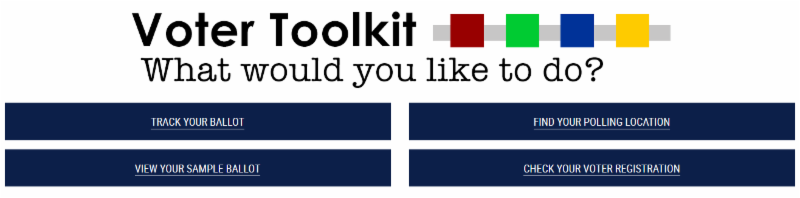
    Says Voter Toolkit on the top half and underneath says What would you like to do Bottom half has 4 boxes. Box1 says Track Your Ballot Box 2 says Find Your Polling Location Box 3 says View Your Sample Ballot and Box 4 says Check Your Voter Registration
  • Loveland Board of Education to hold special meeting for superintendent selection Thursday

    Loveland Board of Education to hold special meeting for superintendent selection Thursday

    Loveland, Ohio – The Loveland Board of Education plans to hold a special meeting at 6 PM Thursday, March 15, at the Loveland Intermediate School Media Center for the purpose of nominating and selecting the new superintendent of the Loveland City School District. In February, the Board announced three finalists for the position who each met with the administrative team, staff, and with the Loveland community.

    The new superintendent’s official duties will begin August 1. The vacancy is the result of the resignation of Chad Hilliker that was effective on July 31, 2017. At that time, Dr. Amy Crouse took over as interim superintendent for the district, and she continues to lead in that capacity.


    [Video] Interviews with finalists for superintendent search

     Loveland, Ohio – These LOVELAND MAGAZINE TV videos are interviews with the three finalists for the position of Loveland Superintendent of Schools. These interviews were conducted after each candidate met with the public, each for a separate two-hour Q&A at Loveland High School.

    Karen Naber,  (Assistant Superintendent Sycamore Schools)


    Dr. Chad Konkle (Assistant Superintendent Hamilton City Schools)


    Dr. Amy Crouse (Interim Loveland Superintendent)


    Wards Corner Chiropractic & Sports Rehab

      Loveland chiropractor Douglas Portmann, DC at Wards Corner Chiropractic & Sports Rehab is one of the best chiropractors in the Loveland area.