Tag: Voters

  • Congressional redistricting hits the Ohio Supreme Court

    Congressional redistricting hits the Ohio Supreme Court

    BY: SUSAN TEBBENOhio Capital Journal

    The case of congressional redistricting was heard by the Ohio Supreme Court on Tuesday, where arguments about reforms put in place by voters and the data used by the General Assembly to draw maps framed consideration of districts going forward.

    Ben Stafford, an attorney representing the National Redistricting Action Fund’s challenge of the congressional maps approved in November, said the case centers on compliance with the constitutional reforms that revised the redistricting process, particularly the GOP majority’s use of partisanship in creating its map.

    “This case is about how the General Assembly has thumbed its nose at these reforms and enacted a plan that palpably violates Article 19’s new anti-gerrymandering protections,” Stafford told the court.

    Stafford said the 2021 enacted map has “extraordinary partisan skew,” with Republicans favored in 12 of 15 districts, amounting to 80% of congressional seats in the state. Using voting results as a starting point for analysis, as Stafford said should have been done, would have leveled out the district lean at 54% Republican, 46% Democrat, according to results of statewide races over the past decades.

    “A plan where one party is favored to win 80% of the seats when it only wins 53 or 54% of that vote clearly favors that party,” Stafford said.

    However, the attorney for the legislative leaders, Senate President Matt Huffman and House Speaker Bob Cupp, Phillip Strach, called the 2021 plan “the most constitutionally compliant of all plans before the General Assembly” because other plans presented “split more counties and other jurisdictions than the enacted plan.”

    But Republican legislators who worked on drawing the maps also saw the redistricting process as a foregone conclusion, destined for a legal battle, according to Strach.

    The attorney for Cupp and Huffman argued that based on the “political geography” of Ohio, the General Assembly could have drawn maps using no election or partisanship data whatsoever, and it still would have come up with a Republican majority, leading to accusations of GOP secrecy and scheming.

    “And so, what the General Assembly decided this time was ‘look, we’re going to be sued no matter what, and so we’re going to make sure that we draw competitive districts,” Strach told the justices.

    Strach was asked to address an expert witness for the map challengers in the case, a political scientist who ran the Ohio map through a redistricting program 5,000 times and never came up with the amount of Republican lean as the map approved by the state legislature.

    The simulations were “deeply flawed,” Strach told the state’s high court, and dependent upon human intervention.

    “At the end of the day, the computers draw what a human being tells it to draw, and so if you don’t tell the computer to use criteria that match what the General Assembly actually used, then what it will spit out is really just garbage,” Strach said. “It really is meaningless for any legal analysis.”

    The idea of what data would be proper to use in redistricting was the subject of lengthy discussion during oral arguments on Tuesday, but the main conclusion attorneys on both sides came to was no database was better than another.

    “Nobody agrees on what data to use,” Strach said. “It’s hard to use congressional districts data because it’s always changing. It’s easier to use statewide data.”

    Challengers debated databases and which specific data to use, such as federal election results versus statewide results, but said the biggest problem with the 2021 plan was how map-drawers used the data they used.

    Stafford said map creators for the GOP, namely Senate staffer Ray DiRossi and House mapmaker Blake Springhetti, had much more data than they let on publicly, but didn’t use it all in presenting the new map proposal.

    “What was disclosed publicly was this cherry-picked measure, a measure designed to make the plan look more competitive than it actually was,” Stafford said.

    Regardless of the measure or metric used, however, Stafford said the bias in the 2021 plan “remains the same.”

    Supreme Court justices also jumped in on the debate of which data to use in forming congressional districts, with Justice Sharon Kennedy seemingly agreeing that the federal results made sense in drawing congressional districts.

    “If you look at Ohio’s elections, and you look at your own datasets, more people turn out in Ohio to vote in federal elections than in statewide elections, by and large,” Kennedy said.

    Justice Patrick DeWine spoke to the argument by map challengers who said the legislature erred in skipping the 2014 election results rather than using all election results for the last 10 years. DeWine said because the 2014 election was an election “unlike any other we’ve had in Ohio,” specifically the landslide victory by former governor John Kasich over Democratic challenger Ed Fitzgerald, it might not be prudent to include that data.

    “I’m not sure which data set is best, I’m not sure the court could pick that, but it doesn’t seem immediately obvious to me that including several statewide elections in a year that was … probably the farthest from the norm we’ve had in Ohio in the last couple decades would make the data a lot better,” DeWine said.

    Other justices explored the idea that reforms of the redistricting should have been the guideposts for mapmakers over database manipulation.

    Chief Justice Maureen O’Connor posed the idea that the “intervening factor” in deciding how to draw maps was “the vote of the people.”

    Strach argued that the previous map passed in 2011 and highly criticized for a lack of public accountability “was never overruled,” and O’Connor jumped in.

    “Didn’t the people overrule it? Maybe not overrule it in front of us or another court, but the people in their vote overruled what had been done up to that point, did they not?”

    Justice Jennifer Brunner touched on minority representation in redistricting, asking whether keeping to the constitution in terms of splits and keeping counties whole overrode the requirement to protect minority voting rights, specifically in Hamilton County.

    Strach argued that under the 14th Amendment if the General Assembly had considered race, it would have violated “racial gerrymandering” prohibitions unless there was a “sufficient reason” to redraw districts, including a minimum of 50% Black population required to combine a district.

    “There’s been no showing in this case, no allegation by anyone even in the legislative process that such a district could have been drawn, and so using race in Hamilton County would have violated federal law in this case, and that’s why it wasn’t done,” Strach said.

    Just as it did in the legislative redistricting case, the court pondered the next steps if the map was rejected as violations of the constitution.

    When Strach said being found in violation of the constitution would be “the end of the story” for congressional maps, O’Connor countered that by saying “it could go back to the drawing board,” something Strach said “could go on for quite a bit” or be taken over by federal courts.

  • Loveland Board of Education asks for combined 16.78-mill levy

    Loveland Board of Education asks for combined 16.78-mill levy

    Loveland, Ohio – On Friday, July 26 the Loveland Board of Education voted unanimously to place a combined operating and bond levy on the November 5 ballot. The additional money if approved by voters will fund daily operations of the school district and a building and construction bond to implement the district’s facility master plan.

    The Board approved a facility master plan in April.

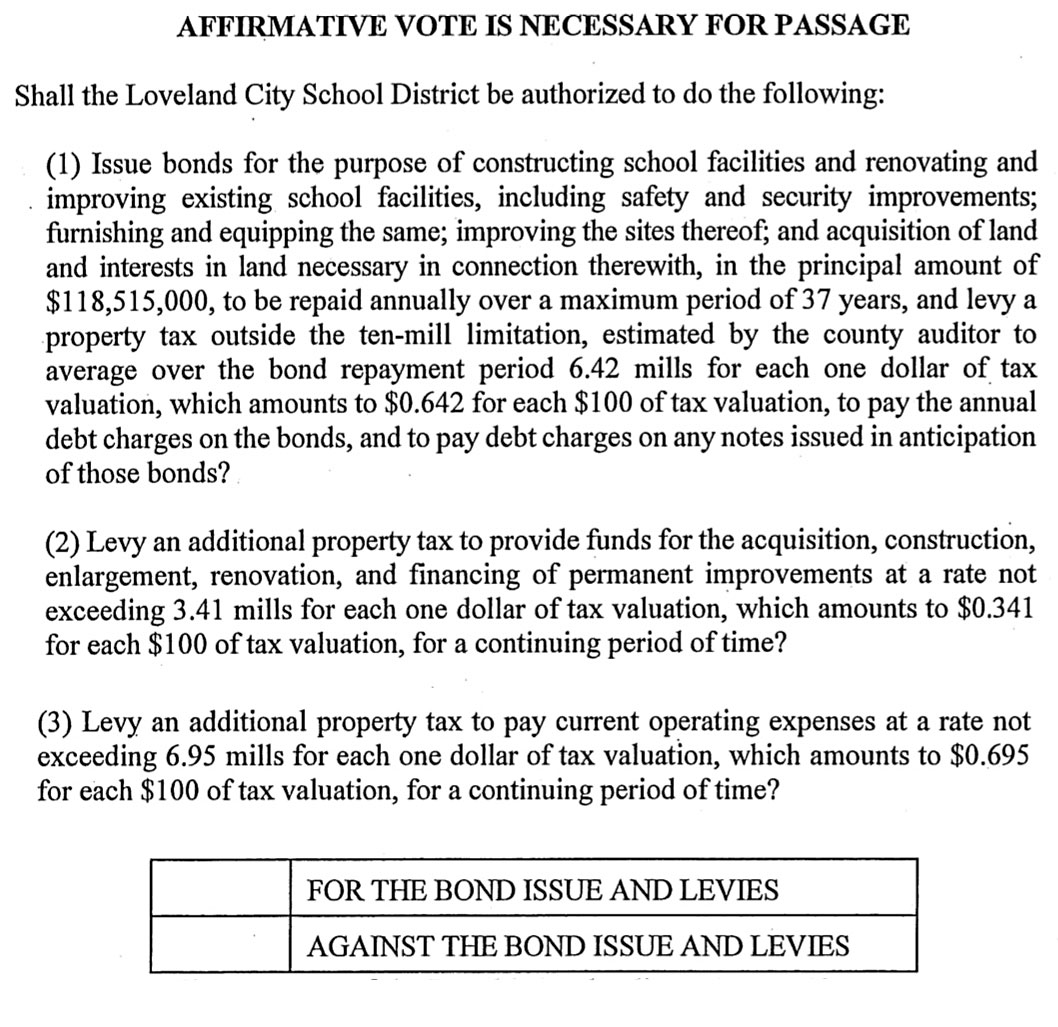
    The District will issue bonds for $118,515,000:

    “For the purpose of constructing school facilities and renovating and improving existing school facilities, including safety and security improvements; furnishing and equipping the same; improving the sites thereof; and acquisition of land and interests in land necessary.”

    The Bonds will be dated approximately December 1, 2019;and bear interest at the estimated rate of 4.00% per annum; and will be paid over a period not to exceed 37 years.

    The cost of the combined 16.78-mill levy translates into $49 monthly per $100,000 of appraised home value. If passed in November, collections will begin in 2020 according to the District.

    The Hamilton County Auditor has certified, to the Board, that the dollar amount of revenue that would be generated by the Combined Levy during the first year of collection is $9,096,111, based on the current tax valuation of the School District of $878,003,060.

    The last operating levy was for 5.6 mills and it was passed in May of 2014 with a 3,633 – 2489 vote. The District says it was a “four-year commitment” and they have stretched those dollars five and a half years. They say, based on their best projections at this time, they expect the new operating request to last at least three years. The operating levy provides operating money – energy bills, instructional costs including salaries and benefits, etc.

    “We have done our due diligence throughout the facility master planning process to investigate every possible avenue for reducing the cost to the taxpayer,” said Kevin Hawley, district treasurer/CFO. “We know for certain that the longer we put off a comprehensive approach to the facilities issues, the more expensive a solution will become.”

    The master plan outlines a new campus at Grailville for all Pre-K through fifth-grade students. It includes repairs, renovations, and additions to the Middle School/Intermediate School and High School campuses. The money will also be used for upgraded building security at all schools with secure entrances, camera systems, and electronically-activated locks. It includes upgraded and expanded science and technology laboratories for biotechnology and robotics, among others.

    Included in the master plan is a new auditorium/fine arts center at the high school. The current auditorium will be repurposed as academic space. The master plan also includes upgrades and enhancements to athletic facilities at both the Middle and High Schools.

    If the levy passes, approximately a year of designing and another year of construction will follow. The plan is to start the new campus construction first so that students (Pre-K-5th grade) can move into the new buildings in the fall of 2022. According to the plan, the additional repairs, renovations, and additions in the district are expected to be completed by 2025/2026.

    A new transportation facility, now at the Primary and Elementary Campus, is planned for a later phase.

    High School Athletic Field Enhancements

    •  New turf fields for baseball and softball
    ●  Additional turf multi-purpose field
    ●  New locker room and restroom facility
    ●  New ticket booth and gateway entrance
    ●  New concessions building
    ●  Possible field lighting and new home bleachers

    High School Addition

    •  New 1000-seat theater and support spaces
    ●  New secured main entrances with administration space
    ●  New large group collaboration and presentation space
    ●  Additional classroom spaces
    ●  Outdoor learning areas

    High School Renovation

    • Existing auditorium transformed into next-generation learning spaces for programs like robotics, computer science, makerspace, and science classes
    ● Enhanced mental health, counseling, and college and career areas
    ● Improved student circulation
    ● Increased student collaboration areas

    During the District’s planning process estimates were made to calculate ranges of cost for the Master Plan, however, no up-dated costs have been provided. The broad estimates provided in January are:

    • Renovations to the existing Intermediate/Middle School campus, renovations, and additions to the existing High School site, and constructing a new Pre-K through fifth-grade campus at Grailville will cost between 123 and 150 million and the milage range would be 7.37 – 9.02.

    (This does not include the price for the Grailville land where the campus would be built. The District has an “Option to Buy” contract with Grailville for the approximately 110-acre site for $70,000 per acre less the value of a conservation easement that may be put on a portion of the land.)

    Read: Grailville and School District Option to Purchase Agreement and Appraisal


    • New fine arts center at the existing high school would cost between $12 and $16 million. The millage range was estimated to be between .72 and .96.

    • Athletic Complex enhancements at the existing Middle and High School would cost between $5 and $7.5 million and a millage range of .3 – .45.

    Architects hired by the District developed the budget for the total project ($165 M). The District told Loveland Magazine, “How the money is allocated towards the different parts of the master plan will be determined by various factors, like current market costs of building materials or the community’s priorities within the design process.”

    You can read the full Resolution passed by the Board: July 26th resolution-1

    Pending Board of Election approval, below is how question will appear on the ballot.

    You can read more about the plans and the planning process at the Building Tiger Nation website.


    [RP Diamond Sale extended] Now Tax Free

    Buy some Tiger Wear! Beginning in 2019, Sub. S.B. 226 provides for a permanent sales tax holiday on the first Friday, Saturday, and Sunday of…
  • Learn how voters with disabilities can still vote

    Learn how voters with disabilities can still vote

    AVIL Logo Press Release OH.jpg

    “Voters with disabilities face very real barriers to the ballot and a critical piece of removing those obstacles is emphasizing that voters know they have the right to vote, regardless of their disability,” said Mike Brickner, State Director of All Voting is Local Ohio. “People may not realize that the law requires election officials to offer assistance and accommodations to any voter who needs it.”


    Disability Rights Ohio is mandated by the Help America Vote Act of 2002 (PL 107-252) to advocate for the rights of Ohio voters with disabilities and to assist the Secretary of State in fulfilling the Secretary’s obligations to those voters under the federal law. Through this program, Disability Rights Ohio:

    • educates individuals, communities, poll workers and boards of election about the voting rights of people with disabilities;
    • monitors and investigates complaints about polling place accessibility and privacy;
    • collaborates with other voting rights advocates for systemic change for people with disabilities;
    • participates in the implementation of provisions of the Help America Vote Act affecting people with disabilities; and
    • assists and represents individual voters in state-based administrative grievance processes.

    Resources

    The Ohio Secretary of State’s voter resource page: MyOhioVotes.com

    Forms to request to use Ohio’s remote absentee ballot marking tool for voters with vision impairments and other print disabilities: PDF version | HTML version

    Voter Rights and Assistance

    Early Voting

    Individuals with Disabilities and Voting: The Glancy Consent Order

    Is Your Polling Place Accessible?

    Protect Your Right to Vote

    Registering to Vote: Frequently Asked Questions

    Voting Rights: Frequently Asked Questions (February 2016)


  • Repeal of Hamilton County sales tax increase inches closer to ballot

    Repeal of Hamilton County sales tax increase inches closer to ballot

    Hamilton, County, Ohio – On June 18, Democratic County Commissioners, Todd Portune, and Denise Driehaus, voted to raise the Hamilton County’s sales tax by 0.2 percent for 18-months to balance the budget.

    Today a group of Hamilton County Republicans presented petition signatures of 38,000 residents to the County Auditor hoping that voters in November will prevent the tax from taking effect. In announcing their success they said they needed 23,629 valid signatures to get the Referendum on the ballot. The petitions will remain in the Auditior’s office for 10-days for public inspection and them go to the Board of Elections where the signatures will be checked for accuracy.

    Alex Triantafilou, the Hamilton County Republican Party chairman said in a press release today, “While the counting and confirming of the validity of these signatures will take several weeks, we are very pleased with the overwhelming support we received from every corner of Hamilton County and from citizens of all political stripes.”

    Todd Portune and Denise Driehaus said the County faces a $28 million structural deficit and they were not willing to lead a county that cannot provide basic services. They blamed actions of the State House for their budget woes.


    Paxton’s Grill

      Relaxed atmosphere and friendly service welcomes you back time and time again! Located in the heart of the Historic Loveland District Just outside Cincinnati, Ohio.
  • Libertarian Party statement on ballot access in Ohio

    Libertarian Party statement on ballot access in Ohio

    page1image1770464

    Libertarian Party of Ohio

    Media Statement: Ballot Access July 02, 2018, 14:00 EDT

    For further information, contact:

    Harold Thomas, LPO Chair harold.thomas@lpo.org (614) 581-6832

    David Jackson, Communication Director david.jackson@lpo.org
    (614) 560-1237

    July 2, The Libertarian Party of Ohio filed petitions containing 102,762 signatures with the Secretary of State to regain ballot access taken away from the citizens of Ohio four years ago because of Republican Party politics

    They intended to destroy the Libertarian Party in Ohio.

    But liberty and choice persevered. We have more volunteers and more enthusiasm than ever. Putting us through the political tricks has made us stronger.

    We are stronger knowing that 102,762 voters are signed their names to give Ohio more and better choices to address our economic and social issues. Ohioans want solutions, and sense that the way forward might lie in less government, instead of more. These petitions came from all 88 counties showing support from every part of this state. We are building from a broad base of voters from every economic level; all racial backgrounds; all faiths, and all sexual orientations, helping the ever-expanding diversity of our party.

    We know that establishment trickery will not end here. We have attorneys armed with the Constitutions of the United States and the State of Ohio. We know of some recent federal court decisions in other states that have made challenger party ballot access easier, not more difficult. Our attorneys are ready to deal with any obstacles they throw our way. However, we seek no fight, just open dialog and new ideas.

    The establishment parties will try to convince you that we are “Republicans-lite” or agroup of spoilers whose primary purpose is to throw elections one way or the other. Some will even try to make you believe that we are anarchists bent on social chaos. Don’t believe them. The Libertarian Party has members all around you and is the only party with a consistent philosophy and platform — one we have followed, faithfully, since our inception nearly 50 years ago. Our philosophy is based on this Golden Rule, which call it the “non-aggression principle.” No one, including government, has theright to use force to promote a political or social agenda. Government aggression should only be used to protect our lives, our property, and our rights from those who would kill, rob, and cheat us.

    Libertarians believe that government exists for one purpose, which Thomas Jefferson made clear in the Declaration of Independence. We are endowed with certain inalienable rights: life, liberty, and the pursuit of happiness, and that the purpose of government is to secure these rights. The framers of the Constitution reinforced the Declaration when they wrote in the Preamble that government’s purpose is to “establish justice, insure domestic tranquility, provide for the common defense, and secure the blessings of liberty to ourselves and our posterity.

    It is a government for adults who can make their own decisions, build their own careers, and have values they want to pass on to their children. Our political system is broken because we have forgotten that. We have allowed our politicians – at all levels –to behave like children, focusing on trivial issues, fighting the cultural wars of past generations, and doling out favors to their largest contributors.

    It’s time to stop this madness. It’s time to stop bickering and to start negotiating real solutions for Ohio. It’s time to engage in the politics of hope instead of the politics of fear. In this spirit, we will cooperate with members of the establishment parties and the Green Party on issues of mutual interest. Together, we can form policies designed to benefit all of us.

    On Saturday, July 14, we will introduce our slate of candidates to you and the people of Ohio. You will find that they represent a new generation of leadership with fresh ideas and a new perspective on governing our state.

    I invite you and all Ohioans to embrace the Libertarian Party and its candidates as we represent a true choice. We will not only show how to fix a broken system, and make it robust enough to secure the blessings of Liberty for ourselves and our posterity.

    -END-

  • Election day is one week away

    Election day is one week away

    Ohio Secretary of State Jon Husted today reminded voters the May 8 Primary Election is one week away, and the deadline to request a mailed absentee ballot is Saturday, May 5 at noon.
     
    This month, voters will weigh-in on a statewide ballot issue, a number of state and local races, as well as a total of 479 local issues across 83counties. You can view the list of candidates for statewide, congressional, state legislative, and court of appeals offices online at MyOhioVote.com. Information on local contests is available by contacting the county board of elections.
     
    Information on the statewide ballot initiative can be accessed on the Secretary of State’s website.
     
    The full, detailed and interactive 2018 elections calendar is available online.
     
    Absentee Voting by Mail and In-Person
    All Ohio voters wanting to cast an absentee ballot by mail must request one by Saturday, May 5 at noon and return it to the appropriate county board of elections’ office by 7:30 p.m. on Tuesday, May 8. Absentee ballots postmarked by May 7 will also be counted, but voters who choose to return their absentee ballot close to the deadline should consider delivering it to their county board of elections’ office to ensure it is counted. For more information on absentee voting, visit MyOhioVote.com.
     
    Secretary Husted has established uniform hours for in-person absentee voting to ensure all voters have fair and equal access to the ballot during the May 8 Primary Election. Ohio voters can vote over the course of four weeks, including the weekend before Election Day.
     
    Military & Overseas Voting
    Military voters who are already registered to vote, but have not submitted a request for an absentee ballot may still do so by visiting OhioMilitaryVotes.com, while overseas voters can visit OhioVoterPassport.com. There they can download the Federal Post Card Application and request an absentee ballot, read through frequently asked questions, track the status of their mailed ballot and sign up for election reminders via email and social media.
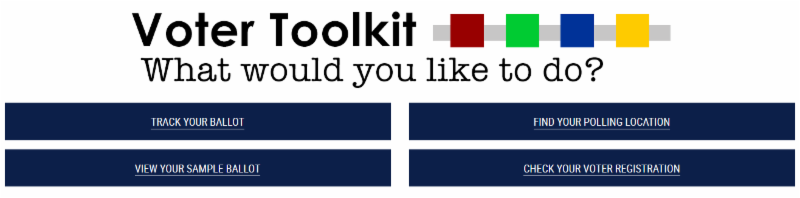
    Says Voter Toolkit on the top half and underneath says What would you like to do Bottom half has 4 boxes. Box1 says Track Your Ballot Box 2 says Find Your Polling Location Box 3 says View Your Sample Ballot and Box 4 says Check Your Voter Registration
     
    Voter Toolkit
    The online Voter Toolkit is a one-stop location for all necessary voting information. Ohio voters can visit MyOhioVote.com/VoterToolkit to check their voter registration status, find their polling location, view their sample ballot and track their absentee ballot.
                                                                         
    Get Election Updates and Ohio’s Virtual Voting Sticker
    All voters are encouraged to connect with “OhioSOSHusted” on Facebook and Twitter to get election information and updates throughout the year. Here they can also get a virtual voting sticker badge to let their friends and followers know they’ve participated in the Primary Election. Facebook users simply need to “like” Ohio Secretary of State Jon Husted’s official Facebook page to “wear” a virtual sticker on their wall. Twitter users may share their voting badge by visiting the Secretary of State’s website.
  • Loveland School levy predicted for May 2019 ballot

    Loveland School levy predicted for May 2019 ballot

    The future of Loveland City Schools

    Loveland Board of Education talks five-year forecast planning and Destination Loveland needs; looks to May 2019 as potential goal for action on both


    A statement from the District:

    The Loveland City School District’s five-year forecast projections show a need for the district to be back on the ballot in the future for an operating levy; during the September Board of Education Business Meeting, this was the information shared with Board Members. After careful consideration in committee meetings, the Board determined during public discussion at the October 17 Business Meeting to set a potential target of May 2019 to have a proposal ready for voters to consider.

    Loveland Treasurer/CFO Brett Griffith

    “When the Loveland City School District passed a 5.6 mill operating levy in May of 2014 we made a promise that the money from that levy would continue to fund the district until 2018, and that promise was maintained due to compelling overall fiscal stewardship of all district employees and fiscally conservative management of expenditures,” said Loveland Treasurer/CFO Brett Griffith. “Our need for an operating levy is very real, and I applaud this Board for taking the steps necessary now to properly plan for a financially stable future. Of course we will provide updates on details for this levy to our community as they are developed.”

    Additionally, during the 2016-17 and present school year, Loveland teachers, staff, administrators and the Board of Education put laser focus on three key areas: academic growth, classroom innovation and Tiger care in an effort to optimize the student experience for the 4,700 Tiger students the Loveland City School District serves. What developed from that focus was the Destination Loveland Task Force – a group of Loveland parents, community members and business leaders who joined educators, staff and administrators in developing future goals. This group spent the better part of the 2016-17 school year developing what the Loveland student experience should look like.

    Interim Superintendent Dr. Amy Crouse

    Now the Loveland Board of Education is ready to invest in putting a more formal structure and definite timeline to that important work. At the October 17 Board of Education Business Meeting, Board Members – after hearing reports from the facilities and finances committees – charged Loveland Interim Superintendent Dr. Amy Crouse and Loveland Business Manager John Ames with the task to begin to develop a plan for the future facility needs in line with district goals, coupled with a financial plan. The potential timeline is to have a proposal ready for voters to consider a bond issue by May 2019.

    “It is the development of a master plan for our district,” said Dr. Crouse. “Our facilities needs are district-wide and growing each new school year; it is both an issue that must be addressed now and an opportunity for the district to think and plan for the future. We will be working with a seasoned team accustomed to the size and scope of the planning that we need to do. This was the right move for the Board of Education, and I’m excited to take the process that was started last year to the next level.” 


    RP Diamond Printing & Embroidery

    RP Diamond is the exclusive retailer of LOVELAND HIGH SCHOOL SPIRIT WEAR Welcome to  RP Diamond Printing & Embroidery located at 370 Loveland Madeira Road


  • Watch Loveland School Board candidates face the public

    Watch Loveland School Board candidates face the public

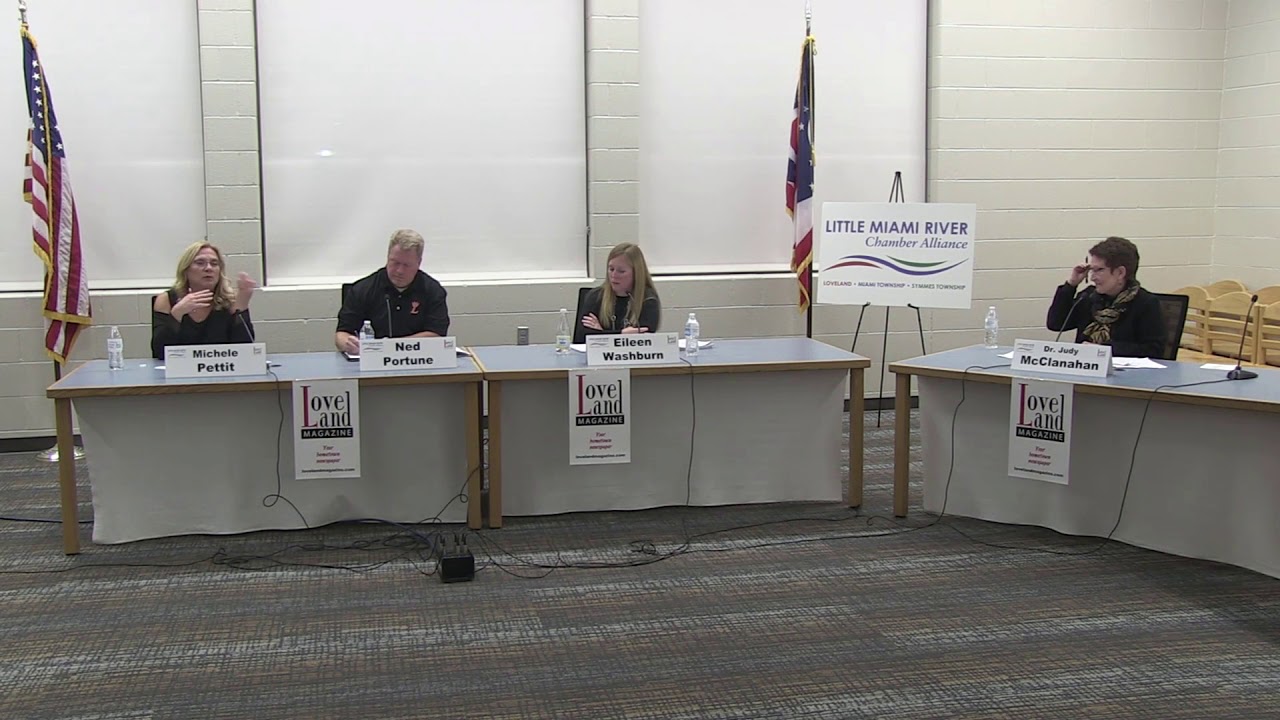
    Loveland, Ohio – Last Wednesday, Loveland Magazine partnered with the Little Miami River Chamber Alliance to bring the candidates for a seat on the Loveland School Board together at the Media Center of the Loveland Intermediate School to face voters and their questions. The forum was moderated by former Board President Dr. Judy McClanahan. She was elected to the Loveland Board of Education and subsequently served 12 years on the Board. During this time she served as President of the Board three times.

    Candidates, Michele N. Pettit, Ned Portune, and Eileen Washburn were in attendance. Dave Blumberg could not attend because of a previous business commitment. Three will be elected to a 4-year term.

    Here is the video of the forum. (Because of technical difficulties Pettit’s opening statement did not record. She repeated her statement for the camera after the forum concluded and that statement is added to the first video.)


    Trick-or-Treat Trade-In for the Troops at Loveland Sweets


    Donate Unwanted Halloween Candy to Operation Gratitude and Receive a 20% Discount at The Loveland Sweet Shoppe From November 1st through the 13th.


  • Meet the Candidates for Loveland School Board on Wednesday, October 25

    Meet the Candidates for Loveland School Board on Wednesday, October 25


    Loveland Chamber and Loveland Magazine partner to bring you Meet the School Board Candidates Night

    Loveland Middle School Media Center

    801 South Lebanon Rd.

    Wednesday October 25 at 7 PM

    Doors Open at 6:30 PM


    by David Miller, Publisher

    I am pleased that Loveland Magazine can partner this year with the Little Miami River Chamber Alliance to bring the candidates for a seat on the Loveland School Board together in one room to face voters and their questions. This election is certainly one of the most consequential for District voters in decades. The Board that sits in January 2018 will choose a new superintendent, make decisions about school facilities and crowded classrooms, and possibly be asking voters for more money within the next eighteen months.

    Voters will have the opportunity to meet the candidates at 6:30 PM and at 7 PM the candidates will begin presenting their case and asking for your vote.

    The forum will be moderated by former Board President Dr. Judy McClanahan. McClanahan and her husband Stephen have lived in the Loveland District for 31 years. McClanahan has a bachelor’s degree from the University of Kentucky in Pharmacy and a PH.D. from the University of Kentucky in Pharmaceutical Sciences.  She did her post-doctoral work at the University of North Carolina School of Pharmacy in Chapel Hill. She was active in the PTA and established a Publishing Center for the students in the elementary building. In 1997, she was elected to the Loveland Board of Education and subsequently served 12 years on the Board. During this time Judy served as President of the Board three times.



    LOVELAND MAGAZINE TV will be broadcasting the forum “live” on Loveland Magazine’s Facebook page, so, people that cannot be at the forum to meet the candidates in person, can watch it wherever they are. Folks can watch on their smartphones, tablets, computers, or even on the widescreen of their smart TV in their family room. Organize your own watch party.

    The forum will be rebroadcast on both our Facebook Page and at www.lovelandmagazine.com so folks can watch at any time leading right up to election day.

    Residents can comment in “real-time” on the Loveland Magazine Facebook page during the live broadcast or afterward by watching the re-broadcast.

    At the Forum, residents will be putting their questions into a “hat,” and all questions will be screened for duplicates. McClanahan will ask as many questions as time allows.

    CeeCee Collins, President of the Little Miami River Chamber Alliance said, “I feel it is important to allow the residents and voters to meet and ask questions prior to going to vote on November 7. Our intent is to provide the community the opportunity to ask questions and make an informed choice when voting.”

    Judge Brad Greenberg is the Presiding and Administrative Judge for the Hamilton County Municipal Court.

    There will be a similar Meet the Candidates Night for candidates for Loveland City Council on October 26, at 7 PM at the Loveland Middle School Media Center. Hamilton County Municipal Court Judge and former Loveland Mayor Brad Greenberg will be the moderator. 

    The doors will open at 6:30 PM on both nights.

  • Meet the Council Candidates Night on Thursday, October 26

    Meet the Council Candidates Night on Thursday, October 26

    Photo not provided by Stephen G. Zamagias

    Loveland Chamber and Loveland Magazine partner to bring you Meet the Candidates for Loveland City Council Night

    Loveland Middle School Media Center

    801 South Lebanon Rd.

    Thursday, October 26 at 7 PM

    Doors Open at 6:30 PM


    by David Miller, Publisher

    Will City Hall be demolished? One, two, or four-story? Who will be Loveland’s next Mayor? Who will be appointed to fill the remaining two-year term vacated by former mayor Mark Fitzgerald? Will pro-growth or slow growth protect our values and environment candidates be elected? Which candidates will be more transparent? Which candidates will have the best temperament when their actions are brought into question? Who will shorten your commute time? Who has the thickest skin and a pleasant disposition? Will new bosses be just like the old bosses?

    What would you like to ask those who want a special seat of trust at City Hall for the next four-years?

    I am pleased that Loveland Magazine can partner this year with the Little Miami River Chamber Alliance to bring the candidates for Loveland Council together in one room to face voters and their questions. Voters will have the opportunity to meet the candidates at 6:30 PM and at 7 PM the candidates will begin presenting their case and asking for your vote.

    LOVELAND MAGAZINE TV will be broadcasting the forum “live” on Loveland Magazine’s Facebook page, so, people that cannot be at the forum to meet the candidates in person, can watch it wherever they are. Folks can watch on their smartphones, tablets, computers, or even on the widescreen of their smart TV in their family room. Organize your own watch party.

    The forum will be rebroadcast on both our Facebook Page and at www.lovelandmagazine.com so folks can watch at any time leading right up to election day.

    Residents can comment in “real-time” on the Loveland Magazine Facebook page during the live broadcast or afterward by watching the re-broadcast.

    Judge Brad Greenberg is the Presiding and Administrative Judge for the Hamilton County Municipal Court.

    At the Forum, residents will be putting their questions into a “hat,” and all questions will be screened for duplicates by Pastor Bill Hounshell. Hamilton County Municipal Court Judge and former Loveland Mayor Brad Greenberg will be the moderator for the evening and ask as many questions as time allows.

    CeeCee Collins, President of the Little Miami River Chamber Alliance said, “I feel it is important to allow the residents and voters to meet and ask questions prior to going to vote on November 7. Our intent is to provide the community the opportunity to ask questions and make an informed choice when voting.”

    There will be a similar Meet the Candidates Night for  voters on, October 25, at 7 PM at the Loveland Middle School Media Center. The School Board Meet the Candidate Night will be moderated by former Board President Dr. Judy McClanahan. 

    The doors will open at 6:30 PM on both nights.