Month: October 2024

  • Loveland Trick-or-Treat Hours

    Loveland Trick-or-Treat Hours

    Loveland, Ohio – The City of Loveland’s trick-or-treat hours are 6 until 8 PM on October 31.

  • Reds & AGAR collaborate on Pete Rose mural for BLINK

    Reds & AGAR collaborate on Pete Rose mural for BLINK

    The Cincinnati Reds have teamed up with AGAR to create a mural honoring Reds Hall of Famer Pete Rose, just in time for BLINK Cincinnati, which runs from October 17-20.

    The mural, featuring Rose in his iconic “headfirst slide,” is painted on a building at the northwest corner of Elm and Magnolia Streets in Over-the-Rhine and celebrates the Hit King’s connection with the city and his hometown team.

    The Reds have partnered with several local artists, spearheaded by AGAR. Mural artists include:

    • Michael Thompson
    • The Dye Brothers

    • Chase Melendez

    • Luke Lehenbaurer

    • Sonny Day

    Mural Artwork by Doug Bunker and Natasha Croft.

    Also during BLINK, the statues at Great American Ball Park of Pete Rose, Johnny Bench, Joe Morgan and Tony Perez will be illuminated as part of the event’s light installations.

    The statue lighting has been designed by The Plant Trolley, Cincinnati’s premier plantscaping company. They are celebrating 50 years in business in Cincinnati.

    Read more about BLINK:

  • The role alcohol plays in new cancer cases – landmark new report

    The role alcohol plays in new cancer cases – landmark new report

    THIS ARTICLE IS republished from The Conversation under a Creative Commons license.

    The original source is The Conversation:  ___________

    A little bit of alcohol was once thought to be good for you. However, as scientific research advances, we’re gaining a clearer picture of alcohol’s effect on health – especially regarding cancer.

    The complex relationship between alcohol and cancer was recently highlighted in a new report from the American Association for Cancer Research. The report’s findings are eye-opening.

    The authors of the report estimate that 40% of all cancer cases are associated with “modifiable risk factors” – in other words, things we can change ourselves. Alcohol consumption being prominent among them.

    Six types of cancer are linked to alcohol consumption: head and neck cancers, oesophageal cancer, liver cancer, breast cancer, colorectal cancer and stomach cancer.

    The statistics are sobering. In 2019, more than one in 20 cancer diagnoses in the west were attributed to alcohol consumption, and this is increasing with time. This figure challenges the widespread perception of alcohol as a harmless social lubricant and builds on several well-conducted studies linking alcohol consumption to cancer risk.

    But this isn’t just about the present – it’s also about the future. The report highlights a concerning trend: rising rates of certain cancers among younger adults. It’s a plot twist that researchers like me are still trying to understand, but alcohol consumption is emerging as a potential frontrunner in the list of causes.

    Of particular concern is the rising incidence of early-onset colorectal cancer among adults under 50. The report notes a 1.9% annual increase between 2011 and 2019.

    While the exact causes of this trend are still being investigated, research consistently shows a link between frequent and regular drinking in early and mid-adulthood and a higher risk of colon and rectal cancers later in life. But it’s also important to realise this story isn’t a tragedy.

    It’s more of a cautionary tale with the potential for a hopeful ending. Unlike many risk factors for cancer, alcohol consumption is one we can control. Reducing or eliminating alcohol intake can lower the risk, offering a form of empowerment in the face of an often unpredictable disease.

    The relationship between alcohol and cancer risk generally follows a dose-response pattern, meaning simply that higher levels of consumption are associated with greater risk. Even light to moderate drinking has been linked to increased risk for some cancers, particularly breast cancer.

    Yet it’s crucial to remember that while alcohol increases cancer risk, it doesn’t mean everyone who drinks will develop cancer. Many factors contribute to cancer development.

    Damages DNA

    The story doesn’t end with these numbers. It extends to the very cells of our bodies, where alcohol’s journey begins. When we drink, our bodies break down alcohol into acetaldehyde, a substance that can damage our DNA, the blueprint of our cells. This means that alcohol can potentially rewrite our DNA and create changes called mutations, which in turn can cause cancer.

    The tale grows more complex when we consider the various ways alcohol interacts with our bodies. It can impair nutrient and vitamin absorption, alter hormone levels, and even make it easier for harmful chemicals to penetrate cells in the mouth and throat. It can affect the bacteria in our guts, the so-called microbiome, that we live with and is important for our health and wellbeing.

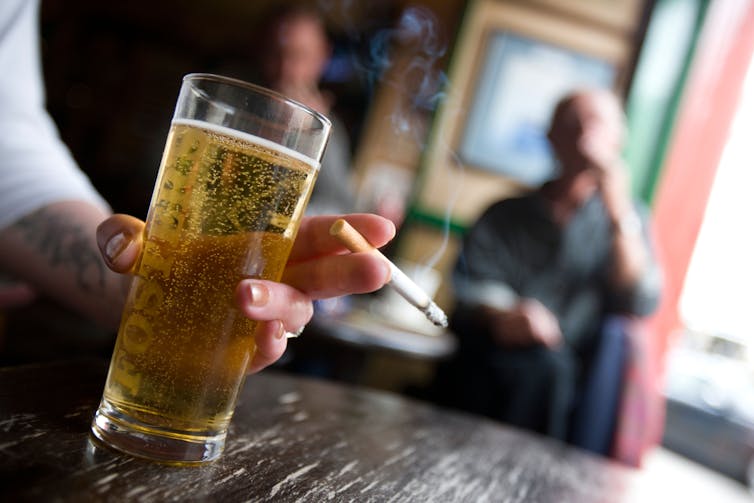
    Alcohol consumption is also linked to other aspects of our own health and lifestyle and it’s important not just to consider this alone. Tobacco use and smoking, for instance, can significantly amplify the cancer risks associated with alcohol. Genetic factors play a role too, with certain variations affecting how our bodies metabolise (break down) alcohol.

    A person's hand holding a pint of beer and a lit cigarette.
    Smoking amplifies the cancer risk of drinking alcohol. Roy Riley / Alamy Stock Photo

    Physical inactivity and obesity, often associated with heavy drinking, also separately increase cancer risks but on top of alcohol makes this much worse. Despite this, misconceptions persist. The type of alcoholic beverage, be it beer, wine, or spirits, doesn’t significantly alter the cancer risk. It’s the ethanol (the chemical name for alcohol) itself that’s carcinogenic (cancer-causing).

    And while some studies have suggested that red wine might have protective effects against certain diseases, there’s no clear evidence that it helps prevent cancer.

    The potential risks of alcohol consumption probably outweigh any potential benefits. The takeaway is not that we should never enjoy a glass of wine or a beer with friends. Rather, it’s about being aware of the potential risks and making choices that align with our health goals. It’s about moderation, mindfulness and informed decision-making.

    Alcohol has lots of effects not just in terms of causing cancer. A recent large study of over 135,000 older drinkers in the UK has shown that the more people drink, the higher the risk of death from any cause.

    These and similar findings underscore the importance of public awareness and education about the potential risks associated with alcohol consumption. As our understanding of the alcohol-cancer link grows, it becomes increasingly clear that what many consider a harmless indulgence may have more significant health implications than previously thought.

    Unfortunately, not many people appear to be aware of these risks. In the US, around half of people don’t know that alcohol increases the risk of cancer. Clearly, a lot of work needs to be done to overcome this lack of awareness.

  • Accessible curbside voting in Hamilton County

    Accessible curbside voting in Hamilton County

    Independence Alliance worked with the Hamilton County Board of Election (BOE) to update their curbside voting policies to be more accessible. Previously, voters needing an accommodation to vote outside of the polling place were required to bring an additional person with them. This person would then need to enter the voting location to inform poll workers about someone needing to vote curbside.

    With the updated policies, curbside voters will now be able to use this accommodation and vote from their vehicle without bringing someone else with them. There will be a designated parking spot for curbside voters, with a sign listing one or two phone numbers to call and inform the polling center you have arrived and are ready to vote. Two poll workers of opposing political parties will come to your vehicle and proceed with the voting procedure.

    If you have questions about curbside voting or other accommodations, contact the Disability Rights and Advocacy Specialist.

    Voting at Your Polling Location

    A voter with a disability, or a voter who is unable to read or write, may be assisted by anyone of the voter’s choice, except a candidate whose candidacy is being voted on in that precinct, the voter’s employer or the employer’s agent, or an officer or agent of the voter’s union. A voter may be assisted by two poll workers (each of a different political party). No one who assists a voter may disclose any information about how that person voted.

    In addition, each polling place has an Access Station that is equipped with audio voting instructions, has larger print, and can accommodate tactile switches and sip-and-puff devices so voters may vote privately and independently.

    A voter with a disability who is unable to enter the polling location, may request poll workers provide a ballot curbside and vote from their car.

    Accessible Voting Equipment (Access Station)

    Voting Remotely

    A voter with a qualifying disability under the Americans with Disabilities Act may vote remotely using the Board of Elections’ remote ballot marking system. Complete the application below and return to the BOE.

    Application for Voter with Disability & Request to Use Remote Ballot Marking System (11-G)

    Voter Process:

    1. Complete an 11-G Application for access to the remote Absentee ballot. (Voter must provide Email)
    2. Voter will receive an email from the BOE with a link to their remote AV ballot along with the 12-N ballot instructions with the 12-A Identification envelope and return envelope. (BOE will also send envelopes by mail)
    3. Once the ballot is completed, a voter must print the ballot and return the ballot to the BOE by mail or in our 24-hour drop box.

    Voter requirements:

    • Computer
    • Printer
    • Internet access
    • Email address
    • Screen reader software or a sip and puff device
    • Operating System – older computers that do not support new windows may not support the system.
  • Download BLINK Insider & Win a 21C Getaway

    Download BLINK Insider & Win a 21C Getaway

    Download the ArtsWave App and unlock the BLINK Insider by October 20 and not only will you gain access to exclusive behind-the-scenes BLINK content, you’ll be entered to win a 21C weekend getaway in downtown Cincinnati!

    ____________

    October 17 – 20, 2024
    Cincinnati, Ohio

    BLINK¼ illuminated by ArtsWave, is the nation’s largest public light and art event.

    From its first event in 2017, BLINK’s founding team sought to nurture a sense of community and connection through public art. They came together, a collection of creatives, entrepreneurs, local artists, art enthusiasts and arts supporters, wanting to show Cincinnati what a future city could be – through an unforgettable art experience. They also wanted to show the world what Cincinnati had to offer, to solidify it as a hub of creativity, forward-thinking conversations, and aspirational ideas. Light was the medium. It is fundamental to the human experience. It connects us all. It can illuminate a path toward inclusion and possibility. What they didn’t know was how much connection it would drive. How it would light up a city, the humans within it and become a beacon of light for our city and beyond.

    Now in its fourth iteration, BLINK has become more than a gift to the city. It attracts artists from around the globe who believe in its mission. It attracts over 2 million people who walk the city’s blocks in wonder and amazement. It crosses a river and connects a region. It provides a $126 million economic impact to our region. But it also still connects us. 

    We welcome everyone to experience the light, the art, and our community.

    BLINK is FOR THE PEOPLE. BY THE ARTISTS. 

    _______________

    What do I get?

    The getaway includes a two-night stay at the 21C Museum Hotel in the one-of-a-kind Nightwatch Room, $100 at Metropole for an amazing dinner, and two tickets to a local theater production.

    How do I enter?

    First, download the ArtsWave App, the region’s one-stop calendar for arts & entertainment. Then unlock the in-app BLINK Insider (free for ArtsWave Pass members or a one-time $10 donation for non-members). That’s it!

    Why do I want the BLINK Insider?

    The BLINK Insider is best way to experience BLINK. It includes pointers by BLINK’s Executive Director, sneak peek and artists interview videos, find out where to park, restroom stops, itineraries for every day of the festival and the music line-up at the click of a button.

    Download the free ArtsWave App today to make your BLINK plans and enter to win!


  • FirstEnergy gave heavily to Trump and Trump worked for a federal bailout, report says

    FirstEnergy gave heavily to Trump and Trump worked for a federal bailout, report says

    The Republican presidential nominee, former President Donald Trump. (Photo by Win McNamee/Getty Images)

    By:  – Ohio Capital Journal

    As it sought a massive, corrupt bailout in Ohio, Akron-based FirstEnergy also spent lavishly on Trump-aligned dark money groups and at hotels and golf courses owned by the former president, a new report said this week.

    Trump and his aides wanted to provide a federal bailout for the company’s coal and nuclear plants, but they hit a brick wall — first in the form of a regulator, and then by public opposition to corporate bailouts, the report said.

    Done by the Energy and Policy Institute, the report is a deep dive into otherwise-secret records that have been pried out as a result of prosecutions and litigation around the Ohio bailout scandal. Called one of the biggest bribery scandals in Ohio history, FirstEnergy funneled $61 million through dark money groups to pass a $1.3 billion ratepayer bailout through the state’s gerrymandered legislature and then protect it from popular opposition.

    Former Ohio House Speaker Larry Householder is serving a 20-year federal prison sentence as a consequence of his involvement, former state Republican Party Chair Matt Borges is serving five years and two others have pleaded guilty and await sentencing. Two others were charged and then died by suicide.

    Former FirstEnergy CEO Chuck Jones and Vice President Michael Dowling face state felony charges related to their involvement in the scandal. Testimony during last year’s federal trial in Cincinnati showed that the pair were desperate for a bailout anywhere they could get one.

    FirstEnergy was heavily invested in coal and nuclear generation when the natural gas boom and the advent of cheap renewables made them uncompetitive. In other words, FirstEnergy’s millionaire leaders had made poor business decisions, and they wanted to escape the consequences.

    So by 2016, the executives were seeking bailouts to prop up the plants so they could spin them — and their environmental liabilities — off.

    Starting in 2015, FirstEnergy had already contributed $1.25 million to the Cleveland Host Committee to support the 2016 Republican National Convention in that city.

    Then, nine days after Trump became the party’s nominee, FirstEnergy CEO Jones met on July 28, 2016 with Trump at Trump Tower. The two discussed electricity generation and how Trump could deliver on his “promise to save coal jobs,” according to a letter the Energy and Policy Institute obtained.

    Some time after, Jones met Trump at a Canton fundraiser where Jones “did explain to Mr. Trump that while I was working behind the scenes to help his campaign, because of a (regulatory proceeding) in Ohio I could not be out front and he completely understood that,” Jones said in an email detailed in the report.

    Trump’s campaign didn’t respond to questions for this story.

    By late 2016, Jones and Dowling were courting Householder at World Series games in Cleveland. And after Trump’s election, they flew the now-imprisoned former speaker to Washington, D.C. aboard FirstEnergy’s corporate jet for Trump’s January 2017 inauguration.

    By April 2017, FirstEnergy had engaged Avenue Strategies — a lobbying firm founded by former Trump Campaign Manager Corey Lewandowski — to help it get “federal relief for nuclear and coal-fired plants,” the Energy and Policy Institute report said. The following month, Lewandowski stepped away from the firm amid accusations that he was violating federal lobbying laws by not registering, Politico reported.

    Lewandowski, who is again working for Trump, later denied that he lobbied on FirstEnergy’s behalf.

    On May 1, 2017, FirstEnergy started really putting money into its efforts, paying $5 million to America First Policies, a 501(c)(4) dark money group founded and run by supporters of Trump. The company financed its bribes in Ohio by pumping tens of millions through such groups, which don’t have to disclose their donors.

    As Jones undertook his charm offensive, he used FirstEnergy money to enrich Trump personally. His expense reports show that on a July 2017 trip to Washington, D.C., Jones spent $1,400 on drinks, another $5,400 for dinner and $900 for a room at the Trump International Hotel, as well as $400 on caddie fees at the Trump National Golf Club.

    And as he spread around the FirstEnergy largesse, Jones had broad interactions with Trump officials. They include Vice President Mike Pence, EPA Administrator Scott Pruitt, Chief of Staff Rick Dearborn, Chief Strategist Steven Bannon, White House Counsel Don McGahn, Energy and Environmental Policy Advisor Mike Catanzaro, and National Economic Council Director Gary Cohn and Deputy Director Jeremy Katz, according to documents assembled by the Energy and Policy Institute.

    To save FirstEnergy’s power-generating subsidiary from bankruptcy, then-Energy Secretary Rick Perry in September 2017 proposed to allow special subsidies for coal and nuclear plants.

    The Federal Energy Regulatory Commission rejected the proposal in early 2018, saying allowing it would upend wholesale markets for electricity generation. In other words, the regulator said it would give unfair special treatment to FirstEnergy and other companies that missed the boat on fracking and renewables.

    In June 2018, Trump ordered Perry to use a provision in the Defense Production Act to prop up coal and nuclear energy — a step that could cost as much as $11 billion a year. That effort also collapsed as the (correct) public perception grew that both measures proposed by the Trump administration were corporate bailouts, the Energy and Policy Institute report said.

    In 2018, Perry called on the states to bail out their own coal and nuclear plants.

    Ohio did just that with the corrupt House Bill 6. Householder shepherded it through Ohio’s gerrymandered legislature and Gov. Mike DeWine signed it immediately.

    Prosecutors haven’t accused them of wrongdoing, but DeWine, Lt. Gov. Jon Husted, Attorney General Dave Yost and Secretary of State Frank LaRose all played roles in the passage and protection of the billion-dollar bailout that they haven’t fully explained.

    For its part, FirstEnergy entered into a deferred prosecution agreement with the Justice Department, admitted wrongdoing and paid a $230 million fine. It fired Jones and Dowling and now says it has new ethical standards.

    However, a group of institutional investors suing the utility accuse it of trying to limit accountability to the two former top executives, Jones and Dowling.

    FirstEnergy spokeswoman Jennifer Young was asked whether FirstEnergy thought it was proper to enrich Trump-aligned groups and Trump personally as it sought taxpayer bailouts from his administration. She was also asked whether it was proper for a regulated utility to — as Jones claimed — play political kingmaker for the ratepayers the utility serves.

    “While we’re unable to respond to your specific questions due to ongoing litigation, it’s important to note that in early 2022, FirstEnergy Corp. adopted a new Political & Public Engagement Policy and Practice grounded in integrity and transparency to ensure principled political and public policy engagement by its Board of Directors, officers, employees, and those acting on the company’s behalf,” Young said in an email. “Positions we take will align with the company’s core values and responsibilities to shareholders and other stakeholders.”

    She added, “Led by a reconstituted Board of Directors and executive team, FirstEnergy has taken significant steps to move the company forward and put past issues behind us. Today, FirstEnergy is a different, stronger company with a sound strategy, a highly effective compliance program and a companywide culture of ethics, integrity and accountability.”


    Marty Schladen
    Marty Schladen

    Marty Schladen has been a reporter for decades, working in Indiana, Texas and other places before returning to his native Ohio to work at The Columbus Dispatch in 2017. He’s won state and national journalism awards for investigations into utility regulation, public corruption, the environment, prescription drug spending and other matters.

    Ohio Capital Journal is part of States Newsroom, the nation’s largest state-focused nonprofit news organization.

    MORE FROM AUTHOR

  • State Fire Marshal Lifts Ban on Open Burning

    State Fire Marshal Lifts Ban on Open Burning

    Columbus, Ohio – Working in collaboration with the Ohio Department of Natural Resources, Ohio State Fire Marshal Kevin Reardon has issued an order lifting a Ban on Open Burning that was initially ordered on Sept. 6, 2024, in response to extremely dry conditions in much of the state.

    While drought conditions persist in parts of the state, the onset of moderate fall temperatures and atmospheric conditions and recent sustained rains that have fallen across the state have provided enough moisture to create a significant and sustained reduction in wildfire fuel loads during the first part of October. Most importantly, those reduced wildfire fuel loads are not projected to increase back to the dangerous levels observed in September for the foreseeable future. Specifically, broad areas of the state that received measurable amounts of rain have seen grass return to green, and heavier wildland fuels like larger sticks and logs have had the opportunity to soak up moisture, substantially lessening the risks of uncontainable wildfires.

    The Ban on Open Burning that was in place for the past month relied heavily on the US Drought Monitor, which focused on overall long-term drought conditions. An additional and proven index to examine regarding drought-related wildfire risks is the Keetch Byram Drought Index (KBDI), which links precipitation effects to wildfire fuel availability and is founded in the concept that fuels with less moisture burn more actively and fuels with more moisture burn with less intensity, or potentially not at all.

    The hot, dry summer and early fall conditions led to extreme and exceptional drought conditions as noted in the US Drought Monitor, as well as very high KBDI values, meaning wildfire fuels were exceptionally dry. This created many problems related to wildfire dangers: grass was withering and dry and very receptive to ignition; large logs were very dry and ready to burn with extreme intensity; and organic materials on and in the ground had very little moisture.

    The early October rain provided enough moisture across many parts of the state to allow the KBDI and wildfire moisture levels to recover to a more average range for this time of year. Additionally, the cooler, fall-like weather that has moved into the state has a less dramatic drying influence on fuels and has also helped fuels recover from the extreme drought conditions.

    “Factors we look at are the burnability, or how easy it is to ignite those fuels that are on the ground,” said State Fire Marshal Kevin Reardon. “When those fuels are drier, they will obviously ignite faster. When there is more moisture, that changes their ignitability quite a bit. There’s a lot that goes into this, but it simply boils down to how easy is it to start a fire on the ground.”

    While the Fire Marshal’s Ban on Open Burning has been lifted, if drought conditions worsen and KBDI values return to concerning levels, the ban could be reinstated in areas of concern.

    For those who want to burn during unrestricted hours, the Division of State Fire Marshal encourages them to do so cautiously and to have a source of water and tools on hand in case they are needed. Fires should never be left unattended.

    “Think about the ground conditions where you’re at, if the ground is very dry, any fire you have could spread quickly and easily,” Reardon said. “We ask all Ohioans to be careful, think before starting a fire, and to be fire safe.”

    “Ohio law dictates that most outdoor burning is prohibited in unincorporated areas from 6 a.m. to 6 p.m. during October and November,” said ODNR Division of Forestry Fire Prevention Manager Aaron Kloss. “In addition, make sure you are aware of any other open burning restrictions that might be in place, including Ohio EPA or any local fire department regulations, and be sure to never burn on dry and windy days, even during an unrestricted time.”

    The Ohio Department of Natural Resource’s normal annual burning restriction is found in the ORC 1503.18c and prohibits most open burning between 6 a.m. and 6 p.m. in unincorporated areas in Ohio. This restriction is in place every fall from October 1 to November 30, and every spring from March 1 to May 31.

    Any local burn bans put into place by local jurisdictions will remain in effect unless lifted by that jurisdiction.

  • Joe Burrow Is Having a MVP Season – The Bengals Cannot Let It Go to Waste

    Joe Burrow Is Having a MVP Season – The Bengals Cannot Let It Go to Waste

    by Chris Ball

    Loveland, Ohio – Bengals fans have had to watch in agony as two of Joe Burrow’s seasons came to terrible ends due to injuries. In 2020 it was several torn knee ligaments against Washington in week 11. Last year it was yet another week 11 injury, this time a season-ending ligament tear in his wrist. But if there is one thing that the Bengals quarterback knows how to do, it is battle back to be even better.

    Burrow returned in 2021 to throw for over 4600 yards and guide the team to their first Super Bowl in decades, which they were one play away from winning. He led the NFL in completion percentage (70.4%) and yards per attempt (8.9). Cincinnati was 10-6 that year and Burrow won the NFL Comeback Player of the Year Award.

    But his comeback tour in 2024 is even more awe-inspiring. He leads the league in touchdown passes (12) and quarterback rating (113.6) and he’s second in completion percentage (72.3). Burrow is also excelling at throwing the ball downfield as he also is front of the pack when it comes to passes of over 40 yards.

    It’s a testament to how well both Tee Higgins and Ja’Marr Chase are playing in that Burrow is also the highest graded quarterback on passes over 10 yards. He boasts a 94.9 rating on such throws:

    There’s little doubt that Burrow is seeing the field better than at any point in his career. But there are other components to it. He has the best-performing offensive line that Cincinnati has seen in recent memory. He has fully healthy weapons on the outside in Chase and Higgins. The Bengals’ running game is more consistent and explosive than in prior years.

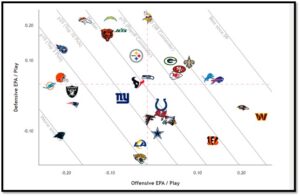
    Take all of that and you get a Bengals team that is 7th in total offense and 6th in yards per play. The one thing that Joe Burrow does not have, to all of our sorrow, is a serviceable defense. As you can see from the chart below, the Bengals are near the top of the league in offensive expected points added. On the other hand, their defense is near the bottom in that same metric.

    Cincinnati is 26th in yards per game allowed (365.4), 18th in passing allowed (214.0) and 30th in rushing allowed (151.4). They are fourth worst in the NFL in scoring percentage, in that their opponents score points on almost 50 percent of their drives. By contrast, in 2022 the Bengals had the 7th best defense in yards per game, on route to 12 regular season wins.

    What it all seems to add up to is a giant missed opportunity. The 2024 Cincinnati Bengals have a bevy of offensive weapons. They are young, they are healthy, they are talented, and they are absolutely motivated. The effort, focus, and execution is present at every level: blocking, running, tackling, and receiving.

    But without a defense to back them up, Cincinnati’s offense can only do so much to win shootout after shootout. When a game comes down to who has the ball last, sometimes you just don’t have enough firepower to get the job done. It was what we all saw on Sunday against the Baltimore Ravens. Joe Burrow was amazing, Ja’Marr Chase was electric, and Tee Higgins hauled in first down catch after first down catch.

    Burrow has talked previously about how he has to be “perfect” in order to win games. While that’s a near impossible task for any NFL player, especially at the quarterback position, it’s unfortunate to say that he’s not far off in his messaging. With a defense as porous as Cincinnati has at the moment, nearly flawless games (like the one we saw against the Ravens) aren’t even good enough to come away with a victory, as patently unfair as that is.

    In the NFL, where windows of success can slam shut so quickly, it is absolutely criminal to waste a MVP year from Joe Burrow simply because a defense fails to show up game in and game out.

    That being said, there is a chance for the defense to play better and gain confidence. Before the Bengals head to Baltimore in week 10 for a rematch against the Ravens, they face the Giants (20th in yards per game), Browns (dead last at 32nd), and Raiders (24th). They also square off against the Eagles who have the 8th rated offense, but who are reeling at the moment. Those are legitimate chances to turn the defense around and find success, which Lou Anarumo can hopefully build upon before facing Baltimore again. The season is not over yet, and Trey Hendrickson, Cam Taylor-Britt, and the rest of the Bengals’ defense can make that very clear by making a statement, starting with Sunday Night Football against Daniel Jones and the New York Giants.

    If Joe Burrow can come back from prior struggles to set the league on fire, why can’t the Bengals’ defense?

    ———————-

    Hey readers
 have an opinion about sports? How about a topic you’d like to see written about in Loveland Magazine or a thought about one of our articles?

    Just need to vent and get out your frustration about the Reds, Bengals, or any other sports issues?

    Feel free to share with an email to lovelandmagazinesports@gmail.com!

    We would love to hear from our readers, and we thank you for your support and engagement.

    Also, don’t forget to follow us at The Loveland Sports Desk at the below links:

    For Facebook, click here.

    For X, click here.

    For Instagram, click here. 


    Christopher Ball is a longtime Loveland resident and an attorney. He graduated from Loveland High School in 2003 and was a member of the football team before going on to become a coach’s assistant at DePauw University in Greencastle, Indiana. He has been following and rooting for the Reds and Bengals since the early 1990s and has been through the many ups and downs that fandom has wrought over the years.

  • New Episode: The Queen City Sports Podcast by Chris Ball & Mark Raines

    New Episode: The Queen City Sports Podcast by Chris Ball & Mark Raines

    by Chris Ball

    Loveland, Ohio – What role did Zac Taylor’s play calling have in the Bengals’ heartbreaking loss this past week against the Baltimore Ravens? Chris and Mark discuss how the Bengals abandoning Joe Burrow and their passing attack at the most crucial moment of the game impacted its end. The guys also discuss what the Bearcats can expect when they take on UCF this weekend, and how Michigan’s quarterback woes may be improving, but their play at the position is far from adequate. The Bearcats basketball squad is also in the top 15, at least by the evaluation of one key prognosticator. Finally, Chris and Mark talk about the Reds’ recent hiring of veteran manager Terry Francona and the impact it will have on the 2025 season.


    Have a listen and don’t forget to leave your comments and feedback!

    _______________________

    Hey readers
 have an opinion about sports? How about a topic you’d like to see written about in Loveland Magazine or a thought about one of our articles?

    Just need to vent and get out your frustration about the Reds, Bengals, or any other sports issues?

    Feel free to share with an email to lovelandmagazinesports@gmail.com!

    We would love to hear from our readers, and we thank you for your support and engagement.

    Also, don’t forget to follow us at The Loveland Sports Desk at the below links:

    For Facebook, click here.

    For X, click here.

    For Instagram, click here. 


    Christopher Ball is a longtime Loveland resident and an attorney. He graduated from Loveland High School in 2003 and was a member of the football team before going on to become a coach’s assistant at DePauw University in Greencastle, Indiana. He has been following and rooting for the Reds and Bengals since the early 1990s and has been through the many ups and downs that fandom has wrought over the years.

  • Ohio Department of Commerce Issues Consumer Alert Following MoneyGram Data Breach

    Ohio Department of Commerce Issues Consumer Alert Following MoneyGram Data Breach

    The Ohio Department of Commerce Division of Financial Institutions (DFI) has issued a Consumer Alert to Ohio residents who have used services provided by MoneyGram following a recent cyber-attack. The money transmitter, who is licensed with DFI, currently operates in over 200 cities across Ohio.

    The breach occurred between Sept. 20-22, 2024 and involved an unauthorized third party to access and acquire sensitive personal information from certain MoneyGram customers.

    According to a statement from MoneyGram, the compromised data includes names, contact information, dates of birth, Social Security numbers, government-issued identification documents, bank account numbers, transaction information and, for some individuals, criminal investigation information.

    The company says immediate steps have been taken to contain the breach, and an investigation is currently underway with the assistance of cybersecurity experts and law enforcement.

    “While cyberattacks are increasingly common, the impact of those attacks on consumers can be limited if those who are impacted take the appropriate measures, and do so quickly,” DFI Deputy Superintendent Ingrid White said. “By taking steps such as regularly and closely reviewing financial statements and credit reports to identify unauthorized transactions or accounts, individuals can help protect themselves from becoming the victim of identity theft and potentially experiencing significant financial loss.”

    MoneyGram has pledged to provide affected U.S. consumers with two years of complimentary identity protection and credit monitoring services. Their systems have since resumed normal operations.

    Meanwhile, Ohioans who have used MoneyGram’s services may consider taking the following steps:

    Review Financial Statements and Credit Reports 

    Stay alert to any unauthorized transactions by regularly checking all financial statements. Free weekly credit reports can be obtained through www.AnnualCreditReport.com.

    Consider Freezing Your Credit

    A security freeze prevents prospective creditors from accessing your credit file, hindering identity thieves from opening new accounts under your name. For additional assistance with freezing your credit, individuals may consider contacting the three major credit reporting bureaus for assistance:

    • Equifax: (800) 685-1111
    • Experian: (888) 397-3742
    • TransUnion: (888) 909-8872

    For Identify Theft Victims

    If you believe you’re the victim of identity theft, visit the Federal Trade Commission’s (FTC’s) website at www.IdentityTheft.gov to access resources and step-by-step instructions on how to recover from identity theft. For individuals affected by data breaches, specific guidance from the FTC is available here.