Year: 2024

  • Black history is on my mind

    Black history is on my mind

    David Miller is the Managing Editor of Loveland Magazine

    Commentary

    The total value of slaves, as an asset, far out weighted the value all other assets owned by Americans in the U.S. and the cost in terms of personal tradgedy cannot ever be measured.

    by David Miller

    Loveland, Ohio – I’m self taught, however a dedicated student of Black History as it has played out since captive humans were brought to this continent below the level of the sea in cargo ships.

    Black History is every American’s history.

    I came across another documentary today titled Underground Railroad: William Still Story. I watch a lot of PBS documentaries via the app I have loaded into my Amazon Fire Stick. I highly recommend it. You will find Ken Burns (Muhammad Ali, Jazz, Jackie Robinson, The Central Park Five), current affairs, and the newest Frontline broadcast as well as their archives. There is a virtual endless offering of stories about American history and American people.

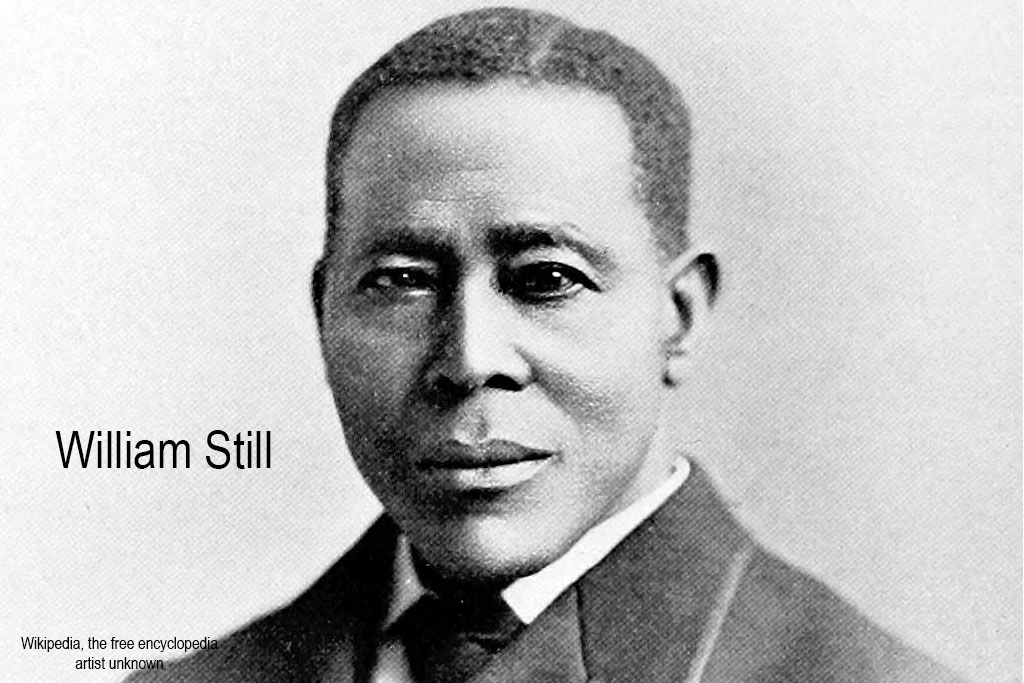
    “The Williams Still Story is the story of a humble Philadelphia clerk who risked his life shepherding runaway slaves to freedom in the tumultuous years leading up to America’s Civil War. William Still was the director of a complex network of abolitionists, sympathizers and safe houses that stretched from Philadelphia to what is now Southern Ontario.”

    He was a conductor of the Underground Railroad and was responsible for aiding and assisting at least 649 slaves to freedom towards North. (1)

    The other documentary I talk about in this very brief video introduction is The 1619 Project starring Hulu six-part docuseries and and expands on “The 1619 Project” created by the Pulitzer Prize-winning journalist and New York Times Magazine. The series seeks to “reframe the country’s history by placing the consequences of slavery and the contributions of Black Americans at the very center of our national narrative.”

    (1) Wikipedia the Free Encyclopedia

    ________________

  • 5 Things To Watch In 2024: Cincinnati Reds Edition

    5 Things To Watch In 2024: Cincinnati Reds Edition

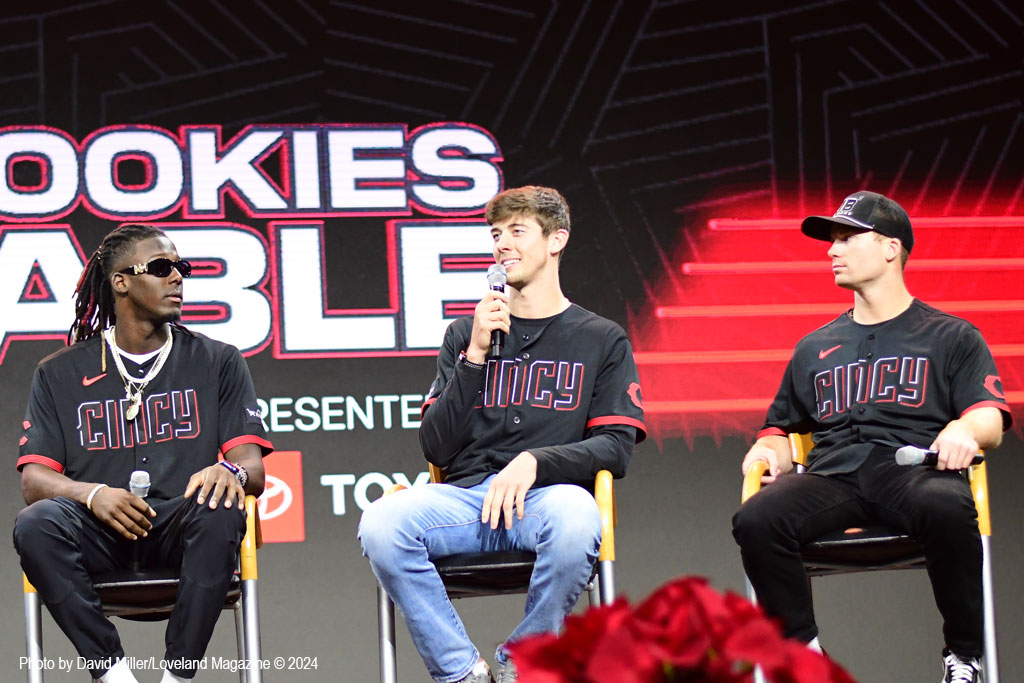
    Elly De La Cruz, Brandon Williamson, and Matt McClain on the Rookies Roundtable at Redsfest in December.

    Photo by David Miller/Loveland Magazine © 2024

    The training wheels are off!

    by Chris Ball

    Loveland, Ohio – Before the 2023 season there were many who believed the Reds might lose 90-100 games after going 62-100 in 2022. Most gave them virtually no chance to even have a relevant season and were simply counting down the days until the Bengals’ season rolled back around. 

    And the beginning of the ’23 season did very little to change those perspectives. There were rumors that the gates were opening and that the Reds were turning their young players loose on the major leagues. And why shouldn’t they? It was a lost season anyways. 

    Matt McClain

    Matt McClain was the first, to be eventually followed by the likes of Christian Encarnacion-Strand, Andrew Abbott and Noelvi Marte. The league likely expected these rookies to take their time adjusting the the big leagues, but they shattered expectations by, in many cases, playing well above their age and experience levels. And no one epitomized this more than Elly De La Cruz. 

    In the eyes of Reds fans Elly was a superstar from the moment he stepped onto the diamond wearing that red helmet. And he soon proved to the world exactly why he was held in such high regard. From the iconic cycle, to stealing home, to the walk off home runs, the man was a human highlight reel for half a season. 

    Elly De La Cruz with a young fan at Redsfest in December.

    And suddenly, the city of Cincinnati went from spending the summer dreaming about the upcoming football season to packing Great American Ballpark and hanging on the edge of their seats all the way through the fall, praying for one of the most improbable postseason berths in recent memory. 

    It may not have come to pass, but there can be no doubt that 2023 gave Reds fans something they haven’t had in quite a while: legitimate hope that the team can contend. But there’s something different in the air this time around. The young core of this team has shown that the Reds’ ability to push for the playoffs, and maybe even more, won’t just be limited to one or two desperate seasons, but rather, could span years of sustained success that could likely make Reds baseball the main event during those hot Cincinnati summers. 

    What are the keys to making that a reality? In 2024 the training wheels are off, the expectations are high, and the fans aren’t just praying for relevance, they are expecting growth, maturation, and most of all, wins. 


    Christopher Ball is a longtime Loveland resident and an attorney. He graduated from Loveland High School in 2003 and was a member of the football team before going on to become a coach’s assistant at DePauw University in Greencastle, Indiana. He has been following and rooting for the Reds and Bengals since the early 1990s and has been through the many ups and downs that fandom has wrought over the years.

  • No Heart was Left Behind at the 3rd Annual Hearts Afire Weekend!

    No Heart was Left Behind at the 3rd Annual Hearts Afire Weekend!


    Cassie Mattia

    by Cassie Mattia,

    Loveland, Ohio – The city of Loveland stole the hearts of many at the 3rd annual Hearts Afire Weekend! The celebration which took place on Friday, February 9 through Sunday, February 11 featured a number of heart-felt activities, vendors, food, drinks, live entertainment, Valentine’s Day decorations, and gorgeous ice sculptures.

    This year, over 30 businesses participated in spreading the love! On Friday, the Little Miami River Chamber Alliance kicked off Hearts Afire Weekend with their annual Valentine’s Day breakfast where the 2024 Valentine’s Lady, Becky Giver, was announced as well as the winners of the poetry and art contests. Later, Friday evening Lemons & Limes Boutique, Blume Home, Alley Boutique, Trailside Provisions, and Whistle Stop Clay Works hosted a Galentine’s Night. The Loveland Stage Company also presented Crushin’ It (Vol. 2), a Valentine themed variety show. The first night of the Hearts Afire celebration ended with Line Dancing Lessons at City Hall and Love Songs Singo at Hops & Berry Taproom.

    On Saturday, the Hearts Afire celebration featured over 30 different activities beginning with a Frozen meet and greet at Bike Trail Books and a puppy kissing booth at Eads Hardware Store and ending with Fireworks and a concert starring Rooster Ridge at Cappy’s Taproom. The day also included a Heart Art Scavenger Hunt, a unique Taylor Swift photo op and friendship bracelet activity, an ice sculpture walking tour, a Caricature Artist, carriage rides, pottery painting, a 360° Photo Booth, speed dating, food trucks, family karaoke, and the first ever dance Elvis costume contest.

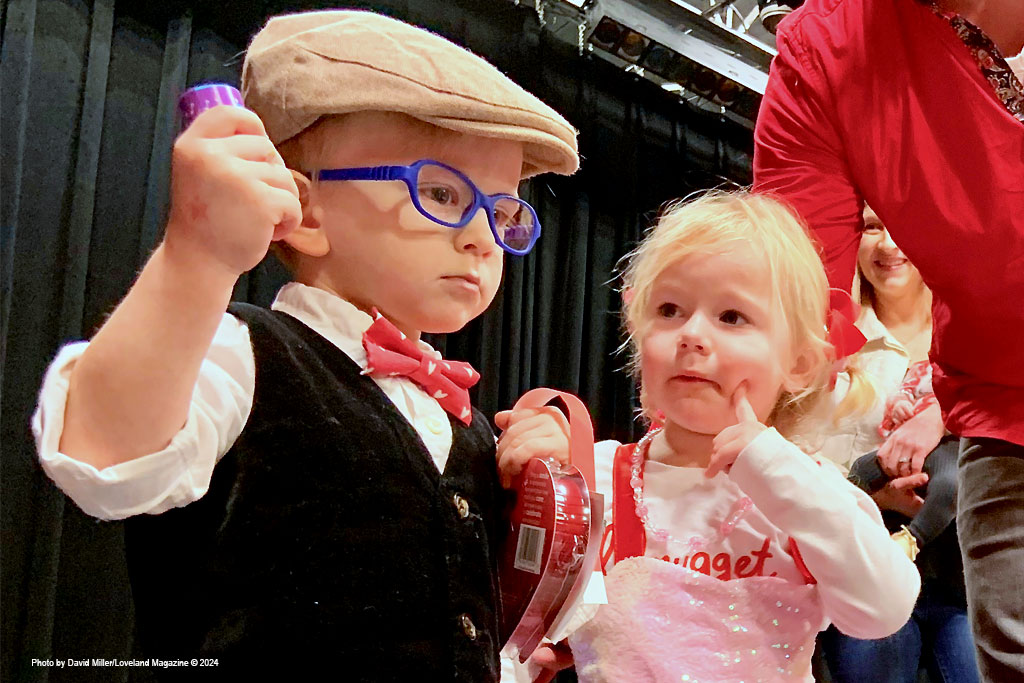
    On Saturday, I got the opportunity to volunteer at one of the most popular activities at the Hearts Afire Weekend, The Valentine Pageant! The 2nd annual Hearts Afire Valentine Pageant took place at the Loveland Stage Company and showcased children ages 1-4 as they competed to be crowned Miss Valentine or Mr. Cupid. The contest was judged by Loveland Valentine Ladies, Jeanie Shumaker, Donna Barns, Debbie Murray, and John Espy. This year Dr. Kathy Lorenz (2019 Valentine Lady) and Kay Bolin (2018 Valentine Lady) emceed the pageant.

    During the pageant I directed guests where to sit and explained to them how to vote for their “Fan Favorite,” a category in which the audience could vote for their favorite child in the pageant. Those that voted included a dollar or more with their vote which went towards funding for a new HVAC system for the Loveland Stage Company.

    Assistant City Manager, Misty Clark, was in awe as the guests rolled in as every single seat was filled in the Loveland Stage Company’s auditorium! “This is the largest turn out I have ever seen,” Misty said, “We also have 24 contestants this year in the pageant!”

    I couldn’t help but get all the pageant action on camera after hearing how unbelievable the turnout was! Watch my Facebook Live and video from the 2nd Annual Hearts Afire Valentine’s Pageant!

    The 2024 Hearts Afire Valentine’s Pageant winners were as follows: (Ages 1-2) – Little Miss Valentine – Rory, Little Mr. Cupid – Beau, (Ages 3-4) – Miss Valentine – Dawson Joan, and (People’s Choice) – Dawson Joan

    The Hearts Afire Weekend ended on Sunday with a Chasing Cupid 5k at Fleet Feet, a Taylor Swift Brunch at Paxton’s Grill, and a Sweetheart Brunch at Tano Bistro.

    I had an absolute blast exploring the Hearts Afire weekend festivities and meeting so many visitors that traveled miles just to experience the Hearts Afire celebration! I am so proud to be a part of the Sweetheart of Ohio! If you missed the 3rd Annual Hearts Afire Weekend watch the Loveland Magazine TV video that captures the essence of the celebration including “Family Karaoke” and the Dance Elvis Costume Contest! The music featured on the video is by DJ JOE KOOL.

    All of our LOVELAND MAGAZINE TV episodes and my Table of Discussions are made possible by the generous support of the team of realtors at Move 2 Loveland.

    President and Publisher of Loveland Magazine, Cassie Mattia is a resident of Historic Downtown Loveland and the Public Relations Coordinator at Butler County Board of DD. Cassie was awarded the Little Miami River Chamber Alliance 2021 Young Business Professional of the Year.

  • [Commentary] Suicide is on the rise in Ohio

    [Commentary] Suicide is on the rise in Ohio

     (Photo by Quentin Young/Colorado Newsline.)

    Rob Mooreby Rob Moore – Ohio Capital Journal

    This article is about suicide. If you or someone you know needs support now, call or text 988 or chat 988lifeline.org.

    Five Ohioans die of suicide every day.

    This is just one of the many data points released in a new publication released last week by the Health Policy Institute of Ohio. This data snapshot focuses on the prevalence of suicide in Ohio and how incidence has changed over time.

    Below are some of the top findings from the release.

    Suicide is a leading cause of death for working-age Ohioans.

    Over 1,400 Ohioans died from suicide in 2022, the most recent year we have data for. This makes suicide the fifth-leading causes of death for working-age Ohioans, behind unintentional injuries like drug overdose and motor vehicle crashes, cancer, heart disease, and COVID-19.

    Ohio’s suicide death rate is 15 deaths per 100,000 people, just slightly above than the national rate of 14.5 deaths per 100,000 people.

    Suicide victims are disproportionately white, male, working-age, and Appalachian.

    In 2022, 17 white Ohioans died from suicide per 100,000 population, higher than the rate of 12 for Black Ohioans, 10 for Hispanic Ohioans, and 7 for Asian Ohioans. Men were also four times likely to die from suicide than women. This is despite the fact that women attempt suicide at a rate 70% higher than men.

    Suicide rates were highest in 2022 for working-age adults, higher than the rate for young adults, retirement-age adults, and children. Suicide was most common in Appalachian counties, with 15 of Ohio’s 22 counties with the highest suicide rates located in Appalachia.

    Suicide is on the rise–for nearly everyone.

    Since 2007, suicide rates have increased for men and women, white, Black, and Hispanic Ohioans, and Ohioans in every age group. The only major demographic group that has seen a flat suicide trend are non-Hispanic Asian or Pacific Islander Ohioans.

    Risk factors for high school students are also becoming more common.

    Compared to 2019, female Ohio high school students were more likely in 2021 to feel sad or hopeless, seriously consider suicide, make a plan to commit suicide, or attempt suicide. While more male high-school felt sad or hopeless and seriously considered suicide over that time period, fewer made a plan or attempted suicide. The increase in suicide plans and attempts among female students was much larger than the decrease among male students.

    The increase in suicide rate is driven by firearms.

    Suicide deaths involving a firearm increased 60% from 2007 to 2022. This accounted for 75% of the total increase in suicides over that time period. The remainder of the increase was driven mostly by an increase in deaths by suffocation and other causes. Deaths by poisoning decreased over that time period.

    Suicide is a hard social problem to make progress against. That being said, the Health Policy Institute of Ohio suggests interventions to improve mental health to prevent suicide attempts.

    A 2016 evidence review published in the American Journal of Psychiatry concluded legislation reducing firearm ownership lowers firearm suicide rates. It also acknowledged, however, that court interpretations of the second amendment to the U.S. Constitution have made most legislative options for reducing firearm ownership politically unfeasible in the United States.

    The researchers however, say targeted initiatives like gun violence restraining orders, smart gun technology, and gun safety education may be able to reduce risk for current gun owners. These sorts of approaches do not have a strong evidence base yet, but they at least give us something to tackle this difficult problem.

    If you or someone you know needs support now, call or text 988 or chat 988lifeline.org.


    Rob Moore
    ROB MOORE

    Rob Moore is the principal for Scioto Analysis, a public policy analysis firm based in Columbus. Moore has worked as an analyst in the public and nonprofit sectors and has analyzed diverse issue areas such as economic development, environment, education, and public health. He holds a Master of Public Policy from the University of California Berkeley’s Goldman School of Public Policy and a Bachelor of Arts in Philosophy from Denison University.

    MORE FROM AUTHOR

  • CancerFree KIDS is expanding to Columbus!

    CancerFree KIDS is expanding to Columbus!

    Loveland, Ohio – In a newsletter sent today CancerFree KIDS announced, they have been proud to invest in pediatric cancer research at Nationwide Children’s Hospital in Columbus for nearly 15 years and are excited to expand the organization’s presence in the Columbus community under the leadership of their newest team member, Melissa Jackson.

    _______________________

    Please help us build our CancerFree KIDS community in Columbus! If you or a friend live in the Columbus area and would like to receive more information about events, volunteer opportunities and research impact in Columbus, please let us know!

    _______________________

    CancerFree KIDS would like to welcome our newest team member, Melissa Jackson, who will serve as our market director in Columbus! CancerFree KIDS has been proud to invest in pediatric cancer research at Nationwide Children’s Hospital for nearly 15 years and we are excited to expand our organization’s presence in the Columbus community under Melissa’s leadership.
    Melissa has extensive experience in public health and non-profit management and has served the cancer community directly through numerous state and national non-profits. As the mother of a pediatric cancer survivor herself, she also founded a local non-profit and support group for parents who have children with cancer.
    Volunteer on Jersey Mike’s Day of Giving! On Jersey Mike’s Day of Giving on March 27th, 100% of sales in Greater Cincinnati and NKY are donated to CancerFree KIDS! Help us make this day a success by volunteering in your local store!
    Learn More and Register to Volunteer


    Join the the Paxton’s Grill Golf Outing

    Save the date for the 19th Annual Paxton’s Grill Golf Outing benefiting CancerFree KIDS on Friday, June 7th, Saturday, June 8th and the Corporate Outing on Monday, July 15th! Sponsor registration is also open! Register your foursome and view sponsorship opportunities here.

    19th Annual Paxton’s Grill Golf Outing Benefitting CancerFree KIDS

    About CancerFree KIDS

    CancerFree KIDS aims to find gentler, more effective childhood cancer treatments by funding innovative research projects in the early stages of development. New ideas need money to grow, yet potential breakthrough treatment methods often go nowhere because pediatric cancer research is drastically underfunded.

    CancerFree KIDS provides grants to high-risk/high-reward childhood cancer research projects in these crucial early stages, which allows researchers to prove their concept, secure additional funding, find new treatment therapies and eventually end childhood cancer.


  • OHSAA Board of Directors Approves Expansion Proposal

    OHSAA Board of Directors Approves Expansion Proposal

    Soccer, girls volleyball, basketball, baseball and softball adding divisions starting in 2024-25

    A Press Release from the Ohio High School Athletic Association

    After months of discussion and meetings around Ohio to gather feedback, the Ohio High School Athletic Association Board of Directors unanimously approved a proposal Thursday morning to utilize a new formula to determine how many divisions will be offered for postseason tournaments. The change affects OHSAA General Sports Regulation 17 and will result in girls and boys soccer now having five divisions, while girls volleyball, girls and boys basketball, softball and baseball will all have seven divisions. In those sports, Division I and Division II will only include 64 schools.

    The new divisions will go into effect with the fall of 2024. The board will continue to discuss additional sports, noting several recent meetings regarding track and field. There are no changes to the number of football divisions, which is already at seven. In addition, any changes to the current deployment of the Competitive Balance process would need to be voted upon by OHSAA member schools during the annual referendum voting process.

    Doug Ute, OHSAA Executive Director, praised the board’s decision as a step toward to level the playing field of OHSAA tournaments.

    “It’s the right thing to do for the student-athletes who have been competing at this disadvantage,” said Ute. “For too long, the largest schools in our divisions have been so much larger than the smaller schools in the same division, which has resulted in many schools accepting that they realistically have little chance at making a run in the tournament. In some of our sports, there have been more than 200 schools competing for a state title in that division, which is significantly more than what most other states do, and what we do in many of our own sports.

    “We know that there is a lot of work to do in the coming months to prepare for additional divisions this fall,” Ute said. “We have already started working on the details to accomplish this, but one thing we know for sure is that having two or three more state champions in these sports doesn’t water them down or diminish winning a state title. And we anticipate that this new format will be revenue neutral, since every school makes the tournament already.”

    Each year, the Board of Directors would still have final authority in determining how many divisions to be used that school year, but the proposal calls for the following scale to be used to guide the board’s decision on the number of divisions for girls volleyball, football, soccer, basketball, softball and baseball, however note that the sports of lacrosse, field hockey, ice hockey and boys volleyball would not change from their current division numbers:

       199 or fewer teams: 1 Division

       200 to 299 teams: 2 Divisions

       300 to 399 teams: 3 Divisions

       400 to 499 teams: 4 Divisions

       500 to 599 teams: 5 Divisions

       600 to 699 teams: 6 Divisions

       700 and more teams: 7 Divisions

    For girls volleyball, soccer, basketball, softball and baseball, the largest 64 schools would be placed into Division I. The next largest 64 schools would be placed into Division II. The remaining schools would be divided as evenly as possible into the remaining divisions. The OHSAA already does something similar to this in football, in which the largest 10 percent of schools are placed into Division I and the remaining schools are divided evenly in Divisions II through VII.

    The proposal does not call for a change to the formula that the OHSAA uses for individual sports to determine the number of student-athletes required for team designation, which includes five in bowling, five in cross country (who score for their team at the district tournament), four in golf, three in girls gymnastics, seven in swimming and diving, four in tennis, nine in track and field and seven in wrestling.

    The proposal calls for the following number of divisions to be used for individual sports:

       200 or fewer teams: 1 Division

       201 to 450 teams: 2 Divisions

       451 to 700 teams: 3 Divisions

       701 and more teams: 4 Divisions

    OHSAA member schools vote to determine any changes to the bylaws or constitution via the referendum process each spring. Member schools also vote for representatives for their District Athletic Boards, who are then selected to serve on the State Board of Directors on a three-year term. The Board of Directors are then charged with reviewing and approving the General Sports Regulations on behalf of the OHSAA membership. The OHSAA General Sports Regulations do not go to the member schools for voting and are posted at: https://ohsaaweb.blob.core.windows.net/files/Sports/GeneralSportsRegulations.pdf

    The OHSAA will announce structural and dates changes for future state tournaments at a later date.

  • Ohio indictments provide a better picture of squalid relationships that spurred massive scandal

    Ohio indictments provide a better picture of squalid relationships that spurred massive scandal

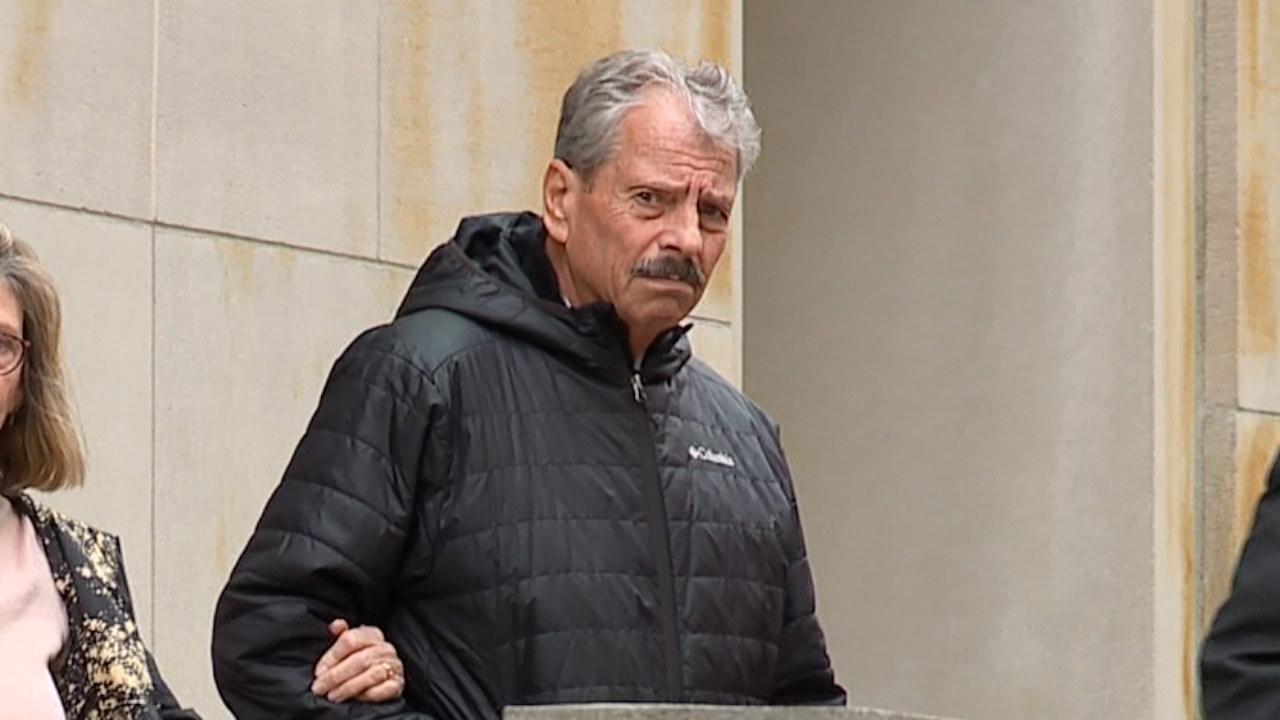
    Former Public Utilities of Ohio Chair Sam Randazzo at court. (Photo by WEWS.)

    BY:  Ohio Capital Journal

    An Ohio grand jury has handed up a 44-count indictment against three players in what is likely the biggest bribery scandal in state history. And when the 50-page indictment was unveiled Monday, it provided new details about a decade of payoffs and conflicts as one of them — who became the state’s top regulator — allegedly did a huge electric utility’s bidding.

    The indictment concerns a $1.3 billion dollar bailout that Akron-based FirstEnergy has already admitted to the federal government that it paid more than $60 million in bribes to purchase.

    Former Ohio House Speaker Larry Householder, R-Glenford, and former state GOP Chairman Matt Borges are serving federal prison sentences for their roles in the 2019 passage of the bailout and the dirty-but-succesful fight to thwart a voter-led repeal.

    When federal prosecutors in 2021 charged those two and three others, they said their investigation continued. But it wasn’t until December that they charged another in the case — Sam Randazzo, a lawyer and longtime energy consultant whom Gov. Mike DeWine nominated to chair the state’s top regulator, the Public Utilities Commission of Ohio.

    That left the people who paid the alleged bribes — FirstEnergy’s top executives — uncharged in a scheme that took place more than four years ago.

    Double dealing

    All that changed Monday when Ohio Attorney General Dave Yost announced state charges against Randazzo and former First Energy CEO Chuck Jones and former Vice President Michael Dowling for their alleged roles in the criminal conspiracy. The three were arraigned in Akron on Tuesday and each pleaded not guilty.

    They were charged in an indictment that alleged shady dealings between the them stretching back 13 years.

    “It all began with a well-lawyered theft in 2010,” the indictment said.

    It went on to describe how Randazzo was general counsel for a group of large FirstEnergy customers — the Industrial Energy Users of Ohio — while also working as a FirstEnergy consultant. Only, the Industrial Energy Users didn’t know that Randazzo was also being paid by the company they were paying him to fight, the indictment said.

    It accuses Randazzo of settling the industries’ claims against FirstEnergy on terms acceptable to FirstEnergy and running the settlements through Randazzo-controlled shell companies where he took a skim — again, unknown to the industrial energy users.

    “His clients, the industrial members of IEU-Ohio, did not know he was a consultant for FirstEnergy,” the indictment said. “Randazzo did not tell them. Years later, some of the money would make its way to IEU-Ohio. Some of it would end up in Randazzo’s pocket.”

    The Industrial Energy Users appear to have engaged in some cynical conduct of their own, however. The indictment describes a 2015 agreement in which FirstEnergy was to pay Randazzo’s company $8.5 million for “consulting services.”

    It was really a cash “side deal” in which FirstEnergy paid the industrial users to drop their objections to a rate hike FirstEnergy wanted, supposedly in the name of “energy security,” the indictment said. In other words, prosecutors said that with Randazzo’s facilitation, FirstEnergy paid off a wealthy, powerful group of electricity users in order to raise rates on everybody else.

    Such arrangements proved quite profitable for Randazzo.

    “Between 2016 and 2019, FirstEnergy paid… $13,152,639.94 to Randazzo’s two shell companies,” the indictment said. “Of that total, Randazzo gave $7,756.903.84 to his IEU-Ohio Client and kept $5,395,736.10 for himself.”

    Cozy relationships

    This is the guy the incoming DeWine-Husted administration thought would be a good candidate to regulate utilities — companies to which Ohioans have little choice in paying their billions.

    The state indictment describes how, on Dec. 18, 2018, FirstEnergy execs Jones and Dowling met with Gov.-elect DeWine and Lt. Gov.-elect Jon Husted at the Columbus Athletic Club and discussed whether the executives wanted Randazzo to regulate their massive electric utility.

    The notion that a governor would ask a huge utility who might be acceptable as a regulator might itself seem startling. But after the dinner, according to the indictment, Jones and Dowling did something even more brazen.

    They went to Randazzo’s German Village condo and pursuant to that, Randazzo solicited a $4.3 million payment from Jones and Dowling, the indictment said. FirstEnergy paid the money “without ever having received an invoice for the payment and without any work or consulting services being performed,” the indictment said. It added that the executives made the payment over the objections of a company lawyer.

    Randazzo told Laurel Dawson, DeWine’s chief of staff, about the payment, calling it a “consulting agreement.” But he didn’t tell her of the other millions he’d gotten from the utility he was seeking to regulate, the indictment said. Randazzo also never told the Ohio Ethics Commission about any of the money he’d gotten from FirstEnergy, the indictment said.

    In Dawson, Randazzo might have had a sympathetic audience. Her husband, Michael Dawson, was a “paid FirstEnergy lobbyist” in 2016, when he’d gotten a $10,000 loan from Randazzo, the indictment said.

    But if his chief of staff told DeWine about the huge payoff Randazzo got from FirstEnergy, it must not have fazed the new governor. DeWine nominated Randazzo to be chairman of the Public Utilities Commission — the ratepayers’ supposed protector — on Feb. 4, 2019.

    Versatile player

    During Householder’s six-week trial in Cincinnati last year, federal prosecutors put on exhaustive evidence of how the FirstEnergy executives financed Householder’s bid to become speaker and to pass the notorious bailout known as House Bill 6.

    “Together, Jones, Dowling, Randazzo and his shell companies worked in concert to steal the power of government and bend it to the will of FirstEnergy,” was the way the state indictment unveiled on Monday put it.

    Most of the details of Randazzo’s involvement in the creation and passage of HB 6 are already known from the federal trial. They show him acting in multiple, conflicting, often-undisclosed capacities — similar to those the state indictment alleges he had already played with FirstEnergy and the industrial energy users.

    Even though he was supposed to be a regulator, Randazzo drafted portions of the bailout legislation and passed them between FirstEnergy officials and a Householder employee who had recently worked for the PUCO. They sometimes only shared printed copies of the huge bill, out of an apparent apprehension about leaving electronic fingerprints.

    According to text messages between Jones and Dowling, Randazzo went so far as to actively lobby for passage of the bailout — which would seem a big departure from the traditional duties of a disinterested regulator.

    Jones and Dowling discussed a meeting about HB 6 that Randazzo had with Sen. Steve Wilson, R-Maineville, and the Senate’s counsel. “We have a good plan to help,” Dowling told his boss.

    Other officials

    Despite the fact that DeWine had reason to know Randazzo was connected to FirstEnergy, the governor made him the state’s top utility regulator and he signed the billion-dollar bailout that benefitted the company the day it passed. And on July 21, 2021 — the day Householder was arrested — DeWine said he wasn’t in favor of repealing the measure.

    The governor subsequently walked that back, but HB 6 is still on the books and Ohio utilities are still getting hundreds of millions in ratepayer subsidies as a result.

    DeWine wasn’t the only state official to act at least peripherally in the scandal.

    Secretary of State Frank LaRose has refused to explain the “private” updates that FirstEnergy CEO Jones said the state’s chief elections official was providing during an attempt to gather signatures to put an HB 6 repeal on the ballot.

    And Yost himself dealt a mortal blow to the signature gathering when he initially rejected the ballot language — cutting nearly in half the time HB 6 opponents had to gather a quarter-million valid signatures. And in text messages presented in the federal trial, Borges told a co-conspirator that Yost thought HB 6 was a bad law, but wouldn’t speak up because of help he’d gotten from FirstEnergy in the past.

    Beyond the bailout

    Randazzo’s alleged help to FirstEnergy wasn’t limited to HB 6. He also thwarted a PUCO look into the company’s books that was likely to force a cut in electricity bills. That would have caused falling stock prices and a hit to Jones’ and Dowling’s portfolios, the indictment said.

    The erstwhile regulator was apparently so helpful that Jones at one point told a FirstEnergy subordinate to back off for fear of being too obvious. In a text message included in the indictment, Jones told Dennis Chack that Randazzo’s pro-FirstEnergy conduct “has a lot of talk going on in the halls of PUCO about does he work there or for us?”

    Even so, Randazzo’s behavior at the PUCO continued to be shameless, urging fellow regulators to join him in lobbying for the corrupt bailout, the indictment said.

    Randazzo “began internally lobbying PUCO staff members between July 2020 and September 2020 to generate strategies to save HB 6, despite facing internal objections about the inappropriateness of the effort to save HB 6,” it said.

    The indictment included a Sept. 15, 2020 email in which Randazzo told subordinates, “One option (and I really think we need to get other commissioners and staff into a proactive mode): We could, on our own initiative, issue a show-cause order to (FirstEnergy) directing (FirstEnergy) to show that no costs associated with HB 6 have been included in any riders or base rates.”

    Had such an order been issued, the result would have been misleading. While the bill didn’t raise consumer costs through riders or base rates, it included a provision that ensured FirstEnergy would collect at least as much as it did in one of its best years and it created a massive subsidy for money-losing coal plants.

    Randazzo’s efforts seemed finally to end two months later, when the FBI searched his condo.


    Marty Schladen
    MARTY SCHLADEN

    Marty Schladen has been a reporter for decades, working in Indiana, Texas and other places before returning to his native Ohio to work at The Columbus Dispatch in 2017. He’s won state and national journalism awards for investigations into utility regulation, public corruption, the environment, prescription drug spending and other matters.

    MORE FROM AUTHOR


  • What Does The Future Hold For Tee Higgins?

    What Does The Future Hold For Tee Higgins?

    by Chris Ball

    Loveland, Ohio – Injuries derailed so much of the promise last season for the Bengals. While the most crucial was to Joe Burrow, Tee Higgins also missed five games due to various injuries and was limited to just 42 receptions, the lowest total of his career. It was very bad timing in a contract year for a player who surely wanted to show the Bengals and the league that he was deserving of a big payday.

    That leaves Higgins and the Bengals in a very unique position this offseason. The team has $53.2 million in cap space which is good for sixth-most in the NFL. There is money to spend , but also plenty of needs to fill including an impending mega-extension for Ja’Marr Chase.

    This is why many Bengals pundits believe that the Franchise Tag is the most likely option with respect to Higgins’ contract status going forward. Briefly, the Franchise Tag a would allow the Bengals to retain Higgins at a salary that reflects the average of the top five players at his position or 120% of his previous salary – whichever figure is higher. There are two types of “tags” the exclusive tag, which would prevent Tee from negotiating with any other team and would fully guarantee his salary.

    The other is the non-exclusive tag which allows players to negotiate with other teams even if they are tagged. If Tee reaches a deal with another team, the Bengals would retain the right to match the deal if they wish. If they choose not to match and Tee signs somewhere else the Bengals would receive a pair of first-round picks as compensation for losing him.

    The average salary of the top five wide receivers would mean that if the Franchise Tag is applied to Tee his potential contract would be for one year at $20.7 million. Bengals fans may recall that this was the track taken by the team with respect to Jessie Bates who played out his year on the Franchise Tag before signing with the Atlanta Falcons last year. It wasn’t a very pretty process as Bates skipped all offseason workouts and much of training camp before finally signing his contract for the year. And just as with Higgins, there were logistical issues in offering Bates a lucrative long-term deal given the need for yet another gargantuan contract the following year for an irreplaceable star player: Joe Burrow.

    It seems unlikely that the Bengals and Higgins will reach an agreement on any sort of extension, though it is a possibility. That leaves the Franchise Tag as the most viable option. The Bengals must tag Higgins by March 5 but the two sides can still negotiate for a longer deal. If they can’t agree by July 15 then (if put in place) the tag becomes official and Tee would be playing on the one-year contract.

    That isn’t necessarily the end of the story, however. There is a question as to whether Tee Higgins would play under the tag. Though it’s rare, players have threatened to sit out an entire season rather than play under the cloud of a one-year contract. While it’s too early to predict what Higgins’ reaction might be, contract talks and the millions of dollars at issue rarely lead to simple or clean solutions.

    The Bengals could apply the tag to Higgins and then trade him to another team that could then work out a longer contract, which is commonly referred to as a “tag and trade.” However, the Bengals are not known for even normal trades much less trades of players playing under the Franchise Tag.

    If Tee Higgins is back for another year, no matter how that’s accomplished, it will undoubtedly be a good thing for this team. Yes, he was injured last year and had some issues with drops, but he showed that he still can be a dynamic and impactful wide receiver. You have no further to look than his 80-yard touchdown against the Steelers to see that when healthy he is a top tier wide receiver.

    Tyler Boyd is gone, Charlie Jones and Andrei Iosivas are young and developing. The Bengals have no consistent threats at tight end. A healthy and productive Tee Higgins punishes teams for double teaming Ja’Marr Chase and frees him up to run deeper routes. Higgins is athletic for his size and strong enough to out muscle most corners in the NFL.

    Even if it is for one year at 20 million, getting Tee Higgins on the field for this team in 2024 is an absolute priority. The window for the Bengals to win and make deep playoff runs will not stay open forever, especially as superstars like Chase (rightfully) will be paid vast sums of money, shrinking the pie for other players on this team.

    While that window is open, the Bengals must do whatever is necessary to put the best players on the field. Players like Tee Higgins.


    Christopher Ball is a longtime Loveland resident and an attorney. He graduated from Loveland High School in 2003 and was a member of the football team before going on to become a coach’s assistant at DePauw University in Greencastle, Indiana. He has been following and rooting for the Reds and Bengals since the early 1990s and has been through the many ups and downs that fandom has wrought over the years.

  • Meet the Deerfield Springs Retirement Community

    Meet the Deerfield Springs Retirement Community


    Welcome Home to Worry-Free Living!
    Loveland’s Independent Living Leader for Seniors

    Picture coming home to a worry-free way of life. Imagine a luxurious, safe, and comfortable community with a great location for fun local outings, as well as engaging events hosted by our expert team. With three chef-prepared meals offered daily, and weekly housekeeping and maintenance included, you’ll have more time for family, friends, and the other important things in life. This vision comes to life at Deerfield Springs Retirement Community, an independent retirement community that’s proudly served the Loveland area for four years.

    Designed for comfort, Deerfield Springs offers apartments for rent in studio, 1, 2, and 3-bedroom options. Each living space features window coverings, a climate-controlled thermostat, and ample closet space. Apartment kitchens are also equipped with full-sized appliances. Besides that, our residents are free to design their units around their unique tastes. Pets are also warmly welcome for no additional fee.

    The best part about all-inclusive living is that there’s no buy-in fee or long-term leases to worry about! Everything’s included in the monthly rent, such as an on-site professional staff, live-in managers, a 24/7 emergency call system, appointment transportation, concierge services, valet parking, and many more amenities. When you retire with Deerfield Springs, you’re getting more out of retirement. You’re getting a community of friends and a team that cares. Stop by for a tour and discover the resort lifestyle difference!

    For more information, visit DeerfieldSpringsRetirement.com or call (513) 208-2558.

    Schedule a personal tour to see for yourself

    We know you’ll like what you see.

    3664 W. US 22 & Ohio 3
    Loveland, OH 45140
    (513) 818-4257

    Get In Touch With Us

    Follow Deerfield Springs Retirement Resort on FaceBook

  • Newest, silliest fun race around: The Leprechaun Chase!

    Newest, silliest fun race around: The Leprechaun Chase!

    Promoted Post

    Loveland, Ohio – Just when you thought they were done, the makers of the Amazing Charity Race announce the newest, silliest fun race around: The Leprechaun Chase!

    Saturday, March 16th, starting at 8:30 AM, teams of 2 will use a map of Loveland to the Leprechauns and pots of gold around the city. Four teams will start every 3 minutes. Once you find a Leprechaun, they will give you a piece of gold that will help you solve the final Irish riddle. You must collect all gold pieces and go as fast as you can to the finish line, where the Leprechauns will be waiting for you to solve the riddle.

    Once solved, you can bask in a feeling of accomplishment and enjoy an Irish breakfast from Ramsey’s Trailside Cafe and post-race laughs. The distance is around a 5K and will be completed all on foot. Runners and walkers are welcome, and it will be a timed event.

    Proceeds from the race benefit the Loveland Legacy Foundation.

    $100 per team of 2. – Kids aged 8-13 need to team up with an adult. 14 and over can run with anyone 14 and over.

    Sign up by February 29th to guarantee your shirt size!

    ENTER TO SOLVE THE FINAL IRISH RIDDLE