Year: 2024

  • Geno Hicks scoops up as winner of Symmes Township Name the Snow Plow contest

    Geno Hicks scoops up as winner of Symmes Township Name the Snow Plow contest

    Symmes Township, Ohio – And there it is, 7-year-old Geno Hicks submitted the winning name in the Township’s “Name the Snow Plow Contest”.

    He entered the name “Scoop, There It Is” and the Road crew selected it as the winner. Geno will help unveil the new truck as soon as it is ready.

  • Ohio’s AG Yost wants to “kickstart” the state’s stalled capital-punishment system

    Ohio’s AG Yost wants to “kickstart” the state’s stalled capital-punishment system

    Kenneth Smith, left, embraces his spiritual advisor, the Rev. Jeff Hood. (Courtesy Rev. Jeff Hood)

    After an experimental execution of inmate, Kenneth Smith, and he was pronounced dead at the William C. Holman Correctional Facility in Atmore, Alabama just six days ago, Ohio Attorney General Dave Yost today issued a press release urging “kickstarting” the execution of Ohio Death Row inmates.

    After the Alabama execution, Alabama Attorney General Steve Marshall said, “Alabama has done it, and now so can you. And we stand ready to assist you in implementing this method in your states”.

    Smith’s spiritual adviser, the Rev. Jeff Hood, who’d previously expressed concern that the method could be inhumane, witnessed the execution and described it in more graphic terms, saying it was “the most horrible thing I’ve ever seen.”

    Smith, wearing a tight-fitting mask that covered his entire face, convulsed when the gas was turned on, “popped up on the gurney” repeatedly, and gasped, heaved and spat, Hood said.

    “It was absolutely horrific,” he said. – (CNN)

    A Press Release from Ohio Attorney General Dave Yost:

    AG Yost, Other Elected Officials Propose Legislation to Address Issues in Ohio’s Capital-Punishment System

    Ohio Attorney General Dave Yost

    (COLUMBUS, Ohio) — Ohio Attorney General Dave Yost, together with state Reps. Brian Stewart and Phil Plummer and Executive Director Lou Tobin of the Ohio Prosecuting Attorneys Association, today announced the introduction of legislation to permit the use of nitrogen hypoxia as a method for carrying out the death penalty.

    The bill is aimed at kickstarting the state’s stalled capital-punishment system.

    “There must be accountability for offenders convicted of the most heinous crimes and prisoners who continue to flout the law behind bars,” Yost said. “The pursuit of justice is a journey, and closure remains elusive for victims’ families until a sentence is fully executed. Ensuring that the consequences align with the severity of an offense is essential to providing solace to grieving relatives.”

    Nitrogen hypoxia drew national attention last week when Alabama used this method to carry out the death sentence of murderer Kenneth Eugene Smith – the first state to employ nitrogen, a colorless and odorless gas, in an execution. With this procedure, a condemned inmate breathes only nitrogen, leading to oxygen deprivation, which results in rapid unconsciousness and death.

    Ohio last carried out an execution by lethal injection on July 18, 2018, more than five years ago. Multiple reprieves have been granted, in part due to the reluctance of pharmaceutical suppliers to provide lethal injection drugs to the Ohio Department of Rehabilitation and Correction for executions.

    Attorney General Yost hopes that nitrogen — widely available and easily sourced — can break the impasse of unavailability of drugs for lethal injection.

    Under the new legislation — sponsored in the House by Stewart, R-Ashville, and Plummer, R-Dayton — manufacturers, suppliers, and distributors that provide lethal injection drugs to the state would receive indefinite confidentiality, instead of the current two-year confidentiality. Suppliers of nitrogen for executions would receive similar confidentiality.

    “As long as capital punishment remains the law in Ohio, the law should be followed – and duly enacted sentences should be carried out to give victims’ families the justice and finality they deserve,” Stewart said. “Providing an additional method for carrying out capital punishments is necessary to ensure Ohio can continue to impose these sentences in response to the most heinous crimes committed in our state.”

    Added Plummer: “By using nitrogen hypoxia, we are giving the system an additional resource for holding accountable those who have committed heinous crimes. It is time that we stop postponing executions and give the families of victims the closure that they deserve.”

    Tobin echoed those thoughts.

    “We will continue to work to ensure that the death penalty is fair, that it is accurate, and that defendants receive the due process that they deserve,” he said. “We want fairness and justice for the victims also. This legislation is about providing closure for victims and for their families.”

    Yost highlighted shortcomings in the state’s capital-punishment system in the “2022 Capital Crimes Report,” released last year. An annual mandate under state law, the report provides a procedural history and other details on every case resulting in a death sentence since 1981, the year Ohio reinstated the death penalty.

    From 1981 to Jan. 30, 2024, a total of 336 criminals convicted in Ohio received a combined 341 death sentences, the report said. Only 56 sentences — one in six — have been carried out.

    In releasing the report, Yost emphasized the need to broaden the death penalty conversation and give a voice to victims’ families. Among those he has engaged in the discussion is Norman Stout, husband of Mary Jane Stout, who was murdered by David Stumpf during a May 1984 robbery near the couple’s home in New Concord, Ohio.

    The Stouts allowed Stumpf and Clyde Wesley into their home to use their phone. While Wesley ransacked the house, Stumpf shot Mr. Stout twice in the head, leaving him seriously wounded, and then shot Mrs. Stout four times, killing her.

    Mr. Stout, now 93, has been seeking justice for his wife for nearly four decades, only to see Stumpf’s execution postponed several times. Mr. Stout has said he plans to witness Stumpf’s execution — currently scheduled for Aug. 13, 2024 — but he worries that his advanced age might preclude him from seeing justice prevail.

    –30–

  • Support Cincinnati Children’s by sending an e-Card smile to a child

    Support Cincinnati Children’s by sending an e-Card smile to a child

    Valentine’s Day is right around the corner, and you can send a smile to a child spending the holiday with Cincinnati Children’s by sending an e-Card. There’s no cost to you, but all the feels will be priceless: https://give.cincinnatichildrens.org/…/ValentinesDay.html!

    f you decide to make a donation, friends at Kolar will match your gift dollar-for-dollar, up to $20,000—helping us give the world the joy of happy, healthy kids living their best lives.

  • Ohio governor, state agency lays out suicide prevention plan

    Ohio governor, state agency lays out suicide prevention plan

    JANUARY 31: Ohio Gov. Mike DeWine during the State of the State Address, Jan. 31, 2023, in the House Chamber at the Statehouse in Columbus, Ohio. (Photo by Graham Stokes for Ohio Capital Journal. Republish photo only with original story.)

    Plan mentions high risk to LGBTQ community impacted by gender-affirming care rules, HB 68

    BY:  Ohio Capital Journal

    Ohio Gov. Mike DeWine announced a two-year plan for suicide prevention, including with it statistics many advocates cited in opposing anti-trans legislation passed by lawmakers, and administrative rules the governor proposed.

    The 2024-2026 Suicide Prevention Plan “aims to promote life-saving strategies statewide,” according to an announcement by the governor’s office. The plan was developed in partnership between the RecoveryOhio initiative and the Ohio Suicide Prevention Foundation, “incorporating input from more than 30 private and public organizations,” according to the governor’s office statement.

    The plan’s main goals are centered around public awareness, data gathering, expansion of health care access and support for those with family members who have died by suicide.

    Tony Coder, executive director of the Ohio Suicide Prevention Foundation, wrote in an introduction to the prevention plan that suicide in the state “is at a crisis level, and it will take a statewide effort to reduce the rate of loss.”

    “We need policymakers to create common sense legislation that will improve our behavioral health care system,” Coder wrote. “…We need all hands on deck to end suicide.”

    The groups listed as most affected by suicide in Ohio include rural and Appalachian Ohioans, Ohioans with disabilities, veterans, males, young adults, and LGBTQ+ Ohioans.

    “Nationally, 1 in 5 transgender and nonbinary youth reported attempting suicide in the past year in 2022,” the report stated, also noting that lesbian, gay and bisexual youth are 4.8 times more likely “to consider suicide” and 4.3 times more likely to attempt it than their heterosexual peers.

    The report comes as transgender rights advocates and parents alike say new legislation by the Ohio General Assembly and administrative rules proposed by the governor could cause even more suicide risk to transgender youth, a group already at major risk of suicide, according to studies and medical data.

    One 2023 national study from The Trevor Project found 41% of LGBTQ+ youth surveyed have “seriously considered attempting suicide in the past year,” and that “anti-LGBTQ victimization” contributes to raise rates of suicide risk.

    House Bill 68 bans gender-affirming care for minors in Ohio, a measure that was supported by the Republican supermajority in the Ohio House and Senate, but was vetoed by DeWine.

    The support from the legislature came despite hours of testimony, hundreds of submissions opposing the bill, public protests at chamber votes, and support for gender-affirming care from major medical organizations across the country.

    DeWine’s veto was overridden by the House earlier this month, and by the Senate just last week, allowing the measure to go through, though it may face legal challenges in the near future.

    Even as DeWine vetoed HB 68, he introduced an emergency rule on Jan. 5 prohibiting health care facilities and other medical facilities from “performing gender surgeries on minors,” despite the fact that Ohio children’s hospitals say they haven’t been doing so, even before the rule or legislation was created.

    Two other rules have been proposed, one of which would establish a process through the Ohio Department of Mental Health and Addiction Services to diagnose and treat a “gender-related condition,” but only provide “gender transition services,” not surgical services, according to the draft language.

    A mental health evaluation and counseling would be required for at least six months before diagnosis or any treatment. That evaluation was criticized in public comment submitted regarding the draft language, in which Kathryn Poe, budget and health researcher for Policy Matters Ohio, said definitions in the draft rule “set a dangerous precedent for an organization concerned with the mental health of Ohioans, especially given th elevated risk for transgender Ohioans.”

    The second proposed rule would direct the Ohio Department of Health to report data on gender care to the General Assembly and the public every six months, while also creating “quality standards for those hospitals and ambulatory surgical facilities that wish to treat gender-related conditions.”

    In the new suicide prevention plan for 2024-2026, goals specifically targeted toward LGBTQ+ youth include offering “learning opportunities to grow knowledge skills for specific evidence-based practices, policies and services to impact high-risk populations, including Black and LGBTQ+ youth and young adults.”

    Included in proposed “action steps” to reduce suicide for LGBTQ+ is the creation of “workforce learning opportunities related to stress and risk factors of LGBTQ+ youth,” building “opportunities for affirming spaces and supportive relationships with trusted adults” and promoting anti-bullying policies in schools.

    The report also cites The Trevor Project as a resource for “evidence-informed strategies” to be used in the state for improved suicide prevention outcomes.

    The creator of HB 68, state Rep. Gary Click, called the Trevor Project an “advocacy group” in November as part of a committee meeting on the bill, claiming statistics on transgender mental health reported by the group were “a political statement” that was “designed to intimidate people like me from carrying legislation which would help protect young people.”

    “I totally reject that my bill causes people harm,” Click said at the time.

    Since passage of the bill and veto override, more than 100 families with transgender members have said they plan to leave the state as a result of the bill.


    Susan Tebben
    SUSAN TEBBEN

    Susan Tebben is an award-winning journalist with a decade of experience covering Ohio news, including courts and crime, Appalachian social issues, government, education, diversity and culture. She has worked for The Newark Advocate, The Glasgow (KY) Daily Times, The Athens Messenger, and WOUB Public Media. She has also had work featured on National Public Radio.

    MORE FROM AUTHOR

  • Ohio business leaders support redistricting reform amendment

    Ohio business leaders support redistricting reform amendment

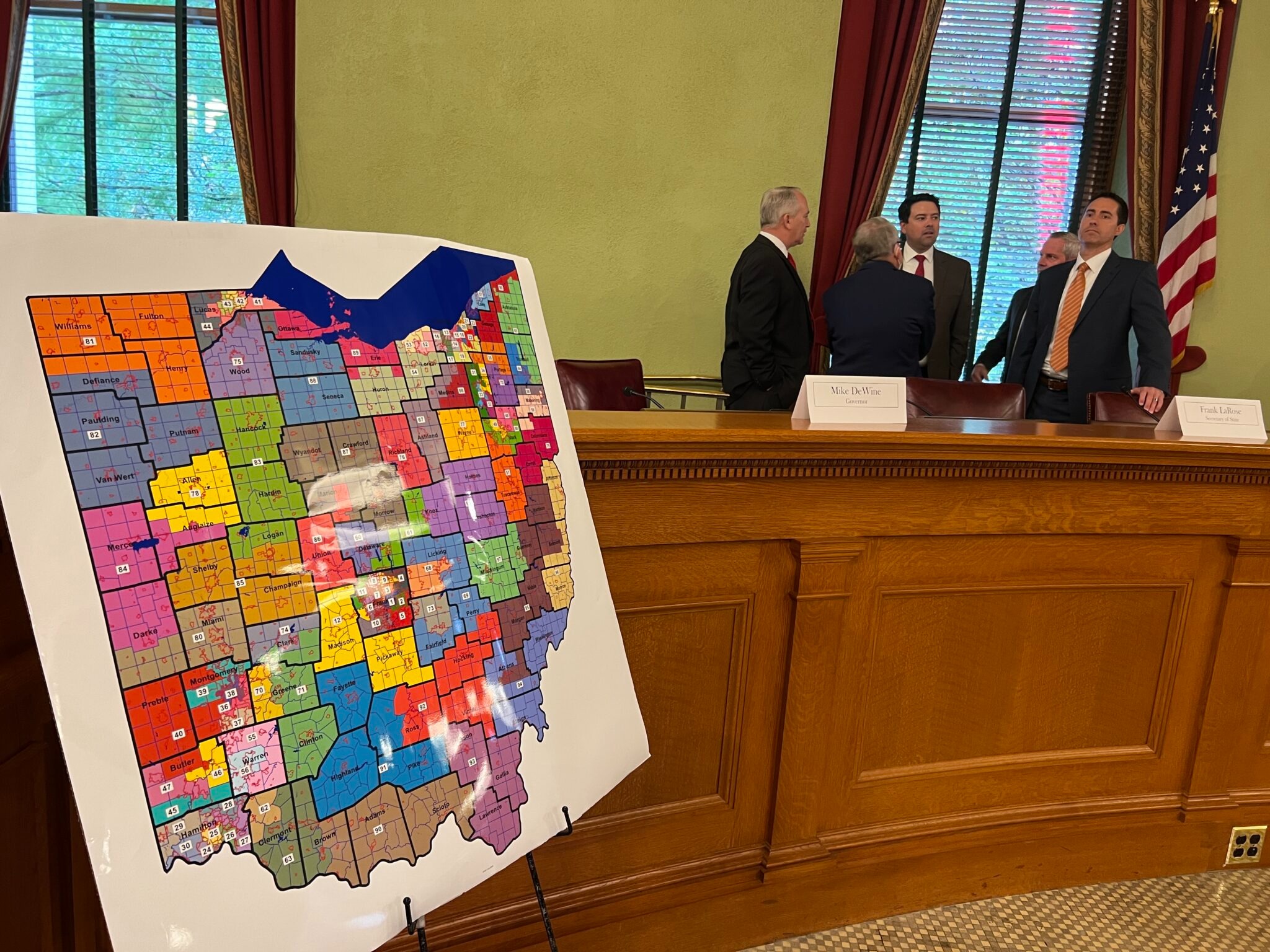
    The Republican members of the Ohio Redistricting Commission talk before a 2023 public hearing on Statehouse district maps. (Photo by Susan Tebben, Ohio Capital Journal.)

    BY:  Ohio Capital Journal

    Business leaders from Ohio are standing in support of a proposed constitutional amendment that would change the way redistricting occurs in the state by removing politicians from the process in favor of a citizen commission.

    “One crucial aspect of ensuring a robust representative democracy are legislative districts that ensure fair representation of the voting population,” an open letter from 67 Ohio business leaders stated. “The sad reality in Ohio is that political leaders of both parties have abused the system.”

    The letter was released via the Leadership Now Project, a national group of business leaders, and organized by a senior advisor to the project, Ohio Business Roundtable co-founder Richard Stoff.

    “Extreme gerrymandering reflects poorly on this great state of ours,” Stoff said in a statement announcing the letter, in conjunction with Citizens Not Politicians, the group leading the effort to get redistricting reform on the ballot.

    Citizens Not Policians is working to get a proposed constitutional amendment on the November 2024 ballot that would eliminate the Ohio Redistricting Commission as it stands now, made up of seven elected officials including the Ohio governor, secretary of state, and auditor, as well as one Republican and one Democratic lawmaker from both the Ohio House and Ohio Senate.

    Instead, if the amendment is approved by voters, a 15-member commission made up of public citizens would be empaneled to choose Ohio Statehouse and U.S. congressional voting districts.

    Over the last two years, the ORC has received staunch criticism for its process, with the adoption of six Statehouse district maps and two congressional maps, all but one of which (the most recent Statehouse maps) were rejected by the Ohio Supreme Court as unconstitutional and unduly partisan.

    The maps came about with behind-the-scenes map drawing that ignored racial demographics, rejected the work of taxpayer-funded independent map-drawers brought in at the behest of the state supreme court, and with redistricting commissioners refusing to go back to the drawing board as ordered by the court, based on legislative leaders’ interpretation of the law and their authority on redistricting.

    The newest constitutional amendment on redistricting would “empower a truly independent citizen-led process to draw congressional and state legislative maps,” according to the letter.

    “Building on successful best practices from other states, the Ohio proposal would ban gerrymandering, prohibit consideration of individual incumbents or candidates when drawing maps, and ensure an open and transparent redistricting process with extensive and meaningful public input,” the business leaders wrote.

    As of Wednesday, individuals who signed the letter included former CEOs and leaders from the banking, energy, insurance, retail, small business and academic worlds. Recognizable names like Dr. Amy Acton, Jeni Britton, and Yvette McGee Brown appear alongside Doug Ulman of Pelotonia, former Procter & Gamble chair and CEO John Pepper, and Robert Schottenstein, chairman and CEO of M/I Homes.

    Citizens Not Politicians and supporters of the proposed amendment are currently collecting signatures to bring the measure to the ballot box. The deadline to collect signatures for the 2024 General Election ballot is July 3.


    Susan Tebben
    SUSAN TEBBEN

    Susan Tebben is an award-winning journalist with a decade of experience covering Ohio news, including courts and crime, Appalachian social issues, government, education, diversity and culture. She has worked for The Newark Advocate, The Glasgow (KY) Daily Times, The Athens Messenger, and WOUB Public Media. She has also had work featured on National Public Radio.

    MORE FROM AUTHOR

  • “This care is medically necessary.” Advocates react to Ohio Senate overriding House Bill 68 veto

    “This care is medically necessary.” Advocates react to Ohio Senate overriding House Bill 68 veto

    A transgender Pride flag is covered with the words “Hands Off Trans Youth.” (Photo by Greg LaRose/Louisiana Illuminator/States Newsroom)

    Ohio transgender youth who aren’t already on a treatment plan won’t be able to access gender-affirming care after House Bill 68 takes effect on April 23.

    BY:  Ohio Capital Journal

    Ohioans have seen firsthand how valuable gender-affirming care is for their children.

    “My son would not be here if he hadn’t found (gender-affirming care) here in Ohio,” Rick Colby said, talking about his 31-year-old transgender son Ashton.

    “You can’t put a price on (gender-affirming care),” Nick Zingarelli said, referring to his 14-year-old transgender daughter.

    But now those dads fear for Ohio transgender youth. Those not already receiving it won’t be able to access gender-affirming care after the House and the Senate voted to override Gov. Mike DeWine’s veto of House Bill 68 — banning doctors from providing gender-affirming care to trans youth. The bill is set to take effect on April 23.

    “They need this care,” said Dr. Carl Streed, President of the U.S. Professional Association for Transgender Health.

    “This care is medically necessary,” Streed said. “It’s critical for their well being. It’s critical for their mental wellbeing long-term.”

    Ohio families can apply for the Southern Trans Youth Emergency Project (STYEP), a regional project of the Campaign for Southern Equality. This is in partnership with Equality Ohio, TransOhio and the Kaleidoscope Youth Center.

    STYEP can help families find out-of-state gender-affirming care providers and offer emergency grants of $500 for things such as travel and medication.

    Gender-affirming care can “include any single or combination of a number of social, psychological, behavioral or medical interventions designed to support and affirm an individual’s gender identity,” according to the World Health Organization.

    A 2022 study published in JAMA Network Open found access to hormones and puberty blockers for young people ages 13-20 was associated with a 60% lower odds of moderate to severe depression and a 73% lower odds of self-harm or suicidal thoughts compared to youths who didn’t get these medications.

    “You’re going to have kids that suffer from higher rates of depression,” Zingarelli said. “You’re going to have kids that are looking to get out of Ohio as soon as they possibly can either together with their parents now or as soon as they turn 18.”

    Gender-affirming care is supported by every major medical organization in the United States and Streed said it boggles his mind when politicians don’t listen to health care professionals.

    “Lawmakers who don’t listen to the best medical practice are causing harm to their constituents,” he said. “The reason that legislators are focused on this is, that for them, they see it as a winning topic to distract from the fact that they don’t know how to govern on any other issue.”

    State Sen. Nathan Manning of North Ridgeville was the only Republican to vote against overriding DeWine’s veto on the gender-affirming care ban. But for Colby, this transcends political party affiliation.

    “I’m a parent before I’m a Republican, first and foremost,” Colby said. “My son has been on an incredible journey. But we’ve done this together, he wasn’t alone. … The unconditional love that I have for him, that all the other parents have for their children, is what guides us and fortifies us in this journey.”

    The Zingarellis consider themselves lucky. Their daughter is already receiving gender-affirming at Cincinnati Children’s Hospital Medical Center, so she’ll be able to continue to receive care under HB 68’s grandfather clause that allows doctors who have already started treatment on patients to continue.

    “We’re grateful for that,” he said. “But that in no way makes it OK that she was lucky enough to have been born in the year that she was born in. … There’s too many out there that are going to be incredibly unlucky and all those that came after her in Ohio if this bill stands up to legal challenge.”

    Families will move out of Ohio in search of better healthcare, said Siobhan Boyd-Nelson, Equality Ohio’s co–interim executive director.

    “We know that many families have been planning for this day, and that right now, families are making some very difficult decisions,” Boyd-Nelson said.

    HB 68 becoming law in Ohio will continue to have ripple effects felt throughout the state.

    “It’s going to impact the way that physicians and other medical providers do their work here in Ohio,” Boyd-Nelson said. “It’s already raised a number of difficult questions for providers in a number of areas because they are now faced with ethical conundrums that I don’t even think you’d want to face on a law school exam.”

    Follow OCJ Reporter Megan Henry on X.

    _______________

    Megan Henry
    MEGAN HENRY

    Megan Henry is a reporter for the Ohio Capital Journal and has spent the past five years reporting in Ohio on various topics including education, healthcare, business and crime. She previously worked at The Columbus Dispatch, part of the USA Today Network.

    MORE FROM AUTHOR

  • Ohio Senate overrides DeWine vetoes on trans youth gender-affirming care and local tobacco bans

    Ohio Senate overrides DeWine vetoes on trans youth gender-affirming care and local tobacco bans

    COLUMBUS, OH — JANUARY 24: A protester asks senators to not override Gov. Mike DeWine’s veto of House Bill 68 that would limit medical care for transgender minors and block transgender girls from sports during the Ohio Senate session, January 24, 2024, at the Statehouse in Columbus, Ohio. (Photo by Graham Stokes for Ohio Capital Journal)

    Both laws — banning gender-affirming care and local flavored tobacco regulations — are now set to take effect at the end of April.

    BY:  Ohio Capital Journal

    The Ohio Senate voted to override two of Gov. Mike DeWine’s vetoes Wednesday — one on a bill blocking gender-affirming care for trans youth and the other blocking cities from banning flavored tobacco sales. Both laws are now set to take effect at the end of April.

    The Senate voted 24-8 to override DeWine’s veto of House Bill 68, which blocks gender-affirming care for trans youth and prevents transgender athletes from playing women’s sports. The bill prohibits transgender youth from starting hormone therapy and puberty blockers.

    “I think parents should make those decisions and not the government,” DeWine said before the vote Wednesday.

    The Senate also voted 24-8 to override DeWine’s veto of a provision that would prevent cities from banning flavored tobacco sales. A flavored tobacco ban took effect in Columbus earlier this month after Columbus City Council voted to stop the sale of flavored tobacco products in December 2022.

    “It will be a win for big tobacco and it will be a loss for Ohio,” DeWine said before the vote Wednesday.

    A three-fifths majority vote from the members of the House and Senate is necessary to override the governor’s veto. The Ohio House voted to override HB 68 earlier this month and voted to override the flavored tobacco ban in December. State Sen. Nathan Manning of North Ridgeville was the only Republican to vote against overriding the Republican governor on the gender-affirming care ban, and state Sen. Louis Blessing of Colerain Township was the sole Republican to vote against overriding DeWine on the tobacco law.

    The laws are set to go into effect 90 days after they are delivered to the Secretary of State’s office, meaning it would likely take effect April 23.

    House Bill 68

     COLUMBUS, OH — JANUARY 24: A protester asking senators to not override Gov. Mike DeWine’s veto of House Bill 68 that would limit medical care for transgender minors and block transgender girls from sports is removed from the gallery during the Ohio Senate session, January 24, 2024, at the Statehouse in Columbus, Ohio. (Photo by Graham Stokes for Ohio Capital Journal) 

    Ohio Senators discussed House Bill 68 for about an hour before taking a vote. Democrats said they celebrated DeWine’s veto while Republicans expressed their disappointment in last month’s veto.

    “There are men and there are women and there are boys and there are girls and they are different,” said State Sen. Kristina Roegner, R-Hudson.

    “Gender is not fluid. There is no such thing as a gender spectrum,” she claimed.

    State Sen. Bill DeMora, D-Columbus, said this bill becoming law will lead to loss of life.

    “Politicians have no business banning evidence-based, life-saving medical care – especially when it is endorsed by every major medical and mental health association,”said Ohio Senate Democratic Leader Nickie J. Antonio, D-Lakewood.

    “We should listen to parents, providers and patients, not willfully and purposely pass harmful legislation that will add to the mass exodus of individuals from the state of Ohio,” Antonio said.

    A protester was removed from the Senate chamber after she interrupted Roegner.

    “Jesus loves the little children, all the children of the world, LGBTQIA,” she screamed. “Jesus would be here on their side today. We need to support them.”

    HB 68 has a grandfather clause that would allow doctors who already started treatment on patients to continue.

    Gender-affirming care is supported by every major medical organization in the United States. Children’s hospitals across Ohio, the Ohio Children’s Hospital Association, and the Ohio Academy of Family Physicians all oppose HB 68. No Ohio children’s hospital performs gender-affirming surgery on patients under 18 currently.

    DeWine said his veto of HB 68 was “about protecting human life.”

    “These are gut-wrenching decisions that should be made by parents and should be informed by teams of doctors who are advising them,”  he said during a press conference on Dec. 29.

    It’s likely this new law will end up in court.

    Twenty-two other states have passed a law that bans gender affirming care for transgender youth, but most have faced legal challenges, according to the Human Rights Campaign.

    Federal appeals judges on the 6th U.S. Circuit Court of Appeals ruled that Tennessee and Kentucky can continue banning gender-affirming care for trans youth while legal challenges against state laws continue. The 6th Circuit has jurisdiction over Ohio.

    Before the Senate voted to override his veto, DeWine said he does not plan to pursue legal against HB 68.

    “The legislature has the constitutional right to override anything, any bill that I sign, or any or any bill that I veto,” DeWine said. “That’s part of our system. And I respect our system. It doesn’t mean I like the vote, but I respect our system.”

    Senate President Matt Huffman, R-Lima, told reporters Wednesday he believes HB 68 will hold up in court.

    “I do think that it’ll pass constitutional scrutiny,” he said.

    State Rep. Gary Click

    The bill’s author state Rep. Gary Click, R-Vickery, has denied that HB 68 has any religious backing, but Click can be heard saying in a recorded sermon from 2018 that trans people break from God’s plan for the family.

     COLUMBUS, Ohio — JANUARY 10: State Rep. Gary Click, R-Vickery, celebrates the vote to override Gov. Mike DeWine’s veto of HB 68 during the Ohio House session, January 10, 2024, at the Statehouse in Columbus, Ohio. (Photo by Graham Stokes for Ohio Capital Journal. Republish photo only with original article.) 

    “You’re not born that way,” Click says about trans people during the sermon. “God’s not going to curse you in the wrong body. He’s not going to curse you with desires that cannot be adequately and appropriately and biologically fulfilled correctly.”

    Click is a pastor at Fremont Baptist Church and celebrated Wednesday’s Senate vote.

    “The SAFE Act and Save Women’s Sports Act are the civil rights issues of our day, ensuring that children have the right to grow up intact and that women are no longer subject to men invading their spaces,” he said in a statement.

    Gender-affirming care

    Gender-affirming care can “include any single or combination of a number of social, psychological, behavioral or medical interventions designed to support and affirm an individual’s gender identity,” according to the World Health Organization.

    It typically consists of four general practices: social affirmation, puberty blockers, hormone therapy and gender-affirming surgeries, according to the U.S. Department of Health and Human Services’s Office of Population Affairs.

    Puberty blockers use hormones to pause puberty development and are reversible.

    Hormone therapy helps align a person’s body with their gender identity by giving testosterone hormones to those who were assigned female at birth and giving estrogen hormones to those who were assigned male at birth. This is partially reversible.

    A 2022 study published in JAMA Network Open found access to hormones and puberty blockers for young people ages 13-20 was associated with a 60% lower odds of moderate to severe depression and a 73% lower odds of self-harm or suicidal thoughts compared to youths who didn’t get these medications.

    Transgender athletes

    House Bill 6, which prevents trans athletes from playing Ohio women’s sports, was rolled into HB 68 during the summer.

    “It’s too bad that House Bill 68 and House Bill 6 were combined into one piece of legislation because the only commonality these two pieces of legislation have is they both target the same small portion of transgender kids,” said State Senator Kent Smith, D-Euclid.

    Twenty-three states have passed similar laws in regards to transgender athletes since 2020, according to ESPN.

    Currently, if a trans girl wants to play on a team with cis girls in Ohio, she must go through hormone treatments for at least one year or show no physical or  physiological advantages, according to the Ohio High School Athletic Association.

    There were only six transgender high school female student athletes in Ohio, the Capital Journal previously reported in the spring.

    Reactions to HB 68 override

    ​​Minna Zelch, the mother of a 19-year-old transgender daughter, said Wednesday’s Senate vote was completely devastating.

    “They think that they can erase transgender people with this legislation and the other legislation they’re passing, but our kids will still be trans and trans people will still be trans no matter what they do,” Zelch said. “And we’re here to fight and continue fighting.”

    Human Rights Campaign President Kelley Robinson said the override of HB 68 will harm innocent children.

    “Despite the fact that they have no medical training, these politicians believe they know better than parents and transgender youth seeking health care. It’s shameful,” Robinson said in a statement.

    Dara Adkison, board secretary of TransOhio, said trans youth deserve better.

    “Our community is strong and resilient in ways that hateful legislators can not comprehend, and trans Ohioans across the state cannot and will not be legislated away,” Adkison said.

    Carson Hartlage, an Ohio medical student, said this is a dark day for the Ohio trans community.

    “I was a trans kid who became a trans adult in Ohio, and it feels so dehumanizing to see my home state spend years trying to stop healthcare from my community,” Harlage said.

    Tobacco

    Back in January 2023, DeWine vetoed a bill that would have prevented any city or municipality from regulating smoking, vaping and other e-cigarette usage and sales. Before the Senate voted to override the tobacco veto, DeWine said a veto override would be horrible for Ohio children.

    “I just don’t know how anybody thinks it was a great idea,” DeWine said. “To have more children in the state of Ohio become addicted (to nicotine).”

    One out of every five children in Ohio vape, DeWine said.

    “It’s the Tutti Frutti and all the other kinds of crazy flavors that masked all nicotine and it gets them addicted,” he said.

    The American Cancer Society Cancer Action Network said lawmakers have turned their backs on Ohio kids with the veto override.

    “Instead of offering solutions to address the health of Ohioans, lawmakers have now rolled back existing local laws regulating the sale of tobacco products and limited what local governments can do to prevent people from starting to use tobacco and help people quit,” ACS CAN said in a statement.

    Municipal home rule gives cities and villages in Ohio the constitutional right to certain powers, including establishing laws in accordance with the self-government clause. Cities have the right to make their own policies, as long as it doesn’t get in the way of laws in the Ohio Revised Code.

    Ohio Capital Journal reporter Zurie Pope contributed to this report. 

    Follow OCJ Reporter Megan Henry on X.

    ________________
    Megan Henry
    MEGAN HENRY

    Megan Henry is a reporter for the Ohio Capital Journal and has spent the past five years reporting in Ohio on various topics including education, healthcare, business and crime. She previously worked at The Columbus Dispatch, part of the USA Today Network.

    MORE FROM AUTHOR

  • Austin Peay State University Govs open volleyball season with a tournament at Loveland’s Grand Sands

    Austin Peay State University Govs open volleyball season with a tournament at Loveland’s Grand Sands

    Loveland, Ohio – The Austin Peay State University Govs open the season at the Grand Sands Tournament in Loveland, Ohio, where they face Tusculum and Morehead State on February 23rd and Liberty and Atlantic Sun Conference opponent Eastern Kentucky on February 24th. Read on at Clarksville Online…

  • Terry Cole of Loveland based Colemine and Plaid Room Records featured in City Beat

    Terry Cole of Loveland based Colemine and Plaid Room Records featured in City Beat

    Terry Cole of Colemine Records and Plaid Room Records Photo by Mitch LaGrow

    “It’s a massive discovery tool for our artists. I wish the pay was more for sure,” Cole says. “But 2023 was the first year where our digital revenue was higher than our physical revenue. And that’s saying something because we sell a shitload of records. We sold 154,000 records last year, LPs, CDs and 45s. And we still generated more revenue digitally.”

    Terry Cole of Colemine and Plaid Room Records, located in Historic Loveland, is featured in CityBeat’s January 24 print edition. Here is the story by City Beat’s Katie Griffith their arts and culture reporter.

    On the Record: How Cincinnati’s Ever-Changing Music Landscape is Shaped by Independent Record Labels

    ABOUT THE AUTHOR

    Katie Griffith

    Katie Griffith is CityBeat’s arts and culture reporter. She proudly hails from the West Side of Cincinnati and studied journalism at the University of Cincinnati. After freelancing for CityBeat for many years, she is happy to continue sharing arts and culture news and stories in novel ways as a staff writer.
  • School Board selects Jonathan Eilert as President and Lynn Mangan to serve as Vice President

    School Board selects Jonathan Eilert as President and Lynn Mangan to serve as Vice President

    Loveland, Ohio – At the January 9th Loveland City School District Board meeting, newly elected Board members Lynn Magan and Christina Jeranek took their oath of office. The five-member Board then voted unanimously to elect Jonathan Eilert to serve as President and Lynn Mangan to serve as Vice President.

    _________________

    Board Members

    Jonathan Eilert is the Loveland School Board President. He was elected to the Board in November 2021. His term expires 12/31/25. eilertjo@lovelandschools.org
    Lynn Mangan is the Loveland School Board Vice President. She was elected to the Board in November 2023 and her term expires 12/31/27. manganly@lovelandschools.org
    Christina Jeranek was elected to the Board in November 2023 and her term expires 12/31/27. jeranech@lovelandschools.org
    Dr. Eric Schwetschenau was appointed to the Board in May 2020 and his term expires 12/31/25. schweter@lovelandschools.org
    Eileen Washburn was elected to the Board in November 2017 and her term Expires 12/31/25. washbuei@lovelandschools.org 

    You can email the entire Loveland City Schools Board of Education, by sending an email to: board@lovelandschools.org

    The Loveland City Schools Board of Education holds its Business Meetings on the third Tuesday of the month at 6 p.m. in the LMS/LIS Media Center unless otherwise noted.

    January 23, 2024 (4th Tuesday)
    February 20, 2024
    March 19, 2024
    April 16, 2024
    May 21, 2024
    June 25, 2024 (4th Tuesday)
    August 20, 2024
    September 17, 2024
    October 15, 2024
    November 19, 2024

    Board Work Sessions are held at the Board of Education Administrative Office Conference Room at 6 p.m. unless otherwise noted.

    February 6, 2024
    March 5, 2024
    April 2, 2024
    May 7, 2024
    August 6, 2024
    September 3, 2024
    October 1, 2024
    November 7, 2024

    Administration

    Superintendent Mike Broadwater Phone: (513) 774-6203 broadwmi@lovelandschools.org
    Treasurer John Espy Phone: (513) 774-6207  treasurer@lovelandschools.org
    Assistant Superintendent Dr. Stace Puerta (513) 774-6220 puertast@lovelandschools.org
    Garth Carlier, Assistant Superintendent of Human Resources (513) 774-6202 carliega@lovelandschools.org
    Jesse Kohls, Director of Student Services (513) 774-6220 kohlsje@lovelandschools.org
    Andrew Setters, Director of Communication and Community Engagement (513) 774-6227 setteran@lovelandschools.org
    John Ames, Business Manager (513) 774-6229 amesjo@lovelandschools.org
    Adam Samuels, Coordinator of Technology and Innovation Phone: (513) 683-5600 samuelad@lovelandschools.org