Month: April 2025

  • [VIDEO] Loveland parents and children rally on Col. Thomas Paxton bridge for fair school funding

    [VIDEO] Loveland parents and children rally on Col. Thomas Paxton bridge for fair school funding

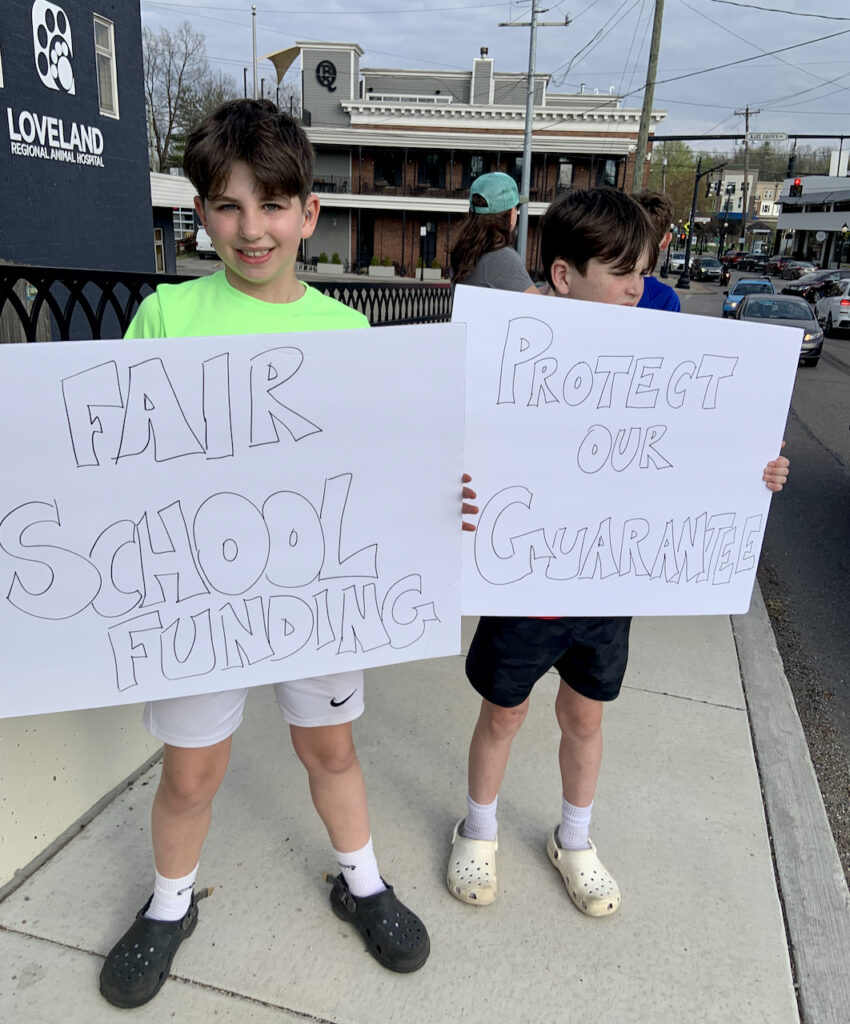
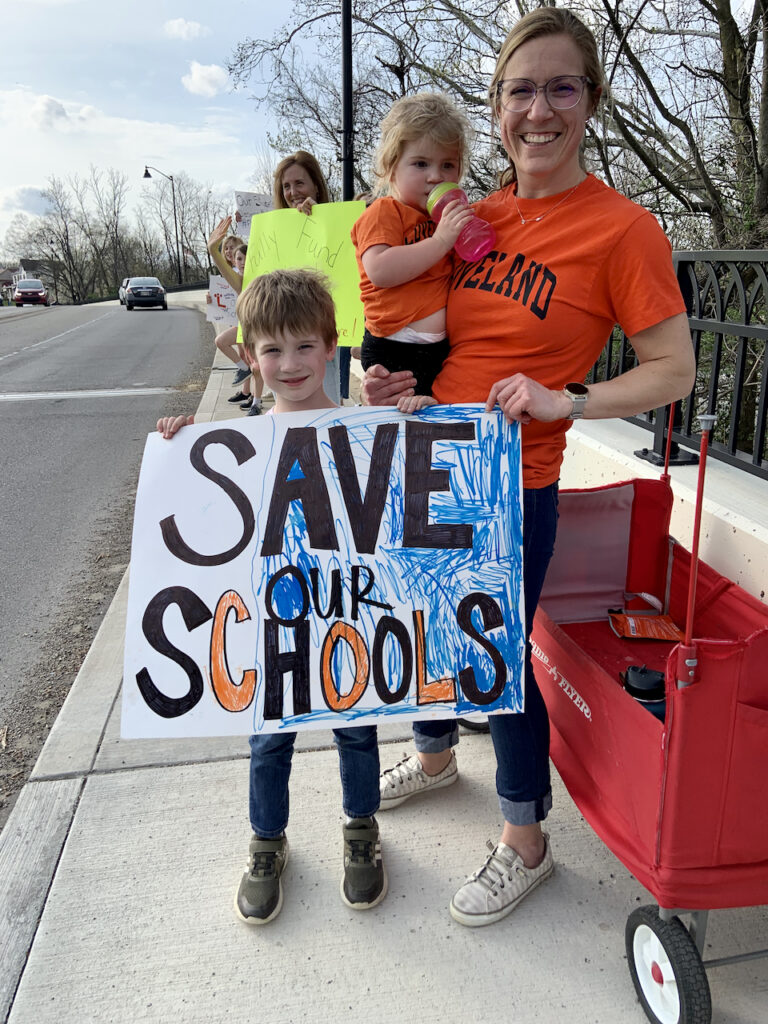
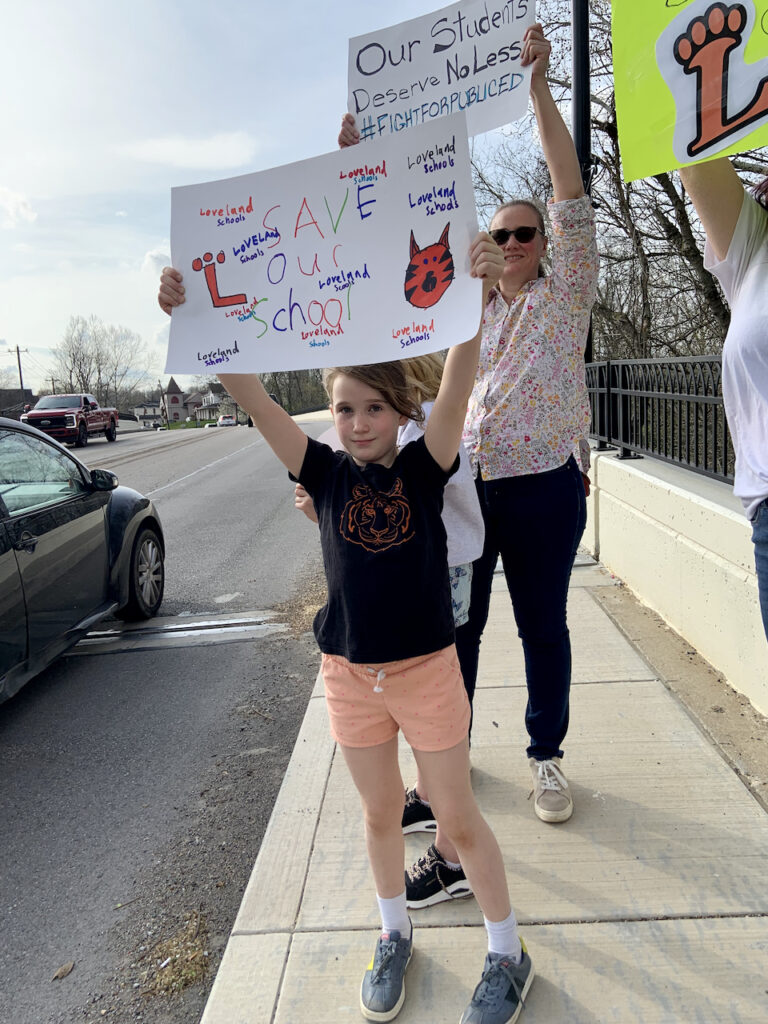
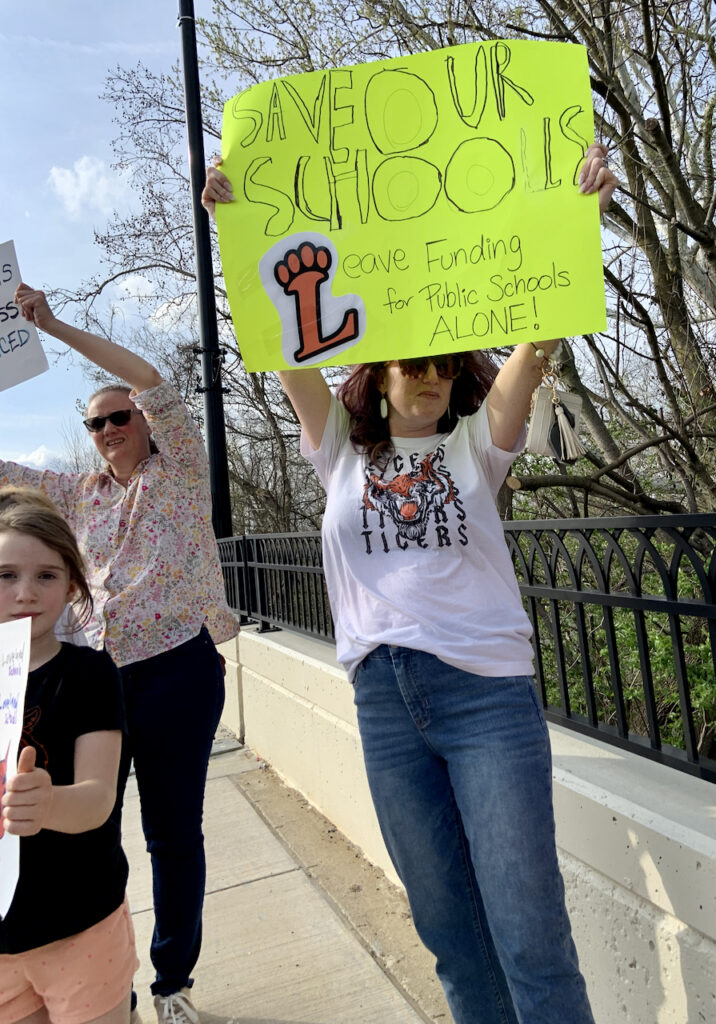
    Loveland, Ohio – Becca Moates and Cindy Daumeyer were on Loveland’s Col. Thomas Paxton bridge Wednesday evening along with many supports to send a message to Ohio Governor Mike DeWine and State legislators. The message was to urge the lawmakers to fully fund Ohio’s Fair School Funding Plan (FSFP) for public schools. They say that if the plan isn’t fully funded, the Loveland City School District may lose $2.5 million over the next five years. The FSFP is commonly referred to as the Cupp-Patterson plan. Backers are urging the full completion of its phase-in.

    Scott DiMauro, president of the Ohio Education Association, pointed out the potential effect on public schools, which he said serve 95% of Ohio students. He told the Public News Service in late March, “The governor has proposed a budget that would cut public schools by over $100 million, while at the same time increasing funding for vouchers for private schools and charter schools by $500 million. We know that is just absolutely unfair.”

    Becca Moates said on March 18 in a guest column published in Loveland Magazine, “The current budget proposal from Governor DeWine leads to lost funds for Loveland schools which will undoubtedly lead to additional revenue requests from the school district. Let’s continue to build the unity we have as community members to support the students who are the heart of our vibrant community.”

    In 2021, Governor DeWine signed the Fair School Funding Plan, which was supposed to be implemented three phases to support public school funding in Ohio. Over 90% of children in the State attend public schools. Only 66.67% of the planned funding levels have been implemented. The phase-in was set to reach full funding by fiscal year 2027. Once fully phased in, the FSFP is supposed to provide constitutionally appropriate funding levels for traditional school districts, Career Tech Centers, and Education Service Centers.

    Moates also said in her column, “It is time for our legislators to hear from all of us. We need Governor DeWine to endorse a bill that benefits our schools. We need to come together. Write letters, call legislators, and call the Governor.”

    DiMauro said that he worries such major shifts in funding could lead to larger class sizes and reduced services in public schools, placing additional burdens on local taxpayers to fill the gaps. He emphasized now is the time for Ohioans who are concerned about the issue and how it might affect their communities to contact their representatives in Columbus.
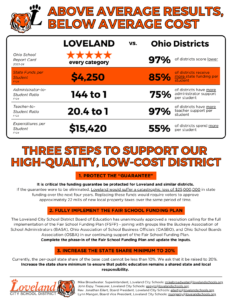
    Provided by Loveland Schools

    Who To Contact

    Download the list or click below PDF to enlarge.

    What to Say?

    Here are Moates’ suggestions for what to include in your phone calls, emails, and letters to state lawmakers:

    • Your name
    • Your role (parent, student, staff member, community member) in the Loveland City School District.
    • Your story (explain why you support Loveland City Schools, your family’s experience with Loveland City Schools, and why you are concerned about funding cuts for our district. Make it clear that decisions about funding impact children and communities.)
    • Your request (for example: protect the “guarantee” because reducing it would hurt funding for our district, fully implement the Fair School Funding Plan with updated inputs, and increase the state share minimum to 20%)
    • Your appreciation (thank them for their work in Columbus and their attention to this issue that is important to you and our community.)

    We suggest you write an email message to lawmaker, then use that message as a script for a phone call. The message can then be printed and mailed to lawmakers for an additional contact point.

    Read the Loveland District’s Lobbying Request.

    [pdf-embedder url=”https://lovelandmagazine.com/wp-content/uploads/2025/03/Loveland-State-Legislators-136th-General-Assembly-2025.pdf” title=”Loveland State Legislators – 136th General Assembly 2025″]

    _______________

  • 2025 Ohio Chamber Childcare Policy Summit releases study on direct financial impact of insufficient childcare

    2025 Ohio Chamber Childcare Policy Summit releases study on direct financial impact of insufficient childcare

    Loveland, Ohio – At its 2025 Ohio Childcare Policy Summit the Ohio Chamber unveiled the “Untapped Potential: Ohio” economic report, a study that assesses the direct financial impact of insufficient childcare coverage on the state’s economy, in partnership with the U.S. Chamber of Commerce Foundation and Groundwork Ohio.

    The study found that childcare is a severe economic barrier in Ohio. The state’s childcare gap drives parents out of the workforce, reduces tax revenue for the state and puts undue strain on households. An estimate of the direct financial impact of insufficient childcare coverage revealed $5.48 billion in lost economic activity for Ohio each year.

    “Access to quality, affordable childcare is both a short-term, urgent priority and a long-term goal,” said Aaron Merchen, Executive Director of Early Childhood Education Policy and Programs at the U.S. Chamber of Commerce Foundation. “These reports outline a challenge for states but also an opportunity.”

    Ohio is the fourteenth state for which the U.S. Chamber Foundation has released an “Untapped Potential” study. The findings are based on results from a statewide survey of households with children under 6 who are not yet in kindergarten.

    Ohio ranks 30th in labor participation relative to other states, and the study’s findings indicate that many parents have been forced to or may soon be forced to stop working without adequate childcare options. In fact, 70% of parents of young children in Ohio missed work or class in the past three months for childcare-related reasons, and 33% of parents that experienced disruptions to their employment in the past year reported leaving the workforce as a direct result of issues with childcare.

    “Ohio is growing every day,” said Ohio Chamber President & CEO Steve Stivers. “We keep bringing in new projects and job opportunities, but we’re not keeping up on creating new childcare options for the people we’re attracting — or even the families we already have here. We’re leaving a lot on the table if we don’t properly address that challenge.”

    The price of childcare is also a significant obstacle for many Ohioans. On average, Ohio families spend $572 per month on childcare, and 58% of surveyed parents stated that they selected their current childcare arrangement primarily for financial reasons. However, 96% of parents believe that health and safety is the most important factor when choosing childcare.

    The study concludes that access to childcare has a sizable impact on parents’ career development and potential and urges legislators and business leaders to thoughtfully consider measures that can alleviate existing childcare issues. It also poses a final question: “What could Ohio’s parents and leaders do with an additional $5.48 billion each year?”

    The full study is below.

    The Ohio Chamber is the state’s leading business advocate and represents thousands of companies that do business in Ohio. Our mission is to aggressively champion free enterprise, economic competitiveness and growth for the benefit of all Ohioans.

    [pdf-embedder url=”https://lovelandmagazine.com/wp-content/uploads/2025/04/Untapped-Potential-Ohio.pdf” title=”Untapped Potential Ohio”]

  • Latest weather advisories

    Latest weather advisories

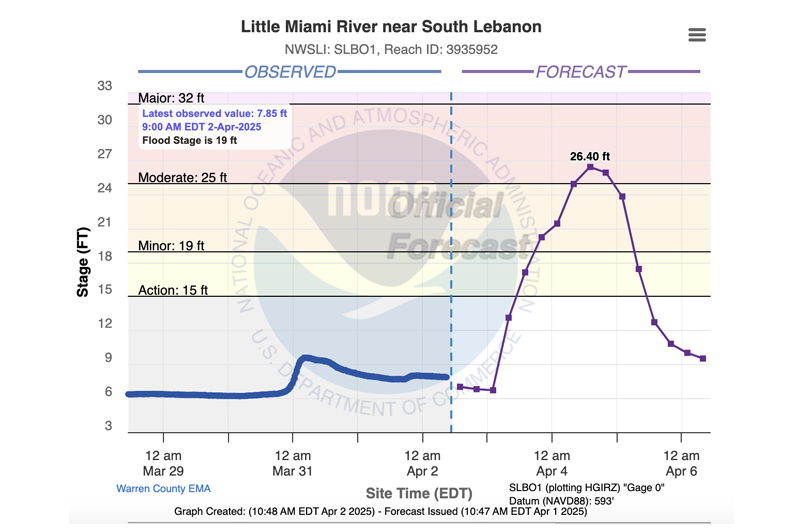
    Little Miami River level prediction for South Lebanon

    Loveland, Ohio – The National Weather Service in Wilmington says a tornado outbreak is expected today and tonight from parts of the lower Mississippi Valley into the Mid-South and lower Ohio Valley. Numerous tornadoes, along with multiple long-track EF3+ tornadoes, appear likely. A multi-day, potentially historic heavy rainfall event may produce catastrophic and life-threatening flooding today through Saturday from the Ozarks into the Ohio River Valley.

    For Loveland:

    • WIND ADVISORY REMAINS IN EFFECT FROM 10 AM THIS MORNING TO
    MIDNIGHT EDT TONIGHT...
    • FLOOD WATCH REMAINS IN EFFECT FROM THIS EVENING THROUGH SUNDAY
    MORNING
    • Flooding caused by excessive rainfall continues to be
    possible.

    _______________

    WCPO: The Tri-State is under a FLOOD WATCH starting this evening through Sunday morning. 4-8 inches of rainfall is possible. Expect to see creeks, streams, and rivers rising, some potentially quickly. Flash flooding cannot be ruled out at times, either. Stay weather-aware if you live along those waterways, and be ready to reach higher ground. Showers and storms will arrive in southeast Indiana around 9-10 p.m. The line will then move toward the Cincinnati metro area and the heart of the Tri-State between 10 p.m. and midnight. This is when we’ll see most of our severe thunderstorms and tornado warnings. The line of storms will continue pushing east of I-75 between 2 a.m. and 5 a.m., still producing severe storms. The threat of severe weather will end before the morning drive.

    Local 12: Strong to Severe Storms likely. Heavy rain takes over into Thursday AM. A Flood Watch has been issued from Wednesday evening through Sunday morning. During this time, waves of heavy rain and storms are expected and some places could pick up 5″ or more of rainfall resulting in flooding.

    Fox19: The Tri-State is under an Enhanced Risk (3 out of 5) for severe storms, flooding rain, and powerful winds on Wednesday.

    WLWT: By Thursday morning, 2-3 inches of rain will have fallen in some communities, which leads to a flash flooding potential. Totals will be around 5-8+ inches. The heaviest rain bands could also come overnight.

  • Ohio college students, educators disappointed in Gov. DeWine for signing higher ed overhaul

    Ohio college students, educators disappointed in Gov. DeWine for signing higher ed overhaul

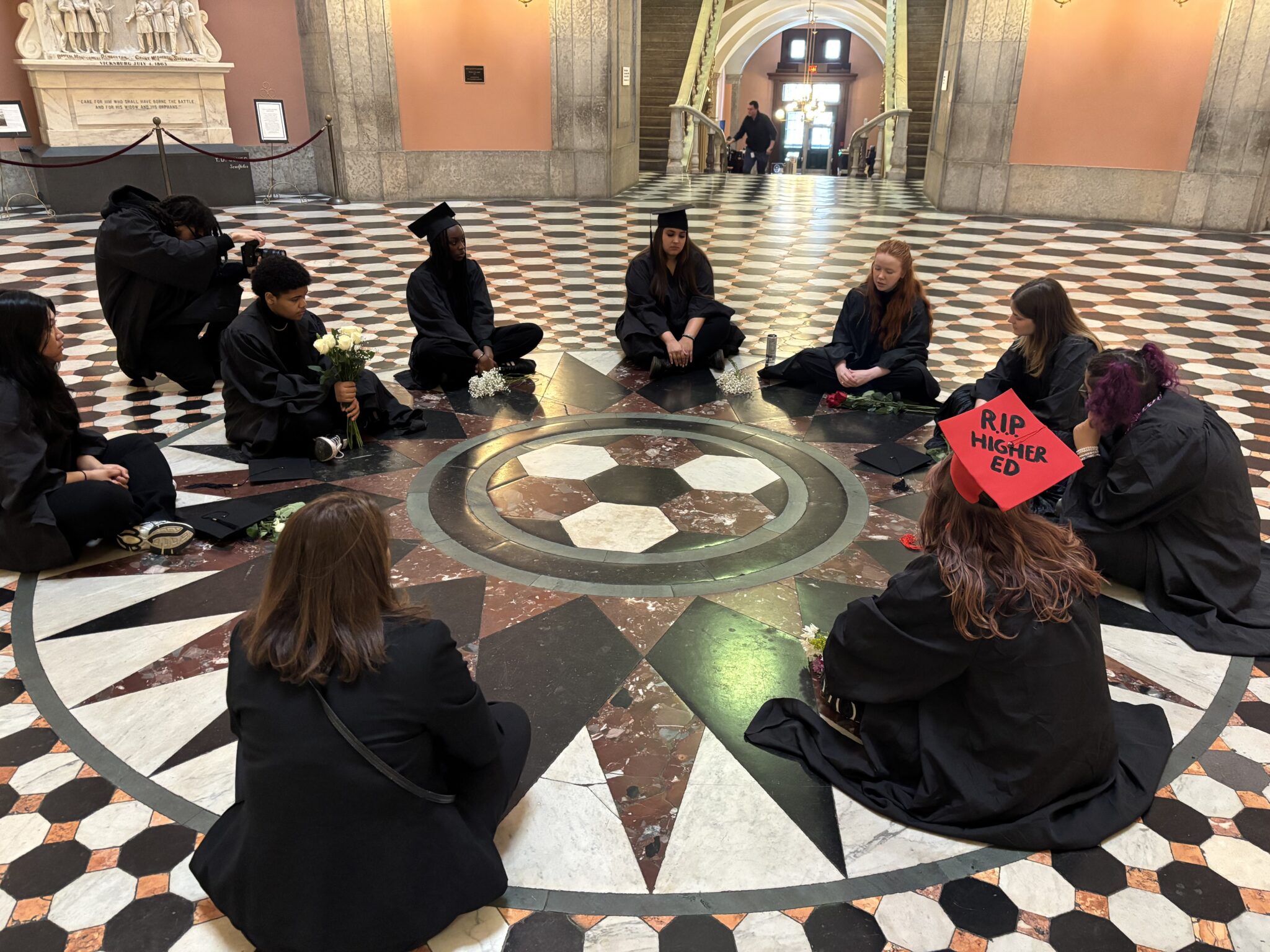
     Members of the Ohio Student Association held a mock funeral for the death of higher education on March 31

    Photo by Megan Henry, Ohio Capital Journal

    The Ohio Student Association organized the mock funeral, which took place Monday afternoon in the Ohio Statehouse Rotunda, days after DeWine signed Senate Bill

    By:  Ohio Capital Journal

    Students donning black graduation robes held a mock funeral for the death of higher education after Ohio Gov. Mike DeWine signed a bill into law that will overhaul the state’s public universities.

    The Ohio Student Association organized the event, which took place Monday afternoon in the Statehouse Rotunda, days after DeWine signed Ohio Senate Bill 1.

    S.B. 1 will ban diversity efforts, prohibit faculty strikes, regulate classroom discussion of “controversial” topics, create post-tenure reviews, put diversity scholarships at risk, create a retrenchment provision that block unions from negotiating on tenure, shorten university board of trustees terms from nine years down to six years, and require students take an American history course, among other things.

    GET THE MORNING HEADLINES.


    For classroom discussion, the bill will set rules around topics involving “controversial beliefs” such as climate policies, electoral politics, foreign policy, diversity and inclusion programs, immigration policy, marriage, or abortion. It prohibits professors from “indoctrination,” and while it doesn’t define that, it allows complaints to be filed against professors for review by the Chancellor of the Ohio Department of Higher Education. S.B. 1 will only affect Ohio’s public universities and community colleges.

    “It was really surprising, the quickness that it was signed,” said Ohio State University junior Brielle Shorter. “I think signing it at such a time was really interesting as well, but it was truly heartbreaking.”

    DeWine got the bill Wednesday — the same day the Ohio Senate concurred with changes to the bill made by the Ohio House — and he signed it Friday.

    “As a Black student on campus, our spaces have already been slowly getting demolished,” Shorter said. “I believe that with this bill there’s going to be more changes like that.”

    Ohio State recently closed its Office of Diversity and Inclusion and the Office of Student Life’s Center for Belonging and Social Change in response to the U.S. Department of Education’s Dear Colleague letter that threatened to rescind federal funds for schools that use race-conscious practices in admissions, programming, training, hiring, scholarships, and other aspects of student life.

    Shorter said she has seen Ohio high school students post on social media how they are no longer interested in attending Ohio universities and instead plan to go to school out of state.

    Scott DiMauro, president of the Ohio Education Association, said it is unfortunate DeWine signed S.B. 1 into law.

    “It’s disappointing to see that he did that, even though the overwhelming amount of opposition that was expressed on the bill from faculty and from students and from concerned citizens was strongly against it,” he said. “I think it’s unfortunate to see collective bargaining rights of people who work in higher education diminished.”

    Pranav Jani, president of Ohio State’s American Association of University Professors chapter, said they will fight the impact of the bill as it becomes law.

    “We know that we stand with thousands of educators, students, and parents, who are disgusted by this naked display of governmental repression of higher education,” he said in a statement.

    State Sen. Jerry Cirino, R-Kirtland, introduced S.B. 1, which took just over two months to pass both chambers and be signed into law.

    “I believe this is monumentally significant legislation that will allow Ohio’s public universities and community colleges to deal with looming enrollment challenges and usher in a renaissance of academic excellence,” Cirino said in a statement.

    Follow Capital Journal Reporter Megan Henry on Bluesky.


    Megan Henry
    Megan Henry

    Megan Henry is a reporter for the Ohio Capital Journal and has spent the past five years reporting in Ohio on various topics including education, healthcare, business and crime. She previously worked at The Columbus Dispatch, part of the USA Today Network.

    Ohio Capital Journal is part of States Newsroom, the nation’s largest state-focused nonprofit news organization.

    MORE FROM AUTHOR

  • Pollinator Protection

    Pollinator Protection

    by Julie Watson

    Save the Bees. I’m sure you’ve heard or seen such slogans increasingly over the past couple of decades. Of course, I’m all for saving any species, but some of the claims of activist groups on bee decline are a bit frightening. In trying to research the topic of bees and their necessity to humanity’s survival, I found varied and often contradictory reports. Sifting through the data, a few undeniable truths emerged.

    First of all, honeybees are not native to North America. They were domesticated over 9,000 years ago which precedes the domestication of animals like chickens, pigs, and horses. Honeybees originated in either Asia or Africa and spread to Europe. European settlers brought honeybees to the east coast of North America approximately 400 years ago. They slowly began to make their way across the continent.

    Secondly, although there are 4,000 species of bees native to North America, bees are not the only kind of insect pollinators. Other insects like ants, flies, butterflies, moths, wasps, and beetles do their fair share of pollinating too. Most of these undomesticated, native pollinators have seen sharp population declines since the turn of the century.

    Thirdly, there are many factors contributing to pollinator decline. More study is needed to determine the exact causes of dwindling populations of pollinating insects. However, we do know that many of the world’s important agricultural crops, including most fruits, nuts, and vegetables, are dependent on insect pollinators.


    At this stage of the game, all insect pollinators could use a little human help. Until researchers and scientists can agree on what is causing pollinator decline and how to stop it, what can you as a homeowner do about the situation?

    There are some steps you can take that will make a difference. Some of them are simple. Most of them will have additional benefits for the planet, your person, and your wallet.

    1. Hold off on spring yard word until we’ve had at least 10 consecutive days of 50 degrees or higher. Many pollinators overwinter in the leaf piles and natural debris that accumulate before the snow begins to fly.
    2. Go chemical free. Avoid using man-made chemical pesticides on your lawn and around your home. Not only do they affect whatever they are targeted towards, they also contaminate ground water, affect air quality, and many have been proven to contribute to human health issues like cancer.
    3. Embrace early bloomers like dandelions and violets. These bright bursts of color in your yard provide much needed sustenance to pollinators emerging from winter hibernation.
    4. Plant pollinator-friendly plants and trees that are native to your area. Native species require less water and care, and they will attract native pollinators. If you don’t have much room, use pots, window boxes, or sprinkle them in among your garden plants. If you want to help on a large scale, replace your grass with flowering lawn alternatives (like clover or creeping thyme) or plant portions of your lawn as native meadows. Both will reduce long-term lawn care costs.
    5. Raise your mowing deck. Leaving the grass slightly longer than normal provides shelter and cover for all kinds of pollinators as well as natural pest eaters like lady bugs and lightning bugs. It also means less frequent mowing which can save both time and money.
    6. Provide pollinators with water and shelter. Insect pollinators benefit from shallow pans of water with rocks placed in them that extend above the water surface. This gives them an opportunity to drink without drowning. Pollinator houses, whether storebought or homemade, can provide safety from predators and weather. Many simple plans are available online.

    Here are some resources to help you become a pollinator protector:

    The Ohio Extension Service has a hotline (April 1st – October 31st) for questions about pollinators or gardening (330) 296-6432 or visit go.osu.edu/pchotline.

    Ohio Pollinator Habitat Initiative https://www.ohiopollinator.org/

    The Cincinnati Zoo has a pollinator program. https://cincinnatizoo.org/gardens/plant-for-pollinators/

    Queen City pollinator Project offers education for grades 3 through adults  https://www.queencitypollinatorproject.org/

  • “Paying off Debt Means Lower Taxes for Loveland City School District Residents”

    “Paying off Debt Means Lower Taxes for Loveland City School District Residents”

    An Op-Ed from Loveland City School District Treasurer John Espy

    Loveland City School District has paid off its last outstanding bond and is now debt-free. A construction bond was issued in 1998, and after nearly three decades of sound financial management, the bond has now been paid in full. The result is lower property taxes for Loveland City School District property owners.

    In 1998, district voters approved a bond for school construction and renovation projects. The money was primarily used to build Loveland Intermediate School and renovate Loveland Middle School. When they were issued, the bonds were funded at 5.17 mills. In the years since, the bonds have been refunded, or essentially refinanced, at lower rates – the most recent being .95 mills. The final payment on the bond debt was made in December of 2024, and local property taxes are no longer being collected to repay that debt.

    With the repayment of the bond, the average property owner in Loveland City School District is now paying about $136 less per year in local property taxes. Unless you looked closely at your most recent tax bill, you might have missed this bit of good news. The district is now debt-free, and all of our building bonds have been paid in full, marking a major financial milestone for our schools and community.

    As the Treasurer of Loveland City School District, I value transparent financial reporting and keeping our commitment to being a responsible steward of taxpayer funds. District leadership remains committed to transparency and providing you with the information you need to understand how your tax dollars are being managed.

    School funding in Ohio is complex, but our community has made it clear they want to learn more about the subject. Our State School Funding Committee, School Finance Town Hall last fall, and our ongoing Community Advisory Team Meetings have all allowed me to explain school finances to our community. I’ve also recently launched a series of educational “Finance Friday” videos and social media posts. The videos explain some foundational topics in school finance so our community is better informed. I hope you’ll take the time to watch my “Finance Friday” videos and share them with your friends. I also ask that you share the good news that Loveland City School District is debt-free after keeping our commitment to paying off the 1998 construction bonds.

    If you ever have questions about our district finances, please let me know. I can be reached at espyjo@lovelandschools.org.


  • Hamilton Township, Loveland, and Goshen Township rate high as safest communities in Ohio

    Hamilton Township, Loveland, and Goshen Township rate high as safest communities in Ohio

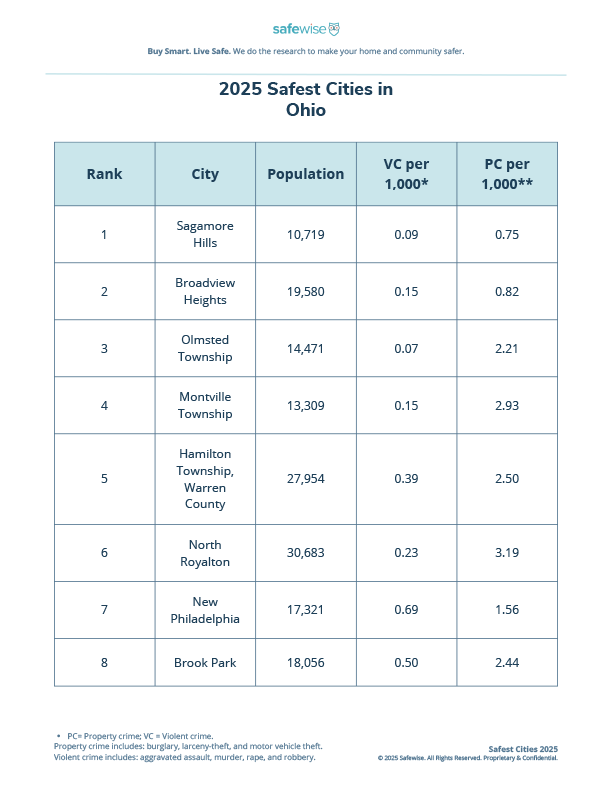
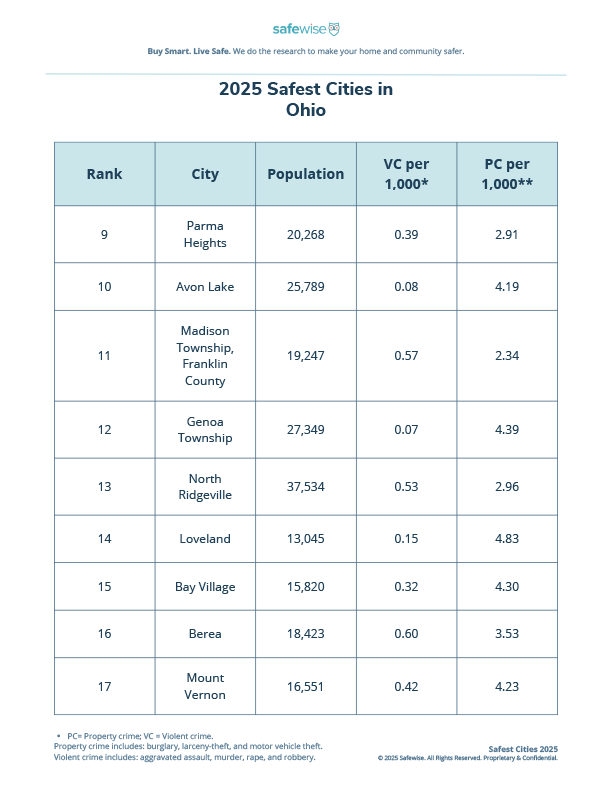
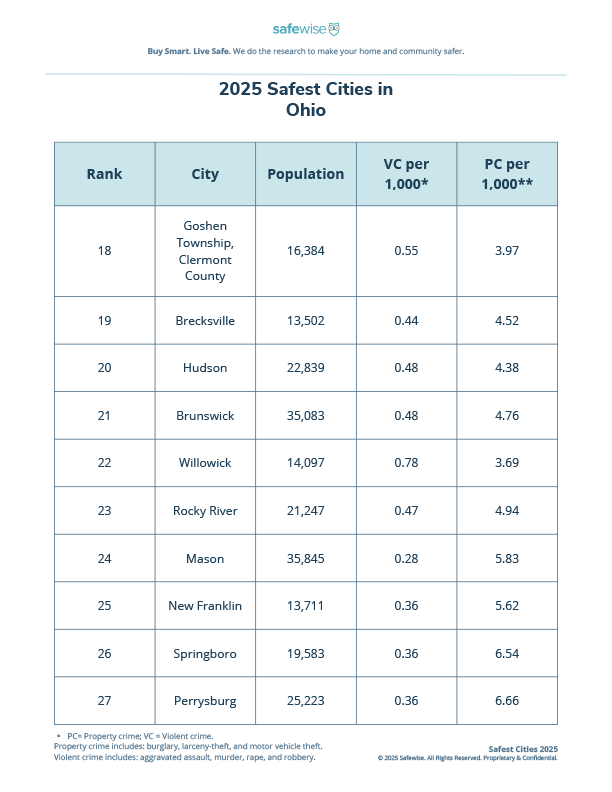
    Loveland, Ohio – Safewise which sells home security systems, crunched the numbers on crime rates across Ohio. The rankings are based on the number of reported violent crimes and property crimes per 1,000 people in each community.

    Hamilton Township in Warren County was rated #5 with Loveland coming in at #14 as the safest community in Ohio. Goshen Township was rated #20.

    The City of Loveland said on their FaceBook page, “This achievement is a team effort, highlighting the strong partnership between the Loveland Police Department and our great citizens, who look out for one another and report suspicious activity. We also want to give a shoutout to our neighboring jurisdictions that also made the list—Hamilton Township Police Department and Goshen Township Police Department. Our communities were the only ones in the region to rank among the top 20 safest cities in Ohio!”

    The Goshen Township Police Department said on their FaceBook page, “Proud to announce that Goshen Township has been ranked as the 18th safest city in Ohio for 2025 by SafeWise! Out of 175 communities evaluated, our low crime rate stands out.”

    Hamilton Township Police Chief Scott Hughes said, “Our officers’ daily commitment makes this possible—thank you. Residents play a key part by staying vigilant and connected, while local leaders, businesses, and strong school districts keep our township thriving. With violent crime at just 0.4 per 1,000, we’re well below state averages. This means safer streets for families, a welcoming home for newcomers, and a strong foundation for local commerce and education.

    Safewise relies on voluntary, self-reported information that cities and jurisdictions across the country report through the FBI Summary Reporting System (SRS) and National Incident-Based Reporting System (NIBRS). For their 2025 reporting year, the most recent FBI data was released in October 2024 for crimes reported in 2023.

  • National Weather Service is predicting significant storm and flooding

    National Weather Service is predicting significant storm and flooding

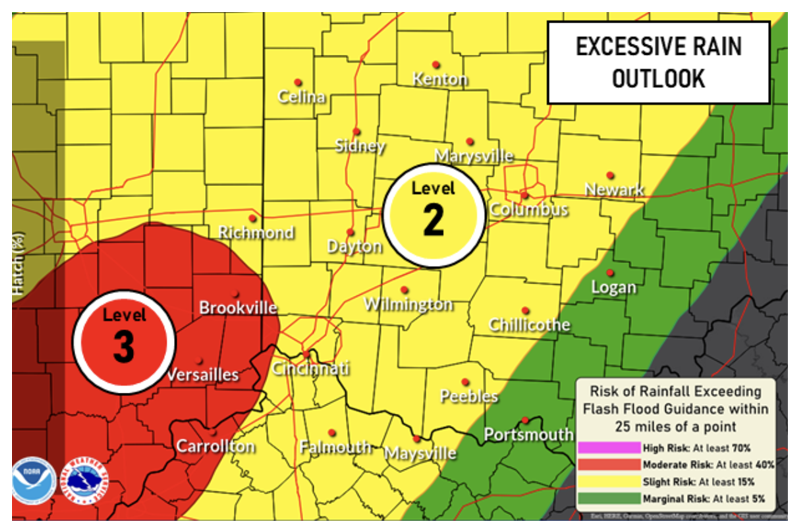
    Loveland, Ohio – The National Weather Service is reporting that a significant storm will track across the central U.S. and into the Great Lakes through Thursday. Heavy snow and blowing snow is expected from the northern Plains into the Upper Midwest. Further south, severe thunderstorms are expected from the southern Plains into the Midwest as well as a multi-day excessive rain and flooding event Wednesday through Saturday from the Ozarks into the Ohio Valley.

    A Flood Watch has been issued for Loveland

    FLOOD WATCH REMAINS IN EFFECT FROM WEDNESDAY EVENING THROUGH
    SUNDAY MORNING
    "People in the watch area, especially those living in areas prone to
    flooding, should be prepared to take action should flooding develop."

    WCPO reports that our region could see 4-8″ of rainfall in total.

    Local 12 says a Flood Watch has been issued from Wednesday evening through Sunday morning. During this time, waves of heavy rain and storms are expected and some places could pick up 5″ or more of rainfall resulting in flooding.

    The Fox 19 Weather Team says anywhere from three to six inches of rain could fall.

    WLWT predicts significant rainfall projected with 5-8+ inches by the weekend.

    ___________________

    noaa.gov provides Little Miami River level information from Milford that is convenient to view.

    Historic Crests for Little Miami River in Milford

    1. 30.50 ft on 03-27-1913
    2. 27.30 ft on 01-22-1959
    3. 21.81 ft on 07-18-2001
    4. 21.69 ft on 04-16-1998
    5. 21.28 ft on 03-19-2008


    Recent Crests for Little Miami River in Milford

    1. 19.65 ft on 02-18-2022 (P)
    2. 18.27 ft on 06-19-2021 (P)
    3. 19.65 ft on 05-19-2020 (P)
    4. 18.00 ft on 04-20-2019
    5. 17.65 ft on 03-31-2019
    6. 18.45 ft on 02-08-2019
    7. 17.38 ft on 02-06-2019
    8. 18.00 ft on 04-03-2018
    9. 20.43 ft on 02-25-2018
    10. 18.56 ft on 11-06-2017
    11. 19.91 ft on 03-01-2017
    12. 19.35 ft on 05-02-2012
    13. 19.13 ft on 12-06-2011
    14. 17.87 ft on 04-19-2011
    15. 21.28 ft on 03-19-2008
    16. 17.07 ft on 03-02-2007
    17. 17.88 ft on 03-28-2005
    18. 19.10 ft on 01-06-2005
    19. 20.62 ft on 01-05-2004
    20. 17.10 ft on 09-03-2003
    21. 17.29 ft on 06-06-2002
    22. 21.81 ft on 07-18-2001
    23. 18.20 ft on 02-18-2000
    24. 17.50 ft on 02-14-2000
    25. 17.40 ft on 01-04-2000
    26. 21.69 ft on 04-16-1998
    27. 19.33 ft on 06-01-1997
    28. 19.30 ft on 05-11-1996
    29. 17.17 ft on 04-29-1996
    30. 17.89 ft on 05-18-1995
    31. 19.30 ft on 04-10-1994
    32. 19.30 ft on 01-30-1994
    33. 17.50 ft on 05-02-1983
    34. 18.80 ft on 06-10-1980
    35. 21.18 ft on 09-14-1979
    36. 17.75 ft on 05-24-1968
    37. 27.30 ft on 01-22-1959
    38. 20.90 ft on 03-06-1945
    39. 20.10 ft on 04-20-1940
    40. 19.55 ft on 01-22-1937
    41. 30.50 ft on 03-27-1913


    Alert Hamilton County and Smart 911

    Hamilton County EMHSA encourages residents to have multiple ways of receiving alerts and warnings. Alert Hamilton County (Alert HC) is a mass notification system used to notify residents about emergencies and other important information throughout Hamilton County. When registering for Alert HC, users can also create a Smart911 profile, allowing first responders to have quicker access to important information in case of an emergency.

    Sign up for alertswww.Smart911.com

  • Public Input Wanted: OKI’s draft transportation improvement program

    Public Input Wanted: OKI’s draft transportation improvement program

    Loveland, Ohio – The Ohio-Kentucky-Indiana Regional Council of Governments (OKI) is a metropolitan planning organization that works with over 100 regional jurisdictions, including Loveland.

    OKI is required to prepare a transportation improvement program (TIP) listing all federally funded and other regionally significant transportation projects in the their planning area. OKI updates the TIP every two years, with each spanning four years.

    A new TIP is being published and OKI is accepting public comment from March 10 to April 10, 2025 via email to RFields@oki.org.

    There is also a public meeting on April 1, 2025, 4 p.m. at OKI’s Office, 720 E. Pete Rose Way, Suite 420, Cincinnati, Ohio 45202 or online.

    The new TIP will be presented to the OKI Board of Directors for approval at their April 10, 2025 meeting and will then be entered in the Kentucky and Ohio Statewide TIPs.

    Questions? Contact Andy Reser.

    [pdf-embedder url=”https://lovelandmagazine.com/wp-content/uploads/2025/04/Draft-OKI-TIP.pdf” title=”Draft OKI TIP”]

    ________________

    Ohio-Kentucky-Indiana (OKI) is a Council of Governments (COG) and Metropolitan Planning Organization (MPO) that works with over 100 regional jurisdictions, governments, and businesses to create an effective regional transportation plan by coordinating and approving federal funding for all surface transportation projects in the eight county region. OKI also works with local jurisdictions on regional planning, air quality, water quality, environmental initiatives and more.