Author: Guest Column

  • But here I am at school everyday with 24 children who truly do believe in the magic of Christmas and Hanukkah [w/Photo Album]

    But here I am at school everyday with 24 children who truly do believe in the magic of Christmas and Hanukkah [w/Photo Album]

    by Jennifer Miller

    As Thanksgiving  Break draws to a close I lay awake that Sunday and wonder how I will make it to Winter Break. You see, I am a first-grade teacher (13-year Kindergarten teacher before that) and December is EXHAUSTING. Can I survive? Can I keep my students in routine to keep “unwanted” behaviors at bay? Can I mix in just the right amount of fun?

    Jennifer Miller teaches 1st graders at Loveland Primary

    And that’s just at work. At home, I am overcome with the anxiety of being a good mom and partner to my significant other through December? Will I be able to make social outings with my friends? When will I shop for my own family? It’s all too much! And I have gone through this cycle for 22 years now. 

    I dig deep. We get back from Thanksgiving Break and we dig back into our learning. The first week back is too soon for Holiday stuff so whew, we all survive. But we can all feel it building. Then there is that dreaded middle week of school. Not the first week back when you are fresh and not the last week before break – the middle one. Routine, routine, routine at school. Keep them in routine. Sprinkle in the fun. Go to bed early. Go to bed early. Don’t worry about getting Christmas ready at home. Self-care. Self-care. Be an OK mom. Let your significant other take care of you. That is my mantra.

    And then, it’s here. The week before winter break. I dig deep. Really deep. I can do this! Keep my eyes on the prize! Eyes on the prize!

    Routine again at school as much as possible. Eat a good breakfast. Consume LOTS of coffee. Self-talk. Self-talk. Self-talk. Believe that I am enough at school for my students and at home for my family. Oh – and sprinkle in the fun at school. Holidays around the world, a Fantasy Field Trip to the North Pole writing assignment, assist 24 little ones in making a gift for their parent, and oh – keep the peace in the classroom and pick my battles. And then, Mother Nature teases us with a possible delay or snow day. But no, it’s just wet and cold enough to cause days worth of inside recess! Inside recess in December- oh come on! I’m definitely being tested. I trudge along. 

    And then I remember that year after year I get to spend December with an incredible age group who never let me forget what the holidays are all about.

    But then something always snaps in me and my brain settles a bit and the anxiety begins to disappear.  Perhaps it’s because I am getting older and my own child is 15 and the holidays look and feel a little different now. Gone are the days of sitting on Santa’s lap and getting up early on Christmas morning to see what Santa left. Gone are the days of having our own elf on a shelf at home. Christmas wish lists are full of makeup and clothes and gift cards instead of American Girl Dolls and Barbies.

    But here I am at school every day with 24 children who truly do believe in the magic of Christmas and Hanukkah. 24 children who think every minute of this last week is amazing and awesome. 24 children who think their classmates and their teachers are awesome.

    But here I am at school every day with 24 children who truly do believe in the magic of Christmas and Hanukkah. 24 children who think every minute of this last week is amazing and awesome. 24 children who think their classmates and their teachers are awesome. And then I remember that year after year I get to spend December with an incredible age group who never let me forget what the holidays are all about. I get to see December through the eyes of a child year after year. I begin to move slower through the week. Observing and listening as I go. I slow down at home too. And I take it all in. And to me, that makes me the luckiest person out there. Maybe even luckier than Santa. 

    PS – I have to say thank you to my incredible family. To Olivia, my daughter, thank you for letting me be just an OK mom during the last few weeks! Thank you for knowing that I give my all to school every day. 

    To my significant other, Kyle – thank you for loving and supporting “teacher me” each day, and understanding this time of year like no one else can. Thank you for feeding me and tucking me in at 9 PM. And to my mom, dad, and sister – thank you for understanding my job and that in December those little people come first. Thank you for supporting me so that I can love and support my students.


    The photos below were taken in Ms. Miller’s classroom the day before the last day of school before Winter Break. The children were making holiday crafts and thank you cards for their custodian, Dave Constant. They got a surprise visit from their Recess Monitor, Mike Scherbenberg and Amy Reiss the building’ English as Second Language teacher. Donna Miller, Ms. Miller’s mom volunteered to help the children wrap the presents they were going to take home.

    Click on any photo to view it full size and flip through the entire gallery…

  • March Operating Levy:  Should Loveland School District Be Asking for More?

    March Operating Levy: Should Loveland School District Be Asking for More?

    “Our analysis of the data indicates that a levy cannot be justified at this time.”

    By Kim and Rick Donaldson

    Dr. Amy Crouse, Loveland City School District Superintendent, has put together a committee of district residents to advise the Board of Education as to whether an operating levy should be placed on the March ballot, and if so,

    Kim and Rick Donaldson live in the Grailville neighborhood of Miami Township

    how much it should be. While we are not members of this committee, we are long-time district residents who have taken some time to examine district revenue and expenditure trends available on the Ohio Department of Education website. Our analysis of the data indicates that a levy cannot be justified at this time.

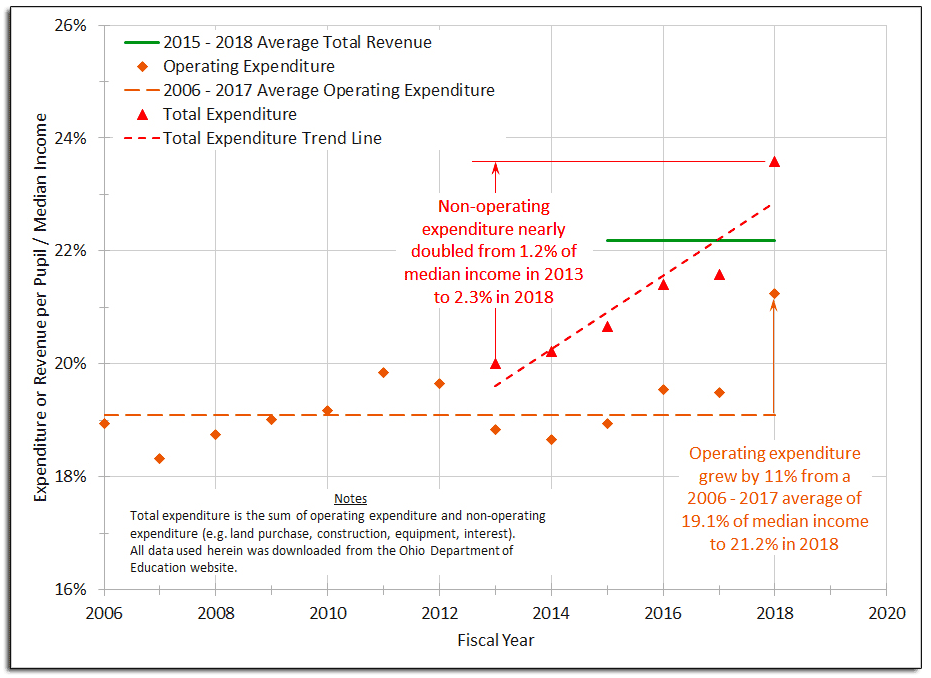
    As we have opined in the past, district expenditures need to be limited to levels the community can support. To that end, we have recommended managing total expenditures per pupil, operating and non-operating, to 20 percent of district median income, which is what it was in 2013. From 2013 to 2018 total expenditures have risen

    We therefore recommend to the Board of Education that instead of rushing to place a levy on the March ballot, they delve into the details of current spending levels and develop a clear understanding of why increases over the past five years have outstripped median income.

    sharply. Operating expenditures alone jumped to 21.2 percent of median income in 2018 after remaining relatively flat around an average of 19.1 percent from 2006 through 2017. While 2.1 percentage points may not sound like much, it represents an 11 percent increase in spending relative to the median income in a single year. Perhaps more alarming is the fact that non-operating expenditures, which include things like land purchase, construction, equipment and interest on the debt, have nearly doubled from 1.2 percent of median income in 2013 to 2.3 percent in 2018. The net result is a 2018 total expenditure per pupil that is 23.6 percent of median income, an 18 percent increase in only 5 years.

    Meanwhile, district revenue per pupil since 2015, the first year after the last levy was passed, has averaged 22.2 percent of median income. While this is less than 2018 expenditures, it is significantly more than was expended in any previous year. Our conclusion is that the district’s problem is excessive spending, not insufficient revenue. We, therefore, recommend to the Board of Education that instead of rushing to place a levy on the March ballot, they delve into the details of current spending levels and develop a clear understanding of why increases over the past five years have outstripped median income. If they believe a 2020 levy is justified after having done this assessment, they can put it on the November ballot. The delay would make no difference in terms of cash flow since it would start delivering increased revenue in 2021, the same time a March levy would.


    Chart by Kim and Rick Donaldson from Ohio Department of Education data. Click on Chart for a Larger View

    We further recommend Loveland voters not support additional levies until the Board of Education demonstrates a solid grasp of district spending and clearly communicates the justification for recent spending increases and the need for future increases. All such justification must be solidly grounded in measurably improved educational outcomes. If we do not demand more of the Board of Education and district administration, we can expect school taxes to continue to consume an ever-increasing share of our income with little tangible benefit.


    Yike$! Our rent just increased by 45%

    If you feel our $tories and Guest Column$ add value to your life, please send us a New$ Tip…


  • Telling us that our children are not safe was the straw that broke the camel’s back for me

    Telling us that our children are not safe was the straw that broke the camel’s back for me

    Not only did Allerton Hill’s tactics divide this community with the “stick to the message at all costs” and scare tactics, but telling us that our children are not safe was the straw that broke the camel’s back for me.

    by Anna Bunker

    You have awakened our sleepy little community to the fact that we can no longer trust the judgment of the Loveland Board of Education to represent our community in matters relating to the Loveland City School District. When you were elected, we gave you our trust to act in the best interest of our community and a few weeks ago the polls stated you have have not.

    This is the outline of Anna Bunker’s speech to the Board of Education during the Hearing of the Public portion of the meeting on November 19

    As a group, you have lost my trust in your ability to recognize what the community needs. We shouldn’t need to be sold the idea of 3 new buildings, 110 acres of land, security upgrades, etc… If the Superintendent and Board of Education spent the same amount of time educating the community before they voted on adopting the plan as they did to promote it during the election, I think we would be having a much different conversation today.

    The fact is you knew this was a big ask and tried to hide the overall costs in the fine print. You conducted a survey before you voted on putting this on the ballot and the survey told you that 90% of the people surveyed had no or little idea about the Building Tiger Nation plan. In that same survey, you were told that 50% of the people believed Loveland already had high taxes.

    And even with this information, you approved the plan and put it on the ballot anyway.

    Speaking of communications, the fact that you felt the need to hire Allerton Hill with a price tag of $133,000 to sell this levy to the community has to be one of the biggest mistakes you made. This is not Washington DC or New York City, this is Loveland, Ohio, a caring and trusting community that takes care of one another.

    Not only did Allerton Hill’s tactics divide this community with the “stick to the message at all costs” and scare tactics, but telling us that our children are not safe was the straw that broke the camel’s back for me.

    This was just a scare tactic because the truth is our Tiger community is safe.

    How dare you tell our community and surrounding communities that our schools are not safe!

    Are there improvements that can be made, of course.

    Are there changes you would like to implement, of course.

    But our schools are safe.

    This was just a scare tactic because the truth is our Tiger community is safe. We have amazing administrators, teachers, staff, and safety officers that in an emergency will do their best to keep our children safe. There will always be some new theory or strategy on school safety, but it doesn’t mean our kids are not safe.

    I believe you are all good people acting with good intentions. But I also believe somewhere along the road things went sideways and you may have forgotten why you initially ran for this position.

    Fool me once, shame you, Fool me twice, shame on me.

    What am I going to do? I am going to keep our Political Action Committee up and running to ensure two things:

    1) A seat on the Board of Education will never be unopposed again.

    2) I will do my best to keep myself informed and continue to keep the Loveland community informed, so they are never blindsided again.

    You have not only lost my trust in your ability to represent our community’s needs, but you have also lost my vote.


  • Restoring Trust: Recommendations for the Loveland Board of Education

    Restoring Trust: Recommendations for the Loveland Board of Education

    By Kim and Rick Donaldson

    A large portion of the Loveland community has lost faith in the Loveland board of education and school administration. This is clear from the decisive 78% to 22% defeat of the school levy and bond issue on November 5th. Further evidence is provided by the fact that the two board members running for reelection each garnered only around 50% of the vote while running unopposed, meaning that half of those who voted chose to vote for neither of them. Before putting another levy on the ballot, the board needs to take substantive actions to regain the community’s trust.

    Before putting another levy on the ballot, the board needs to take substantive actions to regain the community’s trust.

    Others in the community have recommended three actions: terminate the land purchase contract with the Grail, terminate the Allerton Hill consulting contract and implement Ohio’s open checkbook. All three are excellent ideas and we support them wholeheartedly. These three actions would demonstrate that the board is responding to the electorate and that they are committed to communicating openly, honestly and with full financial transparency. In addition, the board needs to demonstrate a commitment to providing strong, fiscally responsible governance in the future.

    We, therefore, recommend two additional actions

    The first is to implement an annual budgeting process that starts with a strict cost cap tied to taxpayers’ ability to pay. A relatively simple way to do this would be to limit the total expenditure per student, including both operating and non-operating expenditures, to a fixed percentage of the median income in the district. We recommend a limit of 20%, which according to the Ohio Department of Education data corresponds to 2013 levels, before the ramp-up that occurred over subsequent years. This would serve to ensure that school taxes do not continue to consume an ever-increasing portion of household income and restrict tax levies to levels more acceptable to voters.

    Because of its focus on cost versus benefit, this method forces much better prioritization and decision making than the typical method.

    The second action is to use a zero-based budgeting approach to allocate money within the budget cap. This is a standard budgeting method in which the budget allotted to each expense category starts at a base level of zero and moves up from that level only to the extent that is justified by its benefit. Because of its focus on cost versus benefit, this method forces much better prioritization and decision making than the typical method wherein each expense is assumed to start at the prior year’s level plus a standard annual increase. In this context, benefits would need to be defined as proven, quantifiable impacts on academic performance in order to ensure we deliver the best education our community can afford for our children.

    Taking these actions now would go a long way toward convincing the community that the Loveland board of education is actively supervising school administrators, ensuring sound management of the school system and advancing the interests of the entire community.

    After all, that is what we elected them for?

    Kim and Rick Donaldson live in the Grailville neighborhood of Miami Township


  • Patty Russo: The time is now for checks and balances!

    Patty Russo: The time is now for checks and balances!

    by Patty Russo

    The pending 16.78 Loveland school combined levy ballot issue, likely the largest net increase asked of taxpayers for schools in the state of Ohio’s history, makes it clear that residents of our district have been trusting if not apathetic for too long. Just because people are elected to represent a community

    Patty Russo is a 10-year Loveland Resident

    doesn’t mean that the best interest of the entire community is served. After this Levy is defeated, I hope every taxpayer takes heed, practices due diligence, stays engaged, and holds this board and administration accountable.

    I am for fiscal responsibility, common sense planning, realistic budgeting, accountability, and quality education. I am against this levy.


    The proposed levy has exposed key issues about Loveland City School District (LSCD) residents that I suspect are reasons we reached the point where we are today.

    • You are busy working and focusing your time/energy on being the best parents you can be rather than inserting yourselves in the process of managing your school district.
    • You do not regularly attend board meetings but you want what’s best for your kids and for your community.
    • You do not ask questions because you trust elected representatives to make decisions in the best interest of the community and of the students.
    • You assume those in elected positions are careful stewards of your hard-earned money and that they spend it wisely.
    • You want to be able to sell your house easily at a good price when the time is right.
    • You expect the community you chose to move to is not going to try to be something it’s not.

    After this levy is defeated, actions for restoring health and trust in our community are necessary. 

    • AUDIT – Request an audit of the district to understand how your money has been spent
    • OPEN CHECKBOOK – Require LSCD to enroll in Ohio Check Book immediately
    • RATIONALE – Ask the board why the community was not informed 6 years ago that maintenance shifted from investing in items that ensure the long-term viability of buildings to as-needed fixes (band-aids) until buildings could be replaced. (Who would do that with any real estate investment?)
    • RE-BOOT/REDUCTION – Require the board to prioritize needs, and revise and reduce the plan to a reasonable, common sense amount while removing the bells, whistles, and non-essential costs. Revisit the baseline plan for using what we have and working within our means.
    • REINVESTMENT – Require board and administration to use any extra funds not needed for a new, common sense plan, to be used to reduce any existing or new debt
    • ACCOUNTABILITY – Attend board meetings, do research, ask questions, hold district representatives accountable
    • TRANSPARENCY – Require the Board to provide detailed board meeting minutes rather than simply logging minutes by agenda topic. Require the board to live-stream all board meetings so that everyone can participate/be informed even if they cannot attend in person


  • Kim and Rick Donaldson suggest: “Quality Schools Loveland can Afford”

    Kim and Rick Donaldson suggest: “Quality Schools Loveland can Afford”

    Kim and Rick Donaldson live on Paxton Road in Miami Township

    By Kim and Rick Donaldson

    As a community, we support the goal of providing high-quality education for our children. But we also need to consider affordability.  Loveland is largely a residential community whose local tax burden falls primarily on individual homeowners who are somewhat less affluent than those in surrounding districts. Whereas a one mil property tax raises about $228 per student in Mariemont, $249 in Madeira, $339 in Sycamore and $607 in Indian Hill, it raises only about $191 per student in Loveland. Consequently, we need to recognize that our school budgets are necessarily more limited, and just as a family with a limited budget must prioritize needs and manage money wisely, so must the school district. The proposed building master plan does not, in our opinion, adequately address these budget constraints.

    We wonder what other cost reduction opportunities we might find were we provided with a more detailed plan.

    In the board of education’s January 23rdcommunity meeting presentation, there is a single slide showing a $65M baseline plan for repairs at all existing building sites, which was rejected because it “does NOT address any of the core identified needs that were discovered during the assessment process.” After evaluating multiple options for addressing these “needs”, the board settled on a $165M plan and a $7.7M land purchase, i.e. $108M more than the baseline plan. From the very high-level cost breakdown subsequently provided by the administration, we can see that the plan includes $10M for athletic facility upgrades and $22.6M for a new fine arts building. That’s 30% of the incremental cost over the baseline plan going toward enrichment programs affecting a subset of the students, not to fundamental academic programs affecting the entire student body. We wonder what other cost reduction opportunities we might find were we provided with a more detailed plan.

    To arrive at a more cost-effective solution, we need to start again from the beginning with clear priorities regarding what is needed, as opposed to what is wanted.

    To arrive at a more cost-effective solution, we need to start again from the beginning with clear priorities regarding what is needed, as opposed to what is wanted. Building safety and security come first, followed by those facility improvements that have a proven impact on academic achievement. Increasing classroom space to enable reducing the student to teacher ratio might fall into the latter category. We then need to develop facility concepts that satisfy these needs in a manner that minimizes both construction and future operational costs. For example, the current facility master plan envisions three separate buildings for pre-K through 5thgrade. Combining these into a single building would reduce construction costs, reduce heating and cooling costs and maximize the opportunity for sharing resources and occasional use spaces like cafeterias, gymnasiums, and auditoriums. A two- or three-story building would also provide the opportunity to use an existing site, eliminating the cost of land purchase and development.

    These are just a few ideas meant to illustrate the point. Given the right set of objectives and constraints, the district’s architectural consultants would undoubtedly come up with more and better ideas. But the first step toward developing a school facility plan that strikes a reasonable balance between the educational needs of our children and the financial limitations of the community is to vote against the Loveland school levy and bond issue on November 5th.

    Reference

    January 23, 2019 Community Meeting Presentation:  https://secureservercdn.net/50.62.175.49/f0o.a87.myftpupload.com/wp-content/uploads/2019/01/CM3-01.23.19-Slide-Deck.pdf


  • Tigers Helping Tigers Launches

    Tigers Helping Tigers Launches

    by Cati O’Keefe

    The prospect of higher property taxes brought on by the proposed Loveland school levy has spawned Tigers Helping Tigers, a charitable foundation formed to help those with limited resources pay their tax bills.

    Cati O’Keefe is a resident of Downtown Loveland

    The foundation was conceived by Art and Kim Jarvis. Art Jarvis is the president of the School Board, which proposed the ambitious new building master plan for the school system. “My job on the Board of Education is to make sure kids get the education they need to excel in the future. And that’s the purpose of the levy,” he says.

    That’s his board member perspective. At home with his wife, however, he found their conversations frequently turning to the impact the financial ask could have on those with limited resources. “The community member Art Jarvis was bothered with the thought that the levy could cause fixed-income neighbors to suffer,” he says.

    The Jarvises reached out to friends in the community, started sharing ideas, and Tigers Helping Tigers was born. Jarvis and the fledgling board (currently Kim Jarvis and Loveland residents Deb Ricci and Katherine Dannemiller) sat down with Greg Knake, executive director of The Care Center, and detailed their plan to raise $80,000-$100,000 to launch the new foundation.

    Knake was on board immediately, framing the issue as a problem that needed to be addressed long before the current levy. “We’ve seen poverty grow 100% locally from 2005-2015 in Loveland,” he says. “Approximately 15% of kids in Loveland are on free and reduced lunch. This is an eight times faster increase than in urban areas.”

    W​e’ve seen poverty grow 100% locally from 2005-2015 in Loveland. Approximately 15% of kids in Loveland are on free and reduced lunch.

    Knake believes the proposed tax relief adds another spoke in The Care Center’s service wheel. “We are trying to bring help and resources to families teetering on the edge, and do it in a targeted way by getting people back to work or into a better job, giving them life skills, and breaking the cycle of poverty with one-on-one coaching and mentoring,” he explains.

    The Care Center, which Knake describes as a faith-based organization, is collocated with the non-denominational North Star Church on Lebanon Road. The center is in the midst of a fund-raising endeavor itself, with a new facility slated for completion October 2020. “Our strategy employs best-practice research that has started organizations locally, like CityLink and the Healing Center, and is focused on bringing resources together under one roof,” he says.

    Knake highlights the synergy between Tigers Helping Tigers and The Care Center: “ We already have relationships with many of the families who would qualify for assistance from the foundation,” he says. “We have the forms and processes in place needed to prequalify families–plus financial coaches and mentors–because hopefully this isn’t just a little bit of help on taxes but is also integrated with financial coaching to get them to an even better place in all parts of their lives.” (While The Care Center encourages people to discover and use its services, participation in the program is not a prerequisite for assistance through Tigers Helping Tigers.)

    Tigers Helping Tigers board members are equally pleased with how the two organizations dovetail.

    While The Care Center encourages people to discover and use its services, participation in the program is not a prerequisite for assistance through Tigers Helping Tigers.

    “I am passionate about The Care Center’s impact on our community, and Tigers Helping Tigers is just another piece in assisting the marginalized, says Ricci. “The Care Center embodies the culture of our community, which generously gives back to those in need. The work of the Care Center team has helped so many cross the bridge of poverty to thriving in life. Having a strong education system is vital to our youth in reaching their greatest potential. This paired with the resources of The Care Center represents a community I am proud to be a part of.”

    Dannemiller, who also serves on the fund-raising executive team for Nest Community Learning Center, believes the partnership will pay dividends for the Loveland community. “We have put six kids through the Loveland school system and stayed for the quality of the schools,” she says. “The levy is a hardship, but bridging the gap for people on limited incomes through the Care Center is a natural fit. The organization takes care of people who need help and creates a continuous path for them to get on their feet. Combining our program with theirs will extend help to people in a way that is impactful.”

    At the end of the day, it is immaterial whether the current levy passes, fails, or gets kicked down the road to return in another iteration. Real need exists now.

    The process of pondering cost versus value on the levy has, for many citizens, served as a reminder that levies–even modest ones–threaten the fragile existence of some community members and families. At the end of the day, it is immaterial whether the current levy passes, fails, or gets kicked down the road to return in another iteration. Real need exists now. Please consider donating to Tigers Helping Tigers and The Care Center. Inquiries regarding donations, receiving services, or volunteering can be made through Greg Knake at greg@carecenter.com or Art Jarvis at jarvisa@fuse.net .


  • Brock Kinser: What better way can we show Tiger Care?

    Brock Kinser: What better way can we show Tiger Care?

    by Brock Kinser

    I feel compelled to ask for your support on November 5th for the Loveland Schools levy request. The District has done a great job of seeking community input and providing detail after detail about the specific request.

    Brock Kinser lives in the Loveland School District on Enyart Road

    While there are many reasons to support the request, as an educator who lives in Loveland and works in another district, I am particularly sensitive to and supportive of the significant need to upgrade the safety and security of our buildings. We, unfortunately, live in a very different world than we did ten years ago, not to mention 50-80 years ago, when the Early Childhood Center, Primary School, and Elementary School were built. Safety requirements are different today, and the current infrastructure places limitations on the upgrades and enhancements that can be made. We have to do everything in our power to protect our children while they are at school.

    The District has been prudent and sought feedback from the Department of Homeland Security and other experts in the realm of safety. Many of the recommendations have been implemented, but others are not possible until new facilities are built.

    While there are many reasons to support the levy request on November 5th, we have to address the need to upgrade safety and security to protect our children and staff for the circumstances of the modern world. My second-grade son talks about Tiger Care. What better way can we show Tiger Care than providing our youngest students and their educators with a safe and secure environment in which to learn and lead? If you are in doubt, please go take a tour of the campuses and ask yourself if we should do better for the children of our community. Please join me in voting FOR the levy request on November 5th.


  • A resident’s Q&A Facts – Loveland City School District Levy

    A resident’s Q&A Facts – Loveland City School District Levy

    by Dale Friemoth

    Dale Friemoth is a Loveland School District resident and lives on East Loveland Avenue in Loveland.

    I have put together some facts on the proposed Loveland City School District (LCSD) Levy in a question and answer format with footnotes on sources.

    After gathering and evaluating these facts, I am voting NO on the Loveland School Levy on the November 5th ballot!

    Question

    I keep hearing about the Levy lasting for 3 years before the Loveland School Board believes they will need to come back to the voters for more money – are the levies on the ballot for 3 years or are they “permanent”?

    The levy on the ballot is divided into three sections totaling 16.78 mills1;  one is for 37 years and the other two are for “continuing period of time” or PERMANENT.

    1. 6.42 mills: Issue bonds for land purchase, construction bond, and improving sites – 37-year duration (This IS permanent for many voters; I’ll be nearly 100 in 37 years!)

    2. 3.41 mills: Funds for permanent improvements – permanent.

    3. 6.95 mills: Funds to pay operating expenses – permanent  (Note:  this is a 24% increase over the last Operating Fund Levy of 5.6 mills in passed in 20142).

    Question

    What is the monthly and yearly increase over what I’m currently paying for Loveland Schools?

    • This levy would be a 42% increase in the school taxes that you are currently paying.

    • You will pay an additional $49 per month ($587.30 per year) for every $100,000 of your home’s appraised value2.  Own a $250,000 home; your taxes increase ~$1,468 per year!

    Question

    I’m a renter, will I need to pay this tax levy?

    • As a renter, you typically would not pay a real estate tax directly, though common sense would tell us that landlords will attempt to pass on their increased costs.

    • This levy will impact you as well – ask your landlord what they intend to do if the levy passes!

    Question

    Will the Board purchase the land at Grailville even if the levy issue fails?

    • The Loveland School District has already paid a $100,000.00 non-refundable deposit on the Grailville property3.  According to Art Jarvis, President – Loveland Board of Education“The board will purchase the GV property if the levy fails. This levy represents needs, not wants.  Unfortunately, the GV (Grailville) property is the only suitable land available in the school district, and it will eventually be needed to expand for our growing student population and their educational needs.” 

    • Dr. Amy Crouse – Superintendent hedges this some stating “The Board of Education has not yet voted on any purchase of land.  The LCSDBOE must take formal action concerning the purchase of the property prior to March (2020) per the option-to-purchase contract with The Grail.”

    • Although not formally approved by the Board, the plan would be to pay for the $70,000 per acre ($7,700,000 total) land purchase using funds from the existing Permanent Improvement Levy that was approved to maintain existing buildings.

    • Use these funds instead of “diverting funds to pay for temporary solutions such as trailers for classroom space.2

    • Use these funds so LSD won’t need “to continue to defer important safety and security upgrades2”.  (Currently deferring important safety and security upgrades – the community should be aghast!!)

    • Use these funds instead of “diverting funds from the classroom” so that we can make critical fixes in our schools.

    Question

    Has the Board of Education and school management held down operating expenses to reduce the impact on taxpayers?

    • Since the last Operating Expense Levy in 2014, the Loveland School District’s Operating Expendituresincreased from $43,225, 390 to $55,568,450 projected for 2019, or 5% compounded annually with a large 13% increase from 2018 to 2019.

    • The Cost per Pupil went from $8,600 in 2014 to $10,689 in 2019 which is now $968 per pupil higher than the state average.

    • This 5% annual LSD expense growth compares to a 1.66% United States average inflation rate(2015-2019E) over the same basic time period. LSD operating expenses are increasing three times (3x) inflation!

    Question

    If the Levy fails, won’t the Loveland School District be in a financial crisis?

    • Loveland School District will have funds required to operate through the end of fiscal 2021 though the district would fall into “fiscal watch” after this time according to the Ohio Department of Education definition. 

    • There are multiple opportunities to put a reasonable levy on the ballot before the end of fiscal 2021, this is not a crisis!

    Question

    There has been extensive growth in housing and rental properties within the LSD the past 10+ years, have we seen this same growth in Loveland students attending our schools?

    • Loveland District total enrolment decreased from 4,566 to 4,462 in the past 10 years (2007/8 to 2017/18)even as the community residence numbers increased.

    • As they say for investments “past performance is not indicative of future results” but no one has presented any evidence supporting future headcount growth.

    Question

    Does the Levy fund updated and new Athletic & Extracurricular Facilities that are historically funded through boosters, private donations, & corporate sponsorships?

    • The LSD plans include ~$10M in athletic upgradesincluding: New turf fields for baseball, softball, & multi-use.;  New locker rooms, restroom facility, ticket booth, and gateway entrance; and New concessions building.

    • Plans also include $22.5M5,8 for a new performing arts building with an auditorium for ~1000 and six (6) additional classrooms.

    • This $32. M equals 20% of the total $165M “ask”.


    1Official ballot language

    2LCSD Website

    3LCSD contract to purchase The Grail land

    426-August-2019 e-mail to Loveland resident

    56-October-2019 letter to Loveland resident

    6Ohio Department of Education Score Card

    7U.S. Bureau of Labor Statistics

    8LCSD breakout of planned cost for implementing “Build Tiger Nation”


    If you find this story useful and helpful in your daily life…

    Receive Headlines Each Morning

    Enter your email address:


  • Proposed anti-SLAPP law protects Ohioans against meritless lawsuits

    Proposed anti-SLAPP law protects Ohioans against meritless lawsuits

    By Monica Nieporte

    More than half of our country’s states protect people who are engaging in their First Amendment right of Freedom of Speech from becoming targets of meritless lawsuits. Our democracy depends on encouraging public dialogue about community issues. Citizens should be allowed to show up at a local government meeting and express their opinions about social and business issues and their government without retribution. Our democracy also depends on journalists being able to witness that dialogue and report it to their audience.

    Monica Nieporte is the President and Executive Director of the Ohio News Media Association.

    (Loveland Magazine is a member of the Ohio News Media Association.)

    The Ohio News Media Association has been working for the past three years on getting legislation enacted that would provide better protection for citizens and journalists against meritless defamation and libel claims.

    Senate Bill 215, introduced this month by Senator Matt Huffman (R- Lima) and co-sponsored by several of his colleagues including Senate President Larry Obhof, will accomplish that.

    Strategic lawsuits against public participation (SLAPP) is litigation that is filed accusing a citizen or media representative of defamation or libel even when there is nothing false about the statements and they are clearly opinion. The subject of the remarks knows that he or she will eventually lose the case but files the lawsuit as a tactic to stop the citizen from making further comment or to deter others from speaking out.

    Eventually the defendant prevails but only after months or years are spent in court.

    Eventually the defendant prevails but only after months or years are spent in court. The determination that the comments were Constitutionally-protected speech comes at the end of that process and meanwhile legal fees continue to accumulate.

    Anti-SLAPP laws are designed to quickly dispose of these defamation or libel claims if it is a clear-cut case that the citizen or journalist was engaged in protected speech. The time window of this litigation shrinks from years to months – and contains a “loser pays” provision meaning if the court decides the defamation or libel allegation is without merit, attorney fees for the defendant will be awarded.

    This bill was modeled after the Texas and California laws, which are generally accepted as the best of the anti-SLAPP laws.

    This bill was modeled after the Texas and California laws, which are generally accepted as the best of the anti-SLAPP laws. As you know, Texas is traditionally a conservative state while California is a more liberal one. This bill enjoys bipartisan support from a diverse coalition including the ACLU, Americans for Prosperity, the Ohio Association of Broadcasters, the Reporters Committee for Freedom of the Press, domestic violence advocacy groups and the motion picture industry.

    It is important to note that this bill does not change the legal definition of defamation or libel in any way.  If such statements are made or printed, the person who believes they were defamed or libeled still has all of the same remedies available to them to pursue. What the bill does do is prevent people from using the legal system to harass, threaten or financially penalize someone for simply exercising their First Amendment rights. We have had member newspapers targeted by such meritless claims and it has cost their libel insurers hundreds of thousands of dollars to defend a case they were always going to win – it was just a question of how long the plaintiff was going to drag out the case and try to outspend them.

    Citizens and government officials who spoke out at a public meeting against a corporation have been likewise frivolously sued.

    Citizens and government officials who spoke out at a public meeting against a corporation have been likewise frivolously sued. Domestic violence victims testifying in support of legislation regarding domestic violence laws have been sued for defamation by their abuser. The motion picture industry has even been threatened with lawsuits in cases involving documentaries.

    The new law also contains a special provision that provides protection for Ohio citizens in the event the plaintiff tried to “forum shop” and filed the lawsuit in a state without an anti-SLAPP law.

    As the bill makes its way through committee hearings, we anticipate some of those who have been targets of meritless defamation and libel litigation to testify about their experience. This will be enlightening anecdotal evidence of the need for an expedited legal process. The bill isn’t being pursued as a reaction to any of those individual situations but rather as a proactive step to make sure Ohio’s legal system has a better mechanism for dealing with these meritless speech-suppression tactics in the future.


    Ohio Citizen Participation Act – Key Questions and Answers

    What is the Ohio Citizen Participation Act?

    Senate Bill 215, commonly referred to as the ‘Ohio Citizen Participation Act’ was introduced in October by State Senator Matt Huffman. The bill has several cosponsors including Senate President Larry Obhof. SB 215 would create a new right for defendants in a defamation case to seek a dismissal of the case if they were exercising their First Amendment right to free speech.

    Why Does Ohio Need This Law?

    The United States and Ohio Constitutions protect the right to free speech, however that does not mean citizens and members of the media are fully protected. These individuals and outlets can be the targets of ‘strategic lawsuits against public participation’, or SLAPPs. Ohio needs an anti-SLAPP law to ensure anyone targeted for exercising their First Amendment rights is protected.

    Who Supports the Ohio Citizen Participation Act?

    There are a number of advocates, coalitions, and businesses who support this important legislation. These proponents span the political spectrum and a wide range of industries. Supporters of the Ohio Citizen Participation Act include ACLU, Common Cause Ohio, Americans For Prosperity, Ohio Association of Broadcasters, Motion Picture Association of American, YELP, and Ohio Domestic Violence Network. Many SLAPP cases impact citizens more than media, so everyone should care about this important issue.

    How Many States Have Enacted Anti-SLAPP Laws Similar to the Ohio Citizen Participation Act?

    More than 30 states have some form of anti-SLAPP law—the two states who are considered to have the strongest laws are California and Texas. The Ohio Citizen Participation Act is modeled after these states. States spanning the political spectrum, from all corners of the United States, have enacted anti-SLAPP laws.

    How Does the Ohio Citizen Participation Act Work?

    SB 215 creates a new definition for “protected communications”, basically any speech covered by the First Amendment. If someone is sued for defamation and they believe their speech, words, actions, or written comments were protected speech and covered by the First Amendment, then they would file a special motion to strike. A judge would review the claim, stay discovery except for cause to evaluate the merits of the motion, and render a decision. Both parties retain their right to appeal the decision to a higher court.

    What is the Impact of the Ohio Citizen Participation Act?

    Under current law, a judge’s decision on whether speech is constitutionally protected comes at the end of the case, which can be several years after it is filed. Given that the speech in question is protected under the First Amendment, the defendants often prevail. However, by the time a resolution is reached the defendant will have incurred hundreds of thousands of dollars in legal fees. Under this new law, defendants have a right to have a judge decide whether the speech is protected at the beginning of the case, not the end. That could allow cases to be resolved in months rather than years, thereby saving the defendant money and clearing the court’s docket for more worthy cases.

    How Does the Ohio Citizen Protection Act Impact Existing Defamation Laws?

    Simple, it doesn’t. SB 215 does not change existing laws against libel and slander. This is about protecting the First Amendment and ensuring people who speak out on matters of public interest are not unfairly targeted.