Author: Guest Column

  • Loveland: YES for Return on Investment

    Loveland: YES for Return on Investment

    By James O’Keefe

    In one week, Loveland residents once more have the opportunity to decide the fate of the operating levy. It is more than likely both levy proponents and opponents have already mentally cast their votes.

    At the end of the day, I feel the one thing both sides can agree on is that this vote is about return on investment and trust. Based on my perspective having lived in different communities, and the experience my family has received from Loveland Schools, I will be supporting the operating levy on March 17.

    James O’Keefe lives in Historic West Loveland

    Since getting married, my wife and I have called Charlotte, Cincinnati, and Indianapolis home. During our time in Cincinnati (2000-2010, 2015 to present) we lived in Deer Park, Madeira, and now Loveland. Along the way, we learned so many valuable lessons about what drives and retains home value. The most consistent driver has always been the strength of the local school system. So when selecting where we wanted to live when returning to Cincinnati in 2015, we targeted Loveland for its walkability (we live in downtown) and the growing strength of Loveland Schools.

    Even though we enrolled our children at Saint Columban, we knew from past experience that the best way to ensure our home value appreciated over time was to buy in a community that was committed to its schools. Supporting the levy has some selfish motive to it as I know over time it will strengthen our home value.

    Our children are receiving a top-tier education both in the classroom and through the varied extra-curricular offerings that support their interests and build their confidence.

    Now five years after moving, two of my children attend Loveland High School. Since day one, the leadership, administration, teachers, and staff have absolutely earned my trust. Our children are receiving a top-tier education both in the classroom and through the varied extra-curricular offerings that support their interests and build their confidence.

    The teachers and coaches that lead them on a daily basis possess high character and demonstrate extreme ownership in student success. When I see what the schools have helped my children become, it gives me great confidence that the leadership in place knows exactly what they are doing and precisely where we need to go in the future.

    I taught high school English for seven years.

    I taught high school English for seven years. While the last time I was in the classroom was 16 years ago, I still retain some perspective on what it means to be in a classroom and what it takes to make schools successful. It is extremely hard work and requires highly intelligent and capable people. More important, it requires strong leadership at the top that will attract, guide and maintain the talent that will deliver on the vision.

    To me, the Board of Education is asking a very simple question:  Do I trust them with my money to continue to drive positive results for our students? Based on what I have seen, my answer is an emphatic yes. When it comes to education and this operating levy, I don’t focus on what I am spending; I focus on what I am getting in return.

  • School Board member says it is “A promise maintained”

    School Board member says it is “A promise maintained”

    by Ned Portune

    “To provide you with relevant history, the Loveland City School District passed a 5.6 mill operating levy in May of 2014; passage of the levy provided our team an opportunity to invest in and enrich the excellent education we provide by enhancing the classroom

    Ned Portune is a member of the Loveland City School Board

    experience for the 4,700 students we serve. Those investments included one-to-one technology for students in grades five through 12, the addition of a tuition-based all-day kindergarten option, a five-year commitment to investigating and purchasing the best instructional materials by subject annually – district-wide, development of more robust offerings at our high school, and strategic investment in classroom instruction district-wide through Innovative Instructional Grants. None of these investments could have happened without your support, and – as always – we offer a sincere thank you to those who believed in our mission and continue to support our district. Our expectation is that the money from that levy will continue to fund the district – as promised – until 2018.”

    These were the words of former Loveland City Schools Treasurer Brett Griffith, posted publicly to the community under the title “A promise maintained” on September 19th, 2017. 

    Why is this important? It’s important to address misinformation that implies that spending was not supposed to increase after the 2014 levy was passed. It reminds us the purpose of the 2014 levy was to increase spending, invest in programs, technology, classroom materials, and educational staff – and that this was all put in motion prior to the current administration. In 2014 there was a commitment to the community to invest in improvements and an expectation to be back on the ballot for operating funds in 2018. The district has stretched that to 2020.

    Obviously this doesn’t fit a narrative of wasteful spending. But the truth is often boring. And the boring truth is that significant investments were a planned outcome of the 2014 levy, and we are actually in line today with the projected cash balance positions previously forecast. 

    But first, what about those investments? Let’s start here:

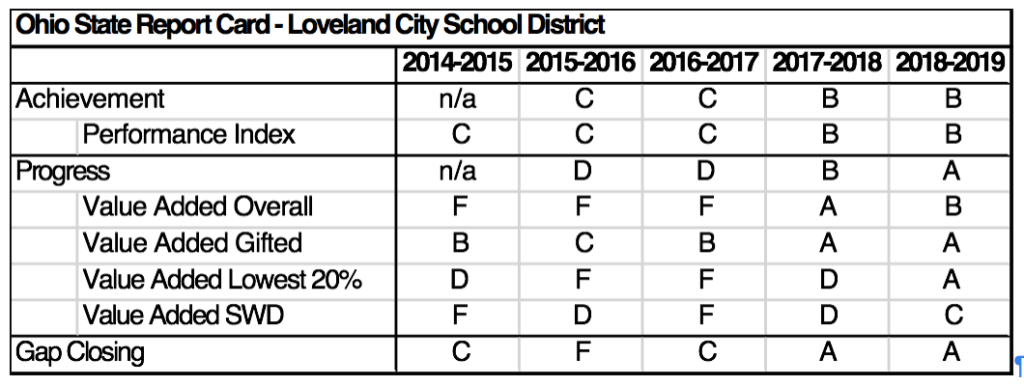
    As the business of the district is education, moving key state report card grades to A and B from C, D and F would indicate a positive return on investment. And that’s exactly the improvement we’ve seen. As of 2016 we seemed mired in a culture of mediocrity, and that is when the planned 2014 levy investments began to phase in. What a difference a few years makes. But these scores, specifically in progress and gap closing, could not change simply due to the addition of technology and programs. Classes don’t teach themselves, technology by itself won’t improve performance, and our results would not have changed without investment in educators. 

    Additionally, students and teachers alike can’t be successful if they aren’t in the right culture of care, support, learning, and high expectations set by their administrators.  And as such, our administrative team and educational staff have raised the bar of expectations at Loveland well beyond “average.” In business, this is exactly the environment, the culture, and the staff you want. It’s a culture of success, and continuous improvement, and every educator and staff member is responsible for it. Recruiting and retaining exceptional personnel in a competitive market, and a competitive region, is imperative.

    And what has this investment in people and culture brought us in addition to raised state report card scores?

    Here are just a few items of note:

    In the Value Added rankings of ODE, Loveland has gone from being ranked 433rd (out of 610 districts) in 2016 to 22nd in 2019.

    LES students are scoring on average 20% higher than the State average in Reading/Math for AIR and are exceeding MAP projections, on average, at 20% higher than the National average.

    For the third consecutive year, 100% of all third graders met the Third Grade Reading Guarantee, LIS students score 20% higher than the state average in 3 of 5 areas, 15% higher in all 5.

    At LMS, 8th-grade foreign language has risen from 150 students receiving HS credit to 227 students, and foreign language exposure in 7th grade has gone from 0 students to 185. 

    LHS has increased AP offerings to 24 courses serving 428 students in 2019, up from 291 in 2016, and our students have earned AP Honor Roll for 2 years (top 3% of districts in the US and Canada), with 80% scoring a 3 or higher. Over 40% of our LHS seniors earn college credit through AP or CCP offerings.

    LHS has added 20 new elective offerings, and added Transition to Work programming with multiple community sites.

    LHS has implemented Learning Lab for math support, added 6-12 College and Career counseling programming, and added class-leading Teaching, Business and IT programs.

    LHS’s ranking in Cincinnati Magazine has improved from 20th in 2017 to 8th out of 80 local high schools in 2019, and it has received the Momentum Award from ODE for the last three years.

    And this doesn’t even begin to address the improvements in gifted and special education services, social-emotional support improvements, or individual awards and accolades our students and teachers themselves have received across all of our schools. (Sourced from public sources including Ohio Department of Education, Cincinnati Magazine, AP/CollegeBoard, 2019-2020 Principals presentation.)

    This is where we find ourselves today in Loveland. An environment led by administrators who have set high bars for excellence, and educators working in a powerfully positive environment with programs and supports that make our students more successful each year. From 2016-2019 we invested as was promised in 2014 – investments in programs, technology, instructional materials, professional development, and people.

    We are now truly at the end of the 2014 levy’s effectivity, which was planned only to last until 2018 but has been stretched to 2020, even with changes that are outside the district’s control such as a $540K rise in health insurance costs.

    We should all take pride in what we have accomplished together since 2014, and the reputation for excellence that has been attained by our schools and community. We collaboratively invested and raised our marks from an F to an A. We are also well aware that the growth we have experienced now needs to be leveled to be maintained, which is why our current forecast reduces expenses and commits to capped expenditure growth and keeps it in line with previous forecast expectations.

    But it will take the continued support of operating funds to keep our strong performance intact. Without these needed funds, significant cuts will be made, and the improvements we have spent years implementing, and the performance we have achieved, will regress. The community’s return on the investments made will be lost.

    I hope that we all will celebrate the tremendous progress of our schools, and support the continuing success of our students and our community into the future.

    Thank you.

  • WHAT ARE THE DUTIES AND RESPONSIBILITIES OF THE BOARD OF EDUCATION?

    WHAT ARE THE DUTIES AND RESPONSIBILITIES OF THE BOARD OF EDUCATION?

    by Lesley Hodge

    What are the responsibilities of a local Board of Education? If you thought as publicly elected officials their duty is first and foremost to represent you, the public, I’m afraid you may be somewhat mistaken. 

    Lesley Hodge lives in Symmes Township off of Enyart Road

    To understand the duties and responsibilities of a local Board of Education you must start with Ohio Revised Code Title 33 – Education. Under §3313 we find board members can be elected to unlimited 4-year terms (unlike State school board members who have term limits). 

    We read that they are to take an oath to uphold the Constitution of the U.S. and the Constitution of the State and to “perform faithfully the duties of their office”. What exactly are those duties? The law says they consist of only two things: 

    1) setting policy for a wide variety of issues; and

    2) appointing, removing and evaluating a superintendent and a treasurer and fixing the compensation for said individuals. 

    Numerous subsections of §3313 define various policies the board should develop pertaining to such things as professional meetings, locker searches, procuring insurance, notifying of absences and determining and selecting all the following: textbooks, instructional materials, and curriculum. The board sets policy for credit card accounts, principles of democracy, and ethics, grade promotion and retention, organizing and operating summer school, and graduation requirements. These are just a sampling.

    Ohio law has nothing to say about where the board’s loyalties lie.

    The Ohio law is quite thorough about the diverse policies the local Board of Education must produce and how they should operate but has nothing to say about where the board’s loyalties lie. Does the board have any responsibility toward the public who elected them?  Is there a conflict of interest? Who else might have input into interpreting board duties?

    To go deeper we must jump to the Ohio School Board Association (OSBA). OSBA is not a legal entity. It is an unelected trade/membership organization with the mission of providing “comprehensive training, support, resources, and inspiration to school boards to maximize their effectiveness in carrying out their leadership roles”. It was founded in 1955 after four regional associations in Ohio banded together to coordinate activities. The OSBA offers a variety of fee-based services to local boards, including communication, strategic planning, tips for meetings, policy development, management, and financial advice. OSBA will even help you run for the school board! Local boards pay a membership fee to OSBA, a percentage of which is allocated for lobbying and political campaigning by the OSBA. The district pays these fees. For Loveland the OSBA fees in 2020 were $7,715.

    You the taxpayer foot the bill.

    When elected a new board member is sent to what one former Board member described as “School Board Camp”. This refers to Board Member 101, a 2-day workshop in Columbus or a satellite location that offers a “survival kit” for the first 90 days in office. You the taxpayer foot the bill. While explaining the law and the direct duties of a board member, the OSBA also interprets the law and expands it with duties they think the law implies. An Ohio Board member from a northern county said the OSBA actually teaches new members to be advocates for the school and to rubber-stamp what the school wants. In other words, OSBA teaches new board members that their loyalties are to be reserved for the district first.

    OSBA teaches new board members that their loyalties are to be reserved for the district first.

    But let’s check the OSBA website (ohioschoolboards.org) to see for ourselves. The OSBA identifies four major objectives for school board leadership suggested by the National School Boards Association. These are:

      1. Vision
        • Keep students as focus
        • Adopt a shared vision based on community beliefs to guide local education
        • Demonstrate a strong commitment to the shared vision by using them to guide decisions
      2. Structure
        • Employ a superintendent and management structure that enables people
        • Establish processes to manage systems
        • Develop long-term plans and revisit them annually
        • Review and adopt policies and allocate resources to support teaching and learning
        • Set high instructional standards
        • Encourage an innovative learning environment
      3. Accountability
        • Monitor progress through quality assessments and reports
        • Evaluate superintendent and treasurer performance
        • Evaluate progress toward long-term goals
        • Report district progress to the community
      4. Advocacy
        • Seek resources to expand opportunities
        • Advocate for families and children through strong partnerships
        • Lead celebrations of student achievement
        • Promote school board service as a meaningful way to contribute to society 

    Metaphorically the Ohio Revised Code is the skeleton of the board’s responsibilities, and an unelected trade organization puts flesh on those bones.

    Within these four objectives, one can see the responsibilities as outlined by the Ohio Revised Code, but they are augmented by the trade organizations. Metaphorically the Ohio Revised Code is the skeleton of the board’s responsibilities, and an unelected trade organization puts flesh on those bones. The OSBA also publishes a code of ethics specifying that board members accept the responsibility to improve education in part by:

      • Remembering  that the first and greatest concern must be the educational welfare of all students attending the public schools;
      • Obeying the laws of Ohio and the United States;
      • Respecting the confidentiality of privileged information;
      • Recognizing that an individual board member has no authority to speak or act for the board;
      • Working with other members to establish effective board policies;
      • Delegating authority for the administration of the schools to the superintendent and staff;
      • Encourage ongoing communications among board members, the board, students, staff, and the community;
      • Render all decisions based on the available facts and independent judgment rather than succumbing to the influence of individuals or special interest groups

    On the Loveland City Schools website, it states that the “Board of Education’s primary responsibility is to establish purposes, programs, and procedures which produce educational achievement. The board must accomplish this while also being responsible for the wise management of resources available to the district. The board fulfills these responsibilities by functioning primarily as a legislative body to formulate and adopt policy, by selecting an executive officer to implement policy, and by evaluating the results; further, it must carry out its functions openly, while seeking the involvement and contributions of the public, students, and staff in its decision-making processes.”

    The Loveland Board Policy Manual found at https://go.boarddocs.com/oh/love/Board.nsf/Public pretty much mirrors what is taught at OSBA regarding the Board’s responsibilities and loyalties.  The code of ethics in the manual is copied almost verbatim from that on the OSBA website with the noted reversal that the laws of Ohio and the United States are to be obeyed first and the educational welfare of the students follows. The accompanying Code of Conduct reiterates that the Board must keep its primary focus on the best interests of the students and act as an advocate for the schools and for the children.

    The Policy Manual defines the Board’s own powers and duties in a simple and direct fashion:

    0122 – SCHOOL BOARD POWERS AND DUTIES

    Under the laws of the State of Ohio, the Board acts as the governing body of the public schools. Within the extent of its legal powers, the Board has responsibilities for operating the District in accordance with the desires of local citizens who elect its members.

    The Board’s major responsibilities are:

    • to adopt policies for its governance and the governance of its employees and the students of the District;
    • to select and employ a Superintendent;
    • to select and employ a Treasurer;
    • to determine and approve the annual budget and appropriations;
    • to provide needed facilities;
    • to provide for the funds necessary to finance the operation of the District;
    • to consider and approve or reject the recommendations of the Superintendent in all matters of policy, appointment or dismissal of employees, salary schedules, courses of study, selection of textbooks and other matters pertaining to the operation of the District;
    • to require reports of the Superintendent concerning the conditions, efficiency and needs of the District;
    • to evaluate and to improve the educational effectiveness of the District; and
    • to inform the public about the progress and needs of the District and to solicit and weigh public opinion as it affects the District.

    These are self-explanatory, but what is interesting is the mention of local citizens in the opening paragraph. This leads us to ask the question again regarding whether there is any duty or responsibility to the electorate?

    Although the law does not specifically define the responsibility of the board towards the public, one can imply that it exists. While the primary focus for OSBA is keeping students and allegiance to the district first it does have some things to say about the community, as does the Loveland Board Policy Manual. 

    The Loveland Board Policy Manual duly notes that “Within the extent of its legal powers, the Board has responsibilities for operating the District in accordance with the desires of local citizens who elect its members.”

    In a segment on its website entitled “Ins and Outs of Board Membership” OSBA offers this advice about the board’s relationship with and responsibility to the outside community:

    Act in the best interest of the district as a whole “You were elected to your position by a specific segment of your community…you can best serve your community by getting information from those who are impacted by a given decision. Your board should realize that it must focus on what is best for the greatest good of the district and community. Make informed decisions that have a positive impact on all students and the community as a whole….. 

    Ask good questions about consequences. Consequences of board actions impact students. Big picture decisions made by the board can have far reaching effects on the district. Your community and district expect your board to make decisions that are well thought out, reflect the greatest good principle, and are responsible.

    The Loveland Board Policy Manual duly notes that “Within the extent of its legal powers, the Board has responsibilities for operating the District in accordance with the desires of local citizens who elect its members.” (0122) It also has a responsibility to inform the public about the progress and needs of the District and to solicit and weigh public opinion as it affects the District (0122(J)). The Board has a responsibility to establish clear goals for the District and ensure that the community is aware of these goals. (0123(P)) Furthermore, the Policy Manual says  “Community participation in the schools is essential to promote and maintain the quality of education for all students.” (2111.01) Finally, under School-Community Relations Goals staff members have a responsibility to promote good school-community relations. They should view every contact with members of the community as an opportunity to build a good relationship through a two-way process of communications using media and other forms of communication to provide factual, objective and realistic data and promote involvement and support. (excerpted from 9120.01).

    While some members of the public might agree that the Board fulfills its responsibility to the public or the community outside the school, there are others who would disagree.

    While some members of the public might agree that the Board fulfills its responsibility to the public or the community outside the school, there are others who would disagree. Does the Board operate the District in accordance with the desires of local citizens who elect it? Is there good two-way communication between the District and the community? Are communications factual and objective? Are you confused about what the law, the OSBA, and the Policy Manual all say and what the Board of Education actually does?

    The Board, however, is supposed to lead.

    Becoming a Board Member is a daunting task and an overwhelming responsibility. Unfortunately, Board members probably don’t get paid enough to want to do the kind of due diligence necessary to understand the details of the district for which they are required to set good policy. Because the Board is an ongoing entity members can simply rely on policies that were adopted in the past and don’t often require revising. Newer board members rely on older Board members’ experience. In addition, Board members lean heavily on the information given to them by the Superintendent and the Treasurer. The Board, however, is supposed to lead. On the organizational chart shown in the Policy Manual (1100) the Board occupies the top spot. This explicitly indicates that the Superintendent and Treasurer are Board employees who are to act at the direction of the Board. 

    Leadership involves building bridges between the district and the outside community and not building a wall around the school.

    The OSBA says the local Board is the face of the district.  Leadership involves building bridges between the district and the outside community and not building a wall around the school. One of the reasons Board members are required to live in the community from which they are elected is that they will presumably have an understanding of the economics and characteristics of that community when they make decisions regarding the educational welfare of the students in that district.

    Do you think the Board has acted for the greatest good of both the district and the community in fulfilling its legal responsibilities and the implied and expanded duties added by the OSBA? Are the decisions they are making responsible and well thought out? Does the Board, per its own directive, operate the District in accordance with the desires of local citizens who elect its members? 

  • Trenna Sowder says you Won’t believe these 8 amazing facts about Loveland schools and #7 will blow your mind!

    Trenna Sowder says you Won’t believe these 8 amazing facts about Loveland schools and #7 will blow your mind!

    Trenna Sowder lives in the Oasis Subdivision

    by Trenna Sowder

    Have you read headlines like these before: “Man tries to hug wild bear and look at what happens next!” or “16 celebrities who ruined their faces with plastic surgery!” 

    We’ve all seen those crazy eye-catching headlines and maybe even clicked on them from time to time. Who can resist? They are “clickbait.” Merriam Webster says clickbait is something designed to make readers want to click on a headline, especially when it leads to content of dubious value. And some clickbait is very effective — you read it, click it and get drawn into the article that you are hoping just has to be true! But…sometimes the article behind the clickbait is, well, dubious. Or, at least lacking necessary context. 

    Here are some more examples of clickbait a little closer to home

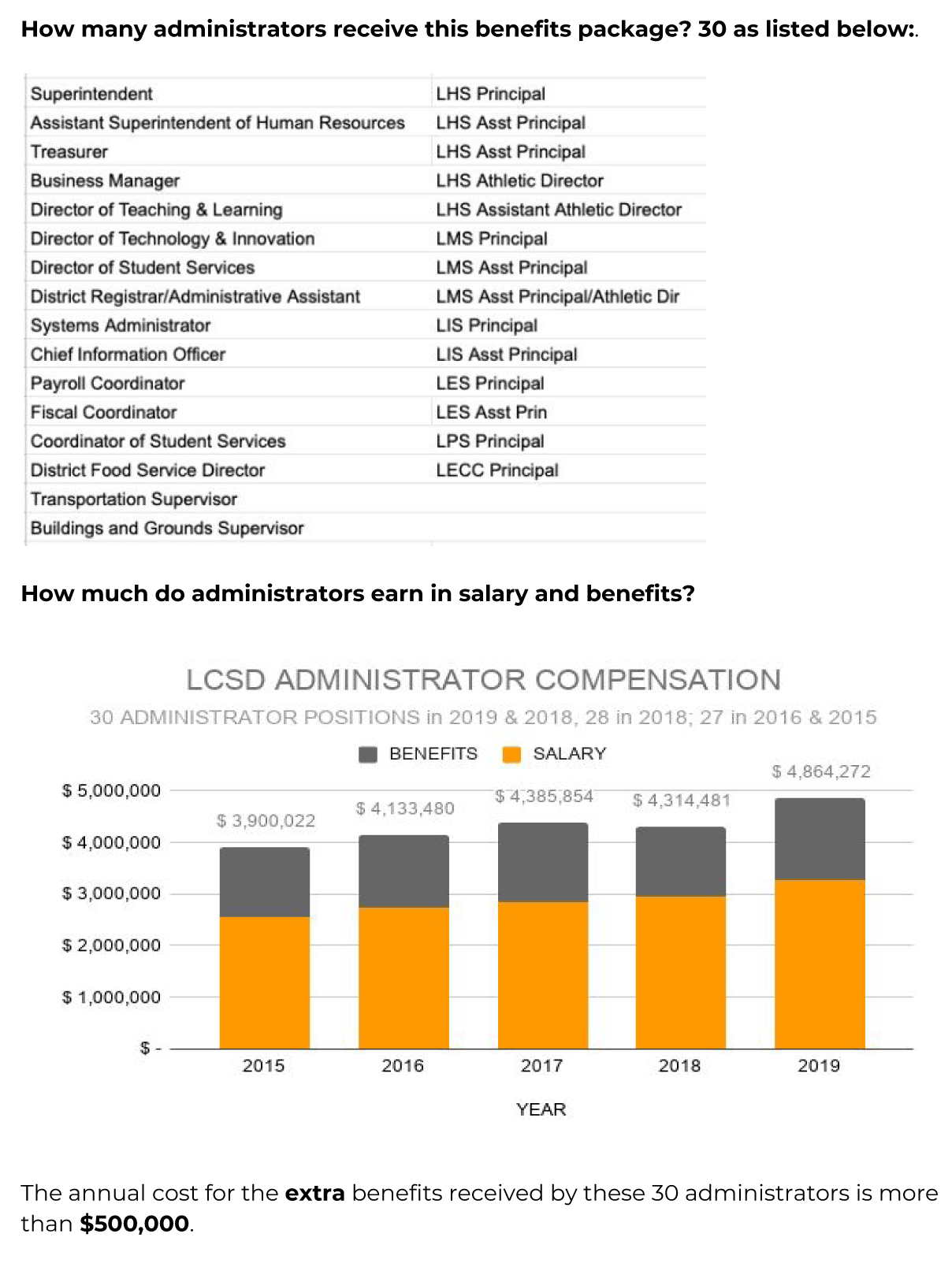
    ● Loveland Schools administrator salaries increase 14% in a year (while the average US worker’s pay barely rises)! 

    ● Loveland Schools hired 16 administrators in 6 years (while hundreds of children flee the district!) 

    Wow! Seriously? Could those statements possibly be true? 

    Let’s dig into those headlines and also get to the reason you started reading this article: the eye-catching headline promising amazing facts about our school district! First, let’s address the school levy clickbait examples: 

    1. Administrator Salaries: Salaries for Loveland administrators in the same positions increased an average of only 1% from the 2017/18 to the 2018/19 school year. Now, that seems much more reasonable. Can you imagine if the district was actually giving its administrators 14% raises? We’d have a line of applicants all the way out to I-275!

    2. Number of Administrators: Loveland has had a net increase of 3 administrators since 2014 (the time of the last levy). And, with the position elimination announced in January 2020, the district will be at a net increase of only 1 administrator at the start of the school year this fall. In fact, Loveland currently has just 6.1 administrators per 1,000 students, almost 3 fewer than the state average of 8.92 administrators per 1,000 students. 

    3. Enrollment: As for enrollment, Loveland’s enrollment has been largely flat, down 38 students since the 2010/2011 school year, but not the hundreds suggested by some. Even with flat enrollment, operating funds are still needed. In Ohio, the money that districts receive from school levies does not increase with inflation or as costs rise. (Ohio House Bill 920) The price of things like technology, security and insurance all rise, but levy funding remains flat. The only way a district can increase funds from levies is by periodically going to voters. 

    For those of you that have been following levy discussions on social media or newspapers or perhaps you received a flier from the group opposing the levy, here are some other topics you might be wondering about: 

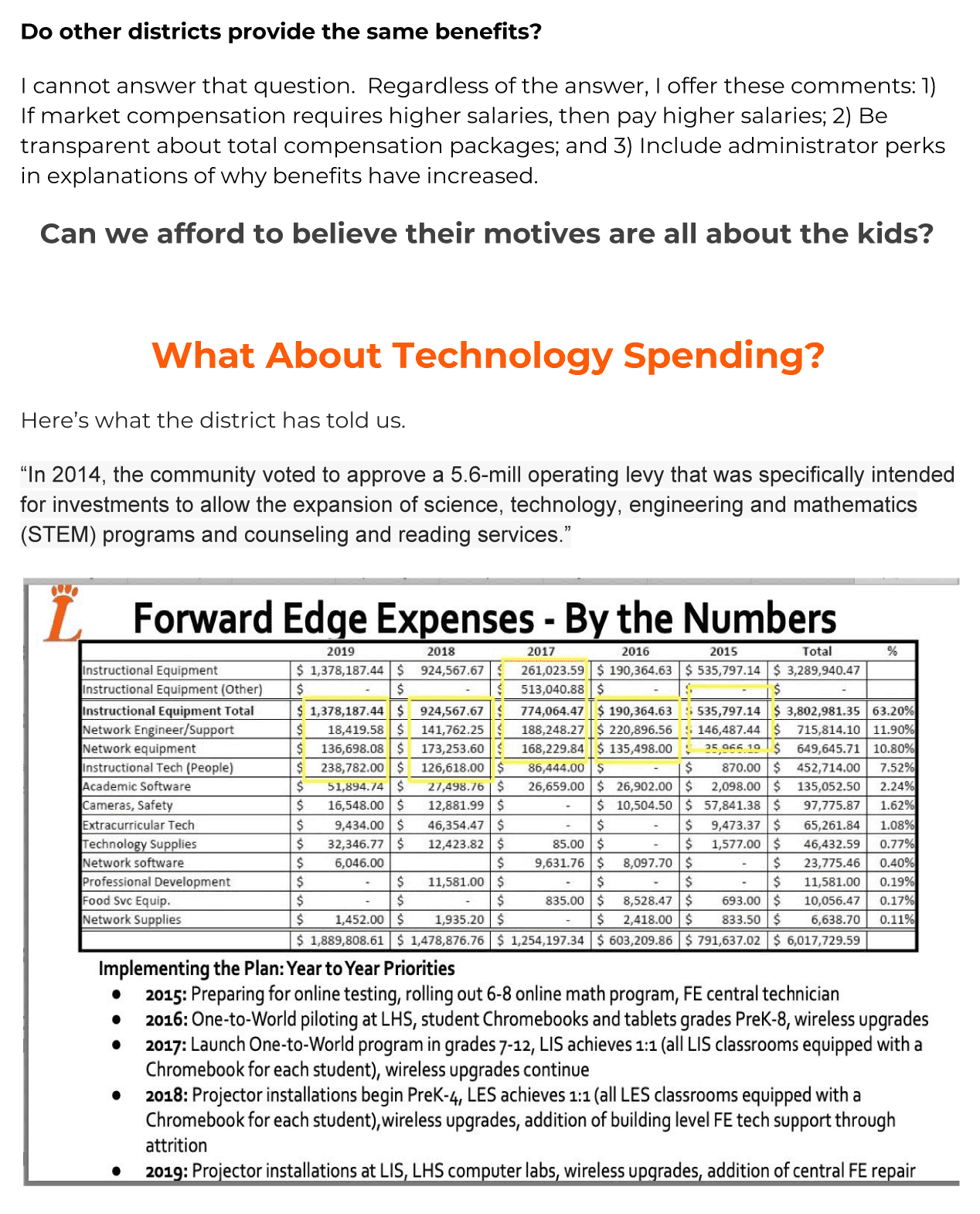
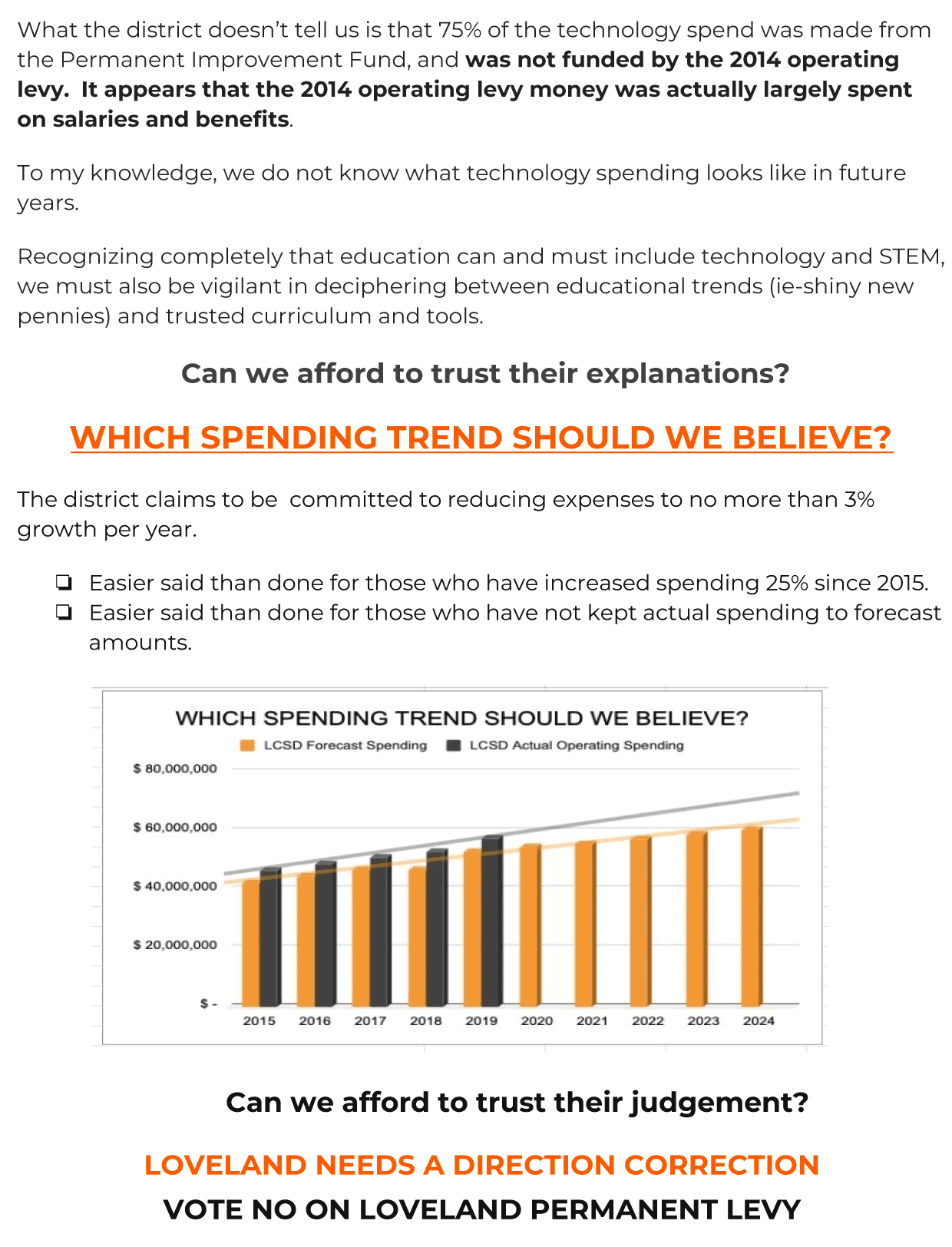
    4. Spending: Spending has increased since 2014 by design. With the 2014 levy, the district committed to improving programming, especially in the critical areas of science, technology, engineering and math (STEM). It’s made significant progress and now it’s shifting into sustaining and optimizing its achievements in order to maintain the outcomes. The current forecast projects limiting average annual expense growth to 2.67% for fiscal year ending 2019 through the end of fiscal year 2024. (I don’t know about you, but I think my family’s cable and cell phone bills increase by more than that each month!) 

    5. Expenditures in fiscal year 2018-2019 were higher than other years – for good reason. The total spending year over year increase from 2017/18 to 2018/19 was 8% which was higher than the prior year increases. (See Five Year Forecast) All of the details on why there was a blip in expenditures can be found on the FAQ section at www.YesForLoveland.com. Some of the highlights include: costs for materials that were deferred from the prior school year, health insurance premiums increased 10% (after three consecutive years of no increase) and execution of technology enhancements directly benefiting students. Just like in our own household budgets, some years we have to spend more either because of things we can’t control, like a medical emergency or things we plan for, like paying for a child’s college. 

    6. Loveland stretches its dollars! Currently the Loveland per student general fund expenses is 2.7% lower than the state average across 608 districts. By 2024, that gap will have more than doubled to 6.3%, spending $1000 less per student than the state average! 

    And for any of you who just want to know a couple truly awesome facts about our schools, consider these: 

    7. Since the last levy, the Loveland district met its commitment to increase program offerings! For example, it increased Advanced Placement classes (classes in which students can earn college credit) to 24. It expanded its STEM offerings in all grades as well as increasing access to technology, all necessary in our modern world to prepare students for tomorrow’s workforce! The district also increased programming to provide support in the critical area of emotional well-being. Now this operating levy (which is not for buildings) will be used to sustain these enhancements and maintain the level of services. 

    8. 100% of Loveland’s 3rd graders met the Ohio Department of Education’s Third Grade Reading Guarantee. Money from this levy will help ensure that programing and services continue to support our youngest community members! 

    More details on these facts as well as all the information about the levy are available at www.YesForLoveland.com. I invite you to avoid the clickbait and get the truth! Please join me in supporting our schools and our community and Vote Yes on March 17th. Also, watch for my upcoming article: “Communities That Support Their Schools Thrive and Here’s What Else Happens!”

    The Operating Levy is not for buildings; rather it is to sustain and optimize the growth and achievements made since the last levy passed in 2014. It will cost taxpayers $20.27/month ($243.25 annually) per $100,000 appraised value of your home as determined by your county auditor. 

    1. District Profile Reports at http://education.ohio.gov/Topics/Finance-and-Funding/School-Payment-Reports/District-Profile-Reports

     2. Ohio State Report Card

    3. Five Year Forecast at https://www.lovelandschools.org/Downloads/Loveland%20CSD%20-%20Updated%20Annual%20Forecast%20Report.pdf

  • NOTES from the SYMPOSIUM on challenges of public school funding in Ohio

    NOTES from the SYMPOSIUM on challenges of public school funding in Ohio

    by Lesley Hodge

    On March 2nd I attended the free Symposium on School Funding in Centerville, Ohio. A panel of four experts spoke including an economist, an Ohio state Senator, a Legislative Analyst and an Education Professional. The presentations looked at trends in American schooling including staff and pay increases as well as national and state test scores and proficiency ratings in comparison to skyrocketing costs.

    Lesley Hodge lives in Symmes Township

    Also discussed were a brief history of Education in America including the influence of The Frankfurt School and John Dewey and where education got off track, an update on the Ohio Supreme Court’s DeRolf decision, suggestions and solutions for making schools more efficient, the elimination of tax levies, preserving our communities, and keeping kids first in education.

    Some salient points made during the presentations included:

    • Ohio may have a spending problem rather than a funding problem.
    • Does more money relate to any measure of success? A study from the Cato Institute shows there is no link between school spending and student achievement.
    • Half of the time Ohio students spend in school is academics and the other half is social and emotional learning. In fact millions of dollars are spent for social/emotional learning.
    • Parents and students want education not social engineering or teaching to a test.
    • The classroom should be returned to the teacher and not be run by the state. Teachers should have the ability to do what they do best and evaluations should be at the local level and not state run.
    • Caps and guarantees need to be eliminated
    • Zero based budgeting should be used instead of fencing off pay and benefits first.
    • A community compensation and benefits survey should be done locally to determine what residents are receiving in raises, benefits and bonuses which should then be reflected in the salaries at the local school.
    • Parents should be empowered and made more responsible for their child’s education
    • Money should follow the child, thus putting the child first.
    • Board members only get paid $125/meeting which is not enough for the time they need to spend to do their job well. Don’t offer benefits to Board members but pay them better for their time.

    Solutions were offered

    It was noted that there are diverse opinions on school funding especially in different regions and for people in different walks of life. Not everyone will agree on the best solution but most agree that we can’t continue the way we have been.

    Several solutions were offered including curbing expenditures, sin taxes and long distance learning platforms. Some of the more progressive ideas that came out of the presentations included

     Scrapping the Ohio Department of Education and starting over
     Freeing districts which are burdened by debt
     Putting the negotiated teacher contracts as a referendum item on the ballot to be voted on by the public since this is the major expense for all schools.

    Responsibilities of members of a community

    The Analyst who spoke zeroed in on the responsibilities of members of a community and the local school district so that education is for the students and puts students first:

     BOARD OF EDUCATION – their job is to lead. The superintendent is their employee. They should direct the employee rather than let the superintendent direct them.
     TEACHER – the teacher’s job is to be free to teach not to be a counselor or a parent.
     TAXPAYER – their job is to encourage their legislator and understand how levies work.
     PARENT – The parent’s job is to know what is happening in the local school and not let the government take away their rights. They should also support teachers.
     STUDENT – the student’s job is to fight for the right to be educated not indoctrinated.

    The state of funding schools

    Unfortunately the system we have pits neighbor against neighbor and friend against friend.

    It was noted that the current system of funding in Ohio is still unfair but the Ohio Supreme Court has deemed that the legislature has made a “good faith effort” to fix the problem. Unfortunately the system we have pits neighbor against neighbor and friend against friend and communities cannot afford it and yet nothing changes.

    The Ohio State Senator who spoke noted that his district in Olentangy has a levy on the ballot in March which will raise his taxes another approximately $250 per $100,000 home valuation. He expects the levy will pass and if it does, he and his wife plan to put their house on the market within two months to get out of their increasingly high taxed district.

    Loveland is experiencing the same headwinds as other school districts in Ohio. How do we curb expenses that are rising faster than household income, and rising and rising faster than inflation as well? Our communities can’t keep up. Are kids really being put first? How do we curb costs and change the funding model so the kids are first?

    Loveland is not unique

    The discussion was an excellent look at the problems and challenges facing Ohio Schools. Loveland is not unique in the issues facing us with the March levy, increased costs, falling enrollment, and rising pay and benefits.

    If you are interested in looking at the recordings and slides from the evening’s presentations you can watch the video below. Unfortunately you may hear mocking statements, denials and derisive laughter in the background of the video. A large contingent of Centerville teachers attended the presentations and quite a few of them exhibited unprofessional and uncivil behavior during the presentations. Although the emcee at the beginning of the evening requested that everyone be respectful of differing opinions, sadly this did not occur.

    Ohio School Funding Options – Panel Discussion Featuring:

    Dr. Kelly Kohls – Professional Educator

    Beth Lear – Legislative Analyst

    Andrew Brenner – Ohio State Senator

    Jon Morrow – Noted Economist

    Related Slides:

    Kelly Kohls’ presentation: https://ohrpac.com/wp-content/uploads…

    Jon Morrow’s Presentation: https://ohrpac.com/wp-content/uploads…

    Post page: https://ohrpac.com/gdwrc-education-fi…

  • Before making a decision, remember that strong schools…

    Before making a decision, remember that strong schools…

    Rick Lewis is the Chief Executive Officer of the Ohio School Boards Association in Columbus which is a trade organization and lobbying arm of the Loveland School District

    by Rick Lewis

    An important issue appears on the March 17 ballot for voters in the Loveland City School District.

    The 6.95-mill continuing operating levy would pay for day-to-day expenses, such as utilities, supplies, busing, salaries and benefits for staff, and maintain the academic improvements established over the past several years. While seeking additional funding, the district has pledged to cut $2.7 million in expenses — cuts that will be made regardless of the vote’s outcome.

    If voters approve the levy, a homeowner would pay $20.27 per month for every $100,000 in valuation.

    Funds generated by the levy are critical. Without them, the district would have to make additional significant cuts in 2021, including a combination of at least 25 administrative, teaching and non- teaching staff positions, high school transportation (including nonpublic routes) and further increase pay-to-participate fees. Some of cuts would have to be made before the start of the 2020-21 school year.

    Before making a decision, remember that strong schools make a community a great place to live, raise a family or start a business.

  • Mindy Voss on why Loveland District needs a “Direction Correction”

    Mindy Voss on why Loveland District needs a “Direction Correction”

    Mindy Voss resides in the Woods at Miami Trails in Miami Township
  • Upcoming Loveland City Schools Levy and Ohio School Funding

    Upcoming Loveland City Schools Levy and Ohio School Funding

    by Dr. Gregg Tracy

    The current system and laws in regard to funding schools in Ohio are flawed. The funding system overemphasizes real estate taxes and creates inequality in educational funding across the state. The system has been declared unconstitutional multiple times by the Ohio Supreme Court, most recently in 2002. However, due to inaction by the administrative and legislative branches, the funding system remains law. So school systems, like Loveland, that do not have large commercial and industrial bases, must rely heavily on local, individual real estate taxes in order to operate. Voters are faced with the choice of voting for higher taxes or not providing our public schools with the funds necessary to operate effectively. Our schools simply cannot be effective in preparing current and future students without the essential funds to operate.

    Dr. Gregg Tracy is a Loveland resident and property owner, a Loveland High School Graduate, a retired professor of leadership, and former school administrator.

    Even as assessed property values increase, no new monies are generated for schools. Thus operating funds are fixed while operating costs increase. New levies are regularly and periodically necessary. It is a reality in Ohio. Excellent schools depend on good administration, teaching, and community participation, but schools just cannot perform effectively without periodic tax levies.

    Loveland’s consistent excellence will continue to benefit students and the community.

    It is easy to say, “I do not want to pay more taxes.” It is equally as easy to come up with justifications for voting “no.” Historically, voting against operating levies has not been a strategy that has facilitated any positive change. It is a weak substitute for dialogue and cooperative participation in a meaningful process aimed at changing and improving schools. Without necessary funds, schools cannot operate effectively, let alone have opportunities to change and improve. With needed funds, Loveland’s consistent excellence will continue to benefit students and the community.  Loveland’s board and administration, have established a number of ways to learn, cooperate and participate in the school improvement process.  Administration is accessible, public meetings have been held and will continue, printed materials have been sent regularly, and  online communications are available. The leadership team has been very clear about the district’s needs and financial status.

    They are simply asking for operating funds to continue the quality education that Loveland has been providing over time.

    As our school board asks for additional operating funds in March, they are not asking for money for building or adding programs. They are simply asking for operating funds to continue the quality education that Loveland has been providing over time. The board has committed to keeping expense growth to less than 3% through fiscal year 2024. As a concerned citizen, I encourage you to make an informed decision in March based on an understanding of the need based on Ohio’s funding system and the recognition of the importance of your vote for our community. Public schools are one of our community’s vital organizations. As you make your decision in March, I hope you have gone directly to the source and not relied on hearsay and negative campaigns. I hope that you have directly accessed information sources made available by the district’s leadership team. I also hope that you consider our students and the short term and long term effects of your vote. Summarily, I hope you cast a concerned and informed vote on March 17.


  • Gypsy tickets going fast

    Gypsy tickets going fast

    by Ann Barfels

    Loveland, Ohio – Tickets are going fast for Loveland Stage Company’s next production in their 2019-2020 season! “Gypsy” opens March 6 and continues through March 22 at the theatre located at 111 So. 2ndStreet (Rt. 49) in Loveland.

    The well known musical tells the story of Gypsy Rose Lee, the epitome of a “backstage mom”, and her dreams and efforts to get her two daughters to perform onstage. It casts an affectionate eye on the hardships of show business life. The character of the eldest daughter Louise is based on Lee, and the character of June is based on Lee’s younger sister, better known as June Havoc in adult life. Baby Louise is played by Ella Kiel and the adult Louise is played by Bonnie Emmer. Baby June is played by Lauren Fritzche and Sophie Viselhoman portrays Dainty June. Lisa Breithaupt portrays Rose, the mother and Larry Harmon is Herbie, the agent, and boyfriend.

    Although the story centers on Gypsy Rose Lee, there is no nudity in the production and it is considered PG.
    Jule Styne wrote the music for the show with lyrics by Stephen Sondheim and Arthur Laurents was the librettist. “Gypsy” is loosely based on the 1957 memoirs of Gypsy Rose Lee, “Gypsy: Memoirs of America’s Most Celebrated Stripper”. The production is under a license agreement with Tams-Witmark.

    Familiar songs in the show include “Some People”, “Let Me Entertain You” and of course, “Everything’s Coming Up Roses.”

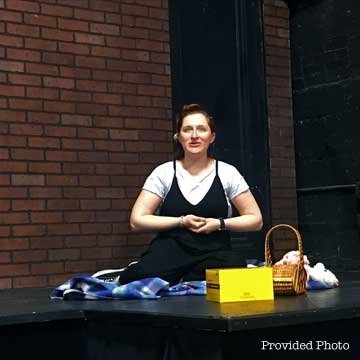
    Bonnie Emmer who portrays Louise in Loveland Stage Company’s “Gypsy” sungs “Little Lamb.” The show opens March 6 and continues through March 22.

    Micheal Harris-Kiser is directing the production with Marjory Clegg as choreographer, Brian Harvey as Vocal Director and Jeanne Bilyeu as Orchestra Director.

    Performances are at 7:30 PM on March 6, 7, 13, 14, 20 and 21 and at 3 PM on March 8, 15 and 22.

    An ASL Interpretive Performance will be on March 8 at 3 PM

    All Tickets are $20 and can be purchased by visiting www.lovelandstagecompany.org. For group rates and accessible seating please call 513-443-4572.

    Thank you for supporting Community Theatre!

    Directions and Parking


  • Loveland School Budget Cuts – Responsible Management?

    Loveland School Budget Cuts – Responsible Management?

    Kim and Rick Donaldson live on Paxton Road in Miami Township

    by Kim and Rick Donaldson

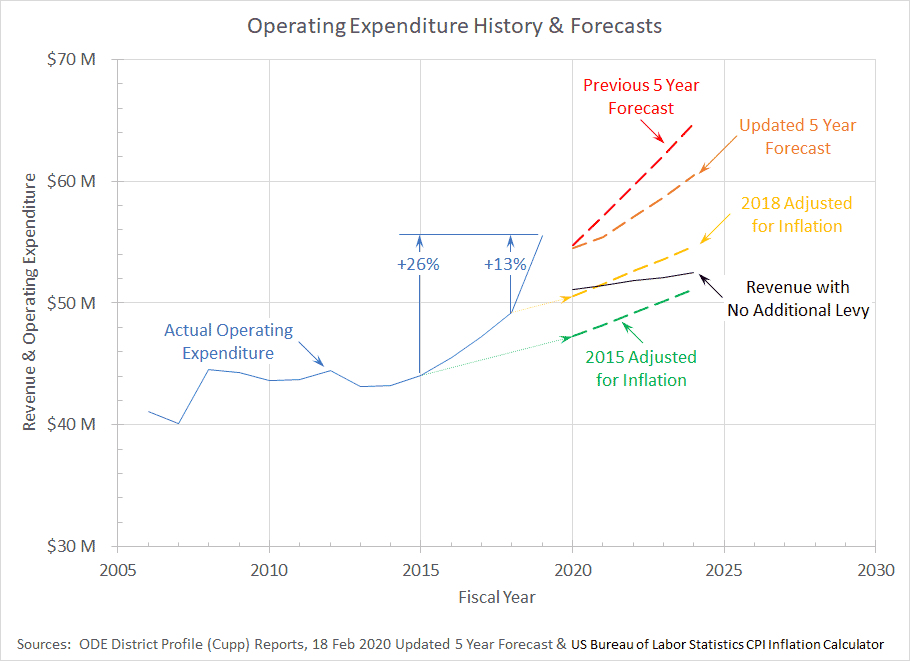
    At its February 18th business meeting, the Loveland City School District Board of Education reviewed the administration’s updated five-year financial forecast, which includes annual operating expenditure cuts averaging $2.5 million and fee increases averaging $0.2 million.* The updated forecast still requires passage of a 6.95 mill operating levy, which will raise annual revenue by $6.3 million, to maintain an adequate cash balance through fiscal year 2024. Indeed, the included budget cuts were made for the express purpose of limiting the levy to only 6.95 mills. So, after cutting $2.5 million from expenditures, why do we need an additional $6.5 million (taxes plus fees) in revenue? Let’s look at the numbers.

    This graphic is the Donaldson’s original presentation of the data sourced from the Ohio Department of Education and the US Bureau of Labor Statistics as noted on the chart and in the list of references.

    As shown in the included chart, both five-year forecasts start from a very high baseline expenditure level established in 2019 when operating expenditures increased 13% from the previous year.** That increase was the culmination of an accelerated spending trend that started in 2015, bringing the total four-year increase to 26%. By comparison, the cumulative inflation rate was only 7.7% during the same period.*** This rapid expenditure increase quickly overtook the 23% annual revenue increase in the years following the 2014 levy.

    Since median income tends to be tied, albeit loosely, to inflation, expenditure increases that exceed the inflation rate make our schools increasingly less affordable to taxpayers.

    Furthermore, it is important to recognize that the spending cuts and fee increases included in the updated forecast are all relative to the previous forecast, which anticipated increasing expenditures by 4% annually. Since the Federal Reserve Board targets a 2% annual inflation rate, the plan was to increase spending by twice the rate of inflation. The updated forecast anticipates annual increases of 3%, which is still 50% above the target inflation rate. Since median income tends to be tied, albeit loosely, to inflation, expenditure increases that exceed the inflation rate make our schools increasingly less affordable to taxpayers.

    As a more affordable alternative, we advocate limiting operating expenditures to 2015 levels on a per student basis, adjusted for inflation.  As shown on the chart, this approach would result in spending much lower than the updated five-year forecast and, more importantly, lower than current projected revenue. It would thus obviate the need for any additional operating levy. It is worth noting that this would be consistent with, and a continuation of, expenditure trends from 2006 through 2015.

    If a 2015 baseline seems too aggressive, the same approach using a 2018 baseline could be considered. Although it would require an additional levy, the levy vote could be postponed to November 2021 and would only need to be around 1 mill to maintain the same cash balance as in the updated forecast.

    These particular cuts, chosen by the administration, raise some serious questions.

    So, what would we cut? After all, in the same February 18th presentation we were told that we will have to eliminate teaching and staff positions even if we approve the levy in March. We have also been warned that failure to pass the levy in March will result in additional cuts, including staff, teachers and high school transportation. These particular cuts, chosen by the administration, raise some serious questions. If we could afford current staffing levels in 2018, why can we not afford them in 2021 with nearly 13% higher expenditures in the updated forecast?****  Even if we choose to defeat the levy and limit expenditures to inflation-adjusted 2018 levels, why could we not continue to support essentially the same staff and transportation that we did in 2018? Where is the additional money going, and why has the administration chosen to cut staff and transportation?

    Before we head to the polls in March, we need to have satisfactory answers to these questions that are quantitative, complete and transparent. We need to know whether the proposed budget and associated cuts are indicative of fiscally responsible management for the benefit of our children, or emotional manipulation designed to get the levy passed.  Ultimately, it comes down to a question of trust.

    References:

    *5 Year Forecast Update from 18 February 2020 Board Meeting:  https://go.boarddocs.com/oh/love/Board.nsf/files/BLY4FG0B571B/$file/5%20Year%20Forecast%20Presentation.pdf

    **Ohio Department of Education District Profile (Cupp) Reports:  http://education.ohio.gov/Topics/Finance-and-Funding/School-Payment-Reports/District-Profile-Reports

    ***US Bureau of Labor Statistics CPI Inflation Calculator:
    https://www.bls.gov/data/inflation_calculator.htm 

    ****Ohio Department of Education District Teacher Information:  https://reportcard.education.ohio.gov/download