
Author: Guest Column

  • Loveland Counselor: How to protect children and adolescents who have experienced abuse during this ‘Stay at Home Order’

    Loveland Counselor: How to protect children and adolescents who have experienced abuse during this ‘Stay at Home Order’

    by Elizabeth Greller, M.A., LPCC

    Children and adolescents who have experienced abuse (physical, sexual and/or neglect) and/or traumatic events (examples – parent death, witness to domestic violence, parent addiction, separation from a parent, scary/painful medical treatment, etc) have additional needs than children and adolescents who have not experienced such life events.

    This is especially important during this unpredictable time.

    They often experience symptoms and triggers of anxiety, panic and emotional dysregulation that their same-age peers do not. It is important that their emotional and physical health needs be met on a daily basis, but it is especially important during this unpredictable time.

    Children and adolescents who have experienced abuse and/or traumatic events often need higher levels of consistency in their daily schedules and routines, emotional support from parents/caregivers, consistency with behavioral expectations, and sense of safety in their environment. Due to the stay at home order and social distancing regulations related to COVID-19, children and adolescents have experienced numerous sudden and drastic changes in their daily schedules, routines and activities, which might increase the level of their needs.

    For children and adolescents who live in the home with a parent, caregiver or loved one who is a perpetrator of such abuse/traumatic events it is even more important that they have a sense of safety and know who they can contact if they need help or feel unsafe.

    For children and adolescents who live in the home with a parent, caregiver or loved one who is a perpetrator of abuse it is even more important that they have a sense of safety and know who they can contact if they need help or feel unsafe.

    Family members and loved ones who reside in the home can help create a safe environment and work to meet their needs as listed above. Family members and loved ones who do not reside in the home can help these children and adolescents by having frequent contact (phone or video calls) with them to provide emotional support and open communication and educate them on who to contact if they need help or feel unsafe. All family members and loved ones can, and should, contact the proper authorities if they suspect or know of any child/adolescent abuse or traumatic events that occur. The authorities to contact are the local police department or children’s services hotline for the county where the child/adolescent resides.

    Hamilton County Children’s Services – 513-241-KIDS (5437)

    Warren County Children’s Services – 513- 695-1546 (after 4:30 pm hotline 513-695-1600)

    Clermont County Children’s Services – 513-732-STOP or 513-732-7173

    Hope Restored Counseling Services is currently accepting new clients. We are able to provide in-office and telehealth sessions at this time. If you or a loved one are in need of behavioral and/or emotional support please contact us at 513-683-4673.

    About Elizabeth Greller

    I am a licensed professional clinical counselor (PCC), and I earned my Masters in Community Counseling from Xavier University. I have over 6 years of experience in the mental health field working with children, adolescents and families. I have experience with adoption readiness/post adoption difficulties, attachment issues, trauma/PTSD, anxiety, ADHD, Oppositional Defiant Disorder, Autism Spectrum Disorders, as well as grief and loss for children, adolescents and adults.

    Also read:

    Loveland Counselor: How to talk to your children about the Coronavirus…

    by Tonya Schaeffer M.Ed, LPCC-S

  • Old age – who cares? Get to the end of the line

    Old age – who cares? Get to the end of the line

    by Laurence C. Gumina, CEO, Ohio Living

    Ok, here we are again, and this time I’m speaking up! As the CEO of Ohio Living, the state’s largest not-for-profit provider of life plan communities (senior living/long-term care), we are on the front lines of the COVID-19 battlefield. I’m frustrated and angry to say that we do not have enough protection.

    As I type, our hero nurses and nursing assistants are at the bedside caring for our “greatest generation” in their reused masks and gowns while hospitals, through no fault of their own, are reportedly “flush” with Personal Protective Equipment (PPE) inventory. Even though, as we care for the most compromised and — in my opinion, the most cherished — members of our society, we are simply unable to safely protect ourselves. Yes, the Ohio Department of Health, specifically Director of Health Dr. Amy Acton, has taken a very proactive role in protecting Ohioans, but even she is unable to effectuate change to ensure that ALL clinicians are protected – not just our hospital personnel.

    Even though, as we care for the most compromised and — in my opinion, the most cherished — members of our society, we are simply unable to safely protect ourselves.

    From my perspective, as a Board member for LeadingAge Ohio and LeadingAge – our national association, my heart bleeds for the pain and frustration my colleagues, and more directly their clinicians, are enduring across the country. God bless ALL of them! If statewide providers like Ohio Living are feeling this pain, how are smaller, single-site aging service providers able to effectively compete for supplies?

    The Federal and State government must address the disparity amongst hospitals and aging service providers and make sure that ALL clinicians are protected.

    My call to action is clear: The Federal and State government must address the disparity amongst hospitals and aging service providers and make sure that ALL clinicians are protected. We, aging service providers, are caring for the most vulnerable members of our society, 24/7, and we are last on the prioritization of PPE. I certainly appreciate our business partners, specifically Medline, for doing everything possible to assist us in getting PPE supplies for our care needs. But, unfortunately, it’s not enough.

    My hope is that in the days and years ahead, we’ll be able to learn from this misplaced hierarchy of value and the aging service segment of our health care delivery system will be equally prioritized. For now, I’m going to praise our team at Ohio Living for leading the charge!


  • Loveland Counselor: How to talk to your children about the Coronavirus (COVID-19)

    Loveland Counselor: How to talk to your children about the Coronavirus (COVID-19)

    Tonya Schaeffer is a Licensed Professional Clinical Counselor (PCC) and earned her Masters of Education from Xavier University. She has more than 15 years of experience working with children, adolescents, couples and families. Her office is Hope Restored Counseling Services in the West Loveland Historic District at 600 West Loveland Ave, Suite 2A.

    by Tonya Schaeffer M.Ed, LPCC-S

    This is new territory for each and every one of us. It is unlikely we have ever had to consider how to talk to our children about a global pandemic. The most important thing to try to do is remain as calm and reassuring as you possibly can when talking to your children about this virus.

    Managing your own stress and anxiety

    If you are feeling anxious or paranoid yourself, this is not the time to talk to your children. Take some time to calm down and then speak to your kids. They will pick up on your cues and you can set the tone. If you are anxious or scared, they will feel similarly.

    Don’t be afraid to talk about the Coronavirus

    It is important, to be honest with your kids. When we don’t have information or knowledge about something, we might try to fill in the blanks. Children might hear rumors and misinformation, and this is likely to increase anxiety. Be cautious of what your children are seeing, hearing and reading online. Consider reducing screen time focused on COVID-19. Don’t volunteer too much information, but try to have an open dialogue for them to ask questions and answer as honestly as you can. Sometimes kids are more willing to open up when they are doing an activity. Consider going out for a walk to have these conversations, or toss a ball or play a board game. Express to them that as their parent you are going to take care of them. Let them know you are available to listen and talk.

    Validate these very real feelings

    Since the schools have closed, vacations have been canceled, and social distancing has been implemented, it is likely to cause feelings of loss, sadness, and isolation. Validate these very real feelings. Tell your children that you know this a difficult time for them. Acknowledge that there is a lot of loss during this time. Adults and children both could be feeling grief. Children might be feeling the loss of their daily structure, loss of school, loss of being with friends, and spring sports halted. Unfortunately, the list can go on and on. Validating this is sad and a hard time for them. They want to know you can relate to these very real issues. But be very careful not to make it about you. They need validation, reassurance and a feeling of being safe.

    Develop a plan for each day

    It might be helpful to sit down with your family and develop a plan for each day. We know our life is likely to change every day at this point. So this could prove to be difficult, but the hope is your children will feel more in control, more secure and safe having a plan.

    You will get through this together

    It is okay to not have all the answers. But you want your kids to know you are handling this new normal. You might say you are learning as much as you can and you want to give them the most accurate news as possible. Relay to them you will keep them informed of anything that will impact them. But send this message with as much reassurance as you can that you will get through this together.

    Get physical exercise

    Encourage your kids to get physical exercise, take a walk, use your home gym equipment. A home gym doesn’t have to be a room full of equipment. Use a jump rope, toss a ball, use cans of soup as weights. Use what you have around your house as gym equipment.

    Go out side and walk! I’ve walked around Loveland every day and it has helped me stay calm through all this ever changing world. pull up YouTube videos for yoga and mediation.

    A great outlet for kids and parents is journaling. You can write about thoughts, fears, questions or anything at all! It is important to stop and think about some of the positives that are coming out of this uncertain time.

    We all have more time with our families now. Use this as a gift, spend time outside, pull out board games, or watch some classic movies. It may seem daunting in the moment, but we will all get through this trying time together.

    Hope Restored Counseling Services was established in Loveland on June 20, 2008 during another difficult time in our world. We wanted to take a moment to let you know we are here for you and if you would like to schedule please go to our website to schedule. We are also in the process of setting up Telehealth sessions.


  • Please, Loveland, let’s put away our signs, and enjoy the spring season as best we can

    Please, Loveland, let’s put away our signs, and enjoy the spring season as best we can

    by Marla Witouski Spaeth,

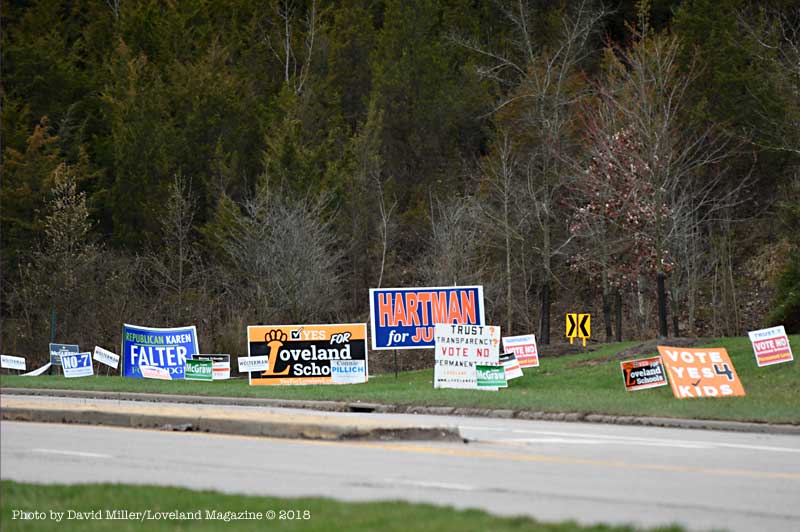
    Since the election has been postponed until June, would it be possible to respectfully request that anyone who posted an election-related sign please remove it, at least temporarily?

    Doing so would help declutter our beautiful neighborhoods and allow us to more fully appreciate the beauty of spring.

    Many of us are taking more walks, and just taking things slower in general.

    Flowers are blooming, trees are budding. These are things I want to see more of. I’ve seen enough levy signs for awhile. And please, only remove signs that you put up. We don’t need anyone accusing an opponent of removing something that didn’t belong to them. We have bigger things to worry about, and need to come together to get through this time.

    So please, Loveland, let’s put away our signs, and enjoy the spring season as best we can.


  • C is for Consumer by Jason Hubbard

    C is for Consumer by Jason Hubbard

    Jason Hubbard is a Miami Township resident who lives in Miami Trails

    Loveland contributes less as a percentage of income than 90% of schools

    A third levy attempt is 1.6x more likely to fail than the original attempt

    by Jason Hubbard

    As we know from previous posts and articles, because of HB920 even when inflation drives costs up, schools don’t receive additional local revenue from voted in levies. I would argue, even if this was the case, schools would still need additional revenue because the inflation number we typically use doesn’t apply to Loveland (or any other school).

    To explain why it doesn’t apply, we first must understand what inflation is. Inflation is the calculation of the rising (or falling) costs of a basket of goods and services. Those specific goods and services, and the weight of those goods and services, will dramatically affect the final outcome. Typically when we talk about inflation, we are referencing either the Consumer Price Index (CPI) or Personal Consumption Expenditure, both of which are calculated based on the buying habits of personal consumers.

    As you can imagine, the buying habits of personal consumers and schools are vastly different, both in terms of the basket of goods and services and the weights/quantities inside the basket.

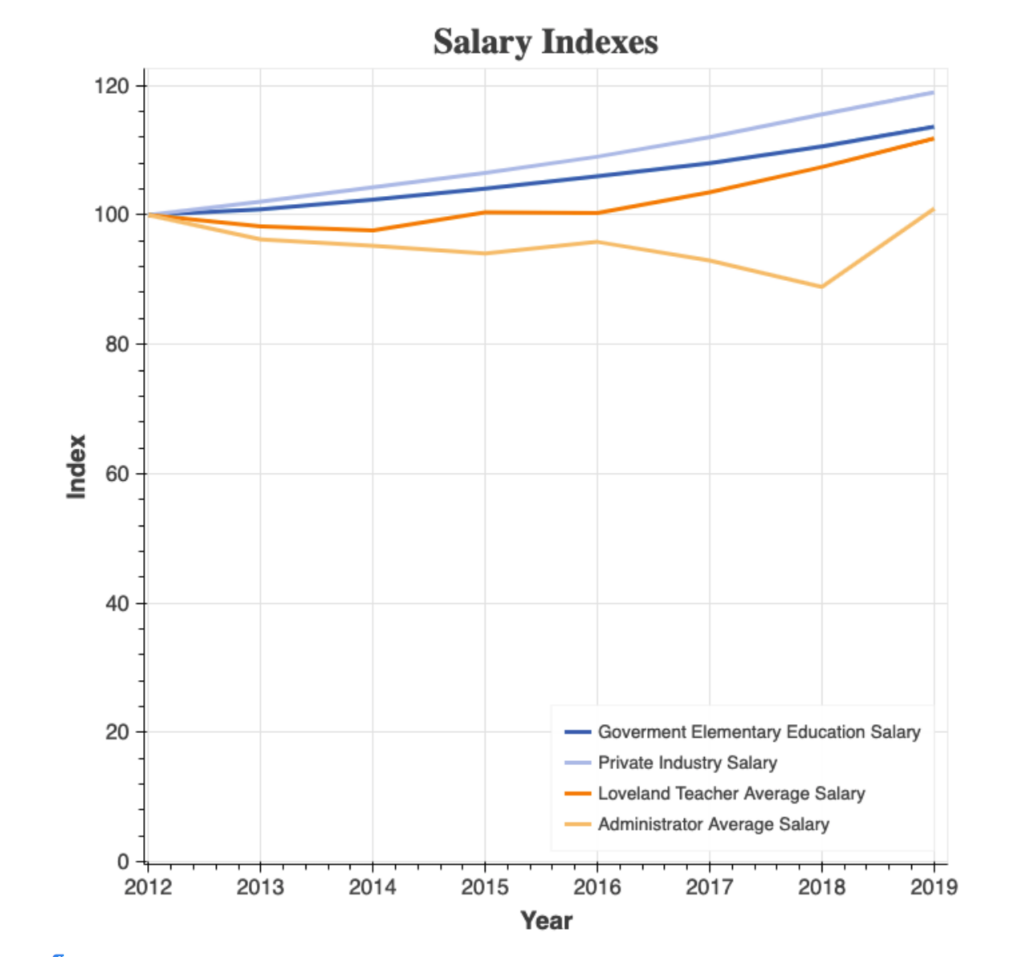
    While we can’t use the CPI itself, we can look at various components or other indexes to get a better idea of the actual adjustments of cost. Let’s first talk about the cost of people. The vast majority of the district’s expenses are people (87% for Loveland in 2012), so this makes up the biggest part or weight of the “basket”. When we look at the components that make up people, we find health insurance costs have increased 31.2% since 2012 and benefits generally have increased 24.6%, while salaries nationwide within public elementary and secondary schools have increased 13.7% (all private-sector salaries increased 14.7%). Total compensation for government education employees increased 17.86% nationwide while the private industry increased 17.85%. During this same timeframe, Loveland has seen only a 22.9% increase in benefits, average teacher salaries have increased 11.8%, and average administration salaries have increased only 1%.

    Other areas of the budget would need to be broken down for comparisons as they don’t match well with indexes that exist, for example, supplies and materials contain textbooks, which has seen a 21% increase nationwide since 2012, but also contains fuel, maintenance parts, etc. Purchased services contain other salary resources along with special services associated with teaching (primarily around disability services) and operations/maintenance of the building. Instead of trying to compare additional indexes, we could look at the elementary and high school tuition and fees index for consumers; that has increased 29.3% since 2012, which is actually in line with Loveland’s 30.2% increase (a difference of only $476,720.75, well below the cuts already made). If we assume the weight used within the CPI for elementary and high school tuition and fees index is consistent with Loveland’s property tax, then the increase would have contributed less than 1% of the total increase in expenses to the CPI since 2012.
    It’s also the case that school taxes typically make up a small percentage of household total income, and if it was increasing faster than income, the effects would be negligible, especially considering some costs of expenses fall offsetting other expenses. The fact is though, this has not been the case for Loveland. If we look at total revenue collected from residential real estate and compare that to total federally adjusted gross income, Loveland contributed less in 2019 than in 2012. Loveland also has a lower local property tax collection to income than the state average, ranking in the lowest 10%. Additionally, Loveland has a low commercial to residential real estate ratio, which typically means more burden will fall on homeowners to support the school, but over the years this hasn’t happened. If Loveland contributed a similar amount of commercial and residential real estate tax as a percent of income, they would have received over $50M more in revenue over the last 6 years.

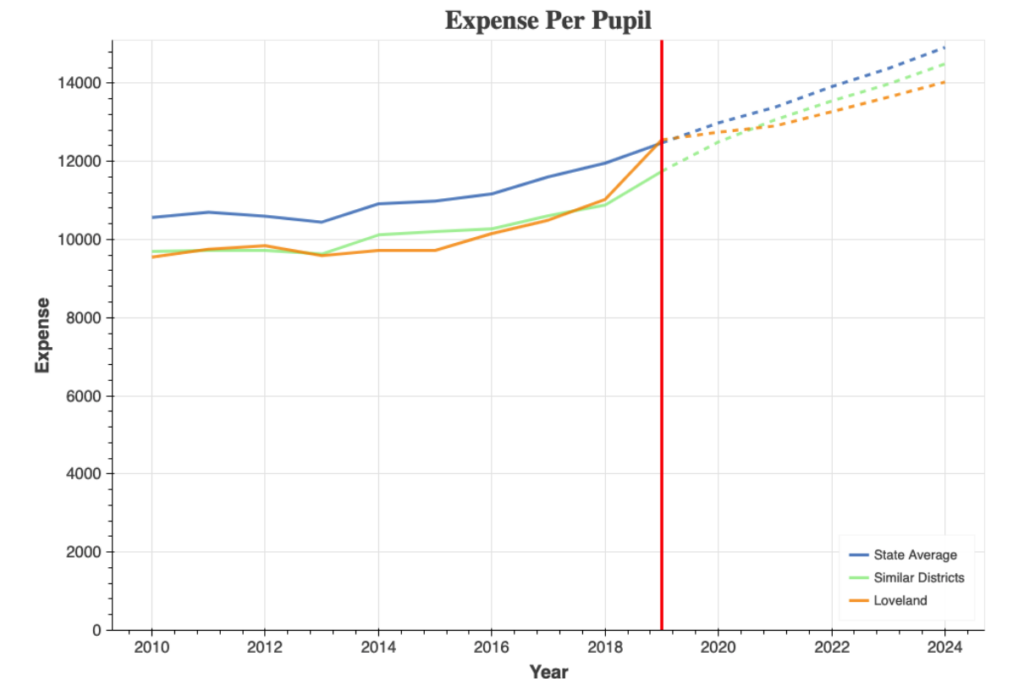
    I’m writing all this, not to tell you to vote Yes, but to ask you to look at your own expenses and income and come to a conclusion yourself. I (and everyone else) can look at all the data and make generalized assumptions, but I don’t know your own situation. The fact is, Loveland’s budget isn’t extravagant, it’s completely ordinary, average. Even with this levy, it will trend lower compared to other schools, so I hope you ask yourself, is my situation really what those that oppose the levy claim, or am I in a position to be able to support this levy and keep Loveland’s average budget where it is. Additionally, even with passage of this levy, the state average and similar* district’s budget increases will outpace Loveland and per-pupil expense will exceed Loveland’s within 2 years.

    Lastly, I would like you to consider the risks of a failed levy. I’m not talking about the additional cuts the administration has already announced, but the loss of support of the schools within the community. If you look historically at other districts with multiple failed levies, school support decreases and it becomes more likely additional levies will fail. Schools with two failed levies are 1.6 times more likely to fail the following request than schools that passed their previous attempt. If you are still undecided, I ask that you consider how much budget cuts you’re willing to tolerate and how much of a decrease in property tax that really means for you, with the over $3M of additional cuts announced if this levy fails (over 25 positions and other changes), that would mean only around $6/month per $100,000 of appraised value. And while the opposition may claim they would endorse a levy later, we’ve already seen they are willing to move the goalpost, so there is no guarantee there won’t be additional opposition. The question is, is voting down this levy worth the risk, do we really want to go through another campaign like this? Voting this down because the incremental cost was slightly higher than you expected, may mean another failed levy on a budget you would support.


    * Similar district as defined by Ohio Department of Education, http://webapp2.ode.state.oh.us/similar_districts/similar_districts.asp?strIRN=044271&intSchool_Year=2019&action=Run

    Sources: U.S. Bureau of Labor Statistics Employment Cost Index & Consumer Price Index, OEA and Ohio Board of Elections Levy Results, Ohio Department of Education District Profile Report, Ohio Department of Education 5-year Forecast, Ohio Department of Taxation


  • What would have been a more appropriate response?

    What would have been a more appropriate response?

    by Marcia Neumann


    1. A student presents his project to the class, submits his presentation to his teacher, then realizes he made a mistake on a chart that would negatively affect the point he was trying to make. He manages to correct the chart on his submitted work without his teacher knowing and doesn’t inform the class of his error.
    2. A teacher, trying to make a point to her class, presents data in a lesson plan proving her point. The teacher later realizes the data has a mistake, reducing the impact of her point. She corrects the data in her lesson plan for the record, but never informs the students.


    I am sure we can all agree that a better response in both scenarios above, would have been to admit the mistake to the people hearing the presented material, giving them the real data, and then noting the revised data in the presentation and lesson plan. This better response shows integrity, accountability, trust, transparency, maturity.

    NOW WHAT ABOUT THIS SCENARIO?

    The Superintendent presents a slide at a district information meeting, trying to prove a point that district enrollment is not declining. The slide is wrong and the correct data, has district enrollment decline almost 50% higher than what was presented. Once this mistake is exposed on social media, the superintendent pulls the slide from the presentation available on the school’s website with no explanation, just noting ‘Questions related to student enrollment numbers are now addressed directly in the Levy FAQ’. Then in that tab, she places the correct data, again not saying this is a corrected chart.

    Marcia Neumann lives on Tanglewood Drive

    ATTENTION Loveland City School District Residents, this is exactly what was done in our district by our current administration. The 2019 Year End enrollment figure was wrong on her slide showing 50% less decline than actual. Instead of noting the mistake, it was hidden, swept under the rug.

    If this is how the current administration handles smaller things, how do they handle bigger, more important matters? 

    TRUST? TRANSPARENCY?

  • Busing at risk if levy fails

    Busing at risk if levy fails

    by Alan Hodge

    When an individual or family or business finds it necessary to trim expenses to fit them into constrained circumstances, the common practice is to begin by eliminating what is least important. Luxuries go first, then the things that are merely nice to have. What’s really important is cut only as a last resort. One might suppose the Loveland

    Alan Hodge lives in Symmes Township off of Enyart Road

    School District would take a similar approach. One might be wrong. In a recent “Protect Our Progress” mailing under the heading “What happens if this levy fails?” the second item reads: “Elimination of high school busing, including non-public routes.”

    What are we to make of this statement? If busing high school students is not necessary (and can, therefore, be cut), why was the District spending money on it in the first place? That does not seem to be a responsible and prudent use of available funding, and it does not reflect favorably on the District’s financial management. It would be eminently sensible to eliminate busing so that its costs could be diverted to items of higher priority.

    On the other hand, if busing high school students is necessary, what are the consequences of eliminating it? One consequence, presumably, is that students who depend on buses to get to school would no longer be able to get to school. While this might be considered an unfortunate outcome for the affected students, it would certainly help alleviate any overcrowding that the school is suffering from.

    Another consequence is that by eliminating high school busing, the District can protect the “Progress” that it obviously deems more important. Of what does that “Progress” consist? According to the same mailing, it consists of “expanding course offerings by over 40 new courses in science, technology, engineering, and math; all while improving reading outcomes, counseling, safety, and technology for our students.” Good heavens! Were the school’s offerings so inadequate that over 40 (over 40!) new STEM courses were — and still are — required for progress? However, did the District earn its “Excellent” rating priors to 2014? Nevertheless, the new courses must surely be good for “our students”; but if the levy fails, we should understand “our students” to mean only those students who are still able to attend high school. Nothing in the mailing suggests that the failure of the levy will jeopardize, preclude or reduce the number of new courses, so it is obviously more important to the District to have them than it is to ensure that its students can get to school in the first place.

    So what are we to conclude? That the District’s definition of “Progress” has more to do with offering “over 40 new courses”, etc., than with serving the fundamental needs of all its students? And that it is willing, in effect, to abandon (or at least create hardship for) some portion of its student population in order to protect that “Progress”? Or that the District has been providing high school busing (for how long?) when there was no need for it, and will be forced to stop this unnecessary expenditure (i.e., waste) of funding if the levy fails? Or that the District is merely trying to bully those members of the community who depend on high school busing into voting for the levy by threatening to make life difficult for them if they don’t?

    Let’s call it as it is. The threat to eliminate high school busing is at best a bogeyman intended to scare some voters into supporting the levy and at worst a cynical and perverse expression of the District’s priorities. Make no mistake about the latter: the kids definitely do not come first. They are a distinct second to the glitzy window dressing that the District chooses to call “Progress.” No matter how you look at it, the school board and the administration should be embarrassed about their attempt to rally support for the levy by threatening to eliminate high school busing. It is a shameful way for them to treat the community of which they claim to be a part.

  • Catch A Tiger By the Tale

    Catch A Tiger By the Tale

    by Lesley Hodge

    Some Fairy tales start with “Once Upon A Time…” and others start with “We are committed to keeping spending increases at 3% or less……”

    Looking at the Loveland School Levy from all angles as to make an informed vote, I am struck by how little leverage the voter has to hold the school district accountable to its promise to keep spending in check

    Lesley Hodge lives in Symmes Township off of Enyart Road

    other than a vote on a levy! The District’s commitment to limit expense growth to 3% or less annually is still double the inflation rate. The district made this promise after raising their baseline expenditures by more than six million dollars in 2019 and on the condition we pass the current levy that will guarantee another $6.225 million per year for eternity. The district says it will have to ask for another levy to increase the operations budget in 2024. And there is the probability of a levy to increase the permanent improvements budget (expenses for items that have a useful life of five years or more) and/or a bond issue for new buildings in the intervening years. We are still currently paying on a loan (building fund) for a 1998, $32 million bond that won’t be paid off until 2025.   

    The district says it is making $2.7 million in cuts, but some of those “cuts” are future realized savings and not cuts at all such as the two teachers who would have been hired if the November levy had passed.  Increased pay to play fees aren’t cuts at all. This is misleading. What is being done to reduce baseline spending?

    Why would a district cut busing to punish parents when all 30 administrators get pick up on the pick up? (Total cost of pensions and medicare picked up by the public with zero contribution from the administrators). The bottom line is enrollment has declined as the number of administrators has increased and it doesn’t matter what the state average of administrators to pupils is. 

    The district’s tale is they need to save the progress they have made. What is the progress that we are really protecting if the spike in expenses, as we are told, was largely due to technology costs, healthcare increases, and textbooks?

    In the meantime ordinary citizens have been looking closely at the numbers, camping out in open checkbook and fact-checking the school. The retired auditor/CPA’s article on “Direction Correction” on Loveland Magazine was brilliant! Our district has never been exposed to this level of scrutiny from ordinary grassroots citizens. No wonder there has been a directed effort to silence the voice and message of those calling out that the school has a spending problem, not a funding problem. It is disappointing to read that posts of those arguing one side of the issue are disappearing in certain neighborhood forums, limiting the free exchange of ideas and opinions. So much for honest debate!

    As one businessman asked at the February 25th information session – “Why doesn’t the school have an income statement?” This is a great question. We are constantly told how complicated school finance is. An income statement would provide a capsule glance of income and expenditures and be a benefit to the public.

    And where is the Loveland Board of Education during this levy campaign given that its own policy manual states: “Within the extent of its legal powers, the Board has responsibilities for operating the District in accordance with the desires of local citizens who elect its members”. Why aren’t they answering citizens’ questions?

    When I look at all these things, I feel like I’m seeing and hearing a tale that doesn’t end with “and they all lived happily ever after.”  Instead it ends “and those who could not afford the entitled spending of their local school district and ever higher property taxes were forced to leave the community they had come to because it was once upon a time welcoming and affordable.” 

    While strong schools are important, strong communities begin with strong families. The school cannot operate in a vacuum. It must operate within the confines of what the entire community can afford. This requires responsible budgeting and spending. Every year taxes increase and insurance costs rise for all of us. In the end “sustain and optimize” sounds like so much corporate blather. Every voter will either take a leap of faith, trusting the district’s tale that they will keep spending in check – or vote no.

  • You Should Vote ‘YES’ (Even If You’re a ‘NO’)

    You Should Vote ‘YES’ (Even If You’re a ‘NO’)

    by Donel Autin

    By now, you’ve probably already decided whether you’re buying what the Loveland City School Board and the leaders in the Administration have been selling. And if you’ve even attempted to pay attention,

    Donel Autin is a resident of Loveland City School District and the father of two sons, one a senior at LHS and one a graduate of Loveland City Schools.  He is an executive with a Cincinnati based real estate development firm

    you’ve had every chance in the world to see multiple iterations of the numbers and analyses, along with the various interpretations by both the ‘YES’ and the ‘No’ camps. But, if you haven’t done that yet, don’t bother, because:

    It. Doesn’t. Matter.

    You don’t have to like how we got here, but the only logical way out of this mess is to cast your vote on March 17th as a ‘YES’.

    Despite the wide use of facts and figures to try to blind you, most of the arguments against this Operating Levy thus far have been “I don’t like the trends” or “I don’t trust them” or “Why haven’t you been more transparent about this or that” or “I’m still mad about that last crazy Capital Levy request”. Everyone agrees we need to do better. But those kinds of protests aren’t ideas or solutions, they’re just criticisms and complaints. Complaints don’t solve problems.

    I believe good people can always find ways to improve. I also believe it will be true that there are things we can do together to better our Loveland Schools’ performance, effectiveness, and cost. The problem will be that very reasonable people are going to disagree mightily on what those things are and on what we should do next. 

    • Are we spending too much on continuing education and training for our teachers? 
    • Subsidizing our Arts, Athletics and Technology programs too much? 
    • Are we adopting new technology too fast? 
    • Outsourcing too many of our needs to for-profit companies?
    • Do we need Human Resources and Finance professionals on the Administration staff?
    • Do we need to change our approach regarding our children with special needs? 
    • Is the pay and benefits we offer our educators too costly?

    For every time you might say “Of course!” to one of the above items, someone else will say “No way!”. And therein lies the rub. The answers will take a little time to think through and will only happen when our community comes together. In the meantime, a ‘No’ leaves us zero time to develop good solutions and implement them in an effective way. There’s an old German word called “Verschlimmbesserung” which literally translates to “disimprovement”, ie: an attempt at improvement which makes the end result worse. This is where a ‘No’ vote will get us.

    Without a ‘YES’ on St Patrick’s Day, the cuts that will be forced onto us will be immediate and life-changing for some of these children, potentially affecting them for many years to come. These decisions won’t, and in some cases legally can’t, wait until the next election cycle in November or sometime afterward in 2021. And, by the way, they’ve already told you what the cuts will look like. If you’re expecting them to magically change their minds and agree with you to do something different in the 90 days after this vote, well…….

    The only real solution is to vote ‘YES’ to this Operating Levy on March 17th, then go directly from the voting booth over to the school board offices and sign up for one of the many committees being put together to help develop real solutions. 

    Do Something. Get Involved. And Vote ‘YES’ on March 17th.

  • Living in a Public or Private World: Know your facts for school funding and planning

    Living in a Public or Private World: Know your facts for school funding and planning

    Lynn Mangan is a 24 year resident of the Loveland City School District and business executive of a software company. She leads the “Citizens for Loveland City Schools” (political action committee)

    by Lynn Mangan

    Imagine running a business in a world where you can’t generate new revenue.  Your income statement is always flat – unless you go to the community and get approval for additional funding.  There are no meaningful options for raising prices, offering new products, raising investment, or taking on debt without public approval.  These are the unique challenges our schools face.

    Some key drivers of this situation include:

    • Ohio public schools don’t receive increases to their revenue when our property values increase (HB 920) or inflationary costs rise; despite the fact that the current funding system was declared unconstitutional due to DeRolph vs. State of Ohio.
    • While public schools can increase a very small portion of their budget through pay to play fees, technology fees or tuition for non-required classes (ex. Full day kindergarten), this doesn’t come close to covering the costs needed to continue to educate our children well.

    On the other hand, costs go up.  All the time.  And I’m not talking about new programs, investments in new capabilities at this point – although the community also agreed to invest in those areas in 2014.  I’m talking about structural costs of running a school ‘business’ – salaries, health care premiums, building maintenance, utilities, security, safety, etc.  They eat away at the operating funds that should be used to provide superior services to students and the community.

    In 2014, the Loveland community voted to increase the School’s revenue stream with a direction to deliver going operations AND improvements in programming.  Our schools were ranked pretty low relative to the state (433 out of 608 public school districts in value added ranking in 2016 when the investment from the 2014 levy started), and the community wanted to invest in turning that around.  Since then, through introductions of new programs focusing on STEAM classes, AP and gifted curriculum, counseling, reading, and safety, Loveland schools have consistently improved.  As of 2019, they are ranked #22 out of 608 districts in value added measures.  Loveland schools are a shining example of outcomes that can occur when schools are supported by their community.

    Now, here we are in 2020, 6 years later and we want to sustain and optimize the community’s investment from 2014.  In that time, structural costs of doing business as a school have predictably risen.  

    • Health care premiums saw a 10% increase last year after 3 years at 0%
    • Instructional materials have seen significant cost increases 
    • Technology is needed at all grade levels and for all staff members
    • Investments in student and staff safety have rising costs

    Yet, we have to go out for a public vote again.  Some in our community are stating the district has spent too much.  Here are a few thoughts for you to consider:

    • Total expenses for the prior 5 years increased by an average of 3.82%
    • General fund expenses (those funds used by revenue generated from property owners) for the prior 5 years have increased by an average of 5.05% 
    • CUPP Operating Expenses only contain two funds that are reported to the state (classroom and non-classroom instruction). Over the past five years, CUPP operating expenses have increased by an average of 5.22%  

    In private business and a personal budget, we have certain years when we are making investments and expenses are higher than the average year. It is not uncommon to see expenses rise as investments in R&D occur.  The same goes for a school.  Look at the trends since the district started its investment from the 2014 levy and you’ll see that the averages paired with the outcomes delivered make sense. Take a look at the reasons why the costs went up and I guarantee they will be the same expenses going up in your personal or company budget (ex. healthcare, technology, safety, etc.).  

    All of the measures above focus on a backward look at expenses. So, what does the future look like? The district is listening to our community and knows that we need a growth rate in expenses that the community can sustain.  As a result, the board has committed to keeping the general fund expenses under 3% for the next 4 years (the current forecast is at 2.70%) and has already reduced $2.7 million in expenses.

    I’d also ask you to consider the following:  unemployment rates are at an all time low in our country. That means, retaining talent (employees) for every type of employer is that much more difficult.  Demanding no raises for those employees, who are regularly innovating on the newest skills that our students need to succeed when they graduate, is not a formula for success.  Every employee in our district needs to be innovating to provide students with the academic, social and emotional skills they need to succeed today and that talent isn’t free.  Like a private company, our district’s board has a compensation committee that evaluates wages relative to peers and the overall labor market to proactively address wages and overall benefit packages to retain top talent.

    If you’re interested in how the district is optimizing resources, take a look at some of the changes happening at our high school:

    • 418 students are enrolled in business classes (financial literacy, marketing, investments and money management, honors accounting, Tigers Inc (partnership with local businesses)) that did not exist up until two years ago.
    • 211 students are enrolled in applied technology classes through the addition of two AP classes and numerous College Credit Plus courses (computer networking/system admin, web development, database management, virtual reality and video game programming)

    Like private business, there are supply and demand needs. This is a classic example where the district realized there was a demand and since 2015-16, invested to meet the demand.

    Finally, imagine if you only received your paycheck twice per year and had to budget your money to cover 6 months at a time? This is the case for Ohio Public Schools. The district receives property tax twice per year.  Thus, the cash balance that the school maintains needs to be sufficient to cover the recurring expenses of the district between payments. The cash balance the district is targeting is not “a rainy day fund.” It is a fund to maintain cash to meet monthly expenses. This plan is very similar to the deposit reserves that a bank is required to keep on hand to ensure that they have cash on hand for all withdrawals.  Not being able to pay a withdrawal at a bank is very similar to not being able to pay bills at a school. The district must plan several years ahead for cash needs.

    In summary, our public schools are challenged with:

    • Funding that doesn’t change when property values or inflation changes and structural costs that are constantly trending upward
    • Funding that is primarily received twice per year requiring cash balances to be maintained carefully
    • A world in which the skills needed to compete in the job market are changing at a rapid pace 
    • School staff who are required to constantly learn new courses and skills to teach our children
    • Unemployment rates that are at all time lows, and 
    • A community that wants what is best for our children – “Preparing our students for tomorrow, today,”

    Providing students in our community with outstanding academic, social and emotional skills so that they are productive citizens each day when they leave the schools as well as when they graduate is the primary objective of our schools. Educating approximately 4,500 students in our community is no easy task. 

    This a complex problem that from a revenue and cash balance perspective varies from what many of us encounter in the private business world each day. Our district is committed to continuing to deliver outstanding outcomes for our children while making sure our spend is less than a 3% average increase.  I encourage each of you to invest in our community’s students:  know the facts, consider what you want for your community and VOTE YES on March 17th. And after March 17th, let’s continue this dialogue and work with our State legislature to transform our current unconstitutional school funding.

    .