Author: Loveland Magazine

  • Ohio Minimum Wage Set to Increase in 2025

    Ohio Minimum Wage Set to Increase in 2025

    Columbus, Ohio – Ohio’s minimum wage is scheduled to increase Jan. 1, 2025, to $10.70 per hour for non-tipped employees and $5.35 per hour for tipped employees. The minimum wage will apply to employees of businesses with annual gross receipts of more than $394,000 per year.

    The current 2024 minimum wage is $10.45 per hour for non-tipped employees and $5.25 per hour for tipped employees. The 2024 Ohio minimum wage applies to employees of businesses with annual gross receipts of more than $385,000.

    The Constitutional Amendment (II-34a) passed by Ohio voters in November 2006 states Ohio’s minimum wage shall increase on January 1 each year by the rate of inflation. The state minimum wage is tied to the Consumer Price Index (CPI-W) for urban wage earners and clerical workers over the 12-month period prior to September. The CPI-W index increased by 2.4 % over the 12-month period from Sept. 1, 2023, to Aug. 31, 2024.

    For employees at smaller companies with annual gross receipts of $394,000 or less per year after Jan. 1, 2025, and for 14- and 15-year-olds, the state’s minimum wage is $7.25 per hour. For these employees, the state wage is tied to the federal minimum wage of $7.25 per hour, which requires an act of Congress and the President’s signature to change.

    Employers can access the 2025 Minimum Wage poster for display in their places of business by visiting the Ohio Department of Commerce’s Division of Industrial Compliance’s Bureau of Wage and Hour website.

    The Division of Industrial Compliance is part of the Ohio Department of Commerce. The department is Ohio’s chief regulatory agency, focused on promoting prosperity and protecting what matters most to Ohioans. We ensure businesses follow the laws that help them create jobs and keep Ohioans safe. To learn more about what we do, visit our website at com.ohio.gov.

  • Loveland teams do well in FIRST LEGO League Challenge

    Loveland teams do well in FIRST LEGO League Challenge

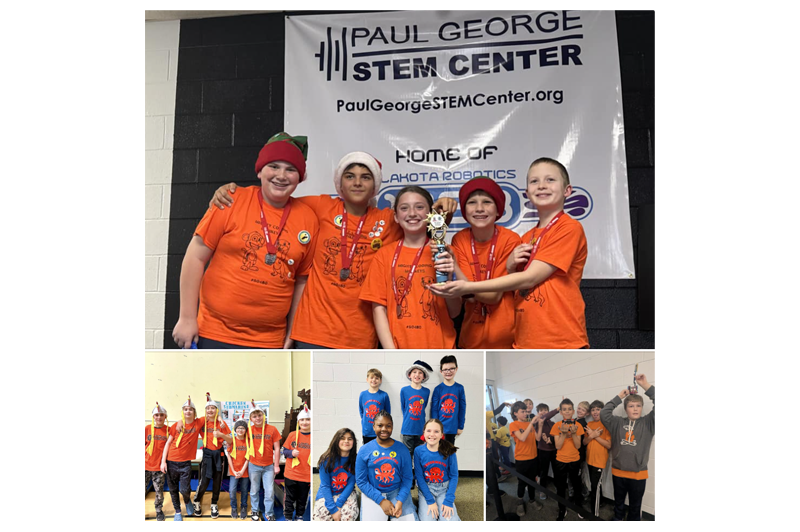
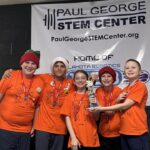
    Loveland, Ohio – The Mighty Coding Monkeys and Rookie teams 66554 Chicken Submarine, 66935 Underwater Coders, and 67024 Duckie Nuggies competed at the Lakota Ohio FIRST LEGO League Challenge Regional robotic tournament on Sunday.
    Team 60480 Mighty Coding Monkeys won the Engineering Excellence Award and is advancing to the Loveland District Tournament. Rookie teams 66554 Chicken Submarine, 66935 Underwater Coders, and 67024 Duckie Nuggies also competed and represented Loveland well with new personal high scores and great judging performances.
    The Loveland District Tournament will be held on January 18 at the Loveland Intermediate School and there will be 4 Loveland teams competing.
    If you are interested in volunteering, please contact the Loveland Robotics Boosters at lovelandroboticsboosters@gmail.com.
  • Governor DeWine Announces New Effort to Improve Care Coordination and Reduce Fatal Drug Overdoses

    Governor DeWine Announces New Effort to Improve Care Coordination and Reduce Fatal Drug Overdoses

    Columbus, Ohio – Ohio Governor Mike DeWine and Ohio Board of Pharmacy Executive Director Steven Schierholt announced today that Ohio’s prescription drug monitoring program, known as the Ohio Automated Rx Reporting System (OARRS), will begin alerting healthcare providers about patients who have experienced a non-fatal drug overdose. These alerts are intended to improve care coordination and promote access to medication for opioid use disorder and other tools to prevent fatal overdoses.

    “The goal of this alert is to give us an extra chance to save someone’s life,” said Governor DeWine. “The research shows us that people who have recently experienced a non-fatal overdose are at a higher risk to overdose again in the near future, and that they often have regular interactions with the healthcare system – including pharmacists and prescribers. This new alert system will be a valuable tool allowing our healthcare providers the opportunity to educate and offer treatment and prevention options to these individuals before a tragedy occurs.”

    The data provided to OARRS is being reported by Ohio hospitals via the Ohio Department of Health because of a rule change announced by Governor DeWine earlier this year.  Using this data, the OARRS system will now flag for prescribers and pharmacists of any patient who experienced a non-fatal drug overdose and was discharged from an Ohio emergency department on or after April 8, 2024. The alerts will only be available for OARRS users who are prescribers and pharmacists.

    “Data from state prescription drug monitoring programs, such as OARRS, continues to be an invaluable resource for healthcare providers,” said Ohio Board of Pharmacy Executive Director Steven W. Schierholt. “With this alert, we are encouraging prescribers and pharmacists to engage with their patients and offer proven interventions that will prevent fatal drug overdoses in the future.”

    Among Ohioans who died in 2022 from an unintentional drug overdose, at least 32% experienced a prior non-fatal overdose. Among the same population, 26% received a prescription for a controlled substance from a healthcare provider within 60 days of their death. These interactions with the healthcare system reinforce the need to ensure high-risk patients have access to interventions such as overdose reversal medications (e.g., naloxone) and medication for opioid use disorder.

    Established in 2006, OARRS is a statewide database that collects information on all prescriptions for controlled substances that are dispensed by pharmacies or furnished by prescribers in Ohio. To assist healthcare providers in using this new alert, the Board of Pharmacy has developed training materials that can be accessed by visiting: Pharmacy.Ohio.gov/NFOD.

    According to DeWine, “This new alert system is another example of Governor DeWine’s ongoing and comprehensive efforts to prevent overdose deaths and fight drug addiction. Ohio’s coordinated efforts are achieving encouraging results.”

    Governor DeWine recently announced newly verified data from the Ohio Department of Health (ODH), demonstrating that Ohio experienced a 9% decline in the number of overdose deaths last year.

    ODH’s 2023 Ohio Unintentional Drug Overdose Report also shows that Ohio has now outperformed national overdose death trends for two years in a row. In 2023, Ohio’s 9% decrease in overdose deaths was better than the 2% decrease seen nationwide. In 2022, Ohio’s 5% decrease in overdose deaths was better than the 1% increase seen nationwide.

  • Clermont County Mental Health and Recovery Board Receives $1 Million Grant to Support a Crisis Receiving Center

    Clermont County Mental Health and Recovery Board Receives $1 Million Grant to Support a Crisis Receiving Center

    Batavia, Ohio – The Clermont County Mental Health and Recovery Board has received a $1 million grant to support its efforts to help fight addiction by delivering needed crisis services, Dr. Lee Ann Watson, the Executive Director of the Clermont County Mental Health and Recovery Board announced.

    The grant from the OneOhio Recovery Foundation will go toward increasing access to behavioral health services by providing a no-wrong door access point for Clermont residents experiencing a behavioral health crisis, Dr. Watson said.

    “While our Board has recognized that the lack of a Crisis Receiving Center has been a major gap in the behavioral health continuum of care in Clermont County for many years, we have simply not had the funding to address the need,” said Dr. Watson. “The OneOhio funding Recovery Foundation grant will allow us to meet this vital need in Clermont County.”

    The grant is part of an inaugural round of approximately $51 million in funding made available by the Foundation as part of its mission to combat the opioid epidemic by supporting prevention, treatment and recovery programs and services in our communities. The grant money was funded by 55 percent of settlement funds that Ohio is receiving from the pharmaceutical industry as a consequence of its role in the national opioid epidemic.

    The grant received by the Clermont County Mental Health and Recovery Board reflects the Foundation’s commitment to supporting organizations on the frontlines of the addiction epidemic by advancing efforts that foster more resilient, healthier communities across Ohio.

    “Across Ohio, organizations like the Clermont County Mental Health and Recovery Board are working day in and day out to strengthen their communities that have been impacted by the opioid epidemic,” said Alisha Nelson, Executive Director of the OneOhio Recovery Foundation.

    “We’re pleased to partner with the Clermont County Mental Health and Recovery Board to support their efforts to save lives, rebuild families affected by addiction, and foster strong and resilient places to live,” Nelson added.

    The recipients announced as part of the Foundation’s first grant cycle were chosen after a review process that included evaluation by the local OneOhio Regional Board, the OneOhio Expert Panel and the Foundation’s Board of Directors.

    Grant recipients have “demonstrated a strong commitment to addressing the opioid crisis”. The funded initiatives are evidenced-based and align with Ohio’s approved abatement strategies, including prevention, recovery supports, services for impacted families and children, and many more.

    A complete list of recipients can be found at OneOhioFoundation.com/GrantAwards.

    The Foundation had an overwhelming response to the 2024 Regional Grant application process, with more than a half-billion dollars in funding requests submitted for the $51 million available this cycle. Organizations and leaders seeking to submit applications in the future can sign up on the Foundation’s website here to receive updates.

    About OneOhio Recovery Foundation

    OneOhio Recovery Foundation is a private, non-profit foundation created under the leadership of Gov. Mike DeWine and Attorney General Dave Yost, and other state and local leaders, with the mission of advancing Ohio’s addiction prevention, treatment, and recovery efforts now and into the future.

    The Foundation is governed by a 29-member board from across Ohio and is funded by 55 percent of settlement funds that Ohio is receiving from the pharmaceutical industry as a consequence of its role in the national opioid epidemic. Funds support local efforts to prevent and combat addiction and are also invested to support those efforts for the long term.

  • Groundbreaking Quantum Computing major approved by Miami University Board of Trustees

    Groundbreaking Quantum Computing major approved by Miami University Board of Trustees

    Next step is approval by Ohio Department of Higher Education

    Oxford, Ohio – During its regular meeting on Friday, Dec. 13, the Miami University Board of Trustees approved the new Quantum Computing major, the first of its kind for an Ohio institution.

    Following approvals from University Senate and the Board of Trustees, the next step is approval from the Ohio Department of Higher Education.

    “It is with great enthusiasm that we successfully complete another phase in the approval process for our Bachelor of Science in Quantum Computing degree,” Miami President Gregory Crawford said. “This has been developed with great input from researchers from Cleveland Clinic and members of the industry, and we look forward to delivering an innovative and comprehensive curriculum and continuing to build partnerships within quantum computing.”

    The Quantum Computing degree is expected to launch in August 2025 and is believed to be not only the first in Ohio, but the first of its type nationwide to focus on the software aspects of quantum computing.

    Beena Sukumaran, the Dinesh & Ila Paliwal Dean of the College of Engineering and Computing, said the groundbreaking Quantum Computing degree program would equip graduates with the knowledge and skills to navigate this exciting and growing field.

    “By offering a unique blend of disruptive computing skills as applied to a specific application area, including the health sciences, this degree program is poised to create a new generation of trailblazers that can apply advanced computational skills to solve the world’s most challenging problems,” Sukumaran said.

    Quantum computing is a multidisciplinary field which combines properties of mathematics, computer science, and physics. Quantum computers are able to solve complex problems faster than a classical computer by determining several solutions in parallel rather than sequentially.

    By developing Ohio’s first specialized degree program, Miami will provide research experiences in quantum computing that will cultivate the scientific and entrepreneurial talent needed to create companies, elevate businesses, and advance organizations that leverage quantum computing.

    A new generation of students will obtain expertise across a spectrum of computing platforms, from classical systems to advanced high-performance and quantum computing techniques (i.e., disruptive computing). The new degree will keep Ohio at the forefront of the quantum computing industry, establish a quantum computing pipeline in the state, and attract, retain, and anchor quantum computing talent in Ohio.

    “Quantum technology is a rapidly expanding market globally,” President Crawford said. “Miami’s bachelor’s degree in Quantum Computing will help address workforce needs in Ohio as well as provide economic resilience through innovation in quantum technology.”

  • Lynn Oury is 2025 Loveland Valentine Lady

    Lynn Oury is 2025 Loveland Valentine Lady

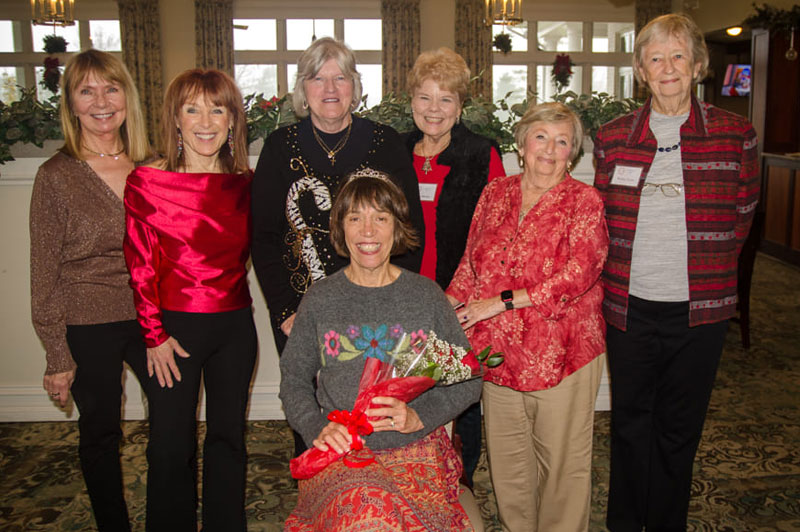
    Photo by Nancy Hartmann Downing on FaceBook

    Editor’s Note: This story has been corrected to reflect that Lynn Oury is not a lifetime Loveland resident.

    Loveland, Ohio – Loveland Valentine Ladies serve the community of Loveland Ohio. They are chosen by community nomination, then picked by a committee from the Little Miami River Chamber Alliance.

    Lynn Oury has been selected as the 2025 Loveland Valentine Lady. She is a former teacher at the Loveland Early Childhood Center.

    _________

    The Valentine Program began in 1972 and has grown over the years to include a variety of Valentine community activities, as well as our nationally-known cachet stamping and postmark program.

    Valentine Ladies are women who have distinguished themselves in community, school, or family endeavors. Being nominated for Valentine Lady is quite an honor!

    The Valentine Lady is the ambassador for the Chamber’s Valentine Program, and visits area businesses, nursing homes and schools, among her duties as Valentine Lady.

    2024: Becky Giver

    2023: Donna Barnes

    2021-2022:  Jeannie Shumaker

    2020:  Debbie Murray

    2019:  Dr. Kathy Lorenz

    2018:  Kay Bolin

    2017:  Carol Williams

    2016:  Laurie Gordon

    2015:  Sue Lundy

    2014:  Janis Fogle

    2013:  Marge Henderson

    2012:  Jan Ranard

    2011:  Avery (Winkie) Foster

    2010:  Bonnie Larson

    2009:  Linda Cox

    2008:  Kay Napier

    2007:  Sue Newburger

    2006:  Peggy Goodwin

    2005:  Lu Boike

    2004:  Helen Gosch

    2003:  Kathryn Undercoffer

    2002:  Patricia Furterer

    2001:  Marirose Stiver

    2000:  Anne Fowler

    1999:  Winona Franz

    1998:  Barbara Dee

    1997:  Bobbie Books

    1996:  Jo Ann Richardson

    1995:  Mary McDonnell

    1994:  Margaret Keifer

    1993:  Kathryn Sidney

    1992:  Doris Osborne

    1991:  Martha Hockman

    1990:  Rose Wene

    1989:  Pat Randolph

    1982-88:  Ruth Jackson (Doris’s daughter)

    1982:  Doris Pfiester

  • ‘It’s become a tradition’ for Coates and Miami RedHawks

    ‘It’s become a tradition’ for Coates and Miami RedHawks

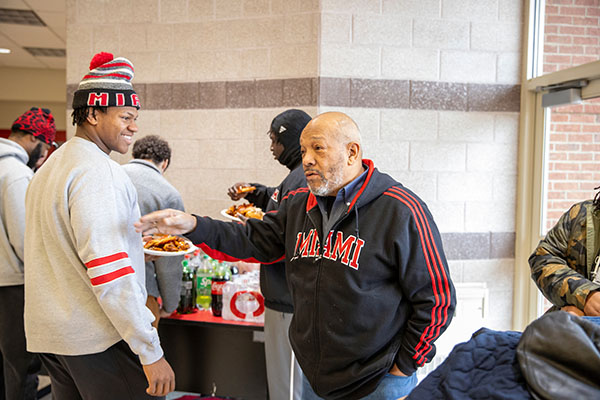
    Rodney Coates, right, talks with members of the Miami University football program on Wednesday, Dec. 11, during a luncheon at the Gross Student-Athlete Development Center organized by Coates to celebrate Miami’s bowl berth. The luncheon has become an annual tradition.

    Oxford, Ohio/Miami University – As members of the Miami University football team filed into – and later out of – the Gross Student-Athlete Development Center on Wednesday afternoon, many offered handshakes and words of appreciation to Rodney Coates.

    The thanks weren’t only for the meal provided, an annual tradition Coates first organized about a decade ago to celebrate when the RedHawks earn a bowl bid, but also for the role Coates plays each year.

    Coates, professor of Global and Intercultural Studies, teaches as part of the Summer Bridge Program, which helps many student-athletes prepare for the academic experience.

    “It’s above and beyond to feed us for a bowl game, but really more so than that what we appreciate is Dr. Coates’ relationship,” said Chuck Martin, head coach of Miami football. “It’s very unique. He’s helped our kids so many different ways. He really helps our kids get ready for college.

    “I couldn’t put a price tag on what he does for our kids.”

    A former Miami football player inspired the initial lunch. The player had a long-term spinal injury, and that resonated with Coates.

    “I said, ‘We need to celebrate it. Not wait for things to happen,’” Coates said. “Let’s make it something really special where Miami comes together to say thank you for what you’ve done. That’s how it started.”

    Coates has taught at Miami since 1990. He received the Distinguished Educator Award from the College of Arts and Science in 2021, as well as the President’s Medal that year.

    Coates has worked with the Summer Bridge Program for more than a decade.

    “Professor Coates is incredibly supportive of our outstanding student-athletes here at Miami,” Miami President Gregory Crawford said. “He works tirelessly with our student-athletes both in and outside the classroom. His December football luncheon is a cherished tradition, celebrating their success and showing our gratitude for all they contribute to Miami and our community.”

    After winning eight games this season and advancing to the Mid-American Conference championship game, the RedHawks will play Colorado State in the Snoop Dogg Arizona Bowl presented by Gin & Juice By Dre and Snoop on Dec. 28 in Tucson, Arizona.

    Kickoff is 4:30 PM at Arizona Stadium. The game will be broadcast on The CW Network.

    This is the fifth straight bowl appearance for the RedHawks and eighth in the last nine years, which has meant several Coates luncheons for many players.

    “As soon as I hear about it, it’s circled on the calendar,” said John Young, a senior offensive lineman.

    “It’s a way for all of us at the end of the year to get together for a couple of last meals,” added senior offensive lineman Reid Holskey. “It’s kind of good to have these moments with the guys who are here right now.”

    David Sayler, Miami’s director of athletics, called the luncheon “a bonding moment.”

    “It’s really nice for the football student-athletes to see deans, the President’s Office, and everybody else who supports it helping provide food for them,” Sayler said. “It’s really a nice gesture and doesn’t go unappreciated by the players.”

    Dec. 28 marks the 16th overall bowl appearance for Miami, beginning with the 1948 Sun Bowl (a 13-12 victory over Texas Tech).

    The last five years have included stops in the LendingTree Bowl (2020), the Frisco Football Classic (2021), the HomeTown Lenders Bahamas Bowl (2022), and the Avocados from Mexico Cure Bowl (2023).

    During that stretch, Martin became Miami’s all-time winningest coach.

    “We’ve done this a few times now,” Coates said. “It’s become a tradition amongst them (the team) too.”

    Established in 1809, Miami University is located in Oxford, Ohio, with regional campuses in Hamilton and Middletown, a learning center in West Chester, and a European study center in Luxembourg.


  • [With Photo Album] I-471 Fire repair update from ODOT

    [With Photo Album] I-471 Fire repair update from ODOT

    I-471 Expected to Reopen By Spring

    Cincinnati, Ohio – Following a November 1 fire that significantly damaged a section of the Interstate 471 Ohio approach to the Daniel Carter Beard Bridge, the Ohio Department of Transportation (ODOT) announced today that it expects to have all lanes reopened in March. FULL NEWS RELEASE

    Updated December 10

    Interstate 471 is closed in the southbound direction at the Ohio River following a fire under the Ohio approach to the Daniel Carter Beard Bridge, which connects Cincinnati, Ohio and Newport, Kentucky.
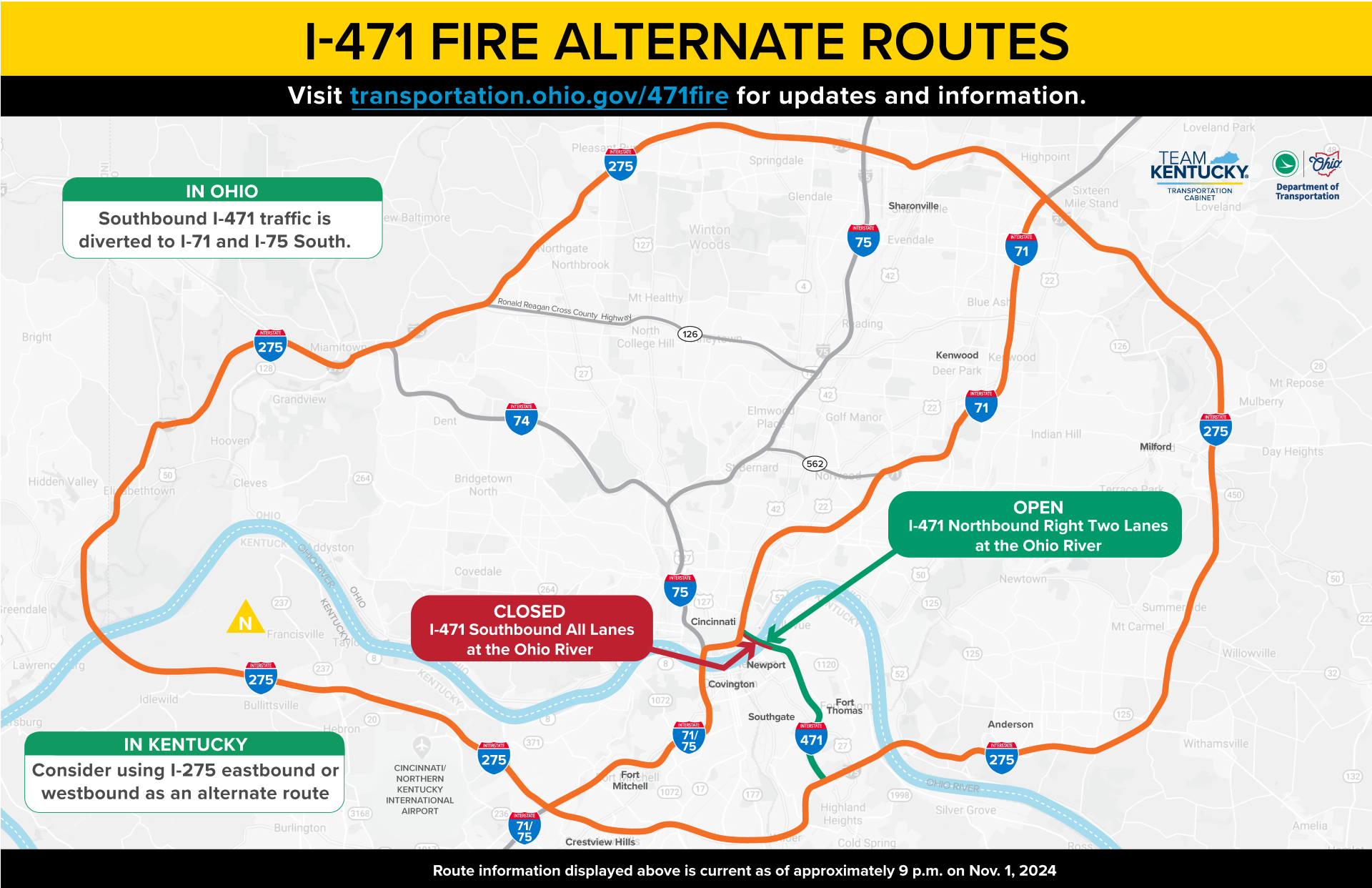
    At 3:20 a.m., November 1, the Cincinnati Fire Department was called to a fire on Pete Rose Way under the Ohio approach span to the bridge. Upon arrival, firefighters discovered a large outdoor fire at a playground in Sawyer Point Park directly under the approach span. At the height of the fire, smoke and flames were seen billowing around and above I-471.

    At this time, the Cincinnati Fire Department has not determined the cause of the fire.

    Detours

    Right Click to see larger in new tab.

    Ohio Traffic Impacts and Detour
    Southbound I-471 remains closed at the bridge crossing in Ohio until further notice. ODOT is diverting southbound traffic by way of I-71 and I-75 South. Heavy truck (semi) drivers are encouraged to use I-275 to I-71/75 to avoid delays, and all HAZMAT operators are required to follow the I-275 outerbelt.

    In addition, the following restrictions are in place in downtown Cincinnati:

    • Liberty Street access to I-471 is closed.
    • 5th Street access to I-471 is closed.
    • U.S. 50 East and West access to I-471 is closed. (U.S. 50 remains open to thru traffic.)

    Kentucky Traffic Impacts
    A single-lane closure is in effect on I-471 North beginning at the 3.6-mile marker near Memorial Parkway and continuing across the Daniel Carter Beard Bridge.

    Sawyer Park Restrictions
    Click here here for the latest updates to the park and surrounding facilities from Cincinnati Parks.

    12/10/24 – 4PM Update

    Demolitions Progresses
    Crews have removed the damaged sections of concrete bridge deck. Now, the attention turns to removing the damaged steel girders. A 550-ton crane has arrived on site from Nashville, Tennessee. There are nine truckloads of parts needed to assemble the crane. It will be used to remove the damaged girders as they are disassembled. Girder removal could begin as early as today. Crews will be watching the weather forecast. If winds are too strong, girder removal will have to be rescheduled.

    Components Starting to Arrive
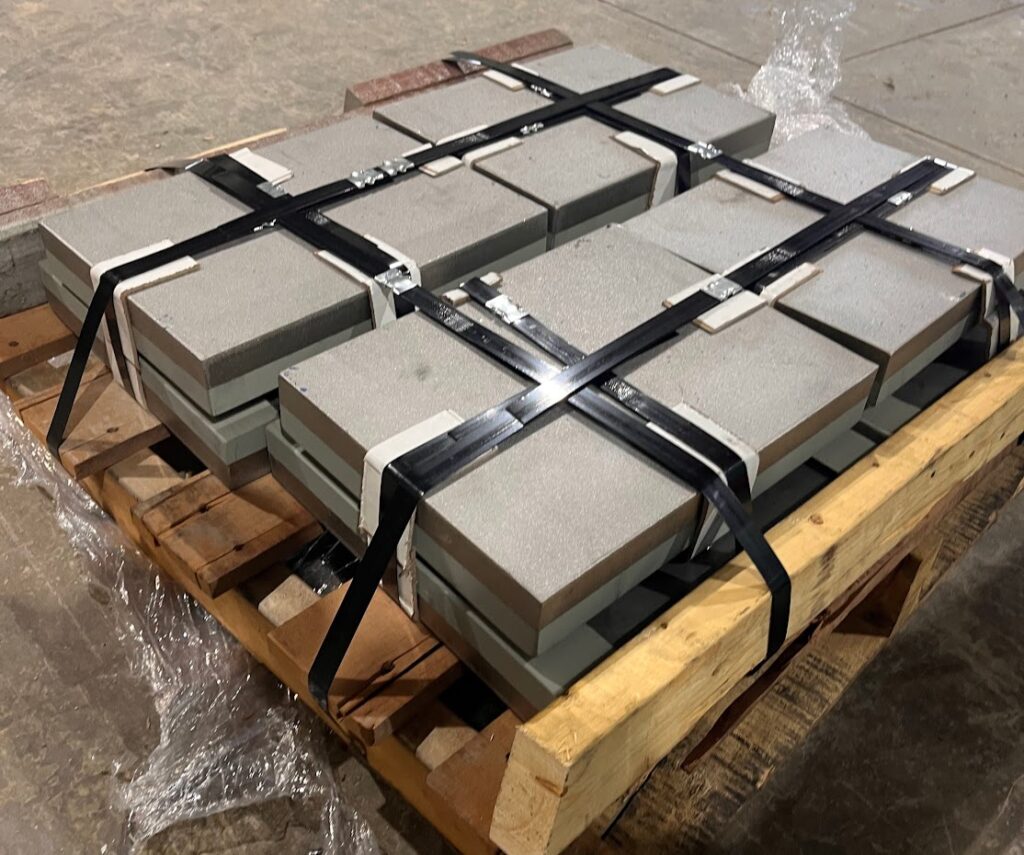
    Bronze bearings, custom-fabricated in Brunswick, Ohio, have arrived at Great Lakes Construction’s office in Cincinnati after being expedited by the manufacturer. These will be used to put four of the new custom-fabricated girders on once they arrive from Bowling Green, Kentucky in mid-January.

    Northbound I-471 Wall Repair
    Crews plan to begin pouring concrete to replace a 70’ damaged section of wall on the northbound side this week, weather permitting. All lanes of northbound I-471 are scheduled to reopen by the end of the year.

    Shoring Towers Relocated

    A group of four shoring towers has been moved south from their original location. These will support the remaining girders once the damaged girders are removed. There are a total of ten shoring towers supporting the structure during the next phase of demolition. These towers will remain in place through construction as well.

  • Loveland gets new Quint

    Loveland gets new Quint

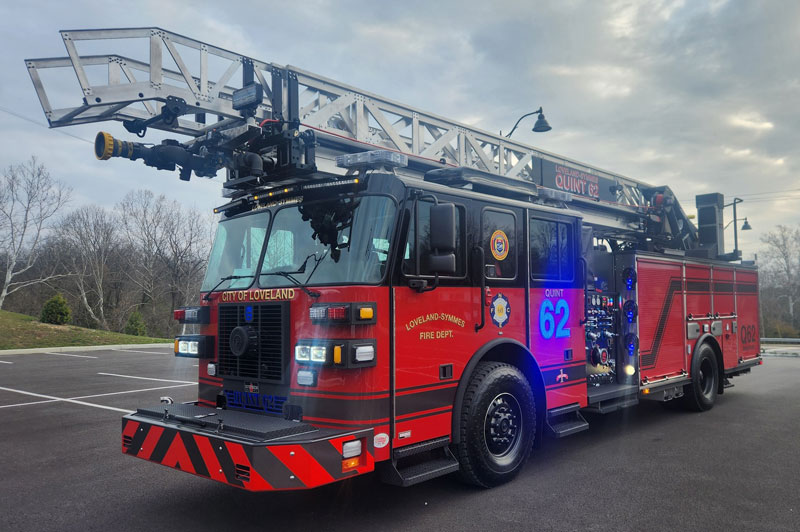
    Photo courtesy of Loveland Symmes Fire Department

    Loveland, Ohio – The Loveland Symmes Fire Department‘s Quint 62 ladder truck has arrived. A Quint, is a quintuple combination pumper, is a fire truck that combines the capabilities of a ladder truck and a fire engine. “Quintuple” refers to the five functions that a quint provides: pump, water tank, fire hose, aerial device, and ground ladders.

    The new truck purchase was approved by City Council in November of 2022. The purchase agreement with the Sutphen Corporation was for an anticipated total cost of $1,173,708.

  • Ohio’s STORK Act: Tax relief for parents or a push against abortion rights?

    Ohio’s STORK Act: Tax relief for parents or a push against abortion rights?

    (Adobe Stock Photo)

    If the STORK Act is passed, Ohio would join states such as Georgia, which already allow tax deductions for unborn children, a policy enacted in 2022. By Vanessa Davidson / Broadcast version by Farah Siddiqi reporting for the Kent State NewsLab-Ohio News Connection Collaboration.

    __________

    Listen to this story:


    Ohio Rep. Gary Click (R-Vickery) in August proposed the STORK Act, which would allow expecting families to claim their unborn children as dependents on their income taxes starting the year the child is conceived.

    Click says every dollar makes a difference for expecting families.

    “You start planning and preparing ahead of time,” he said. “The hospital won’t even let you take them home without a car seat. So, you have to get that car seat, you get a crib, you get a bassinet, you get a pack-and-play, and you get all the little toys for a newborn, and you just stock up before they’re born to get ready for that child.”

    However, some raise concern that the proposal could lead toward the recognition of fetal personhood, which could affect abortion rights within Ohio.

    Danielle Firsich, director of public policy for Planned Parenthood Advocates of Ohio, said Click’s proposal acts as a continued attempt to attack abortion rights following the passage of Issue 1 in 2023.

    Firsich said there have been several other proposals that have tested fences and sought out loopholes to get around state codifications of reproductive rights, including similar bills proposed in Wisconsin, Florida, Kansas and Kentucky.

    “We know that this argument – that someone can have tax credits for an unborn child – directly correlates with the concept that if you’re receiving some sort of tax benefit, or tax credit, you are thereby able to be recognized as a person and be granted rights as such,” Firsich said. “This is a movement that has come, largely, especially after the Dobbs decision.”

    Given Click’s extensive history of pro-life advocacy – with one of his past proposals declaring fetal personhood from conception – Firsich believes the STORK Act could have possible ulterior motives.

    Click denied such claims and called such rhetoric an “extremist attack.”

    “This bill recognizes the expenses that parents put out,” said Click. “It doesn’t say anything about the baby… this tax credit has no power to overturn a constitutional amendment.”

    Jessie Hill, a law professor at Case Western Reserve University who specializes in reproductive rights in Ohio, believes the proposal will have little impact on abortion rights.

    “I just don’t think that this is something that is going to really, in the end, make a big difference in light of Issue 1 still being there,” Hill said. Issue 1 is “part of our constitution, and our constitution is supreme over state law,” she added.

    However, Hill believes concerns about the proposal aren’t baseless. She pointed out that it’s not clear whether parents would still be able to receive tax benefits for an unborn child even if the pregnancy isn’t carried to term.

    Firsich argues that Click should demonstrate his commitment to Ohio families by expanding paid family leave and offering affordable childcare.

    “That would mean real change for pregnant people and for parents in the state of Ohio, not something like this,” Firsich said.

    The STORK Act is currently being reviewed by the Ohio House Ways and Means Committee.

    This collaboration is produced in association with Media in the Public Interest and funded in part by the George Gund Foundation.