Author: Loveland Magazine

  • Dr. Dean Nicholas to be the next Head of School at CHCA

    Dr. Dean Nicholas to be the next Head of School at CHCA

    Symmes Township, Ohio – Cincinnati Hills Christian Academy’s (CHCA’s) Board of Trustees has announced that Dr. Dean Nicholas, currently the school’s Assistant Head of School and formerly Upper School Principal, has accepted the invitation of the Board of Trustees to be the next Head of School at CHCA, effective July 1, 2021.

    In a press release the school said that the appointment is the result of a national search that began in late November 2020 when the Board learned that CHCA’s current Head of School, Randy Brunk, would be retiring at the end of the school year, completing a “long and successful” 18-year tenure as the school’s Head.

    “Under Brunk’s leadership, CHCA saw many years of record enrollment, endowments grew substantially, he oversaw capital campaigns raising nearly $20M, and championed innovative programming that established CHCA as one of the nation’s leading Christian schools.”

    Angela Sweeney, CHCA Board of Trustees Search Committee Chair, led select Board Members and a Community Panel through the selection process. “The selection of the Head of School is the single most important duty of our Board members. Our mission was to find a leader who is passionate about Christian education and has a strong vision for the school’s future. And it was important that this leader reflect CHCA’s Christ-centered culture and values,” said Sweeney.

    “Among the qualified candidates, Dr. Dean Nicholas rose to the top given his extensive expertise being a national leader in Christian Education and his successful 25-year tenure at Cincinnati Hills Christian Academy,” shared Ben Beshear, CHCA’s current Board President and ’97 graduate of the school.

    CHCA’s current Head of School Randy Brunk had this to share of his successor: “Dean and I have worked towards this day together for many years knowing this was a possible outcome, and I am thrilled for this opportunity for him.  He knows what is necessary for the job and I am confident he will fully embrace this opportunity to lead CHCA well into the future.”

    After spending the early years of his teaching career as a college instructor, Nicholas joined CHCA’s Christian Studies Department as a teacher and as Chair of the Department. In June of 2007, he was named Principal over Grades 9-12 and in 2015, added Grades 7-8 to become the school’s first Upper School Principal.  In July of 2020, Nicholas was appointed Assistant Head of School, leading the school’s COVID response efforts and operations. He holds degrees from Wheaton College (B.A. Double Major), Wheaton Graduate School (M.A.), and Hebrew Union College (Ph.D.).

    The release said that Nicholas also received endorsements from Christian educational leaders throughout the country. Dr. Katie Wiens, Executive Director of the Council on Educational Standards and Accountability, shared, “I’ve known Dr. Nicholas for over a decade, as we have worked togetherto build a network of the very best Christian Schools across the nation and the world. From the beginning, I recognized him as an excellent thinker, with the highest standards for what Christian education can and should be.” 

    Dr. Jon Eckert, Baylor University Professor of Leadership and Endowed Chair for Christians in School Leadership added, “I’ve worked with and studied schools all over the U.S., and CHCA is one of the best. I can think of no one better to lead the work forward than Dean Nicholas.”

    Nicholas said that he is thrilled for what the future holds for CHCA and excited to build on the foundation that was laid before him. “For the past 25 years, I have had the distinct pleasure of working with students and seeing them develop a passion to learn, lead, and serve. I have seen them take their gifts and passions to do incredible things, not just within the walls of these campuses, not just within the city of Cincinnati, but literally around the world. I am so honored and excited to be stepping into this role as the next Head of School at CHCA.” 

    As an instructor and published author in both Christian higher education and secondary education, Nicholas has served on numerous accreditation and leadership teams, education panels, and is a sought-after lecturer and presenter.  He also served on the Steering Committee and as the Cincinnati Coordinator for the America-Israel Friendship League.

    Nicholas is married to Julie, who is also a published author and currently works for CHCA. Together they have three boys – a CHCA graduate attending Grand Canyon University and two currently attending CHCA’s Upper School. Nicholas enjoys fishing, reading, and taking every chance to see and root for the Milwaukee Brewers and Green Bay Packers in his spare time.
  • Mini-grants available for activities that promote positive mental health and prevent addiction

    Mini-grants available for activities that promote positive mental health and prevent addiction

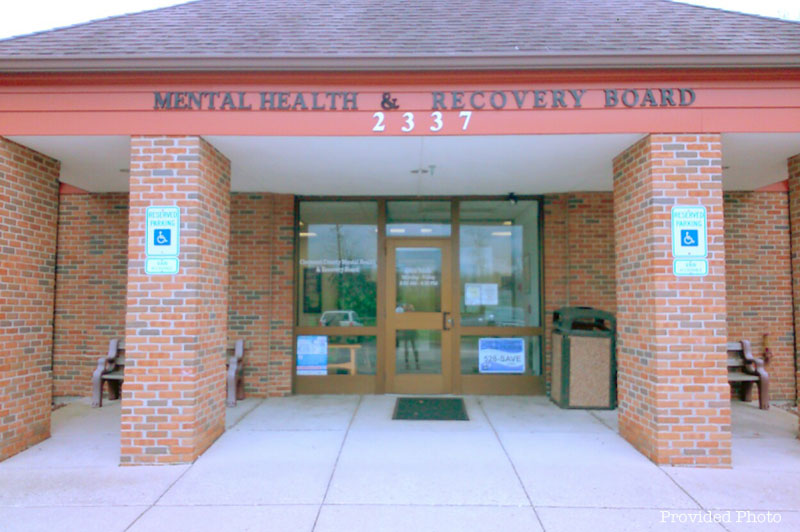
    Clermont County, Ohio – In a continuing effort to foster activities that promote positive mental health and prevent addiction, the Clermont County Mental Health and Recovery Board has announced that the opportunity for funding called “mini-grants” will again be available for the upcoming year.

    The Board is looking for innovative projects that will positively affect mental health and/or prevent addiction for any age group. A total up to $30,000, from the Board’s levy funds, is available for programs serving Clermont County residents.  The maximum funding per project is $4,000. The grant period is July 1, 2021 through June 30, 2022. Any organized group in Clermont County – with the exception of the contract agencies of the Mental Health and Recovery Board – can apply for funding. Previously funded applicants are eligible to reapply. Applicants must have a financial structure in place to account for the awarded funds. Funds may not be used to cover ongoing operating expenses.

    To apply for a mini-grant, please submit a brief proposal that includes the name, address, email address, and phone number of the contact person, a description of the activity/purpose for which the grant will be used, an explanation of how the activity will promote positive mental health and/or prevent addiction, a description of what part of the activity the mini-grant will fund if used with other monies, the date(s) of activity, and the amount of the funding request. Mini-grant funds cannot be used to purchase equipment such as iPads, iPods, tablets, or other electronic items. The funds can be used for materials, supplies, and/or food for activities planned.

    Proposals must be submitted no later than Monday, May 17, 2021, to: Mini-Grant Project, c/o Cindy Knoblauch, Clermont County Mental Health and Recovery Board, 2337 Clermont Center Drive, Batavia, OH 45103. Cindy Knoblauch: (513) 732-5400

    In 2019, the Clermont County Mental Health and Recovery Board funded a total of 17 mini-grants to 13 separate organizations. Ten schools in Clermont County received grants that assisted in initiating activities that helped children stay drug-free, established mentoring programs, or promoted mental health well-being. In addition, grants were awarded to other agencies providing services directed to community members, such as Safe Harbor of Hope and the YWCA.

    Any group receiving funding is required to submit a report to the Mental Health and Recovery Board on its efforts and resulting outcomes following completion of the activity. A final accounting of funds must be submitted within 60 days of the end of the activity. All unused funds must be returned to the Mental Health and Recovery Board.

    It is possible that mini-grants may not be available in the future or that a project funded once may not receive funds a second time, so mini-grants should be viewed as one-time-only funds.

    If you have any questions about applying for these grants, call the Clermont County Mental Health and Recovery Board at (513)732-5400.

  • Free rides to COVID-related appointments

    Free rides to COVID-related appointments

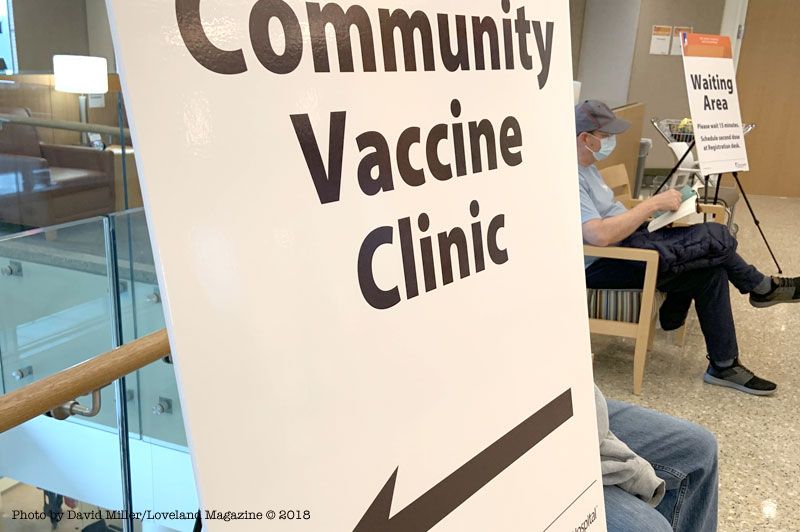
    Loveland, Ohio – Clermont Transportation Connection (CTC) is offering free rides to COVID-19 vaccination, testing and doctor’s appointments within Clermont County to people age 59 and younger. Rides are available 7 AM until 6 PM, Monday-Friday.

    Call 732-7433 (ext. 2) to schedule a ride. Give your name and phone number, home address, the clinic’s address, time of appointment and expected time to be picked up from the clinic.

    People 60 and older may call Clermont Senior Services at 513-536-4115 to schedule a ride.

    CTC received an Ohio Department of Transportation grant through its Rides to Community Immunity program offered throughout the state

  • Load rating is reduced for East Loveland Avenue Bridge

    Load rating is reduced for East Loveland Avenue Bridge

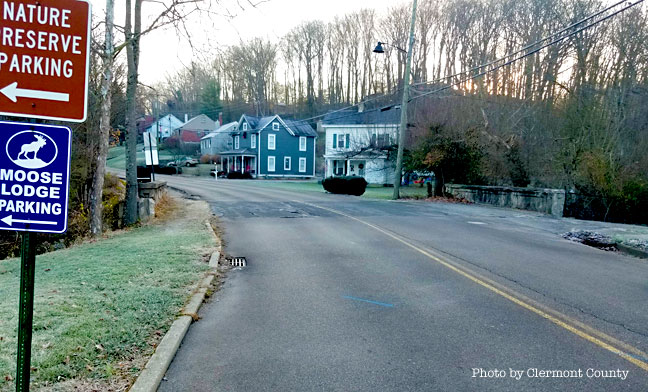
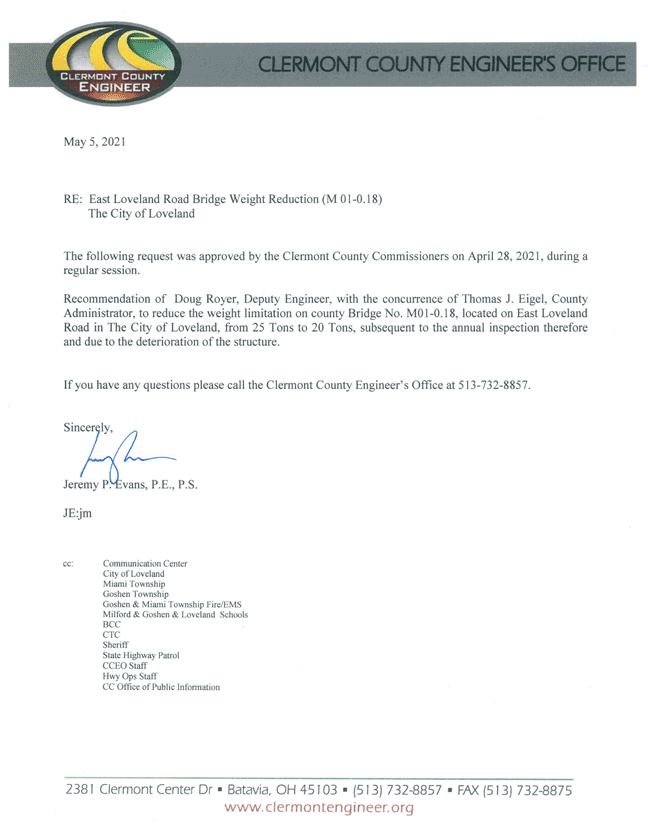
    Loveland, Ohio – After their annual inspection the Clermont County Engineer reported on May 6 that a new load rating has been added to East Loveland Avenue Bridge (No. M01-0.18) located in the City of Loveland. The weight limit has been reduced from 25 ton to 20 ton. The roadway is still open to through traffic at this time, however if the condition of the bridge worsens a full closure could occur according to the County. If that happens they will issue an update at that time.

    This bridge is slated to be replaced later this year.

  • Ohio’s COVID-19 vaccination slows ‘dramatically’

    Ohio’s COVID-19 vaccination slows ‘dramatically’

    Photo from the U.S. Department of Defense.

    By Jake Zuckerman and Ohio Capital Journal– May 4, 2021

    One month ago, nearly 475,000 Ohioans over seven days marched into small pharmacies and mass clinics alike around the state to get vaccinated against COVID-19.

    Each week since, the number of newly “vaccine-started” Ohioans has tumbled. Just 152,000 Ohioans were vaccinated during the week ending April 25, according to data from the Ohio Department of Health.

    As the vaccine rollout pace slows, only about 4.7 million of Ohio’s 11.7 million residents have begun the vaccination process.

    “We clearly have a lot more vaccine than we have demand,” Gov. Mike DeWine said to reporters Monday.

    The week ending April 25, the most recent with complete data, shows vaccine uptake at its lowest rate since mid-February, when a nasty winter storm swept the country and temporarily closed vaccination sites.

    https://datawrapper.dwcdn.net/1jYQd/2/

    Vaccines protect individuals against COVID-19 but, at a certain threshold, can protect those in a population who haven’t yet or cannot receive the vaccine. Experts have estimated this threshold, known as herd immunity, to be somewhere between 70% and 90%.

    While the first four months of the vaccine rollout were defined by scarcity, uptake rates began to plunge nationally in April.

    DeWine, noting the uptake has declined “dramatically,” said herd immunity is more of a gradient than a black-and-white concept. The formula, he said, is simple.

    “The more people that get vaccinated, the harder it is for this virus to spread,” he said. “The more people that get vaccinated, the fewer people that are going to die.”

    All told, more than 19,200 Ohioans have died from COVID-19, and nearly 57,000 have been hospitalized. The Ohio Department of Health reports more than 1 million residents have been infected, though the true count is likely much higher.

    Ohio is in the middle of the pack in terms of states and percentage of the population who have received at least one dose.

    On the low end: Mississippi (31%), Louisiana (32%), Alabama (33%), Wyoming (34%) and Idaho (34%) according to New York Times Vaccine Tracker data.

    On the upper end: New Hampshire (61%), Massachusetts (58%), Vermont (57%), Connecticut (56%) and Maine (55%).

    The U.S. Census Bureau has been surveying Americans’ attitudes about the COVID-19 vaccine. As of March 29, nearly 20% of Ohioans expressed hesitancy toward the vaccine, compared to about 15.6% nationally. The bureau is slated to release fresh data later this week that will give a sense of whether the trend is improving or worsening.

    Similarly, polling data from Kaiser Family Foundation estimates 13% of Americans will “definitely not” get the vaccine and another 7% only will if they’re required to. Other data from Gallup estimates that 26% of Americans are unwilling to take the vaccine, down from about 35% when they were authorized for use in December.

  • Man dead after raising gun to 2 Hamilton Township police officers

    Man dead after raising gun to 2 Hamilton Township police officers

    Hamilton Township Press Conference

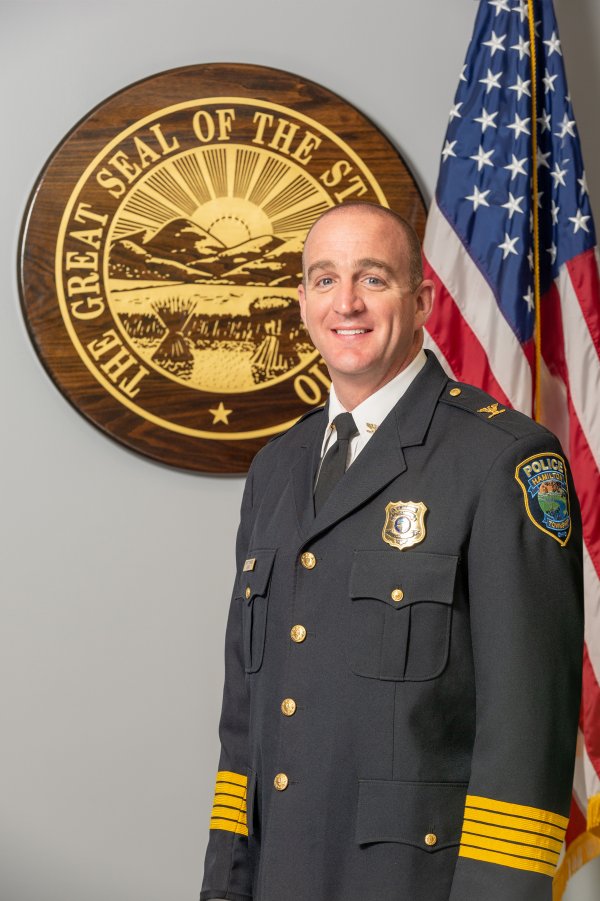
    Hamilton Township, Ohio – Sunday night after 57-year-old Anthony Williams had discharged shots inside his home, Hamilton Township police officers were dispatched to the 1200 block of Adams Road for a report of a male armed with a weapon threatening to harm himself.

    Hamilton Township Police Chief Scott Hughes (Provided Photo)

    When Sgt. Chris Wall and Ofc. Josh Clift arrived at the home, they requested assistance from the Warren County Tactical Response Unit (SWAT). Hamilton Township Police Chief Scott Hughes says a preliminary investigation indicates that while his officers were securing the perimeter, and awaiting the arrival of the SWAT Team, the individual emerged from the residence pointing a firearm at the direction of his officers.

    Hughes said that the man’s action caused his officers to “defend themselves and use lethal force.”

    Ohio Bureau of Criminal Investigation is in charge of the investigation, along with Warren County Prosecutor David Fornshell.

    According to Hughs, both officers have been placed on standard administrative leave.

  • Walmart and Sam’s Club Now Administering Walk-Up COVID-19 Vaccines at 171 Pharmacies Across Ohio

    Walmart and Sam’s Club Now Administering Walk-Up COVID-19 Vaccines at 171 Pharmacies Across Ohio

    Retailer offering customers and associates access to COVID-19 vaccines

    Walmart and Sam’s Club today announced a new COVID-19 vaccine milestone: Immunizations are now available to customers and associates in all of their more than 5,100 pharmacy locations nationwide, across 49 states, Puerto Rico and Washington, D.C. This includes the 171 Walmart and Sam’s Club pharmacies in Ohio.

    Vaccines are being administered via both walk-up and scheduled appointments, providing convenient options for customers and members to get protected against COVID-19 where they already shop for groceries and health care essentials. Additionally, the company is rolling out new programs to both encourage people to get a vaccine and continue efforts to increase access across the country.

    “Now that supply and eligibility have expanded, it’s even more important for us to reach underserved and vulnerable populations to ensure equitable distribution of the COVID-19 vaccine,” said Dr. Cheryl Pegus, executive vice president, Health & Wellness. “Widespread vaccination is the only way we will eventually end the pandemic and help our country reopen, and we don’t want anyone to get left behind as we enter this new chapter in our fight against COVID-19.”

    Providing Education on Vaccine Effectiveness: Get Out The Vaccine campaign (GOTV)

    The company launched a nationwide Get Out The Vaccine (GOTV) campaign to encourage more people to get vaccinated. The GOTV campaign, an extension of the retailer’s role in the Federal Retail Pharmacy Program and the existing vaccination program, provides education materials in their stores and clubs about the effectiveness and safety of COVID-19 vaccine

    As part of the GOTV effort, Walmart is utilizing mobile clinics to bring vaccines directly into select communities via events and gatherings. Most recently, Walmart partnered with the National Hot Rod Association at their Southern Nationals Event in Commerce, Georgia, to offer walk-up vaccinations for race fans, educational resources with background on the safety and efficacy of the vaccines and an official Walmart branded dragster with information on how to schedule a vaccine.

    Reaching Into Communities

    Walmart and Sam’s Club continue emphasizing vaccine access in locations that reach customers in vulnerable communities. With the expansion of vaccine supply nationwide, there are now nearly 4,000 Walmart and Sam’s Club locations administering the vaccine in locations designated as Medically Underserved Areas by the Health Resources and Services Location (HRSA).

    To encourage vaccination in these communities, Walmart and Sam’s Club will continue partnering with national and local non-profits, community partners and faith-based organizations on community vaccine events.

    Walk-Ins Welcome

    All Walmart and Sam’s Club pharmacy locations across Ohio are now accepting walk-in vaccine appointments, as supply allows, in addition to scheduled appointments. Customers who schedule an appointment can complete pre-vaccination paperwork ahead of time, if interested.

    Appointments can be made at walmart.com/COVIDvaccine and samsclub.com/covid. Walmart Pharmacies are open seven days a week (Sam’s Club pharmacies are closed on Sunday), and are administering the approved J&J, Pfizer and Moderna vaccines. Individuals are not required to be a member to receive the COVID-19 vaccine at Sam’s Club.

    Encouraging Associates to Get Vaccinated

    Walmart and Sam’s Club said they continue to “strongly” encourage, but not mandate, associates to get vaccinated. To help make this process as easy as possible, the retailers are:

    • offering appointments to associates in stores and clubs,
    • providing two hours paid time to get a vaccination, regardless of where associates get their shots,
    • and allowing associates to get the vaccine during their shifts if vaccines are being offered at their location.

    Both Walmart and Sam’s Club have also enhanced their COVID-19 emergency leave policy to include three days of paid leave for any vaccine side effects for associates.

  • Explainer: The proposals to keep Ohio’s redistricting process on track

    Explainer: The proposals to keep Ohio’s redistricting process on track

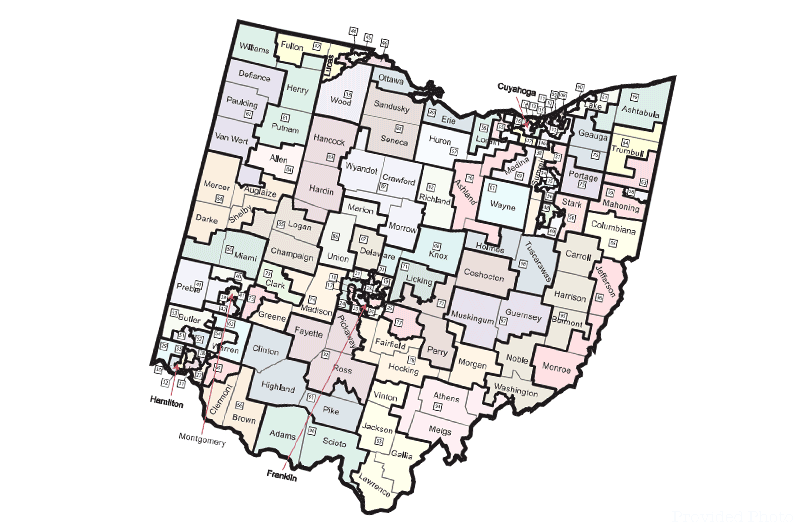
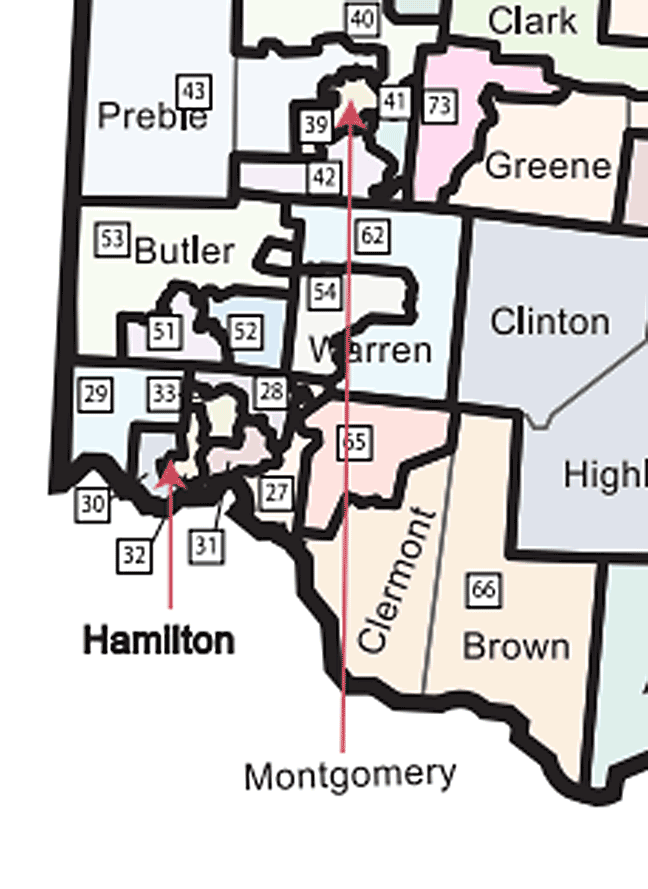
    The current district map for the Ohio House of Representatives. Map courtesy the Ohio Secretary of State.

    (See a complete list of Maps below this article)

    By Tyler Buchanan and Ohio Capital Journal

    Ohio’s redistricting process is in a state of turmoil, with a delay in Census data leading the state to worry about there not being enough time to adequately draw new legislative maps.

    Republicans and Democrats have both presented plans for how Ohio can deal with these delays. In essence, legislative leaders from both parties want to push back the deadline for completing the new maps that will be in place starting in the 2022 elections.

    But the sides propose two very different ways to achieve that goal.

    The next few days will be critical as Ohio lawmakers determine the preferred way of moving forward. The results from this week could have lasting implications for Ohio’s legislative government over the coming decade.

    The current district map for the Ohio House of Representatives.

    Not how Ohio voters drew it up

    Each decade, Ohio redraws its federal legislative seats in the U.S. House of Representatives and state legislative seats in both the Ohio Senate and Ohio House of Representatives. 

    This is done to reflect changes in population and coincides with the U.S. Census, which is also conducted every 10 years.

    After the last redistricting effort a decade ago, Ohio voters chose to reform the process for this year and the decades to follow. In short, voters approved a new system which puts a greater emphasis on transparency and bipartisanship. 

    These new plans — for federal and state maps —  were approved via constitutional amendments on the 2018 and 2015 ballots, respectively. 

    These plans set specific deadlines to meet during the redistricting process.

    Ohio voters could not have anticipated a global pandemic would occur at the same time the U.S. Census Bureau conducted its decennial count of American residents. The pandemic not only made the count more difficult, but has led to delays in processing and distributing census data used by officials to draw new legislative districts.

    The Census Bureau announced this redistricting data will be provided to states by Sept. 30.

    That’s a major problem — Ohio would therefore miss its redistricting deadlines:

    This flow chart shows the new process for redrawing Statehouse districts. Circled is the deadline in question due to the delay in U.S. Census data.
    This flow chart shows the new process for redrawing congressional districts in Ohio. Circled is the deadline in question due to the U.S. Census data delay.

    Plan A involved a federal lawsuit from Attorney General Dave Yost seeking to get the redistricting data released earlier. The case was quickly dismissed. Now the two parties are offering some ideas for Plan B.

    Back to the drawing board

    If the government won’t release data early enough to match Ohio’s deadlines, officials here propose shifting the deadlines back to account for the late data.

    This is not an easy fix. The 2021 deadlines were approved by voters and are thus embedded in the Ohio Constitution.

    Senate President Matt Huffman, R-Lima, suggests the state get approval from voters to move back the deadlines as part of a one-time fix for this unique circumstance.

    State Sen. Matt Huffman, R-Lima. Screenshot courtesy the Ohio Channel.

    The next opportunity to get a constitutional amendment before Ohio voters would be the Aug. 3 special election.

    Both chambers of the Ohio General Assembly (House and Senate) would have to pass a joint resolution to place the constitutional amendment on the August ballot. A three-fifths majority is required in each chamber for passage.

    The deadline for filing this joint resolution with the Ohio Secretary of State’s Office is 90 days before the August election — that’s this Wednesday, May 5. 

    It’s possible, but the Republican leadership would need to work quickly. As of Monday morning a joint resolution has not yet been formally introduced. 

    An amendment requires a majority statewide vote to pass.

    House Democratic Minority Leader Emilia Strong Sykes. Source: Ohio General Assembly.

    Democratic leaders in the General Assembly say there are better options for handling the census delays than a hurried constitutional amendment attempt.

    House Minority Leader Emilia Strong Sykes, D-Akron, and Senate Minority Leader Kenny Yuko, D-Richmond Heights, outlined their party’s own take on Friday for how to move forward.

    “Constitutional amendments should be our final options,” Sykes argued, “not our first.”

    The Democrats believe the best option is to ask the Ohio Supreme Court for an extension of the deadlines as other states, including Michigan, have done. 

    Senate Minority Leader Kenny Yuko is pictured at the Ohio Statehouse in 2018. Source: The Ohio General Assembly.

    “I think (the Supreme Court) could understand that the people have spoken loud and clear, twice already, asking us to put an end to gerrymandering,” Yuko said. “What we’re proposing will do just that.”

    While both plans call for extending the redistricting deadlines, neither party is suggesting to push back the 2022 primary election day to keep the full timeline intact.

    All On The Line Ohio, a left-leaning organization which advocates for a fair mapmaking process, is calling for the primary election to get pushed back by a few weeks.

    Sykes and Yuko said the Democrats would be introducing a plan to ensure the public has an adequate chance to provide input during what could be a truncated redistricting timeline.

    DISTRICT MAPS

    Every 10 years, following the decennial census, Ohio General Assembly and Congressional districts are redrawn to reflect changes in the state’s population in two parallel, but separate processes. The goal of each is to preserve the important one person-one vote principle – that all citizens are equally represented at the Statehouse and in the United States Capitol.

    These maps were drawn based on data from the 2010 U.S. Census and are in effect from 2012-2022.

    The PDF files below contain visual representations of Ohio legislative, judicial and education districts. For more information about what districts you reside in, click here to visit Check My Voter Registration(opens in a new window).

    STATE GENERAL ASSEMBLY DISTRICTS

    FEDERAL CONGRESSIONAL DISTRICTS

    *Equivalency Files are compressed DBF files that can be opened in Excel. 

    EDUCATIONAL & JUDICIAL DISTRICTS

     DISTRICT MAPS BY COUNTY

    The Secretary of State’s office provides by-county breakdown maps of Ohio Legislative Districts. Click here to request a ZIP file of these maps(opens in a new window). For up-to-date county district information, contact your county Board of Elections.

    HISTORICAL DISTRICT MAPS

    The Secretary of State’s office provides, for reference purposes, historical district maps dating back to 1972. Click here to request a ZIP file of these maps(opens in a new window). The file will be e-mailed to you. For up-to-date county district information, contact your county Board of Elections.

  • Tonight’s Loveland High School Band Concert moves indoors

    Tonight’s Loveland High School Band Concert moves indoors

    Loveland, Ohio – Tonight’s scheduled Band concert will be in the high school auditorium instead of downtown Loveland, due to the weather.

    Only parents of the students will be permitted to attend tonight in the LHS gym.

  • Ohio loses a congressional seat, will have 15 for next decade

    Ohio loses a congressional seat, will have 15 for next decade

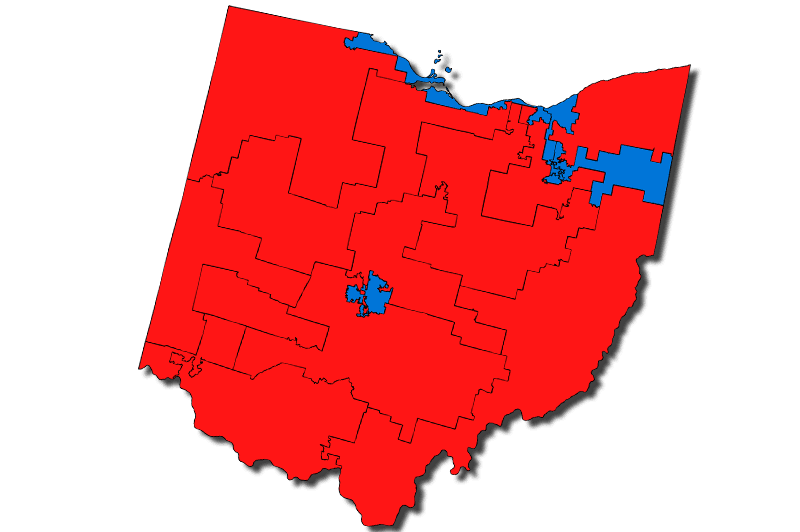
    Pictured is Ohio’s congressional delegation as it has looked after the 2012, ’14, ’16, ’18 and ’20 elections. The map will soon be redrawn.

    By Tyler Buchanan and Ohio Capital Journal

    Ohio’s sway in Congress ain’t what it used to be.

    The Buckeye State will lose one congressional seat when the map is redrawn ahead of the 2022 elections, the U.S. Census Bureau announced Monday. Ohio will go from 16 seats to 15.

    The U.S. House of Representatives has 435 total seats that are divided up among the 50 states based on population. Maps are redrawn and seats are reapportioned every 10 years to reflect the latest census data.

    Ohio’s population grew slightly between the 2010 census and the one conducted in 2020, but is still losing a seat because other states’ populations grew at much larger levels.

    A few years ago, Ohioans voted to reform the mapmaking system with an eye on transparency: 

    Delays in the release of detailed census data may cause some issues with this timeline. Some of the data used toward mapping out new districts is not scheduled to come until the fall, right around when Ohio is supposed to have its proposed maps drafted and voted upon. State legislative leaders are reportedly working on a suggested solution.

    Ohio once had as many as 24 seats in the U.S. House of Representatives, but has slowly lost seats since the 1970s. The 15 seats that will be up for election in 2022, 2024, 2026, 2028 and 2030 cycles are the fewest Ohio has had since the 1830s.