Author: Loveland Magazine

  • State COVID-19 Update: Nursing Home Visitation, Statewide Case Rate, Rapid Testing, County Fairs

    State COVID-19 Update: Nursing Home Visitation, Statewide Case Rate, Rapid Testing, County Fairs

    Ohio Governor Mike DeWine and Lt. Governor Jon Husted today provided the following updates on Ohio’s response to the COVID-19 pandemic. 

    NURSING HOME VISITATION

    Governor DeWine today discussed the new federal regulations for nursing home visitation, as well as Ohio’s Vaccine Maintenance Program. The visitation guidelines, issued by the Centers for Medicare and Medicaid Services (CMS) indicate visitation should be happening in nursing homes. There are a few specific exceptions that would limit visitation, such as outbreaks in the facility or an extreme number of cases in the community.  Full information on the federal nursing home visitation guidance is available at cms.gov. 

    Additionally, Governor DeWine highlighted the progress being made by Ohio’s Vaccine Maintenance Program for nursing homes and assisted living facilities. Ohio’s Vaccine Maintenance Program ensures new nursing home residents and employees, and established residents and employees who previously decided not to receive a vaccine, can still choose to receive one. Governor DeWine emphasized the importance of every nursing home resident receiving a vaccine. 

    Long-term care facility visitation status is available on the dashboard at coronavirus.ohio.gov.

    STATEWIDE CASE RATE

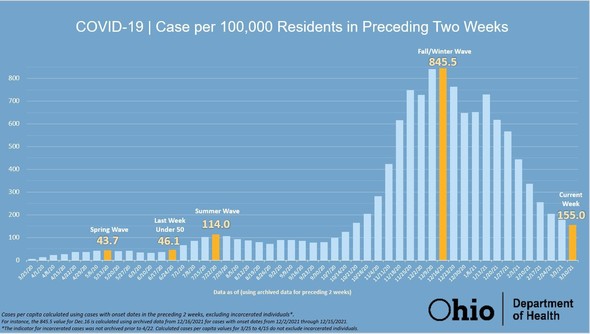
    Governor DeWine announced that, statewide, Ohio is currently at a rate of 155 cases of COVID-19 per 100,000 people during the past two weeks. Last week, statewide data put Ohio at 180 cases per 100,000 people. 

    “In Ohio, we are still at a very elevated level of cases, but today’s health data is certainly trending in the right direction,” said Governor DeWine. 

    In an evening address last week, Governor DeWine announced that when Ohio reached 50 cases per 100,000 people for two weeks, all health orders will be lifted. 

    The Ohio Department of Health will update this data each Thursday.
    March 11

    RAPID TESTING 

    Governor DeWine today detailed four initiatives that are making rapid COVID-19 tests more accessible to Ohioans:

    • Federal Qualified Health Centers
      • The state’s ongoing partnership with federally qualified health centers has led to the availability of over 150,000 rapid tests at community health centers. These centers have professionals on-hand to administer the tests free of charge.
    • Local Health Departments
      • Local health departments have partnered with their communities to make at-home testing available to schools, nonprofit organizations, and first responders.
    • Public Libraries
      • The state has recently partnered with public libraries to make at-home tests available to more Ohio communities. During the first two weeks, Ohio has partnering with 120 libraries.
    • K-12 Schools
      • A new partnership launched today will bring 200,000 at-home tests to Educational Service Centers. To increase confidence and safety in schools, Governor DeWine encourages school districts to take advantage of this resource and develop aggressive testing plans.

    Between libraries and local health departments, at-home testing is accessible in 76 of Ohio’s 88 counties. Some of these areas had disproportionate access to testing earlier in the COVID-19 pandemic.

    GUIDANCE ON FAIRS

    Governor DeWine announced that the Ohio Department of Health issued a revised order that allows for the reopening of all fair activities if certain health conditions are met. The updated order includes compliance with the statewide mask order and social distancing. Additionally, there will be a 25 percent maximum for indoor grandstand capacity and a 30 percent maximum for outdoor grandstand capacity. 

    Additionally, the Ohio Department of Health will issue updated order and guidance regarding festivals, parades, proms, and spring sports. For spring sports, students will not be required to quarantine because they have an incidental exposure to COVID-19 in a classroom unless symptoms develop. 

    These orders and guidance will be forthcoming from the Ohio Department of Health.

    LETTER ADDRESSING PUA FRAUD

    Governor DeWine and Lt. Governor today sent a letter to President Joe Biden urging the development of a national, coordinated response to ongoing, widespread fraud attempts being committed through the unemployment system, specifically the federal Pandemic Unemployment Assistance (PUA) Program.

    See below for an excerpt from the letter:

    “We urge you to immediately develop a national, coordinated response to this ongoing attempt to defraud the American people and our national and state governments. While states are doing everything they can to administer the federal programs while maintaining system integrity, a state-by-stare response is proving inadequate. This is not an Ohio problem — it’s a national problem that requires a national solution.”

    CURRENT CASE DATA

    In total, there are 984,934 confirmed and probable cases of COVID-19 reported in Ohio and 17,825 COVID-19 deaths. A total of 51,323 people have been hospitalized throughout the pandemic, including 7,255 admissions to intensive care units. In-depth data can be accessed by visiting coronavirus.ohio.gov. 

    Video of today’s full update, including versions with foreign language translation, can be viewed on the Ohio Channel’s YouTube page. 

    For more information on Ohio’s response to COVID-19, visit coronavirus.ohio.gov or call 1-833-4-ASK-ODH.
  • New COVID-19 vaccination site opens at UC Clermont College

    New COVID-19 vaccination site opens at UC Clermont College

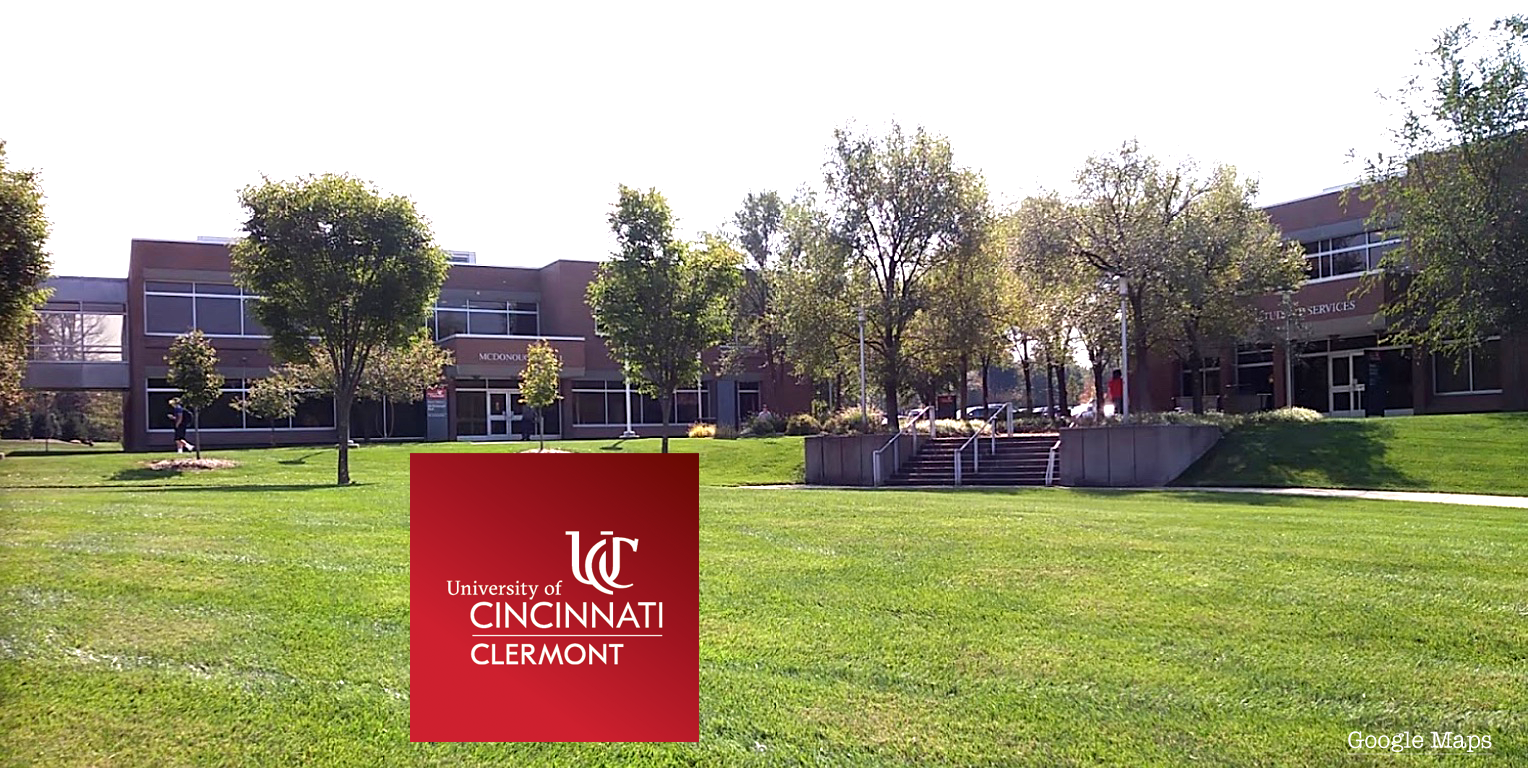
    Loveland, Ohio – Clermont County Public Health and the University of Cincinnati Clermont College are partnering to open a new COVID-19 vaccination site at the Student Activities Center on the college’s Batavia campus.

    The vaccination site will open on Saturday, March 13. Appointments must be scheduled. Walk-ins will not be accepted.

    The new site will more than double the number of people who can be vaccinated in one day by the health department. Public Health has been vaccinating up to 300 people per day to date; the new site will accommodate 600 or more people per day.

    Clermont County Health Commissioner Julianne Nesbit

    The quantity of the vaccine that Public Health receives weekly has increased from about 200 doses during the first week of February to more than 1,200 doses during the first week of March.

    “We’re looking forward to working with UC Clermont to get more of our residents vaccinated,” said Health Commissioner Julianne Nesbit. “Throughout this pandemic, we have relied on many of our community partners along the way, and this latest partnership will benefit the entire county. We’re grateful that UC has stepped up to provide the much-needed space.”

    “We are excited to partner with Clermont County Public Health to provide the space for this critical service to the community,” said UC Clermont Dean Jeff Bauer. “The vaccination effort is crucial to guiding us out of the pandemic, and we are proud to be able to help.”

    How to register

    To register for an appointment, residents can use the new online scheduling site, which can be found at https://ccphohio.org/covid-19-vaccine-info/. Anyone without internet access can call 513-735-8500 for assistance with scheduling an appointment.

    Currently, any Ohio resident aged 50 or older is eligible to be vaccinated. Other groups that are eligible include people with certain congenital medical conditions, law enforcement officers, childcare workers and funeral services employees. The full list of eligible people can be found online at www.coronavirus.ohio.gov/vaccine.

  • DeWine Announces mass vaccination Pop-Up Site at Xavier University’s Cintas Center

    DeWine Announces mass vaccination Pop-Up Site at Xavier University’s Cintas Center

    Loveland, Ohio – Ohio Governor Mike DeWine announced today that Ohio’s state-sponsored Cincinnati pop-up mass vaccination site will open next week.

    The vaccination clinic will offer the Pfizer vaccine to those eligible to be vaccinated under the Ohio Department of Health’s vaccination plan.

    Individuals who receive their first dose of vaccine at a pop-up site will be guaranteed their second dose at the same site approximately three weeks later. Details on how to register for an appointment will be available in the coming days.

    The 50,000 total vaccine doses (including Columbus) that will be available as part of these pop-up mass vaccination clinics are being reallocated from Ohio’s unused long-term care vaccine supply that was initially required by the federal government to be set aside for use in Ohio’s more than 2,400 long-term care facilities as part of the federal long-term care program. Ohio has already administered nearly 160,000 reallocated doses from the program.

    Cintas Center
    1624 Herald Avenue


    First dose clinic dates: March 18, 19, 20 – 8:30 AM to 4:30 PM.

    Second dose clinic date: April 8, 9, 10 – 8:30 AM to 4:30 PM.

    This state-sponsored, pop-up mass vaccination site will be operated by Kroger in cooperation with Cincinnati Public Health, Hamilton County Public Health, and the Health Collaborative. The clinic will offer approximately 10,000 first doses and 10,000 second doses of the Pfizer vaccine. 

    Also, approximately 2,500 first doses and 2,500 second doses will be administered in Kroger stores located in high-risk Cincinnati-area communities that could be disproportionately impacted by the virus.

    The Kroger clinic locations will be announced. 


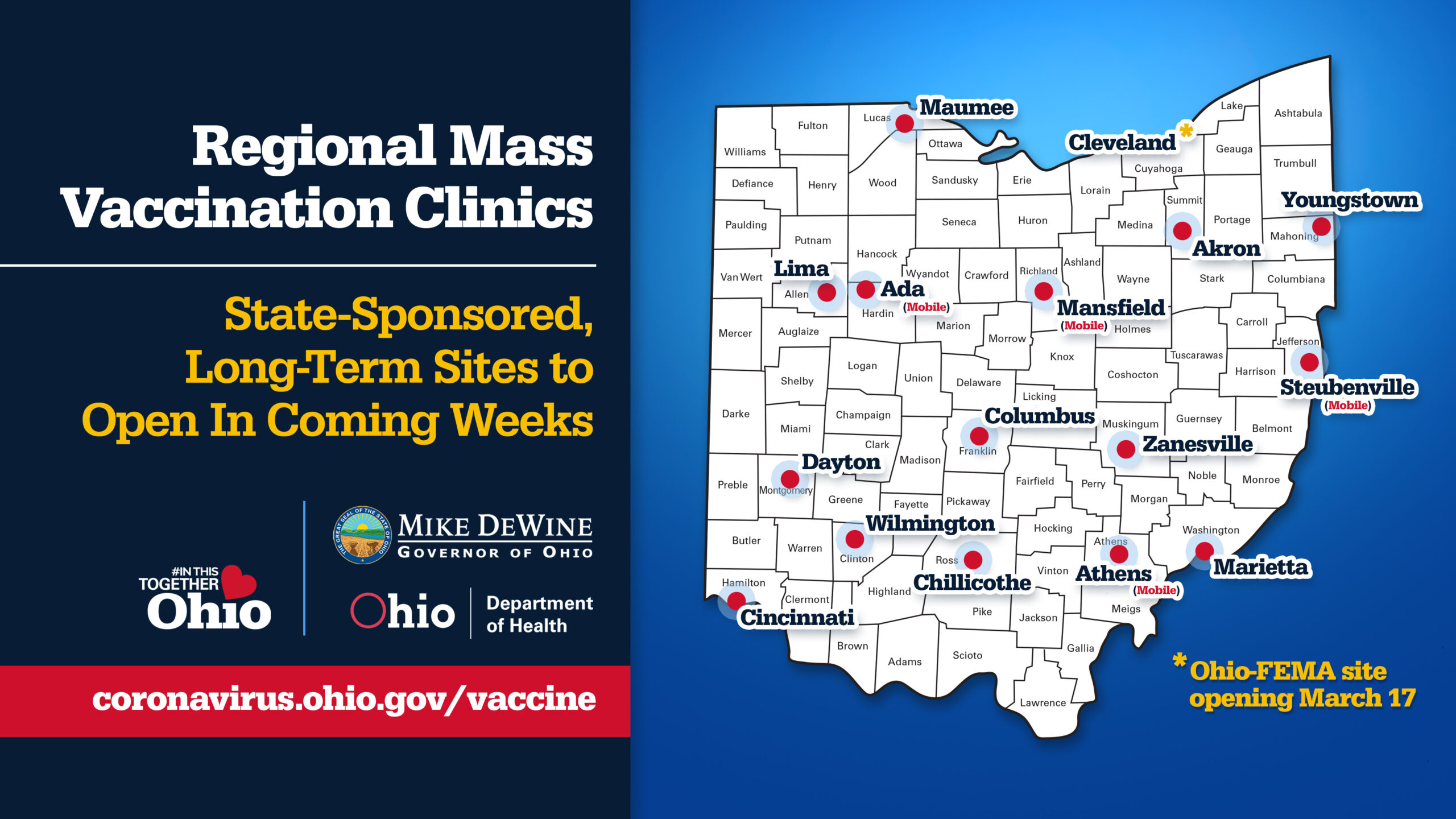
    The Columbus and Cincinnati pop-up mass vaccination clinics being held next week are in addition to 15 permanent state-sponsored mass vaccination clinics and one state-federal mass vaccination clinic announced last week.

    To learn more about the Cleveland mass vaccination site visit governor.ohio.gov.

    For details on the 15 permanent mass vaccination sites located regionally across the state, visit coronavirus.ohio.gov. 

  • COVID-19 Update: Vaccination Phase 1D and Phase 2B, Centralized Vaccination Scheduling Tool

    COVID-19 Update: Vaccination Phase 1D and Phase 2B, Centralized Vaccination Scheduling Tool

    gettheshot.coronavirus.ohio.gov

    Loveland, Ohio – Ohio Governor Mike DeWine and Lt. Governor Jon Husted have provided the following updates on Ohio’s response to the COVID-19 pandemic. 

    PHASE 1D AND PHASE 2B VACCINATION ELIGIBILITY 

    In response to a significant increase in the amount of vaccines coming into Ohio, Governor DeWine outlined the individuals who are included in Phase 1D and Phase 2B of Ohio’s vaccination plan, which will go into effect on Thursday, March 11. 

    Phase 1D includes approximately 197,000 eligible Ohioans with certain medical conditions not addressed in previous phases, including type 2 diabetes and end-stage renal disease. 

    Phase 1D

    Phase 2B will open vaccinations based on age for Ohioans ages 50 and older. This group includes approximately 1.2 million eligible Ohioans.  

    Phase 2B

    VACCINATION SCHEDULING TOOL

    DeWine also announced that Ohio’s centralized scheduling website is now available at gettheshot.coronavirus.ohio.gov. The website will serve as a singular location for Ohioans to confirm that they are eligible to be vaccinated, identify nearby providers, and schedule their vaccine appointments according to the Statehouse. 

    “As we continue to receive more vaccines, having a centralized scheduling website will streamline the process, reduce data lags, and provide real-time information on vaccination progress across the state,” said Governor DeWine. 

    The Ohio Department of Health will continue to work directly with vaccine providers to integrate their current systems into the statewide system. Providers will be expected to use this system or another electronic scheduling system that interfaces with this portal.

    The centralized scheduling website will also be used for scheduling appointments at the mass vaccination clinics, including the FEMA site in Cleveland, and at the Cintas Center at Xavier University that was announced. 

    Outside partners, including the Area Agencies on Aging, will be available to help Ohioans who do not have access to the internet with appointment scheduling.  

    UMEPLOYMENT UPDATE

    Governor DeWine announced the Ohio Department of Job and Family Services (ODJFS) has signed a contract with IBM to improve the unemployment call center. ODJFS has additionally signed a contract with LexisNexis to assist the department with on-going efforts to keep fraud out of the system. 

    Jeff Ficke, leader of the ODJFS Public-Private Partnership Team (P-3 Team), joined Governor DeWine to provide an update on improvements being made to Ohio’s unemployment system. Members of the ODJFS Public-Private Partnership Team include highly-skilled experts, most of whom are on loan from some of Ohio’s top banking and insurance companies.  

    For more information on Ohio’s response to COVID-19, visit coronavirus.ohio.gov or call 1-833-4-ASK-ODH.
  • [Corrected Date] Miami Township’s “Shred Day”

    [Corrected Date] Miami Township’s “Shred Day”

    Miami Township, Ohio – Miami Township will be holding a ‘Shred Day’ for residents on Saturday, APR 28 (7:30 AM until -5 PM) at the Safety Services Training Center. Bring your documents to be securely shredded and destroyed.

    Residents are encouraged to enter the campus off Meijer Drive and exit onto McPicken Drive.

  • Governor Appoints Michael Denlinger, of Hamilton County Chairperson to Ohio Developmental Disabilities Council

    Governor Appoints Michael Denlinger, of Hamilton County Chairperson to Ohio Developmental Disabilities Council

    Hamilton County, Ohio – Michael Denlinger, of Hamilton County, has been named Chairperson of the Ohio Developmental Disabilities Council by Governor Mike DeWine. During his tenure, Denlinger has served on nearly all the Council’s committees including Community Living, Employment, Leadership Development, among others.  

    Denlinger, who has cerebral palsy, says he has always been a lifelong advocate for people with disabilities.  His focus is often on the areas of housing and transportation for people with disabilities. In addition, he has begun to work on an LGBTQ initiative. “I want the voices of those LGBTQ with disabilities to be equally represented, so all have a seat at the table,” Denlinger says. 

    He also serves as the host of Ohio DD Council’s popular podcast “Ohio DD Talks”, a web series featuring stories and conversations of Ohioans with disabilities. In addition to his Council work, Denlinger is a member of the Housing Network of Hamilton County’s Board on Developmental Disabilities.

    As Denlinger looks ahead to being chair of the Council, he says, “One thing I really want to do is to look at the counties in eastern and northeastern Ohio where people either don’t apply to be on the Council or don’t know about it. I’d like to see the Council create an outreach plan to invite people from all over the state to talk to us about advocacy work they’ve done in those underserved populations.”

    Denlinger adds,” We are doing wonderful, revolutionary things [on the Council]. Our diversity and inclusion work with various ethnicities and with LGBTQ is making sure everyone is represented and heard. Being a Council member is a reward to me, allowing me to help others.”

  • Inside Ohio Republicans’ 10-month war on the state health department over COVID-19

    Inside Ohio Republicans’ 10-month war on the state health department over COVID-19

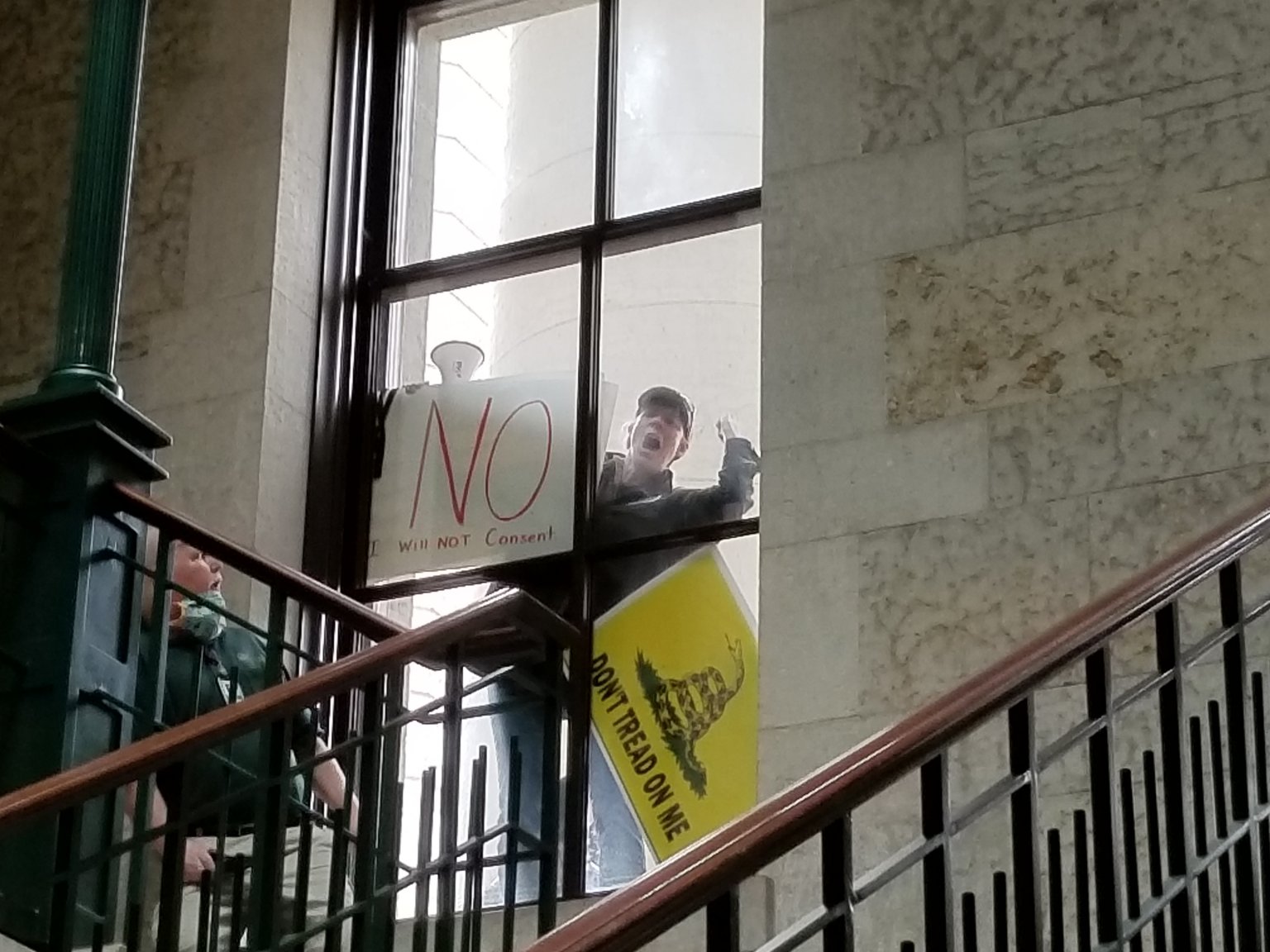
    A man protesting Ohio’s health orders at the state Capitol on May 1. Gov. Mike DeWine later repealed most of them only to start reimposing orders on Tuesday as coronavirus cases continued to surge. Capital Journal photo by Marty Schladen

    By Jake Zuckerman and Ohio Capital Journal

    Ohioans were living with the coronavirus for about two months before GOP lawmakers initiated what would be a nearly yearlong effort to squash the state health department’s ability to issue public health orders.

    The earliest version of the idea was to limit any order issued by the Ohio Department of Health to a two-week window. After that, a small panel of lawmakers would need to approve the order for it to stay in effect any further.

    “We are clearly on the downside of the curve, there is no longer a risk of overwhelming the health care system,” said now-former Rep. John Becker to the House State and Local Government Committee, setting one of the first legislative attacks on the health department in motion via Senate Bill 1.

    “I’m not sure there ever was, but that argument did make sense to me initially.”

    Ten months, three gubernatorial vetoes, and more than 520,000 Americans dead from COVID-19 later, little has changed. The Senate passed a similar version of the idea last month on a party-line vote.

    A review of emails obtained by public records requests, committee hearings, interviews and contemporaneous media reports highlight just how absent public health was from efforts to wrest power from the health department during a pandemic.

    In several instances, abortion politics, coronavirus infections among lawmakers, and overly rosy assessments of the pandemic from Republican leaders played a larger role in the legislation than the coronavirus itself.

    SB 1 died an unusual death last May when every state Senator — even the bill’s sponsors — voted it down. Its supporters gave varying explanations from the Senate floor. They said it didn’t have an emergency clause, meaning it wouldn’t take effect for 90 days; and it was clumsily drafted.

    Then-Senate President Senate President Larry Obhof, one of the most powerful Republicans in the state, later told constituents that Senators killed the bill, in part, because it could have expanded women’s access to abortion.

    “A prominent Right to Life organization pointed out that the language, as written, could allow lawsuits challenging health orders that regulate or close abortion clinics,” he said in an email obtained in a public records request.

    “Thus, the language could have been used to protect abortion clinics.”

    The concern came from a letter the Greater Columbus Right to Life sent to lawmakers. Ohio Right to Life, which operates independently of the Columbus organization, disagreed, according to its director, Michael Gonidakis. However, he tried to stay out of it.

    “We had no desire to be involved in that debate,” he said in a recent interview.

    Sen. Tim Schaffer, R-Lancaster, later wrote on Facebook that the bill would have limited the state’s ability to “shut down illegal abortion clinics.” Then-Speaker of the House Larry Householder, R-Glenford, prior to being indicted in an alleged racketeering scheme, commented on the post. He told the senator to “grow a pair” and called his rationale “bullshit.”

  • Do you know what the Harlem Renaissance was?

    Do you know what the Harlem Renaissance was?

    by Barbara Kyles

    Do you know?

    The Harlem Renaissance was an intellectual and cultural revival of African American music, dance, art, fashion, literature, theater and politics centered in Harlem, Manhattan, New York City, spanning the 1920s and 1930s.

    Take a look at this story from Historical African American Images and welcome to Black history…

    https://www.facebook.com/adoshistory/posts/119025793465904
  • Participate in the process of selecting a new Superintendent

    Participate in the process of selecting a new Superintendent

    Loveland, Ohio – Four simple and straightforward questions is all you are being asked at this first step. Just check the boxes to provide “important” feedback.

    A press release from the Loveland City School District:

    To: All Loveland Schools Stakeholders:

    Welcome to Loveland City Schools’ search for our next Superintendent. We want you to participate in the process and provide important feedback. 

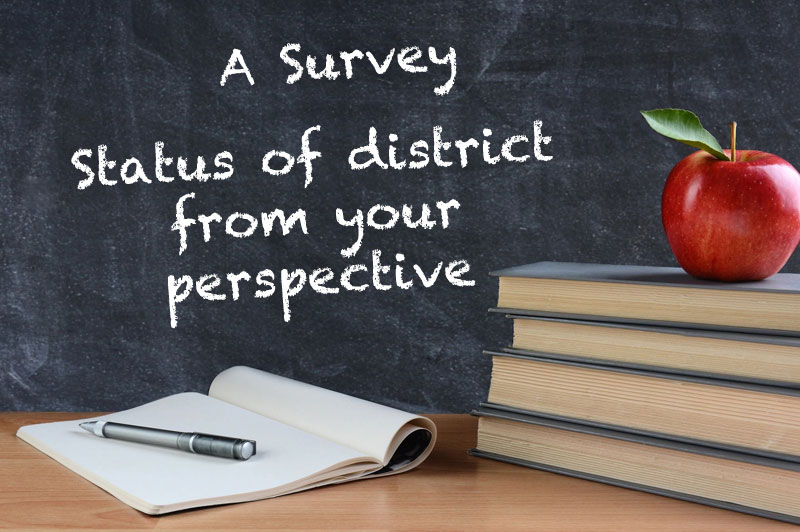
    This first survey is designed to give us a clear sense of the status of our district from your perspective. It won’t ask about the skills and attributes we should be seeking in our next superintendent. That survey will be coming later.

    Please click on the URL below to complete this district status survey.  We genuinely want to hear from you on this survey and future opportunities as well.

  • Spring ahead Dawling

    Spring ahead Dawling

    Loveland, Ohio – Here are some useful dates for Loveland area residents:

    Daylight Saving Time 2021

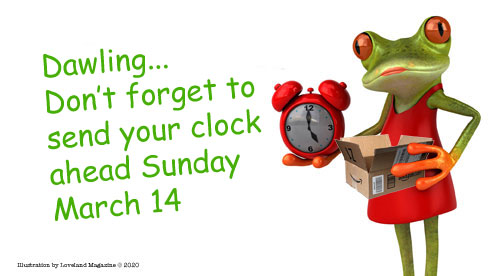
    • begins Sunday, March 14
    • set your clocks AHEAD 1 hour to Spring Ahead

    When local standard time is about to reach Sunday, March 14, 2 AM clocks are turned forward 1 hour to 3 AM local daylight time instead.

    Sunrise and sunset will be about 1 hour later on Mar 14, 2021 than the day before. There will be more light in the evening.

    Spring 2021

    • begins Saturday, March 20 (in 13 days)

    From the Old Farmer’s Almanac

    THE MARCH EQUINOX

    In the Northern Hemisphere, the March equinox (aka spring equinox or vernal equinox) occurs when the Sun crosses the equator line, heading north in the sky. This event marks the start of spring in the northern half of the globe. After this date, the Northern Hemisphere begins to be tilted more toward the Sun, resulting in increasing daylight hours and warming temperatures. (In the Southern Hemisphere, it’s the opposite: the March equinox marks the start of autumn, as the Southern Hemisphere begins to be tilted away from the Sun.)

    Spring Break for Loveland Schools

    Begins Monday, March 29 through Friday, April 2

    Last Day of school before break is March 26

    First day of school after break is April 5