Author: Loveland Magazine

  • IRS extends Federal filing for individuals until May 17

    IRS extends Federal filing for individuals until May 17

    Does not apply to State and Local taxes

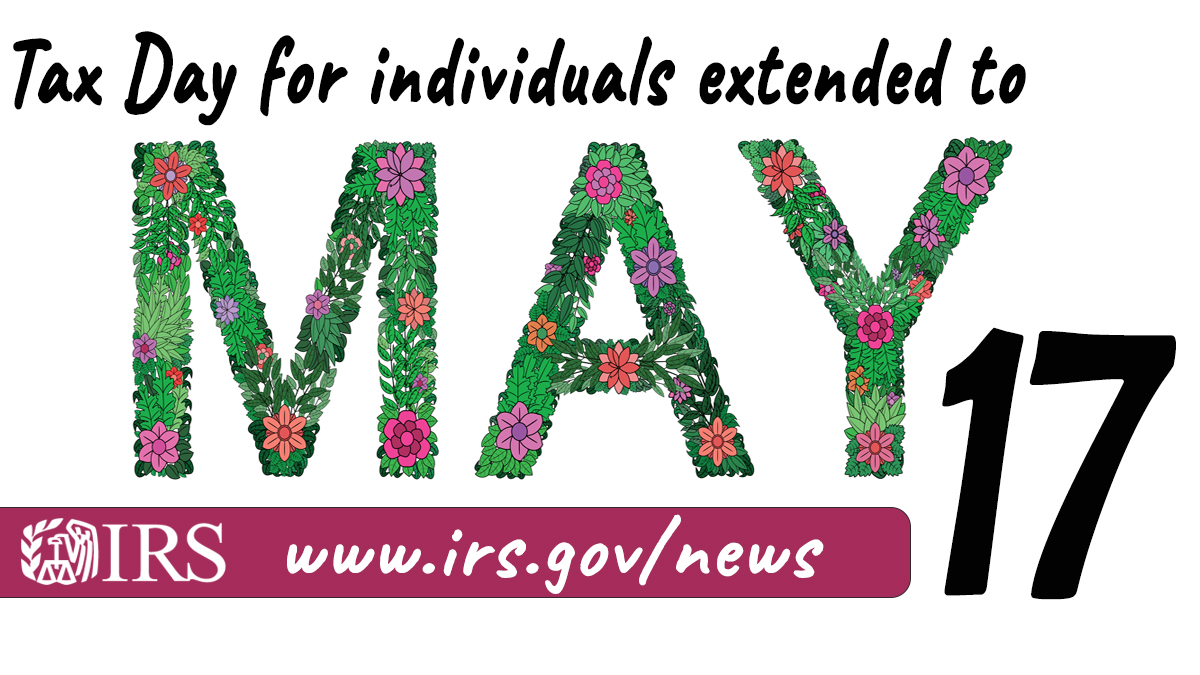
    The Treasury Department and Internal Revenue Service announced today that the federal income tax filing due date for individuals for the 2020 tax year will be automatically extended from April 15, 2021, to May 17, 2021. The IRS will be providing formal guidance in the coming days.

    “This continues to be a tough time for many people, and the IRS wants to continue to do everything possible to help taxpayers navigate the unusual circumstances related to the pandemic, while also working on important tax administration responsibilities,” said IRS Commissioner Chuck Rettig. “Even with the new deadline, we urge taxpayers to consider filing as soon as possible, especially those who are owed refunds. Filing electronically with direct deposit is the quickest way to get refunds, and it can help some taxpayers more quickly receive any remaining stimulus payments they may be entitled to.”

    Individual taxpayers can also postpone federal income tax payments for the 2020 tax year due on April 15, 2021, to May 17, 2021, without penalties and interest, regardless of the amount owed. This postponement applies to individual taxpayers, including individuals who pay self-employment tax. Penalties, interest, and additions to tax will begin to accrue on any remaining unpaid balances as of May 17, 2021. Individual taxpayers will automatically avoid interest and penalties on the taxes paid by May 17.

    Individual taxpayers do not need to file any forms or call the IRS to qualify for this automatic federal tax filing and payment relief. Individual taxpayers who need additional time to file beyond the May 17 deadline can request a filing extension until Oct. 15 by filing Form 4868 through their tax professional, tax software or using the Free Filelink on IRS.gov. Filing Form 4868 gives taxpayers until October 15 to file their 2020 tax return but does not grant an extension of time to pay taxes due. Taxpayers should pay their federal income tax due by May 17, 2021, to avoid interest and penalties.

    The IRS urges taxpayers who are due a refund to file as soon as possible. Most tax refunds associated with e-filed returns are issued within 21 days.

    Estimated tax payments

    This relief does not apply to estimated tax payments that are due on April 15, 2021. These payments are still due on April 15. Taxes must be paid as taxpayers earn or receive income during the year, either through withholding or estimated tax payments. In general, estimated tax payments are made quarterly to the IRS by people whose income isn’t subject to income tax withholding, including self-employment income, interest, dividends, alimony or rental income. Most taxpayers automatically have their taxes withheld from their paychecks and submitted to the IRS by their employer.

    State tax returns

    The federal tax filing deadline postponement to May 17, 2021, only applies to individual federal income returns and tax (including tax on self-employment income) payments otherwise due April 15, 2021, not state tax payments or deposits or payments of any other type of federal tax. Taxpayers also will need to file income tax returns in 42 states plus the District of Columbia. State filing and payment deadlines vary and are not always the same as the federal filing deadline. The IRS urges taxpayers to check with their state tax agencies for those details.

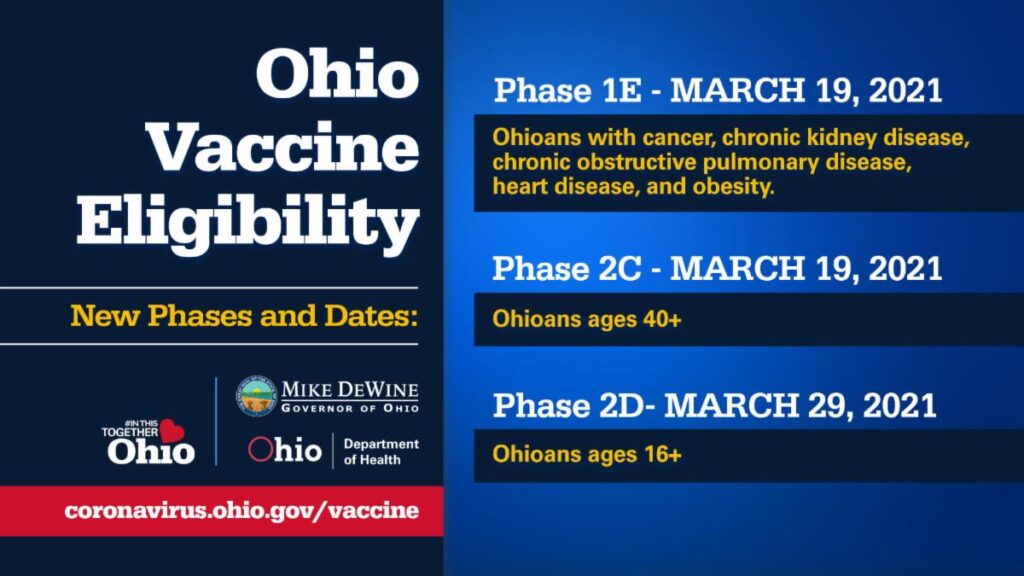
  • Beginning March 19: DeWine extends eligibility to Ohioans 40 and older and other groups

    Beginning March 19: DeWine extends eligibility to Ohioans 40 and older and other groups

    Loveland, Ohio – While in Cleveland yesterday at Ohio’s mass vaccination clinic at Cleveland State University’s Wolstein Center, Governor DeWine also announced expanded vaccine eligibility in Ohio beginning on March 19, 2021, for phases 1E and 2C. Phase 1E includes those with cancer, chronic kidney disease, chronic obstructive pulmonary disease, heart disease, and obesity. Phase 2C extends eligibility to Ohioans who are 40 and older. Between these two eligible groups, 1.6 million more Ohioans will have access to the vaccine. 

    Beginning on March 29, eligibility will be expanded to all Ohioans ages 16 and older. FDA emergency use authorization only allows those ages 16 and 17 to receive the Pfizer vaccine.

    The state of Ohio is also offering two pop-up mass vaccination clinics in Columbus and Cincinnati beginning on March 18, and 15 long-term mass vaccination clinics will open regionally across Ohio in coming weeks.

    Visit gettheshot.coronavirus.ohio.gov. Ohioans can also schedule mass vaccination clinic appointments by calling 1-833-4-ASK-ODH (1-833-427-5634).

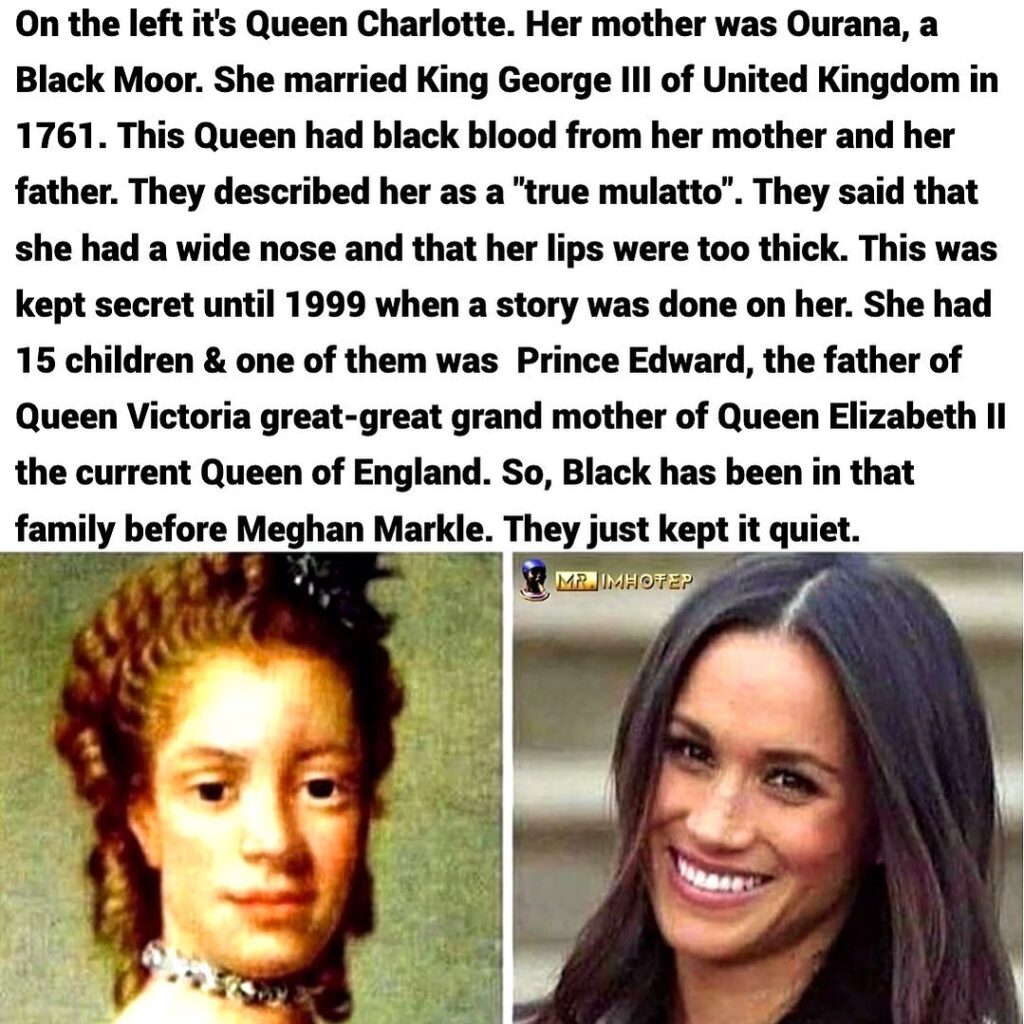
  • Do you know “Black” was in the Royal Family before Meghan Markle?

    Do you know “Black” was in the Royal Family before Meghan Markle?

    by Barbara Kyles

    Do you know?

    Take a look at this story and read more from Mr. Imhotepr…

    Charlotte of Mecklenburg-Strelitz, originally named Sophie Charlotte was born on May 19, 1744. Queen Charlotte also held the titles of Electress of Hanover and Queen Consort of Hanover. Mecklenburg-Strelitz was a minute north German dukedom in the Holy Roman Empire.

    Queen Charlotte was the youngest daughter of Princess Elizabeth Albertine Saxe-Hildburghausen and Duke Charles Louis Frederick of Mecklenburg-Strelitz, otherwise known as Prince of Mirow.

    Queen Charlotte is a descendant of a black branch of the Portuguese royal family; more specifically, Alfonso III and his concubine, Madragana, a black moor.

    This fact makes Queen Elizabeth II, Prince Charles and Prince William technically mixed race. Many historians have tried to cast doubt on the nature of Queen Charlotte’s heritage. But her personal physician has noted her “true mulatto face” and the public report released before Queen Elizabeth II’s coronation in 1953 acknowledges the monarchy’s African heritage.

    Africans don’t beg for royalty. We know we are the originals and we’ve been there before anyone else. They just hide it but we remember and we will teach it to our children. Don’t forget to get your copies of My African Icons, I Love Africa and The Black Samurai to teach your children that their ancestors are the original royals and that they civilized the whole planet.

  • Health Order Signed Regarding Spring Sports and Extracurricular Activities

    Health Order Signed Regarding Spring Sports and Extracurricular Activities

    Ohio Governor Mike DeWine announced today that Ohio Department of Health Director Stephanie McCloud has issued an addendum that updates quarantine guidance for student-athletes and participants in extracurricular activities who may have been incidentally exposed to COVID-19 in a classroom setting.

    The Addendum to Director’s Second Amended Order that Provides Mandatory Requirements for Youth, Collegiate, Amateur, Club and Professional Sports and Extracurricular Activities is in effect now. For spring sports and extracurricular activities, students will not be required to quarantine because they have an incidental exposure to COVID-19 in a classroom under the school-based exposure guidance unless symptoms develop. Students will now be permitted to participate in organized sporting and extracurricular activities as long as they remain symptom-free and follow applicable safety precautions.

    However, students who are exposed in other settings outside of the classroom will be required to continue following existing CDC quarantine guidance.

  • Ohio abortion ban with felony charges back in the works, targeting Roe v. Wade

    Ohio abortion ban with felony charges back in the works, targeting Roe v. Wade

    By Susan Tebben and Ohio Capital Journal

    The battle on abortion in Ohio will only be stopped by the U.S. Supreme Court or a change in the U.S. Constitution, according to reproductive law experts and those once again pushing for abortion bans.

    Two state legislators have introduced a bill making abortion procedures a felony, which marks the second time in as many years that a bill was introduced hoping for the overturning of Roe v. Wade, the national Supreme Court decision that said abortion was legal nationwide.

    A physician accused of “causing or inducing an abortion” would face an official charge of “criminal abortion,” which would be a fourth-degree felony under the new Senate Bill, introduced recently in the Ohio Senate.

    If signed into law, the bill would not take into effect until either the U.S. Supreme Court overturns the 1973 decision in Roe. V. Wade, which legalized abortion nationwide, or an amendment to the U.S. Constitution “upholds Ohio’s authority under the federal system to prohibit abortion,” according to a statement from bill cosponsor state Sen. Kristina Roegner’s office.

    “I believe that when the U.S. Supreme Court considers a challenge to Roe, they will realize that the original decision from 1973 was seriously flawed, and return the authority regarding abortion to the states,” Roegner said in the statement.

    Nearly a year ago to the day, former state Rep. John Becker introduced similar legislation, which would have barred state funds from being disbursed for abortion-related services and created a first-degree felony charge of “abortion manslaughter.”

    Becker’s bill never received a hearing, and therefore never moved in the 133rdGeneral Assembly. Currently, abortions are legal in Ohio up to 22 weeks gestation.

    Both bills have an exception in the event that “the abortion was necessary to prevent the death of the pregnant woman,” according to language in the current bill.

    Ohio is one of a few states trying to pass anti-abortion laws and create a review of Roe v. Wade.

    The abortion fight in the state has been going on since Roe v. Wade was decided, but a law professor who also works on abortion challenges says the last few years have been more active than most.

    “I think there’s almost nothing that’s beyond the pale right now,” said Professor Jessie Hill of Case Western Reserve University.

    Hill is also cooperating attorney for the ACLU, which has five lawsuits against state abortion measures going on simultaneously, including one filed this weekchallenging a law on burial and cremation after surgical abortions. Since Hill returned to Ohio in 2001, she’s only seen efforts to regulate abortion ramp up year after year.

    “All of a sudden these bills started passing, and in the last few years they’ve been more and more extreme,” Hill said, adding that gerrymandering creating a Republican-leaning legislature contributed to the increase in anti-abortion legislation.

    Anti-abortion groups are lining up to support the bill, with lobby group Ohio Right to Life calling the legislation “powerful and life-affirming.”

    “For the first time since abortion was legalized, we have a pro-life majority on the (U.S.) Supreme Court,” said Mike Gonidakis, president of Ohio Right to Life. “Roe v. Wade hangs by a thread. Ohio must be prepared for what comes next.”

    Planned Parenthood’s Ohio chapter said the newest bill restricts access to care rather than making lives better.

    “S.B. 123 is the latest egregious attack on abortion access from leaders in the Ohio General Assembly who are only focused on eliminating legal access to abortion, to the neglect of everything else – including the pandemic.”

    Hill sees a constitutional amendment as a long shot, with a requirement of support from 75% of states in order to make that happen.

    Targeting a U.S. Supreme Court decision is a bigger possibility, and even if the high court decides not to overturn the decision as a whole, Hill says cutting back the protections included in Roe v. Wade is something not often considered as the debate continues.

    “I think it’s an under-appreciated possibility that the court is not really interested in overturning Roe v. Wade, but that they would reduce it to almost nothing,” Hill said.

    The new Ohio bill will now be assigned to a House committee for hearings and consideration.

  • Ohio on track to meet Biden push to make all adults eligible for COVID-19 vaccines by May 1

    Ohio on track to meet Biden push to make all adults eligible for COVID-19 vaccines by May 1

    By Laura Olson and Ohio Capital Journal

    President Joe Biden is directing states to make all adults eligible for the COVID-19 vaccine by May 1, and Ohio Gov. Mike DeWine said over the weekend the state is on track to do that or better.

    Biden’s COVID-19 advisers are projecting that enough Americans in priority groups will be able to access the vaccine by the end of April to allow for the lifting of restrictions on who can access the vaccine.

    Alaska on Tuesday became the first state to open eligibility to anyone age 16 or older.

    The announcement came Thursday on the one-year anniversary of the World Health Organization declaring the COVID-19 outbreak to be a pandemic.

    Earlier on Thursday, Biden signed into law a massive pandemic stimulus bill that includes $20 billion to boost vaccination efforts across the country.

    He also announced Wednesday that his administration secured another 100 million of the one-dose Johnson & Johnson vaccine, after helping to broker a deal in which Johnson & Johnson will team up with drugmaker Merck to produce doses faster.

    More than 81 million vaccines have been administered since Biden took office in January. But state officials seeking to get those shots into arms have been hamstrung by too few doses, antiquated technology for coordinating appointments, and the challenge of securing enough manpower and other resources to meet the demand for vaccinations.

    The administration has launched federally run vaccination sites across the country, and will more than double the number of federal mass vaccination centers. More than 4,000 active duty troops will deploy to support those vaccination efforts.

    The Biden administration also will expand who is qualified to administer shots, adding dentists, advanced and intermediate emergency medical technicians, midwives, optometrists, paramedics, physician assistants, podiatrists, respiratory therapists, and veterinarians.

    The Department of Health and Human Services will launch a new website for individuals to check if they are eligible to volunteer to administer shots.

    Biden also will seek to make it easier for Americans to find a vaccination appointment, announcing plans to launch a federal website by May 1 that will show nearby locations that have vaccines, as well as a 1-800 number for those who lack internet access.

    The administration also says it will deploy technology teams to states that need assistance in improving the websites they’re using to schedule vaccinations.

  • Ryan Brandenburg from Loveland serving on aircraft carrier USS Theodore Roosevelt

    Ryan Brandenburg from Loveland serving on aircraft carrier USS Theodore Roosevelt

    PACIFIC OCEAN (March 6, 2021) – U.S. Navy Chief Electrician’s Mate (Nuclear) Ryan Brandenburg, from Loveland, Ohio, left, and Chief Machinist’s Mate Samuel Brown, from Rocky Mountain, Va., fish on the fantail of the aircraft carrier USS Theodore Roosevelt (CVN 71) March 6, 2021. The Theodore Roosevelt Carrier Strike Group is on a scheduled deployment to the U.S. 7th Fleet area of operations. As the U.S. Navy’s largest forward-deployed fleet, 7th Fleet routinely operates and interacts with 35 maritime nations while conducting missions to preserve and protect a free and open Indo-Pacific Region. (U.S. Navy photo by Mass Communication Specialist 2nd Class Kyle Hafer)

  • Do you know: What a sundown or sunset town is

    Do you know: What a sundown or sunset town is

    by Barbara Kyles

    Do you know?

    A sundown or sunset town was a town, city, or neighborhood in the US that excluded non-whites after dark. The term sundown came from the signs that were posted stating that people of color had to leave the town by sundown.

    Take a look at this story from Dorothy Weaver…

    A sundown or sunset town was a town, city, or neighborhood in the US that excluded non-whites after dark. The term sundown came from the signs that were posted stating that people of color had to leave the town by sundown. In most cases, signs were placed at the town’s borders which read: “Negro, Don’t Let the Sun Set On You Here.” The exclusion was official town policy or through restrictive covenants agreed to by the real estate agents of the community. Often, the policy was enforced through intimidation. This intimidation could occur in a number of ways, including harassment by law enforcement officers or neighbors, and in some circumstances violence. The phenomenon of sundown towns was the impetus for Harlem civil rights activist Victor Green to write the Negro Motorist Green Book, which detailed safe places for Black travelers to rest and eat without fear of harassment, threats or death. With the 1968 Fair Housing Act, sundown towns became illegal — on paper. Many people are surprised to learn that some of the places they live, were once sundown towns. Contrary to popular belief, sundown towns were a Northern and not Southern phenomenon. #TeachTheChildren

    https://www.facebook.com/dorothy.weaver.505/posts/2054929637982543
  • The Inside Garden

    The Inside Garden

    Nature Interpreter Allyson Ernst knows it’s still cold outside, but spring is on its way! With a little ingenuity and a window, spring can start inside long before winter’s end. Learn how you can begin your own inside garden with these gardening tips from Allyson and Great Parks of Hamilton County.

    “Despite the forecast, live like it’s spring.” – Lilly Pulitzer

    I know it’s still cold.

    I know the nights are still well below freezing.

    I know that there still might be snow on the way.

    I know it’s cloudy and miserable and dreary.

    But you know what else?

    I’m living like it’s spring!

    I work at Glenwood Gardens in the Highfield Discovery Garden and my specialty is vegetables. This year, the garden started in February. Now I can just hear the complaints, “But Allyson, you can’t grow vegetables in February! What are you doing!? You’ll kill the plants!” Hold your horses until you’ve heard my side of the story, OK? You’re right, you just can’t be throwing seeds into snow banks, but with a little ingenuity and a window, spring can start inside long before winter’s end.

    The Seeds

    Three different seed packets, okra, snap peas and spinach
    Several different types of seeds from different seed companies.
    The back descriptions of two seed packets, okra and snap peas.
    Some seed companies provide more information than others. Make sure you always do your research!

    Without seeds, you have nothing. Full stop. So go pick out some of them! You can stop by a nursery, a big box store or order online.

    Once you have seeds, read the seed packet. They have a lot of useful information on growing suggestions and starting dates on the back of the packet. Now, I will admit, some seed companies put more information on the packets than others, so do a little research if need be. A great tool I use for getting starting dates is this online date calculator.

    The Growing Medium

    Seeds need something to grow in, so while you’re out picking up seed, buy a bag of potting soil. If you have a compost pile, you can skip buying a bag and just use what you have. Make sure the compost is well rotted, fairly fine (you can run it through a sieve to get out any large chunks) and smells like soil, not rotten food scraps.

    A hand holds a pile of dirt and compost.
    Compost straight from the garden!

    We use compost here at Glenwood Gardens, because it’s free and we know what went into making it. We do get the occasional odd weed in it, but for the most part, if the compost pile has been done right, weeds shouldn’t be much of a problem.

    The Pot & Pan

    Now you can buy seed starting trays fairly cheaply at most places that sell soil and seed, but what’s the fun in that?

    Clean yogurt and pudding cups make excellent pots and all they need is a few holes poked in the bottom. Clear plastic containers with lids make great mini-greenhouses, as they help hold the moisture. Just leave the lid cracked or poke a hole in it so the plants can breathe. Find the appropriate sized pot for your plants and they will be quite happy! A good rule of thumb is that the longer you will be keeping your plants inside, the bigger the pot you should put them in.

    Potted succulents are lined up on an old boot tray.
    Not only can you grow vegetables this way, but other plants as well. Notice that the pan for these plants is actually an old boot tray.

    The pan is what the pot is set into to catch the water that drains out the bottom. You can set pots in saucers, trays or anything really, as long as it holds water. Make sure you empty the pan every other day or so, so that your plants are not constantly sitting in water.

    The Light

    Commercial growers use special grow lights to provide light for seedlings. We have four of them at Glenwood Gardens, and by all means, you can use them if you want to, but they’re not essential.

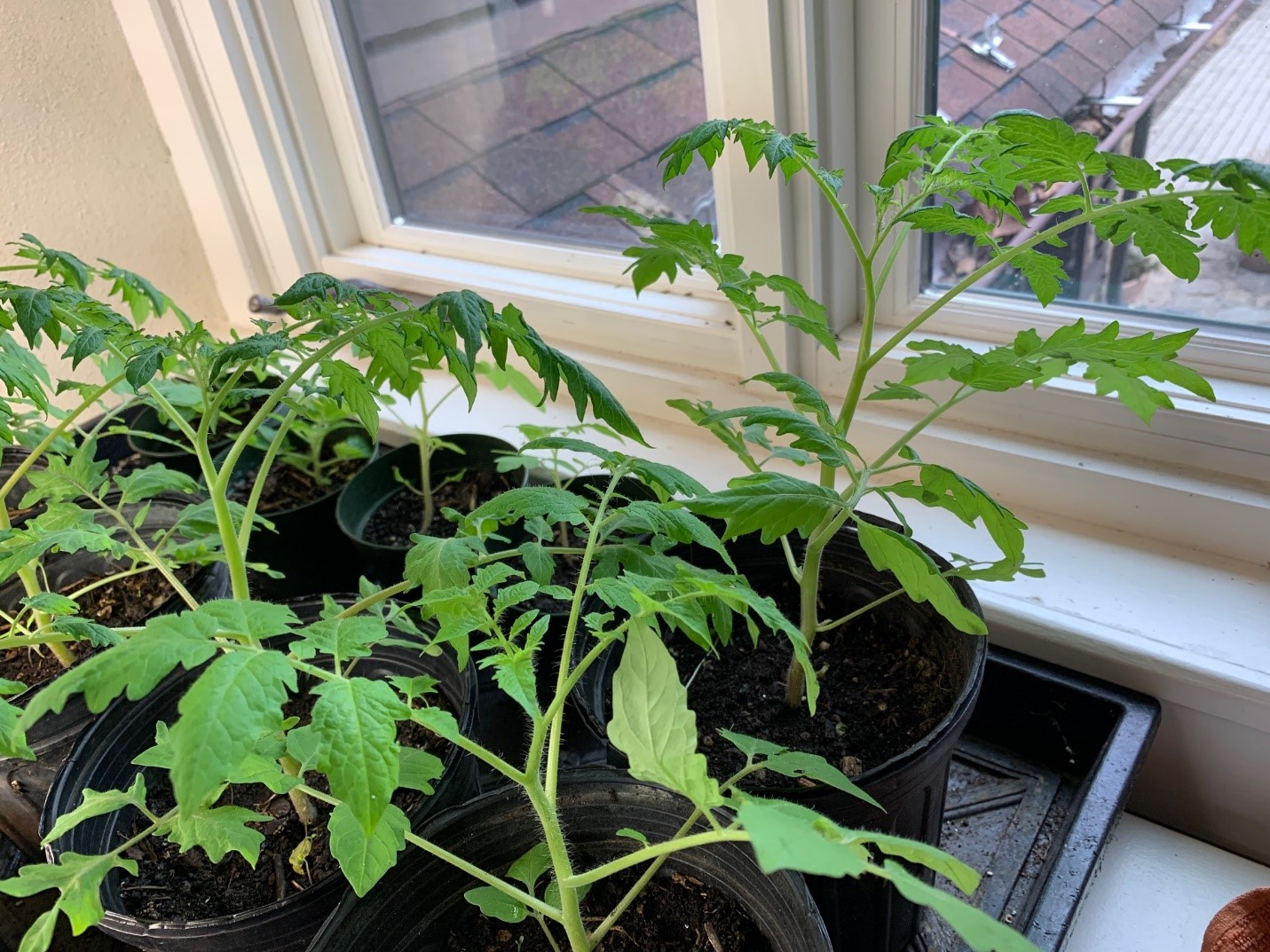
    Tomato plants sit in front of a window and are beginning to bloom.
    These tomatoes are quite happy in a window.

    A sunny window, (preferably south-facing if you are in the northern hemisphere and north-facing if you are in the southern hemisphere) is really all you need. Yes, it may take a little longer to grow than under lights, just because of cloudy days, but it will get the job done.

    Putting it All Together

    Now that all the supplies are gathered let’s get growing!

    In an area that you are OK with getting dirty, fill all the pots, trays or yogurt cups with pre-moistened growing medium. Set the pots in their pans and then place the seeds in a hole as deep as the seed itself (i.e., if you have 1/2-inch seed, place it in a 1/2-inch deep hole) and cover gently with growing medium. I like to put 2–3 seed per container if the container is only going to have one plant, but if your pot will hold multiple plants without overcrowding, place more seeds with a little extra. Why the extra seeds? Not every seed will germinate, so it’s nice to hedge your bets.

    Little pots are full of dirt. Some of them have small plants beginning to bloom.
    When it all comes together.

    Place the pots and pans in that sunny window. Water when you feel that the soil is dry. I like to use a watering can with a sprinkler attachment or a spray bottle when the seeds are very small so I don’t wash them away if the water comes out with any force. Transplant outside when the seedlings are ready for the outdoors.

    So yes, I know it’s cold outside.

    Yes, I know it may still snow.

    Yes, I know it’s been gray and miserable.

    But despite the forecast, I’m going to continue to live like it’s spring, even if it’s just on the inside.

    —
    Allyson Ernst
    Nature Interpreter, Glenwood Gardens

  • Ohio Schools to Receive COVID-19 Test Kits

    Ohio Schools to Receive COVID-19 Test Kits

    The Ohio Department of Education in cooperation with the Ohio Department of Health and the Ohio Educational Service Center Association today announced plans to provide an estimated 200,000 Abbott BinaxNOW Home Tests to Ohio public and private schools as another means of providing a safe learning environment for students, in addition to staff vaccinations and continued adherence to safety protocols like surface cleaning and facial coverings.

    The state purchased the tests and will work closely with Ohio’s network of educational service centers to distribute them to schools and districts.

    The 15-minute BinaxNOW COVID-19 Ag Card Home Test has received FDA Emergency Use Authorization and is packaged with instructions to access a telehealth professional who will oversee test administration, prescription writing, and result reporting. Schools and districts are encouraged to work with their local departments of health to determine the best strategies for using the tests at their locations. It would be appropriate to use the tests for symptomatic students, teachers, and staff members.

    “It was important to get these tests in the hands of school leaders because we know how important it is for students to be able to continue learning in their classrooms,” said Ohio Governor Mike DeWine. “In addition to the staff vaccinations, masks and physical-distancing practices that Ohio’s schools already employ so well, these tests will be a big help in our efforts to keep students, staff and communities safe.”

    “Convenient access to testing is one more tool in our toolbox as we all work together to help slow the spread of COVID-19,” said State Superintendent of Public Instruction Paolo DeMaria. “Even with these tests and school staff members having the opportunity to be vaccinated, it still will be important to continue protective strategies like mask wearing, frequent hand-washing, and maintaining social distancing.”

    “We’ve worked very closely with leaders at the state and local levels to make sure Ohio’s schools have access to the resources they need to ensure the safety and health of their students and staff members,” said Ohio Educational Service Center Association Director Craig Burford. “We’re proud to be able to assist in this effort by distributing test kits to public and private schools across the state.”

    Schools and districts should contact their regional educational service centers for more information on how to obtain tests.

    Find more information about the BinaxNOW At Home COVID-19 Test including a list of Frequently Asked Questions and Answers here.