Columbus, Ohio – Ohio Gov. Mike DeWine got a lot of attention Wednesday when he said that 60% of nursing home workers who were offered a coronavirus vaccine refused to take it.
But state health officials on Thursday said there’s no organized effort to track refusals among people they consider so critical that they’ve been given first crack at the scarce vaccines.
In a press conference, DeWine implored people who are eligible for the vaccine to accept it, warning that it could be a long time before they get another chance. That argument might seem pretty compelling, given that a fast-spreading variant of the virus has popped up in two states, ICU beds are filling and the two approved vaccines have trickled out at a rate far lower than the Trump administration promised.
But DeWine lamented that many nursing home workers are passing on the vaccines anyway.
“Our bigger concern is the amount of staff who are not taking it,” he said. “I don’t have data in front of me, but anecdotally, it looks like somewhere around 40% of staff at nursing homes are taking the vaccines and 60% are not taking it.”
The statement went viral. A tweet about it generated more than 5 million impressions as of Thursday evening.
60% of Ohio nursing home staff refusing covid vaccine @GovMikeDeWine says
DeWine made his statement about nursing home workers “from some reports we have been hearing from our pharmacy partners,” Ohio Department of Health spokeswoman Melanie Amato said in an email Thursday. “It ranges in facilities, but this is a rough average. Remember the nursing home are largely being vaccinated by Walgreens/CVS as part of the federal program. We rely on them for the information. Same with hospitals. We track vaccines that have been given. We don’t track who would have refused.”
Neither CVS nor Walgreens could immediately be reached for comment. While they are handling vaccinations in congregate settings such as nursing homes, they aren’t in charge of vaccinating hospital staff, paramedics and the like. Ohio health officials apparently aren’t tracking the rate at which those groups are refusing the vaccine, either.
Dan Tierney, DeWine’s press secretary, said that despite the low level of nursing home workers agreeing to be vaccinated, the governor isn’t considering a mandate — at least for now.
“On mandating the vaccine for these groups, we are still in the rollout of this phase, and our message to Ohioans is that if you are in group 1A, we urge you to take the vaccine now, because it may be months before there is another opportunity available to you,” he said. “We believe that increasing awareness will help increase the utilization rate. Ultimately, it is up to each health care provider to determine which workers they employ meets the criteria in group 1A to receive the vaccine in this phase.”
The Ball State football team’s historical checklist for 2020 is nearly complete.
Win the MAC West Division for the first time since 2008? Check.
Win the overall MAC championship for the first time since 1996? Check.
It had been a while, but both of those things has been accomplished before. This last one, the final box, has not. A bowl victory.
For a team that has already achieved so much in this unique year, a win over No. 19 San Jose State in Thursday’s Offerpad Arizona Bowl would further cement its legacy in Ball State annals.
“It’s monumental for us,” senior cornerback Antonio Phillips said. “But we’ve been preparing for every game like it’s a championship game all year.”
All this in a season that looked like it might not happen. The MAC was the first FBS conference to postpone its football season because of concerns surrounding the COVID-19 pandemic and the last to announce its return.
When the Cardinals finally took the field on Nov. 4, they were dealt an early blow, falling in the final seconds at rival Miami (Ohio). But the loss only galvanized the veteran team more. The Cardinals were undeterred and kept their sights fixed on the goal of a MAC championship.
Doing it on the ground at times and through the air at times all while getting tougher and tougher on defense each week, Ball State rattled off one win after another — six in all — culminating with their 38-28 victory over undefeated No. 23 Buffalo in the MAC Championship Game. Now, on the final day of 2020, BSU will look to check that final box.
“We were on a mission to get ourselves to Detroit, and that was such a great feeling when that clock hit zero,” head coach Mike Neu said. “To have that celebration with our team in the locker room was special. We’ve worked hard for this … Our next goal that lies ahead is to win the first bowl game in the history of our program.”
Ball State isn’t hiding from that fact or from being an underdog again this week against the ranked Spartans. It’s a role the team has embraced all season long since it was picked to finish fourth of six teams in the MAC West Division.
Fueled by that, by how close they were last year and by a brotherhood of togetherness, the 2020 Cardinals are champions and are still looking for more. This bowl trip to Arizona is both a reward and an opportunity, and they are not taking it for granted.
“Last year we were at home watching people play bowl games, we were at home watching conference championships,” running back Tye Evans said. “This was the year of, ‘Hey, we’re not doing that anymore. We don’t want to go home early and sit and watch people play football. We want to continue to play football as long as we can.’”
As long as they can is New Year’s Eve, one way or another. Might as well write a little more history.
As the coronavirus vaccine dribbles out far more slowly than promised, many of the people who can get it are refusing to do so.
Gov. Mike DeWine on Wednesday said that a whopping 60% of nursing home workers who have been offered the vaccine have refused it.
The news comes amid disappointing vaccination numbers across Ohio, which was told by the Trump administration that it would receive more than 530,000 doses of the vaccines by the end of December. Just 94,000 so far have been administered.
“I am not satisfied with where we are in Ohio,” DeWine said during a coronavirus press conference. “We’re not moving fast enough, but we’re going to get there.”
He said he had a Wednesday morning conference call with CEOs of Ohio hospital systems and set a goal of getting the covid vaccine into people’s arms within 24 hours of when hospitals receive it. DeWine said the job of distributing the vaccine is more complex than many appreciate, but it’s vital to do it quickly.
“There’s a moral imperative to get this out just as quickly as we can,” he said.
But the numbers emerging from nursing homes might portend something just as bad.
“Our bigger concern is the amount of staff who are not taking it,” DeWine said. “I don’t have data in front of me, but anecdotally, it looks like somewhere around 40% of staff at nursing homes are taking the vaccines and 60% are not taking it.”
Those figures are disturbing not only because of what they might say about attitudes toward the vaccines among the larger population. They also mean that most staffers will be unprotected as they move between the outside world and nursing homes filled with vulnerable people — some of whom will not be able to take the vaccine for medical reasons.
Even so, DeWine said he isn’t going to make anybody take it.
“I’m not going to compel anybody to do it, but I’m urging people to take that vaccine,” he said. “It’s very important,”
It’s not clear why the governor isn’t imposing such a requirement.
A DeWine spokesman didn’t immediately respond when asked why DeWine wouldn’t order Ohio nursing homes to follow suit.
Ohio’s problems distributing the coronavirus vaccine come amid national problems producing and distributing the two vaccines that so far have received approval. With hospital beds filling, the country is falling far short of the Trump administration’s promises.
At the current pace, it will take 10 years to vaccinate enough Americans to achieve herd immunity, NBC reported.
Among those promising 20 million vaccinated Americans by the end of 2020 was U.S. Surgeon General Jerome Adams. He made the statement just 11 days ago in a press conference with DeWine.
Adams dismissed reports that vaccine doses were coming to states at substantially lower levels than promised as blips that are to be expected in such a complex project. He also scoffed at the need to invoke the Defense Production Act to scale up production of approved vaccines, saying the manufacturers were operating at full capacity.
Three days later, the New York Times reported that Pfizer, manufacturer of one of the vaccines, was close to a deal with the administration to use the Defense Production Act to obtain more of the materials to make it. Pfizer had been asking for such help since September, the story said.
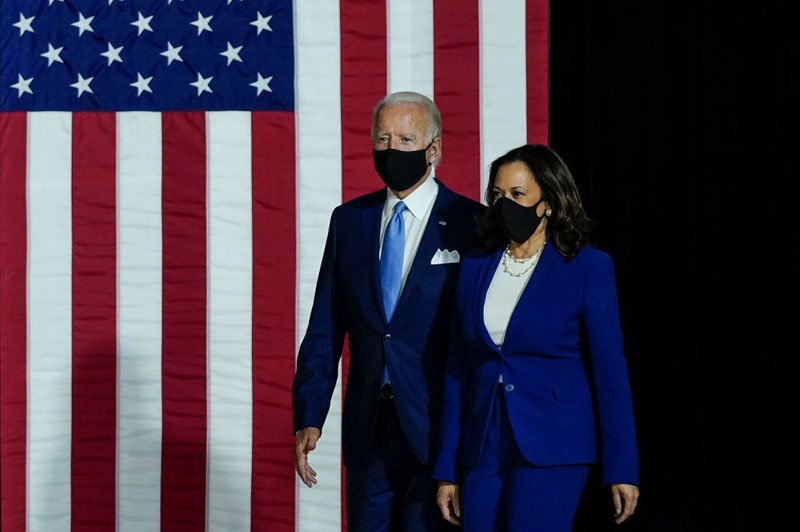
Washington D.C. – As with so many other events during the year preceding it, the inauguration of President-elect Joe Biden will be a ceremony unlike those of his predecessors.
Tempering the celebratory tone is a directive from Biden’s inaugural team for supporters to refrain from traveling to D.C. for the Jan. 20 swearing-in. Instead, they’ve urged Americans to participate in the inaugural activities from home.
It’s not yet clear what exactly those virtual festivities will include — or if President Donald Trump will attend Biden’s swearing-in. But the event will be scaled down in size, with an emphasis on safety precautions.
“First and foremost, my objective is to keep America safe but still allow people to celebrate,” Biden said at a news conference this month.
The crowd on the platform of the west front of the Capitol will be far less crowded than a typical inauguration. The Joint Congressional Committee on Inaugural Ceremonies typically would be distributing 200,000 tickets, but instead will hand out enough for each of the 535 members of Congress to attend with only one guest each.
U.S. Sen. Roy Blunt (R-Mo.), who is chairman of the joint committee, said in a statement this month that the ongoing coronavirus pandemic and rising case counts “warranted a difficult decision to limit attendance.”
Blunt added that the committee is “working on enhanced opportunities to watch the ceremonies online, in addition to the traditional televised national broadcast.”
“The election of President-elect Biden and Vice President-elect Harris was historic and we know that many Americans would have wanted to attend the inauguration in-person,” said Sen. Amy Klobuchar (D-Minn.), who also serves on the inaugural committee. “At the same time, safety must be our top priority.”
Biden’s inaugural committee has tapped medical experts to oversee safety precautions, including former Food and Drug Administration Commissioner David Kessler as its chief medical adviser.
The details released so far have been vague beyond the limited number of tickets. A news release from Biden’s inaugural team described an “extremely limited” footprint for the swearing-in ceremony, and a parade that will be “reimagined.”
That revamped parade could look similar to the Democratic National Convention’s virtual roll call, which featured video clips of delegates in their home states.
“There probably will not be a gigantic inaugural parade down Pennsylvania Avenue,” Biden said. “But my guess is you’ll see a lot of virtual activity in states all across America, engaging even more people.”
Crowded inaugural balls also are likely out of the question due to the pandemic.
The Walter E. Washington Convention Center that typically would host soirees was once again prepped this month for use as a COVID-19 field hospital.
Another question looming over the inauguration: What will Trump do?
Traditionally, the outgoing president and first lady would meet with the incoming first family at the White House, and then ride together to the Capitol for the noontime ceremony.
But Trump has refused to accept the election results, launching a failed series of legal challenges and posting unfounded claims of election fraud, even after the Electoral College certified his defeat. Asked in a Fox News interview this month if he’ll attend Biden’s inauguration, Trump replied: “I don’t want to talk about that.”
The last time a president did not participate in their successor’s inauguration was in 1869, when President Andrew Johnson left office and Ulysses S. Grant was sworn in.
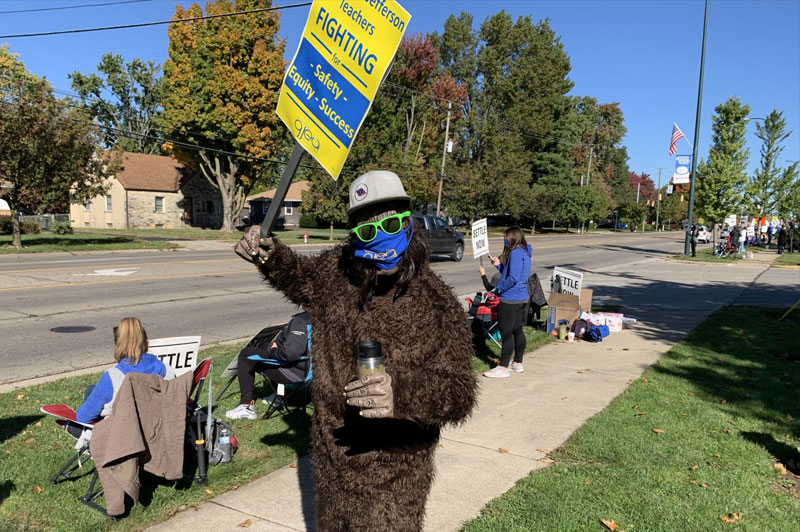
A Gahanna-Jefferson Education Association teacher opted to arrive in costume for the first day of a strike outside Gahanna Lincoln High School. By Jake Zuckerman.
Ohio teachers are adapting to COVID-19 learning, while also fighting for wages and benefits that are lower than professionals with similar education and experience.
Teachers from across the state shared their experiences in an event hosted by the progressive think-tank Policy Matters Ohio.
Tati Weaks, of the Greenfield Exempted Schools, which serves portions of Fayette, Highland and Ross counties, said investment in the community is an important part of being a teacher. But in an area that lost thousands of jobs when DHL pulled out of the Wilmington Air Park more than a decade ago, and saw the wealth in the area change to poverty as factories went elsewhere, she said keeping teachers engaged in the area isn’t easy.
Despite the fact that Wilmington Air Park has had investment since DHL left, the roller coaster of success and loss creates stress with a state public school funding system based on property wealth.
“We want to attract good teachers, we want to keep good teachers,” Weaks said. “But our base salary is already so much lower due to school funding.”
“Wage Penalty”
Experts call the lower wage that teachers receive compared to other professionals with similar education and experience a “wage penalty.”
In a 2020 study by the Economicy Policy Institute, the teacher wage penalty was shown to have grown from 6% in 1996 to 19.2% in 2019. The year before, the penalty had been even worse, at 22%.
“This is something where there’s been an attack on teachers,” said one author of the study, EPI fellow Lawrence Mishel, during the Policy Matters discussion. “We have not been putting in the resources, and this is something we really need to do to guarantee children have the professionals that they need.”
That lowering came from “widespread strikes and other actions by teachers in 2018 and 2019,” the study stated.
In Ohio, the wage penalty stands at 15.2%, according to the Economic Policy Institute.
Teachers actually received a wage higher than those of similar experience — called a wage premium — back in the 1960s and 1970s, when women teachers received pay that was 14.7% more than comparable female professionals., according to the EPI study.
“In 2019, women teachers were earning 13.2% less in weekly wages than their nonteaching counterparts were — a 27.9% percentage-point swing over the last six decades,” the study concluded.
The wage penalty for men was found to be larger than women, and getting worse, according to the policy institute.
In 1979, the teacher wage penalty for men was 16.6%, and in 2019, men received 30.2% less as teachers than men did in other professions.
Teachers sacrifice
With less funding from their school districts, teachers are still sacrificing their lesser pay for supplies for their classrooms and students.
Mandy Wagner had to get a second job for her first 10 years of teaching just to pay rent and make student loan payments. She also wanted to pursue her Master’s degree in English literature so she could teach higher level classes to her students, but that meant spending more money.
“More education means more debt, so trying to benefit the kids, I’m putting myself in more debt,” Wagner said.
Those sacrifices are being asked of them in collective bargaining negotiations as well, as Tamar Gray, of the Cleveland Heights-University Heights School District, saw first-hand. The teachers and the district just finished contract negotiations in which the district entertained the idea of raising health care costs 250%, with only a total of 8% in raises over the last ten years.
The district and the teachers were able to come to an agreement, but Gray came out with a bad taste in her mouth, especially after teachers were called “heroes” at the beginning of the pandemic.
“The fact that teachers are being asked to settle, to make less, to fix budget problems on one of the most important things that can happen in the state…there’s something wrong with that,” Gray said.
Two education bills were in the General Assembly, and after years of work, House Bill 305 made it through the House. But the end of the lame duck session has run out the clock on the legislation, and the bill floundered in a Senate committee.
The capital budget passed last week included only a small part of the school funding overhaul. Legislators have said they want to make education a priority, but need to see more studies on the cost of the funding formula before they sign on.
House Bill 305’s funding framework would have taken some of the pressure off of property taxes as the main informer of funding levels for local school districts, and put more of the onus on direct state funding.
Many teachers and school district officials spoke in support of the bill, seeing it as a sign of hope for teachers and struggling school districts.
“We’re running education on a budget,” Wagner said. “And what are we doing having budget teachers and budget education? This is something that we should absolutely be investing in and prioritizing.”
The teachers present during the Policy Matters event say the fate of education affects the poor, affects people of color, and affects the disenfranchised. Therefore, it shouldn’t be hard for their representatives in the Statehouse to do something.
“We’re supposed to have people that want to do well by the public, so to sit up here and say we can’t find the solution…it’s inexcusable,” Gray said.
Columbus, Ohio – The 133rd Ohio General Assembly wrapped up its term with a flurry of lame-duck activity last week, closing out a challenging year of legislating amid a global pandemic.
Lawmakers hurried to get priority bills passed and sent to Gov. Mike DeWine’s desk for a signature before the two-year term ended. There were, however, a number of major legislative projects that did not get passed.
Here are some of the priorities falling to the 134th General Assembly, which starts in January:
What to do with House Bill 6?
After months of deliberation about House Bill 6, lawmakers have decided to punt any repeal or replacement effort to 2021.
HB 6 is the $1.3 billion nuclear bailout bill at the center of what has been called the largest corruption scheme in state history.
In the days after Speaker Larry Householder and four other political operatives were arrested in July, one thing was clear: Ohio lawmakers needed to do something about the tainted bill.
DeWine, who signed the bill into law in 2019, called for its repeal. Householder was removed as House Speaker. His replacement, Rep. Robert Cupp, R-Lima, said one of the first priorities of his speakership would be addressing HB 6.
Davis Bees Nuclear Power Station with electricity pylons, Ohio. Getty images.
Cupp did create a new “House Select Committee on Energy Policy and Oversight,” which met nine times between September and December to hear testimony on various attempts to repeal HB 6.
Members could not come to an agreement on how to best approach HB 6; some wanted a full repeal, others wanted only certain portions replaced and a few defended the whole bill as being good public policy, even if it did come about through sordid means.
Two of those involved have already pleaded guilty in federal court; the cases against Householder and two others are ongoing.
Householder was reelected to another term and it remains to be seen if the chamber will take a vote in 2021 to expel him. When Cupp was elected as speaker in July, he indicated such a vote would wait until after the new term starts.
School spending reform will take more time
The Ohio Supreme Court ruled the state’s school funding model was unconstitutional back in 1997. Decades later, lawmakers are still working to figure out a constitutional and equitable substitute.
A bipartisan funding overhaul passed the House in early December, but did not make it through the Senate.
Sen. Matt Dolan, R-Chagrin Falls, who chairs the Senate Finance Committee, wrote in a December letter “there is not enough time in the legislative session for the Senate to have the in-depth hearings this bill deserves.” Dolan suggested the new formula could be passed as a piece of the next state budget, which will be decided in the first half of 2021.
Republicans still concerned about pandemic authority
For all the condemnation leveled against Ohio’s pandemic response by Republican lawmakers in 2020, the legislature achieved little this year in the way of curbing the government’s executive powers.
Between May and December, Republicans introduced numerous bills targeting the pandemic authority of the governor and the Ohio Department of Health (ODH). Only a few of them passed, and DeWine followed through on a pledge to veto any bill restricting ODH’s ability to issue health orders meant to stem the spread of COVID-19.
DeWine vetoed a bill over the summer which would have reduced the penalties for violating a public health order. Lawmakers did not seek a veto override.
Gov. Mike DeWine is pictured during his statewide address on Wednesday, Nov. 11. Photo courtesy Ohio Channel.
More recently, DeWine vetoed a bill to prevent ODH from issuing widespread quarantine orders (it also would’ve given lawmakers authority to vote down any public health orders). Despite protests and pressure from conservative lawmakers to override the veto, such a vote was not taken during the lame-duck session.
Late in the term, lawmakers debated efforts to make future health orders more fair to business owners, should they be necessary. At other points this year, legislators said they wanted to address the state’s pandemic authority for future crises beyond the coronavirus. Those efforts may come up again in 2021.
Campaign finance and election reform
These were two hotly-debated topics this year in large part because of the presidential election cycle and the House Bill 6 scandal.
As the Ohio Capital Journal has reported, lawmakers proposed a wide array of improvements to the state’s election system over the past term — from automated voter registration to online absentee ballot requests. Some legislators expressed worry about approving reforms during an election year, which may provide an opportunity for reforms to be heard during an “off year” like 2021.
The HB6 scandal involved allegations of bribery money being funneled through “dark money” groups in order to influence Ohio elections and public policy. These groups are registered nonprofits which are not required to disclose who funds them.
Ohio Secretary of State Frank LaRose, whose office oversees campaign finance in the state, came out in favor of improved transparency when it comes to “dark money groups.” He supported legislative efforts which followed Householder’s arrests to require such groups to publicly disclose their financial activity.
Secretary of State Frank LaRose is flanked by state Reps. Gayle Manning and Jessica Miranda during a press conference in support of HB 737.
A bipartisan bill proposing reforms to the state’s campaign finance system did not receive a hearing in 2020, but these efforts may carry over to the new term.
Split opinions on criminal justice reform
There was much attention paid to the legislature’s work to reform the Ohio criminal justice system, with plenty of disagreements leading to mixed results.
Lawmakers passed Senate Bill 1, which expands access to drug treatment programs in lieu of convictions and broadens the description for criminal records that may be sealed.
A separate bill to reclassify low-level drug offenses from felonies to misdemeanors passed the Senate last June, but was not taken up for a vote during the House’s lame-duck session. The bill sought to divert drug offenders into treatment rather than criminal punishment.
Despite bipartisan support in the Statehouse and among civil rights groups, the bill remained controversial among law enforcement groups and prosecutors. The Ohio State Bar Association came out against the bill, arguing in testimony that some drug offenders “must have serious consequences hanging over their heads like the threat of a felony and prison time” in order to commit to a treatment program.
Rep. Bill Seitz, R-Green Twp., a supporter of the bill who will serve as Majority Floor Leader next term, told The Cincinnati Enquirer that work will continue in 2021 on criminal justice reform.
The Ohio minimum wage will rise by 10 cents to $8.80 per hour in 2021.
That will be the wage for non-tipped employees. Tipped workers will earn $4.35 per hour plus tips in 2021.
Ohio workers under the age of 16 will make the federal minimum wage, which is $7.25 per hour.
Ohio’s minimum wage rises gradually each year to match the rate of inflation, per a state constitutional amendment implemented in 2007. The minimum wage that year was $6.85; it has gone up nearly $2 in the 14 years since.
Michael Shields, a researcher with the left-leaning think tank Policy Matters Ohio, said this increase is not enough to help low-income Ohioans still suffering from the pandemic.
There were several unsuccessful attempts this legislative term (which ends next week) to increase the Ohio minimum wage.
A 2019 bill from state Rep. Brigid Kelly, D-Cincinnati, called for increasing the wage to $12 per hour and then going up by $1 per year until it reached $15 per hour. Tipped workers would have risen to $6 per hour, going up by 50 cents per year until it reached $7.50 per hour. From there, wages would have risen gradually as is presently done.
State Sens. Cecil Thomas, D-Cincinnati, and Hearcel Craig, D-Columbus, offered a similar bill in the Ohio Senate. These two bills would have allowed local governments to set even higher minimum wages.
Later in 2019, Democratic state Reps. Lisa Sobecki of Toledo and Kent Smith of Euclid introduced a bill to raise the minimum wage for all workers (regular, tipped and juvenile) to $10.55 per hour in 2021. The wages would’ve then risen gradually in years after that.
None of the above bills made substantial legislative progress.
There was also an effort in early 2020 to place a referendum raising the minimum wage on the November ballot. Organizers suspended the campaign, saying coronavirus shutdowns made it difficult to secure the signatures necessary to place the referendum on the ballot.
Hollywood on the Ohio River – Christmas movie to be filmed in New Richmond starting right after New Year’s Day!
“Join in the excitement of bringing a Christmas film to life.”
Casting extras for cafe patrons, holiday shoppers, town residents and party attendees.
Potential for upgrade to featured extra.
“Theodora, a time consumed professional crosses paths with Charlie, a writer, when she travels to his hometown for business just before Christmas. Both are taken by surprise when unexpected circumstances present themselves.”
A couple things to keep in mind: 1) Some scenes will require you to be outside in the cold for unknown periods of time. 2) You will be required to sign an image release if you are selected.